
Paule Marshall (1929–2019)
Author of Brown Girl, Brownstones
About the Author
Paule Marshall was born on April 9, 1929 in Brooklyn, New York. She received a B.A. in English literature from Brooklyn College in 1953. She worked briefly as a librarian before joining Our World magazine. Her first novel, Brown Girl, Brownstones, was published in 1959. Her other novels include The show more Chosen Place, the Timeless People; Daughters; and The Fisher King. She is also the author of two collections of short fiction: Soul Clap Hands and Sing, which received the National Institute of Arts Award, and Reena and Other Stories. She has received several awards including the John Dos Passos Prize for Literature and the Columbus Foundation American Book Award for Praisesong for the Widow in 1983. Paule Marshall passed away on August 12, 2019 at the age of 90. (Bowker Author Biography) show less
Image credit: Courtesy of Serpent's Tail Press
Works by Paule Marshall
Associated Works
Breaking Ice: An Anthology of Contemporary African-American Fiction (1990) — Contributor — 306 copies, 1 review
The Norton Anthology of African American Literature {2nd edition} (2003) — Contributor, some editions — 282 copies, 2 reviews
The Best Short Stories by Black Writers, 1899-1967: The Classic Anthology (1967) — Contributor — 200 copies, 1 review
Daughters of Africa: An International Anthology of Words and Writings by Women of African Descent from the Ancient Egyptian to the Present (1992) — Contributor — 186 copies
Calling the Wind: Twentieth Century African-American Short Stories (1992) — Contributor — 116 copies
Black-Eyed Susans and Midnight Birds: Stories by and about Black Women (1990) — Contributor — 114 copies
On Girlhood: 15 Stories from the Well-Read Black Girl Library (2021) — Contributor — 83 copies, 1 review
The Heath Anthology of American Literature, Concise Edition (2003) — Contributor — 73 copies, 1 review
Her True-True Name : an anthology of women's writing from the Caribbean (1989) — Contributor — 48 copies
Stories from Blue Latitudes: Caribbean Women Writers at Home and Abroad (2006) — Contributor — 32 copies
Centers of the Self: Stories by Black American Women, from the Nineteenth Century to the Present (1994) — Contributor — 31 copies
The Unforgetting Heart: An Anthology of Short Stories by African American Women, 1859-1993 (1993) — Contributor — 23 copies
Tagged
Common Knowledge
- Other names
- Burke, Valenza Pauline (birth name)
- Birthdate
- 1929-04-09
- Date of death
- 2019-08-12
- Gender
- female
- Education
- Girls High School
Hunter College
Brooklyn College (BA ∙ 1952) - Occupations
- librarian
novelist
short story writer
teacher - Organizations
- Our World
Yale University
Columbia University
Virginia Commonwealth University
New York University - Awards and honors
- John Dos Passos Prize (1989)
Guggenheim Fellowship (1961)
Anisfield-Wolf Book Award (2010) - Nationality
- USA
- Birthplace
- Brooklyn, New York, USA
- Place of death
- Richmond, Virginia, USA
- Associated Place (for map)
- USA
Members
Discussions
Novel: African-American woman reconnects w/ African heritage in Name that Book (July 2013)
Reviews

Merle Kinbona is one of the most memorable and interesting protagonists in all of West Indian literature. She is one of the strongest characters in all of the literature that emerged from the 1960s, and she reflects what was going on politically not only in the Caribbean, but also in the United States during that time. American social anthropologists have been sent to a West Indian island, Merle's homeland, with plans to help the residents. With this as a backdrop, Marshall explores race, show more politics, and cultural differences. She addresses the issues of immigrants, outsiders, and all those living outside of their cultures. Particularly effective are her portrayals of white male characters, proving that cross-race, cross-gender writing can work. The book may be too long, but the text is accessible, and the novel features a very real sense of place. Subtle and well-handled issues of homosexuality show that Marshall was, indeed, a woman ahead of her time. show less

I'm so glad to have come across Paule Marshall.
Through both fiction and nonfiction (and in Reena, a combination of the two), her pieces explore the lives of Black women in relation to their surroundings, their sense of displacement, of neither here nor there, in looking and being different to what their context dictates, a theme which reminded me of Nella Larsen's equally powerful and historically important book, Passing.
What really stood out for me with Marshall's Black women is the fact show more that their roots are not African but Caribbean, something which I've not encountered much in my readings. Just as the characters themselves state how frustrating it is to always be viewed with pity, to be regarded as a victim of centuries of injustice, I love that Marshall's women were strong and capable, they had ideals and fought for them, they believed in themselves, yet they were still very much human, very much flawed. I also enjoyed the commentaries by the author which preceded each piece, detailing her motivation in writing the piece and the circumstances which led her to it. Some of the stories may have been stylistically rough but the themes in each story still resonated very strongly, with often an interesting subversion.
I'm looking forward to more of Marshall's works, especially Brown Girls, Brownstones.
For the intrigued readers: the first piece of the book, From the Poets in the Kitchen, was part of The NYTimes Book Review series called The Making of a Writer and is absolutely brilliant. It touches on the political nature of language and how it can be used to reclaim and shape oneself, the importance of representation in literature, feminism, racism, issues that remain pertinent to this day. show less
Through both fiction and nonfiction (and in Reena, a combination of the two), her pieces explore the lives of Black women in relation to their surroundings, their sense of displacement, of neither here nor there, in looking and being different to what their context dictates, a theme which reminded me of Nella Larsen's equally powerful and historically important book, Passing.
What really stood out for me with Marshall's Black women is the fact show more that their roots are not African but Caribbean, something which I've not encountered much in my readings. Just as the characters themselves state how frustrating it is to always be viewed with pity, to be regarded as a victim of centuries of injustice, I love that Marshall's women were strong and capable, they had ideals and fought for them, they believed in themselves, yet they were still very much human, very much flawed. I also enjoyed the commentaries by the author which preceded each piece, detailing her motivation in writing the piece and the circumstances which led her to it. Some of the stories may have been stylistically rough but the themes in each story still resonated very strongly, with often an interesting subversion.
I'm looking forward to more of Marshall's works, especially Brown Girls, Brownstones.
For the intrigued readers: the first piece of the book, From the Poets in the Kitchen, was part of The NYTimes Book Review series called The Making of a Writer and is absolutely brilliant. It touches on the political nature of language and how it can be used to reclaim and shape oneself, the importance of representation in literature, feminism, racism, issues that remain pertinent to this day. show less
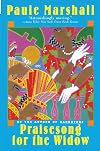
This 1983 novel stitches up the rended fabric between Africa and the US for Avey (short for Avatara) Johnson. A middle aged widow, Avey is with two friends on a Caribbean cruise when she abruptly decides to leave them and return to New York. Instead, while she's waiting for the flight home from Grenada, Avey is drawn to a rum shop on the beach and to its elderly proprietor, Lebert Joseph. He is preparing for an annual homecoming to an outer island, Carriacou, and Avey makes the rough journey show more with him, still compelled by she doesn't know what. The dancing, singing, and summoning up of ancestors reminds Avey of her childhood visits to Tatem, the South Carolina island where her Ibo ancestors walked into the sea, refusing to succumb to enslavement.
Sandwiched in between the island tales is Avey's life with her husband Jay, an ambitious accountant who is almost destroyed by virulent post-WW II racism he encounters as he tries to move his family to higher economic ground.
The lovely recounting of Jay and Avey's secret private dances, and of the Banda, Temne, Arada, Moko, Congo, Chamba tribe members and their Beg Pardon circles of celebration on Carriacou, make this a novel to savor and to reread. show less
Sandwiched in between the island tales is Avey's life with her husband Jay, an ambitious accountant who is almost destroyed by virulent post-WW II racism he encounters as he tries to move his family to higher economic ground.
The lovely recounting of Jay and Avey's secret private dances, and of the Banda, Temne, Arada, Moko, Congo, Chamba tribe members and their Beg Pardon circles of celebration on Carriacou, make this a novel to savor and to reread. show less
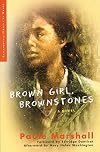
This is an engrossing story of a Brown girl and her family, and their life in Brooklyn NY, around the time of the start of WWII. Selina's mom and dad are from Barbados, having come to NY to better their lives. However, the father only dreams of returning, and will contribute nothing to the mom's dream of buying the brownstone they lease, and turning it into a rooming house. For Selina, whose Dad is her shining star, this creates destructive Dynamics in her world.
Selina, as she grows up, show more becomes painfully aware of the power of white people over her and those who share her skin color.
Author Marshall has a power of imagery that lets the reader see Selina's world: the scenery, houses, neighborhoods, people, their clothes, their mannerisms, their attitudes. These are easily visualized for the reader and you will be the more engrossed in her work for this art.
Selina, at the age of 18, talking with her boyfriend of the scorn she feels for young members of the Barbados business association, which her mother wants her to join:
" 'I don't care, I won't be like them!' she replied savagely, and angrily struck the water with her foot so that the spray burst in a white design before them and then dropped. 'I won't be cut out of the same piece of cloth.' 'And most people want just that,' he offered, his eyes shrouded and aloof again, his voice bland. 'Because who wants to be out here alone? Who can take it? Most people want to be one with the lowering herd, to be told, to be led. They gladly hand over themselves to do something... ' " p.228
Selina, the star of her dance club, performed a solo at a dance recital. Afterwards, a huera who sang in the choir accompanying the recital, invited the members of the club to her house. The mother, jealous of Selina's spotlight, calls her away from the rest of the dancers for a talk:
"But when she looked up and saw her reflection in those pair of eyes, she knew that the woman saw one thing above all Else. Those eyes were a Well - lighted mirror in which, for the first time, Selena truly saw -- with a sharp and shattering clarity--the full meaning of her black skin.
"And knowing was like dying -- like being poised on the rim of time when the heart's simple rhythm is syncopated and then silenced and the blood chills and congeals, when a pall passes in the dark wind over the eyes. In that instant of death, false and fleeting though it was, she was beyond hurt. And then, as swiftly, terror flared behind her eyes, terror that somehow, in some way, this woman, the frightened girl at the door, those others dancing down the hall, even Rachel, all, everywhere, sought to rob her of her substance and herself. The thrust of hate at that moment was strong enough to sweep the world and consume them. What had brought her to this place? To the shattering knowledge? And obscurely she knew: the part of her which had long hated her for her blackness and thus begrudged her every small success like the one tonight..." P. 250
Running away from the party, Selina collapses sobbing in the doorway of a closed shop, and seeing her reflection in the window next to her, tries unsuccessfully to smash it:…
"She peered shyly at her reflection--the way a child looks at himself in the mirror. And, in a sense, it was a discovery for her also. She was seeing, clearly for the first time, the image which the woman--and the ones like the woman--saw when they looked at her. What Clive had said must be true. Her dark face must be confused in their minds with what they feared most: with the night, symbol of their ancient fears, which seethed with sin and Harbored violence, which spawned the beast in its fen; with the heart of darkness within them and all its horror and fascination. The woman, confronted by her brash face, had sensed the arid place within herself and had sought absolution in cruelty. Like the night, she was to be feared, spurned, purified -- and always reminded of her darkness..." p.251
"She cried because, like all her kinsmen, she must somehow prevent it from destroying her inside and find a way for her real face to emerge."p.252 show less
Selina, as she grows up, show more becomes painfully aware of the power of white people over her and those who share her skin color.
Author Marshall has a power of imagery that lets the reader see Selina's world: the scenery, houses, neighborhoods, people, their clothes, their mannerisms, their attitudes. These are easily visualized for the reader and you will be the more engrossed in her work for this art.
Selina, at the age of 18, talking with her boyfriend of the scorn she feels for young members of the Barbados business association, which her mother wants her to join:
" 'I don't care, I won't be like them!' she replied savagely, and angrily struck the water with her foot so that the spray burst in a white design before them and then dropped. 'I won't be cut out of the same piece of cloth.' 'And most people want just that,' he offered, his eyes shrouded and aloof again, his voice bland. 'Because who wants to be out here alone? Who can take it? Most people want to be one with the lowering herd, to be told, to be led. They gladly hand over themselves to do something... ' " p.228
Selina, the star of her dance club, performed a solo at a dance recital. Afterwards, a huera who sang in the choir accompanying the recital, invited the members of the club to her house. The mother, jealous of Selina's spotlight, calls her away from the rest of the dancers for a talk:
"But when she looked up and saw her reflection in those pair of eyes, she knew that the woman saw one thing above all Else. Those eyes were a Well - lighted mirror in which, for the first time, Selena truly saw -- with a sharp and shattering clarity--the full meaning of her black skin.
"And knowing was like dying -- like being poised on the rim of time when the heart's simple rhythm is syncopated and then silenced and the blood chills and congeals, when a pall passes in the dark wind over the eyes. In that instant of death, false and fleeting though it was, she was beyond hurt. And then, as swiftly, terror flared behind her eyes, terror that somehow, in some way, this woman, the frightened girl at the door, those others dancing down the hall, even Rachel, all, everywhere, sought to rob her of her substance and herself. The thrust of hate at that moment was strong enough to sweep the world and consume them. What had brought her to this place? To the shattering knowledge? And obscurely she knew: the part of her which had long hated her for her blackness and thus begrudged her every small success like the one tonight..." P. 250
Running away from the party, Selina collapses sobbing in the doorway of a closed shop, and seeing her reflection in the window next to her, tries unsuccessfully to smash it:…
"She peered shyly at her reflection--the way a child looks at himself in the mirror. And, in a sense, it was a discovery for her also. She was seeing, clearly for the first time, the image which the woman--and the ones like the woman--saw when they looked at her. What Clive had said must be true. Her dark face must be confused in their minds with what they feared most: with the night, symbol of their ancient fears, which seethed with sin and Harbored violence, which spawned the beast in its fen; with the heart of darkness within them and all its horror and fascination. The woman, confronted by her brash face, had sensed the arid place within herself and had sought absolution in cruelty. Like the night, she was to be feared, spurned, purified -- and always reminded of her darkness..." p.251
"She cried because, like all her kinsmen, she must somehow prevent it from destroying her inside and find a way for her real face to emerge."p.252 show less
Lists
Awards


You May Also Like


Associated Authors
Statistics
- Works
- 15
- Also by
- 25
- Members
- 1,932
- Popularity
- #13,330
- Rating
- 3.9
- Reviews
- 20
- ISBNs
- 60
- Languages
- 2
- Favorited
- 4