

Katharine Weber
Author of Triangle
About the Author
Katharine Weber is the author of the novels True Confections, Triangle, The Little Women, The Music Lesson, and Objects in Mirror Are Closer Than They Appear. She lives in Connecticut with her husband, the cultural historian Nicholas Fox Weber.
Image credit: Katharine Weber.
Works by Katharine Weber
The Memory of All That: George Gershwin, Kay Swift, and My Family's Legacy of Infidelities (2011) 74 copies, 23 reviews
Associated Works
The Book That Changed My Life: 71 Remarkable Writers Celebrate the Books That Matter Most to Them (2006) — Contributor — 411 copies, 18 reviews
Tagged
Common Knowledge
- Other names
- Kaufman, Katherine Swift (birth name)
- Birthdate
- 1955-11-12
- Gender
- female
- Education
- New School for Social Research
Yale University - Occupations
- novelist
non-fiction writer - Relationships
- Weber, Nicholas Fox (husband)
Swift, Kay (grandmother)
Warburg, James P. (grandfather)
Warburg, Paul Moritz (great-grandfather) - Nationality
- USA
- Birthplace
- New York, New York, USA
- Places of residence
- New York, New York, USA
Forest Hills, New York, USA
Bethany, Connecticut, USA
Paris, France - Associated Place (for map)
- USA
Members
Reviews
The Memory of All That: George Gershwin, Kay Swift, and My Family's Legacy of Infidelities by Katharine Weber

What is the proper way to review a memoir? Does the author get points for suffering in new ways, or bringing a new understanding of the old ways of suffering - , or or or -
I'm obsessed with personal history. If you don't have it, make it up. This is what Weber does - except the lies - this is what I understand: we speak our past over and over to try and understand it, not just our past but everyone's, and whatever memory of that coming through is criss-crossed with blotches and lost names, show more lost dates, that someone else blacked out and mailed to you and now you piece together. Fill in the holes with cobwebs and sawdust.
... in all honesty I might be a terrible person to review this book. My knowledge of popular culture is (ahem) sketchy. I have not seen The Wizard of Oz. I've never been to Disneyland. I couldn't recognize a Gershwin tune to save my life.
Maybe that puts me in the rare position of being able to really listen, for once, to the story behind the names.
... Reading this is edging on hallucinatory, or maybe just for me? It's a long shared conversation over tea, when too much disclosure feeds on itself and becomes a living presence in the room -- all that past; the memory of all that. And how do you face the other person in the morning? How do you face yourself?
My mother always said I don't want to know what you kids do. She didn't want to be aware (even after the fact) the angel of death passed by her house. It's a reprehensible point of view, in ways - indefensible - but I understand a bit. I want to go back in time and protect thirteen-year-old Katharine, and eight-year-old-Katharine, and Katharine of twenty-odd years. I don't want it to be true. I want everyone to be safe and secure and alive and well-loved and not freaking pretentious jackasses, for fuck's sake.
It doesn't work that way. Life doesn't. Floods eat the springtime. My friends keep being raped. There is nothing good and easy and simple in all the world. Life is a slow disaster and we all grapple about for a set of shoulders to stand on to keep our own head out of the water.
There isn't any simplicity in the past; not in living it and not in remembering it and certainly not in making sense of it. Weber doesn't seek to draw it out and untangle it, I think, as so many memoirists do; she wants to trace the knot and leave it intact. It brought us here.
on a personal note: the thing I dreaded most being true was true. well, shit.
(disclosure: ARC.) show less
I'm obsessed with personal history. If you don't have it, make it up. This is what Weber does - except the lies - this is what I understand: we speak our past over and over to try and understand it, not just our past but everyone's, and whatever memory of that coming through is criss-crossed with blotches and lost names, show more lost dates, that someone else blacked out and mailed to you and now you piece together. Fill in the holes with cobwebs and sawdust.
... in all honesty I might be a terrible person to review this book. My knowledge of popular culture is (ahem) sketchy. I have not seen The Wizard of Oz. I've never been to Disneyland. I couldn't recognize a Gershwin tune to save my life.
Maybe that puts me in the rare position of being able to really listen, for once, to the story behind the names.
... Reading this is edging on hallucinatory, or maybe just for me? It's a long shared conversation over tea, when too much disclosure feeds on itself and becomes a living presence in the room -- all that past; the memory of all that. And how do you face the other person in the morning? How do you face yourself?
My mother always said I don't want to know what you kids do. She didn't want to be aware (even after the fact) the angel of death passed by her house. It's a reprehensible point of view, in ways - indefensible - but I understand a bit. I want to go back in time and protect thirteen-year-old Katharine, and eight-year-old-Katharine, and Katharine of twenty-odd years. I don't want it to be true. I want everyone to be safe and secure and alive and well-loved and not freaking pretentious jackasses, for fuck's sake.
It doesn't work that way. Life doesn't. Floods eat the springtime. My friends keep being raped. There is nothing good and easy and simple in all the world. Life is a slow disaster and we all grapple about for a set of shoulders to stand on to keep our own head out of the water.
There isn't any simplicity in the past; not in living it and not in remembering it and certainly not in making sense of it. Weber doesn't seek to draw it out and untangle it, I think, as so many memoirists do; she wants to trace the knot and leave it intact. It brought us here.
on a personal note: the thing I dreaded most being true was true. well, shit.
(disclosure: ARC.) show less
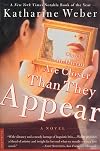
I read this on a trip to Vermont, which is about as far (politically and geographically) as one can get from my home state without falling into the ocean, or Canada. It was a gloriously sunny day of the sort one can only get at higher latitudes -- the light seems closer, somehow; why would that be?
So I sat on a bench in the sun, gave myself a nice burn, and cried.
I also dog-eared every other page (this, in a library book. I am a terrible terrible person.)
Here's where I say that it's a debut show more novel and very very good, though a first novel from a very very good author is still a first novel; and here's where I apologize for my rating system, which makes sense to no one but myself and places Pride and Prejudice on par with Objects (the latter is better-written); and here's where I apologize, again, for my inability to do any justice to Weber's writing and -- is scope too pretentious a word for such an unpretentious novel? -- her scope.
This is why it's good, why Weber is good: she is not retreating. She says: horrible horrible things will happen and you will have to deal with them. You created the horror - unwillingly, unwittingly; but now it is here and it is your fault. You will live with this. You have no choice. And you will not forget, and you will do it again.
Le Guin called this "equilibrium", capital E, which is a beautiful and unwieldy word for such a deeply nasty, treacherous goblin.
This - that creation of horror, through our essential forgetful sloppiness - is wholly selfish. And even more so, says Weber (and I agree) is that we can forget about it; we can love; and we call that love more important than the evil we've done.
"Benedict: you are my You."
Oh, my god. show less
So I sat on a bench in the sun, gave myself a nice burn, and cried.
I also dog-eared every other page (this, in a library book. I am a terrible terrible person.)
Here's where I say that it's a debut show more novel and very very good, though a first novel from a very very good author is still a first novel; and here's where I apologize for my rating system, which makes sense to no one but myself and places Pride and Prejudice on par with Objects (the latter is better-written); and here's where I apologize, again, for my inability to do any justice to Weber's writing and -- is scope too pretentious a word for such an unpretentious novel? -- her scope.
This is why it's good, why Weber is good: she is not retreating. She says: horrible horrible things will happen and you will have to deal with them. You created the horror - unwillingly, unwittingly; but now it is here and it is your fault. You will live with this. You have no choice. And you will not forget, and you will do it again.
Le Guin called this "equilibrium", capital E, which is a beautiful and unwieldy word for such a deeply nasty, treacherous goblin.
This - that creation of horror, through our essential forgetful sloppiness - is wholly selfish. And even more so, says Weber (and I agree) is that we can forget about it; we can love; and we call that love more important than the evil we've done.
"Benedict: you are my You."
Oh, my god. show less

An accomplished architect, Duncan is driving home from a site visit when a car accident leaves him almost entirely paralyzed from the neck down. Worse, his colleague in the passenger seat, was killed. After Duncan's wife Laura hears of an experimental primate assistance program, Ottoline, a female capuchin monkey, is welcomed into their home and trained to help Duncan with simple tasks when Laura and other caregivers are not present. Despite Ottoline's presence, Laura's support and the many show more fancy pieces of technology designed to make his new circumstances easier which have been added to their home, Duncan's bleak future makes each day a mental struggle for him.
Though it took a few chapters for me to really get into the story, I was thereafter totally engrossed. The story alternates between scenes from the present, events leading up to the accident and vignettes from both Duncan's and Laura's pasts, providing insight on their lives and personalities. Ottoline (I really wanted to know the correct way to pronounce her name — folks on the internet are of several opinions) and her big personality and antics are only a small fraction of narrative but her presence helps tie together the dual timelines. Weber's writing touches with sensitivity on all kinds of topics, from disability and infertility to guilt and hopelessness. I learned about all kinds new concepts in architecture, medicine, and art conservation. Weber must either be incredibly knowledgeable or have done extensive research. Her writing is really stellar, both authentic and perceptive. I'm frankly confused by how this book hasn't received more recognition. It's a sleeper hit for sure. Highly recommended. show less
Though it took a few chapters for me to really get into the story, I was thereafter totally engrossed. The story alternates between scenes from the present, events leading up to the accident and vignettes from both Duncan's and Laura's pasts, providing insight on their lives and personalities. Ottoline (I really wanted to know the correct way to pronounce her name — folks on the internet are of several opinions) and her big personality and antics are only a small fraction of narrative but her presence helps tie together the dual timelines. Weber's writing touches with sensitivity on all kinds of topics, from disability and infertility to guilt and hopelessness. I learned about all kinds new concepts in architecture, medicine, and art conservation. Weber must either be incredibly knowledgeable or have done extensive research. Her writing is really stellar, both authentic and perceptive. I'm frankly confused by how this book hasn't received more recognition. It's a sleeper hit for sure. Highly recommended. show less
The Memory of All That: George Gershwin, Kay Swift, and My Family's Legacy of Infidelities by Katharine Weber

There is no denying that author Katharine Weber came from an extraordinary family. As a group, they seem to have possessed more than their share of wealth, talent, and a penchant for infidelity. Much of the well-written, engaging narrative emphasizes Weber's father, Sidney Kaufman, an unreliable dreamer who hovered on the fringe of the motion picture industry, full of grand plans that never came to fruition. The remainder focuses on Kay Swift, the author's maternal grandmother, a gifted show more musician and composer of songs that have become standards. Torn between her love for her husband and her love for George Gershwin, she lost them both.
There is less about Gershwin than the subtitle suggests, but considering that he wasn't actually part of the family, it is not surprising that he does not figure prominently in the narrative. His fans may be most interested in recent, little-publicized speculation concerning the probable cause of the great composer's death.
The Memory of All That is entertaining, but I am not likely to read it again. It renewed my gratitude for my ordinary, celebrity-free, faithful family, and it reminded me that the memoir genre is not one I truly enjoy. show less
There is less about Gershwin than the subtitle suggests, but considering that he wasn't actually part of the family, it is not surprising that he does not figure prominently in the narrative. His fans may be most interested in recent, little-publicized speculation concerning the probable cause of the great composer's death.
The Memory of All That is entertaining, but I am not likely to read it again. It renewed my gratitude for my ordinary, celebrity-free, faithful family, and it reminded me that the memoir genre is not one I truly enjoy. show less
 This review was written for LibraryThing Early Reviewers.
Lists
Awards


You May Also Like


Associated Authors
Statistics
- Works
- 8
- Also by
- 5
- Members
- 1,333
- Popularity
- #19,311
- Rating
- 3.5
- Reviews
- 77
- ISBNs
- 38
- Languages
- 5
- Favorited
- 2

