
Jennifer Lee Carrell
Author of Interred with Their Bones
About the Author
Series
Works by Jennifer Lee Carrell
Tagged
Common Knowledge
- Canonical name
- Carrell, Jennifer Lee
- Birthdate
- 1962
- Gender
- female
- Education
- Harvard University
University of Oxford
Stanford University - Short biography
- JENNIFER LEE CARRELL holds her Ph.D. in English and American Literature from Harvard University, as well as other degrees in English Literature from Oxford and Stanford Universities. She won three awards for distinction in undergraduate teaching at Harvard, where she taught in the History and Literature Program and directed Shakespeare for the Hyperion Theatre Company. Jennifer is the author of The Speckled Monster, a work of historical nonfiction about battling smallpox at the beginning of the eighteenth century, which USA Today praised as being written "in a compelling, almost novelistic voice." She has also written a number of articles for Smithsonian magazine. Interred With Their Bones is her first novel. She lives in Tucson, Arizona.
- Nationality
- USA
- Places of residence
- Tucson, Arizona, USA
- Associated Place (for map)
- Arizona, USA
Members
Reviews
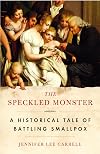
This incredibly enjoyable book reads like a dramatic novel but is entirely factual save for a few creative liberties. It is the story of two individuals, on opposite sides of the Atlantic, fighting the same battle. Both parts biography and medical history, but written for those who may not enjoy scholarly nonfiction.
"London" focuses on the rise and marriage of Lady Mary Wortley Montagu, an intelligent, cultured, head-strong writer of high society. As queens and kings succumb to smallpox, she show more comes to learn of inoculation or "engrafting" while in Adrianople with her diplomatic husband. Having survived and tragically scarred by smallpox herself, she will bring this radical idea to London - with the help of Scottish Dr. Maitland - by having her own son and daughter inoculated...
"Boston" opens with Dr. Zabdiel Boylston (see my post from March 9), the fire and brimstone Rev. Cotton Mather and his slave Onesimus. In 1721, smallpox enters Boston from the HMS Seahorse, bypassing quarantine laws, and Onesimus becomes instrumental by introducing Mather to the principle of inoculation. Word spreads to Dr. Boylston who inoculates his son Thomas first, then his slave Jack, his young son Jackey, a family friend, then Jack's wife Moll, then his sons John and Zabdiel Jr . All recovered with full immunity but Boylston must navigate an egotistical Dr. William Douglass, the spurrious John Campbell and the mighty Elisha Cooke, who wish to see this "nonsense" stopped.
In the final chapter, Lady Mary attempts to convince a naive court and the King of England himself the importance of inoculation while Dr. Boylston is met with hostility and outright violence from superstitious Bostonians and eventually faces a charge of "attempted murder"... show less
"London" focuses on the rise and marriage of Lady Mary Wortley Montagu, an intelligent, cultured, head-strong writer of high society. As queens and kings succumb to smallpox, she show more comes to learn of inoculation or "engrafting" while in Adrianople with her diplomatic husband. Having survived and tragically scarred by smallpox herself, she will bring this radical idea to London - with the help of Scottish Dr. Maitland - by having her own son and daughter inoculated...
"Boston" opens with Dr. Zabdiel Boylston (see my post from March 9), the fire and brimstone Rev. Cotton Mather and his slave Onesimus. In 1721, smallpox enters Boston from the HMS Seahorse, bypassing quarantine laws, and Onesimus becomes instrumental by introducing Mather to the principle of inoculation. Word spreads to Dr. Boylston who inoculates his son Thomas first, then his slave Jack, his young son Jackey, a family friend, then Jack's wife Moll, then his sons John and Zabdiel Jr . All recovered with full immunity but Boylston must navigate an egotistical Dr. William Douglass, the spurrious John Campbell and the mighty Elisha Cooke, who wish to see this "nonsense" stopped.
In the final chapter, Lady Mary attempts to convince a naive court and the King of England himself the importance of inoculation while Dr. Boylston is met with hostility and outright violence from superstitious Bostonians and eventually faces a charge of "attempted murder"... show less
Excellent narrative nonfiction that looks at two people: Lady Mary Wortley Montagu of London and Zabadiel Boyston of Boston, both of whom learned about smallpox inoculation. Both of them had survived rough cases and were quite scarred, and knew many who had died of smallpox. She learned about inoculation while on a 1-year posting (for her husband) in Istanbul, where it had been practiced from some time. He learned about it through pamphlets from England that discussed its use in Turkey and show more Africa.
Lady Mary had her son inoculated, and then encouraged various doctors and others to read about it and learn more. With her personality and connections, she managed to get doctors to run a trial on 6 Newgate prisoners.
Boyston learned about it from Cotton Mather, who received the pamphlets from the Royal Society in London. He then asked his adult slave, and talked to other Africans around Boston and saw their scars. Boyston was the only doctor/apothecary willing to try. As smallpox brought on a ship swept through town, he started by inoculating his youngest son and two slaves. After their recovery, he slowly inoculated others.
Carrell skips back and forth between London and Boston, as Boyston is inoculating desparate people and London doctors are experimenting at the request of the queen. Both learn the others are looking into it. Both have detractors and setbacks (more so Boyston, with no medical degree).
Very well done. Carrell has exceptional sources--Lady Mary herself, Boyston's notes, Cotton Mather, the various doctors in England, newspapers, Royal Society proceedings, and more. Usually I hate it when historians put words into peoples' mouths, but she did a magnificent job and had a lot of their own words to work with. Very readable, and very very interesting! show less
Lady Mary had her son inoculated, and then encouraged various doctors and others to read about it and learn more. With her personality and connections, she managed to get doctors to run a trial on 6 Newgate prisoners.
Boyston learned about it from Cotton Mather, who received the pamphlets from the Royal Society in London. He then asked his adult slave, and talked to other Africans around Boston and saw their scars. Boyston was the only doctor/apothecary willing to try. As smallpox brought on a ship swept through town, he started by inoculating his youngest son and two slaves. After their recovery, he slowly inoculated others.
Carrell skips back and forth between London and Boston, as Boyston is inoculating desparate people and London doctors are experimenting at the request of the queen. Both learn the others are looking into it. Both have detractors and setbacks (more so Boyston, with no medical degree).
Very well done. Carrell has exceptional sources--Lady Mary herself, Boyston's notes, Cotton Mather, the various doctors in England, newspapers, Royal Society proceedings, and more. Usually I hate it when historians put words into peoples' mouths, but she did a magnificent job and had a lot of their own words to work with. Very readable, and very very interesting! show less
I've wanted to read this book for ages and ages. Admittedly, I thought it was a typical nonfiction book, so I was surprised to open it and find a narrative that, for all intents and purposes, read like historical fiction--albeit impeccably researched historical fiction. I noticed that other reviewers are pretty split on whether they like this or not, and I'm not entirely sure myself. But this is something that the publishers definitely should have addressed better in the back cover text, show more which sounds like a typical nonfiction book. Something along the lines of, "spinning the impeccable research of nonfiction with the narrative threads of historical fiction..." (obviously that's a first draft!).
For historical fiction, it's absolutely fantastic for a history lover. We're not limited to the "characters'" points of view, so we get accurate information about statistics and the broader world, without going into the clinical depth of a typical nonfiction book. At the same time, there are detailed historical notes at the end of the book--not footnotes--and there's one for every chapter! They're easily skipped, but they're also easily referenced for nerds like me.
All that said, I did get a bit slowed down by the nonfiction elements in the middle of the book, when Carrell got a bit caught up in detailed descriptions of the comings and goings of individuals on ships in the Boston harbor. It seems as though this would be a perfect place to cut a few "characters" and streamline the narrative.
Even more than a month after finishing this book, I'm astounded that these two stories took place at exactly the same time on different sides of the Atlantic. What are the odds that both London and Boston would embark on inoculation experiments not only in the same year, but in the same summer? Okay, well, actually the timing was probably related to the weather supporting the illness, but still! This book also serves as a fascinating introduction to the history of modern scientific practices: many of the building blogs of the scientific method are there in the experiments conducted.
It's also not hard to draw parallels between early inoculations and today's anti-vaccer movement. In those days, there was a rumor that inoculation caused the plague; today there are rumors that vaccines cause autism, though we have much more evidence from clinical studies now. In both cases, though, there simply was no swaying many of those determined to be afraid of modern medicine.
All in all, a fascinating book and one that I would happily recommend to fans of both historical fiction and nonfiction.
Quote Roundup
69: "Englishmen," [a Turkish woman] informed her companions after inspecting the boned corset, "lock up their wives in little boxes shaped like their bodies." ... European women, they all assured Lady Mary through her interpretess, were to be pitied for being such slaves as to be kept prisoner in their own clothing; no man of the East would dream of such barbarity.
Okay, I just love reading about intercultural interactions like this. No other reason this is here.
Though "interpretess" did bother me. Lady Mary is at a Turkish bath--I think it's safe to use "interpreter" and trust that readers won't be confused about the gender.
78: "I cannot forbear admiring the very great sagacity of the men who first invented this method," [Maitland] said upon one return.
"What makes you think it was men?" asked Lady Mary, raising an eyebrow.
He stopped in his tracks and stared at her. "I--"
"Men do not practice it. Why should they have invented it?"
101: Four short lessons [for a New England doctor]: Do as little as Possible. Be clean. When surgery is absolutely necessary--be decisive, precise, and lighting quick. Above all, take knowledge wherever you find it. By which is father meant pay attention to the Indians. Those who are left.
I would argue that the rules of medicine haven't changed much, though I do think that more attention should be paid to alternative medicinal practices. Alas, they're not moneymakers enough for major companies to sponsor the research.
112: I loved the description from Onesiumus's point of view of a winter New England robbed of color and heat. What an awful way to arrive in a new place without warning! I mean, even given the circumstance of arriving as a slave. At least the heat of the South would have been somewhat familiar.
248: I wish there had been a tad more speculation about why Mather delayed so long with inoculating his children if he was such a staunch supporter of inoculation. Surely he would have understood, if not in quite as many words, that the showmanship involved in inoculating a member of his family would bring positive attention and respect to the practice. Yes, on this page he worries that if it goes wrong, people will be against the practice--but if he was so confident, why worry?
Obviously that's oversimplified, but it's hard to understand how others might reconcile the contrast between Mather's words and actions. Perhaps that hypocrisy is just always been something that people expect of leaders.
335: Absolutely fascinating to read that most of Harvard got on board with inoculation, if informally! I wonder if their history museum touches on that at all.
355: Here we get some comments from England very reminiscent of anti-vaccers:
“Mr. Maitland is grubbing for money and patronage.”
“A new way to murder with impunity!”
“An artificial way of depopulating the whole country.”
391: After receiving good evidence that the British were using smallpox-infected blankets and refugees as an insidious weapon—and knowing the terrible vulnerability of most of his men—George Washington had the entire Continental Army inoculated in 1777. Washington’s own face was already famously scarred from an earlier bout with the disease, contracted on a visit to Barbados in 1751. But Marth had herself inoculated, so that she might visit her husband in the soldiers’ camps with impunity; smallpox parties became popular among Revolutionary women—including Abigail Adams and Mrs. John Hancock.
Quotes from the Notes…
411: I have so much respect for doctors in those days. I hadn’t actually thought about it, but young doctors sometimes [deliberately infected themselves with diseases]. They were otherwise virtually useless in an epidemic. … Before the shields of antisepsis and antibiotics, being a doctor was not for the faint of heart; repeatedly risking “putrid” fevers (typhus and typhoid, not then differentiated), dysentery, and various streptococcal infections, to name just a few of the common killers in colonial New England, required no small dose of courage. At least smallpox only had to be suffered once.
Well, unfortunately I've forgotten why I flagged most of the passages I did, so that's it. Alas! show less
For historical fiction, it's absolutely fantastic for a history lover. We're not limited to the "characters'" points of view, so we get accurate information about statistics and the broader world, without going into the clinical depth of a typical nonfiction book. At the same time, there are detailed historical notes at the end of the book--not footnotes--and there's one for every chapter! They're easily skipped, but they're also easily referenced for nerds like me.
All that said, I did get a bit slowed down by the nonfiction elements in the middle of the book, when Carrell got a bit caught up in detailed descriptions of the comings and goings of individuals on ships in the Boston harbor. It seems as though this would be a perfect place to cut a few "characters" and streamline the narrative.
Even more than a month after finishing this book, I'm astounded that these two stories took place at exactly the same time on different sides of the Atlantic. What are the odds that both London and Boston would embark on inoculation experiments not only in the same year, but in the same summer? Okay, well, actually the timing was probably related to the weather supporting the illness, but still! This book also serves as a fascinating introduction to the history of modern scientific practices: many of the building blogs of the scientific method are there in the experiments conducted.
It's also not hard to draw parallels between early inoculations and today's anti-vaccer movement. In those days, there was a rumor that inoculation caused the plague; today there are rumors that vaccines cause autism, though we have much more evidence from clinical studies now. In both cases, though, there simply was no swaying many of those determined to be afraid of modern medicine.
All in all, a fascinating book and one that I would happily recommend to fans of both historical fiction and nonfiction.
Quote Roundup
69: "Englishmen," [a Turkish woman] informed her companions after inspecting the boned corset, "lock up their wives in little boxes shaped like their bodies." ... European women, they all assured Lady Mary through her interpretess, were to be pitied for being such slaves as to be kept prisoner in their own clothing; no man of the East would dream of such barbarity.
Okay, I just love reading about intercultural interactions like this. No other reason this is here.
Though "interpretess" did bother me. Lady Mary is at a Turkish bath--I think it's safe to use "interpreter" and trust that readers won't be confused about the gender.
78: "I cannot forbear admiring the very great sagacity of the men who first invented this method," [Maitland] said upon one return.
"What makes you think it was men?" asked Lady Mary, raising an eyebrow.
He stopped in his tracks and stared at her. "I--"
"Men do not practice it. Why should they have invented it?"
101: Four short lessons [for a New England doctor]: Do as little as Possible. Be clean. When surgery is absolutely necessary--be decisive, precise, and lighting quick. Above all, take knowledge wherever you find it. By which is father meant pay attention to the Indians. Those who are left.
I would argue that the rules of medicine haven't changed much, though I do think that more attention should be paid to alternative medicinal practices. Alas, they're not moneymakers enough for major companies to sponsor the research.
112: I loved the description from Onesiumus's point of view of a winter New England robbed of color and heat. What an awful way to arrive in a new place without warning! I mean, even given the circumstance of arriving as a slave. At least the heat of the South would have been somewhat familiar.
248: I wish there had been a tad more speculation about why Mather delayed so long with inoculating his children if he was such a staunch supporter of inoculation. Surely he would have understood, if not in quite as many words, that the showmanship involved in inoculating a member of his family would bring positive attention and respect to the practice. Yes, on this page he worries that if it goes wrong, people will be against the practice--but if he was so confident, why worry?
Obviously that's oversimplified, but it's hard to understand how others might reconcile the contrast between Mather's words and actions. Perhaps that hypocrisy is just always been something that people expect of leaders.
335: Absolutely fascinating to read that most of Harvard got on board with inoculation, if informally! I wonder if their history museum touches on that at all.
355: Here we get some comments from England very reminiscent of anti-vaccers:
“Mr. Maitland is grubbing for money and patronage.”
“A new way to murder with impunity!”
“An artificial way of depopulating the whole country.”
391: After receiving good evidence that the British were using smallpox-infected blankets and refugees as an insidious weapon—and knowing the terrible vulnerability of most of his men—George Washington had the entire Continental Army inoculated in 1777. Washington’s own face was already famously scarred from an earlier bout with the disease, contracted on a visit to Barbados in 1751. But Marth had herself inoculated, so that she might visit her husband in the soldiers’ camps with impunity; smallpox parties became popular among Revolutionary women—including Abigail Adams and Mrs. John Hancock.
Quotes from the Notes…
411: I have so much respect for doctors in those days. I hadn’t actually thought about it, but young doctors sometimes [deliberately infected themselves with diseases]. They were otherwise virtually useless in an epidemic. … Before the shields of antisepsis and antibiotics, being a doctor was not for the faint of heart; repeatedly risking “putrid” fevers (typhus and typhoid, not then differentiated), dysentery, and various streptococcal infections, to name just a few of the common killers in colonial New England, required no small dose of courage. At least smallpox only had to be suffered once.
Well, unfortunately I've forgotten why I flagged most of the passages I did, so that's it. Alas! show less
Since the beginning of time smallpox has killed hundreds of millions of people. The disease killed more people than the plague and all the 20th Century wars combined. Long before Edward Jenner perfected a vaccination in 1796, Lady Mary Wortley Montague of London and Zabdiel Boylston of Boston learned about inoculation in two surprisingly different ways. Each determined to use this knowledge to prevent others from contracting smallpox.
In The Speckled Monster Jennifer Lee Carrell tells the show more story of how these two people fought smallpox in the 1720s. Unknown to each other, they simultaneously waged this war on two different continents and managed to promote the idea of smallpox inoculation in the English-speaking world.
Doctors of this time had heard about inoculation and dismissed it as an old wives tale. Lady Mary and Boylston were not researchers or formally trained doctors. They were not concerned with how the inoculations worked, only that they did. Lady Mary defied her husband and had her children inoculated. Boylston found himself traveling the streets of Boston at night to inoculate people who didn’t want their neighbors to know.
Carrell’s book reads like a novel. I suspected how the book was going to end but it was fascinating to watch the heroes battle the establishment. I found myself looking forward to the end of each chapter when I would go to the notes section at the end of the book and read the details she didn’t include in the book. Perhaps even more interesting was the name dropping of historical characters throughout the book, some who heeded Lady Mary’s and Boylston’s advice and others who battled it until the very end.
I did not expect to like or even finish this book when I picked it up, but the style of writing drew me in and the story that unfolded kept me reading to the end and then past that through the end notes. I would recommend The Speckled Monster to anyone interested in history or even historical fiction. show less
In The Speckled Monster Jennifer Lee Carrell tells the show more story of how these two people fought smallpox in the 1720s. Unknown to each other, they simultaneously waged this war on two different continents and managed to promote the idea of smallpox inoculation in the English-speaking world.
Doctors of this time had heard about inoculation and dismissed it as an old wives tale. Lady Mary and Boylston were not researchers or formally trained doctors. They were not concerned with how the inoculations worked, only that they did. Lady Mary defied her husband and had her children inoculated. Boylston found himself traveling the streets of Boston at night to inoculate people who didn’t want their neighbors to know.
Carrell’s book reads like a novel. I suspected how the book was going to end but it was fascinating to watch the heroes battle the establishment. I found myself looking forward to the end of each chapter when I would go to the notes section at the end of the book and read the details she didn’t include in the book. Perhaps even more interesting was the name dropping of historical characters throughout the book, some who heeded Lady Mary’s and Boylston’s advice and others who battled it until the very end.
I did not expect to like or even finish this book when I picked it up, but the style of writing drew me in and the story that unfolded kept me reading to the end and then past that through the end notes. I would recommend The Speckled Monster to anyone interested in history or even historical fiction. show less
Lists
Awards


You May Also Like


Associated Authors
Statistics
- Works
- 4
- Members
- 3,219
- Popularity
- #7,951
- Rating
- 3.3
- Reviews
- 119
- ISBNs
- 70
- Languages
- 15
- Favorited
- 1