

Leslie Marmon Silko
Author of Ceremony
About the Author
Leslie Marmon Silko was born in 1948 in Albuquerque, New Mexico. Growing up on a reservation, she went to Bureau of Indian Affairs schools before attending the University of New Mexico. She taught at the Navajo Community College in Arizona and is a professor of English at the University of Arizona, show more Tucson. Marmon has written short stories, poetry, plays and novels. Her books include Laguna Woman, Ceremony and Yellow Woman. (Bowker Author Biography) show less
Image credit: Credit: James Nguyen, The Fairfield Mirror.
Works by Leslie Marmon Silko
A Circle of Nations: Voices and Visions of American Indians (The Earthsong Collection) (1993) — Editor — 68 copies
Associated Works
The Story and Its Writer: An Introduction to Short Fiction (1976) — Contributor — 1,215 copies, 3 reviews
Race, Class, and Gender in the United States: An Integrated Study (1992) — Contributor, some editions — 561 copies
Sisters of the Earth: Women's Prose and Poetry About Nature (1991) — Contributor — 442 copies, 5 reviews
You've Got to Read This: Contemporary American Writers Introduce Stories that Held Them in Awe (1994) — Contributor — 413 copies, 3 reviews
When the Light of the World Was Subdued, Our Songs Came Through: A Norton Anthology of Native Nations Poetry (2020) — Contributor — 378 copies, 4 reviews
Spider Woman's Granddaughters: Traditional Tales and Contemporary Writing by Native American Women (1989) — Contributor — 362 copies
Walking the Clouds: An Anthology of Indigenous Science Fiction (2012) — Contributor — 218 copies, 3 reviews
Reinventing the Enemy's Language: Contemporary Native Women's Writings of North America (1997) — Contributor — 183 copies, 1 review
Still Wild: Short Fiction of the American West 1950 to the Present (2000) — Contributor — 165 copies, 1 review
The Man to Send Rain Clouds: Contemporary Stories by American Indians (1992) — Contributor — 154 copies, 1 review
The Remembered Earth: An Anthology of Contemporary Native American Literature (1979) — Contributor — 77 copies
Songs from This Earth on Turtle's Back: Contemporary American Indian Poetry (1983) — Contributor — 73 copies
The Heath Anthology of American Literature, Concise Edition (2003) — Contributor — 73 copies, 1 review
Before Columbus Foundation Fiction Anthology: Selections from the American Book Awards 1980-1990 (1992) — Contributor — 72 copies
Song of the Turtle: American Indian Literature 1974-1994 (1996) — Contributor — 69 copies, 2 reviews
Native Heritage: Personal Accounts by American Indians, 1790 to the Present (1995) — Contributor — 66 copies
Nothing But the Truth: An Anthology of Native American Literature (2000) — Contributor — 54 copies, 2 reviews
Speaking for the Generations: Native Writers on Writing (Sun Tracks) (1997) — Contributor — 47 copies
Earth Power Coming: Short Fiction in Native American Literature (1983) — Contributor — 37 copies, 1 review
The Lightning Within: An Anthology of Contemporary American Indian Fiction (1991) — Contributor — 32 copies
Pueblo Imagination: Landscape and Memory in the Photography of Lee Marmon (2003) — Contributor — 12 copies
Come to power;: Eleven contemporary American Indian poets (The Crossing Press series of contemporary anthologies) (1974) — Contributor — 4 copies
TriQuarterly 48: Western Stories — Contributor — 2 copies
Tagged
Common Knowledge
- Birthdate
- 1948-03-05
- Gender
- female
- Education
- University of New Mexico (BA)
- Occupations
- poet
novelist - Awards and honors
- Lannan Literary Award (Fiction ∙ 2000)
MacArthur Foundation "Genius Grant" (1981)
Lifetime Achievement Award, Native Writers Circle of The Americas (1994)
Robert Kirsch Award (2020) - Nationality
- Laguna Pueblo
- Birthplace
- Albuquerque, New Mexico, USA
- Places of residence
- Albuquerque, New Mexico, USA (USA)
- Map Location
- USA
Members
Reviews
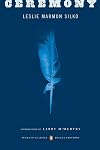
I'm going to be thinking about this novel for a long time. I don't understand its power. I'm not sure how it works. The same actions and perceptions, throughout the novel, can be taken as signs of mental illness, or signs of mental clarity. Time sequence is broken over and over again in the novel, and yet the movement of the story from beginning to end feels as propulsive and climactic as any linear story. The language feels simple and declarative at first, until I realize that it's highly show more elevated, to the extent that it resembles poetry--and then it becomes actual poetry on the page. Characters seem simultaneously real and mythological. There are no sharp edges between the characters, either--rather than having any sense of autonomous 'self' they are defined instead by their relationship to one another. What is real and not-real is likewise not sharply defined. Dream bleeds into memory into a fictive reality and back into dream. I didn't feel this novel was written to explain something to me. I felt instead that Silko wrote exactly and uniquely to her purpose. She wrote something entirely new. I've never read anything like it. show less

This is a challenging, disturbing read. The main character, Tayo, is an American Indian from the Laguna Pueblo reservation. Convinced by his cousin and best friend, Rocky, he enlists in the Army during WWII. Ultimately both young men are taken prisoner together by the Japanese. The horrors of that experience leave Tayo adrift in a limbo-like state, in an Army mental hospital. When he is discharged, still far from well, he finds himself wavering between a desire to return to the hospital's show more sterile cold white environment, where he felt invisible yet safe; and a tendency to slip into the false happiness of near-constant drunkenness which some of his old friends and fellow veterans have embraced. Wise women in his family have another plan, and hold hope for his redemption, however. They encourage Tayo to seek out a medicine man who can put him in touch with the old ways, and help him complete a journey...a journey which is also a ceremony of deliverance from the evil they know as "witchery"...a journey which may end with a promising sunrise and a form of peace.
I found it difficult to engage with this story at first; I would pick it up, read several pages and find myself totally lost---who is speaking, whose point of view is this, did this happen before or after Tayo went to war? I persisted, not wanting to give up on what I was sure was a significant piece of literature. There were beautiful descriptive passages, and the women intrigued me. A story poem interjected into the text a bit at a time tempted me just to find its parts and read it all at once. (I resisted doing so.) At some point, I found I was invested in Tayo's struggle, and was rooting for him to prevail. I am quite pleased to have stuck with it to the end, although I cannot say I totally grasp all there is in it. There are beautiful moments, even some small measure of hope on an individual scale. I think it is impossible to appreciate Ceremony fully without knowing something of the creation myths and other beliefs of the Pueblo people. Part of Tayo's difficulty is that he himself (in part because he has mixed heritage and has suffered the epithet "half-breed" all his life) neither understands nor accepts the cultural norms so important to his grandmother until he has undertaken his journey and acknowledged the witchery at work in the world. This story can not make sense in the context of European morality; it has to be taken on the characters' terms or left alone. I can admire it without completely understanding it, especially as I assume it was not written for me, a white woman of Anglo-Saxon and Eastern European descent. It is one of those novels that, like much of Faulkner, cannot simply be read, but must be re-read. show less
I found it difficult to engage with this story at first; I would pick it up, read several pages and find myself totally lost---who is speaking, whose point of view is this, did this happen before or after Tayo went to war? I persisted, not wanting to give up on what I was sure was a significant piece of literature. There were beautiful descriptive passages, and the women intrigued me. A story poem interjected into the text a bit at a time tempted me just to find its parts and read it all at once. (I resisted doing so.) At some point, I found I was invested in Tayo's struggle, and was rooting for him to prevail. I am quite pleased to have stuck with it to the end, although I cannot say I totally grasp all there is in it. There are beautiful moments, even some small measure of hope on an individual scale. I think it is impossible to appreciate Ceremony fully without knowing something of the creation myths and other beliefs of the Pueblo people. Part of Tayo's difficulty is that he himself (in part because he has mixed heritage and has suffered the epithet "half-breed" all his life) neither understands nor accepts the cultural norms so important to his grandmother until he has undertaken his journey and acknowledged the witchery at work in the world. This story can not make sense in the context of European morality; it has to be taken on the characters' terms or left alone. I can admire it without completely understanding it, especially as I assume it was not written for me, a white woman of Anglo-Saxon and Eastern European descent. It is one of those novels that, like much of Faulkner, cannot simply be read, but must be re-read. show less
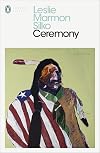
I feel a little like my previous 5-star ratings have been a bit wasted now that I have read Ceremony. Star-inflation leaves me ill-equipped to convey how much I enjoyed this book — it gave me goosebumps. On its surface, Ceremony is a powerful story about Tayo, a soldier returning home from the Pacific Theater of WWII after spending time in a POW camp. Tayo is a destroyed man who returned to the Laguna Pueblo Reservation in New Mexico to a repetitive existence of sleep, sickness, and guilt show more that he tries to keep away with drunkenness. He recognizes that in living as he does he is fulfilling one of the worst and most destructive stereotypes of Native Americans — the “drunken Indian.”
The book is also a tale of redemption and rebirth through a rediscovery and renewed appreciation of Native American myth and stories and the recognition that these are Tayo’s myths and stories even if, for some people, his mixed heritage positions him in a nowhere-space between White and Native American society. That tale on its own is poignant and well told.
… but what makes this book really special is how Silko uses the form of Native American myth and storytelling to set up layers of interpretation in the book. After finishing a first reading, I can see that she gave instructions to the readers right from the start. From the opening of the book:
She goes on to say that she is about to write about the importance of stories because “You don’t have anything if you don’t have the stories.” The stories are defenses against the “destroyers” —
The stories shared in this book come through many characters’ voices, most notably the medicine-man Betonie, who represents Tayo’s last hope to recover something of himself.
Although I have only read the novel through once, I have already gone back to re-read the embedded stories multiple times. In doing that I have seen how recursive the whole novel is. The events of the novel mirror the stories … or maybe it is Tayo who fits his world to the stories once he has them as a guide. It quickly became clear that this novel can support a literal, an allegorical, and an anagogical (spiritual/mystical) reading at the same time, and the readings are mutually influential and informing. You can get one set of meanings from reading about Tayo and what he has done and then see things in quite another way when looking at the same details allegorically or analogically. This is a book that supports multiple reading.
Simply marvelous. show less
The book is also a tale of redemption and rebirth through a rediscovery and renewed appreciation of Native American myth and stories and the recognition that these are Tayo’s myths and stories even if, for some people, his mixed heritage positions him in a nowhere-space between White and Native American society. That tale on its own is poignant and well told.
… but what makes this book really special is how Silko uses the form of Native American myth and storytelling to set up layers of interpretation in the book. After finishing a first reading, I can see that she gave instructions to the readers right from the start. From the opening of the book:
Ts’its’tsi’nako, Thought-Woman,
is sitting in her room
and whatever she thinks about
appears.
She goes on to say that she is about to write about the importance of stories because “You don’t have anything if you don’t have the stories.” The stories are defenses against the “destroyers” —
“Their evil is mighty
but it can’t stand up to our stories.
So they try to destroy the stories
let the stories be confused or forgotten.
They would like that
They would be happy to
Because we would be defenseless then”
The stories shared in this book come through many characters’ voices, most notably the medicine-man Betonie, who represents Tayo’s last hope to recover something of himself.
Although I have only read the novel through once, I have already gone back to re-read the embedded stories multiple times. In doing that I have seen how recursive the whole novel is. The events of the novel mirror the stories … or maybe it is Tayo who fits his world to the stories once he has them as a guide. It quickly became clear that this novel can support a literal, an allegorical, and an anagogical (spiritual/mystical) reading at the same time, and the readings are mutually influential and informing. You can get one set of meanings from reading about Tayo and what he has done and then see things in quite another way when looking at the same details allegorically or analogically. This is a book that supports multiple reading.
Simply marvelous. show less
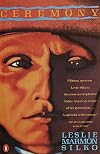
I like to compare reading Silko to drinking a icy cold glass of limoncello. It is not the kind of thing you gulp down in chug-a-lug like fashion. It is better to take in small sips of the scenes in order to let them slide over your subconscious and filter slowly into your brain. Think of it this way. It is as if you have to give the words time to mellow and ultimately saturate your mind.
First things first. When you get into the plot of Ceremony what you first discover is that Tayo is a show more complicated character. After being a prisoner of the Japanese during World War II, alcoholism, battle fatigue (now called post traumatic stress disorder), mental illness, and guilt all plague Tayo. It's as if threads of guilt tangle in his mind, strangling his ability to comprehend reality, especially when other veterans on the Laguna Pueblo reservation turn to sex, alcohol and violence to cope. Friends are no longer friendly.
Next, what is important to pay attention to are the various timelines. There is the time before the war and the time after at the mental health facility with the timeline with Thought (Spider) Woman, Corn Woman, and Reed Woman. Each timeline dips back and forth throughout the story. Tayo struggles to reconcile what it means to be Native American, with all its traditions and beliefs, with the horrors of war and captivity. How does one as gentle as Tayo forgive himself for being a soldier? "He stepped carefully, pushing the toe of his boot into the weeds first to make sure the grasshoppers were gone before he set his foot down into the crackling leathery stalks of dead sunflowers" (p 155). He can't even inadvertently harm a bug.
Interspersed between the plot are pages of lyrical poetry.
Throughout it all, I found myself weeping for Tayo's lost soul. show less
First things first. When you get into the plot of Ceremony what you first discover is that Tayo is a show more complicated character. After being a prisoner of the Japanese during World War II, alcoholism, battle fatigue (now called post traumatic stress disorder), mental illness, and guilt all plague Tayo. It's as if threads of guilt tangle in his mind, strangling his ability to comprehend reality, especially when other veterans on the Laguna Pueblo reservation turn to sex, alcohol and violence to cope. Friends are no longer friendly.
Next, what is important to pay attention to are the various timelines. There is the time before the war and the time after at the mental health facility with the timeline with Thought (Spider) Woman, Corn Woman, and Reed Woman. Each timeline dips back and forth throughout the story. Tayo struggles to reconcile what it means to be Native American, with all its traditions and beliefs, with the horrors of war and captivity. How does one as gentle as Tayo forgive himself for being a soldier? "He stepped carefully, pushing the toe of his boot into the weeds first to make sure the grasshoppers were gone before he set his foot down into the crackling leathery stalks of dead sunflowers" (p 155). He can't even inadvertently harm a bug.
Interspersed between the plot are pages of lyrical poetry.
Throughout it all, I found myself weeping for Tayo's lost soul. show less
Lists
Awards


You May Also Like


Associated Authors
Statistics
- Works
- 22
- Also by
- 48
- Members
- 6,840
- Popularity
- #3,573
- Rating
- 3.9
- Reviews
- 100
- ISBNs
- 88
- Languages
- 9
- Favorited
- 11