
John Seigenthaler (1927–2014)
Author of James K. Polk
About the Author
Works by John Seigenthaler
A false Wikipedia 'biography 1 copy
Associated Works
When Race Becomes Real: Black and White Writers Confront Their Personal Histories (2002) — Contributor — 49 copies
Pictures of Our Nobler Selves: a History of Native American Contributions to News Media (1995) — Foreword — 8 copies, 1 review
Tagged
Common Knowledge
- Legal name
- Seigenthaler, John Lawrence Jr.
- Birthdate
- 1927-07-27
- Date of death
- 2014-07-11
- Gender
- male
- Education
- George Peabody College for Teachers
- Occupations
- journalist
editor
publisher
political advisor - Organizations
- The Tennessean
USA Today
Vanderbilt University (Founder, First Amendment Center)
American Society of Newspaper Editors (President) - Awards and honors
- Middle Tennessee State University (endowed chair)
- Relationships
- Seigenthaler, John M. (son)
- Nationality
- USA
- Birthplace
- Nashville, Tennessee, USA
- Place of death
- Nashville, Tennessee, USA
- Associated Place (for map)
- Nashville, Tennessee, USA
Members
Reviews
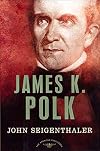
I was not prepared to like this book. My opinion of the book was colored by my opinion of the Polk, which in turn was colored by my idolization of Abraham Lincoln (who was "agin" him).
The notion that we went to war with a sovereign state (Mexico) to take their land was obnoxious to me. But I must ask myself how much my identity and the identity of our nation is formed by its shape: what would our nation be like without Texas, New Mexico, and California? Were I living at the time, what would show more my sentiments have been? It is no good (for me) to be comparing it to the war with Iraq and a President I truly believe was misguided (to put it most charitably): One cannot judge the past by the present.
I was quite surprised that Polk had announced he was only running for one term and stuck to it. And surprised at how much he was able to accomplish. Evidently Congress was not much more of a functioning body then, either, though supposedly their problem then was one of patronization.
I was very surprised to find that Polk is ranked by historians as the 9th most able President; above Woodrow Wilson and Teddy Roosevelt! But evidently, Jack Kennedy was similarly surprised, so I am in good company. Polk came into office with three goals and he accomplished all three. Whether I can in good conscience agree with the goal of "manifest destiny," I have to admit he did what he set out to do, and what he did changed the face of our nation, perhaps nearly as much as the Civil War did.
The author, John Seigenthaler, ended his book with the following:
"Arthur Schlesinger, Jr., has compared Polk's standing among presidents with that of Harry Truman: 'Neither Polk nor Truman was one of those creative presidents who make the nation look at things in a new way.... But both had the intelligence and courage to accept the challenge of history. History might have broken them, as it broke Buchanan and Hoover. Instead it forced them, not into personal greatness, but into the performance of great things.' He did great things. That is a powerful epitaph." show less
The notion that we went to war with a sovereign state (Mexico) to take their land was obnoxious to me. But I must ask myself how much my identity and the identity of our nation is formed by its shape: what would our nation be like without Texas, New Mexico, and California? Were I living at the time, what would show more my sentiments have been? It is no good (for me) to be comparing it to the war with Iraq and a President I truly believe was misguided (to put it most charitably): One cannot judge the past by the present.
I was quite surprised that Polk had announced he was only running for one term and stuck to it. And surprised at how much he was able to accomplish. Evidently Congress was not much more of a functioning body then, either, though supposedly their problem then was one of patronization.
I was very surprised to find that Polk is ranked by historians as the 9th most able President; above Woodrow Wilson and Teddy Roosevelt! But evidently, Jack Kennedy was similarly surprised, so I am in good company. Polk came into office with three goals and he accomplished all three. Whether I can in good conscience agree with the goal of "manifest destiny," I have to admit he did what he set out to do, and what he did changed the face of our nation, perhaps nearly as much as the Civil War did.
The author, John Seigenthaler, ended his book with the following:
"Arthur Schlesinger, Jr., has compared Polk's standing among presidents with that of Harry Truman: 'Neither Polk nor Truman was one of those creative presidents who make the nation look at things in a new way.... But both had the intelligence and courage to accept the challenge of history. History might have broken them, as it broke Buchanan and Hoover. Instead it forced them, not into personal greatness, but into the performance of great things.' He did great things. That is a powerful epitaph." show less
US President James Polk (1845-1849) elicits strong opinions from those aware of his record. They either love him for his effectiveness and performance or hate him for his difficult personality and the Mexican War. So-called “Young Hickory,” styling himself after “Old Hickory” Andrew Jackson, Polk set out to be a one-term president and to accomplish four specific goals outlined in his inaugural. He accomplished all of them and died a few months after leaving the presidency. In this show more book, fellow Tennessean John Seigenthaler describes the events of his life and presidency in a short biography.
This book brings readers back to a prior era, when Whigs and Democrats battled for power and at the beginning of when slavery became the dominant national issue. Like now, American politics was deeply polarizing. Henry Clay, whom Polk defeated, proposed the “American System” for internal improvements. Polk instead sought to extend the country coast-to-coast in a fulfillment of “Manifest Destiny.” Seigenthaler describes and illustrates all of these historical with eloquence and discernment.
To accomplish two goals, Polk acquired both Oregon Territory from the British and the American Southwest forcibly from Mexico. For another goal, he also reduced a tariff against Northern industry. Finally, he disbanded the National Bank and instituted an economic system that stayed in place until the Great Depression. His supporters point to this efficient track record of success to support his case for the upper tier of presidents. Seigenthaler tends to stick to this narrative and not become sidetracked by negative critiques of the president.
However, Polk kept a personal diary full of his vision about the day’s affairs. Many a historian has lambasted this diary. It’s full of personality quirks and pettiness that do not put him in a great light. Seigenthaler generally stays away from the diary as a dominant source and instead focuses on Polk’s accomplishments. As such, this account positions Seigenthaler as more of an apologist than a critic. Polk’s admirers in his (and my) home state of Tennessee can thus appreciate this friendly account. Love Polk or hate Polk, Seigenthaler lays it out in this accessible, short, and carefully worded volume. show less
This book brings readers back to a prior era, when Whigs and Democrats battled for power and at the beginning of when slavery became the dominant national issue. Like now, American politics was deeply polarizing. Henry Clay, whom Polk defeated, proposed the “American System” for internal improvements. Polk instead sought to extend the country coast-to-coast in a fulfillment of “Manifest Destiny.” Seigenthaler describes and illustrates all of these historical with eloquence and discernment.
To accomplish two goals, Polk acquired both Oregon Territory from the British and the American Southwest forcibly from Mexico. For another goal, he also reduced a tariff against Northern industry. Finally, he disbanded the National Bank and instituted an economic system that stayed in place until the Great Depression. His supporters point to this efficient track record of success to support his case for the upper tier of presidents. Seigenthaler tends to stick to this narrative and not become sidetracked by negative critiques of the president.
However, Polk kept a personal diary full of his vision about the day’s affairs. Many a historian has lambasted this diary. It’s full of personality quirks and pettiness that do not put him in a great light. Seigenthaler generally stays away from the diary as a dominant source and instead focuses on Polk’s accomplishments. As such, this account positions Seigenthaler as more of an apologist than a critic. Polk’s admirers in his (and my) home state of Tennessee can thus appreciate this friendly account. Love Polk or hate Polk, Seigenthaler lays it out in this accessible, short, and carefully worded volume. show less
Very readable account of a consequential, virtually forgotten presidency. What I liked best were the details of Polk's dealings with James Buchanan. (Seigenthaler paints a clearer portrait of this future terrible president than I derived from the book on Buchanan in this series, as a matter of fact.) As for Polk, he emerges as an irascible and stubborn workaholic who managed to achieve the objectives he set for himself at the beginning of his presidency through a combination of relentless show more determination, brilliant generals, and dumb luck.
My one complaint is that Seigenthaler is so committed to making the case that Polk was a successful president who "got results" that he spends too little time considering whether those "results" (e.g. the annexation of Texas) were actually commendable. When he does invoke one of Polk's critics (such as Thoreau) his tone is patronizing. show less
My one complaint is that Seigenthaler is so committed to making the case that Polk was a successful president who "got results" that he spends too little time considering whether those "results" (e.g. the annexation of Texas) were actually commendable. When he does invoke one of Polk's critics (such as Thoreau) his tone is patronizing. show less

St. Barts 2018 #6 - I have always had a fascination with the US Presidency going back to at least 2nd grade, and when my travels take me somewhere near any Presidential point of interest, i make the necessary detours and visit when time allows. I was able to visit the Polk Homestead in Columbia, TN and was duly interested in the information there, and bought this at the local bookstore in Columbia to further my knowledge of this often forgotten leader. All Presidencies are unbelievably show more interesting to me, and this one was no different. Polk campaigned as a one-term President and kept to his word.....mapped out exactly what he hoped to accomplish in 4 broad goals, and strangely enough did exactly that. As part of the American Presidency Series of books, Seigenthaler's book is a nice overview of early life, political landscape leading up to and through the term, and a good smattering of the significant accomplishments and/or failures during Polk's time in office. It is not a smothering detailed day by day, blow by blow recounting, and thus it is fast-moving and very readable. More of us should read history, because there are events in this book that by just changing some dates and a few words, could be an accounting of current political goings-on......and frankly, today seems much more mild, yet our society wails that what goes on today is 'absolutely the worst ever'. Books like this give great context to the political wrangling of today, and to me highlight that the political wrangling, which is by design, is the thing that saves us and finds us still here thriving and functioning as a nation 240+ years later. Enjoyed this very much and will probably seek out others in this series, especially of those more off-beat, rarely mentioned holders of our highest office. show less
You May Also Like


Associated Authors
Statistics
- Works
- 5
- Also by
- 4
- Members
- 337
- Popularity
- #70,619
- Rating
- 3.5
- Reviews
- 9
- ISBNs
- 7