
Junot Díaz
Author of The Brief Wondrous Life of Oscar Wao
About the Author
Junot Díaz was born in Santo Domingo, Dominican Republic and was raised in New Jersey. His fiction has appeared in numerous publications including The New Yorker, The Paris Review, African Voices, and Best American Short Stories. He wrote the story collection Drown and the novel The Brief Wondrous show more Life of Oscar Wao, which won the John Sargent Sr. First Novel Prize, the National Book Critics Circle Award, the Anisfield-Wolf Book Award, the Dayton Literary Peace Prize and the 2008 Pulitzer Prize. His debut picture book is entitled Islandborn, published June 2018. He is a professor of creative writing at the Massachusetts Institute of Technology. (Bowker Author Biography) show less
Image credit: Junot Diaz at New York Public Library on October 17, 2013 in New York City
Works by Junot Díaz
Ysrael (Short Story) 5 copies
Miss Lora 4 copies
Associated Works
The Story and Its Writer: An Introduction to Short Fiction (1976) — Contributor — 1,218 copies, 3 reviews
The Scribner Anthology of Contemporary Short Fiction: Fifty North American American Stories Since 1970 (1999) — Contributor — 588 copies, 4 reviews
The Art of the Story: An International Anthology of Contemporary Short Stories (1999) — Contributor — 395 copies, 5 reviews
New York Stories [Everyman's Library Pocket Classics] (2011) — Contributor, some editions — 200 copies, 5 reviews
Light the Dark: Writers on Creativity, Inspiration, and the Artistic Process (2017) — Contributor — 166 copies, 5 reviews
The Ecco Anthology of Contemporary American Short Fiction (2008) — Contributor — 142 copies, 2 reviews
Black Ink: Literary Legends on the Peril, Power, and Pleasure of Reading and Writing (2018) — Contributor — 95 copies
Sudden Fiction Latino: Short-Short Stories from the United States and Latin America (2010) — Contributor — 76 copies, 15 reviews
Latin@ Rising: An Anthology of Latin@ Science Fiction and Fantasy (2017) — Contributor — 54 copies, 2 reviews
Las Christmas: Favorite Latino Authors Share Their Holiday Memories (1998) — Contributor — 39 copies, 1 review
Nightmare Magazine, October 2016 - People of Colo(u)r Destroy Horror special issue (2016) — Contributor — 28 copies, 1 review
Tagged
Common Knowledge
- Canonical name
- Díaz, Junot
- Birthdate
- 1968-12-31
- Gender
- male
- Education
- Kean College (Kean University)
Rutgers University (BA ∙ English ∙ 1992)
Cornell University (MFA ∙ 1995) - Occupations
- novelist
lecturer
short story writer - Organizations
- Rutgers University Press
Massachusetts Institute of Technology
Boston Review
American Academy of Arts and Letters (2017) - Awards and honors
- PEN/Malamud Award (2002)
Pulitzer Prize for Fiction (2008)
MacArthur Fellowship (2012) - Agent
- Nicole Aragi
- Relationships
- Liu, Marjorie (partner)
- Nationality
- Dominican Republic
USA - Birthplace
- Santo Domingo, Dominican Republic
- Places of residence
- Parlin, New Jersey, USA
Boston, Massachusetts, USA - Associated Place (for map)
- USA
Members
Discussions
Junot Diaz on POC in MFA programs in Pro and Con (May 2014)
*** February - What are you reading? in Club Read 2013 (April 2013)
Reviews
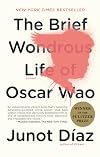
Weaving the history of politics in the Dominican Republic over the 20th century with the story of a family over three generations and writing with such flair and intelligence, Junot Díaz created a masterful book here. He’s so fearless, never worrying about political correctness, bluntly assessing the brutal regimes of Trujillo and Balaguer, and letting it rip from beginning to end, freely dropping in references to works of fantasy, untranslated Spanish, and little snippets of the show more supernatural. The result is a work containing a history lesson, a drama, and comedy, one that kept this reader on his toes and engaged from beginning to end.
The book tells of the fall from grace of an affluent family, starting in the present with the nerdy, obese titular character, his strong, rebellious sister, their sometimes overbearing mother, who we find was once rebellious and in love herself, and finally getting to their grandparents, whose lives were gradually destroyed by Trujillo. The immigrant experience is often written about, but it has such vitality here, and elements like the chapter on Oscar returning to the D.R. (“Oscar Goes Native”) were among my favorite in a book full of great chapters. Because of all its references and ideas this is a book that takes active effort to read, but I found it rewarding, and well worth it. show less
The book tells of the fall from grace of an affluent family, starting in the present with the nerdy, obese titular character, his strong, rebellious sister, their sometimes overbearing mother, who we find was once rebellious and in love herself, and finally getting to their grandparents, whose lives were gradually destroyed by Trujillo. The immigrant experience is often written about, but it has such vitality here, and elements like the chapter on Oscar returning to the D.R. (“Oscar Goes Native”) were among my favorite in a book full of great chapters. Because of all its references and ideas this is a book that takes active effort to read, but I found it rewarding, and well worth it. show less
This is one of the best books I've read in a long time. Having said that, have to admit: this is both a fabulous and wrenchingly difficult read. Others have addressed the plot, so thought I'd go straight to what makes this book so complex, and so worthwhile.
What makes the book amazing: Diaz's totally unique first person narration (the story is related by the Dominican "player" boyfriend of Oscar's sister Lola), combining Dominican history, ethnic references, Jersey street slang, vulgarity, show more scifi/fantasy nerd references, honesty, humility and compassion to create a narrative voice unlike anything I've ever encountered in fiction. In a world full of quality literature, Junot Diaz deserves major props for creating something completely new and utterly compelling.
Unfortunately, this is also what makes the story's plot so wrenching to endure. If the characters weren't so unbearably real, so deeply sympathetic, then perhaps it wouldn't hurt so much to watch them line up, one after the other (first Dr. Abelard Luis Cabral, then his daughter Beli, then her son Oscar....), hell-bent on risking everything for love, only to endure heartbreaking loss and increasingly horrific consequences.
The central question of the novel seems to be: how is one's destiny determined? Is it determined by supernatural forces: fate, God, fuku (the Dominican equivalent of a curse)? Or can you shape fate by your own actions? Or - a terrifying but inescapable possibility - is one's destiny a complete crapshoot? I won't give away the ending, except to provide a little reassurance for prospective readers, for what it's worth: surely an author with as much compassion for his characters as Junot Diaz would never posit a world entirely bereft of hope. show less
What makes the book amazing: Diaz's totally unique first person narration (the story is related by the Dominican "player" boyfriend of Oscar's sister Lola), combining Dominican history, ethnic references, Jersey street slang, vulgarity, show more scifi/fantasy nerd references, honesty, humility and compassion to create a narrative voice unlike anything I've ever encountered in fiction. In a world full of quality literature, Junot Diaz deserves major props for creating something completely new and utterly compelling.
Unfortunately, this is also what makes the story's plot so wrenching to endure. If the characters weren't so unbearably real, so deeply sympathetic, then perhaps it wouldn't hurt so much to watch them line up, one after the other (first Dr. Abelard Luis Cabral, then his daughter Beli, then her son Oscar....), hell-bent on risking everything for love, only to endure heartbreaking loss and increasingly horrific consequences.
The central question of the novel seems to be: how is one's destiny determined? Is it determined by supernatural forces: fate, God, fuku (the Dominican equivalent of a curse)? Or can you shape fate by your own actions? Or - a terrifying but inescapable possibility - is one's destiny a complete crapshoot? I won't give away the ending, except to provide a little reassurance for prospective readers, for what it's worth: surely an author with as much compassion for his characters as Junot Diaz would never posit a world entirely bereft of hope. show less
What seems like a book of short stories is actually more like glimpses of the life of Diaz' alter ego, Yunior. Each chapter is usually dedicated to a girl in his life that he made love to and cheated on. A character flaw that not only runs in his family but one that he hints is part of being a Dominican male. The stories are not in sequential order but as a whole give you an articulate look, in Diaz' curse filled vernacular, of Yunior's life, moving to Jersey next to a landfill, growing up show more with a brother who died of cancer, hardly knowing a father who lived in the states for five years before bringing his family. Diaz states that his stories are not autobiographical but deeply personal. This book is also about the writing, which is a joy to read. A quote from the New Yorker magazine's fiction editor, Deborah Treisman, calls his voice "unlike any I've come across, with its combination of the lyrical and the vernacular, of English and Spanish, of speech rhythms and internal reflection. It has a kind of unstoppable energy, an inexorable drive forward -- even when his stories move in difficult or tragic directions, the language jumps off the page in ways that can be simultaneously comic and heartbreaking. "
Only one story is not narrated by Yunior and in that one we come to realize it is the voice of the mistress his dad has in America while Yunior and his mom remain hopeful of being called up to the states. Perhaps her voice will create a new novel idea. One can only hope. I think his Oscar Wao novel is essential reading for all. This collection continues to confirm his gift.
Some great lines listed below for a flavor of the writing:
But that was before she’d gotten that chest, before that slash of black hair had gone from something to pull on the bus to something to stroke in the dark.
In another universe I probably came out OK, ended up with mad novias and jobs and a sea of love in which to swim, but in this world I had a brother who was dying of cancer and a long dark patch of life like a mile of black ice waiting for me up ahead.
You, Yunior have a girlfriend named Alma, who has a long tender horse neck and a big Dominican ass that seems to exist in a fourth dimension beyond jeans. An ass that could drag the moon out of orbit. An ass she never liked until she met you. Ain’t a day that passes that you don’t want to press your face against that ass or bite the delicate sliding tendons of her neck. You love how she shivers when you bite, how she fights you with those arms that are so skinny they belong on an after- school special.
The half life of love is forever. show less
Only one story is not narrated by Yunior and in that one we come to realize it is the voice of the mistress his dad has in America while Yunior and his mom remain hopeful of being called up to the states. Perhaps her voice will create a new novel idea. One can only hope. I think his Oscar Wao novel is essential reading for all. This collection continues to confirm his gift.
Some great lines listed below for a flavor of the writing:
But that was before she’d gotten that chest, before that slash of black hair had gone from something to pull on the bus to something to stroke in the dark.
In another universe I probably came out OK, ended up with mad novias and jobs and a sea of love in which to swim, but in this world I had a brother who was dying of cancer and a long dark patch of life like a mile of black ice waiting for me up ahead.
You, Yunior have a girlfriend named Alma, who has a long tender horse neck and a big Dominican ass that seems to exist in a fourth dimension beyond jeans. An ass that could drag the moon out of orbit. An ass she never liked until she met you. Ain’t a day that passes that you don’t want to press your face against that ass or bite the delicate sliding tendons of her neck. You love how she shivers when you bite, how she fights you with those arms that are so skinny they belong on an after- school special.
The half life of love is forever. show less
"The half-life of love is forever."
I could share a dozen-plus favorite lines from the book, and because I want everyone to experience it, I'm tempted to. But instead, I'll just implore you: If you appreciate beautiful writing and have ever loved (and lost) anyone or anything, read "This Is How You Lose Her." Díaz is a brilliant writer, and he uses a "Spanglish freestyle narration," sprinkling his prose with Spanish words and phrases. The collection of short stories mostly narrated by the show more Dominican Yunior are moving, relatable, witty and electric.
When Yunior's girlfriend, Alma, reads his journal and discoverers he's been cheating:
“Instead of lowering your head and copping to it like a man, you pick up the journal as one might hold a bady's beshattered diaper, as one might pinch a recently benutted condom. You glance at the offending passages. Then you look at her and smile a smile your dissembling face will remember until the day you die. Baby, you say, baby, this is part of my novel.
This is how you lose her.” show less
I could share a dozen-plus favorite lines from the book, and because I want everyone to experience it, I'm tempted to. But instead, I'll just implore you: If you appreciate beautiful writing and have ever loved (and lost) anyone or anything, read "This Is How You Lose Her." Díaz is a brilliant writer, and he uses a "Spanglish freestyle narration," sprinkling his prose with Spanish words and phrases. The collection of short stories mostly narrated by the show more Dominican Yunior are moving, relatable, witty and electric.
When Yunior's girlfriend, Alma, reads his journal and discoverers he's been cheating:
“Instead of lowering your head and copping to it like a man, you pick up the journal as one might hold a bady's beshattered diaper, as one might pinch a recently benutted condom. You glance at the offending passages. Then you look at her and smile a smile your dissembling face will remember until the day you die. Baby, you say, baby, this is part of my novel.
This is how you lose her.” show less
Lists
BitLife (1)
My TBR (1)
100 New Classics (1)
Magic Realism (1)
First Novels (1)
USA Road Trip (1)
. (1)
Latin America (1)
Florida (1)
AP Lit (1)
Reading Globally (1)
2000s decade (1)
Urban Fiction (1)
Latin America (1)
1960s (1)
Overdue Podcast (2)
Unread books (1)
Five star books (1)
Favourite Books (1)
Youth: DEI (1)
Awards


You May Also Like


Associated Authors
Statistics
- Works
- 26
- Also by
- 35
- Members
- 21,906
- Popularity
- #982
- Rating
- 3.8
- Reviews
- 773
- ISBNs
- 199
- Languages
- 20
- Favorited
- 57


