

Comte de Lautréamont (1846–1870)
Author of Complete Works
About the Author
Works by Comte de Lautréamont
Maldoror Prose Poem 7 copies
Maldoror : Une traversée des Chants de Maldoror d'Isidore Ducasse comte de Lautréamont (2006) — Auteur — 4 copies
The Dirges of Maldoror: An illustrated English translation of Les Chants de Maldoror (2018) 3 copies
Lautréamont’s Apocrypha 2 copies
Oeuvres compltes 1 copy
Os cantos de Maldoror 1 copy
Poézia 1 copy
De zangen van Maldoror 1 copy
Obras completas 1 copy
I canti di Maldoror 1 copy
Poetica 1 copy
Poesias 1 copy
ロートレアモン詩集 1 copy
Poesías y Cartas 1 copy
Poëzie 1 copy
Lautreamont's Apocrypha 1 copy
Poesies 1 copy
Zpěvy Maldororovy 1 copy
Poésies I 1 copy
Poésies II 1 copy
Œuvres complètes 1 copy
Poesías 1 copy
Tutte le poesie 1 copy
Lautréamont 1 copy
Poemas esenciales 1 copy
Cartas 1 copy
Associated Works
The Second Dedalus Book of Decadence (The Black Forrest) (v. 2) (1992) — Contributor — 60 copies, 3 reviews
The Serpent and the Fire: Poetries of the Americas from Origins to Present (2024) — Contributor — 17 copies
Gedoemde dichters : van Gérard de Nerval tot en met Antonin Artaud : een bloemlezing uit de "poètes maudits" (1957) — Contributor — 9 copies
Tagged
Common Knowledge
- Canonical name
- Lautréamont, Comte de
- Legal name
- Ducasse, Isidore Lucien (birth name)
- Other names
- Lautréamont, Comte de (nom de plume)
- Birthdate
- 1846-04-04
- Date of death
- 1870-11-24
- Gender
- male
- Education
- Imperial Lycée, Tarbes
Lycée Louis Barthou, Pau
École Polytechnique - Occupations
- poet
- Nationality
- Uruguay (birth)
France - Birthplace
- Montevideo, Uruguay
- Places of residence
- Montevideo, Uruguay
Tarbes, France
Pau, Pyrénées-Atlantiques, France
Paris, France - Place of death
- Paris, France
- Burial location
- Cimitière du Nord, Paris, France
- Map Location
- France
Members
Reviews
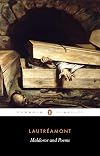
This is a very peculiar book for review because one can approach it from two perspectives - its 'importance' in literature and whether it is actually worth reading. It is like the Bible in that respect - the sort of blasphemous implication that Isidore Ducasse (the actual author) might have appeared to revel in.
Let us start with a first proposition - that it is 'important'. Yes, Maldoror is important if you are a specialist or interested in French literature and at two levels. It is both a show more stepping stone from the Gothick (with Maldoror containing many of Gothick's traditional tropes) over the stream of decadence to surrealism with its famous phrase in the seminal Book Six referring to the "chance juxtaposition of a sewing machine and an umbrella on a dissecting table!" and a first step to the self-knowing French literary meme of literature as a thing that refers to itself.
The addition of the so-called Poems to this edition is important because they change our reception to Maldoror simply by being read alongside them. Maldoror might be read as a sincere rage against God and Man filled with brutality and evil if we did not see the author in the Poems assert in a series of cynical platitudes the exact opposite point of view in the Poems.
This tricksiness continues with the titling and style - the Poems are just sets of often pompous rhetorical aphorisms, often contradictory, while Maldoror, ostensibly presented as a novel (though only the Sixth Book comes close to being a coherent narrative) is really a large number of prose poems but connected only through the Mathurin-like character of Maldoror (though even this is never clear).
Ducasse is undoubtedly a possible literary genius but since he died at the age of 24 (his life is almost incredibly obscure to the extent that one is suspicious of his very existence though it is indeed evidenced) we cannot confirm any claim to this effect. My own interpretation is that we have a very intelligent and possibly obsessive young man playing with the literature of his time in order to expose its and our absurdities through exposing the rhetorical positions it and we take.
Without the cynico-beneficent platitudes of the associated Poems, left to take Maldoror at face value, we might fall into the trap of taking his essay in evil so seriously as to dismiss him as a very clever, possibly insane, adolescent but the whole is too well crafted for that, including the very clever pastiching of the pompous declamatory styles of the era and of late romanticism as a whole.
The litanisation of literary figures of the first two thirds of the French (and European) nineteenth century in the Poems, many of whom are now forgotten, makes them of their time and place. It tells us one of the few things we 'know' about this body of work - it is literary work about literature that tells us nothing of life and is conscious of that position.
Those who have just read Maldoror and taken it as another 'set text' of 'evil, be thou my good' are missing the point that they are the subjects of the satire themselves - for satire it is.
But what of our second proposition - is it worth reading? Well, unless you are a student of European literary culture in the nineteenth and early twentieth centuries, probably not.
The Poems certainly are only interesting in that context and as counterpoint to Maldoror but they are what they are designed to be - two long sets of platitudes being declaimed by a pompous fool (not, of course, Ducasse as Ducasse but Ducasse as player of pompous fools).
Maldoror has its moments where a page or passage grips but its incoherence and self-referencing as well as its internal debate with a late romanticism that is no longer an 'issue' for us today is mostly rather dull while the type of evil it offers is no longer persuasive to a world of scientific precision in our understanding of the inadequacy of serial and child killers.
The book is set in a specific mental milieu - that of the problem of God and evil in a believing age where many intellectuals were not believers or were forced into believing positions by politics or the market. This question is now only of interest to theologians and historians and not to the intelligent general observer in an advanced Western culture which can more safely take this God-thing out of the political equation and just consider how banal the evil that men do is when looked at more closely. This age needs no rhetoric, pomposity, complex sentences and epic similes. Milton did this definitively and better and everything else is just a foot-note to his Satan.
If you want to avoid being bogged down in the grand scheme (some 200 pages in this edition) and are prepared to miss out on the one or two real gems in the flow of rhetorical mud, you can just jump to the 'novel' itself in Book Six and kill two birds with one stone - get a sense of the cruel wit of Ducasse at the expense of his contemporaries and some understanding of his influence on the surrealists where the section cries out for Max Ernst's collages to illustrate it.
So, all in all, an important book in its context but a rather dull one not because Ducasse is a dull or bad writer (he is not) but because he is contesting things and ideas with an almost brutal intensity that are not really going to be of much interest to us or our age. show less
Let us start with a first proposition - that it is 'important'. Yes, Maldoror is important if you are a specialist or interested in French literature and at two levels. It is both a show more stepping stone from the Gothick (with Maldoror containing many of Gothick's traditional tropes) over the stream of decadence to surrealism with its famous phrase in the seminal Book Six referring to the "chance juxtaposition of a sewing machine and an umbrella on a dissecting table!" and a first step to the self-knowing French literary meme of literature as a thing that refers to itself.
The addition of the so-called Poems to this edition is important because they change our reception to Maldoror simply by being read alongside them. Maldoror might be read as a sincere rage against God and Man filled with brutality and evil if we did not see the author in the Poems assert in a series of cynical platitudes the exact opposite point of view in the Poems.
This tricksiness continues with the titling and style - the Poems are just sets of often pompous rhetorical aphorisms, often contradictory, while Maldoror, ostensibly presented as a novel (though only the Sixth Book comes close to being a coherent narrative) is really a large number of prose poems but connected only through the Mathurin-like character of Maldoror (though even this is never clear).
Ducasse is undoubtedly a possible literary genius but since he died at the age of 24 (his life is almost incredibly obscure to the extent that one is suspicious of his very existence though it is indeed evidenced) we cannot confirm any claim to this effect. My own interpretation is that we have a very intelligent and possibly obsessive young man playing with the literature of his time in order to expose its and our absurdities through exposing the rhetorical positions it and we take.
Without the cynico-beneficent platitudes of the associated Poems, left to take Maldoror at face value, we might fall into the trap of taking his essay in evil so seriously as to dismiss him as a very clever, possibly insane, adolescent but the whole is too well crafted for that, including the very clever pastiching of the pompous declamatory styles of the era and of late romanticism as a whole.
The litanisation of literary figures of the first two thirds of the French (and European) nineteenth century in the Poems, many of whom are now forgotten, makes them of their time and place. It tells us one of the few things we 'know' about this body of work - it is literary work about literature that tells us nothing of life and is conscious of that position.
Those who have just read Maldoror and taken it as another 'set text' of 'evil, be thou my good' are missing the point that they are the subjects of the satire themselves - for satire it is.
But what of our second proposition - is it worth reading? Well, unless you are a student of European literary culture in the nineteenth and early twentieth centuries, probably not.
The Poems certainly are only interesting in that context and as counterpoint to Maldoror but they are what they are designed to be - two long sets of platitudes being declaimed by a pompous fool (not, of course, Ducasse as Ducasse but Ducasse as player of pompous fools).
Maldoror has its moments where a page or passage grips but its incoherence and self-referencing as well as its internal debate with a late romanticism that is no longer an 'issue' for us today is mostly rather dull while the type of evil it offers is no longer persuasive to a world of scientific precision in our understanding of the inadequacy of serial and child killers.
The book is set in a specific mental milieu - that of the problem of God and evil in a believing age where many intellectuals were not believers or were forced into believing positions by politics or the market. This question is now only of interest to theologians and historians and not to the intelligent general observer in an advanced Western culture which can more safely take this God-thing out of the political equation and just consider how banal the evil that men do is when looked at more closely. This age needs no rhetoric, pomposity, complex sentences and epic similes. Milton did this definitively and better and everything else is just a foot-note to his Satan.
If you want to avoid being bogged down in the grand scheme (some 200 pages in this edition) and are prepared to miss out on the one or two real gems in the flow of rhetorical mud, you can just jump to the 'novel' itself in Book Six and kill two birds with one stone - get a sense of the cruel wit of Ducasse at the expense of his contemporaries and some understanding of his influence on the surrealists where the section cries out for Max Ernst's collages to illustrate it.
So, all in all, an important book in its context but a rather dull one not because Ducasse is a dull or bad writer (he is not) but because he is contesting things and ideas with an almost brutal intensity that are not really going to be of much interest to us or our age. show less
There's a certain way to approach this book.
If you try to read it like a normal book, like a regular piece of prose, you'll have to get out a notebook, and then reread the same paragraphs over and over again. It took me a long time to get through this work, because of the nature in which this was written.
This book is extremely beautiful, and very well crafted. However, when you read it, you need to look at it like you would a piece of abstract art. See the whole picture first, then look show more closer, move away and look at it from far away again, move closer and begin to inspect the smaller working parts.
Looking at abstract art is a lot like meditation for me, which is what this piece felt like. I had to let go of my preconceived notions as a reader. Often you go into a book, trying to guess ahead what will happen, what it all means. I tend to do this a lot, and because of that, I had to work slower towards it's completion.
If like me, you MUST find meaning in things, then this will be slow progress for you as it was for me. And one reading is nowhere near enough. I will be reading this book for a long time. Just as I would meditate on a painting.
Parts of this book are revolting to look at. Horrifying even. I felt like it was staining my soul as I read it, but the narrator warns us of this before we even begin. It's one of the reasons that I see genius running through this piece.
It reminds me of House of Leaves in the sense that it's construction is very much psychological, and a lot of careful thought went into how things were placed in this book.
Highly recommended, but not an easy, quick, or happy read. show less
If you try to read it like a normal book, like a regular piece of prose, you'll have to get out a notebook, and then reread the same paragraphs over and over again. It took me a long time to get through this work, because of the nature in which this was written.
This book is extremely beautiful, and very well crafted. However, when you read it, you need to look at it like you would a piece of abstract art. See the whole picture first, then look show more closer, move away and look at it from far away again, move closer and begin to inspect the smaller working parts.
Looking at abstract art is a lot like meditation for me, which is what this piece felt like. I had to let go of my preconceived notions as a reader. Often you go into a book, trying to guess ahead what will happen, what it all means. I tend to do this a lot, and because of that, I had to work slower towards it's completion.
If like me, you MUST find meaning in things, then this will be slow progress for you as it was for me. And one reading is nowhere near enough. I will be reading this book for a long time. Just as I would meditate on a painting.
Parts of this book are revolting to look at. Horrifying even. I felt like it was staining my soul as I read it, but the narrator warns us of this before we even begin. It's one of the reasons that I see genius running through this piece.
It reminds me of House of Leaves in the sense that it's construction is very much psychological, and a lot of careful thought went into how things were placed in this book.
Highly recommended, but not an easy, quick, or happy read. show less
How in the world am I supposed to rate this one? Often clever use of language, brilliant snark, and righteous rage—but said rage is just as frequently uncontrolled and (I can't put it in any more satisfying fashion) unhelpful/irredeemable. That may well have been the author's intent, so...
This is poised between moustache-twirling gothic and surrealism avant la lettre. (It's the original source of Duchamp's chance encounter of the sewing machine and umbrella on operating table, and an avowed influence also on Artaud, Dalí, others). Maldoror is some kind of planeswalker who spends his time murdering beautiful young men, having sex with sharks, and kicking the shit out of God in weird, cartoonishly vulgar ways, like he sees God coming down the street but then God realizes the show more street is a giant snake that Maldoror left there in wait for him and the snake squeezes God until his eyes burst and then Maldoror has sex with his butt till he screams. No, okay, it's really not all butts, but in the anarchic mojo here, I'm still gonna revise and say this is poised between moustache-twirling gothic, surrealism avant la lettre, and Chuck Tingle, author of Pounded in the Butt by My Own Butt. It's the Tingle spirit applied to a Satanic antihero with a heaping dose of bright lucid nightmares for fuel. It's one of the most incredible things I've read, and I don't esteem it more only because of the deep expanse of its viciousness--a lot of this is just torture porn, and I seem to have little tolerance for that kind of stuff these days no matter how pretty and pink the flayed quivering flesh is. show less
Lists
Awards


You May Also Like


Associated Authors
Statistics
- Works
- 66
- Also by
- 7
- Members
- 2,830
- Popularity
- #9,059
- Rating
- 4.0
- Reviews
- 31
- ISBNs
- 146
- Languages
- 20
- Favorited
- 37
