
Auguste Villiers de l'Isle-Adam (1838–1889)
Author of Cruel Tales
About the Author
Disambiguation Notice:
Full name was Jean-Marie-Mathias-Philipe-Auguste, Count de Villiers de L'Isle-Adam
Image credit: Image from Villiers de l'Isle Adam; his life and works (1894) by Robert Du Pontavice de Heussey
Series
Works by Auguste Villiers de l'Isle-Adam
Quatre contes cruels 5 copies
Vera y otros relatos 4 copies
Trois contes cruels 4 copies
Vox Populi 3 copies
The Unknown Woman 2 copies
Geschichten vom Jenseits 2 copies
The Impatient Mob 2 copies
Tribolato Bonomo 1 copy
The Messenger 1 copy
The Doctor's Heroism 1 copy
Le triomphe de la vérité 1 copy
Nuevos cuentos crueles 1 copy
The Eleventh-Hour Guest 1 copy
Queen Ysabeau 1 copy
The Duke Of Portland 1 copy
The Brigands 1 copy
Sombre Tale, Sombre Teller 1 copy
Flowers Of Darkness 1 copy
The Sign 1 copy
Sentimentality 1 copy
The Secret Of The Old Music 1 copy
Maryelle 1 copy
Virginia And Paul 1 copy
The Glory Machine 1 copy
Occult Memories 1 copy
Antonie 1 copy
Celestial Publicity 1 copy
未来のイヴ 1 copy
Doctor Tristan's Treatment 1 copy
Le Pouvoir de l'amour 1 copy
Viitoarea Eva 1 copy
Morgane 1 copy
VŽra 1 copy
Contes Cruels 1 copy
Grausame Geschichten 1 copy
Erzählungen 1 copy
La nièce du docteur 1 copy
Two Augurs 1 copy
The Bienfilatre Sisters 1 copy
Olympe And Henriette 1 copy
Sus mejores cuentos crueles 1 copy
Reliques 1 copy
La Eva futura 1 copy
ÊEva Futura 1 copy
Vera (y otros cinco relatos) 1 copy
Associated Works
75 Short Masterpieces: Stories from the World's Literature (1961) — Contributor — 316 copies, 2 reviews
The Decadent Reader: Fiction, Fantasy, and Perversion from Fin-de-Siècle France (1998) — Contributor — 146 copies, 2 reviews
H.P. Lovecraft's Book of the Supernatural: 19 Classics of the Macabre, Chosen by the Master of Horror Himself (2006) — Contributor — 98 copies, 2 reviews
The Second Dedalus Book of Decadence (The Black Forrest) (v. 2) (1992) — Contributor — 59 copies, 3 reviews
Demons of the Night: Tales of the Fantastic, Madness, and the Supernatural from Nineteenth-Century France (1995) — Contributor — 52 copies
Isaac Asimov Presents : The Best Horror and Supernatural of the 19th Century (1983) — Contributor — 21 copies, 1 review
Library of the World's Best Mystery and Detective Stories: French, Italian, Spanish and Latin (2009) — Contributor — 18 copies
Historie osobliwe i fantastyczne : nowela francuska od Cazotte'a do Apollinaire'a — Contributor — 4 copies
From Flaubert to the Present: French Stories — Contributor — 3 copies
Weird Fiction in France: A Showcase Anthology of Its Origins and Development (2020) — Contributor — 3 copies
Opowiadania Pisarzy Francuskich Dziewiętnastego Wieku — Contributor — 1 copy
Tagged
Common Knowledge
- Canonical name
- Villiers de l'Isle-Adam, Auguste
- Legal name
- Villiers de l'Isle-Adam, Jean-Marie-Mathias-Philippe-Auguste comte de
- Birthdate
- 1838-11-07
- Date of death
- 1889-08-19
- Gender
- male
- Occupations
- poet
dramatist
short story writer - Nationality
- France
- Birthplace
- Saint-Brieuc, Côtes-d'Armor, Bretagne, France
- Place of death
- Paris, France
- Burial location
- Cimetière du Père-Lachaise, Paris, France
- Map Location
- France
- Disambiguation notice
- Full name was Jean-Marie-Mathias-Philipe-Auguste, Count de Villiers de L'Isle-Adam
- Associated Place (for map)
- Paris, France
Members
Reviews
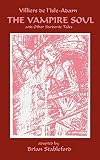
Auguste Villiers de L’lsle-Adam (1838-1889), eccentric French literary figure par excellence, created dozens of innovative tales and novels, but none more innovative, more peculiar than his novella The Vampire Soul (Claire Lenoir). Published by Black Coat Press and adopted by Brian Stableford, this collection includes several other short tales, but for the purpose of review, I will focus on the novella, the weirdest of the weird. And, fortunately, to better enable a reader to appreciate show more the novella’s various dimensions, included is Brian Stableford's most informative fifteen page introduction as well as his extensive notes on the text.
Doctor Tribulat Bonhomet is the novella’s first-person narrator and a less reliable narrator is not to be found in all of literature. Bonhomet portrays himself as a brilliant, witty, dapper, highly refined and cultured man-of-the-world; in fact, he is exactly the opposite: insensitive, dim-witted, rude, coarse, smug, bourgeois, buffoonish. Since Villiers viewed most French readers of serialized stories published in the newspapers of the day as having similar traits as Bonhomet, he was hoping his novella (scheduled to be printed in installments) would initially draw readers into the story and then drive some readers mad and perhaps even send a few to the lunatic asylum. Brian Stableford's introduction notes how two leading French authors, Paul Verlaine and Remy de Gourmont, judged rightly when they observed that nothing like The Vampire Soul (Claire Lenoir) had ever been written in the entire ninteenth century and that Villiers’ novella remains a bizarre literary landmark.
In Chapter One Bonhomet describes his own physical characteristics in serious, excruciating detail that are laugh aloud hilarious for us as readers. Here is our puffed-up narrator describing one of his prominent features: “My nose is considerable in dimension – large, even. . . . The nose, you see, is the expression of the human capacity for reason; it is the organ that goes before, which enlightens, which proclaims one’s presence, which scents trouble and which points the way.” And then, “My voice is sometimes shrill and sometimes (especially when I speak to women) rich and profound – and it can go from one to the other seamlessly, as I please.” This quote provides us with our first glimpse of Bonhomet’s views on women: totally condescending and misogynist in the extreme, reminiscent of Arthur Schopenhauer, but in Bonhomet case, he has no more brains or capacity for philosophy than Mr. Bumble.
A good portion of the story takes place before, during and after dinner, at the home of Bonhomet’s best friends, Cesaire and Clair Lenoir. Much conversation transpires; many opinions are shared, including opinions on music and poetry, the nature of the mind and reality, the existence of God, the existence of soul and spirits along with a number of recent studies in the fields of medicine and natural science. One of my favorite parts is when Bonhomet reflects on Edgar Allan Poe. “Did I mention the American? That one appeared to me to be a hearty fellow with a nice line in colorful rhetoric. But one thing that struck me was the way he labeled his works. He called them, rather conceitedly, Unparalleled Stories or Extraordinary Tales or some such. I have read all these stories and have tried in vain to see anything extraordinary in what he relates. It is, in fact, the last word in banality-presented, it is true, in a bourgeois manner, but banal nevertheless. It sent me off to sleep many a time, in a delightful way. I can only conclude that the title was chosen by the editor to pique the curiosity of vulgar readers.”
Clair Lenoir has a keen sense of the supernatural in its many manifestations. For example, as she explains to Bonhonet, “”There are other beings,” she continued, softly, “who know the roads of life and are curious about the paths of death. Those, who must submit to the realm of the Spirit, disdain the years in order to possess Eternity. In the depths of their sacred eyes, they are alert to a gleam more precious than a million tangible solar systems like ours, from our equator to that of Neptune.” As we read on, the reality of other beings, savage and demonic, frightful and possessive, take center stage in the tale, a provocative twist in light of Bonhomet’s disdain and dismissal of Edgar Allan Poe.
And here is Bonhomet describing Clair’s husband, Cesaire. “He was a haunter of solitary places, a man of dark theories and a vindictive temperament. Something rudimentary had gone astray in his fundamental nature. He pretended, laughing under his South Sea Islander’s nose, that he had something in him of the hairy vampire. He was excessively fond of making jokes about cannibalism. It all seemed to be submerged within bourgeois innocence, but wherever he was carried away by his favorite themes – the form that the nervous fluid of a dead person might take; the physical and temporal power of the spirits of the dead over the living – his eyes burned with the flames of superstition.” And as the evening’s conversation progresses, Cesaire's views take on a progressively darker cast.
If all this sounds like an odd combination of philosophy, science, paranormal phenomenon and occult speculation, you are correct. And to add yet another twist, in the course of the evening’s conversation, as we listen to each of the three exchange feelings and opinions and passions, it becomes increasingly probable we are dealing with three unreliable narrators. I will stop here so as not to spoil the novella’s unexpected twists and turns right up to its shocking conclusion. Chances are, reading Villiers’ tale will not send you to the lunatic asylum; however, it might drive you a little mad, but in a good way. show less

Thomas Edison as wizard-scientist does a Pygmalion and fashions, in excruciating loving technical detail, an android for a love-lorn, suicidal romantic British aristocrat. Gothic, subtly repellent, and chock-full of manly cogitation, it introduced the the very word "android" to the world. It is, and for good reason, reproduced in full in the anthology The Decadent Reader: Fiction, Fantasy, and Perversion From Fin-De-Siecle France, edited by Asi Hustvedt. Virulently misogynistic, her analysis show more of Maj. Motoko's several-times great-grandma should be read by every incel. (And it's an easier read than Frankenstein.) show less
Auguste Villiers de L’lsle-Adam (1838-1889), eccentric French literary figure par excellence, created dozens of innovative tales and novels, but none more innovative, more peculiar than his novella The Vampire Soul (Claire Lenoir). Published by Black Coat Press and adopted by Brian Stableford, this collection includes several other short tales, but for the purpose of review, I will focus on the novella, the weirdest of the weird. And, fortunately, to better enable a reader to appreciate show more the novella’s various dimensions, included is Brian Stableford's most informative fifteen page introduction as well as his extensive notes on the text.
Doctor Tribulat Bonhomet is the novella’s first-person narrator and a less reliable narrator is not to be found in all of literature. Bonhomet portrays himself as a brilliant, witty, dapper, highly refined and cultured man-of-the-world; in fact, he is exactly the opposite: insensitive, dim-witted, rude, coarse, smug, bourgeois, buffoonish. Since Villiers viewed most French readers of serialized stories published in the newspapers of the day as having similar traits as Bonhomet, he was hoping his novella (scheduled to be printed in installments) would initially draw readers into the story and then drive some readers mad and perhaps even send a few to the lunatic asylum. Brian Stableford's introduction notes how two leading French authors, Paul Verlaine and Remy de Gourmont, judged rightly when they observed that nothing like The Vampire Soul (Claire Lenoir) had ever been written in the entire ninteenth century and that Villiers’ novella remains a bizarre literary landmark.
In Chapter One Bonhomet describes his own physical characteristics in serious, excruciating detail that are laugh aloud hilarious for us as readers. Here is our puffed-up narrator describing one of his prominent features: “My nose is considerable in dimension – large, even. . . . The nose, you see, is the expression of the human capacity for reason; it is the organ that goes before, which enlightens, which proclaims one’s presence, which scents trouble and which points the way.” And then, “My voice is sometimes shrill and sometimes (especially when I speak to women) rich and profound – and it can go from one to the other seamlessly, as I please.” This quote provides us with our first glimpse of Bonhomet’s views on women: totally condescending and misogynist in the extreme, reminiscent of Arthur Schopenhauer, but in Bonhomet case, he has no more brains or capacity for philosophy than Mr. Bumble.
A good portion of the story takes place before, during and after dinner, at the home of Bonhomet’s best friends, Cesaire and Clair Lenoir. Much conversation transpires; many opinions are shared, including opinions on music and poetry, the nature of the mind and reality, the existence of God, the existence of soul and spirits along with a number of recent studies in the fields of medicine and natural science. One of my favorite parts is when Bonhomet reflects on Edgar Allan Poe. “Did I mention the American? That one appeared to me to be a hearty fellow with a nice line in colorful rhetoric. But one thing that struck me was the way he labeled his works. He called them, rather conceitedly, Unparalleled Stories or Extraordinary Tales or some such. I have read all these stories and have tried in vain to see anything extraordinary in what he relates. It is, in fact, the last word in banality-presented, it is true, in a bourgeois manner, but banal nevertheless. It sent me off to sleep many a time, in a delightful way. I can only conclude that the title was chosen by the editor to pique the curiosity of vulgar readers.”
Clair Lenoir has a keen sense of the supernatural in its many manifestations. For example, as she explains to Bonhonet, “”There are other beings,” she continued, softly, “who know the roads of life and are curious about the paths of death. Those, who must submit to the realm of the Spirit, disdain the years in order to possess Eternity. In the depths of their sacred eyes, they are alert to a gleam more precious than a million tangible solar systems like ours, from our equator to that of Neptune.” As we read on, the reality of other beings, savage and demonic, frightful and possessive, take center stage in the tale, a provocative twist in light of Bonhomet’s disdain and dismissal of Edgar Allan Poe.
And here is Bonhomet describing Clair’s husband, Cesaire. “He was a haunter of solitary places, a man of dark theories and a vindictive temperament. Something rudimentary had gone astray in his fundamental nature. He pretended, laughing under his South Sea Islander’s nose, that he had something in him of the hairy vampire. He was excessively fond of making jokes about cannibalism. It all seemed to be submerged within bourgeois innocence, but wherever he was carried away by his favorite themes – the form that the nervous fluid of a dead person might take; the physical and temporal power of the spirits of the dead over the living – his eyes burned with the flames of superstition.” And as the evening’s conversation progresses, Cesaire's views take on a progressively darker cast.
If all this sounds like an odd combination of philosophy, science, paranormal phenomenon and occult speculation, you are correct. And to add yet another twist, in the course of the evening’s conversation, as we listen to each of the three exchange feelings and opinions and passions, it becomes increasingly probable we are dealing with three unreliable narrators. I will stop here so as not to spoil the novella’s unexpected twists and turns right up to its shocking conclusion. Chances are, reading Villiers’ tale will not send you to the lunatic asylum; however, it might drive you a little mad, but in a good way. show less

The proto-decadent short novel Isis was the first published prose composition of Auguste de Villiers de l'Isle Adam, and has only recently been translated to English by Brian Stableford. Although the author's dedication claims that the title "is the collective formula of a series of philosophical novels" projected to be written, none further followed, and "Isis" clearly alludes to the principal character Marchesa Tullia Fabriana.
It is noteworthy the extent to which this nineteenth-century show more work (set in the late eighteenth) anticipates and rehearses the tropes of the eventual modern superhero formula. Tullia is preternaturally learned, mystically initiated, and a superlative swordswoman. She has a trusty assistant/protege (recruited from orphaned destitution) and a secretly splendid headquarters. She routinely journeys out at the dead of night to aid the afflicted and heal the sick, under the anonymizing cover of a mask and specially-designed armor.
Unlike later crime-fighting capes tales, this book seems mostly unconcerned with plot, or at least fails to advance one very far. Short as it is, it indulges in some fine architectural description, anatomies of altered states of consciousness, and philosophical digressions. The style is reasonably abstruse, and its matter should be welcomed by those readers willing to tackle and appreciate classics of occult fiction such as Zanoni and Seraphita.
In the traditional Rosicrucian grade system, Tullia seems to be a rather accomplished Exempt Adept, perhaps a Babe of the Abyss. Her advancement to the grade of Master of the Temple in these terms would then be bound up with her encounter of the main viewpoint character Count Strally, a promising young man of parts who seems ready to accept her guidance. show less
It is noteworthy the extent to which this nineteenth-century show more work (set in the late eighteenth) anticipates and rehearses the tropes of the eventual modern superhero formula. Tullia is preternaturally learned, mystically initiated, and a superlative swordswoman. She has a trusty assistant/protege (recruited from orphaned destitution) and a secretly splendid headquarters. She routinely journeys out at the dead of night to aid the afflicted and heal the sick, under the anonymizing cover of a mask and specially-designed armor.
Unlike later crime-fighting capes tales, this book seems mostly unconcerned with plot, or at least fails to advance one very far. Short as it is, it indulges in some fine architectural description, anatomies of altered states of consciousness, and philosophical digressions. The style is reasonably abstruse, and its matter should be welcomed by those readers willing to tackle and appreciate classics of occult fiction such as Zanoni and Seraphita.
In the traditional Rosicrucian grade system, Tullia seems to be a rather accomplished Exempt Adept, perhaps a Babe of the Abyss. Her advancement to the grade of Master of the Temple in these terms would then be bound up with her encounter of the main viewpoint character Count Strally, a promising young man of parts who seems ready to accept her guidance. show less
Lists
Romans (1)
Awards

You May Also Like


Associated Authors
Statistics
- Works
- 130
- Also by
- 54
- Members
- 1,260
- Popularity
- #20,361
- Rating
- 4.0
- Reviews
- 23
- ISBNs
- 160
- Languages
- 8
- Favorited
- 11