
Damien Broderick (1944–2025)
Author of The Spike: How Our Lives Are Being Transformed By Rapidly Advancing Technologies
About the Author
Damien Broderick is an Australian writer, editor and critical theorist who lives in San Antonio, Texas.
Image credit: Barbara Lamar
Series
Works by Damien Broderick
The Spike: How Our Lives Are Being Transformed By Rapidly Advancing Technologies (1997) 145 copies, 2 reviews
Outside the Gates of Science: Why It's Time for the Paranormal to Come in from the Cold (2007) 32 copies
The Last Mortal Generation: How Science Will Alter Our Lives in the 21st Century (1999) 25 copies, 1 review
Intelligence Unbound: The Future of Uploaded and Machine Minds (2014) — Editor — 24 copies, 1 review
The Time Machine Hypothesis: Extreme Science Meets Science Fiction (Science and Fiction) (2019) 7 copies
A Passage in Earth 3 copies
Flowers of Asphodel [short fiction] 2 copies
Warriors of the Tao: The Best of Science Fiction: A Review of Speculative Literature (2011) 2 copies
Thy Sting 2 copies
Dead Air 2 copies
Tao Zero 1 copy
Yggdrasil Station 1 copy
The Interior 1 copy
Quicken (Novella) 1 copy
Drowning in Fire 1 copy
The Final Weapon 1 copy
A Question of Conscience 1 copy
I Remember Man 1 copy
Darkness Changeling 1 copy
Every Little Star 1 copy
There was a Star 1 copy
Resurrection 1 copy
The Drover's Wife's Dog 1 copy
The Writeable Text 1 copy
Little Tin God 1 copy
Children of Tantalus 1 copy
Billenium 1 copy
The Disposal Man 1 copy
various 1 copy
Reading SF as a Mega-Text 1 copy
The Howling Sky 1 copy
The Sea's Nearest Shore 1 copy
Schrodinger's Catch 1 copy
Requiem in Heaven 1 copy
Do unto Others 1 copy
Associated Works
The Year's Best Science Fiction: Fourteenth Annual Collection (1997) — Contributor — 444 copies, 2 reviews
The Year's Best Science Fiction: Twenty-Eighth Annual Collection (2011) — Contributor — 328 copies, 3 reviews
The Year's Best Science Fiction: Twenty-Seventh Annual Collection (2010) — Contributor — 323 copies, 6 reviews
The Year's Best Science Fiction: Twenty-Ninth Annual Collection (2012) — Contributor — 276 copies, 5 reviews
The Year's Best Science Fiction: Thirty-First Annual Collection (2014) — Contributor — 204 copies, 3 reviews
The Best Science Fiction and Fantasy of the Year, Volume 5 (2011) — Contributor — 166 copies, 4 reviews
The Best Science Fiction and Fantasy of the Year, Volume 4 (2010) — Contributor — 143 copies, 2 reviews
Asimov's Science Fiction: Vol. 33, No. 10 & 11 [October/November 2009] (2009) — Contributor — 13 copies, 2 reviews
The Magazine of Fantasy and Science Fiction December 1982, Vol. 63, No. 6 (1982) — Contributor — 10 copies
To the Stars—and Beyond: The Second Borgo Press Book of Science Fiction Stories (2011) — Contributor — 1 copy
Tagged
Common Knowledge
- Legal name
- Broderick, Damien Francis
- Other names
- Jenkins, Philip
- Birthdate
- 1944-04-22
- Date of death
- 2025-04-19
- Gender
- male
- Education
- Deakin University (PhD - Literary Studies)
Monash University (BA - English) - Occupations
- journalist
research associate
science fiction writer
science writer - Organizations
- University of Melbourne (research associate)
- Awards and honors
- IAFA Distinguished Scholarship (2005)
A. Bertram Chandler Memorial Award (2010) - Relationships
- Lamar, Barbara (widow)
- Nationality
- Australia
- Birthplace
- Melbourne, Victoria, Australia
- Places of residence
- San Antonio, Texas, USA
Portugal - Place of death
- Castelo Branco, Portugal
Members
Discussions
Very Daintily in Good Show Sir! — bad science fiction and fantasy covers (June 2025)
Reviews

In an unspecified hi-tech future, a young woman and a friend decides to try train-surfing supersonic underground maglev bullet trains. Disaster follows; and into this, she drags a youth from a protected community of those who have chosen faith over technology, and regard any outside influences as being of the Devil.
The woman, Amanda, is in her late twenties; but the society she lives in has tweaked biology so that adolescence is extended up to the age of thirty; puberty occurs on a similar show more timescale.
The conflict and unexpected interactions between two vastly different, and diametrically opposed, societies is presented front and centre as the core of this novel; and indeed, if you were not careful reading it, you might imagine you were in YA territory here.
But that is just window dressing. There is a lot more going on in this novel that the young protagonists - Amanda in the Outside, and Mathewmark in the Valley of the God of Your Choice - have no inkling of. Much of this is brought to us through the eyes of Magistrate Mohammed Abdel-Malik, a resurrectee from the late 20th Century who deals with the disciplining of Amanda after her prank goes horribly wrong.
I shall say no more about the events of the novel: suffice it to say that what you see is only a part of what is going on. Damian Broderick makes what could be a fairly superficial story about coming of age in the future into something much bigger.
Characterisation is good; the mall-rat Amanda, her friend Vikram and the country bumpkin Mathewmark (he has a brother called Lukenjon) are well-drawn. The society of the Valley is also well described. It is inhabited by a series of characters with a surprising range of viewpoints. The key thing about the Valley is that any and all belief systems are tolerated there - all that is required is that you have chosen faith - any faith - over technology. So evangelical Christians live cheek by jowl - and in apparent harmony - with Buddhists, Wiccans and even a Communist, although Moslems seem rather thin on the ground. That the other major protagonist, the afore-mentioned Mohammed Abdel-Malik, presents to us as a Moslem was the one area of the book I had problems with. He first appears in our time (the book was written in 2002 and the earliest section of it, dealing with Abdel-Malik, is set in 2004) meeting his death at the hands of a street gang; but he is attacked because he is rich, not because he is a Moslem. He actually is portrayed as a secular Moslem, which is not unheard of, but fairly uncommon. The only Islamic thing about the character throughout the rest of the book (after his resurrection, of course) is his name. I found this unconvincing.
But ultimately, the book isn't about the characters; their stories are merely the vehicle for the heavy-duty speculation going on under the surface. Things are not quite what they seem in the Valley; there are talking animals and hybrid plants, and the Under-Godders seem quite relaxed about those things. I began to get a sense as to what was going on about two-thirds of the way through. Like the other Broderick novel I've recently read (The Sea's Furthest End), a seemingly straightforward story hides a lot more going on. show less
The woman, Amanda, is in her late twenties; but the society she lives in has tweaked biology so that adolescence is extended up to the age of thirty; puberty occurs on a similar show more timescale.
The conflict and unexpected interactions between two vastly different, and diametrically opposed, societies is presented front and centre as the core of this novel; and indeed, if you were not careful reading it, you might imagine you were in YA territory here.
But that is just window dressing. There is a lot more going on in this novel that the young protagonists - Amanda in the Outside, and Mathewmark in the Valley of the God of Your Choice - have no inkling of. Much of this is brought to us through the eyes of Magistrate Mohammed Abdel-Malik, a resurrectee from the late 20th Century who deals with the disciplining of Amanda after her prank goes horribly wrong.
I shall say no more about the events of the novel: suffice it to say that what you see is only a part of what is going on. Damian Broderick makes what could be a fairly superficial story about coming of age in the future into something much bigger.
Characterisation is good; the mall-rat Amanda, her friend Vikram and the country bumpkin Mathewmark (he has a brother called Lukenjon) are well-drawn. The society of the Valley is also well described. It is inhabited by a series of characters with a surprising range of viewpoints. The key thing about the Valley is that any and all belief systems are tolerated there - all that is required is that you have chosen faith - any faith - over technology. So evangelical Christians live cheek by jowl - and in apparent harmony - with Buddhists, Wiccans and even a Communist, although Moslems seem rather thin on the ground. That the other major protagonist, the afore-mentioned Mohammed Abdel-Malik, presents to us as a Moslem was the one area of the book I had problems with. He first appears in our time (the book was written in 2002 and the earliest section of it, dealing with Abdel-Malik, is set in 2004) meeting his death at the hands of a street gang; but he is attacked because he is rich, not because he is a Moslem. He actually is portrayed as a secular Moslem, which is not unheard of, but fairly uncommon. The only Islamic thing about the character throughout the rest of the book (after his resurrection, of course) is his name. I found this unconvincing.
But ultimately, the book isn't about the characters; their stories are merely the vehicle for the heavy-duty speculation going on under the surface. Things are not quite what they seem in the Valley; there are talking animals and hybrid plants, and the Under-Godders seem quite relaxed about those things. I began to get a sense as to what was going on about two-thirds of the way through. Like the other Broderick novel I've recently read (The Sea's Furthest End), a seemingly straightforward story hides a lot more going on. show less

In a distant future galactic empire, the heir apparent struggles against his father to prevent planetary genocide. All this is watched by an alien race of great wisdom from their place inside the singularity at the galactic core. Meanwhile, in present-day Australia, a teenaged boy has his own struggles with a different race of aliens, known to him as 'girls'. But his tech genius older brother has read Cyrano de Bergerac, and has a solution for him...
Surprisingly, all this does fit together. show more The only jarring note is the technobabble in the 'present-day' segments, which has not aged well, although readers may be surprised to see a modern AI in play. We have forgotten that AI is nothing new - I recollect friends in IT talking about expert systems back in the 1980s - and the current obsession with artificial intelligence has only happened because it has become sufficiently widespread to be available to anyone with a connected computer, instead of only being runnable on a major mainframe that you had to have a hard connection to, as here.
Otherwise, we have here an effective and well-told story that takes the reader to unexpected places. Apart from the outdated technobabble, there is some Martian mysticism that has been generally debunked since 1993, which is when this novel was written, but I didn't find this off-putting. The galactic empire segments show us a far future society based on Hindu culture, which makes a change. For me as a UK reader, perhaps equally alien is the Australian setting for the "present day" segments, especially when the p.o.v. character speaks of "the end of the summer holidays" as being in February.
Damian Broderick's bibliographer, Russell Blackford, points out that this novel started out as a short story written as early as 1964, which probably accounts for the appearance of an MGA sports car, which would have been a snazzy set of wheels then but even by 1993 would have been a classic, which just adds to the atmosphere reading this in 2025. Blackford also points out that this was marketed as a young adult novel, although the jacket gives no suggestion of that, and indeed only the age of the teen protagonist hints at that. Certainly the narrative makes few concessions to a YA audience.
I picked this off the shelf to read following Damian Broderick's death earlier this year. Broderick's work got published in the USA but he never had a UK publisher, which on the strength of this book is a shame. The text is quite short - 192 pages - and there is a lot crammed into this space (the galactic empire isn't the limit of the book's scope). That Broderick got so much into a short space is commendable; other writers might have been tempted to empty this story out into a doorstop-sized work of twice or three times the length. Yet there is enough detail in here to carry the story forward without unnecessary bloating. This demonstrates Damian Broderick's command of his craft. It makes it all the more regrettable that his work isn't better known. show less
Surprisingly, all this does fit together. show more The only jarring note is the technobabble in the 'present-day' segments, which has not aged well, although readers may be surprised to see a modern AI in play. We have forgotten that AI is nothing new - I recollect friends in IT talking about expert systems back in the 1980s - and the current obsession with artificial intelligence has only happened because it has become sufficiently widespread to be available to anyone with a connected computer, instead of only being runnable on a major mainframe that you had to have a hard connection to, as here.
Otherwise, we have here an effective and well-told story that takes the reader to unexpected places. Apart from the outdated technobabble, there is some Martian mysticism that has been generally debunked since 1993, which is when this novel was written, but I didn't find this off-putting. The galactic empire segments show us a far future society based on Hindu culture, which makes a change. For me as a UK reader, perhaps equally alien is the Australian setting for the "present day" segments, especially when the p.o.v. character speaks of "the end of the summer holidays" as being in February.
Damian Broderick's bibliographer, Russell Blackford, points out that this novel started out as a short story written as early as 1964, which probably accounts for the appearance of an MGA sports car, which would have been a snazzy set of wheels then but even by 1993 would have been a classic, which just adds to the atmosphere reading this in 2025. Blackford also points out that this was marketed as a young adult novel, although the jacket gives no suggestion of that, and indeed only the age of the teen protagonist hints at that. Certainly the narrative makes few concessions to a YA audience.
I picked this off the shelf to read following Damian Broderick's death earlier this year. Broderick's work got published in the USA but he never had a UK publisher, which on the strength of this book is a shame. The text is quite short - 192 pages - and there is a lot crammed into this space (the galactic empire isn't the limit of the book's scope). That Broderick got so much into a short space is commendable; other writers might have been tempted to empty this story out into a doorstop-sized work of twice or three times the length. Yet there is enough detail in here to carry the story forward without unnecessary bloating. This demonstrates Damian Broderick's command of his craft. It makes it all the more regrettable that his work isn't better known. show less
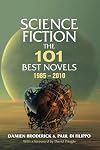
Inevitably idiosyncratic as all such lists are, Broderick & Di Filippo at the very least like their science fiction in the sweeping cosmic tradition of Olaf Stapledon, they like it Trans-Human, and they like to invoke the term "fantastika" a lot. According to John Clute (who admittedly ought to know), "...fantastika designates science fiction and all the other literatures that SF shares significant characteristics with..." This allows for the annexation of novels by Philip Roth, Kazuo show more Ishiguro and Cormac McCarthy to the canon in question.
What's interesting to me are some of the authors whom Broderick and Di Filippo don't seem to have a lot of love for; no David Brin, no Dan Simmons, no Mary Gentle, no James Morrow and no George Alec Effinger (just to note a few). Perhaps their visions just aren't radical or literary enough for the authors, or perhaps it was thought that they're sufficiently well known that they needed no additional attention, but that begs the question of how the likes of George Zebrowski, David Marusek and Jamil Nasir were included; let's say that I'd like to see the list of the twenty-five or so novels that didn't make the cut. Which is another way of saying that if you're throwing around the word the "best" as a description I'm likely to respond with a rhetorical "oh really?" An index would have been nice too.
After writing these thoughts I learned that Broderick (in particular) is a partisan of the concept of "transrealism," which tends to privilege subjective perception over naturalistic realism; this brings at least some of the choices into focus, and clarifies why books coming out of a more traditional brand of American SF tended not to make the cut. Again, the authors can make any list they like, but they're still obligated to make their editorial strategies clear if they're going to play the game right. show less
What's interesting to me are some of the authors whom Broderick and Di Filippo don't seem to have a lot of love for; no David Brin, no Dan Simmons, no Mary Gentle, no James Morrow and no George Alec Effinger (just to note a few). Perhaps their visions just aren't radical or literary enough for the authors, or perhaps it was thought that they're sufficiently well known that they needed no additional attention, but that begs the question of how the likes of George Zebrowski, David Marusek and Jamil Nasir were included; let's say that I'd like to see the list of the twenty-five or so novels that didn't make the cut. Which is another way of saying that if you're throwing around the word the "best" as a description I'm likely to respond with a rhetorical "oh really?" An index would have been nice too.
After writing these thoughts I learned that Broderick (in particular) is a partisan of the concept of "transrealism," which tends to privilege subjective perception over naturalistic realism; this brings at least some of the choices into focus, and clarifies why books coming out of a more traditional brand of American SF tended not to make the cut. Again, the authors can make any list they like, but they're still obligated to make their editorial strategies clear if they're going to play the game right. show less
My reaction to reading this novel in 1998. Spoilers follow.
This novel was a pleasure to read.
I originally read it because I saw a review comparing it to Alfred Bester’s The Stars My Destination. Broderick, in his afterword, acknowledges an “immense debt” to Bester; however, the resemblance is not as strong as I hoped. Broderick, like Charles Sheffield in his Bester inspired The Mind Pool, seems to associate aristocratic societies with Bester though I can’t recall either Bester’s show more The Demolished Man or The Stars My Destination featuring such a society. However, Broderick, even if he lacks the flair of Bester’s read aloud language (his prose is denser and definitely not as witty), captures the baroqueness of Bester’s worlds. I liked the cyborg chicken and cyborg dog spaceship pilots, the group of humans nostalgic for the “lost satisfactions of rote labor”, the asteroid Genetics with their feathers and tiger stripes (the latter perhaps a reference to Gully Foyle in The Stars My Destination). There seems to also be a hint of the Freudian motives Bester was so fond of in Telmah’s (and it took me almost 200 pages to discover that was Hamlet backwards) seemingly incestuous attraction for his mother.
Broderick also freely admits to rifling many sf ideas from others. Ratio, his robot, is inspired by C. L. Moore’s “No Woman Born” (I don’t see much of a final similarity). The marvelous space fountain that gets Rato and Telmah off Earth is from Dr. Robert Forward’s non-fiction Future Magic. Broderick’s “nonexclusive gender particles” are original but similar to some creations of fellow Australian Greg Egan. Lord Brass seems to be reminiscent of the obscene Baron Harkonnen of Frank Herbert’s Dune. The background of the story with personalized virtual realities everywhere (and I really liked everyone having personalized musical accompaniment), the vast Gestell (a sort of computer overmind – benevolent – you can access for knowledge), the asteroids heroically working for centuries to bring the metric defect to Earth only to be left as a useless, backwater, overcompensating society I liked.
The basic plot is explicitly taken from Shakespeare’s Hamlet. The secret (and this is another similarity to Bester since he used Alexander Dumas’ The Count of Monte Cristo as the plot template for The Stars My Destination) of using classic literary plots in sf is not following them too closely and adopting when necessary. Broderick does a good job in using the plot of the most famous of all Jacobean revenge dramas. He does the complete setup with murder (though that turns out to not be what it seems play), dead father’s call for vengeance, “incestuous” marriage, and seeming insanity. He does this with clever rationalizations.
The asteroid societies believe in reincarnation and try to preserve the souls in soulbanks. It is at a soulbank (rather than Hamlet’s Elsinore) that Telmah’s father possesses him and gives him poltergeist powers (later this seems to be explained as a peculiar trait of Telmah’s family to use the “metric defect”) – Telmah, unlike Hamlet, is fully committed to vengeance later on. Telmah stages a Mousetrap-like play. However, Broderick deviates significantly from Hamlet where his Ophelia – stand-in, the Warrior Rose (definitely not meek and insane), murders Feng, the Claudius figure. The plot goes off to detail the union of Telmah and the Warrior Rose and the timehopping, space altering abilities of their offspring. Psyche’s politics are dealt with too.
Broderick goes off on some interesting philosophical tangents that don’t integrate that well with the plot of his self-described “neo pulp ficto-critical novel”. One section (which is partly presented in typography reminiscent of the telepaths' conversation in Bester The Demolished Man) seems to be based on the literary theories of Harold Bloom. Essentially, it’s a description of the stages of man’s life (Shakespeare gave us a different version in As You Like It) and the life of a civilization. I suppose it’s relevance to the novel is the course of Telmah’s life. Another, more interesting, section was the philosophy of the fictional (I think) Daimon Keith. He talks about the ingrained human need for narrative (and that certain narratives, called archetypes, may have been selected in the human brain structure via evolution) and that science, myth, and religion are attempts to impose a narrative on the universe. I don’t think this novel works as an integrated structure, but it was an entertaining read, a fun reworking of a classic drama (I liked this version better but then I don’t think Hamlet works), and sometimes philosophically thoughtful. This is my first Broderick, and I’d be interested in reading more. show less
This novel was a pleasure to read.
I originally read it because I saw a review comparing it to Alfred Bester’s The Stars My Destination. Broderick, in his afterword, acknowledges an “immense debt” to Bester; however, the resemblance is not as strong as I hoped. Broderick, like Charles Sheffield in his Bester inspired The Mind Pool, seems to associate aristocratic societies with Bester though I can’t recall either Bester’s show more The Demolished Man or The Stars My Destination featuring such a society. However, Broderick, even if he lacks the flair of Bester’s read aloud language (his prose is denser and definitely not as witty), captures the baroqueness of Bester’s worlds. I liked the cyborg chicken and cyborg dog spaceship pilots, the group of humans nostalgic for the “lost satisfactions of rote labor”, the asteroid Genetics with their feathers and tiger stripes (the latter perhaps a reference to Gully Foyle in The Stars My Destination). There seems to also be a hint of the Freudian motives Bester was so fond of in Telmah’s (and it took me almost 200 pages to discover that was Hamlet backwards) seemingly incestuous attraction for his mother.
Broderick also freely admits to rifling many sf ideas from others. Ratio, his robot, is inspired by C. L. Moore’s “No Woman Born” (I don’t see much of a final similarity). The marvelous space fountain that gets Rato and Telmah off Earth is from Dr. Robert Forward’s non-fiction Future Magic. Broderick’s “nonexclusive gender particles” are original but similar to some creations of fellow Australian Greg Egan. Lord Brass seems to be reminiscent of the obscene Baron Harkonnen of Frank Herbert’s Dune. The background of the story with personalized virtual realities everywhere (and I really liked everyone having personalized musical accompaniment), the vast Gestell (a sort of computer overmind – benevolent – you can access for knowledge), the asteroids heroically working for centuries to bring the metric defect to Earth only to be left as a useless, backwater, overcompensating society I liked.
The basic plot is explicitly taken from Shakespeare’s Hamlet. The secret (and this is another similarity to Bester since he used Alexander Dumas’ The Count of Monte Cristo as the plot template for The Stars My Destination) of using classic literary plots in sf is not following them too closely and adopting when necessary. Broderick does a good job in using the plot of the most famous of all Jacobean revenge dramas. He does the complete setup with murder (though that turns out to not be what it seems play), dead father’s call for vengeance, “incestuous” marriage, and seeming insanity. He does this with clever rationalizations.
The asteroid societies believe in reincarnation and try to preserve the souls in soulbanks. It is at a soulbank (rather than Hamlet’s Elsinore) that Telmah’s father possesses him and gives him poltergeist powers (later this seems to be explained as a peculiar trait of Telmah’s family to use the “metric defect”) – Telmah, unlike Hamlet, is fully committed to vengeance later on. Telmah stages a Mousetrap-like play. However, Broderick deviates significantly from Hamlet where his Ophelia – stand-in, the Warrior Rose (definitely not meek and insane), murders Feng, the Claudius figure. The plot goes off to detail the union of Telmah and the Warrior Rose and the timehopping, space altering abilities of their offspring. Psyche’s politics are dealt with too.
Broderick goes off on some interesting philosophical tangents that don’t integrate that well with the plot of his self-described “neo pulp ficto-critical novel”. One section (which is partly presented in typography reminiscent of the telepaths' conversation in Bester The Demolished Man) seems to be based on the literary theories of Harold Bloom. Essentially, it’s a description of the stages of man’s life (Shakespeare gave us a different version in As You Like It) and the life of a civilization. I suppose it’s relevance to the novel is the course of Telmah’s life. Another, more interesting, section was the philosophy of the fictional (I think) Daimon Keith. He talks about the ingrained human need for narrative (and that certain narratives, called archetypes, may have been selected in the human brain structure via evolution) and that science, myth, and religion are attempts to impose a narrative on the universe. I don’t think this novel works as an integrated structure, but it was an entertaining read, a fun reworking of a classic drama (I liked this version better but then I don’t think Hamlet works), and sometimes philosophically thoughtful. This is my first Broderick, and I’d be interested in reading more. show less
Lists
Awards


You May Also Like


Associated Authors
Statistics
- Works
- 111
- Also by
- 39
- Members
- 1,557
- Popularity
- #16,553
- Rating
- 3.5
- Reviews
- 41
- ISBNs
- 121
- Languages
- 6
- Favorited
- 3