
Walter Abish (1931–2022)
Author of How German Is It
About the Author
Walter Abish was born in Vienna, Austria. Much of his childhood was spent in China. He became an American citizen in 1960. Abish's fascination with human communication led him to write works focused on the use of language. His first novel, Alphabetical Africa (1974), was an experiment in show more alliteration, moving forward and backward through the alphabet while telling the story. Throughout the 1970s, he wrote short stories that demonstrated a variety of unique writing formats. His second novel, How German Is It (1980), a more conventionally written book, received the 1981 PEN/Faulkner award, an honor bestowed by his peers. In Eclipse Fever (1993), Abish continues to play with language, this time within the context of a suspense story about Mexico's social and intellectual elite. Abish lives in New York where he is a lecturer in English and Comparative Literature at Columbia University. (Bowker Author Biography) show less
Image credit: Joyce Ravid
Works by Walter Abish
Renegade #1 1 copy
Associated Works
Antaeus No. 64/65, Spring/Autumn 1990 - Twentieth Anniversary Issue (1990) — Contributor — 14 copies
Personal Injury Magazine, no. 4 — Contributor — 1 copy
Tagged
Common Knowledge
- Canonical name
- Abish, Walter
- Birthdate
- 1931-12-24
- Date of death
- 2022-05-28
- Gender
- male
- Occupations
- author
lecturer
Holocaust survivor
novelist
short story writer
librarian (show all 7)
memoirist - Organizations
- International PEN
- Awards and honors
- Guggenheim Fellowship
MacArthur Fellowship (1987)
American Academy of Arts and Sciences (fellow, 1998) - Short biography
- Walter Abish was born to a prosperous Jewish family in Vienna, Austria. His parents were Friedl and Adolph Abish, a perfumer. After Nazi Germany's Anschluss (annexation) of Austria, they fled the country, traveling first to Nice, France, before taking a ship to Shanghai, China. They lived there in a Jewish ghetto from 1940 to 1948. In 1948, they moved to Israel, where Abish served in the army and then worked in the American Library. In 1957, the family emigrated to the USA. He was in his 40s when he published his debut novel, Alphabetical Africa, in 1974. It was the first of his experimental fiction works, and was quickly followed by his first collection of short stories, Minds Meet (1975). His second novel, How German Is It?/Wie Deutsch ist es? (1980), is his most celebrated work and won the PEN/Faulkner Award for Fiction in 1981. Abish received a fellowship from the National Endowment for the Arts in 1979, a Guggenheim Fellowship in 1981, and a MacArthur Fellowship in 1987. In his career, Abish published three novels, three collections of short stories, a volume of poems, and a memoir, Double Vision (2004). He also worked and taught at Empire State College, Wheaton College, the University at Buffalo, The State University of New York, Columbia University, Brown University, Yale University, and Cooper Union. He sat on the contributing editorial board of the literary journal Conjunctions, and served on the board of International PEN from 1982 to 1988. He was on the Board of Governors for the New York Foundation for the Arts. Abish was elected a Fellow of the American Academy of Arts and Sciences in 1998. He married Cecile Gelb, a photographer and sculptor, in Tel Aviv in 1953.
- Nationality
- Austria
USA - Birthplace
- Vienna, Austria
- Places of residence
- Vienna, Austria
Nice, France
Shanghai, China
Israel
New York, New York, USA - Place of death
- New York, New York, USA
Members
Reviews

Alphabetical Africa is one of the wittiest, most cleverly constructed novels I've ever read. Here's why: The first chapter, "A," only contains words that begin with the letter "a"; the second chapter, "B," only contains words beginning with either the letters "a" or "b"; and so on and so forth goes the rest of the novel, chapters C, D, E, F, G and on to chapter "Z". Then, the novel starts erasing itself, so to speak, as it retreats from chapter "Z" -- the only chapter in the book where show more Walter Abish is "allowed" to use words beginning with every letter in the alphabet -- and backwards on through the incrementally reduced availability of letters in chapters Y, W, V, U, T, and so on, culminating where the novel began in the most hyper-restrictive chapter of the book, chapter "A", replete with paragraphs like the following nugget of alliterative awesomeness:
"After air attack author assumes Alva's asexuality affected African army's ack-ack accuracy, an arguable assumption, anyhow, army advances, annilihating antelopes, alligators and ants. Admirable attrition admits Ashanti admiral as author all alone autographs Ashanti atlas, authenticating anthill actions. Actually, asks Alva, are all Ashanti alike."
Alphabetical Africa's artifice is also artful. It's purposeful self-limits help make it one of the funniest "experimental" or "avant-garde" novels, or whatever you want to call these unconventionally structured novels that Walter Abish and other Oulipo-type writers tend to produce; novels whose narratives employ radically unorthodox structural or organizational devices in communicating their unusual message to the reader. The structure, in fact, sometimes becomes, in whole or in part, the message being communicated, along with the story, and gives the novel a certain texture and depth, a sort of funky, surreal feel like a 3D drawing by Escher, that more conventionally styled novels can only dream of invoking. Maybe I'm strange, but I think it's hysterical that the first person narrator of Alphabetical Africa can't appear in his novel until chapter "I" and then must disappear after the half point apex of chapter "Z" has been reached and the novel, having lost access to the complete English alphabet (as it pertains to the first letters of words), backtracks from chapter "I" to chapter "H", where it's goodbye to the "I" first person narrator, and welcome back, "author".
I'm aware that many readers might automatically turn their noses up at the label "avant garde" or "experimental," as it does, regrettably, tend to signify that the book labeled as such is just so precious ... so cutting edge, conceived by the artsy-fartsy, pretentious, so highbrowed you can barely see their foreheads, hoity-toity, just plain stuck-up, literati-elect as (can you hear them like I do?) "pushing fiction beyond heretofore preconceived limits to lofty new horizons in literature; of such visionary and lyrical grandeur and excellence, blah blah blah," or some other blurbish bullshit like that denoting next to nothing; when in fact all the book has "accomplished" is come up with some cutesy, minutely original contrivance or gimmick to coverup the fact of its fated (and deserved) remainder-pile-mediocrity, the sole foci of its promoters having been its supposed "innovaton" because quality craftsmanship and compelling storytelling it completely lacks. House of Leaves, for instance, has taken a ton of abuse for allegedly being a hollow shell of a novel whose shallowness is disguised by its carnival of textual formatting, though I disagree vehemently (as I digress) and believe the artifice of House of Leaves only enhances its uniquely imaginative artistry ....
The artifice of Alphabetical Africa works brilliantly too. Though, yes, "avant-garde" and "experimental" it is, it's nevertheless a novel experiment worth reading. It's worth reading twice or three times too just to figure out what words Abish had to excise or replace with synonyms because of his letter limitations. Not to mention the many "mistakes" he made in the writing, when he included words that began with, say, the letter "w" in chapter "D". Were the mistakes made by Abish -- or his editors -- made on purpose? I don't know. Even so, occasional imperfections considered, the novel's a fascinating riot to read. Abish's poetic prose rings true no matter how much or little of the alphabet he has at his disposal. His writing never sounds like he had to force it to fit inside the mould of his self-imposed artifice. True, it's mildly uncomfortable at first, at least to this reader, reading non-stop alliteration for two and three pages at a spell, but you get used to it eventually, and it feels natural, like watching sub-titles of some gorgeous foreign film and becoming so entranced by the movie that you no longer even notice the subtitles on the screen. Life is Beautiful was like that for me.
So what's Alphabetical Africa about already?
About Africa. Alphabets. Angolans. Animals. Alligators. Ants. Antelopes. Archaeologists. Alva. Alva's abduction. Alex and Allen's articulate arguments about Alva's awful abduction. As in who done the dirty deed? Though (ooops) see how I just violated my impromptu, Walter Abish-inspired, self-imposed, seemingly unending "a" alliteration? It's damn hard trying to emulate, or pay homage, to Alphabetical Africa! So I'll just keep on praising it to anybody who'll listen. Did I mention there's this Tanzanian transvestite traveling through Alphabetical Africa's tremendous text too? show less
"After air attack author assumes Alva's asexuality affected African army's ack-ack accuracy, an arguable assumption, anyhow, army advances, annilihating antelopes, alligators and ants. Admirable attrition admits Ashanti admiral as author all alone autographs Ashanti atlas, authenticating anthill actions. Actually, asks Alva, are all Ashanti alike."
Alphabetical Africa's artifice is also artful. It's purposeful self-limits help make it one of the funniest "experimental" or "avant-garde" novels, or whatever you want to call these unconventionally structured novels that Walter Abish and other Oulipo-type writers tend to produce; novels whose narratives employ radically unorthodox structural or organizational devices in communicating their unusual message to the reader. The structure, in fact, sometimes becomes, in whole or in part, the message being communicated, along with the story, and gives the novel a certain texture and depth, a sort of funky, surreal feel like a 3D drawing by Escher, that more conventionally styled novels can only dream of invoking. Maybe I'm strange, but I think it's hysterical that the first person narrator of Alphabetical Africa can't appear in his novel until chapter "I" and then must disappear after the half point apex of chapter "Z" has been reached and the novel, having lost access to the complete English alphabet (as it pertains to the first letters of words), backtracks from chapter "I" to chapter "H", where it's goodbye to the "I" first person narrator, and welcome back, "author".
I'm aware that many readers might automatically turn their noses up at the label "avant garde" or "experimental," as it does, regrettably, tend to signify that the book labeled as such is just so precious ... so cutting edge, conceived by the artsy-fartsy, pretentious, so highbrowed you can barely see their foreheads, hoity-toity, just plain stuck-up, literati-elect as (can you hear them like I do?) "pushing fiction beyond heretofore preconceived limits to lofty new horizons in literature; of such visionary and lyrical grandeur and excellence, blah blah blah," or some other blurbish bullshit like that denoting next to nothing; when in fact all the book has "accomplished" is come up with some cutesy, minutely original contrivance or gimmick to coverup the fact of its fated (and deserved) remainder-pile-mediocrity, the sole foci of its promoters having been its supposed "innovaton" because quality craftsmanship and compelling storytelling it completely lacks. House of Leaves, for instance, has taken a ton of abuse for allegedly being a hollow shell of a novel whose shallowness is disguised by its carnival of textual formatting, though I disagree vehemently (as I digress) and believe the artifice of House of Leaves only enhances its uniquely imaginative artistry ....
The artifice of Alphabetical Africa works brilliantly too. Though, yes, "avant-garde" and "experimental" it is, it's nevertheless a novel experiment worth reading. It's worth reading twice or three times too just to figure out what words Abish had to excise or replace with synonyms because of his letter limitations. Not to mention the many "mistakes" he made in the writing, when he included words that began with, say, the letter "w" in chapter "D". Were the mistakes made by Abish -- or his editors -- made on purpose? I don't know. Even so, occasional imperfections considered, the novel's a fascinating riot to read. Abish's poetic prose rings true no matter how much or little of the alphabet he has at his disposal. His writing never sounds like he had to force it to fit inside the mould of his self-imposed artifice. True, it's mildly uncomfortable at first, at least to this reader, reading non-stop alliteration for two and three pages at a spell, but you get used to it eventually, and it feels natural, like watching sub-titles of some gorgeous foreign film and becoming so entranced by the movie that you no longer even notice the subtitles on the screen. Life is Beautiful was like that for me.
So what's Alphabetical Africa about already?
About Africa. Alphabets. Angolans. Animals. Alligators. Ants. Antelopes. Archaeologists. Alva. Alva's abduction. Alex and Allen's articulate arguments about Alva's awful abduction. As in who done the dirty deed? Though (ooops) see how I just violated my impromptu, Walter Abish-inspired, self-imposed, seemingly unending "a" alliteration? It's damn hard trying to emulate, or pay homage, to Alphabetical Africa! So I'll just keep on praising it to anybody who'll listen. Did I mention there's this Tanzanian transvestite traveling through Alphabetical Africa's tremendous text too? show less
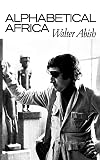
This book isn't simply "in the line of writers such as Raymond Roussel, Raymond Queneau, Georges Perec and Harry Mathews," as Ashbery says in the back cover copy. That's because, unlike those authors, Abish does not try to match his stories with the constraints he gives himself. His linguistic constraints are "terrifying and irrefutable," as Ashbery says (chapters from A to Z and back to A, each one containing only a subset of letters of the alphabet), but the stories he tells are carefree show more and funny.
I think this matters because in the Oulipo tradition, the stories that are told have some correspondence, in tone, philosophy, pointlessness, absurdity, and so on, to the rules the authors imposed on themselves. That correspondence is the glue that binds the books together: otherwise Perec and others could have simply taken existing novels or newspaper accounts (as Goldsmith and others do now) and subjected them to predetermined rules. The lack of correspondence in "Alphabetical Africa" is its principal characteristic, I think: after you have marveled at what he's done with his alphabetical rules, and after you've laughed at his stories, you're left wondering whether the two have collided randomly, or for surrealistic purpose, or whether, in fact, Abish never thought through the possible meanings of the lack of correspondence between his insouciant stories and his rigid rules. More on this at the end.
In Perec's "Life: A User's Guide," for example, the elaborately constrained writing is in close harmony with the stories of the people in the apartment building. Just as the principal character tries to make a life that will sum to nothing, so the writer's constraints produce a distorted narrative that cannot conform to ordinary novels. In Roussel, the elaborate rules (which are, in contrast to Perec's, largely unknown, despite Roussel's own book on the subject) are in intricate and partly hidden harmony with the acephalic or obsessive or autistic behavior of his principal characters and his implied narrator.
"Alphabetical Africa" is often very funny. Its humor is a kind I recognize, without difficulty, from other authors of the 1970s. He is interested in Africa's politics ("But can Alva's claims also cure Americans bombing Chad beaches. Anyhow, all concur America's angst cannot corrupt Chadians," p. 6), in the absurdity of the places he visits, and in the ridiculous continuation of colonial and tourist expectations; but he is insouciant about most of it. He is untroubled about mentioning that his characters take acid: they are who they are. The result is a politically invested but carefree tone that reminds me, in a different sphere, of Arlo Guthrie. He spins cliché plots about dictators, spies, and murders, and he weaves in tourist impressions and fears, all in a kind of deadpan colloquial collage.
Meanwhile, each chapter in the first half of the book adds another letter, and each chapter in the second half subtracts one, and the machinery of that expansion and contraction works alongside the stories but almost never to any determinate purpose. A reader watches the first letters of many words, and also attends to the stories. The result is not a surrealist juxtaposition, because it so often seems that Abish is simply trying to write well, in spite of his own constraints. The first chapter "M" is not at all exceptional in this regard:
"M
"My memory isn't accurate anymore. Mentioning my memory makes me feel insecure. A few months ago Alex and Allen kidnapped a jeweler in Antibes and killed him almost inadvertently..."
Because this is chapter "M," a reader will be watching for Abish to display as many m's as he can. So the second sentence here, with four m's, stands out. But the sentence immediately following serves the purpose of furthering one of his stories. So it is not clear how we are expected to attend to the alliterations. Are we to read as Oulipeans for part of one sentence, and then forget that regimen, and think instead about the plot? When "Alphabetical Africa" is funny, it is so in spite of its linguistic constraints. (The first chapter "C" is an excellent example: it's really funny, and doesn't suffer, but also doesn't gain, by being constrained to words beginning with "a," "b," or "c.") Same when it's violent, or absurdist, or intentionally hackneyed.
The principal expressive option here would be surrealism: the stories would be juxtaposed in unexpected and irrational ways with the language used to express them. But that does not happen often, or consistently, and sometimes it seems not to happen intentionally. In most cases, Abish's narrator seems to have one set of concerns, and his compositor another.
In the end, it seemed to me that this is a lighthearted spoof about American attitudes to Africa in the 1970s, placed, for reasons I think the author himself never entirely analyzed, into the "terrifying and irrefutable" Procrustean frame of a linguistic game. It is an example of a book that reveals a crucial criterion for constrained writing: there needs to be a nameable connection between the linguistic constraint and whatever stories are being told. That connection can be a contrast (irrational, surrealist, or satiric) or a harmonious correspondence (between constrained lives and rule-bound writing, between partly unknowable psychologies and partly private constraints, etc.) -- but it has to be something the reader can conclude was planned and controlled, or at least observed, by the writer.
*
Reading this on Facebook July 2014, Andrei Molotiu noted that some Oulipo writers seem to be great "despite" their Oulipean interests. I might not be interested in such a writer. There should be a strong connection between story and constraints: it can be a strong contrast, or dissociation, or affinity, but it really has to work as a whole: otherwise it seems to me the interest of any constraint is diminished. Note the constraint in this book, by itself, isn't interesting. Anyone can invent a constraint: not everyone can write a book based on a constraint, but that's not a very interesting goal anyway. Relatively few people can figure out how to link or contrast the constraint to the material (story, subject matter, voice, mood).
And just to be clear about the argument I'm proposing: I am not especially interested in organic, harmonious, "coherent" (Ruskin's word) relationships between form and content, or in the humanist or romantic traditions that require such relationships. I do find I want the relationship between form and content to be acknowledged in some manner: form and content can exhibit a radical disconnection, disharmony, incoherence, randomness, surrealism, or irrationalism; regardless of the kind of relationship, I am most engaged when the author (or the narrator, or the text) demonstrates that the problem has been considered. Abish doesn't seem to notice, or care. show less
I think this matters because in the Oulipo tradition, the stories that are told have some correspondence, in tone, philosophy, pointlessness, absurdity, and so on, to the rules the authors imposed on themselves. That correspondence is the glue that binds the books together: otherwise Perec and others could have simply taken existing novels or newspaper accounts (as Goldsmith and others do now) and subjected them to predetermined rules. The lack of correspondence in "Alphabetical Africa" is its principal characteristic, I think: after you have marveled at what he's done with his alphabetical rules, and after you've laughed at his stories, you're left wondering whether the two have collided randomly, or for surrealistic purpose, or whether, in fact, Abish never thought through the possible meanings of the lack of correspondence between his insouciant stories and his rigid rules. More on this at the end.
In Perec's "Life: A User's Guide," for example, the elaborately constrained writing is in close harmony with the stories of the people in the apartment building. Just as the principal character tries to make a life that will sum to nothing, so the writer's constraints produce a distorted narrative that cannot conform to ordinary novels. In Roussel, the elaborate rules (which are, in contrast to Perec's, largely unknown, despite Roussel's own book on the subject) are in intricate and partly hidden harmony with the acephalic or obsessive or autistic behavior of his principal characters and his implied narrator.
"Alphabetical Africa" is often very funny. Its humor is a kind I recognize, without difficulty, from other authors of the 1970s. He is interested in Africa's politics ("But can Alva's claims also cure Americans bombing Chad beaches. Anyhow, all concur America's angst cannot corrupt Chadians," p. 6), in the absurdity of the places he visits, and in the ridiculous continuation of colonial and tourist expectations; but he is insouciant about most of it. He is untroubled about mentioning that his characters take acid: they are who they are. The result is a politically invested but carefree tone that reminds me, in a different sphere, of Arlo Guthrie. He spins cliché plots about dictators, spies, and murders, and he weaves in tourist impressions and fears, all in a kind of deadpan colloquial collage.
Meanwhile, each chapter in the first half of the book adds another letter, and each chapter in the second half subtracts one, and the machinery of that expansion and contraction works alongside the stories but almost never to any determinate purpose. A reader watches the first letters of many words, and also attends to the stories. The result is not a surrealist juxtaposition, because it so often seems that Abish is simply trying to write well, in spite of his own constraints. The first chapter "M" is not at all exceptional in this regard:
"M
"My memory isn't accurate anymore. Mentioning my memory makes me feel insecure. A few months ago Alex and Allen kidnapped a jeweler in Antibes and killed him almost inadvertently..."
Because this is chapter "M," a reader will be watching for Abish to display as many m's as he can. So the second sentence here, with four m's, stands out. But the sentence immediately following serves the purpose of furthering one of his stories. So it is not clear how we are expected to attend to the alliterations. Are we to read as Oulipeans for part of one sentence, and then forget that regimen, and think instead about the plot? When "Alphabetical Africa" is funny, it is so in spite of its linguistic constraints. (The first chapter "C" is an excellent example: it's really funny, and doesn't suffer, but also doesn't gain, by being constrained to words beginning with "a," "b," or "c.") Same when it's violent, or absurdist, or intentionally hackneyed.
The principal expressive option here would be surrealism: the stories would be juxtaposed in unexpected and irrational ways with the language used to express them. But that does not happen often, or consistently, and sometimes it seems not to happen intentionally. In most cases, Abish's narrator seems to have one set of concerns, and his compositor another.
In the end, it seemed to me that this is a lighthearted spoof about American attitudes to Africa in the 1970s, placed, for reasons I think the author himself never entirely analyzed, into the "terrifying and irrefutable" Procrustean frame of a linguistic game. It is an example of a book that reveals a crucial criterion for constrained writing: there needs to be a nameable connection between the linguistic constraint and whatever stories are being told. That connection can be a contrast (irrational, surrealist, or satiric) or a harmonious correspondence (between constrained lives and rule-bound writing, between partly unknowable psychologies and partly private constraints, etc.) -- but it has to be something the reader can conclude was planned and controlled, or at least observed, by the writer.
*
Reading this on Facebook July 2014, Andrei Molotiu noted that some Oulipo writers seem to be great "despite" their Oulipean interests. I might not be interested in such a writer. There should be a strong connection between story and constraints: it can be a strong contrast, or dissociation, or affinity, but it really has to work as a whole: otherwise it seems to me the interest of any constraint is diminished. Note the constraint in this book, by itself, isn't interesting. Anyone can invent a constraint: not everyone can write a book based on a constraint, but that's not a very interesting goal anyway. Relatively few people can figure out how to link or contrast the constraint to the material (story, subject matter, voice, mood).
And just to be clear about the argument I'm proposing: I am not especially interested in organic, harmonious, "coherent" (Ruskin's word) relationships between form and content, or in the humanist or romantic traditions that require such relationships. I do find I want the relationship between form and content to be acknowledged in some manner: form and content can exhibit a radical disconnection, disharmony, incoherence, randomness, surrealism, or irrationalism; regardless of the kind of relationship, I am most engaged when the author (or the narrator, or the text) demonstrates that the problem has been considered. Abish doesn't seem to notice, or care. show less
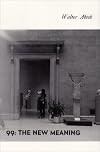
I was thrilled with 99: The New Meaning, which brings together five separate experiments in borrowing short excerpts from several authors and collaging a new text. Flaubert and Kafka are the more prominent sources used. While some reviewers may focus on how the excerpts make up a narrative or a new text, what seems more overt to me in the experiments is how homogenous the sources actually are. Perhaps the selection process meant Abish was looking for "sameness" between voices in order to show more create unity. It may seem that Flaubert and Kafka are overtly disparate sources, but if a case is to made for the Formalist taxonomy of narratives, this book seems to prove the case. As I read, I cared little about recognizing the sources. Tropes dominate, and subjectivity, despite its unique and several sources, is remarkably similar from excerpt to excerpt. This is one I'll be interested in talking about with friends, or perhaps teaching, in the future. show less
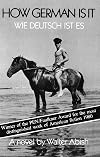
When should victims and their descents stop being victims and when do the crimes of our ancestors stop being our fault? This is territory of How German Is It = Wie Deutsch Ist Es by Walter Abish published in 1981 but set in the 70’s when the post war generation were having to come to terms with their futures and the pasts it was built on. Abish is an American but whose family had fled Europe during the Hitler years.
The central character is Ulrich a writer who is the son of a former high show more ranking German military officer executed for his role in the 1944 plot to assassinate Hitler. He and his brother a modernist architect are from the aristocratic elite who supported Hitler’s anti-communist stance as a political necessity. We first meet Ulrich having returned to the new post war town and discover that he had been caught up with a terrorist cell who were imprisoned based on his evidence so he and his wife are free. This has serious consequences as it clear that his wife who leaves him believes in the terrorist cause as may one of his girl friends. His brother, Helmuth is helping to build the new Germany and is in cahoots with the Mayor and has a chaotic sex life causing his marriage to fall about. This again ripples through the novel and helps to shape the climax of the story.
A servant who saved the family in the fall of Nazi Germany lives in the new town and serves in the best restaurant and is known and loved by the two brothers. But it’s clear in the web of relationships that build up that not all is as it seems. As the character’s relationships build up a picture of who Ulrich is and why he must react in the final count in the way he does, we also start to discover that the new town is built on the ruins of a concentration camp and a willingness to try and ignore the past. To the point that we begin to see that the terrorists may well be the moralists except they are as much a failure as the bright new town.
It is a political thriller and more as Abish is an experimentalist writer who uses German stereotypes and a central character, Ulrich, who is initially a cipher to builds up the story by switches in narrator, by the author questioning the action or intention of the character or situation etc. As the story unfolds the interaction with the other characters builds in to real psychological studies. The climax and its consequences for Ulrich seek to answer the question of the novel’s title.
The novel is highly recommended and for all it being experimental is not a difficult read. It won the American book award(PEN/Faulkner) in 1981 and deserves a wider readership. show less
The central character is Ulrich a writer who is the son of a former high show more ranking German military officer executed for his role in the 1944 plot to assassinate Hitler. He and his brother a modernist architect are from the aristocratic elite who supported Hitler’s anti-communist stance as a political necessity. We first meet Ulrich having returned to the new post war town and discover that he had been caught up with a terrorist cell who were imprisoned based on his evidence so he and his wife are free. This has serious consequences as it clear that his wife who leaves him believes in the terrorist cause as may one of his girl friends. His brother, Helmuth is helping to build the new Germany and is in cahoots with the Mayor and has a chaotic sex life causing his marriage to fall about. This again ripples through the novel and helps to shape the climax of the story.
A servant who saved the family in the fall of Nazi Germany lives in the new town and serves in the best restaurant and is known and loved by the two brothers. But it’s clear in the web of relationships that build up that not all is as it seems. As the character’s relationships build up a picture of who Ulrich is and why he must react in the final count in the way he does, we also start to discover that the new town is built on the ruins of a concentration camp and a willingness to try and ignore the past. To the point that we begin to see that the terrorists may well be the moralists except they are as much a failure as the bright new town.
It is a political thriller and more as Abish is an experimentalist writer who uses German stereotypes and a central character, Ulrich, who is initially a cipher to builds up the story by switches in narrator, by the author questioning the action or intention of the character or situation etc. As the story unfolds the interaction with the other characters builds in to real psychological studies. The climax and its consequences for Ulrich seek to answer the question of the novel’s title.
The novel is highly recommended and for all it being experimental is not a difficult read. It won the American book award(PEN/Faulkner) in 1981 and deserves a wider readership. show less
Lists
Best First Lines (1)
Gimmicks (1)
Awards


You May Also Like


Associated Authors
Statistics
- Works
- 11
- Also by
- 11
- Members
- 1,106
- Popularity
- #23,234
- Rating
- 3.6
- Reviews
- 13
- ISBNs
- 39
- Languages
- 7
- Favorited
- 9