
Alfred Duggan (1903–1964)
Author of Winter quarters
About the Author
Works by Alfred Duggan
The Castle Book 1 copy
Los fundadores de Roma 1 copy
Associated Works
Tagged
Common Knowledge
- Legal name
- Alfred Leo Duggan
- Birthdate
- 1903
- Date of death
- 1964
- Gender
- male
- Education
- Eton College
University of Oxford (Balliol College) - Occupations
- archaeologist
novelist
aircraft worker - Relationships
- Duggan, Alfredo Hubert (father)
Hinds, Grace Elvina (mother)
Curzon, George Nathaniel (stepfather) - Nationality
- UK
- Birthplace
- Argentina
- Places of residence
- Buenos Aires, Argentina (birth)
- Place of death
- Ross-on-Wye, Herefordshire, England, UK
- Burial location
- Ross-on-Wye, England
Members
Discussions
Alfred Duggan! in Ancient History (August 2013)
Reviews

I’ve been fascinated by ancient Rome since 7th grade. I can’t remember my teacher’s name, but I do remember what he taught me about the Romans. I even put Roman Power on my three-ring-binder that year. What a histo-dweeb, huh? Well, yeah, but I’m still under the spell. And I don’t have any excuse for not knowing about Alfred Duggan before last month. He seems to have been a prolific author of historical fiction based in ancient times. And not just from the winner’s perspective show more either and that’s what’s so intriguing about Winter Quarters. It’s an account of a Gallic warrior who signs onto Publius Crassus’s army as a cavalry officer. Even though I have no way to really know, the way Camul views the Romans, their army and his role in it rings true. He and his lifelong friend Acco sign on for pay; no illusions of glory or grand purpose, it’s money they’re after. And a way to escape Pyrenee, a goddess who appears to have it in for Acco after he kills one of her sacred bears.
By one thing and another they’re introduced to Roman politics and come away with a worse opinion than they already had. Gone are the illusions of proud, masculine warriors. Now they see the flabby, toadying and scheming politicians who buy office and launch these great campaigns for mercenary reasons alone. From Publius they get on to dad - Marcus Crassus, who is determined to make a name for himself over and above his rivals Julius Caesar and Pompey the Great. After all, defeating a rabble of slaves (Spartacus’s rebellion) is a bit paltry compared to the other two. He makes a bid for Parthia and launches an army out of winter quarters in Syria. Crassus, being Crassus, thinks its going to be a piece of cake and as history tells us it was. For the Parthians.
In between battles, marches and what few actual duties Acco and Camul have, they spend a lot of time thinking about religion and trying to avoid areas of goddess worship in all its forms. Outwardly, they reject feminine worship in favor of sky fathers and war gods, but in their hearts they fear her tremendously and will do anything they can to keep out of her line of sight. Unfortunately, goddess worship usually exacts a high price (Ariadne and Medea come to mind, as do the Queens of Eleusis and their unique crop-rotation method) and Acco’s bride-to-be succumbs and they leave her, horrified at what she’s become, at Artemis’s shrine. It seems though, she wasn’t through with them yet and the book ends with Camul on his own, shanghaied into the Parthian army and dictating his story to a fellow. Overall I liked the book even though it was a bit short on action and intrigue. The social, martial and religious aspects were interesting enough to keep me going though and it’s always fun to have a look at the Romans from the outside. show less
By one thing and another they’re introduced to Roman politics and come away with a worse opinion than they already had. Gone are the illusions of proud, masculine warriors. Now they see the flabby, toadying and scheming politicians who buy office and launch these great campaigns for mercenary reasons alone. From Publius they get on to dad - Marcus Crassus, who is determined to make a name for himself over and above his rivals Julius Caesar and Pompey the Great. After all, defeating a rabble of slaves (Spartacus’s rebellion) is a bit paltry compared to the other two. He makes a bid for Parthia and launches an army out of winter quarters in Syria. Crassus, being Crassus, thinks its going to be a piece of cake and as history tells us it was. For the Parthians.
In between battles, marches and what few actual duties Acco and Camul have, they spend a lot of time thinking about religion and trying to avoid areas of goddess worship in all its forms. Outwardly, they reject feminine worship in favor of sky fathers and war gods, but in their hearts they fear her tremendously and will do anything they can to keep out of her line of sight. Unfortunately, goddess worship usually exacts a high price (Ariadne and Medea come to mind, as do the Queens of Eleusis and their unique crop-rotation method) and Acco’s bride-to-be succumbs and they leave her, horrified at what she’s become, at Artemis’s shrine. It seems though, she wasn’t through with them yet and the book ends with Camul on his own, shanghaied into the Parthian army and dictating his story to a fellow. Overall I liked the book even though it was a bit short on action and intrigue. The social, martial and religious aspects were interesting enough to keep me going though and it’s always fun to have a look at the Romans from the outside. show less

Duggan's Alfred the Great is a man destined for the Church, who becomes a man of action due to a bad case of Viking. Though weak on the blood and guts and sexy sides this book provides a fine corrective on some of the excesses of the "Uthred of Bebbenburgh" books written by Bernard cornwell. I think both visions are necessary to provide a balanced view of alfred in fiction. Read this book! It won't be hard.

This is one of my favourite Duggan novels. Set in the 1200's in the Crusader state in the Peloponnesus, the story is intimate for a Duggan novel. While the politics of a successor state of the Byzantine empire do intrude, the major plot is a love story but a sadly destructive one. A knight from Wales, William Breiwerr takes service with Geoffrey de Briwerr a baron of the small state. William watches the development of Geoffrey's adulterous love and sees it result in the banishment of his show more lord from a respected position to that of a wandering place seeker, which was Geoffrey's status at the beginning of the tale. show less
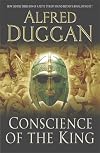
An historical novel from 1951 and Alfred Duggan's second novel is a good one. He tells the story of Cerdic Elesing who was said to be the founder of the Kingdom of Wessex. It is told in the first person as Cerdic now in his eighties looks back on his life and times. The title stems from the fact that Cerdic had no conscience. Born in 451 AD; the third son of a Roman Briton his only path to glory was to murder his elder brother and then plot to overthrow his father whose stronghold was in show more Canterbury England. Cerdic had to make his own way in the world and apart from having no conscience his other advantages were that being born a Roman he had an education which enabled him to read and write, and being wet-nursed by a Saxon woman, he learned to speak `german and was fully conversant with Saxon culture. He could therefore make his way in either world at a time in England when Roman educated Britons were being harried by Saxon adventurers and settlers on the East side of the Country. The Romans had effectively abandoned England some fifty years earlier and the civilisation that they had founded was rapidly unwinding.
Cerdic remains a shadowy figure in English history and Duggan has plenty of scope to invent a likely personage. As an historian and archeologist he is able to paint a credible picture of England during its transition from Roman rule to a darker age when warring factions struggled to maintain a semblance of civilisation. Allowing Cerdic to tell his own story places the reader inside the head of a successful adventurer. Cerdic achieves his aspiration to become an independent king, through cunning, feats of arms and letting nothing stand in the way of his ambition. He suffers some reverses, but his ability to transfer allegiance from Roman Briton to Saxon Briton and to outthink his opponents enables him to achieve his objective. Duggan's Cedric is not weighed down by later day morals and it is this portrait that convinced this reader that somebody like Cedric could be successful and even perhaps admirable.
The description of fifth century England is convincing, Roman towns have largely been abandoned, agriculture is carried out when and where people find or clear an area and can gain protection from raiders. The taking of oaths, the fear of the unknown, superstition, rituals are all part of the culture that Duggan describes. He also comes into his own when describing military action, for example the battle of Badon Hill where he envisages Cerdic's saxon army suffering a reversal at the hands of Artorious heavy cavalry. Legends and scraps of history are fitted together to give a convincing picture and characters are brought to life. An entertaining four star read. show less
Cerdic remains a shadowy figure in English history and Duggan has plenty of scope to invent a likely personage. As an historian and archeologist he is able to paint a credible picture of England during its transition from Roman rule to a darker age when warring factions struggled to maintain a semblance of civilisation. Allowing Cerdic to tell his own story places the reader inside the head of a successful adventurer. Cerdic achieves his aspiration to become an independent king, through cunning, feats of arms and letting nothing stand in the way of his ambition. He suffers some reverses, but his ability to transfer allegiance from Roman Briton to Saxon Briton and to outthink his opponents enables him to achieve his objective. Duggan's Cedric is not weighed down by later day morals and it is this portrait that convinced this reader that somebody like Cedric could be successful and even perhaps admirable.
The description of fifth century England is convincing, Roman towns have largely been abandoned, agriculture is carried out when and where people find or clear an area and can gain protection from raiders. The taking of oaths, the fear of the unknown, superstition, rituals are all part of the culture that Duggan describes. He also comes into his own when describing military action, for example the battle of Badon Hill where he envisages Cerdic's saxon army suffering a reversal at the hands of Artorious heavy cavalry. Legends and scraps of history are fitted together to give a convincing picture and characters are brought to life. An entertaining four star read. show less
Lists
Awards


You May Also Like


Associated Authors
Statistics
- Works
- 36
- Also by
- 2
- Members
- 1,578
- Popularity
- #16,353
- Rating
- 3.8
- Reviews
- 46
- ISBNs
- 136
- Languages
- 2
- Favorited
- 6
