
Ninian Smart (1927–2001)
Author of The World's Religions
About the Author
Ninian Smart is Emeritus Professor of Comparative Religion and of Religious Studies at the Universities of California and Lancaster. His status as one of the world's foremost scholars in religious studies has been recognized by his election as President of the American Academy of Religion for the show more year 2000. He is the author of many acclaimed books show less
Image credit: By Oceane777 - Article Wikipédia version anglaise, http://en.wikipedia.org/wiki/Ninian_Smart, Public Domain, https://commons.wikimedia.org/w/index.php?curid=3422870
Series
Works by Ninian Smart
The science of religion & the sociology of knowledge: some methodological questions (1973) 17 copies
Beyond ideology: Religion and the future of Western civilization (Gifford lectures delivered in the University of Edinburgh) (1981) 13 copies
The Religious Experience of Mankind 10 copies
The yogi and the devotee the interplay between the Upanishads and Catholic theology (2011) 10 copies, 1 review
OPEN UNIVERSITY ARTS A SECOND LEVEL THE RELIGIOUS QUEST UNITS 3-4 HINDU PATTERNS OF LIBERATION (1987) 2 copies
A Theory of Religious and Ideological Change: Illustrated from Modern South Asian and other Religious Nationalisms (1984) 2 copies
Associated Works
Tagged
Common Knowledge
- Legal name
- Smart, Roderick Ninian
- Other names
- SMART, Roderick Ninian
SMART, Ninian - Birthdate
- 1927-05-06
- Date of death
- 2001-01-29
- Gender
- male
- Education
- University of Oxford (Queen's College - Classics and Philosophy)
London School of Oriental and African Studies
Glasgow Academy - Occupations
- army officer
university lecturer
professor of theology
Pro-Vice-Chancellor
professor of comparative religion - Organizations
- British Army Intelligence Corps
University of Wales
London University
Yale University
Birmingham University
Lancaster University (show all 7)
University of California, Santa Barbara - Relationships
- סמרט, ניניאן
- Nationality
- UK
- Birthplace
- Cambridge, England, UK
- Places of residence
- Cambridge, Cambridgeshire, England, UK
Glasgow, Scotland, UK
Lancaster, Lancashire, England, UK - Place of death
- Lancaster, Lancashire, England, UK
- Associated Place (for map)
- England, UK
Members
Reviews

Does anyone else think that the reference to "universal" in the title might be a little bit presumptuous?
I will grant you: there is a lot of wisdom in the book, but its scope does not contain every religion by a longshot. Many Native American traditions are left out, as are all of the Neo-pagan ones. The Ancient Egyptian religion is touched for four stories. Akhnaton's hymn to the Aten-disk is included even though his excursion to semi-monotheism lasted a mere seventeen years, and is not show more even a pimple on the face of the Sphinx, especially given that the religion changed and grew for over 2,500 years -- longer than any other religion in the world -- and an undeniable influence in the creation of all three of the Western "world religions."
But enough of my particular prejudices.
The material that is in this book is, for the most part, golden. It very definitely shows that no religion in the world has a lock on either goodness or wisdom. More is the pity that the people who truly need to learn this will never see any of that proof.
Even if these folks did see, it would still not be enough to show them that religion is a creation of the culture that gave it birth. It is something that is difficult to export because whatever "pimples" it has will become glaring in the eyes of people not accustomed to the ways that gave it birth.
I think that this must be the biggest lesson learned from this collection. show less
I will grant you: there is a lot of wisdom in the book, but its scope does not contain every religion by a longshot. Many Native American traditions are left out, as are all of the Neo-pagan ones. The Ancient Egyptian religion is touched for four stories. Akhnaton's hymn to the Aten-disk is included even though his excursion to semi-monotheism lasted a mere seventeen years, and is not show more even a pimple on the face of the Sphinx, especially given that the religion changed and grew for over 2,500 years -- longer than any other religion in the world -- and an undeniable influence in the creation of all three of the Western "world religions."
But enough of my particular prejudices.
The material that is in this book is, for the most part, golden. It very definitely shows that no religion in the world has a lock on either goodness or wisdom. More is the pity that the people who truly need to learn this will never see any of that proof.
Even if these folks did see, it would still not be enough to show them that religion is a creation of the culture that gave it birth. It is something that is difficult to export because whatever "pimples" it has will become glaring in the eyes of people not accustomed to the ways that gave it birth.
I think that this must be the biggest lesson learned from this collection. show less
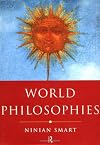
Ninian Smart was a founding figure in British secular religious studies. This review of 'world philosophy' came at the very end of his life as perhaps a summation of at least one part of his life's work - a particular approach to religion as containing within it varieties of philosophy.
The reader should be warned, therefore, that this is a book largely of the many different potentialities of philosophy as justifications for belief and culture rather than any set of positions about philosophy show more as a professional investigation of the truth or challenge in the cause of truth.
Smart is instinctively non-judgmental and tolerant, the epitome of the kindly Scottish relativist who refuses to get off the fence even when it is a matter of saying whether God exists or not. The question is irrelevant to him - the issue is whether those he studies believe what they believe.
Once this position is established, then the book can abandon the study of religion qua religion and look at the many varieties of judgement and criticism that we call philosophy and that make up the human religious condition along equally non-judgemental globalist lines.
From this perspective, the book is useful as a reference work but Smart has taken on too big a task, especially as he insists on giving broadly equal value to all parts of the world and all traditions. The result is (as with so many general companions to philosophy) short-handing and so obscurities.
Still, as sets of summary of the many components of human belief and the 'thinking' that goes into sustaining them, the book is better in the library than out of it. The extensive bibliography alone provides a baseline, at the end of the last century, for further study. show less
The reader should be warned, therefore, that this is a book largely of the many different potentialities of philosophy as justifications for belief and culture rather than any set of positions about philosophy show more as a professional investigation of the truth or challenge in the cause of truth.
Smart is instinctively non-judgmental and tolerant, the epitome of the kindly Scottish relativist who refuses to get off the fence even when it is a matter of saying whether God exists or not. The question is irrelevant to him - the issue is whether those he studies believe what they believe.
Once this position is established, then the book can abandon the study of religion qua religion and look at the many varieties of judgement and criticism that we call philosophy and that make up the human religious condition along equally non-judgemental globalist lines.
From this perspective, the book is useful as a reference work but Smart has taken on too big a task, especially as he insists on giving broadly equal value to all parts of the world and all traditions. The result is (as with so many general companions to philosophy) short-handing and so obscurities.
Still, as sets of summary of the many components of human belief and the 'thinking' that goes into sustaining them, the book is better in the library than out of it. The extensive bibliography alone provides a baseline, at the end of the last century, for further study. show less
I got like half way through where for various reasons I lost steam. I mean it's a perfectly good summary of a lot of different philosophical stuff from around the world but often because it can only be a very short summary of each it gets hard to keep up and it's very hard to keep track of many philosophies which clearly have big differences but which appear very similar if you don't understand the concepts well and when they're not explained in detail. So after a while a lot of what's show more written appears almost redundant because you can't really get a grasp on the differences between these philosophies. Which is frustrating. It's a lot my fault of course and I appreciate the effort and know it's a hard thing to do well. Oh well.
Couple of stunning lines in this that I want to remark on because my only philosophy knowledge is Marxism and that Nietzsche sucks.
He remarks of Nietzsche "It was as if Nietzsche anticipated Nazism (and he was of course falsely linked to the Nazi message, as if Goebbels and Goering and the like could possibly be mistaken for Nietzsche's classically inspired idea of the superior human being)" ! Apparently the Nazis were bad because they were not superhuman *enough*. The message of Aryan racial superiority would have been ok if it was true. This is some sick shit. He talks about Nietzsche's idea of "slave morality" but doesn't criticise it and doesn't mention his idea that it's all traceable to Jewish influence. Hmm.
The short Marx section is a pretty decent short summary. And then he mentions Lenin, and we get this:
"It is this system [Marxism-Leninism] which in 1989 largely collapsed amid disillusionment. One main reason for this is that Marx's own devaluation of legal institutions and democratic values paved the way for a ruthless State machinery and command economy which created a vast amount of human suffering...
One of the themes, specially of Lenin, was the importance of praxis for understanding. The way to the truth lay through Marxism. This doctrine made Marxism virtually unfalsifiable."
My problem isn't with the line about "ruthless State machinery" but the justification given for it is so weak. It's very hard to say that "devalued democratic values" given his entire concept of a new society was sort of about ultra democracy and "devaluation of legal institutions" is funny because yes he "devalued" bourgeois legal institutions and thought we should build something new but also it implies that somehow "legal institutions" don't do bad things, as if the USSR didn't have laws and a sophisticated policing and justice system. It's absurd. And of course it's interesting to contrast with Nietzsche - his devaluing of democratic values ie insisting democracy is evil and bad doesn't get a mention at all.
The second part is funny because that's not really what praxis means but also because in a book about philosophy "falsifability" rarely comes into things. It'd be hard to falsify Plato's philosophy of forms, for example, and he'd never even think to say it. It's just interesting to me the way Marxism is talked about in ways that don't aid understanding at all. show less
He remarks of Nietzsche "It was as if Nietzsche anticipated Nazism (and he was of course falsely linked to the Nazi message, as if Goebbels and Goering and the like could possibly be mistaken for Nietzsche's classically inspired idea of the superior human being)" ! Apparently the Nazis were bad because they were not superhuman *enough*. The message of Aryan racial superiority would have been ok if it was true. This is some sick shit. He talks about Nietzsche's idea of "slave morality" but doesn't criticise it and doesn't mention his idea that it's all traceable to Jewish influence. Hmm.
The short Marx section is a pretty decent short summary. And then he mentions Lenin, and we get this:
"It is this system [Marxism-Leninism] which in 1989 largely collapsed amid disillusionment. One main reason for this is that Marx's own devaluation of legal institutions and democratic values paved the way for a ruthless State machinery and command economy which created a vast amount of human suffering...
One of the themes, specially of Lenin, was the importance of praxis for understanding. The way to the truth lay through Marxism. This doctrine made Marxism virtually unfalsifiable."
My problem isn't with the line about "ruthless State machinery" but the justification given for it is so weak. It's very hard to say that "devalued democratic values" given his entire concept of a new society was sort of about ultra democracy and "devaluation of legal institutions" is funny because yes he "devalued" bourgeois legal institutions and thought we should build something new but also it implies that somehow "legal institutions" don't do bad things, as if the USSR didn't have laws and a sophisticated policing and justice system. It's absurd. And of course it's interesting to contrast with Nietzsche - his devaluing of democratic values ie insisting democracy is evil and bad doesn't get a mention at all.
The second part is funny because that's not really what praxis means but also because in a book about philosophy "falsifability" rarely comes into things. It'd be hard to falsify Plato's philosophy of forms, for example, and he'd never even think to say it. It's just interesting to me the way Marxism is talked about in ways that don't aid understanding at all.
The Yogi And The Devotee (Routledge Revivals): The Interplay Between the Upanishads and Catholic Theology by Ninian Smart

The book presents a general theory of the relation between religious experience and doctrines. It is argued that we need to present a new form of natural theology, which would indicate the relevance of religious experience and ritual to what is given in revelation. This may be the key to a new understanding between Christianity and Indian religions. The author also examines the license which Christians can learn from other faiths.
You May Also Like


Associated Authors
Statistics
- Works
- 56
- Also by
- 3
- Members
- 2,278
- Popularity
- #11,267
- Rating
- 3.3
- Reviews
- 17
- ISBNs
- 149
- Languages
- 10
- Favorited
- 3