
Thomas P. M. Barnett
Author of The Pentagon's New Map: War and Peace in the Twenty-First Century
About the Author
Thomas P.M. Barnett is a strategic planner who has worked in national security affairs since the end of the Cold War and has operated his own consulting practice (Barnett Consulting) since 1998. Dr. Barnett is best known as the author of The Pentagon's New Map: War and Peace in the Twenty-First show more Century (New York: G.P. Putnam's Sons, 2004). He has a BA from the University of Wisconsin. Following Wisconsin, Dr. Barnett earned an AM in Regional Studies: Russia, Eastern Europe and Central Asia and a PhD in Political Science from Harvard University. (Bowker Author Biography) show less
Image credit: Naval War College Public Affairs Office photo by Jon Hockersmith
Works by Thomas P. M. Barnett
Associated Works
Tagged
Common Knowledge
- Other names
- Barnett, Thomas
- Birthdate
- 1962
- Gender
- male
- Education
- University of Wisconsin–Madison
Harvard University (Ph.D. ∙ Political Science) - Occupations
- professor
journalist - Organizations
- Center for Naval Analyses
Naval War College
Enterra Solutions
Esquire - Nationality
- USA
- Places of residence
- Indiana, USA
- Associated Place (for map)
- Indiana, USA
Members
Reviews

This is not as successfully argued as his first book, The Pentagon's New Map. Pity the poor pundit as Barnett optimistically posits a positive appraisal for the Pentagon and Americans. No such blueprint could possibly exist since the world we are in is much more precarious than Barnett seems to believe. There is much that is wishful thinking here.
In contrast to his first work, he does expand on an Islamic global presence.
In contrast to his first work, he does expand on an Islamic global presence.
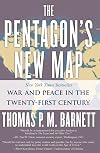
Many good ideas here. The book gets surprisingly personal at points, with Barnett recounting his own experiences and emotions as part of his explanation of Defense Department analysis processes. Extremely arrogant. Many of his policy recommendations and his sense of the scope of U.S. power seem hopelessly naive in hindsight after several years mired in Iraq. Other recommendations seem prescient. Colonial perspective on developing world -- for instance, he is overly skeptical about Africans show more finding home-grown solutions to African problems. This leads him to promote a strategy of military intervention and occupation more than foreign direct investment, to a greater extent than I think warranted. show less
Barnett?s book started out strong, but it became less credible towards the end. His contention that much of what ails the earth is due to a lack of connectedness is a reasonable one, and it explains a lot, but it doesn?t explain everything. I need to go r
A Clarion Call for a New World View
This is one of those rare books that set your mind’s inner light bulbs flashing.
Thomas P. M. Barnett, professor at the U.S. Naval War College, posits a worldwide perspective that integrates political, economic and military elements as a model for the post September 11th world.
He argues well-written book that terrorism and globalization have ended the great-power model of war that has dominated foreign policy thinkers during the past 400 years.
He calls show more globalization "this country’s gift to history." Building on the thinking of Thomas Friedman and Francis Fukuyama, the author distills recent history into three pertinent observations:
1. The world is divided into a Functioning Core and a Non-Integrating Group.
2. Connectivity is the primary method to define and influence which countries move into the Functioning Core.
3. Economic relationships have replaced military power.
Wherever you stand on recent events Barnett’s book promises to provide a platform for a thoughtful and meaningful debate over our country’s role in the world. show less
This is one of those rare books that set your mind’s inner light bulbs flashing.
Thomas P. M. Barnett, professor at the U.S. Naval War College, posits a worldwide perspective that integrates political, economic and military elements as a model for the post September 11th world.
He argues well-written book that terrorism and globalization have ended the great-power model of war that has dominated foreign policy thinkers during the past 400 years.
He calls show more globalization "this country’s gift to history." Building on the thinking of Thomas Friedman and Francis Fukuyama, the author distills recent history into three pertinent observations:
1. The world is divided into a Functioning Core and a Non-Integrating Group.
2. Connectivity is the primary method to define and influence which countries move into the Functioning Core.
3. Economic relationships have replaced military power.
Wherever you stand on recent events Barnett’s book promises to provide a platform for a thoughtful and meaningful debate over our country’s role in the world. show less
Awards


You May Also Like


Associated Authors
Statistics
- Works
- 7
- Also by
- 3
- Members
- 950
- Popularity
- #27,087
- Rating
- 3.6
- Reviews
- 12
- ISBNs
- 13
- Languages
- 1
- Favorited
- 1
