
Sissela Bok
Author of Lying: Moral Choice in Public and Private Life
About the Author
Works by Sissela Bok
Can Lawyers be Trusted? 1 copy
Associated Works
An Autobiography; or, The Story of My Experiments with Truth (1957) — Foreword, some editions — 4,216 copies, 51 reviews
A World of Ideas : Conversations With Thoughtful Men and Women About American Life Today and the Ideas Shaping Our Future (1989) — Interviewee — 604 copies, 1 review
Taking Sides: Clashing Views on Controversial Issues in Business Ethics and Society (1990) — Contributor, some editions — 76 copies, 1 review
Tagged
Common Knowledge
- Other names
- Myrdal, Sissela (maiden)
- Birthdate
- 1934-12-02
- Gender
- female
- Education
- Harvard University (Ph.D.)
George Washington University (BA|MA) - Occupations
- philosopher
ethicist
professor
memoirist
scholar - Organizations
- American Academy of Political and Social Science
American Philosophical Society
Harvard University - Awards and honors
- George Orwell Award (1978|Lying: Moral Choice in Public and Private Life)
- Relationships
- Bok, Derek (husband)
Bok, Hilary (daughter)
Myrdal, Alva (mother)
Myrdal, Gunnar (father)
Myrdal, Jan (brother) - Short biography
- Sissela Bok, née Myrdal, is the daughter of two Nobel Prize winners: Gunnar Myrdal (Economics) and Alva Myrdal (Peace). She was born in Sweden and attended the Sorbonne in Paris before earning her B.A. and M.A. in psychology from George Washington University, and her Ph.D. in philosophy from Harvard University. She was a professor of philosophy at Brandeis University before teaching ethics at Harvard’s Medical School and Kennedy School of Government. She then became a Senior Visiting Fellow at the Center for Population and Development Studies at the Harvard School of Public Health. Her writings explore the psychology and ethics of lying, the consequences of deception, and the perils of keeping secrets. Her books include Lying: Moral Choice in Public and Private Life (1978), considered one of the seminal books in philosophy of the 20th century, and A Strategy for Peace for Peace: Human Values and the Threat of War (1989). In 1955, she married Derek Bok, now former president of Harvard, with whom she has three children. Sissela Bok received the Courage of Conscience Award in 1991 for her "contributions to peacemaking strategies in the tradition of her mother." Her memoir of her mother was published that same year. A former member of the Pulitzer Prize Board, she is a fellow of the American Academy of Political and Social Science.
- Nationality
- Sweden
USA - Birthplace
- Stockholm, Sweden
- Associated Place (for map)
- Stockholm, Sweden
Members
Reviews
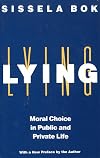
Bok, Sissela. Lying: Moral Choice in Public and Private Life. 1978. 3rd edition. Vintage, 1999.
Sissela Bok’s groundbreaking work on the ethics of lying was written when an U.S. president being caught in a lie was not a ho-hum event in the daily news cycle. Bok is now in her late 80s, so it may be fruitless to hope that we will get a fourth edition of Lying that will cover all our recent innovations in deceit. Nevertheless, we would do well to take what she says to heart. Here is the short show more version of her test of a moral lie: a good lie is one that cannot be avoided and would pass a test of rational publicity that includes the person to whom the lie was told. It is not quite the absolute stricture against lying proposed by Augustine and Kant, but it would make most lies morally wrong—even ones that many people would find unobjectionable. For example, she is generally critical of codes of medical ethics that allow the physician license to lie to patients when he or she thinks it medically advisable. Such lies, she says, should be the subject of public debate and be agreed on beforehand. It is obvious that most political lies could not pass her test. It is too easy to rationalize that one is lying in the public interest if the public has not been asked about it beforehand. Besides Bok’s own lucid analysis, I found the Appendix in which she includes statements on lying by Augustine, Aquinas, Bacon, Grotius, Kant, Sidgwick, Harrod, Bonhoeffer, and Warnock extremely useful. 5 stars. show less
Sissela Bok’s groundbreaking work on the ethics of lying was written when an U.S. president being caught in a lie was not a ho-hum event in the daily news cycle. Bok is now in her late 80s, so it may be fruitless to hope that we will get a fourth edition of Lying that will cover all our recent innovations in deceit. Nevertheless, we would do well to take what she says to heart. Here is the short show more version of her test of a moral lie: a good lie is one that cannot be avoided and would pass a test of rational publicity that includes the person to whom the lie was told. It is not quite the absolute stricture against lying proposed by Augustine and Kant, but it would make most lies morally wrong—even ones that many people would find unobjectionable. For example, she is generally critical of codes of medical ethics that allow the physician license to lie to patients when he or she thinks it medically advisable. Such lies, she says, should be the subject of public debate and be agreed on beforehand. It is obvious that most political lies could not pass her test. It is too easy to rationalize that one is lying in the public interest if the public has not been asked about it beforehand. Besides Bok’s own lucid analysis, I found the Appendix in which she includes statements on lying by Augustine, Aquinas, Bacon, Grotius, Kant, Sidgwick, Harrod, Bonhoeffer, and Warnock extremely useful. 5 stars. show less
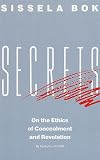
I'm going to add this book to the list of "books that so thoroughly cover a concept that I'm never going to argue about it again but rather send people a copy of this instead." I can't recommend this enough for literally everyone. So many fallacies and social-media arguments are undermined so thoroughly in these pages I can't even begin to list them all. Do yourself a favor and put this in the to-read pile.
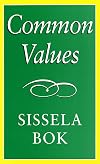
I read this for our monthly study group. It was a disappointing read in that the author, in her attempt to identify values common to all cultures, proceeded to attenuate the concept beyond the point that was acceptable to the group, or at least to this reader. Her attempt to find a minimal set of values flounders by virtue of the goal of the exercise.
The result was a set of values that limited the usefulness of the concept of value.
The result was a set of values that limited the usefulness of the concept of value.

Excellent, and a must read, especally by those who believe lies are opinions, therefore somehow legitimate.
But whoever said there had never been a book-length study of lying before this hadn't heard of Mark Twain's lifelong exploration of lying -- both as a practitioner, and as a demolisher of them.
Or of the earlier Lies & Truth by Marcel Eck.
But whoever said there had never been a book-length study of lying before this hadn't heard of Mark Twain's lifelong exploration of lying -- both as a practitioner, and as a demolisher of them.
Or of the earlier Lies & Truth by Marcel Eck.
Lists
Awards


You May Also Like


Associated Authors
Statistics
- Works
- 12
- Also by
- 3
- Members
- 1,326
- Popularity
- #19,389
- Rating
- 3.9
- Reviews
- 10
- ISBNs
- 40
- Languages
- 7
- Favorited
- 2