
Willard F. Harley, Jr.
Author of His needs, her needs
About the Author
Dr. Harley admits that he wasn't always the successful marriage counselor he is today. In fact, there was a time when nearly every couple who came to him for counsel ended up divorced. But rather than give up, Dr. Harley set out to find a solution to the problem. This book is the product of that show more commitment. For the past fifteen years, Dr. Harley has used this book to teach couples what's most important in marriage--how to fall in love and stay in love. Now, with more than a million copies and twelve translations of His Needs, Her Needs in print, he shares the story behind the book and continues to offer readers a practical plan for creating and sustaining a passionate marriage. Nationally acclaimed clinical psychologist Willard F. Harley, Jr., Ph.D. is the author of many books on marriage, including Love Busters and Five Steps to Romantic Love. His popular web site, www.marriagebuilders.com, offers practical solutions to almost any marital problem. Dr. Harley lives in White Bear Lake, Minnesota, with Joyce, his wife of thirty-eight years. show less
Image credit: Used by permission of Baker Publishing Group, copyright © 2008. All rights to this material are reserved. Materials are not to be distributed to other web locations for retrieval, published(see © info.)
Works by Willard F. Harley, Jr.
Five Steps to Romantic Love: A Workbook for Readers of Love Busters and His Needs, Her Needs (1993) 144 copies, 1 review
Love Busters, Revised and Expanded: Protecting Your Marriage from Habits that Destroy Romantic Love (2008) 5 copies
Ela Precisa Ele Deseja 3 copies
What Are Your Top Ten Needs? 1 copy
Inside a Woman 1 copy
5 Steps to Romantic Love 1 copy
Fall in Love, Stay in Love 1 copy
Give & Take 1 copy
Love Busters 1 copy
Marriage Insurance 1 copy
Tagged
Common Knowledge
- Canonical name
- Harley, Willard F., Jr.
- Gender
- male
- Education
- University of California, Santa Barbara (Ph.D | Psychology | 1967)
- Occupations
- psychologist
Marriage Counselor
Members
Reviews

My wife and I listened to this book together on a long car ride, where we could pause and discuss when prompted. This is the worst book on marriage that I have read, there are a host of others I would recommend above it. While Harley claims to write from a Christian worldview, the Gospel and the meaning of marriage is completely absent from this book. That, alone, makes it ineffectual and makes me sad that it's held up by so many Christians. If you have an incorrect view of what marriage show more represents, then you will also diagnose and treat conflict within the marriage incorrectly. In this book, humans are nothing more than products of biology responding to various stimuli and cognitive biases. Therefore, this is a 2-star book at best. My understanding is much of the material of the book comes from the 1970s, even though the first printing was 1995 and this was an updated 2001 version.
Over this book I would recommend Arterburn's Seven Minute Marriage Solution, Emerson Eggerichs' Love and Respect, and many more.
Harley breaks down the basic needs of husbands and wives into five each, focusing more on the male aspects. He is a psychologist and I felt he was coming at everything from an old-school Freudian approach-- everything on the male side comes down to sexual fulfillment. He makes the false claim that 50% of spouses are sexually unfaithful. The reader is treated to the sordid details of stories of extramarital affairs, perhaps made up whole cloth by Harley.
Men's needs:
1. Sexual fulfillment
2. Recreational companionship- the wife should take an interest in doing things the husband likes-- watching football, for example. If she tries it and really doesn't like it, she should find something else they can do together. Couples should spend "15 hours a week" of "undivided attention" on each other, doing the same things.
3. An attractive spouse- there is very little in this book about acceptance and celebration of differences. The wife should change her weight, clothes, and hair to suit her husband. If he doesn't find her "irresistible" he will likely have a passionate affair from which he'll never completely recover.
4. Domestic support- The wife should not pursue a career, and if she does work household chores should be divided according to the needs of the husband. Harley had a good point here about making a list of everything that needed to be done in the house and having each partner put priorities on the item. Whoever ranks something with the highest priority gets to be responsible for that chore.
5. Admiration - This mostly came at the end of the book, which is a shame because respect really is ultimate to a husband and is the driver (not sex) behind many of the affairs Harley describes.
Women's needs:
1. Affection - Men should learn to be more affectionate. (Eggerichs would just focus on #5 above and #1 here).
2. Conversation - women have affairs with men who will actively listen to them.
3. Honesty and openness - Husbands should have no problem turning their schedules over to their wives, especially if they've been unfaithful.
4. Financial support - Men should be the breadwinners.
5. Family commitment - Fathers should be dads, otherwise women will have affairs with other men who will raise their children better-- including relatives of the biological father. Harley writes that there should be 15 hours together with the children (is that added to the 15 hours of undivided attention for the spouse as well, or do parents get out of that?).
I think my wife was most offended by the section where Harley tells women readers to do their hair nicely, consume fewer calories, exercise more, and consult magazine articles for tips on beauty, or else their husband will cheat on them. Most books on marriage deal with the importance of the man fulfilling his wife's needs during daylight hours ("women are ovens, men are microwaves") by being a supportive husband, this did not put as much impetus on the man. It's up to the woman to respond to her husband's wants, no matter what.
There is no grace in this book, no acceptance of your spouse as a spiritual creature with a history and a brain, no dealing with expectations or letting go of them and preconceived notions of marital bliss, and no growing together to be like Christ. Your wife is a biological partner you can have fun with, nothing more. While he strongly cautions against divorce, he is pretty flippant in saying sometimes these things just don't work out.
Read this book if you're not a Christian but want a step-by-step how-to guide to fix your marriage as though it were a piece of IKEA furniture. show less
Over this book I would recommend Arterburn's Seven Minute Marriage Solution, Emerson Eggerichs' Love and Respect, and many more.
Harley breaks down the basic needs of husbands and wives into five each, focusing more on the male aspects. He is a psychologist and I felt he was coming at everything from an old-school Freudian approach-- everything on the male side comes down to sexual fulfillment. He makes the false claim that 50% of spouses are sexually unfaithful. The reader is treated to the sordid details of stories of extramarital affairs, perhaps made up whole cloth by Harley.
Men's needs:
1. Sexual fulfillment
2. Recreational companionship- the wife should take an interest in doing things the husband likes-- watching football, for example. If she tries it and really doesn't like it, she should find something else they can do together. Couples should spend "15 hours a week" of "undivided attention" on each other, doing the same things.
3. An attractive spouse- there is very little in this book about acceptance and celebration of differences. The wife should change her weight, clothes, and hair to suit her husband. If he doesn't find her "irresistible" he will likely have a passionate affair from which he'll never completely recover.
4. Domestic support- The wife should not pursue a career, and if she does work household chores should be divided according to the needs of the husband. Harley had a good point here about making a list of everything that needed to be done in the house and having each partner put priorities on the item. Whoever ranks something with the highest priority gets to be responsible for that chore.
5. Admiration - This mostly came at the end of the book, which is a shame because respect really is ultimate to a husband and is the driver (not sex) behind many of the affairs Harley describes.
Women's needs:
1. Affection - Men should learn to be more affectionate. (Eggerichs would just focus on #5 above and #1 here).
2. Conversation - women have affairs with men who will actively listen to them.
3. Honesty and openness - Husbands should have no problem turning their schedules over to their wives, especially if they've been unfaithful.
4. Financial support - Men should be the breadwinners.
5. Family commitment - Fathers should be dads, otherwise women will have affairs with other men who will raise their children better-- including relatives of the biological father. Harley writes that there should be 15 hours together with the children (is that added to the 15 hours of undivided attention for the spouse as well, or do parents get out of that?).
I think my wife was most offended by the section where Harley tells women readers to do their hair nicely, consume fewer calories, exercise more, and consult magazine articles for tips on beauty, or else their husband will cheat on them. Most books on marriage deal with the importance of the man fulfilling his wife's needs during daylight hours ("women are ovens, men are microwaves") by being a supportive husband, this did not put as much impetus on the man. It's up to the woman to respond to her husband's wants, no matter what.
There is no grace in this book, no acceptance of your spouse as a spiritual creature with a history and a brain, no dealing with expectations or letting go of them and preconceived notions of marital bliss, and no growing together to be like Christ. Your wife is a biological partner you can have fun with, nothing more. While he strongly cautions against divorce, he is pretty flippant in saying sometimes these things just don't work out.
Read this book if you're not a Christian but want a step-by-step how-to guide to fix your marriage as though it were a piece of IKEA furniture. show less
His Needs, Her Needs: Building an Affair-Proof Marriage Fifteenth Anniversary Edition by Willard F.Jr. Harley

I was appalled. As I recall it proposed to base happiness in a marriage on superficial, co-dependent "needs." Good for shallow couples, I guess.
If I'm remembering right, it did have one point that I could agree with -- that is, to think of a relationship as having a "love bank," meaning that you couldn't keep making withdrawals without making deposits. If that is done by a partner or both partners, eventually the love balance is zero.
If I'm remembering right, it did have one point that I could agree with -- that is, to think of a relationship as having a "love bank," meaning that you couldn't keep making withdrawals without making deposits. If that is done by a partner or both partners, eventually the love balance is zero.
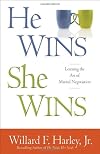
This book is just as devoid of the Gospel as His Needs, Her Needs. Who would I give it to? Probably hard-core atheists who still believe in an idea of "love" and want some principles for maintaining respect and romance through conflict without any principles overtly connected to the Bible. So, should Christians relegate this book to the rubbish bin? Not necessarily. Too often, committed Christians think all will be well if they just put their spouse's needs ahead of their own and submit to show more one another (Philippians 2:3, Ephesians 5:21-33). When conflict or resentment arises, we fall into a "if I would just submit harder," or "if only my spouse would submit like I am..." mentality that doesn't solve the problem. This is where Smalley's book can be useful-- given a Gospel-centered view of marriage and nature, how can I improve our communication and the overall satisfaction of both my mate and myself in marriage? I think evangelicals could also do a better job reading about biology, neurology, behavioral economics and the like to understand how habits develop.
His Needs, Her Needs operated from a clearly Freudian foundation and this book is no different. Much of it revolves around the man's sexual satisfaction as the base of marital happiness. Harley has a PhD in psychology and a long-time marriage counselor; he opens the book with a look at neuropsychology and how the brains of men and women are biologically different. These differences explain differences in perceptions, judgement, decision-making, and personality.
The basic premise: Continual self-sacrifice creates a "win-lose" situation where one spouse may be submissively unhappy with his end of the bargain. So, a wife who submits to her husband's wishes because that's how she understands her role as a wife is likely unhappy about much of it. My personal takeaway from this idea is that in marriage we should not suffer in silence. We should not submit with a silent hope that "I'll go along with what he wants this time, and hopefully he'll reciprocate by doing something I want another time." That's not grace, it's secretly trying to earn merit and hoping for the best, and it's a recipe for bitterness. Harley is right that the spouse submitted to will likely not see the submission as sacrificial and will simply come to expect it. "Of course that's how it should be done," he might say. Instead, a wife (for example) can say "I'll go along with this because I love and respect you. I trust that the consequences of this decision will lead to a happier husband who is also willing to listen to my needs and concerns and help me out as well. But let's sit down and work out something we can both be happy with."
"Don't be a dictator," writes Harley. Too often spouses play "dual dictator" roles, playing a game of tit-for-tat over how something should be done. You will each be in an "I told you so!" mode, which is unhelpful. Harley advocates a "democratic marriage" in which both parties win and decisions aren't made unless both parties can be in "enthusiastic agreement" about the decision. He refers back to the "love bank" idea of His Needs, Her Needs-- win-win agreements allow couples to make simultaneous deposits in the others' love bank.
Reluctant agreement on issues is "dangerous" and "enthusiastic agreement" is a "must." As a practical example, Harley recommends grocery shopping together without the kids frequently. Fill the cart with things you know you'll both be enthusiastic about eating. Then, allow for some experimentation--the wife can pick a couple things she's most confident the husband will like if he just tries it. If he doesn't like it, it never gets bought again. Only buy things you will both be happy about.
Now, think about the impractical nature of this for a minute (I owe this critique to my wife). What if there is a particular food allergy one spouse has, or one is a vegetarian? Should they only buy foods they both really want? Harley allows for the rule to be broken in times of urgency or medical emergency. But, in general, he seems to be saying that husband and wife should always eat together and never differ in their choices. Separate interests are listed as "harmful," and Harley encourages husbands to find activities that the wife enjoys doing to. Trading horses by saying "I'm going bowling with the guys tonight, and you can go shopping with the girls tomorrow" are two different win-lose situations-- they violate Harley's rule and he discourages such trade-offs. Harley applies this thinking to career decisions as well, pursuing a career because you're gifted at it or you particularly like it is not a good enough reason-- you should only do it if both you and your spouse agree on how the career affects each other. Remember, no self-sacrifice of one spouse putting career behind the other--at least for the long-haul (his wife worked while he finished his PhD).
The other practical problem is with "enthusiastic agreement." How many times do you make a decision that you're truly "enthusiastic" about? I approach decisions with probability in mind: there is uncertainty what the result of the decision will be and how happy either of us will be with the outcome. We'll likely be revisiting this decision down the road and adjusting or wishing we'd done something differently. When writing about how to meet others' needs when you are not enthusiastic about it, Harley gives somewhat of a cop-out in the form of self-sacrifice called something else. He basically says "enjoy the consequences" you'll have of having a happier spouse. Communicate about it and see if you can reach a different arrangement in areas where you're unhappy.
Harley gives some principles of negotiation. Negotiation can only happen when you've established a framework that you guarantee the others' safety and be kind. Ground rules include being "pleasant and cheerful" throughout negotiations. If you reach an impasse, come back to the table later. There has to be trust, in other words. First, both sides need to come to the table knowing what he/she wants. (This also might be unrealistic if one spouse feels strongly about the issue more than the other, see the "enthusiastic" critique above). Ask "How would you feel if...?" questions to introduce what you want. Brainstorm together, use a notebook to record ideas. What are the possible alternatives? Lastly, among the alternatives listed, "reach enthusiastic agreement" about one.
You can read these guidelines and other themes of Harley's books at his website. http://www.marriagebuilders.com/graphic/mbi3550_summary.html
Harley concludes the book with an application to sex, time with extended family, and basic budgeting. He reminds the reader that his system demands no fewer than 15 hours of undivided attention for your spouse each week.
In all, I give this book 2 stars out of 5. It was much shorter than His Needs, Her Needs but has the same fundamental flaw of an unbiblical worldview and absence of the Gospel. I gleaned a few good points about communication and negotiation, but recognize that much of what he writes about "enthusiastic agreement" is unrealistic. It is a publish-or-perish world out there, so I guess Harley has to keep cranking little books like this out to maintain an income flow. show less
His Needs, Her Needs operated from a clearly Freudian foundation and this book is no different. Much of it revolves around the man's sexual satisfaction as the base of marital happiness. Harley has a PhD in psychology and a long-time marriage counselor; he opens the book with a look at neuropsychology and how the brains of men and women are biologically different. These differences explain differences in perceptions, judgement, decision-making, and personality.
The basic premise: Continual self-sacrifice creates a "win-lose" situation where one spouse may be submissively unhappy with his end of the bargain. So, a wife who submits to her husband's wishes because that's how she understands her role as a wife is likely unhappy about much of it. My personal takeaway from this idea is that in marriage we should not suffer in silence. We should not submit with a silent hope that "I'll go along with what he wants this time, and hopefully he'll reciprocate by doing something I want another time." That's not grace, it's secretly trying to earn merit and hoping for the best, and it's a recipe for bitterness. Harley is right that the spouse submitted to will likely not see the submission as sacrificial and will simply come to expect it. "Of course that's how it should be done," he might say. Instead, a wife (for example) can say "I'll go along with this because I love and respect you. I trust that the consequences of this decision will lead to a happier husband who is also willing to listen to my needs and concerns and help me out as well. But let's sit down and work out something we can both be happy with."
"Don't be a dictator," writes Harley. Too often spouses play "dual dictator" roles, playing a game of tit-for-tat over how something should be done. You will each be in an "I told you so!" mode, which is unhelpful. Harley advocates a "democratic marriage" in which both parties win and decisions aren't made unless both parties can be in "enthusiastic agreement" about the decision. He refers back to the "love bank" idea of His Needs, Her Needs-- win-win agreements allow couples to make simultaneous deposits in the others' love bank.
Reluctant agreement on issues is "dangerous" and "enthusiastic agreement" is a "must." As a practical example, Harley recommends grocery shopping together without the kids frequently. Fill the cart with things you know you'll both be enthusiastic about eating. Then, allow for some experimentation--the wife can pick a couple things she's most confident the husband will like if he just tries it. If he doesn't like it, it never gets bought again. Only buy things you will both be happy about.
Now, think about the impractical nature of this for a minute (I owe this critique to my wife). What if there is a particular food allergy one spouse has, or one is a vegetarian? Should they only buy foods they both really want? Harley allows for the rule to be broken in times of urgency or medical emergency. But, in general, he seems to be saying that husband and wife should always eat together and never differ in their choices. Separate interests are listed as "harmful," and Harley encourages husbands to find activities that the wife enjoys doing to. Trading horses by saying "I'm going bowling with the guys tonight, and you can go shopping with the girls tomorrow" are two different win-lose situations-- they violate Harley's rule and he discourages such trade-offs. Harley applies this thinking to career decisions as well, pursuing a career because you're gifted at it or you particularly like it is not a good enough reason-- you should only do it if both you and your spouse agree on how the career affects each other. Remember, no self-sacrifice of one spouse putting career behind the other--at least for the long-haul (his wife worked while he finished his PhD).
The other practical problem is with "enthusiastic agreement." How many times do you make a decision that you're truly "enthusiastic" about? I approach decisions with probability in mind: there is uncertainty what the result of the decision will be and how happy either of us will be with the outcome. We'll likely be revisiting this decision down the road and adjusting or wishing we'd done something differently. When writing about how to meet others' needs when you are not enthusiastic about it, Harley gives somewhat of a cop-out in the form of self-sacrifice called something else. He basically says "enjoy the consequences" you'll have of having a happier spouse. Communicate about it and see if you can reach a different arrangement in areas where you're unhappy.
Harley gives some principles of negotiation. Negotiation can only happen when you've established a framework that you guarantee the others' safety and be kind. Ground rules include being "pleasant and cheerful" throughout negotiations. If you reach an impasse, come back to the table later. There has to be trust, in other words. First, both sides need to come to the table knowing what he/she wants. (This also might be unrealistic if one spouse feels strongly about the issue more than the other, see the "enthusiastic" critique above). Ask "How would you feel if...?" questions to introduce what you want. Brainstorm together, use a notebook to record ideas. What are the possible alternatives? Lastly, among the alternatives listed, "reach enthusiastic agreement" about one.
You can read these guidelines and other themes of Harley's books at his website. http://www.marriagebuilders.com/graphic/mbi3550_summary.html
Harley concludes the book with an application to sex, time with extended family, and basic budgeting. He reminds the reader that his system demands no fewer than 15 hours of undivided attention for your spouse each week.
In all, I give this book 2 stars out of 5. It was much shorter than His Needs, Her Needs but has the same fundamental flaw of an unbiblical worldview and absence of the Gospel. I gleaned a few good points about communication and negotiation, but recognize that much of what he writes about "enthusiastic agreement" is unrealistic. It is a publish-or-perish world out there, so I guess Harley has to keep cranking little books like this out to maintain an income flow. show less
His Needs, Her Needs: Building an Affair-Proof Marriage Fifteenth Anniversary Edition by Willard F.Jr. Harley
This book has some value points and I think accurately describe what are commonly men's and women's desires. I think this book can help partners understand the others desires which helps inform how to love them in a way that they feel loved. The flaw in the book is calling these "desires" people have "needs", and failing to recognize that when these "needs" aren't met, that it is a an opportunity to grow. We are not beasts driven by our passions and hungers.
You May Also Like


Statistics
- Works
- 35
- Members
- 3,754
- Popularity
- #6,749
- Rating
- 3.8
- Reviews
- 31
- ISBNs
- 111
- Languages
- 3