
Gordon A. Craig (1913–2005)
Author of Germany, 1866-1945
About the Author
Gordon A. Craig is J. E. Wallace Sterling Professor of Humanities Emeritus Stanford University.
Series
Works by Gordon A. Craig
Associated Works
Makers of Modern Strategy: Military Thought from Machiavelli to Hitler (1943) — some editions — 146 copies, 1 review
History of Germany in the nineteenth century : selections from the translation of Eden and Cedar Paul (1975) — Editor, some editions — 8 copies
Tagged
Common Knowledge
- Legal name
- Craig, Gordon Alexander
- Birthdate
- 1913-11-13
- Date of death
- 2005-10-30
- Gender
- male
- Education
- Princeton University (BA, MA, PhD)
University of Oxford (Balliol College) - Occupations
- historian
professor - Organizations
- United States Marine Corps (WWII)
Office of Strategic Services (WWII)
American Historical Association (President, 1982)
Princeton University
Stanford University - Awards and honors
- Pour le Merite
J.E. Wallace Sterling Professor of Humanities (Stanford)
Rhodes Scholar - Short biography
- Gordon Alexander Craig, born in Scotland, emigrated with his family initially to Canada and then to the USA. He became a cultural and diplomatic historian of Germany; his book The Germans was a bestseller in both the USA and Germany and Professor Craig became a celebrity in the German-speaking world.
- Nationality
- UK
USA - Birthplace
- Glasgow, Scotland, UK
- Places of residence
- Toronto, Ontario, Canada
Jersey City, New Jersey, USA - Place of death
- Portola Valley, California, USA
Members
Reviews
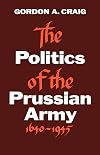
Craig's work still stands as one of the most important studies extant on German militarism. Written during the first two decades after the end of World War II, The Politics of the Prussian Army, also gives burgeoning historians insight into the state of historiography dealing with Germany during this period. It is comprehensive, institutionally oriented, and far afield from the current generation's emphasis on class, sex, and race. Rather, Craig describes not only the Prussianization of the show more German army but the Prussianization of the German nation. At the same time, he also traces the rise of the Prussian/German military as an independent political force, subject to nobody--not even the kaiser during World War I. I don't know if this work is still taught in undergraduate studies or graduate seminars. It should be. show less
This book was the foundation of a class I took on German Operational Art and Military tradition. Unlike the other books in the course (and most of the others that I have read), this book focuses of the political process and the interplay between the King, the Government and the Military rather than purely military matters. My professor wrote: Craig is a master historian, and his version of Prussian history has become the standard in the field. No sound study of Prussia can be made without show more Gordon Craig’s incisive analysis and commentary. Nevertheless, Craig’s style is not without fault. He often marginalizes people, choosing instead to write that ideas and events often shaped the personalities, rather than the personalities shaping the events. This is particularly true when Craig seeks to show that the Prussian Army was continually the obstacle to social and political reform. Indeed, Craig sees Prussian history as a continuous constitutional struggle between those seeking an English constitutional monarchy with those wanting absolutism. But Prussia was an alliance between king and nobility; liberalism was not fashionable even to the middle class, given the neighbors of Prussia. All of which is absolutely true, and yet, he managed to make the political process, often a tedious thing to me, interesting and engaging. You feel like, during the course of the book, that if you could reach in and fix a few things, history might have turned out very differently. show less

Very dry. Narrative is very boring. Hard to follow. However very detailed and we'll researched.
Great book! Discusses the interplay between the Prussian Army, the Crown and the population. From 1640 on the army was a separate entity in Prussia, later Imerial Germany. Loyal only to the Crown, and standing in the way of any liberal change in the nation. The book also focuses on how the army influenced internal and foreign policy in general. Without giving away too much....the army continued in this manner until the arrival on the scene of Adolph Hitler. Apparently AH was the only one to show more figure out how to curb and then donimate the German Army. All this resulted in disaster for Reich.
The only reason I did not give the book 5 Stars is that Gordon Craig is one of those authors that thinks EVERYONE speaks and reads German and French. His book is laced with phrases in primarily German, but also French. He gives no translations. I find this extremely frustrating. This style really takes away from my experience reading a book. How much do I miss by not reading German/French? I don't know. I am one of those readers who actually reads footnotes. When they are in German/French, I am out. show less
The only reason I did not give the book 5 Stars is that Gordon Craig is one of those authors that thinks EVERYONE speaks and reads German and French. His book is laced with phrases in primarily German, but also French. He gives no translations. I find this extremely frustrating. This style really takes away from my experience reading a book. How much do I miss by not reading German/French? I don't know. I am one of those readers who actually reads footnotes. When they are in German/French, I am out. show less
Lists
Awards


You May Also Like


Associated Authors
Statistics
- Works
- 36
- Also by
- 3
- Members
- 1,670
- Popularity
- #15,388
- Rating
- 3.9
- Reviews
- 13
- ISBNs
- 83
- Languages
- 2
