
Anna Deavere Smith
Author of Twilight: Los Angeles, 1992
About the Author
Anna Deavere Smith is an acclaimed actress, playwright, author, and teacher. Smith rose to prominence with her verbatim theater pieces Fires in the Mirror and Twilight: Los Angeles 1992. She is also known for her performances in the films The American President, Philadelphia, and Rachel Getting show more Married, and her recurring roles on TV's black-ish, The West Wing, and Nurse Jackie. Smith is the recipient of the MacArthur "Genius" Fellowship, two Tony nominations, and she was a finalist for the Pulitzer Prize in Drama. She received the 2012 National Humanities Award from President Obama. show less
Works by Anna Deavere Smith
Letters to a Young Artist: Straight-up Advice on Making a Life in the Arts-For Actors, Performers, Writers, and Artists of Every Kind (2006) 187 copies, 2 reviews
House Arrest: A Search for American Character in and around the White House, Past and Present (2002) 9 copies
Smith, Anna Deavere Archive 1 copy
Associated Works
With Their Eyes: September 11th: The View from a High School at Ground Zero (2002) — Foreword, some editions — 175 copies, 3 reviews
Extreme Exposure: An Anthology of Solo Performance Texts from the Twentieth Century (1999) — Contributor — 92 copies
Black Genius: African American Solutions to African American Problems (1999) — Contributor — 72 copies
A Way Out of No Way: Writing about Growing Up Black in America (1996) — Contributor — 34 copies, 2 reviews
Race, Gender, and Power in America: The Legacy of the Hill-Thomas Hearings (1995) — Contributor — 22 copies
Tagged
Common Knowledge
- Birthdate
- 1950-09-18
- Gender
- female
- Occupations
- playwright
actor - Awards and honors
- National Humanities Medal (2012)
- Nationality
- USA
- Associated Place (for map)
- USA
Members
Reviews
Letters to a Young Artist: Straight-up Advice on Making a Life in the Arts-For Actors, Performers, Writers, and Artists of Every Kind by Anna Deavere Smith
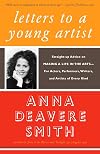
ADS doesn't waste time with wimpy, elementary, or patronizing tips and inspirations for an artist. Peppered economically with personal anecdotes, each essay instructs fundamental, practical, and philosophically persuasive work for an artist to do. She addresses process, feelings, sociality of art, business, physiology, responsibility, joy, belief, and so many specific tasks and values. Even while engaging many familiar ideas, I kept finding myself wanting to share and practice what I was show more hearing, as well as to occasionally practice a little push back. I would almost literally jump at a chance to sit and listen and talk with ADS about teaching and mentoring and work and art. And young artists. The book is passionately no-nonsense. (I also can't help picturing her delivering these letters in the style of the formidable National Security Advisor Dr McNally's interrupted-gala-dressed entrance to the Situation Room, WW S2E1, "Good evening everybody. Mike, could you have somebody send over some clothes from my office, please? I look like an idiot.") I recommend the audio version, read by the author. show less

World Premiere run: Berkeley Repertory Theatre (2015) in a different form
Length: Full Length Play
The published version of this play is a combination of the original play, later revisions and scenes from the 2018 movie based on it. The play is somewhere between a play and a non-fiction journalistic research - the words used are the ones of real people but they are told by a single actor. I have half a mind checking the movie - I cannot imagine this actually working properly but who knows.
The show more play is part of a bigger project by the author - her series of plays "On the Road: A Search for American Character" had been started in the 1980s. This is the first play by her that I had ever read - and while I am not sure I want to see it, reading it actually works.
The main topic of the play is the school-to-prison pipeline in the US educational system - a topic that cannot be discussed if you do not incorporate the topics of race, mass incarceration and everything around them. Reading it in mid-2021 adds another layer to the whole thing - it made me wonder what else would the author add to this play if it was created today.
As it is, the play covers people from all walks of life - from a high school student who get arrested (for nothing) to a Native American man who finally got released from jail, from activists to judges, from a European teacher to social workers and James Baldwin, closing with the late John Lewis. It is a series of interviews without questions; real speeches and interviews (some published, some not), collected together into a narrative that looks disjointed but somehow manages to become a complete piece at the end.
The format is unconventional and I am still not sure it was the most effective one - I would have preferred a complete book, containing the same images and words but also containing some analysis. It it somehow works - it makes you stop and think and consider - and maybe as with most social commentary plays, that's what makes it powerful.
I wish that this play will read dated and irrelevant in less than a decade. Unfortunately I suspect that even decades from now, it will sound fresh and topical. And that is a shame.
Highly recommended. show less
Length: Full Length Play
The published version of this play is a combination of the original play, later revisions and scenes from the 2018 movie based on it. The play is somewhere between a play and a non-fiction journalistic research - the words used are the ones of real people but they are told by a single actor. I have half a mind checking the movie - I cannot imagine this actually working properly but who knows.
The show more play is part of a bigger project by the author - her series of plays "On the Road: A Search for American Character" had been started in the 1980s. This is the first play by her that I had ever read - and while I am not sure I want to see it, reading it actually works.
The main topic of the play is the school-to-prison pipeline in the US educational system - a topic that cannot be discussed if you do not incorporate the topics of race, mass incarceration and everything around them. Reading it in mid-2021 adds another layer to the whole thing - it made me wonder what else would the author add to this play if it was created today.
As it is, the play covers people from all walks of life - from a high school student who get arrested (for nothing) to a Native American man who finally got released from jail, from activists to judges, from a European teacher to social workers and James Baldwin, closing with the late John Lewis. It is a series of interviews without questions; real speeches and interviews (some published, some not), collected together into a narrative that looks disjointed but somehow manages to become a complete piece at the end.
The format is unconventional and I am still not sure it was the most effective one - I would have preferred a complete book, containing the same images and words but also containing some analysis. It it somehow works - it makes you stop and think and consider - and maybe as with most social commentary plays, that's what makes it powerful.
I wish that this play will read dated and irrelevant in less than a decade. Unfortunately I suspect that even decades from now, it will sound fresh and topical. And that is a shame.
Highly recommended. show less
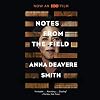
Notes from the Field is essentially the script from the stage play of the same name. Anna Deavere Smith toured, interviewing numerous people about their roles in life in the USA. They include the woman who climbed the pole to tear down the South Carolina rebel flag, the girl involved in the roughing up and arrest of a classmate who refused to leave her seat, the man who taped the Freddie Gray murder, the Congressman who marched in Selma, as well as people who try to help people. Her focus is show more the school-to-prison pipeline the country is becoming famous for.
This book is a complement to the HBO special the play has also been made into. Anna Deavere Smith plays all the roles, speaking the storytellers’ words and assuming their personas. It expands the litany of persecution, racism, neglect and injustice in the United States today. The book is immensely moving.
It is far more moving than the play, which four of us saw at Second Stage in New York in 2016. We were underwhelmed, for all the wrong reasons, it turns out. Smith was less than convincing and authentic. She is after all, a middle aged white woman. She played black teenagers, protestors, a Congressman, a convict, whites, blacks, and a Salvadoran, and all with truly minor additions to costume. We found ourselves trying too hard to appreciate her effort. She adopted accents and cadences, mimicked their postures and attitudes, and reproduced the hand and head movements of her storytellers. We wanted to appreciate how she and the bass player who was the only other person onstage, worked with each other as the stories unfolded.
We watched all those details in an attempt to assign kudos if not genius to the effort, because it reflected a huge amount of work by Smith. But it wasn’t all that impressive. Worse, we thereby missed the impact of what the storytellers had to say through her, which was the point of it all. We left unsatisfied.
So I’ve never thought about it again, but was curious to read what I might have missed when this book was offered.
The book notes all those postures and attitudes, and recreates the cadences and linguistic styles in print, so that readers can be right there, and appreciate the storytellers for who they are, what they have to say and how they say it. To me, it is more valuable than seeing it live. Unlike the play, the book is valuable, informative and unforgettable.
David Wineberg show less
This book is a complement to the HBO special the play has also been made into. Anna Deavere Smith plays all the roles, speaking the storytellers’ words and assuming their personas. It expands the litany of persecution, racism, neglect and injustice in the United States today. The book is immensely moving.
It is far more moving than the play, which four of us saw at Second Stage in New York in 2016. We were underwhelmed, for all the wrong reasons, it turns out. Smith was less than convincing and authentic. She is after all, a middle aged white woman. She played black teenagers, protestors, a Congressman, a convict, whites, blacks, and a Salvadoran, and all with truly minor additions to costume. We found ourselves trying too hard to appreciate her effort. She adopted accents and cadences, mimicked their postures and attitudes, and reproduced the hand and head movements of her storytellers. We wanted to appreciate how she and the bass player who was the only other person onstage, worked with each other as the stories unfolded.
We watched all those details in an attempt to assign kudos if not genius to the effort, because it reflected a huge amount of work by Smith. But it wasn’t all that impressive. Worse, we thereby missed the impact of what the storytellers had to say through her, which was the point of it all. We left unsatisfied.
So I’ve never thought about it again, but was curious to read what I might have missed when this book was offered.
The book notes all those postures and attitudes, and recreates the cadences and linguistic styles in print, so that readers can be right there, and appreciate the storytellers for who they are, what they have to say and how they say it. To me, it is more valuable than seeing it live. Unlike the play, the book is valuable, informative and unforgettable.
David Wineberg show less
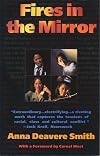
Although this was definitely meant to be staged as opposed to read, it's still worth discovering as a reader since subtleties of character are explored (and in some cases explained or defended, in relation to the writer's choices as based on the real people who are characters are based off of). It does start off slowly. Since the beginning of the book examine the context of the play, and the deaths that set off the Crown Hill riots in the early 90s, the reader is invested in those events. show more The beginning of the play itself, though, after setting out the deaths, takes a step back to discover Jewish and African American life in the area, before moving forward to what the reader was expecting. The choice makes sense, in terms of power and in terms of the writer's goal, but it does make for something of a slow-down, and I have to admit that I also felt the last pieces of the play were short in comparison. That said, I have a feeling the introductions have something to do with that--they built up Smith's project and the play in such a way that I was expecting a lot, whereas I might have been more impressed with the play itself had I not read those introductions. They are worthwhile, and there's nothing to really be given away a might happen with another work's introduction, but it's worth noting for readers who are heading into this. Of course, whether or not the play would be so powerful without some of that extra understanding... well, it's a catch-22, I suppose.
Nevertheless, I'm glad to have found my way to the play, and I'd certainly recommend it to readers who are interested in the events/relations at the heart of it, or interested in documentary-type and interview-based performance pieces. show less
Nevertheless, I'm glad to have found my way to the play, and I'd certainly recommend it to readers who are interested in the events/relations at the heart of it, or interested in documentary-type and interview-based performance pieces. show less
Lists
Awards


You May Also Like


Associated Authors
Statistics
- Works
- 18
- Also by
- 13
- Members
- 1,179
- Popularity
- #21,802
- Rating
- 3.9
- Reviews
- 8
- ISBNs
- 37