
Robert A. Heinlein (1907–1988)
Author of Starship Troopers
About the Author
Robert Anson Heinlein was born on July 7, 1907 in Butler, Mo. The son of Rex Ivar and Bam Lyle Heinlein, Robert Heinlein had two older brothers, one younger brother, and three younger sisters. Moving to Kansas City, Mo., at a young age, Heinlein graduated from Central High School in 1924 and show more attended one year of college at Kansas City Community College. Following in his older brother's footsteps, Heinlein entered the Navel Academy in 1925. After contracting pulmonary tuberculosis, of which he was later cured, Heinlein retired from the Navy and married Leslyn MacDonald. Heinlein was said to have held jobs in real estate and photography, before he began working as a staff writer for Upton Sinclair's EPIC News in 1938. Still needing money desperately, Heinlein entered a writing contest sponsored by the science fiction magazine Thrilling Wonder Stories. Heinlein wrote and submitted the story "Life-Line," which went on to win the contest. This guaranteed Heinlein a future in writing. Using his real name and the pen names Caleb Saunders, Anson MacDonald, Lyle Monroe, John Riverside, and Simon York, Heinlein wrote numerous novels including For Us the Living, Methuselah's Children, and Starship Troopers, which was adapted into a big-budget film for Tri-Star Pictures in 1997. The Science Fiction Writers of America named Heinlein its first Grand Master in 1974, presented 1975. Officers and past presidents of the Association select a living writer for lifetime achievement. Also, the Science Fiction and Fantasy Hall of Fame inducted Heinlein in 1998. Heinlein died in 1988 from emphysema and other related health problems. Heinlein's remains were scattered from the stern of a Navy warship off the coast of California. (Bowker Author Biography) show less
Series
Works by Robert A. Heinlein
Off the Main Sequence: The Other Science Fiction Stories of Robert A. Heinlein (2005) 239 copies, 2 reviews
Infinite Possibilities: Tunnel in the Sky, Time for the Stars, Citizen of the Galaxy (2002) 204 copies, 4 reviews
To The Stars: Between Planets, The Rolling Stones, Starman Jones, The Star Beast (2004) 183 copies, 2 reviews
Outward Bound: Have Space Suit—Will Travel, Starship Troopers, Podkayne of Mars (2006) 145 copies, 1 review
Stranger in a Strange Land 103 copies
Chroniken der Zukunft II. Revolte auf Luna / Die dunklen Wüsten des Titan / Das letzte Sternenschiff. (1984) 19 copies
Robert Heinlein presenta Tropas del espacio ; Robert Heinlein presenta Las 100 vidas de Lazarus Long (1987) 10 copies
Forastero en tierra extraña I 10 copies
The Future Worlds of Robert A. Heinlein: The Star Beast; Tunnel in the Sky; The Rolling Stones; Rocket Ship Galileo (Box Set) (1978) 9 copies
Farmer im All / Die Feuerteufel / Spion aus der Zukunft. Drei Science Fiction Romane in einem Band. (1990) 8 copies
Robert A. Heinlein 5 Book Box Set Including: Revolt in 2100 the Man Who Sold the Moon, Menace From Earth Double Star, and Puppet Masters (1956) 7 copies
Science Fiction Omnibus Bruna (1969) 5 copies
Himmelstorm : noveller av James Blish, Robert A. Heinlein og A. E. van Vogt ; presentert av Jon Bing og Tor Åge Bringsværd (1974) — Author — 5 copies
The Last Days Of The United States 5 copies
The Man From U.N.C.L.E. (UNCLE) Magazine January 1967 "The Light-Kill Affair" Robert A. Heinlein Story (1967) 5 copies
O Mundo Que Nos Espera/2 5 copies
Science fiction verhalen 2 4 copies
Nearly Complete Collection 4 copies
Short Stories by Robert A. Heinlein (Study Guide): -all You Zombies-, by His Bootstraps, -we Also Walk Dogs, the Roads Must Roll (2010) 4 copies
O gato que atravessa as paredes - 2 4 copies
New Worlds To Conquer 4 copies
The Good News of High Frontier 4 copies
O Número do Monstro/3 3 copies
O número do monstro - 3 3 copies
How to Be A Survivor 3 copies
Heil! 3 copies
Rotostrada n. 20 e altri racconti 3 copies
Time Enough for Love, Volume 1 3 copies
O número do monstro - 2 3 copies
O número do monstro - 1 3 copies
No Bands Playing No Flags Flying 3 copies
Short Story Collections by Robert A. Heinlein: The Green Hills of Earth, the Man Who Sold the Moon, Revolt in 2100, the Robert Heinlein Omnibus (2010) 3 copies
Dance Session 3 copies
La storia futura - Volume 4 3 copies
O Gato que Atravessa as Paredes - 1 2 copies
O Mundo Que Nos Espera - 1 2 copies
Todos ustedes, zombies 2 copies
℗O ℗nu mero do monstro 2 copies
Il numero della bestia 2 copies
To The Stars, (4 in 1) the City of the Lost Ones; Forgotten World; the Time Gate; the Sun Maker 2 copies
A Reader's Companion 2 copies
2000x: By His Bootstraps 2 copies
Rocket Ship Galileo [short story] 2 copies
Pied Piper 2 copies
The Future Revisited 2 copies
First Step Outward 2 copies
La Luna è una severa maestra - Parte prima — Author — 2 copies
Pie From The Sky 1 copy
Por sus propios medios 1 copy
Tropas de espacio 1 copy
Revolta na lua - II 1 copy
16 Heinleins 1 copy
??? travel book ?? from LC 1 copy
Nybyggare i rymden 1 copy
Tunnel Through Earth 1 copy
The Past Throught Tomorrow 1 copy
Science fiction verhalen 1 copy
The l-5 Society 1 copy
Interview mit Heinlein 1 copy
O Mundo Que Nos Espera/1 1 copy
Starship Soldiers (Starship Troopers) in The Magazine of Fantasy and Science Fiction October and November 1959. (1959) 1 copy
Science Fiction verhalen 2 1 copy
Дублер = Double Star; Дверь в лето = The Door into Summer / Роберт Хайнлайн; [Пер. с англ. В. Ковалевского и др.] (1999) 1 copy
Гражданин Галактики Ракетный корабль "Галилей" : [Фантаст. романы] / Роберт Хайнлайн; [Пер. с англ. Р… (2000) 1 copy
Science Fiction verhalen 2 1 copy
Science Fiction verhalen 2 1 copy
Science Fiction verhalen 2 1 copy
Science Fiction verhalen 2 1 copy
Science Fiction verhalen 2 1 copy
" Fantasticheskie romany". 1 copy
High Frontier [short story] 1 copy
TITÁN INVADE LA TIERRA 1 copy
Stea dublă 1 copy
L'enfant de la science 1 copy
Kot, który przenika ściany 1 copy
Dubler 1 copy
The Science Fiction Novel 1 copy
Кот, проходящий сквозь стены 1 copy
Нам, живущим 1 copy
Revolta na Lua - Vol 2 1 copy
Fanteria nello spazio 1 copy
Estrada da glória 1 copy
Estrada da Glória (Vol. 2) 1 copy
O Mundo Que Nos Espera I 1 copy
1967 1 copy
La invasión sutil 1 copy
GUERRA NELL'INFINITO 1 copy
Von Stern zu Stern- Outland 1 copy
LA VIA DELLE STELLE. 1 copy
Διάστημα 1999 1 copy
Revolta na Lua 2 1 copy
Revolta na Lua - Vol 1 1 copy
Tʻan hsing shih tai 1 copy
Elsewhere (AKA "Elsewhen") 1 copy
L'enfant de la science 1 copy
Pebble in the Sky 1 copy
Science Fiction Omnibus 1967 1 copy
Nr. 511. Piraten im Weltraum 1 copy
Elsõdiek 1 copy
Gerações do amanhã 1 copy
Life Line. Illustrated 1 copy
℗La ℗porta sull'estate 1 copy
Robert A. Heinlein 3 Books Collection Set (The Moon is a Harsh Mistress, Stranger in a Strange Land, Starship Troopers) (2024) 1 copy
EStrada da glória 2 1 copy
La Luna è una severa maestra - Parte seconda — Author — 1 copy
O mistério de valis / 2 1 copy
Στρατιώτες του σύμπαντος 1 copy
Revolta na Lua 1 1 copy
Ajtó a nyárba 1 copy
o mundo que nos espera 1 1 copy
La luna e' una severa maestra: parte prima: storia della luna dall'eta' coloniale alla Rivoluzione 1 copy
O monstro do espaço 1 copy
La storia futura : volume 3 1 copy
LA STORIA FUTURA VOL4 1 copy
La Storia Futura, Volume 2 1 copy
La storia futura vol. 2 1 copy
O dia depois de amanhã 1 copy
A Hold börtönében 1 copy
Associated Works
The Science Fiction Hall of Fame, Volume One: The Greatest Science Fiction Stories of All Time (1970) — Contributor — 2,111 copies, 34 reviews
This I Believe: The Personal Philosophies of Remarkable Men and Women (2006) — Contributor — 1,147 copies, 36 reviews
The Science Fiction Hall of Fame, Volume Two A: The Greatest Science Fiction Novellas of All Time (1973) — Contributor — 993 copies, 12 reviews
Adventures in Time and Space (1946) — Contributor, some editions; Contributor, some editions — 611 copies, 8 reviews
The Arbor House Treasury of Great Science Fiction Short Novels (1980) — Contributor — 189 copies, 1 review
American Science Fiction: Nine Classic Novels of the 1950s (2012) — Contributor — 122 copies, 3 reviews
Analog Anthology #1: Fifty Years of the Best Science Fiction From Analog (1980) — Contributor — 118 copies, 1 review
The Saturday Evening Post Reader of Fantasy and Science Fiction (1963) — Contributor — 104 copies, 1 review
The Prentice Hall Anthology of Science Fiction and Fantasy (2000) — Contributor — 101 copies, 2 reviews
The Magazine of Fantasy & Science Fiction: A 30-Year Retrospective (1980) — Contributor — 94 copies, 1 review
Dangerous Dimensions: Mind-Bending Tales of the Mathematical Weird (2021) — Contributor — 71 copies, 1 review
Analog Science Fiction/Science Fact: Vol. XCII, No. 5 (January 1974) (1974) — Contributor — 26 copies
Analog Science Fiction/Science Fact: Vol. XCII, No. 2 (October 1973) (1973) — Contributor — 24 copies
Analog Science Fiction/Science Fact: Vol. LXXVIII, No. 4 (December 1966) (1966) — Contributor — 20 copies
Beyond Human Ken: 21 Startling Stories of Science Fiction and Fantasy (1952) — Contributor — 20 copies
Fremde aus dem All. Lübbes Auswahlband. Science Fiction-Geschichten. (1982) — Contributor, some editions — 15 copies
The Magazine of Fantasy and Science Fiction July 1963, Vol. 25, No. 1 (1963) — Contributor — 14 copies
Rejser i tid og rum : en bog om science fiction (1973) — Author, some editions — 12 copies, 1 review
Die Fußangeln der Zeit. Die schönsten Zeitreise- Geschichten I. (1984) — Contributor, some editions — 11 copies
The Magazine of Fantasy and Science Fiction August 1958, Vol. 15, No. 2 (1958) — Contributor — 8 copies
Science fiction omnibus 5 copies
Faseskift : science fiction noveller : et udvalg (1984) — Author, some editions — 5 copies, 1 review
Amazing Stories Vol. 27, No. 4 [April-May 1953] — Author — 4 copies
Den elektriske myre og andre science fiction-fortællinger (1984) — Author, some editions — 2 copies, 1 review
Avontuur in ruimte & tijd nummer 1 — Contributor — 1 copy
Tagged
Common Knowledge
- Legal name
- Heinlein, Robert Anson
- Other names
- Heinlein, R. A.
MacDonald, Anson
Monroe, Lyle
Riverside, John
Saunders, Caleb
York, Simon - Birthdate
- 1907-07-07
- Date of death
- 1988-05-08
- Gender
- male
- Education
- United States Naval Academy (B.Eng.|1929)
- Occupations
- novelist
short story writer
essayist
screenwriter
naval officer
aeronautical engineer - Organizations
- United States Navy
Science Fiction and Fantasy Writers of America - Awards and honors
- SFWA Grand Master (1974)
SF Hall Of Fame (Posthumous Inductee, 1998)
Forry Award, Los Angeles Science Fantasy Society (1980) - Relationships
- Heinlein, Virginia (wife)
- Short biography
- Robert Anson Heinlein was born in July 1907, in Missouri. A military career was ended by tuberculosis in 1934. After a brief attempt at politics, he became a hugely prolific science fiction author, writing novels and short stories until his death in 1988.Robert Anson Heinlein July 7, 1907 – May 8, 1988) was an American science-fiction author, aeronautical engineer, and retired Naval officer. Sometimes called the "dean of science fiction writers", he was among the first to emphasize scientific accuracy in his fiction, and was thus a pioneer of the subgenre of hard science fiction. His published works, both fiction and non-fiction, express admiration for competence and emphasize the value of critical thinking. His work continues to have an influence on the science-fiction genre, and on modern culture more generally.
Heinlein became one of the first American science-fiction writers to break into mainstream magazines such as The Saturday Evening Post in the late 1940s. He was one of the best-selling science-fiction novelists for many decades, and he, Isaac Asimov, and Arthur C. Clarke are often considered the "Big Three" of English-language science fiction authors. Notable Heinlein works include Stranger in a Strange Land, Starship Troopers (which helped mold the space marine and mecha archetypes) and The Moon Is a Harsh Mistress. His work sometimes had controversial aspects, such as plural marriage in The Moon is a Harsh Mistress, militarism in Starship Troopers and technologically competent women characters that were strong and independent, yet often stereotypically feminine – such as Friday.
A writer also of numerous science-fiction short stories, Heinlein was one of a group of writers who came to prominence under the editorship (1937–1971) of John W. Campbell at Astounding Science Fiction magazine, though Heinlein denied that Campbell influenced his writing to any great degree.
Heinlein used his science fiction as a way to explore provocative social and political ideas, and to speculate how progress in science and engineering might shape the future of politics, race, religion, and sex. Within the framework of his science-fiction stories, Heinlein repeatedly addressed certain social themes: the importance of individual liberty and self-reliance, the nature of sexual relationships, the obligation individuals owe to their societies, the influence of organized religion on culture and government, and the tendency of society to repress nonconformist thought. He also speculated on the influence of space travel on human cultural practices.
Heinlein was named the first Science Fiction Writers Grand Master in 1974. Four of his novels won Hugo Awards. In addition, fifty years after publication, seven of his works were awarded "Retro Hugos"—awards given retrospectively for works that were published before the Hugo Awards came into existence. In his fiction, Heinlein coined terms that have become part of the English language, including grok, waldo and speculative fiction, as well as popularizing existing terms like "TANSTAAFL", "pay it forward", and "space marine". He also anticipated mechanical computer-aided design with "Drafting Dan" and described a modern version of a waterbed in his novel Beyond This Horizon. In the first chapter of the novel Space Cadet he anticipated the cell phone, 35 years before Motorola invented the technology. Several of Heinlein's works have been adapted for film and television. - Cause of death
- emphysema
- Nationality
- USA
- Birthplace
- Butler, Missouri, USA
- Places of residence
- Butler, Missouri, USA
Kansas City, Missouri, USA
Los Angeles, California, USA
Bonny Doon, California, USA
Carmel, California, USA
Colorado, USA - Place of death
- Carmel, California, USA
- Burial location
- cremated (Ashes spread in the Pacific)
- Associated Place (for map)
- California, USA
Members
Discussions
Feet Are Hard... in Good Show Sir! — bad science fiction and fantasy covers (June 9)
Revolt in 2100 in Good Show Sir! — bad science fiction and fantasy covers (November 2025)
The Puppet Masters in Good Show Sir! — bad science fiction and fantasy covers (November 2025)
Heinlein didn't deserve this in Good Show Sir! — bad science fiction and fantasy covers (July 2025)
Is that you, Heinlein? in Good Show Sir! — bad science fiction and fantasy covers (August 2024)
Heinlein - yay or nay? in Science Fiction Fans (January 2023)
Reviews
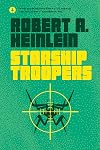
***Re-read November 2021 for a book club
I've read this book in my early twentieth, but apart from the general idea of a hero waging a war on some bug-like aliens I didn't remember a thing. So the re-read was in many ways a rediscovery of this book for me.
Short, fast-pacing and with some exhilarating battle scenes this book actually has very little plot movements. The hero, young man Juan Rico, in a spur of the moment decides to enlist and the apparent drive to this decision is his desire to show more get a franchise, which is limited to people who served in the military for a period of two years. The bigger part of the text is dedicated to discussing some moral and philosophical points of social organization. While the aggressive anti-communist position is understandable for an American author writing during the Cold War, some other ideas are really mind boggling.
One is the clear idolizing of the military in general and the over-the-board promotion of the battle experience as the epitome of feelings and the ultimate way to understanding the meaning of life and everything. This is especially troubling for a book written so soon after the World War II.
Another is the statement that any contact with another sentient civilization has to result in war.
Yet another, and the most troubling for me, is the social structure of the depicted society. The worldbuilding outside of the military world is very limited and made in few broad strokes.
We're to understand, that all the important governmental positions can only be taken by the veterans and they're the ones that can vote and be elected. It is mentioned, that the non-franchise citizens are protected by the law, but this is not expanded and I just don't believe there could be a just system that would work in such a society.
There is a corporal punishment, even public corporal punishment both in the military and for the non-franchise for administrative offenses. Rico and one other recruit go through such a public procedure during their military training and the scenes are awful.
There are almost no women in this world. All we know is that women make better pilots and that Rico's mother had to defer to her husband's decisions when it came to writing to her son. And how exactly would they perform public flogging on women?
And there is no opposition movements in this society. The only political decision everyone has to make is either to enlist or not. All the governmental decisions are taken as good and reasonable one, there are no anti-war movements and etc. Have you ever seen a society like this? show less
I've read this book in my early twentieth, but apart from the general idea of a hero waging a war on some bug-like aliens I didn't remember a thing. So the re-read was in many ways a rediscovery of this book for me.
Short, fast-pacing and with some exhilarating battle scenes this book actually has very little plot movements. The hero, young man Juan Rico, in a spur of the moment decides to enlist and the apparent drive to this decision is his desire to show more get a franchise, which is limited to people who served in the military for a period of two years. The bigger part of the text is dedicated to discussing some moral and philosophical points of social organization. While the aggressive anti-communist position is understandable for an American author writing during the Cold War, some other ideas are really mind boggling.
One is the clear idolizing of the military in general and the over-the-board promotion of the battle experience as the epitome of feelings and the ultimate way to understanding the meaning of life and everything. This is especially troubling for a book written so soon after the World War II.
Another is the statement that any contact with another sentient civilization has to result in war.
Yet another, and the most troubling for me, is the social structure of the depicted society. The worldbuilding outside of the military world is very limited and made in few broad strokes.
We're to understand, that all the important governmental positions can only be taken by the veterans and they're the ones that can vote and be elected. It is mentioned, that the non-franchise citizens are protected by the law, but this is not expanded and I just don't believe there could be a just system that would work in such a society.
There is a corporal punishment, even public corporal punishment both in the military and for the non-franchise for administrative offenses. Rico and one other recruit go through such a public procedure during their military training and the scenes are awful.
There are almost no women in this world. All we know is that women make better pilots and that Rico's mother had to defer to her husband's decisions when it came to writing to her son. And how exactly would they perform public flogging on women?
And there is no opposition movements in this society. The only political decision everyone has to make is either to enlist or not. All the governmental decisions are taken as good and reasonable one, there are no anti-war movements and etc. Have you ever seen a society like this? show less
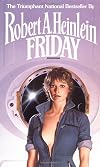
Reading the reviews here on Goodreads, this is clearly a divisive book. Folks seem either to love it or hate it. It was nominated for Hugo, Nebula, Locus SF, and Prometheus awards, although it did not end up winning any of them. While it's not Heinlein's best, I think it's a fairly solid effort.
At its core, the story is about what all good science fiction is about: What does it mean to be human? Friday explores that question in the setting of a futuristic world that is rapidly degrading show more through balkanization and surreptitious control by multinational corporations. The eponymous character, Friday Jones, is an "artificial person" (AP) – what today we would call a genetically engineered person – who has no legal rights, although she is technically free, unlike some APs who are slaves or indentured. As an AP, Friday is stronger and more intelligent than "real" people, and she is also immune to many diseases. However, because of rampant prejudice and fear against APs, she hides her talents as much as possible, relying on them only when necessary. As one might expect, it becomes more necessary to rely on those characteristics as the story continues.
I found the mixture of Friday's superhumanness and subhumanness intriguing. Her constant fear of being found out as an AP is tempered by the knowledge that she can, at any time, perform feats that are impossible for the average person. In one way or another, she is almost never among equals, and societal prejudice (and fear of that prejudice) conspires to scuttle any potential moments when she might otherwise have had a meaningful encounter with another AP. The people she meets are constantly drawing lines, both literally and figuratively, to delineate their tolerance, and far too often Friday finds herself on the opposite side of those lines.
Having grown up in the 1980s, I remember some of the discussions (and fear) about test-tube babies and the supposed horrors they would create. Debates today about genetic modifications and human cloning are descendants of those discussions. Also, the way Heinlein portrays people talking about APs also reminded me of some of the ways people today talk about genetically modified organisms (GMOs), using words like "frankenfoods" to incite fear and cynicism.
Some reviewers have criticized the book for having no clear plot, which doesn't make sense to me. What I think they mean is that there is no singular MacGuffin driving the entire story. But there is most definitely a plot: Friday's discovery of her own humanity. Yes, it meanders sometimes, and there is backtracking and indecision at others. But isn't that the way of it in everybody's life? Who wants a story about someone who goes directly from point A to point B? So what if we never find out the full details about Red Thursday? MacGuffins are fine enough for what they can do, but it is wrong to think that a MacGuffin is required to have a plot worth reading.
There is one piece that requires a little more in-depth analysis, partly because it is controversial, but more importantly because I think it highlights what is wrong with some of the criticism of this novel. However, first I must issue a
Trigger Warning
In Chapter 2, Friday gets gang raped. There is no way to discuss this gently.
A lot of reviewers dislike this scene, and it's understandable why. For one thing, it's an incredibly uncomfortable – if such an inadequate word may be used – scene to read, not merely because it is a rape, but because of the detached way in which Friday handles it. First, she criticizes the act of rape as an outdated method of interrogation: "No professional group uses either beating or rape before interrogation today; there is no profit in it; any professional is trained to cope with either or both." Then, Friday outlines three such coping methods: A) "detach the mind and wait for it to be over"; B) "emulate the ancient Chinese adage" (which adage that may be is never revealed, or at least I didn't pick up on it); and C) use the event "as an opportunity to gain an edge" over one's captors. Finally, Friday transitions from academic theory to application, indicating her choice of method C (with a little B) and explaining her calculated responses to the relative unpleasantness of each of the four men who raped her.
The scene (indeed, the whole chapter, which later subjects Friday to a variety of tortures) is both terrible and terrifying. I was eventually able to integrate only by justification of it being part of the extremely harsh world, run nominally by balkanized states but in reality by multinational corporations, in which Friday lives, works and plays. As she narrates later about the probability of her being killed if she continues with a particular job, "If you don't believe that such things can happen, we aren't living in the same world and there is no point in your reading any more of this memoir." Criticism against the way Friday handles being raped seems largely to ignore the realities of the world in which Friday lives, a world in which it is not only prudent but expected that those who trade in secrets (as she does) be trained to handle such methods. I daresay such training occurs in the primary world – not to say that it is right, but that it happens.
There are some who suggest that this scene shows that Heinlein is dismissive of rape, and that Friday's method of handling being raped is somehow commentary by the author that rape itself is not a big deal or that all women who are raped should respond similarly to Friday. This sort of "crit fic" analysis goes directly against the text. Friday acknowledges that she has suffered "bruises, contusions, and multiple personal indignities – even heartbreaking ones had I been an untrained female" (emphasis added). There is no suggestion in the text that every person should be able to handle such a situation in the same way, or that even having such training and being able to handle gang rape in the way Friday did is a good thing. It is an unfortunate – another inadequate word – part of Friday's world that such occurrences exist, but ignoring their existence does not make them go away. Friday has been trained because it makes sense for her to be, given her career and the world she lives in, but it is absurd to extend that idea to propose that Heinlein thinks all real-life women should treat gang rape the same way as a specially trained, genetically engineered woman who lives in a fictional future does.
More striking than the event itself is the later revelation that one of her rapists (known variously as "Mac," "Pete" and "Percival") is a member of Friday's security detail during an off-planet job. When she confronts him and asks why he participated, Pete says, "I did it because I wanted to. Because you are so sexy you could corrupt a Stylite. Or cause Venus to switch to Lesbos. I tried to tell myself I couldn't avoid it. But I [k]new better." This goes against the conventional idea that rape is about power and domination, rather than sex, and the all-to-common excuse that such violation is a compulsion on the part of the perpetrator. In lieu of killing Pete (he even offers to make it look like a suicide), Friday demands various information and explanations from him. She also says that letting her go pee (after the rape, but before the other tortures) was when she decide he was "not totally beyond hope." Later, while making her escape from her employers – whom she deduces are most likely going to kill her once the job is over – Pete helps her, and they eventually get married. That's right: Friday marries one of her rapists. Those who have a problem with how Friday handles the rape scene in situ also dislike these later developments.
Those who criticize this book (and Heinlein) seem to focus more on the fact that Friday has the wrong responses to being gang raped, according to their view, rather than asking why it is that Friday has the reactions she does. Friday is not dehumanized by the assault, nor does she dehumanize her assaulters. Partly this is because she is already dehumanized by the fact of her existence. From the beginning she identifies herself as an Artificial Person, and the entire novel is an exploration of what it means to be human. She travels from place to place seeking to find those who will accept her for who she really is, rather than for the various identities she takes on during the course of her work. It is somewhat ironic that despite this very clear and ubiquitous theme throughout the novel, some readers can't see through their own preconceived notions about rape enough to allow Friday her own thoughts and reactions. show less
At its core, the story is about what all good science fiction is about: What does it mean to be human? Friday explores that question in the setting of a futuristic world that is rapidly degrading show more through balkanization and surreptitious control by multinational corporations. The eponymous character, Friday Jones, is an "artificial person" (AP) – what today we would call a genetically engineered person – who has no legal rights, although she is technically free, unlike some APs who are slaves or indentured. As an AP, Friday is stronger and more intelligent than "real" people, and she is also immune to many diseases. However, because of rampant prejudice and fear against APs, she hides her talents as much as possible, relying on them only when necessary. As one might expect, it becomes more necessary to rely on those characteristics as the story continues.
I found the mixture of Friday's superhumanness and subhumanness intriguing. Her constant fear of being found out as an AP is tempered by the knowledge that she can, at any time, perform feats that are impossible for the average person. In one way or another, she is almost never among equals, and societal prejudice (and fear of that prejudice) conspires to scuttle any potential moments when she might otherwise have had a meaningful encounter with another AP. The people she meets are constantly drawing lines, both literally and figuratively, to delineate their tolerance, and far too often Friday finds herself on the opposite side of those lines.
Having grown up in the 1980s, I remember some of the discussions (and fear) about test-tube babies and the supposed horrors they would create. Debates today about genetic modifications and human cloning are descendants of those discussions. Also, the way Heinlein portrays people talking about APs also reminded me of some of the ways people today talk about genetically modified organisms (GMOs), using words like "frankenfoods" to incite fear and cynicism.
Some reviewers have criticized the book for having no clear plot, which doesn't make sense to me. What I think they mean is that there is no singular MacGuffin driving the entire story. But there is most definitely a plot: Friday's discovery of her own humanity. Yes, it meanders sometimes, and there is backtracking and indecision at others. But isn't that the way of it in everybody's life? Who wants a story about someone who goes directly from point A to point B? So what if we never find out the full details about Red Thursday? MacGuffins are fine enough for what they can do, but it is wrong to think that a MacGuffin is required to have a plot worth reading.
There is one piece that requires a little more in-depth analysis, partly because it is controversial, but more importantly because I think it highlights what is wrong with some of the criticism of this novel. However, first I must issue a
Trigger Warning
In Chapter 2, Friday gets gang raped. There is no way to discuss this gently.
A lot of reviewers dislike this scene, and it's understandable why. For one thing, it's an incredibly uncomfortable – if such an inadequate word may be used – scene to read, not merely because it is a rape, but because of the detached way in which Friday handles it. First, she criticizes the act of rape as an outdated method of interrogation: "No professional group uses either beating or rape before interrogation today; there is no profit in it; any professional is trained to cope with either or both." Then, Friday outlines three such coping methods: A) "detach the mind and wait for it to be over"; B) "emulate the ancient Chinese adage" (which adage that may be is never revealed, or at least I didn't pick up on it); and C) use the event "as an opportunity to gain an edge" over one's captors. Finally, Friday transitions from academic theory to application, indicating her choice of method C (with a little B) and explaining her calculated responses to the relative unpleasantness of each of the four men who raped her.
The scene (indeed, the whole chapter, which later subjects Friday to a variety of tortures) is both terrible and terrifying. I was eventually able to integrate only by justification of it being part of the extremely harsh world, run nominally by balkanized states but in reality by multinational corporations, in which Friday lives, works and plays. As she narrates later about the probability of her being killed if she continues with a particular job, "If you don't believe that such things can happen, we aren't living in the same world and there is no point in your reading any more of this memoir." Criticism against the way Friday handles being raped seems largely to ignore the realities of the world in which Friday lives, a world in which it is not only prudent but expected that those who trade in secrets (as she does) be trained to handle such methods. I daresay such training occurs in the primary world – not to say that it is right, but that it happens.
There are some who suggest that this scene shows that Heinlein is dismissive of rape, and that Friday's method of handling being raped is somehow commentary by the author that rape itself is not a big deal or that all women who are raped should respond similarly to Friday. This sort of "crit fic" analysis goes directly against the text. Friday acknowledges that she has suffered "bruises, contusions, and multiple personal indignities – even heartbreaking ones had I been an untrained female" (emphasis added). There is no suggestion in the text that every person should be able to handle such a situation in the same way, or that even having such training and being able to handle gang rape in the way Friday did is a good thing. It is an unfortunate – another inadequate word – part of Friday's world that such occurrences exist, but ignoring their existence does not make them go away. Friday has been trained because it makes sense for her to be, given her career and the world she lives in, but it is absurd to extend that idea to propose that Heinlein thinks all real-life women should treat gang rape the same way as a specially trained, genetically engineered woman who lives in a fictional future does.
Those who criticize this book (and Heinlein) seem to focus more on the fact that Friday has the wrong responses to being gang raped, according to their view, rather than asking why it is that Friday has the reactions she does. Friday is not dehumanized by the assault, nor does she dehumanize her assaulters. Partly this is because she is already dehumanized by the fact of her existence. From the beginning she identifies herself as an Artificial Person, and the entire novel is an exploration of what it means to be human. She travels from place to place seeking to find those who will accept her for who she really is, rather than for the various identities she takes on during the course of her work. It is somewhat ironic that despite this very clear and ubiquitous theme throughout the novel, some readers can't see through their own preconceived notions about rape enough to allow Friday her own thoughts and reactions. show less
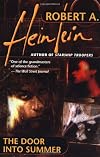
What can I say? This book was charming. Except for one little (kind of not little, actually pretty creepy) quibble, which I will get to later. This is Heinlein, no doubt about it. It has all the trappings: libertarian leanings; benign, rather than openly hostile, sexism (though I wouldn't call this feminist by any means, at least there are female characters who say things and have feelings, even if they ultimately are accessories rather than full people); an eye-rolling horror of the aging show more female form. I mean, I could go on but we know Heinlein, so I won't.
And yet, I loved this book a lot more than any other Heinlein I've read, and not just for what I am pretty sure was a little friendly jab at Asimov about a third of the way in. I loved this book because at its heart, it's a love story between a man and a cat. A kind of douchy but ultimately pretty ok man, and a very cantankerous but extremely lovable cat. And it's a pretty fun and satisfying time travel story, where pretty much everything works out the way you want it to. Also, both 1970 and 2000 are hilarious in their conception.
And yet. Here's that quibble.The relationship between Ricky and Dan disturbs me at best, horrifies me at worst. This is a man who got a young girl who idolizes him and calls him "Uncle Danny" to put herself in cold sleep at the tender age of 21 so that he can marry this perfect paragon who he has groomed. He stays spotless in her memory because he puts himself in cold sleep while she's a little girl, and although it's set up to be her choice whether or not she decides to go into cold sleep and wake up in the future to marry her "Uncle Danny," come ON. It's kind of like if The Doctor had actually married Amy Pond, except in addition to being a constant presence in her childhood he also was a family friend, which: ew.
So...it was a fun time-travel novel and Pete's the best but...that final thing just kind of has ruined it for me. Damnit, Heinlein. show less
And yet, I loved this book a lot more than any other Heinlein I've read, and not just for what I am pretty sure was a little friendly jab at Asimov about a third of the way in. I loved this book because at its heart, it's a love story between a man and a cat. A kind of douchy but ultimately pretty ok man, and a very cantankerous but extremely lovable cat. And it's a pretty fun and satisfying time travel story, where pretty much everything works out the way you want it to. Also, both 1970 and 2000 are hilarious in their conception.
And yet. Here's that quibble.
So...it was a fun time-travel novel and Pete's the best but...that final thing just kind of has ruined it for me. Damnit, Heinlein. show less

Max Jones flees his abusive stepfamily, carrying his late uncle's prized astrogation manuals, which he has memorized. He heads to Earthport hoping to claim his uncle's spot in the exclusive Astrogators' Guild, but finds he has no official inheritance.
He partners with a drifter named Sam. Together, they forge service records and stow away aboard the star cruiser Asgard. Max takes a lowly job in the stewards' department, tending to livestock and pets.
A fatal accident and catastrophic computer show more failures leave the Asgard lost in deep space, stripped of the vital mathematical tables required to pilot the ship. Stepping up in the crisis, Max reveals his photographic memory and deep knowledge of astrogation. He successfully calculates the complex jumps required to rescue the ship, eventually earning his way into the prestigious guild show less
He partners with a drifter named Sam. Together, they forge service records and stow away aboard the star cruiser Asgard. Max takes a lowly job in the stewards' department, tending to livestock and pets.
A fatal accident and catastrophic computer show more failures leave the Asgard lost in deep space, stripped of the vital mathematical tables required to pilot the ship. Stepping up in the crisis, Max reveals his photographic memory and deep knowledge of astrogation. He successfully calculates the complex jumps required to rescue the ship, eventually earning his way into the prestigious guild show less
Lists
current (1)
Geek Books (1)
Lucy's Long List (1)
science fiction (1)
1980 great books (1)
Strange Cities (1)
Read (1)
Swashbucklers (1)
Audio Books (1)
Summer Books (1)
Five star books (1)
. (1)
Very Very Bad (1)
Page Turners (1)
Books with Twins (1)
Generation Ship (1)
Read These Too (1)
Elevenses (3)
Classic Sci-Fi (2)
Fiction For Men (2)
Allie's Wishlist (2)
Read (2)
Books Read in 2017 (15)
Best Young Adult (9)
Favourite Books (5)
1950s (5)
SF Masterworks (4)
1960s (1)
SF - To Read (1)
Best Cyberpunk (1)
SF Masterworks (2)
Unread books (2)
Science Fiction (2)
Solar System (2)
Awards


You May Also Like


Associated Authors
Statistics
- Works
- 456
- Also by
- 177
- Members
- 174,097
- Popularity
- #31
- Rating
- 3.7
- Reviews
- 2,599
- ISBNs
- 2,018
- Languages
- 28
- Favorited
- 727


