
R. A. Lafferty (1914–2002)
Author of Past Master
About the Author
Image credit: DeepSouthCon, 1978.
Series
Works by R. A. Lafferty
The Man Who Walked Through Cracks: The Collected Short Fiction of R.A. Lafferty, volume 5 (2019) 22 copies
Associazione genitori e insegnanti 5 copies
Dieci storie dell'altro mondo 3 copies
Magazine Section 3 copies
La banda di Barnaby Sheen 3 copies
Fantastic Stories Presents the Worlds of If Super Pack #1 (Positronic Super Pack Series Book 29) (2016) 3 copies
Company in the Wings 3 copies
Come si chiamava quella città? 3 copies
Pistolero fuori tempo — Contributor — 3 copies
Short Science Fiction Collection 056 2 copies
Short Science Fiction Collection 058 2 copies
Rainbird 2 copies
Entire and Perfect Chrysolite 2 copies
All Pieces Of A River Shore 2 copies
And Name My Name {short story} 2 copies
Ifrit 2 copies
This Grand Carcass 2 copies
Through Other Eyes 2 copies
Passed Master 1 copy
Snuffles 1 copy
Splinters [short story] 1 copy
Le maître diu passé 1 copy
900 Großmütter Band 2 1 copy
Lafferty Raphael Aloysius 1 copy
Summa Risus 1 copy
Buone notizie dal Vaticano 1 copy
The Forty-Seventh Island 1 copy
Bequest of Wings 1 copy
The Emperor's Shoestrings 1 copy
The Transcendent Tigers 1 copy
Bank And Shoal Of Time 1 copy
La planète ours voleur 1 copy
The All-at-Once Man 1 copy
Brain Fever Season 1 copy
Scorner's Seat {short story} 1 copy
Le Hot Sport {short story} 1 copy
Symposium {short story} 1 copy
町かどの穴 ラファティ・ベスト・コレクション1 1 copy
Associated Works
The Big Book of Science Fiction: The Ultimate Collection (2016) — Contributor — 521 copies, 8 reviews
The Norton Book of Science Fiction: North American Science Fiction, 1960-1990 (1993) — Contributor — 344 copies, 6 reviews
The Year's Best Science Fiction: Third Annual Collection (1986) — Contributor — 250 copies, 1 review
The Year's Best Science Fiction: First Annual Collection (1984) — Contributor — 148 copies, 1 review
American Science Fiction: Four Classic Novels 1968-1969: Past Master / Picnic on Paradise / Nova / Emphyrio (2019) — Contributor — 129 copies, 1 review
The Very Best of Fantasy & Science Fiction, Volume 2 (2014) — Contributor, some editions — 110 copies, 7 reviews
Best Science Fiction Stories of the Year First Annual Collection (1972) — Contributor — 89 copies, 2 reviews
Best Science Fiction Stories of the Year Fourth Annual Collection (1975) — Contributor — 84 copies, 3 reviews
And walk now gently through the fire, and other science fiction stories (1972) — Contributor — 77 copies, 2 reviews
The Best Fantasy Stories from the Magazine of Fantasy & Science Fiction (1985) — Contributor — 77 copies, 2 reviews
Best Science Fiction Stories of the Year Second Annual Collection (1973) — Contributor — 68 copies, 1 review
Beyond Tomorrow: Anthology of Modern Science Fiction (1976) — Contributor, some editions — 55 copies, 1 review
Speculations : 17 Stories Written Especially for This Volume By Well-Known Science Fiction Authors, But Their Names are Concealed By a Code and It's Up to You to Figure Out Who… (1982) — Contributor — 53 copies, 1 review
Light Years and Dark: Science Fiction and Fantasy of and for Our Time (1984) — Contributor — 38 copies
Transformations: Understanding World History Through Science Fiction (1973) — Contributor — 26 copies
The Magazine of Fantasy and Science Fiction October 1982, Vol. 63, No. 4 (1982) — Author — 16 copies
The Magazine of Fantasy and Science Fiction October 1967, Vol. 33, No. 4 (1967) — Contributor — 14 copies
Galaxy Science Fiction 1973 November, Vol. 34, No. 2 (1973) — Contributor, some editions — 12 copies
Die Fußangeln der Zeit. Die schönsten Zeitreise- Geschichten I. (1984) — Contributor, some editions — 11 copies
Worlds of If Science Fiction 152, January/February 1971 (Vol. 20, No. 9) (1971) — Contributor — 11 copies
Worlds of If Science Fiction 85, December 1964 (Vol. 14, No. 7) (1964) — Contributor, some editions — 7 copies
The Magazine of Fantasy and Science Fiction 68. Mythen der nahen Zukunft. (1984) — Contributor — 7 copies
Short Science Fiction Collection 004 5 copies
Fantastic Imaginings: A Journey Through 3500 Years of Imaginative Writing, Comprising Fantasy, Horror, and Science Fiction (2012) — Contributor — 4 copies
The Best of the Rest 1990: The Best Science Fiction and Fantasy from the Small Press (1992) — Contributor — 2 copies
Millemondi Primavera 2001: Nuove avventure nell'ignoto — Contributor — 2 copies
Bizarrotektyw 1 copy
Tagged
Common Knowledge
- Legal name
- Lafferty, Raphael Aloysius
- Birthdate
- 1914-11-07
- Date of death
- 2002-03-18
- Gender
- male
- Education
- University of Tulsa
- Occupations
- electrical engineer
science fiction writer - Organizations
- United States Army (WWII)
- Awards and honors
- Cordwainer Smith Rediscovery Award (2002)
World Fantasy Award (Life Achievement, 1990)
Ditmar Award finalist (Best Contemporary Writer of Science Fiction ∙ 1969) - Agent
- Virginia Kidd Literary Agency
- Nationality
- USA
- Birthplace
- Neola, Iowa, USA
- Places of residence
- Perry, Oklahoma, USA
Tulsa, Oklahoma, USA - Place of death
- Broken Arrow, Oklahoma, USA
- Burial location
- St. Rose Catholic cemetery, Perry, Oklahoma, USA
- Associated Place (for map)
- Oklahoma, USA
Members
Discussions
Cabell and Religion in The Rabble Discuss Cabell: James Branch Cabell &c (February 2019)
R. A. Lafferty in The Weird Tradition (January 2014)
Reviews

Lafferty, R. A. The Best of R. A. Lafferty. Edited by Jonathan Strahan. Tor, 2019.
R. A. Lafferty, 1914-2002, wrote most of his science fiction between 1960 and 1980. During the 1960s, he worked fulltime as an electrical engineer, but his career literary output was prodigious: 32 novels and 200 short stories. He won Hugo nominations for his first novel and for three of his short stories. The agent who manages his literary estate still holds a cache of unpublished manuscripts.
Each of the show more stories in this collection is introduced by a major writer who has been influenced by him. The list includes Neil Gaiman, John Scalzi, Connie Willis, and Samuel R. Delany, and other well-established writers in the field. They are unanimous in saying that he is a “writer’s writer.” Most are grateful for his influence, but Delany, who began writing about the same time Lafferty did, seems miffed to be so often compared with him. Faulkner had a similar reaction to being compared to James Joyce. As much as other writers admired his work, I bet Lafferty had a lot of rejection slips from editors who did not know what to make of him. His prose style displays a wry, understated sense of humor. It combines a colloquial working-class slang with occasional words that can send readers to the dictionary to check the etymology. His narrative structures are tightly compressed but often have double or triple twists that spin the reader’s head around. There are echoes of fables and folktales from several cultures. The combination often reminds me of such diverse writers as Kurt Vonnegut, Roger Zelazny, Cordwainer Smith, Flannery O’Connor, and John Barth. Lafferty’s bio makes his education seem spotty, but he knew history, languages, science, philosophy, and plains Indian culture. His symbolism is never straightforward and his humor is often undercut by pessimism as characters find that wrestling with the gods is dangerous and that the universe is a much stranger place than they imagined.
Let me discuss just one of the stories—and, warning, I cannot do it without spoilers, and I cannot do it justice. “Sky” begins with a man coming up out of a mine to sell some skydivers some sky. It should bother us a little that one of the skydivers is named Icarus, and one of them seems to be herself almost lighter than air. Their pilot takes them up to a high altitude and they begin to inject, smoke, and snort the sky they bought from the man in the mine. They go higher, talking like hippies on an acid trip that gives them the sense that they are immortal and exist outside time. And maybe they do, and maybe they don’t. Some of the skydivers have chutes. Some don’t. Maybe that matters. Maybe not. And there are more twists to come.
I have not read Lafferty for years, and that is a failing I intend to remedy. This collection of excellent short stories Is a good route back into his work. Lafferty was a unique talent. 5 stars. show less
R. A. Lafferty, 1914-2002, wrote most of his science fiction between 1960 and 1980. During the 1960s, he worked fulltime as an electrical engineer, but his career literary output was prodigious: 32 novels and 200 short stories. He won Hugo nominations for his first novel and for three of his short stories. The agent who manages his literary estate still holds a cache of unpublished manuscripts.
Each of the show more stories in this collection is introduced by a major writer who has been influenced by him. The list includes Neil Gaiman, John Scalzi, Connie Willis, and Samuel R. Delany, and other well-established writers in the field. They are unanimous in saying that he is a “writer’s writer.” Most are grateful for his influence, but Delany, who began writing about the same time Lafferty did, seems miffed to be so often compared with him. Faulkner had a similar reaction to being compared to James Joyce. As much as other writers admired his work, I bet Lafferty had a lot of rejection slips from editors who did not know what to make of him. His prose style displays a wry, understated sense of humor. It combines a colloquial working-class slang with occasional words that can send readers to the dictionary to check the etymology. His narrative structures are tightly compressed but often have double or triple twists that spin the reader’s head around. There are echoes of fables and folktales from several cultures. The combination often reminds me of such diverse writers as Kurt Vonnegut, Roger Zelazny, Cordwainer Smith, Flannery O’Connor, and John Barth. Lafferty’s bio makes his education seem spotty, but he knew history, languages, science, philosophy, and plains Indian culture. His symbolism is never straightforward and his humor is often undercut by pessimism as characters find that wrestling with the gods is dangerous and that the universe is a much stranger place than they imagined.
Let me discuss just one of the stories—and, warning, I cannot do it without spoilers, and I cannot do it justice. “Sky” begins with a man coming up out of a mine to sell some skydivers some sky. It should bother us a little that one of the skydivers is named Icarus, and one of them seems to be herself almost lighter than air. Their pilot takes them up to a high altitude and they begin to inject, smoke, and snort the sky they bought from the man in the mine. They go higher, talking like hippies on an acid trip that gives them the sense that they are immortal and exist outside time. And maybe they do, and maybe they don’t. Some of the skydivers have chutes. Some don’t. Maybe that matters. Maybe not. And there are more twists to come.
I have not read Lafferty for years, and that is a failing I intend to remedy. This collection of excellent short stories Is a good route back into his work. Lafferty was a unique talent. 5 stars. show less
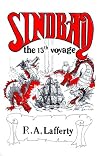
The novel Sindbad: The 13th Voyage is late Lafferty, one of several published in the late 1980s, well after his first stroke had curtailed his writing, and quite possibly banked away in manuscript from the 1970s. It is in a setting that extends back to Lafferty's first novel Past Master (1968) and is used in many of his short stories and some other novels: the Five (or Four) Worlds including the exoplanets Astrobe and Camiroi grouped with Gaea-Earth. In that framework, it is science fiction show more with an espionage plot, and Lafferty indulges in much typical (for him) doubling of characters, feints of identity, and amply-foreshadowed betrayals.
At the same time, the more immediate context as signaled in the title is an Orientalist fantasy riffing on the Thousand and One Nights and set in the ninth century C.E. It dramatizes the succession to the caliphate of Harun al-Rashid in a fabulous magical Baghdad, which is all possibly an intoxicated dream facilitated by "Lady Narkos."
The "true" Sindbad is himself an extraterrestrial from the world Kentauron Mikron, but his identity is occasionally usurped by John Thunderson, a teenager from twentieth-century Chicago who has invented a time machine. These two are the most frequent narrators, but the first chapter introduces a total of four competing narrators, one of whom is Scheherezade Carillo y Krinski, another emigrant from the twentieth century, who claims to "have the universe by the tail." The fourth narrator (first introduced) is the Caliph Mamun the Great.
This kaleidoscopic tale is delightful. If a reader is tempted to suspect that it has wandered somewhat aimlessly into crazy events, perspectives, and rationales, it is only needful to return to the first chapter at the very end, to see how the plan of the story is laid out like a complex mandala. Lafferty's fiction may be something of an acquired taste, but I acquired it a long time ago, and this book satisfies it. show less
At the same time, the more immediate context as signaled in the title is an Orientalist fantasy riffing on the Thousand and One Nights and set in the ninth century C.E. It dramatizes the succession to the caliphate of Harun al-Rashid in a fabulous magical Baghdad, which is all possibly an intoxicated dream facilitated by "Lady Narkos."
The "true" Sindbad is himself an extraterrestrial from the world Kentauron Mikron, but his identity is occasionally usurped by John Thunderson, a teenager from twentieth-century Chicago who has invented a time machine. These two are the most frequent narrators, but the first chapter introduces a total of four competing narrators, one of whom is Scheherezade Carillo y Krinski, another emigrant from the twentieth century, who claims to "have the universe by the tail." The fourth narrator (first introduced) is the Caliph Mamun the Great.
This kaleidoscopic tale is delightful. If a reader is tempted to suspect that it has wandered somewhat aimlessly into crazy events, perspectives, and rationales, it is only needful to return to the first chapter at the very end, to see how the plan of the story is laid out like a complex mandala. Lafferty's fiction may be something of an acquired taste, but I acquired it a long time ago, and this book satisfies it. show less

"The devil has the broadest perspectives for God; therefore he keeps so far away from God--the devil being the most ancient friend of wisdom." (Nietzsche, Beyond Good and Evil, aphorism 129)
I first read The Devil Is Dead over three decades ago, getting it through a suburban Chicago library where I had requested it by inter-library loan; the owner of that volume was the library of Fort Benning, Georgia. I think I requested it solely because I had enjoyed some Lafferty stories that I had read show more in SF magazines and in collections like Orbit, and I was intrigued by the title when I explored the author's bibliography. So, as a high school student, I read this book and loved it.
Of course, I didn't understand it. Given its cryptic attitude, few would on a first reading in any case. I adored the style, and I was fascinated by its profusion of enigmas. Looking back, I see myself as having been woefully unequipped to appreciate both the exoteric and esoteric dimensions of the book, but I could somehow smell them, and they smelled good. In particular, I had not yet visited any of the places in the long itinerary of the protagonist's journey. I was inexperienced in sex and drink. I had not yet studied Roman Catholicism. (Lafferty was a rather devout Catholic.) And perhaps most importantly, I had not yet read Nietzsche.
The very title of this novel is a mirroring of the declaration made by Nietzsche (in The Gay Science and Thus Spake Zarathustra) that "God is dead." But the dialogue between the Catholic Lafferty and the anti-Christian Nietzsche is not so clearly antagonistic as might be assumed. At one point, I paused in my rereading of The Devil Is Dead to look up a reference in Beyond Good & Evil, and I felt as if I were still reading the same book--a tone persisted: jocular, allusive, profound, and riddling, an epigrammatic approach that juxtaposes a garrulous leisure with a laconic urgency. The narrative in The Devil Is Dead is no more naturalistic than the one in Thus Spake Zarathustra, and almost as prone to indulgence in poetry.
Nietzsche refers to the advocatus dei as "honorable" (BG&E 34), and protests, after supposing himself vulgarly accused of disposing of God only to keep the devil, "On the contrary! On the contrary, my friends. And, the devil--who forces you to speak with the vulgar?" (BG&E 37). Lafferty's book is clearly not addressed to the facile enjoyment of "the vulgar." He could say with Nietzsche, "I obviously do everything to be 'hard to understand' myself!" (BG&E 27).
Lafferty's novel concerns "several who are disinclined to stay dead" (9) and "those of a different flesh; and may not you yourself be of that different flesh?" (10) By the book's end, that different flesh has been variously explained as the progeny of the devil, the descendants of Nephilim, or "the old race throwing angry primordials" (212) rather than Nietzsche's anticipated overman, but the essential distinction is that of an "ugly" elite that defines itself over against an insipid mass, and the conflicts among that elite regarding the application of their powers. Lafferty's literary genius was such that his presentation of this "people before the people" echoes both the giants of Rabelais and the "little people" of Arthur Machen, savoring equally of Fortean parapsychological speculation and Platonic political philosophy. They bear on the pulse of their left wrists the mark of the false octopus, which I cannot help but see as a seven-headed beast.
The Devil Is Dead protagonist John "Finnegan" Solli is of the "mixed blood," and for all the emphasis on the distinction of types both in the novel and by Nietzsche, it remains an open question whether any individual is "pure"--regardless of whether this divide is genealogical or "spiritual" in its nature. And it may be this conflict within the people--and behind each person--that propels human effort and accomplishment.
To rewrite Nietzsche's The Gay Science, aphorism 125, with the substitution indicated in Lafferty's title: "The Devil is dead. The Devil remains dead. And we have killed him. How shall we comfort ourselves, the murderers of all murderers? ... Is not the greatness of this deed too great for us? Must we ourselves not become devils simply to appear worthy of it?"
"Ye are against the people, o my chosen!" show less
I first read The Devil Is Dead over three decades ago, getting it through a suburban Chicago library where I had requested it by inter-library loan; the owner of that volume was the library of Fort Benning, Georgia. I think I requested it solely because I had enjoyed some Lafferty stories that I had read show more in SF magazines and in collections like Orbit, and I was intrigued by the title when I explored the author's bibliography. So, as a high school student, I read this book and loved it.
Of course, I didn't understand it. Given its cryptic attitude, few would on a first reading in any case. I adored the style, and I was fascinated by its profusion of enigmas. Looking back, I see myself as having been woefully unequipped to appreciate both the exoteric and esoteric dimensions of the book, but I could somehow smell them, and they smelled good. In particular, I had not yet visited any of the places in the long itinerary of the protagonist's journey. I was inexperienced in sex and drink. I had not yet studied Roman Catholicism. (Lafferty was a rather devout Catholic.) And perhaps most importantly, I had not yet read Nietzsche.
The very title of this novel is a mirroring of the declaration made by Nietzsche (in The Gay Science and Thus Spake Zarathustra) that "God is dead." But the dialogue between the Catholic Lafferty and the anti-Christian Nietzsche is not so clearly antagonistic as might be assumed. At one point, I paused in my rereading of The Devil Is Dead to look up a reference in Beyond Good & Evil, and I felt as if I were still reading the same book--a tone persisted: jocular, allusive, profound, and riddling, an epigrammatic approach that juxtaposes a garrulous leisure with a laconic urgency. The narrative in The Devil Is Dead is no more naturalistic than the one in Thus Spake Zarathustra, and almost as prone to indulgence in poetry.
Nietzsche refers to the advocatus dei as "honorable" (BG&E 34), and protests, after supposing himself vulgarly accused of disposing of God only to keep the devil, "On the contrary! On the contrary, my friends. And, the devil--who forces you to speak with the vulgar?" (BG&E 37). Lafferty's book is clearly not addressed to the facile enjoyment of "the vulgar." He could say with Nietzsche, "I obviously do everything to be 'hard to understand' myself!" (BG&E 27).
Lafferty's novel concerns "several who are disinclined to stay dead" (9) and "those of a different flesh; and may not you yourself be of that different flesh?" (10) By the book's end, that different flesh has been variously explained as the progeny of the devil, the descendants of Nephilim, or "the old race throwing angry primordials" (212) rather than Nietzsche's anticipated overman, but the essential distinction is that of an "ugly" elite that defines itself over against an insipid mass, and the conflicts among that elite regarding the application of their powers. Lafferty's literary genius was such that his presentation of this "people before the people" echoes both the giants of Rabelais and the "little people" of Arthur Machen, savoring equally of Fortean parapsychological speculation and Platonic political philosophy. They bear on the pulse of their left wrists the mark of the false octopus, which I cannot help but see as a seven-headed beast.
The Devil Is Dead protagonist John "Finnegan" Solli is of the "mixed blood," and for all the emphasis on the distinction of types both in the novel and by Nietzsche, it remains an open question whether any individual is "pure"--regardless of whether this divide is genealogical or "spiritual" in its nature. And it may be this conflict within the people--and behind each person--that propels human effort and accomplishment.
To rewrite Nietzsche's The Gay Science, aphorism 125, with the substitution indicated in Lafferty's title: "The Devil is dead. The Devil remains dead. And we have killed him. How shall we comfort ourselves, the murderers of all murderers? ... Is not the greatness of this deed too great for us? Must we ourselves not become devils simply to appear worthy of it?"
"Ye are against the people, o my chosen!" show less

Lafferty wrote two books, and then hid one inside the other. He doesn't mention this in his preface, instead advising the reader "This is a do-it-yourself thriller or nightmare. Its present order is only the way it comes in the box. Arrange it as you will." and a little later, "If you do not wake up screaming, you have not put it together well."
The first book presents an overt story obscured in the telling, a thriller in which the reader is akin to a protagonist with amnesia. As a thriller, show more it follows a plot, but there are diverging narratives, and cartoon-like characters: not in being unrealistic so much as in being two-dimensional cut-outs, with little interiority. Pieces of a story surface, but it's not clear who anyone is, where or when events take place. Despite this, and partly because of it, the first 2/3 are pleasant enough, quirky and odd but also droll and observant. Stylistically I was reminded of Flann O'Brian or Pynchon or Vonnegut, a romp with meaning somehow outside the storyline.
The second, hidden book is hinted at in the first's narration and in character dialogue by turns. The covert text features a mysterious mark of a seven- or nine-armed false octopus. There figures in it perhaps a cabal of alien invaders. There are posited three sorts of people, some leaders, some sheep. This hidden book is obscured by the confusion and lacunae of the thriller's plot. It is not a story, it offers no secondary plot to set against the first book's, rather it presents odd intrusions into the first book's plot. Lafferty hovers over the story, noting interesting developments separate from the story, as though story were an armature into which he can place interesting ideas. And so the second book remains largely submerged, until Chapter 16.
In Chapter 16, Lafferty simply outdoes himself in fulfilling hints he'd been leaving about an occulted influence on events. It was clear something was coming, and the hints given and the style up to this point suggest it would be fun, but THIS. The revelation is not a plot surprise, it is a daring leap into a different order of magnitude: like watching a science fiction B serial and having it seamlessly dissolve into a live Apollo transmission. With no loss of continuity before or after. show less
The first book presents an overt story obscured in the telling, a thriller in which the reader is akin to a protagonist with amnesia. As a thriller, show more it follows a plot, but there are diverging narratives, and cartoon-like characters: not in being unrealistic so much as in being two-dimensional cut-outs, with little interiority. Pieces of a story surface, but it's not clear who anyone is, where or when events take place. Despite this, and partly because of it, the first 2/3 are pleasant enough, quirky and odd but also droll and observant. Stylistically I was reminded of Flann O'Brian or Pynchon or Vonnegut, a romp with meaning somehow outside the storyline.
The second, hidden book is hinted at in the first's narration and in character dialogue by turns. The covert text features a mysterious mark of a seven- or nine-armed false octopus. There figures in it perhaps a cabal of alien invaders. There are posited three sorts of people, some leaders, some sheep. This hidden book is obscured by the confusion and lacunae of the thriller's plot. It is not a story, it offers no secondary plot to set against the first book's, rather it presents odd intrusions into the first book's plot. Lafferty hovers over the story, noting interesting developments separate from the story, as though story were an armature into which he can place interesting ideas. And so the second book remains largely submerged, until Chapter 16.
In Chapter 16, Lafferty simply outdoes himself in fulfilling hints he'd been leaving about an occulted influence on events. It was clear something was coming, and the hints given and the style up to this point suggest it would be fun, but THIS. The revelation is not a plot surprise, it is a daring leap into a different order of magnitude: like watching a science fiction B serial and having it seamlessly dissolve into a live Apollo transmission. With no loss of continuity before or after. show less
Lists
SF Masterworks (1)
Awards


You May Also Like


Associated Authors
Statistics
- Works
- 183
- Also by
- 219
- Members
- 4,649
- Popularity
- #5,427
- Rating
- 3.7
- Reviews
- 56
- ISBNs
- 221
- Languages
- 7
- Favorited
- 39
