
Mo Yan
Author of Red Sorghum
About the Author
Mo Yan is the pseudonym of Guan Moye, who was born in Gaomi, Shandong Province, China on March 5, 1955. He became a teenager during the Cultural Revolution, leaving school to work first on a farm and then in a cottonseed oil factory. He started writing while he was serving in the People's show more Liberation Army. His first short story was published in 1981. His works include Life and Death Are Wearing Me Out, Red Sorghum, The Garlic Ballads, Big Breasts and Wide Hips, The Republic of Wine, and Sandalwood Death. He received the 2012 Nobel Prize in Literature. (Bowker Author Biography) show less
Image credit: Mo Yan - Photo: © J. Kolfhaus
Works by Mo Yan
BRETKOSA 1 copy
莫言訪問 1 copy
Colourwash Quilts 1 copy
(208) 檀香刑 1 copy
Lost Dreams No. 3 1 copy
Élni és halni végkimerülésig 1 copy
Day the Sun Died, The 1 copy
Le Pays De L' Alcool 1 copy
I 41 colpi 1 copy
Il paese dell'alcool 1 copy
Rod rudého čiroku 1 copy
Cambios 1 copy
රතු සෝගම් 1 copy
檀香刑 (莫言作品全编) 1 copy
Mo Yan volume (contemporary Chinese novelist Collector s Edition) / to Nobel (Paperback) (1991) 1 copy
YAN MO WEN JI 1 copy
Yaşam ve Ölüm Yorgunu 1 copy
Αλλαγή 1 copy
Mo Yan (Guan Moye) 1 copy
Associated Works
Literaire rechtspraak — Contributor, some editions — 1 copy
Trésors de la turquie. notes et commentaires de robert mantran. photographies de yan. (1959) — Photographer — 1 copy
Tagged
Common Knowledge
- Canonical name
- Mo Yan
- Legal name
- Moye, Guan
- Other names
- Yan, Mo
Mo, Yan - Birthdate
- 1955-02-17
- Gender
- male
- Education
- Beijing Normal University
People's Liberation Army Art School - Occupations
- teacher
novelist
short story writer - Organizations
- Bayrische Akademie der schönen Künste, Abteilung Literatur, korrespondierendes Mitglied
- Awards and honors
- Nobel Prize (Literature, 2012)
- Nationality
- China
- Birthplace
- Gaomi, Shandong Province, China
- Places of residence
- Gaomi, Shandong Province, China
Beijing, People's Republic of China - Associated Place (for map)
- China
Members
Discussions
Life and Death Are Wearing Me Out - discussion in Read Mo Yan (May 6)
Shifu, You'll Do Anything for a Laugh - discussion in Read Mo Yan (April 2013)
Is Mo Yan one of the Nobel laureates who shouldn't be? in Nobel Laureates in Literature (February 2013)
The Garlic Ballads - discussion in Read Mo Yan (February 2013)
Red Sorghum - discussion in Read Mo Yan (December 2012)
Sandalwood Death - discussion in Read Mo Yan (November 2012)
Pow! - discussion in Read Mo Yan (November 2012)
Big Breasts & Wide Hips - discussion in Read Mo Yan (November 2012)
The Republic of Wine - discussion in Read Mo Yan (November 2012)
Reviews

Truly bizarre from beginning to end, it is easy to see why some readers might be put off. The author weaves at least three threads here - the story of an investigator sent to Liquorland to investigate reports of babies being eaten, an exchange of letters between the author (Mo Yan himself) and a Doctor of Liquor Studies in Liquorland who is also an amateur writer, and the stories the amateur writer sends to Mo Yan. All of these threads eventually weave together into a hallucinatory ending show more that leaves pretty much everything unresolved. I think the author (Mo Yan, that is) is trying to say something here, but I'm not quite sure what. Nor am I sure that I need to know. The pleasures of this book, and there are many, come from the absurd scenes, whether it is the investigator trying to make love to a lady truck driver, or apes making wine, there are laughs, horrors, and grotesqueries one after the other. I think it helps to have lived some time in China, which I have, and to have made some attempt to study and understand Chinese culture to appreciate the role that food and drink play in people's lives. So no matter how extreme or ridiculous parts of the book feel, there is just an edge of reality to them that keeps you enthralled. As usual, the translation by Howard Goldblatt is superb. If you are new to the author, definitely turn to Red Sorghum, his masterpiece, first. But if you are anxious to understand a little more about his range as an author, definitely check this out. It's an immersive experience different from any you've had before. show less
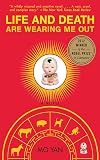
I know it's lazy to describe a book in terms of other books, but when I say that "Life and Death Are Wearing Me Out" has the Lebenslust and earthiness of Rabelais — the fantastical evocation of village life and the life of children of The Tin Drum — the satirical perversity of Swift and Gogol (whose Dead Souls shares this book's interest in the risks and opportunities of turbulent times) — that goes some way to explaining why I loved it. It reminded me too of European writers like show more Gombrowicz, Konwicki, Hrabal, and Hašek, in its irreverent humour and surrealistic flirtations against a backdrop of buereaucratic terror. And although I've read very little Chinese literature, I was delighted to trace a stylistic and thematic line from Cao Xueqin, whose mastery of tonal shifts — from sentimental to slapstick, sometimes in a single chapter — and eschewal of black and white morality, archetypes and clichés are equally evident in Mo Yan's multi-generational story. In short, I fucking loved it. show less

A family in rural China in the 1920s and 30s confronts banditry, civil war and the Japanese occupation. Mo Yan plays with the timeline to force us to read this as a novel about individual people, not abstract historical events, and there's a lot of local colour — most of it red and cereal-based — grim wit, and human resilience in the face of overwhelming odds.
Inevitably, given that it's dealing with times in which civil order had broken down in the face of barbarism and competing show more factions, there's a lot of violence. Mo Yan places at least one act of extreme violence at the centre of each chapter, and each one is described in loving and often grotesque detail. I'm guessing that the idea is that we are supposed to realise how the incessant piling up of shocking detail is desensitising us to what is going on, in something like the way it might if we were confronted with it in real life, but after a while it just started to feel vaguely pornographic.
I can see the importance of this book, and it probably goes a long way to explain how China works and why the current Chinese government is so authoritarian and so extremely allergic to any sign of disorder. But, from the perspective of my particular squeamish, western, liberal ivory tower, it's not really a book that I would ever want to read again or to recommend to anyone else. show less
Inevitably, given that it's dealing with times in which civil order had broken down in the face of barbarism and competing show more factions, there's a lot of violence. Mo Yan places at least one act of extreme violence at the centre of each chapter, and each one is described in loving and often grotesque detail. I'm guessing that the idea is that we are supposed to realise how the incessant piling up of shocking detail is desensitising us to what is going on, in something like the way it might if we were confronted with it in real life, but after a while it just started to feel vaguely pornographic.
I can see the importance of this book, and it probably goes a long way to explain how China works and why the current Chinese government is so authoritarian and so extremely allergic to any sign of disorder. But, from the perspective of my particular squeamish, western, liberal ivory tower, it's not really a book that I would ever want to read again or to recommend to anyone else. show less

In 1948, the Chinese landlord Ximen Nao was murdered by his villagers. Such events were commonplace in the China of the time, but Ximen Nao felt he had been unjustly dealt with, for in his eyes, he had been an excellent landlord. Two years later, on January 1, 1950, still full of rage and still proclaiming his innocence, he was sent back to earth by Lord Yama, ruler of the underworld. Lord Yama couldn't bear to listen to him any longer.
Full of hope, Ximen Nao made the journey back, only to show more find he had been tricked. He had been reincarnated not as a human, but as a donkey foal. Worse yet, the farm where he landed was his own, now that of his former peasant, Lan Lian. Adding insult to injury, Lan's pregnant wife was Ximen Nao's former first concubine, Yingchun.
Ximen Donkey had retained enough of his previous humanity to not only follow the events in Ximen Village, but also to be recognized by his wife, Ximen Bai, now fallen upon hard times for having been married to a landlord. Lan and Yingchun also found something compelling in the donkey and treated him with extra care, going so far as to create a prosthetic hoof for him after he suffered a terrible accident.
When collectivization came, Lan refused to join the new cooperative and remained an independent farmer. This created great hardship for himself, Yingchun and their three children, the older two being twins born to Yingchun and Ximen Nao before his death. The hardship they experienced trying to make it on their own was made worse by the famine. Ten years after returning to earth, Ximen Donkey was killed and eaten by the starving villagers.
In awarding Mo Yan the Nobel Prize for literature, the Swedish Academy said his work "with hallucinatory realism merges folk tales, history and the contemporary". This perfectly summarizes this novel, in which Ximen Nao will return again and again in the cycle of life as various animals, until his mind is at peace. Lord Yama will not allow him to return as a human until all his hatred is gone, saying there is too much hatred on earth already.
In each incarnation, Ximen Nao will maintain links with his family, following them over the next forty years. His animal personae allow him free rein for observation and comment. His adventures as a pig on the Ximen Village Production Brigade Apricot Garden Pig Farm present the greatest opportunity for satire, as giant pig farms were one of Mao's great failed projects. Mo Yan himself is a character, first as the village's child mischief maker and later as a scurrilous author.
As Ximen Nao's earthly manifestations change, so too does the world around him. The Cultural Revolution comes and goes, Mao dies. Overt capitalism creeps back slowly at first, then with excessive speed and greed. By the end, there are billionaires in mansions and beggars on the streets once more. The wheel has turned completely. Ximen Nao has learned his lesson.
Full of hope, Ximen Nao made the journey back, only to show more find he had been tricked. He had been reincarnated not as a human, but as a donkey foal. Worse yet, the farm where he landed was his own, now that of his former peasant, Lan Lian. Adding insult to injury, Lan's pregnant wife was Ximen Nao's former first concubine, Yingchun.
Ximen Donkey had retained enough of his previous humanity to not only follow the events in Ximen Village, but also to be recognized by his wife, Ximen Bai, now fallen upon hard times for having been married to a landlord. Lan and Yingchun also found something compelling in the donkey and treated him with extra care, going so far as to create a prosthetic hoof for him after he suffered a terrible accident.
When collectivization came, Lan refused to join the new cooperative and remained an independent farmer. This created great hardship for himself, Yingchun and their three children, the older two being twins born to Yingchun and Ximen Nao before his death. The hardship they experienced trying to make it on their own was made worse by the famine. Ten years after returning to earth, Ximen Donkey was killed and eaten by the starving villagers.
In awarding Mo Yan the Nobel Prize for literature, the Swedish Academy said his work "with hallucinatory realism merges folk tales, history and the contemporary". This perfectly summarizes this novel, in which Ximen Nao will return again and again in the cycle of life as various animals, until his mind is at peace. Lord Yama will not allow him to return as a human until all his hatred is gone, saying there is too much hatred on earth already.
In each incarnation, Ximen Nao will maintain links with his family, following them over the next forty years. His animal personae allow him free rein for observation and comment. His adventures as a pig on the Ximen Village Production Brigade Apricot Garden Pig Farm present the greatest opportunity for satire, as giant pig farms were one of Mao's great failed projects. Mo Yan himself is a character, first as the village's child mischief maker and later as a scurrilous author.
As Ximen Nao's earthly manifestations change, so too does the world around him. The Cultural Revolution comes and goes, Mao dies. Overt capitalism creeps back slowly at first, then with excessive speed and greed. By the end, there are billionaires in mansions and beggars on the streets once more. The wheel has turned completely. Ximen Nao has learned his lesson.
It's nobody's fault...Everything is determined by fate and there's no way anyone can escape it.show less
Lists
1980s (1)
A Novel Cure (1)
Awards


You May Also Like


Associated Authors
Statistics
- Works
- 120
- Also by
- 6
- Members
- 4,917
- Popularity
- #5,104
- Rating
- 3.7
- Reviews
- 154
- ISBNs
- 455
- Languages
- 26
- Favorited
- 8
