Baswood's books, music, films etc.
This topic was continued by Baswood's books, music, films etc. Part 2.
Talk Club Read 2013
Join LibraryThing to post.
This topic is currently marked as "dormant"—the last message is more than 90 days old. You can revive it by posting a reply.
1baswood
I can already feel the pressure to keep reading this year, but I have the added distraction of learning to play the saxophone, which is sitting nicely on it's stand all shiny and new just waiting to be picked up....... - ....... sorry I got distracted; back to the books.
LT challenges/projects will probably dominate my reading choices this year as follows:
http://www.librarything.com/groups/infinitejesters Enriquefreequ's group read of Infinite Jest, which may snowball into biographies and other stuff by David Foster Wallace.
http://www.librarything.com/groups/literarycentennials, steven03tx is the administrator for Literary centennials and I am intending to read the the following:
Albert Camus
The Stranger
The Fall
The Plague
Exile and the Kingdom
I will also read collections of his essays and non fiction
I am starting off with Albert Camus; A Life by Olivier Todd
Robertson Davies
The Salterton Trilogy
The Cornish Trilogy
The Deptford Trilogy
Laurence Sterne,
Tristram Shandy
Alain Fournier
Le Grand Meaulnes
Then There is http://www.librarything.com/groups/authorthemereads lilisin's author theme read group, which is concentrating on French authors this year and has Emile Zola as its year long author.
I am thinking of dipping into the Rougon-Macquart series.
My local book club is going from strength to strength and it's members chose some excellent books last year. We meet every six weeks or so and read two books for each meeting one of which is contemporary fiction and the other is a classic. First two up this year which I must read before January 10th are:
The Hare with Amber Eyes by Edmund de Waal
What Maisie Knew by Henry James
My own project is to continue with reading from the 15th and 16th centuries and my list of books on the shelf is looking like this;
Machiavelli and his friends; their Personal Correspondence currently reading this
Five Italian Renaissance Comedies
A Troubadour's Testament by James Cowan
England in the Age of Wycliffe by George Macaulay Trevelyan
The Fears of Henry IV Ian Mortimer
Morality Play Barry Unsworth
Fortune is a River: Leonardo Da Vinci and Niccolo Machiavelli's Magnificent Dream to change the Course of Florentine History by Roger D Masters
The Death of King Arthur by Simon Armitage
The Praise of Folly and other Writings Desiderius Erasmus
Discourse on Free Will Erasmus-Luther
The Wars of the Roses Alison Weir
Petrarchan love and the Continental Renaissance Gordon Bradon
The CIvilization of Europe in the Renaissance John Hale
Nun's behaving Badly Craig A. Monson
Tudor England by S T Bindoff
Lives of the Artists Vasari
The secret life of Nuns Pietro Aretino
Hmmmm...........Better stop this list making and start reading.
LT challenges/projects will probably dominate my reading choices this year as follows:
http://www.librarything.com/groups/infinitejesters Enriquefreequ's group read of Infinite Jest, which may snowball into biographies and other stuff by David Foster Wallace.
http://www.librarything.com/groups/literarycentennials, steven03tx is the administrator for Literary centennials and I am intending to read the the following:
Albert Camus
The Stranger
The Fall
The Plague
Exile and the Kingdom
I will also read collections of his essays and non fiction
I am starting off with Albert Camus; A Life by Olivier Todd
Robertson Davies
The Salterton Trilogy
The Cornish Trilogy
The Deptford Trilogy
Laurence Sterne,
Tristram Shandy
Alain Fournier
Le Grand Meaulnes
Then There is http://www.librarything.com/groups/authorthemereads lilisin's author theme read group, which is concentrating on French authors this year and has Emile Zola as its year long author.
I am thinking of dipping into the Rougon-Macquart series.
My local book club is going from strength to strength and it's members chose some excellent books last year. We meet every six weeks or so and read two books for each meeting one of which is contemporary fiction and the other is a classic. First two up this year which I must read before January 10th are:
The Hare with Amber Eyes by Edmund de Waal
What Maisie Knew by Henry James
My own project is to continue with reading from the 15th and 16th centuries and my list of books on the shelf is looking like this;
Machiavelli and his friends; their Personal Correspondence currently reading this
Five Italian Renaissance Comedies
A Troubadour's Testament by James Cowan
England in the Age of Wycliffe by George Macaulay Trevelyan
The Fears of Henry IV Ian Mortimer
Morality Play Barry Unsworth
Fortune is a River: Leonardo Da Vinci and Niccolo Machiavelli's Magnificent Dream to change the Course of Florentine History by Roger D Masters
The Death of King Arthur by Simon Armitage
The Praise of Folly and other Writings Desiderius Erasmus
Discourse on Free Will Erasmus-Luther
The Wars of the Roses Alison Weir
Petrarchan love and the Continental Renaissance Gordon Bradon
The CIvilization of Europe in the Renaissance John Hale
Nun's behaving Badly Craig A. Monson
Tudor England by S T Bindoff
Lives of the Artists Vasari
The secret life of Nuns Pietro Aretino
Hmmmm...........Better stop this list making and start reading.
2zenomax
Bas, will you get to a point this year where you could play the saxophone whilst reading?
You could then play tunes appropriate to the book in hand....
I admire you for learning to play an instrument.
You could then play tunes appropriate to the book in hand....
I admire you for learning to play an instrument.
3rebeccanyc
Looking forward to following your reading (and other activities) again this year.
6absurdeist
Thanks for the welcome, bas; I'll be following your reading closely.
7arubabookwoman
I'm looking forward to following your reading this year--you have some great books to look forward to. I would love to join you when you read Tristram Shandy.
8baswood
I am thinking of reading Tristram Shandy later in the year, when I have finished Infinite Jest. I will post possible dates on the Literary Centennials group.
9RidgewayGirl
I always enjoy your posts and I'm hoping you'll be visiting a jazz festival or two again this year? Won't the saxophone insist that you go?
10detailmuse
I hope to join you in Literary Centennials for The Plague, looks like the second quarter?
11janeajones
Just stopping by to say hello... looking forward to your reviews.
13dchaikin
Your first post makes Camus and Davies look so doable. Looking forward to your thread(s) this year.
14janemarieprice
Looking forward to all of your adventures this year.
15baswood
The Hare With Amber Eyes by Edmund De Waal
On the whole I found Waal’s book a disappointment. I just could not get worked up about a super rich family losing their possessions and this was Waal’s fault because he has made this biography so personal. Any empathy I had for these bankers and their entourage dissipated the further I got into the book and I began to find Waal himself just a little annoying. I was not put in the best frame of mind by the self-promotion of his preface.
The basic premise behind the book is a good one. Edmund De Waal has inherited a cabinet (vitrine) full of netsuke, which are small hand carved items from Japan made from wood, ivory or other materials. They are of some value and de Waal uses this inheritance to explore his family ancestry from the time that these 264 netsuke came into their possession. The Ephrussi family were Jews originally from Odessa and they settled in Vienna where they made a fortune in Banking. They were also active in Paris and this is where the book starts with Charles Ephrussi who was an art love, flaneur, and perhaps a little dilettante. The family business was centred in Vienna where the palace Ephrussi was built to celebrate their wealth and prosperity. De Waal decamps to the Capital of the Austro-Hungarian empire at the turn of the 19th century, following the netsuke which were wedding gift from Charles to his cousin Viktor. The netsuke were now part of an enormous collection of artifacts and we follow the fortunes of their owners as they struggled to maintain their position in society during the fierce anti-semitism evident during the first half of the 20th century in central Europe. Hitler’s Anschluss of Austria Hungary saw the persecuted family lose most of their wealth and possessions as they flee the Nazis, many of them going to America. The final section of the book sees the netsuke in Uncle Iggy’s possession as he settles in post-war Japan doing what the family does best: making money.
The book settles down to be a life and times of the family Ephrussi, there is no mystery about the netsuke which are only of interest when they are owned by the family. The family did live in turbulent times and so there is a story to tell and de Waal tries to imagine what it must have been like to be part of this rich family. He therefore invites us to walk with Charles through his large Parisian house with his latest acquisitions on show, bought as a result of his friendship with the impressionist painters. There were issues however and de Waal tells us that Renoir became suspicious of this Jewish connoisseur: was it the love of art that guided him or was it mere acquisitiveness with an eye for an investment. De Waal says “And it was at this point that Charles Jewishness made him suspect.”. It is also the point in the book where being Jewish and suffering from the anti-semitism that abounded at the time becomes the guiding theme of the book as it must, for a story about a Jewish family living in Paris and Vienna at that time.
DeWaal adopts the same approach when he moves the book to Vienna, the reader is asked to stand with him while he explores the old family home. We are exhorted to imagine what Victor felt like when the Allied terms for settlement after the first world war caused inflation to cycle out of control:
“Viktor looked into his own vacuum: in the safe at the office the Schottengasse were stacks of files of deeds and bonds and share certificates. They were worthless. As the citizen of a defeated power, all his assets in London and in Paris, the accounts that had been building in one city…….had been confiscated under the Allied terms of the punitive settlement……. That was not just a spectacular loss of money, it was the loss of several fortunes.”
De Waal treads a fine line between a biography of his family and an historical fiction of their life and times. There are no references or notes (yet there are plenty of quotes from contemporary documents}, which tends to push the book more towards an historical fiction. This is not to say that de Waal does not do this well, some of the best passages of the book describe Paris at the fin de siècle and Vienna at the time of the Nazi invasion.
This is a very personal biography and de Waal makes no bones about that, but it is just this aspect that I find off putting. I really have little sympathy for these entrepreneurial money men and their partners; We are asked to admire them and in the end I don’t and what is worse I don’t even care about them. A very personal view of a book that just isn’t for me, therefore 3 stars
On the whole I found Waal’s book a disappointment. I just could not get worked up about a super rich family losing their possessions and this was Waal’s fault because he has made this biography so personal. Any empathy I had for these bankers and their entourage dissipated the further I got into the book and I began to find Waal himself just a little annoying. I was not put in the best frame of mind by the self-promotion of his preface.
The basic premise behind the book is a good one. Edmund De Waal has inherited a cabinet (vitrine) full of netsuke, which are small hand carved items from Japan made from wood, ivory or other materials. They are of some value and de Waal uses this inheritance to explore his family ancestry from the time that these 264 netsuke came into their possession. The Ephrussi family were Jews originally from Odessa and they settled in Vienna where they made a fortune in Banking. They were also active in Paris and this is where the book starts with Charles Ephrussi who was an art love, flaneur, and perhaps a little dilettante. The family business was centred in Vienna where the palace Ephrussi was built to celebrate their wealth and prosperity. De Waal decamps to the Capital of the Austro-Hungarian empire at the turn of the 19th century, following the netsuke which were wedding gift from Charles to his cousin Viktor. The netsuke were now part of an enormous collection of artifacts and we follow the fortunes of their owners as they struggled to maintain their position in society during the fierce anti-semitism evident during the first half of the 20th century in central Europe. Hitler’s Anschluss of Austria Hungary saw the persecuted family lose most of their wealth and possessions as they flee the Nazis, many of them going to America. The final section of the book sees the netsuke in Uncle Iggy’s possession as he settles in post-war Japan doing what the family does best: making money.
The book settles down to be a life and times of the family Ephrussi, there is no mystery about the netsuke which are only of interest when they are owned by the family. The family did live in turbulent times and so there is a story to tell and de Waal tries to imagine what it must have been like to be part of this rich family. He therefore invites us to walk with Charles through his large Parisian house with his latest acquisitions on show, bought as a result of his friendship with the impressionist painters. There were issues however and de Waal tells us that Renoir became suspicious of this Jewish connoisseur: was it the love of art that guided him or was it mere acquisitiveness with an eye for an investment. De Waal says “And it was at this point that Charles Jewishness made him suspect.”. It is also the point in the book where being Jewish and suffering from the anti-semitism that abounded at the time becomes the guiding theme of the book as it must, for a story about a Jewish family living in Paris and Vienna at that time.
DeWaal adopts the same approach when he moves the book to Vienna, the reader is asked to stand with him while he explores the old family home. We are exhorted to imagine what Victor felt like when the Allied terms for settlement after the first world war caused inflation to cycle out of control:
“Viktor looked into his own vacuum: in the safe at the office the Schottengasse were stacks of files of deeds and bonds and share certificates. They were worthless. As the citizen of a defeated power, all his assets in London and in Paris, the accounts that had been building in one city…….had been confiscated under the Allied terms of the punitive settlement……. That was not just a spectacular loss of money, it was the loss of several fortunes.”
De Waal treads a fine line between a biography of his family and an historical fiction of their life and times. There are no references or notes (yet there are plenty of quotes from contemporary documents}, which tends to push the book more towards an historical fiction. This is not to say that de Waal does not do this well, some of the best passages of the book describe Paris at the fin de siècle and Vienna at the time of the Nazi invasion.
This is a very personal biography and de Waal makes no bones about that, but it is just this aspect that I find off putting. I really have little sympathy for these entrepreneurial money men and their partners; We are asked to admire them and in the end I don’t and what is worse I don’t even care about them. A very personal view of a book that just isn’t for me, therefore 3 stars
16Linda92007
Barry, The Hare With Amber Eyes was all over the bookstores here. But I resisted and having read your excellent review, I'm glad I did.
18StevenTX
Excellent review. I think my reaction would likely be the same as yours to the woes of the super rich. (Check your review on the book page, by the way. It looks like the first line is missing.)
19JDHomrighausen
Hi Barry - you have some very interested reads coming up. I'm also doing the Literary Centennials, but to my delight many of them are on librivox so they'll be fodder for driving!
What made you focus on 15th and 16th century?
What made you focus on 15th and 16th century?
20yolana
It's always difficult to choose between practice and reading for me as well I read A Troubadour's Testament years ago and can't remember what it was about. Maybe your thoughts will jog my memory..
21dmsteyn
I own The Hare with Amber Eyes, and was interested to read your personal response, Barry. Great review, and I hope to get something from the book, even if it is imperfect.
22helensq
Good review of The Hare With Amber Eyes which reminded me of my own disappointment that the netsuke collection did not feature more strongly as a theme in the book.
I'm looking forward to your review of What Maisie Knew - I had strong feelings about it so will be interested to see what you think.
I'm looking forward to your review of What Maisie Knew - I had strong feelings about it so will be interested to see what you think.
23kidzdoc
Excellent review of The Hare with Amber Eyes, Barry. I'll give it a pass.
24baswood
Linda, for many people The Hare with Amber Eyes hits all the right notes and I read it in advance of my book club discussion, where I expect to be in a minority of one.
Thanks steven - fixed
Jonathan I am reading 15th and 16th century literature because it follows after the 14th century. I started a project a couple of years ago to start reading from The Age Of Chaucer and have now crawled into the start of the 15th century.
Yolana, what do you play?
dewald you will probably get something from The Hare with Amber Eyes because de Waal has set out to write a book that will appeal to many readers. (Damning with faint praise)
helen, I am starting What Maisie knew tonight and I need to finish it before the book club meeting on Thursday. I have never failed to get through a book yet although I have had to grit my teeth sometimes.
Thanks steven - fixed
Jonathan I am reading 15th and 16th century literature because it follows after the 14th century. I started a project a couple of years ago to start reading from The Age Of Chaucer and have now crawled into the start of the 15th century.
Yolana, what do you play?
dewald you will probably get something from The Hare with Amber Eyes because de Waal has set out to write a book that will appeal to many readers. (Damning with faint praise)
helen, I am starting What Maisie knew tonight and I need to finish it before the book club meeting on Thursday. I have never failed to get through a book yet although I have had to grit my teeth sometimes.
25helensq
Of course I didn't say whether my feelings were positive or negative....! I did finish it - and I can't say that for all the books I start.
Is your reading group local? We have a house in Normandy and although we don't live there, we have English friends locally who are members of a book group but they have to travel quite a distance.
Is your reading group local? We have a house in Normandy and although we don't live there, we have English friends locally who are members of a book group but they have to travel quite a distance.
26edwinbcn
Great review, Barry. The story of that Ephrussi family sounds very interesting, so like many people, I would be interested in that book. Your review has definitely put me off, now.
27Jargoneer
Thought it was time to start catching up (after only a week, it's shameful).
I was supposed to read The Hare with Amber Eyes for a book group last year but decided to go and see some music instead - now I'm glad I gave it a miss. (I think I heard the author on the radio discussing the book and how the family had lost everything and were reduced to living in a superior town house in London).
Hope the saxophone playing is going well. I thought you may be interested in this short BBC documentary - Jazz is Dead. (It's a topic that deserves longer than 30 minutes, especially when it asks 'what is jazz?' now).
I was supposed to read The Hare with Amber Eyes for a book group last year but decided to go and see some music instead - now I'm glad I gave it a miss. (I think I heard the author on the radio discussing the book and how the family had lost everything and were reduced to living in a superior town house in London).
Hope the saxophone playing is going well. I thought you may be interested in this short BBC documentary - Jazz is Dead. (It's a topic that deserves longer than 30 minutes, especially when it asks 'what is jazz?' now).
29baswood
#27 Oh thats exciting the link to Jazz is Dead. I thought the Iplayer link would not work here, but it is playing away as I type - thanks.
Yeh the saxophone playing is taking over much of my time. I know enough now to be able to blow along to backing tracks that I can get from the net and play through my headphones. As I improvise along to some swinging rhythms it feels like I'm playing in a band. I have never gotten that close to music before.
Yeh the saxophone playing is taking over much of my time. I know enough now to be able to blow along to backing tracks that I can get from the net and play through my headphones. As I improvise along to some swinging rhythms it feels like I'm playing in a band. I have never gotten that close to music before.
30avidmom
I have never gotten that close to music before.
Feels great doesn't it?!?!
When my mother bought me a very, very much wanted piano when I was 12 I spent so much time practicing that my grades in school took a nosedive. She told me if I didn't do my homework she'd take my piano away! So I did my homework. Now that I think about though I wonder how she was planning to do that. Hide it in the closet?! LOL!
I still have that piano :)
Feels great doesn't it?!?!
When my mother bought me a very, very much wanted piano when I was 12 I spent so much time practicing that my grades in school took a nosedive. She told me if I didn't do my homework she'd take my piano away! So I did my homework. Now that I think about though I wonder how she was planning to do that. Hide it in the closet?! LOL!
I still have that piano :)
31LisaMorr
A couple of other gems I discovered in storage boxes were The Plague and Le Grand Meaulnes - neat to see you will be reading them this year also.
32baswood
#25 helen, yes the reading group is a local one. I live in the Gers, S W France and the group is based around Marciac and Maubourguet. The Gers is the least populated area of France and the towns are small.
avidmom, I envy you having a piano in the house.
avidmom, I envy you having a piano in the house.
33baswood

Disc of the week - Kayo Dot's Choirs of the Eyes
Experimental music from a band that had its beginnings in heavy metal. Crunching guitar chords are a feature but it is the textured sound of much of this music that grabbed my attention. Apart from two guitars bass and drums this CD features violin, clarinet, flute, piano keyboards trumpets and French Horn. There are five tracks of longish compositions that on first listen seem to meander into the listeners ear and this is because for the most part they start with no drums or bass and so lack a rhythmic pulse. The drums and bass do tend to infiltrate the sounds as the music develops but tend not to lay down a recognisable rhythm. It is on closer listening that the scope of the music and the compositions start to take shape and the intelligence behind it becomes apparent.
My two favourite tracks are the longest on the CD both over 14 minutes and a description of one of these"The Antique" will give some idea of what this music sounds like. It starts with some tuneless guitar strumming and an exploration of chords that finally becomes more musical and a few jazz notes are incorporated, then an electronic figure from the keyboards heralds bass and drums as finally those guitar chords are fully developed into a five chord motif. fuzz and reverb are added and the drums pick up the rhythm of the by now fully developed chord riff and we are in dark metal territory with shouted vocals, but the music changes around those chords; a new structure to the music appears propelled by drums, followed by a quieter passage. Then more sounds from the keyboard, still those chords are evident, but then a gorgeous piano theme emerges from the darkness, with some faintly distorted yet lyrical trumpet playing before we are treated to some recognisable vocals over this now relaxed piano figure. The music ends with more keyboards and trumpet floating over the top of the vocals. The feeling at the end is of a composition that makes perfect sense.
OK this music is not for everybody, it needs time to develop and will not be appreciated by those put off by some heavy metal stylings, but these modern post metal compositions deserve to be heard I think.
Here is a link to "The Antique" on youtube. http://www.youtube.com/watch?v=7X6FKD1EX_o
34rebeccanyc
Not like anything I'd ever listened to before but very compelling nonetheless. I'm not sure I liked it, but it held my interest.

36baswood
#35 Well thats one view of What Maisie knew, but not one that I would wholly subscribe to

38baswood
What Maisie Knew by Henry James
This was my first read of a book by Henry James and I thought I might not even get that far after struggling through his almost impenetrable preface to the 1909 American publication of the book. Finally I got to the novel itself, but there was no time to relax, as I plunged back into some intense verbiage and obfuscation as I tried to make sense of what was going on. A friend who recommended the book to me had labelled James as “Mr Wordy” and I could see what he meant, but it is not just the volume of words; in paragraphs that can stretch over two pages that is the real problem; it is the syntax itself. I have read that James’s style was a precursor to modernism and the stream of conscious technique and where there is some evidence of this in the novel, the impression I got was that James was looking back to the 19th century rather than forward to the 20th century. A difficult reading experience then, but was it worth the effort?
The Story is a good one. We first meet Maisie as a young child who is subject to a court order following divorce proceedings. Her parents finally agree to have Maisie for half a year each, not we are told in consideration of each other, or of Maisie, but because of their ill feeling, they wish to saddle each other with the burden of the child. Maisie finds herself under the supervision or protection of two very different governesses. Her mother; Ida employs Mrs Wix; a widower whose concerns are mainly with Maisie’s moral welfare, while her father Mr Beale employs the beautiful Miss Overmore. Maisie’s parents are both in James’s words immoral characters who exude charm to all who meet them and it is no surprise that Miss Overmore soon becomes the second Mrs Beale and that Ida marries the equally charming Sir Claude. Maisie now has a step mother and a step father, but the real complications begin when these two step parents meet and start an affair of their own. Little Maisie grows up within this whirlwind of meetings and love affairs {Ida is soon seen with other men and Mr Beale is not far behind with seeing other women) and James shows us Maisie’s world through the eyes of this somewhat precocious child: though thankfully not in the first person..
It is the world seen through Maisie’s eyes that gives this book it’s feeling of modernism, and James does this so well. He conveys her fears, her confusion, her gullibility, her sinless character, her desire to make the right choices and to please everybody around her. Maisie’s main concern especially in her most childish phase is to please everyone, but as the novel develops so does Maisie until faced with her difficult choice at the end of the novel she is empowered to do so. She is always careful and thoughtful about what she says and does and even when she fails to understand much of what is happening she manages to not cause too much upset. The brilliance of this novel is James’s ability to make us believe in all these facets of a young child character, we as readers can see and feel more than Maisie ever can about her situation and although she sometimes makes us cringe with the things she says, we admire her natural common sense.
A child surrounded by charming manipulative characters as Maisie is, cannot herself fail to be charmed and we very rarely witness any bad behaviour towards the child, in fact quite the opposite and in Sir Claude’s case it may be that his love for his mistresse’s step daughter goes beyond the bounds of propriety. This lurking fear for Maisie’s safety is the hook that will ensure many readers will finish the novel, as well as some brilliant passages of prose and insights into the characters that are presented before us. I particularly enjoyed the sojourn to the channel port of Boulogne on the North coast of France, where Maisie’s future must eventually be decided. James captures for me the essence of this French town at the turn of the century and the hotel life of English ex-pats, who look wistfully back across the channel.
For me it is Henry James’s moral standpoint that places his novel with both feet firmly in the 19th century. He tends to scream out moral rectitude to his readers. Mrs Wix is the moral force in the novel, it is she that has the task of saving Maisie from the charming people around her and although James is careful to present Mrs Wix character to us with warts and all (she is also hopelessly charmed and a little in love with Sir Claude), it is her moral viewpoint that will prevail, it is she that will scold Maisie that will force her to sort right from wrong. “Haven’t you really and truly any moral sense” she says in exasperation to Maisie and this reader felt that Henry James was addressing this question directly to him.
It would be overstepping the mark to say that there is a brilliant novel here struggling to get out, because at times James writing style does enhance the confusion and fears of Maisie, however it also buries the story a little too deep to make this a comfortable reading experience. I found it difficult to concentrate fully at times and sleep inducing at others, but then I would wake up with a start; coming across a brilliant passage and find myself thinking “how good is that” I suppose therefore I am ambivalent about Henry James as a writer and certainly about this novel. I would not wish to read it through again, but it has made me wish to try another of his works, but not just yet. This was for me a three star read.
This was my first read of a book by Henry James and I thought I might not even get that far after struggling through his almost impenetrable preface to the 1909 American publication of the book. Finally I got to the novel itself, but there was no time to relax, as I plunged back into some intense verbiage and obfuscation as I tried to make sense of what was going on. A friend who recommended the book to me had labelled James as “Mr Wordy” and I could see what he meant, but it is not just the volume of words; in paragraphs that can stretch over two pages that is the real problem; it is the syntax itself. I have read that James’s style was a precursor to modernism and the stream of conscious technique and where there is some evidence of this in the novel, the impression I got was that James was looking back to the 19th century rather than forward to the 20th century. A difficult reading experience then, but was it worth the effort?
The Story is a good one. We first meet Maisie as a young child who is subject to a court order following divorce proceedings. Her parents finally agree to have Maisie for half a year each, not we are told in consideration of each other, or of Maisie, but because of their ill feeling, they wish to saddle each other with the burden of the child. Maisie finds herself under the supervision or protection of two very different governesses. Her mother; Ida employs Mrs Wix; a widower whose concerns are mainly with Maisie’s moral welfare, while her father Mr Beale employs the beautiful Miss Overmore. Maisie’s parents are both in James’s words immoral characters who exude charm to all who meet them and it is no surprise that Miss Overmore soon becomes the second Mrs Beale and that Ida marries the equally charming Sir Claude. Maisie now has a step mother and a step father, but the real complications begin when these two step parents meet and start an affair of their own. Little Maisie grows up within this whirlwind of meetings and love affairs {Ida is soon seen with other men and Mr Beale is not far behind with seeing other women) and James shows us Maisie’s world through the eyes of this somewhat precocious child: though thankfully not in the first person..
It is the world seen through Maisie’s eyes that gives this book it’s feeling of modernism, and James does this so well. He conveys her fears, her confusion, her gullibility, her sinless character, her desire to make the right choices and to please everybody around her. Maisie’s main concern especially in her most childish phase is to please everyone, but as the novel develops so does Maisie until faced with her difficult choice at the end of the novel she is empowered to do so. She is always careful and thoughtful about what she says and does and even when she fails to understand much of what is happening she manages to not cause too much upset. The brilliance of this novel is James’s ability to make us believe in all these facets of a young child character, we as readers can see and feel more than Maisie ever can about her situation and although she sometimes makes us cringe with the things she says, we admire her natural common sense.
A child surrounded by charming manipulative characters as Maisie is, cannot herself fail to be charmed and we very rarely witness any bad behaviour towards the child, in fact quite the opposite and in Sir Claude’s case it may be that his love for his mistresse’s step daughter goes beyond the bounds of propriety. This lurking fear for Maisie’s safety is the hook that will ensure many readers will finish the novel, as well as some brilliant passages of prose and insights into the characters that are presented before us. I particularly enjoyed the sojourn to the channel port of Boulogne on the North coast of France, where Maisie’s future must eventually be decided. James captures for me the essence of this French town at the turn of the century and the hotel life of English ex-pats, who look wistfully back across the channel.
For me it is Henry James’s moral standpoint that places his novel with both feet firmly in the 19th century. He tends to scream out moral rectitude to his readers. Mrs Wix is the moral force in the novel, it is she that has the task of saving Maisie from the charming people around her and although James is careful to present Mrs Wix character to us with warts and all (she is also hopelessly charmed and a little in love with Sir Claude), it is her moral viewpoint that will prevail, it is she that will scold Maisie that will force her to sort right from wrong. “Haven’t you really and truly any moral sense” she says in exasperation to Maisie and this reader felt that Henry James was addressing this question directly to him.
It would be overstepping the mark to say that there is a brilliant novel here struggling to get out, because at times James writing style does enhance the confusion and fears of Maisie, however it also buries the story a little too deep to make this a comfortable reading experience. I found it difficult to concentrate fully at times and sleep inducing at others, but then I would wake up with a start; coming across a brilliant passage and find myself thinking “how good is that” I suppose therefore I am ambivalent about Henry James as a writer and certainly about this novel. I would not wish to read it through again, but it has made me wish to try another of his works, but not just yet. This was for me a three star read.
39avidmom
That was a very interesting review and the story sounds like a good one but I don't think I could get through 2 page paragraphs. *ugh*
40detailmuse
>38 baswood: loved, loved your review, thanks for making the book accessible! Unparagraphed pages also cause me dread, and so I was surprised to look forward to them, in clumps of 8-10, in Paul Auster's Winter Journal. Of course, James's and Auster's syntax are probably toward opposite ends of the scale.
41StevenTX
I'm a bit surprised that after sailing through Patrick White you would find What Maisie Knew to be tough sledding. I've read it twice, and have read a half dozen or so of James's other novels. What Maisie Knew is easier than average for a James novel. His post-1900 novels are all quite challenging but equally rewarding. The Ambassadors is my overall favorite.
I found his portrait of Maisie to be quite frightening as a depiction of a child's mind (can they really know so much about us?). Of course the novel is also a damning picture of the inhumanity and materialism of the 1890s. (I wouldn't say "amorality" after having read The Ambassadors where James takes his swipes at prudish moral conventions.)
If you want to learn more about James, I highly recommend Colm Tóibín's biographical novel The Master.
I found his portrait of Maisie to be quite frightening as a depiction of a child's mind (can they really know so much about us?). Of course the novel is also a damning picture of the inhumanity and materialism of the 1890s. (I wouldn't say "amorality" after having read The Ambassadors where James takes his swipes at prudish moral conventions.)
If you want to learn more about James, I highly recommend Colm Tóibín's biographical novel The Master.
42baswood
steven, interesting to get the views of a Henry James aficionado. I was surprised by how difficult I found the book to read and went back to sections of it to try and understand just why this was. I came to no firm conclusions, although of course it was a little easier the second time round.
Thanks for the recommendation to the Colm Toibin biography which I will read before I approach Henry James again.
Thanks MJ and don't be put off avidmom, it might just have been me struggling with the syntax.
Thanks for the recommendation to the Colm Toibin biography which I will read before I approach Henry James again.
Thanks MJ and don't be put off avidmom, it might just have been me struggling with the syntax.
43helensq
Thanks for the great review - I entirely share your views about the way it is written. The only other book by James I have read is Washington Square where I found the writing more approachable but the story vapid. If Maisie is easier than average, I don't feel at all inclined to read some more!
I found Maisie just too knowing to be a sympathetic or believable character. After reading your review I realise I may have dismissed the book too hastily - but I'm afraid I don't feel inclined to go back and have another look!
I found Maisie just too knowing to be a sympathetic or believable character. After reading your review I realise I may have dismissed the book too hastily - but I'm afraid I don't feel inclined to go back and have another look!
44Linda92007
I really enjoyed reading your reactions to What Maisie Knew, Barry. I read The Portrait of a Lady and The Turn of the Screw a few years ago and each time found that it took me awhile to adapt to James' writing style, but once having done so, loved him. Steven has reminded me that I was also anxious to read The Master.
45deebee1
Wonderful review, Barry. I second Steven on The Master.
46tonikat
Hi Barry , just a mundane post to say hello to your thread. I haven't read these. The only James I have read is a short story, which I loved and want to read more. I did get about 500 pages into Infinite Jest once, it kept making me feel really sad, which I think was what he intended, and I drifted. This was since his loss and that also gave that sadness and tone of the book a darkness. But a fascinating and wonderful man from everything I have heard and read and a great loss as everyone knows but which I want to add having said that last sentence.
48janemarieprice
Interesting review of the James. I've only read one novella and enjoyed it immensely though I had to go very slowly to get the feel of the writing.
49pamelad
I ploughed through Henry James when I was young, with lots of time, so appreciate your review of What Maisie Knew, with its perspective of reward vs effort . I remember James as humourless, unlike Patrick White whose scathing wit leavens even his least penetrable prose.
50DieFledermaus
A good review of What Maisie Knew though I remember enjoying it more than you did. I do like impenetrable James though - like Steven, The Ambassadors is my favorite. I can see how someone would describe his writing as "a hippopotamus straining to pick a daisy" though.
Too bad about The Hare with the Amber Eyes. I probably would have been intrigued otherwise. Although before and after the American elections there did seem to be a lot about the problems of the super-rich - apparently people were being mean to them.
Too bad about The Hare with the Amber Eyes. I probably would have been intrigued otherwise. Although before and after the American elections there did seem to be a lot about the problems of the super-rich - apparently people were being mean to them.
51dmsteyn
Nice review, Barry. I've read Turn of the Screw and The Portrait of a Lady, both of which I immensely enjoyed, and I have Maisie around here somewhere... I'll give it a look sometime.
52baswood
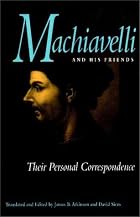
Machiavelli and his friends: their personal correspondence Translated and edited by James B Atkinson and David Sices.
This collection of letters gives a fabulous insight into Italian renaissance life covering the period from1497 to 1527. I had previously read a selection of Machiavelli’s letters, but when the collection is limited to just the letters of one person then you only get half the picture. This volume of letters features as many letters from Machiavelli’s friends as it does from the man himself and so suddenly a much fuller picture emerges. We get both sides of the story, we learn the reasons for many of the letters, we get other peoples views of Machiavelli and some stories have more closure. Machiavelli was a great man of letters, but some of his correspondents were not too far behind.
The letters can be divided into three distinct periods of Machiavelli’s life. The first period sees him as a man of increasing importance in the political sphere of Florentine life. He held various government posts and enjoyed a good relationship with Pierro Soderini the chief officer of the fledgling Republic. Machiavelli is a man of importance thoroughly immersed in the business of government, often being sent as ambassador or negotiator to other states and his correspondence reflects this aspect of his life. While away from Florence it was essential that his supporters in government kept him informed as to what was happening in his absence; some of this is very amusing as there was obviously a Machiavelli faction in the offices who sorely missed their leader when he was away. This is an example from his two underlings Biagio and Andrea:
“My Machiavelli, a thousand poxes upon you, for keeping us in great anxiety and things remain very hard for us in the 2nd Chancellery, so that theses conditions and all that goes on, etc., have us in a tizzy. We are beginning to learn how to deal with Ser Antonio, and every day his stomach bothers him; I believe it is because he does not have his Madonna Agostanza here to warm him up or give him exercise on the see-saw, however we often laugh in the 1st Chancellery and we have a few little parties at Biagio’s house……”
Along with the chit chat are reports on what is happening in Florence and Rome, essentially to keep Machiavelli informed of developments. Machivelli’s letters are full of the latest analysis on foreign policy and toward the end of the period: his pet project the organisation of the Florentine militia.
In 1513 the Medici family replaced the Republican government and Machiavelli failed to keep his job, worse still he was thrown into prison and tortured following his suspected involvement in a counter coup. These events marked the start of a second very different period in his life. He soon secured his release from prison but was banished to his farm in the country and could no longer take part in political life and instead put his talents to use in writing political treatise such as the The Prince. Effectively his exile from politics did not stop him thinking about the increasingly desperate situation for his beloved Florence and there were plenty of men who still valued his opinions. Machiavelli’s correspondence to Francesco Vettori is full of his political thoughts and at times appears to be a rehearsal of ideas that would appear later in The Prince He had his eye at all times on getting back into favour with the Medici family and bemoaned his fate at being sidelined..
From 1520 until his death in 1527 he gradually found more employment. His plays were performed, he carried out various tasks for Governors and other important people and finally he secured favour from the Medici’s and was again carrying out ambassadorial and even military tasks His patron and most frequent correspondent during this period was Francesco Guiccardini governor of Modena and Reggio. Guiccardini was a member of the nobility, but Machiavelli addressed him as an equal and the two men wrote about their love affairs as well as their business.
The letters cover a turbulent period in Italian history and provide first hand accounts of the political manoeuvrings, but they are so much more than this; providing a wonderful portrait of Florentine life and the characters of the period. The letters cover such things as: arrangements and negotiations of dowry’s, events on the field of battle, ideas for home improvements, difficulties of communication, the merits of favoured courtesans, advice on matters of love, health issues and fear of the plague and of course family business. Machiavelli and his friends were not effete courtly lovers, they were men of the world and their letters reflect this
Machiavelli himself comes across not only as the sharp political operator that he was, but also as a man in love with life, fascinated by the latest news and world events.. He was loyal to his friends, outspoken to his enemies, enjoyed banter and practical jokes, passionate in his beliefs and perhaps at times a little too honest for his own good.
This is typical Machiavelli, his patron has sent him to Carpi on business where he stayed with the bishop and his friars. Machiavelli wants to emphasise his importance so that he will be served the best food and get the best room. He arranges for his patron to send him frequent messages, instructing the messenger to ride up to him sweating and the horse well lathered to demonstrate the importance of the dispatches. Machiavelli was enjoying himself and he wrote:
“I must tell you that the crossbowman arrived with your letter and said, bowing to the ground that he had been sent expressly and in all haste - everyone sprang up with such bowings and such a hubbub that everything was topsy-turvy and several people asked me what the news was. And I in order to heighten my prestige said that the Emperor was expected in Trent, that the Swiss had convened fresh assemblies, that the king of France wanted to go and confer with that king, but his counsellors were advising him against going - so they all stood around with their mouths open and with their caps in hand. And even as I am writing this, I have a circle of them about me; to see me write at length, they marvel and gaze at me as one inspired and I to make them marvel even more, sometimes pause writing and breathe deeply, then they absolutely begin drooling…….
Your Lordship knows how these friars say that when one is confirmed as being in a state of grace, the Devil no longer has any power to tempt him. Well, I have no need to fear that these friars will infect me with their hypocrisy, because I believe that I have been adequately confirmed”
James Atkinson and David Sices have produced an exemplary book, There is a very good general introduction as well as a more detailed introduction to each batch of letters by year, informing the reader of the essential events of that period. The translation is lively, there are copious notes and a very useful list of all the letters by year and who wrote them and of course a very good index. These letters serve as a wonderful portrayal of renaissance life and bring to life both men of public renown as well as the forgotten clerks and family members. A wonderful reading experience and a five star book.
53LisaMorr
I wasn't sure as I started to read your comments if I was up to the challenge of this book of letters, but by the end, I think it is something to add to the wishlist. Thanks!
57kidzdoc
Barry, your review of What Maisie Knew has made me very eager to read it, and simultaneously made me want to avoid it! I've just "purchased" the free Kindle version.
Fabulous review of Machiavelli and His Friends as well.
Fabulous review of Machiavelli and His Friends as well.
58dchaikin
Catching up and find two major reviews here. Great stuff. I'm intimated by HJames...your review of What Maisie Knew didn't help. : ) And very entertaining on Machiavelli. That quote at the end is brilliant. It may define him, the person, for me for a while...unless I read one these letter collections...
59detailmuse
bas, you continue to surprise me that Machiavelli was so much besides Machiavellian, and now remind me that the 1500s included such light-heartedness.
60detailmuse
>38 baswood: From Henry James's story, "The Jolly Corner," snipped from Sister Bernadette's Barking Dog, a light retro volume about diagramming sentences:

The sentence:


The sentence:

61dchaikin
well...the sentence gets better every time I read...from 1. "I kind of get it"...to 2. "oh..." to 3. "wow"
62baswood
I thought at first I was looking at a map of the London underground. A complex sentence indeed, but the question remains; is it unnecessarily complicated.?
I don't share your admiration Dan, I am struggling with "precious reference" which does not add anything to the sentence and I am not sure what those two words mean in their context.
I don't share your admiration Dan, I am struggling with "precious reference" which does not add anything to the sentence and I am not sure what those two words mean in their context.
63avidmom
Oh my. I'm so glad my 8th grade English teacher didn't make us diagram a sentence like that!
64_debbie_
>60 detailmuse: I loved that book when I read it! LT is probably the only place, other than a diagramming conference, that I can say that and not be completely ridiculed!
65rebeccanyc
I loved diagramming sentences but, as an editor, I have to say that sentence seriously needs help (Henry James notwithstanding).
66dchaikin
#62 "precious reference...to memories..." Doesn't make sense without it. : )
The picture in my head on tries four and five is vivid. I don't know how else to give that impression. I'll stand by him.
The picture in my head on tries four and five is vivid. I don't know how else to give that impression. I'll stand by him.
67absurdeist
Slightly off topic, but my favorite "precious" reference is from The Silence of the Lambs.
bas, check out "The Last of the Valerii" sometime. Eerie tale, w/easier to parse sentences, not that I'm necessarily averse to that blueprint prose of post 60.
bas, check out "The Last of the Valerii" sometime. Eerie tale, w/easier to parse sentences, not that I'm necessarily averse to that blueprint prose of post 60.
68LesMiserables
> 52
Thank you for this reflection on Machiavelli and the work reviewed. My own experience I'm afraid goes no further than reading/assessing The Prince as part of my degree in Philosophy. My initial thoughts at that time perceived Machiavelli as doing anything possible to gain political influence and the book's didactic nature reinforced that impression.
Reading The Prince in isolation to the cultural and political epoch does not however lend itself to a just impression.
Thank you for this reflection on Machiavelli and the work reviewed. My own experience I'm afraid goes no further than reading/assessing The Prince as part of my degree in Philosophy. My initial thoughts at that time perceived Machiavelli as doing anything possible to gain political influence and the book's didactic nature reinforced that impression.
Reading The Prince in isolation to the cultural and political epoch does not however lend itself to a just impression.

70baswood
Albert Camus; A life by Olivier Todd
“Freedom means being able to defend what I don’t agree with, even in a government or a world I approve of. It’s being able to admit your opponent is right.”
Women - “They inspire in us the desire to create masterpieces and prevent us from finishing them”
“The (Liason group) proposes to create communities of men beyond borders, which are united by things other than abstract ties of ideology”
“Only one thing is stupider than absolute pessimism and that is absolute optimism”
Albert Camus kept working notebooks throughout his life as well as being a pamphleteer and a journalist and was always ready with a maxim or aphorism to convey his message. There is much of his work in the public domain and Olivier Todd’s biography uses this material to such an extent that it almost feels, at times, that Camus is telling his story in his own words. As an attempt to get into the creative mind of Camus; I think it works fairly well, my only issue is that Camus wrote almost exclusively in French and I fear that some of what he has said may have been lost in translation.
Olivier Todd does an excellent job of painting a vivid picture of the life and times of his subject. There are excellent chapters on his early life in Algiers. He was born to a poor working class French family and he made his name in the colony as a novelist, playwright and journalist, not moving to Paris until 1940 when he was 27 years old. He had been diagnosed with tuberculosis as a teenager and his health problems, which plagued him all his life prevented him from doing active service in World War II. During the war years he became editor of Combat a journal sympathetic to the resistance movement. The extent of Camus involvement in the resistance is still not clear: he claimed never to have touched a gun, but typically at the end of the war he involved himself in pleas for mercy for collaborators who came up for trial. In Paris he was a powerful figure in the literary world and his allegiances and then enmity with Sartre and many of the left wing intellectuals is well documented. Camus led a busy life at one time he was editor in chief of Combat, a reader with the publishing firm Gallimard and desperately trying to find time for his own writing, His love life was complicated and he always had the threat of his own and his wife’s ill health to sap his spirits. After his break from the circle of Parisian left wing intellectuals he felt himself to be in exile and when the Algerian war of independence loomed; as a pied-noir he felt himself even more out on a limb when he refused to endorse the FLN (The Arab independence organisation). He made a lecture tour of the USA and accepted the award of the Nobel prize; he was hardly ever out of the public limelight and always it seemed found himself tied up in knots by politics.
Oliver Todd does not lose sight of the fact that it is Camus’s novels, plays, essays and journalism that is his real legacy and does well in describing his working methods, his constant re-writing, his dissatisfaction with much of his output and his contention that hard work and study got him through rather than any innate genius. Todd manages to incorporate in his narrative, reviews and comments on the novels, plays, essays and their impact on the literary world. His narrative helps the reader to get a feel for Camus thoughts and influences and Todd takes time out to explain what Camus meant by the Absurd and how it differed from Existentialism.
Albert Camus always had an eye for the ladies and was a noted seducer of women. His long lasting second marriage to Francine survived his affairs. He comes across as a man of infinite charm, who managed to juggle his women around his working life. His mistresses tended to stay with him, accepting the man for what he was, a marvellous companion with an honesty and sensibility that was tremendously appealing. In fact honesty is a character trait that exudes from these pages. I got the feeling that Camus always tried to be honest with himself and with other people. He cared deeply about humanity and although not a pacifist would not support any group that advocated violence. It was Camus stand against the horrors perpetrated by the Stalinist regime in Russia that alienated him from many of the left wing groupings in Paris.
Olivier Todd in a fine conclusion to his biography says about Camus
His enduring human warmth and goodness embarrass some thinkers. The present book is neither an expose nor a hagiography, nor is it a compendium of Camus’s good deeds. Camus could seem brusque or unpleasant, but he was more often understanding and kind. Vulnerable, he was faithful in friendship and love, despite his numerous affairs. He gave an encapsulated view of his emotional beliefs: ‘No great work… has ever been based on hatred and contempt. The true creator always reconciles people through some part of his heart and life’
Todd’s admiration for the man shines through and this is no bad thing for a biographer. I also found myself agreeing with much of what Camus said and thought and so I am eagerly looking forward to reading some Camus over the coming year. This is a very good biography and at just over 400 pages it gives a well rounded portrait of the man and his works. Unhesitatingly recommended for anyone wishing to get to know more about Albert Camus before, or while reading him. My only quibble is, that although Camus is extensively quoted there are no references or notes as to where they originate from. A minor quibble with a biography that I rate as 4.5 stars.
“Freedom means being able to defend what I don’t agree with, even in a government or a world I approve of. It’s being able to admit your opponent is right.”
Women - “They inspire in us the desire to create masterpieces and prevent us from finishing them”
“The (Liason group) proposes to create communities of men beyond borders, which are united by things other than abstract ties of ideology”
“Only one thing is stupider than absolute pessimism and that is absolute optimism”
Albert Camus kept working notebooks throughout his life as well as being a pamphleteer and a journalist and was always ready with a maxim or aphorism to convey his message. There is much of his work in the public domain and Olivier Todd’s biography uses this material to such an extent that it almost feels, at times, that Camus is telling his story in his own words. As an attempt to get into the creative mind of Camus; I think it works fairly well, my only issue is that Camus wrote almost exclusively in French and I fear that some of what he has said may have been lost in translation.
Olivier Todd does an excellent job of painting a vivid picture of the life and times of his subject. There are excellent chapters on his early life in Algiers. He was born to a poor working class French family and he made his name in the colony as a novelist, playwright and journalist, not moving to Paris until 1940 when he was 27 years old. He had been diagnosed with tuberculosis as a teenager and his health problems, which plagued him all his life prevented him from doing active service in World War II. During the war years he became editor of Combat a journal sympathetic to the resistance movement. The extent of Camus involvement in the resistance is still not clear: he claimed never to have touched a gun, but typically at the end of the war he involved himself in pleas for mercy for collaborators who came up for trial. In Paris he was a powerful figure in the literary world and his allegiances and then enmity with Sartre and many of the left wing intellectuals is well documented. Camus led a busy life at one time he was editor in chief of Combat, a reader with the publishing firm Gallimard and desperately trying to find time for his own writing, His love life was complicated and he always had the threat of his own and his wife’s ill health to sap his spirits. After his break from the circle of Parisian left wing intellectuals he felt himself to be in exile and when the Algerian war of independence loomed; as a pied-noir he felt himself even more out on a limb when he refused to endorse the FLN (The Arab independence organisation). He made a lecture tour of the USA and accepted the award of the Nobel prize; he was hardly ever out of the public limelight and always it seemed found himself tied up in knots by politics.
Oliver Todd does not lose sight of the fact that it is Camus’s novels, plays, essays and journalism that is his real legacy and does well in describing his working methods, his constant re-writing, his dissatisfaction with much of his output and his contention that hard work and study got him through rather than any innate genius. Todd manages to incorporate in his narrative, reviews and comments on the novels, plays, essays and their impact on the literary world. His narrative helps the reader to get a feel for Camus thoughts and influences and Todd takes time out to explain what Camus meant by the Absurd and how it differed from Existentialism.
Albert Camus always had an eye for the ladies and was a noted seducer of women. His long lasting second marriage to Francine survived his affairs. He comes across as a man of infinite charm, who managed to juggle his women around his working life. His mistresses tended to stay with him, accepting the man for what he was, a marvellous companion with an honesty and sensibility that was tremendously appealing. In fact honesty is a character trait that exudes from these pages. I got the feeling that Camus always tried to be honest with himself and with other people. He cared deeply about humanity and although not a pacifist would not support any group that advocated violence. It was Camus stand against the horrors perpetrated by the Stalinist regime in Russia that alienated him from many of the left wing groupings in Paris.
Olivier Todd in a fine conclusion to his biography says about Camus
His enduring human warmth and goodness embarrass some thinkers. The present book is neither an expose nor a hagiography, nor is it a compendium of Camus’s good deeds. Camus could seem brusque or unpleasant, but he was more often understanding and kind. Vulnerable, he was faithful in friendship and love, despite his numerous affairs. He gave an encapsulated view of his emotional beliefs: ‘No great work… has ever been based on hatred and contempt. The true creator always reconciles people through some part of his heart and life’
Todd’s admiration for the man shines through and this is no bad thing for a biographer. I also found myself agreeing with much of what Camus said and thought and so I am eagerly looking forward to reading some Camus over the coming year. This is a very good biography and at just over 400 pages it gives a well rounded portrait of the man and his works. Unhesitatingly recommended for anyone wishing to get to know more about Albert Camus before, or while reading him. My only quibble is, that although Camus is extensively quoted there are no references or notes as to where they originate from. A minor quibble with a biography that I rate as 4.5 stars.
71zenomax
A fine review, bas. I like Camus' absurdist philosophy as a counterpoint to Sartre's existentialism, but have never read about him as a person. Based on your review this sounds like the book to read.
72kidzdoc
>60 detailmuse: MJ, I actually had a second of panic when I looked at that diagram, as it reminded me of the horrifying biochemical and neural pathways I had to learn in graduate school and medical school:

>70 baswood: Great review of Albert Camus: A Life, Barry; clearly you got more out of it than I did. It's been awhile since I read it, so I might give it another go this year.

>70 baswood: Great review of Albert Camus: A Life, Barry; clearly you got more out of it than I did. It's been awhile since I read it, so I might give it another go this year.
73Linda92007
Fabulous review of Albert Camus: A Life, Barry. That's one I think I would enjoy, but my eyes are burning from trying to read all of the horrifying diagrams that have found their way over here!
74SassyLassy
Great review, bas. I would like to know more about Camus, and Algeria too for that matter.
doc, I was happy to think of the diagramming chart as a subway map, but now you have me thinking of the dreaded glycolysis and Krebs cycle, which was a fixture on my kitchen wall all through one long winter. Give me a subway any day!
doc, I was happy to think of the diagramming chart as a subway map, but now you have me thinking of the dreaded glycolysis and Krebs cycle, which was a fixture on my kitchen wall all through one long winter. Give me a subway any day!
75kidzdoc
Oh yes, I definitely remember the glycolysis pathway and the Krebs cycle! Fortunately I learned those in my undergraduate Biochemistry course, after spending hours writing out those pathways hundreds of times, so it was much easier to relearn them in medical school. However, I think that activity fried half of my brain cells, so learning new material like the neural pathways was much more painful in comparison.
I agree; I'd much rather study a subway map!
I agree; I'd much rather study a subway map!
76rebeccanyc
Oh no, don't remind me of the Krebs cycle!
Very interesting review of the Camus biography, Barry, and good background for the Camus books I hope to read this year for the Literary Centennials group.
Sassy, I found the movie "The Battle of Algiers" fascinating, and I've had A Savage War of Peace on the TBR for way too long.
Very interesting review of the Camus biography, Barry, and good background for the Camus books I hope to read this year for the Literary Centennials group.
Sassy, I found the movie "The Battle of Algiers" fascinating, and I've had A Savage War of Peace on the TBR for way too long.
77RidgewayGirl
How is it that the Krebs cycle has scarred so many of us?
78rebeccanyc
Learned it in biology, learned it again in biochemistry, and maybe in cell biology too. Third time was NOT the charm. But I can picture the page in my biology textbook (and that was 40+ years ago!).
79avidmom
>78 rebeccanyc: Guess they call it the Krebs cycle for a reason "The Krebs cycle goes round and round, round and round ........"
I am thankful that I have never had to learn it.
I am thankful that I have never had to learn it.
80casvelyn
Ahhh!!! The Krebs cycle, bringing back memories of high school biology. I knew it at one time, but now, not so much. I can still draw most of the internal structure of nematodes, though.
81dchaikin
You've done it again, Bas. Terrific review of the Camus biography. If I had a copy sitting next me right now, I think I would be reading tonight.
82dmsteyn
Echoing the praise of the Camus biography, Barry! I also hope to get into the Literary Centennials reading, so maybe this would be a good place to start.
84baswood
After my purchase of Ender's Game those good people at Abe books sent me a list of 50 essential science fiction books. I think it is a pretty good list. I think I have read 9 or 10 of them, but I might be getting confused with the film versions.
They are listed in chronological order and I just love chronology. I am sooo tempted to read through this list. Only 50 books. I can do that. I don't know how long it will take, but they will be light relief from some of the more literary books I read. Sounds like fun.
50 Essential Science Fiction Books
1 A Journey to the Center of the Earth
by Jules Verne (1864)
Famous adventure tale that practically launched the genre in 1864.
2 The War of the Worlds
by H.G. Wells (1898)
The Martians come to England. A famous example of invasion literature from 1898.
3 Brave New World
by Aldous Huxley (1932)
Set in 2540, this novel imagines a radically different future. So good, it’s taught in schools.
4 When Worlds Collide by Edwin Balmer & Philip Wylie (1933)
Earth must be evacuated because another planet is on a collision course.
5 Odd John
by Olaf Stapledon (1935)
A superhuman novel where supernormal abilities lead to conflict.
6 Nineteen Eighty-Four by George Orwell (1949)
Social sci-fi from the era of Soviet growth where a nasty political system defines the plot.
7 Earth Abides
by George R. Stewart (1949)
Written shortly after Hiroshima, this post-apocalyptic novel imagines the rebuilding process.
8 Foundation
by Isaac Asimov (1951)
The original novel in a pioneering series. An immense plot that I cannot sum up in a sentence.
9 The Illustrated Man
by Ray Bradbury (1951)
18 masterful and highly imaginative short stories from one of the genre’s masters.
10 The Demolished Man
by Alfred Bester (1953)
First Hugo winner. A science fiction detective novel featuring telepathy.
11 Ring Around the Sun
by Clifford D. Simak (1953)
Clever invasion novel from the 1950s where aliens introduce devices to disrupt Earth’s economy.
12 Mission of Gravity
by Hal Clement (1954)
A world-building novel on a planet with variable surface gravity. Insect-like locals, human explorers.
13 The Long Tomorrow
by Leigh Brackett (1955)
Following a nuclear war, religious sects create an anti-technology society.
14 The Chrysalids
by John Wyndham (1955)
Set way in the future in a fundamentalist society. Telepathy makes people different.
15 The Death of Grass or No Blade of Grass
by John Christopher (1956)
A virus kills off all strains of grasses & causes a famine. England descends into anarchy.
16 Starship Troopers
by Robert Heinlein (1959)
Fine example of military science fiction from the late 1950s. A war against bugs.
17 The Sirens of Titan
by Kurt Vonnegut (1959)
Douglas Adams described it as a “tour de force” – a novel set amid a Martian invasion of Earth.
18 Alas, Babylon
by Pat Frank (1959)
Frank imagines the effects of nuclear war on a small town in Florida.
19 A Canticle for Leibowitz
by Walter M. Miller (1960)
Post-apocalyptic science fiction where monks are trying to preserve vital books and humanity.
20 Venus Plus X
by Theodore Sturgeon (1960)
20th century Charlie Johns wakes in a future filled with overpopulation, bigotry, and no gender.
21 Solaris
by Stanislaw Lem (1961)
Humans study a planet while the planet studies them. A novel about miscommunication.
22 The Drowned World
by J.G. Ballard (1962)
The ice-caps melt and the world floods. Set in 2145, the protagonist has adapted rather well.
23Hothouse
by Brian Aldiss (1962)
An ecological-themed novel set in the far future with fantasy elements.
24 A Wrinkle in Time
by Madeleine L’Engle (1962)
Children’s fiction, with fantasy elements, where a government scientist goes missing.
25 Dune
by Frank Herbert (1965)
This novel has sold 12 million copies so can’t be bad. Spice before the Spice Girls.
26 Make Room! Make Room!
by Harry Harrison (1966)
Set in 1999, a novel about over-population. Basis for the movie, Soylent Green.
27 Logan’s Run
by William F. Nolan & George Clayton Johnson (1967)
Age-themed science fiction. Everyone is killed off at 21 but there are “runners.”
28 Do Androids Dream of Electric Sheep?
by Philip K. Dick (1968)
A bounty hunter tracks down escaped androids in a post-apocalyptic future.
29 The Left Hand of Darkness
by Ursula K. Le Guin (1969)
Le Guin is prolific and a must-read for everyone. This book details an imagined universe.
30 Behold the Man
by Michael Moorcock (1969)
A time travel story where a man goes from 1970 back to AD 28 to meet Jesus.
31 Ringworld
by Larry Niven (1970)
From the golden era of the early 1970s. Set in 2850 in a radically different universe.
32 Rendezvous with Rama
by Arthur C. Clarke (1972)
A classic set in the 22nd century, an alien starship enters the solar system.
33 Roadside Picnic / Tale of the Troika
by Boris & Arkady Strugatsky (1972)
Roadside Picnic is a classic alien-encounter story from Russia’s most important sci-fi writers.
34 The Female Man
by Joanna Russ (1975)
A novel following the lives of four women in parallel worlds. Feminist sci-fi.
35 Man Plus
by Frederik Pohl (1976)
Cyborg (where man & machine combine) science fiction as humans attempt to colonise Mars.
36 The Stand
by Stephen King (1978)
Apocalyptic novel where a virus kills off most people and it is nightmarish for survivors.
37 The Hitchhiker's Guide to the Galaxy
by Douglas Adams (1979)
A radio series. Adams introduced a huge and much-needed dose of humor into the genre.
38 Nor Crystal Tears
by Alan Dean Foster (1982)
Imagines the Humanx Commonwealth where humans exist alongside aliens.
39 Ender's Game
by Orson Scott Card (1985)
Violent futuristic sci-fi where the Earth is threatened by an ant-like species.
40 Consider Phlebas
by Iain M. Banks (1987)
Pure space opera. First in the Culture series, this novel features a sprawling space war between species.
41 Falling Free
by Lois McMaster Bujold (1988)
Quaddies are genetically modified humans used as slaves. They become obsolete and face a grim end.
42 Hyperion
by Dan Simmons (1989)
A complicated story-within-a-story novel with humanity spread across the galaxy
.
43 Red Mars
by Kim Stanley Robinson (1993)
First in a readable trilogy imagining the colonisation of Mars.
44 Ribofunk
by Paul Di Filippo (1996)
Biopunk short story collection – a spin-off from cyberpunk featuring biotechnology.
45 Cryptonomicon
by Neal Stephenson (1999)
Historical science fiction adored by Geeks for its technology themes.
46 Uglies
by Scott Westerfeld (2005)
A novel based on cosmetic surgery for teenagers. Modern science fiction on a modern issue.
47 Old Man’s War
by John Scalzi (2005)
Scalzi’s debut saw humans fighting aliens Heinlein-style except old people pull the trigger.
48 Little Brother
by Cory Doctorow (2007)
Modern cyberpunk in post-9/11 era. Teenage hackers battle Homeland Security over civil rights.
49 Acme Novelty Library #19
by Chris Ware (2008)
Post-modern plot in a graphic novel. A sci-fi writer & his girlfriend are the last humans on Earth.
50 Embassytown
by China Miéville (2011)
Set in a small town on a distant planet, this 2011 novel depicts interaction between aliens & humans. Let the indignant outcry of our fellow nerds commence - what did we miss?
They are listed in chronological order and I just love chronology. I am sooo tempted to read through this list. Only 50 books. I can do that. I don't know how long it will take, but they will be light relief from some of the more literary books I read. Sounds like fun.
50 Essential Science Fiction Books
1 A Journey to the Center of the Earth
by Jules Verne (1864)
Famous adventure tale that practically launched the genre in 1864.
2 The War of the Worlds
by H.G. Wells (1898)
The Martians come to England. A famous example of invasion literature from 1898.
3 Brave New World
by Aldous Huxley (1932)
Set in 2540, this novel imagines a radically different future. So good, it’s taught in schools.
4 When Worlds Collide by Edwin Balmer & Philip Wylie (1933)
Earth must be evacuated because another planet is on a collision course.
5 Odd John
by Olaf Stapledon (1935)
A superhuman novel where supernormal abilities lead to conflict.
6 Nineteen Eighty-Four by George Orwell (1949)
Social sci-fi from the era of Soviet growth where a nasty political system defines the plot.
7 Earth Abides
by George R. Stewart (1949)
Written shortly after Hiroshima, this post-apocalyptic novel imagines the rebuilding process.
8 Foundation
by Isaac Asimov (1951)
The original novel in a pioneering series. An immense plot that I cannot sum up in a sentence.
9 The Illustrated Man
by Ray Bradbury (1951)
18 masterful and highly imaginative short stories from one of the genre’s masters.
10 The Demolished Man
by Alfred Bester (1953)
First Hugo winner. A science fiction detective novel featuring telepathy.
11 Ring Around the Sun
by Clifford D. Simak (1953)
Clever invasion novel from the 1950s where aliens introduce devices to disrupt Earth’s economy.
12 Mission of Gravity
by Hal Clement (1954)
A world-building novel on a planet with variable surface gravity. Insect-like locals, human explorers.
13 The Long Tomorrow
by Leigh Brackett (1955)
Following a nuclear war, religious sects create an anti-technology society.
14 The Chrysalids
by John Wyndham (1955)
Set way in the future in a fundamentalist society. Telepathy makes people different.
15 The Death of Grass or No Blade of Grass
by John Christopher (1956)
A virus kills off all strains of grasses & causes a famine. England descends into anarchy.
16 Starship Troopers
by Robert Heinlein (1959)
Fine example of military science fiction from the late 1950s. A war against bugs.
17 The Sirens of Titan
by Kurt Vonnegut (1959)
Douglas Adams described it as a “tour de force” – a novel set amid a Martian invasion of Earth.
18 Alas, Babylon
by Pat Frank (1959)
Frank imagines the effects of nuclear war on a small town in Florida.
19 A Canticle for Leibowitz
by Walter M. Miller (1960)
Post-apocalyptic science fiction where monks are trying to preserve vital books and humanity.
20 Venus Plus X
by Theodore Sturgeon (1960)
20th century Charlie Johns wakes in a future filled with overpopulation, bigotry, and no gender.
21 Solaris
by Stanislaw Lem (1961)
Humans study a planet while the planet studies them. A novel about miscommunication.
22 The Drowned World
by J.G. Ballard (1962)
The ice-caps melt and the world floods. Set in 2145, the protagonist has adapted rather well.
23Hothouse
by Brian Aldiss (1962)
An ecological-themed novel set in the far future with fantasy elements.
24 A Wrinkle in Time
by Madeleine L’Engle (1962)
Children’s fiction, with fantasy elements, where a government scientist goes missing.
25 Dune
by Frank Herbert (1965)
This novel has sold 12 million copies so can’t be bad. Spice before the Spice Girls.
26 Make Room! Make Room!
by Harry Harrison (1966)
Set in 1999, a novel about over-population. Basis for the movie, Soylent Green.
27 Logan’s Run
by William F. Nolan & George Clayton Johnson (1967)
Age-themed science fiction. Everyone is killed off at 21 but there are “runners.”
28 Do Androids Dream of Electric Sheep?
by Philip K. Dick (1968)
A bounty hunter tracks down escaped androids in a post-apocalyptic future.
29 The Left Hand of Darkness
by Ursula K. Le Guin (1969)
Le Guin is prolific and a must-read for everyone. This book details an imagined universe.
30 Behold the Man
by Michael Moorcock (1969)
A time travel story where a man goes from 1970 back to AD 28 to meet Jesus.
31 Ringworld
by Larry Niven (1970)
From the golden era of the early 1970s. Set in 2850 in a radically different universe.
32 Rendezvous with Rama
by Arthur C. Clarke (1972)
A classic set in the 22nd century, an alien starship enters the solar system.
33 Roadside Picnic / Tale of the Troika
by Boris & Arkady Strugatsky (1972)
Roadside Picnic is a classic alien-encounter story from Russia’s most important sci-fi writers.
34 The Female Man
by Joanna Russ (1975)
A novel following the lives of four women in parallel worlds. Feminist sci-fi.
35 Man Plus
by Frederik Pohl (1976)
Cyborg (where man & machine combine) science fiction as humans attempt to colonise Mars.
36 The Stand
by Stephen King (1978)
Apocalyptic novel where a virus kills off most people and it is nightmarish for survivors.
37 The Hitchhiker's Guide to the Galaxy
by Douglas Adams (1979)
A radio series. Adams introduced a huge and much-needed dose of humor into the genre.
38 Nor Crystal Tears
by Alan Dean Foster (1982)
Imagines the Humanx Commonwealth where humans exist alongside aliens.
39 Ender's Game
by Orson Scott Card (1985)
Violent futuristic sci-fi where the Earth is threatened by an ant-like species.
40 Consider Phlebas
by Iain M. Banks (1987)
Pure space opera. First in the Culture series, this novel features a sprawling space war between species.
41 Falling Free
by Lois McMaster Bujold (1988)
Quaddies are genetically modified humans used as slaves. They become obsolete and face a grim end.
42 Hyperion
by Dan Simmons (1989)
A complicated story-within-a-story novel with humanity spread across the galaxy
.
43 Red Mars
by Kim Stanley Robinson (1993)
First in a readable trilogy imagining the colonisation of Mars.
44 Ribofunk
by Paul Di Filippo (1996)
Biopunk short story collection – a spin-off from cyberpunk featuring biotechnology.
45 Cryptonomicon
by Neal Stephenson (1999)
Historical science fiction adored by Geeks for its technology themes.
46 Uglies
by Scott Westerfeld (2005)
A novel based on cosmetic surgery for teenagers. Modern science fiction on a modern issue.
47 Old Man’s War
by John Scalzi (2005)
Scalzi’s debut saw humans fighting aliens Heinlein-style except old people pull the trigger.
48 Little Brother
by Cory Doctorow (2007)
Modern cyberpunk in post-9/11 era. Teenage hackers battle Homeland Security over civil rights.
49 Acme Novelty Library #19
by Chris Ware (2008)
Post-modern plot in a graphic novel. A sci-fi writer & his girlfriend are the last humans on Earth.
50 Embassytown
by China Miéville (2011)
Set in a small town on a distant planet, this 2011 novel depicts interaction between aliens & humans. Let the indignant outcry of our fellow nerds commence - what did we miss?
85Linda92007
Sounds like great fun, Barry. You should go for it. I have read a few of these, including The Left Hand of Darkness. I don't know much about science fiction, but Ursula Le Guin is a favorite of mine.
86rebeccanyc
Back in my 20s, I had a boyfriend who was seriously into science fiction and foisted some on me. Many of them left me cold, but I was impressed by Dune, The Left Hand of Darkness, and especially A Canticle for Leibowitz. Can't really remember much about them now. Interesting to call Brave New World and 1984 science fiction.
87henkmet
I read 9 of them and, just to be contrary, I must say I found H.G.Wells irritating beyond belief.
#86 I think the essence of SF is that a future or otherworldly setting is used so that the writer can explore societies that are alien to what we know on earth while still retaining internal consistency and plausibility. Looked at it that way, I can see BNW and 1984 as SF.
#86 I think the essence of SF is that a future or otherworldly setting is used so that the writer can explore societies that are alien to what we know on earth while still retaining internal consistency and plausibility. Looked at it that way, I can see BNW and 1984 as SF.
88dchaikin
Cryptonomicon ? And not Snow Crash? Maybe I don't understand sci-fi. Snow Crash should be on your list. I've read nine, most a those a long long time ago. (I had forgotten that I had read A Journey to the Center of the Earth or The War of the Worlds)
#86 Brave New World & 1984 are both futuristic, and BNW has genetic coding of a sort, among other things that have been lost to my memory. So, yes on both. But then I wouldn't put Cryptonomicon down as sci-fi.
#86 Brave New World & 1984 are both futuristic, and BNW has genetic coding of a sort, among other things that have been lost to my memory. So, yes on both. But then I wouldn't put Cryptonomicon down as sci-fi.
89labfs39
I've read 10 that I remember well, a couple more that I read, but don't really remember, and have a couple more on my shelves. Been wanting to read The Chrysalids since seeing it's out in an NYRB edition. Great list!
90Jargoneer
>70 baswood: - ‘No great work… has ever been based on hatred and contempt. The true creator always reconciles people through some part of his heart and life’. I did a course on existential literature a few years ago (and, before people point this out, yes I know Camus wasn't really an existentialist) and to me this is what makes him a great novelist, far more so than Sartre.
>84 baswood: - I've read quite a few of them but I'm not sure how many I agree with, about 50%. I prefer Pringle's list which travels from 1949-1984 (available here) and which has now been followed by Broderick & Di Filippo's list from 1985-2010 (available here). The Pringle list actually looks at the books as novels and not just pieces of SF that fans drool over; the Broderick list is too kind to fandom and writers to really be a completely successful follow-up.
>84 baswood: - I've read quite a few of them but I'm not sure how many I agree with, about 50%. I prefer Pringle's list which travels from 1949-1984 (available here) and which has now been followed by Broderick & Di Filippo's list from 1985-2010 (available here). The Pringle list actually looks at the books as novels and not just pieces of SF that fans drool over; the Broderick list is too kind to fandom and writers to really be a completely successful follow-up.
91kidzdoc
I hope that you do read the list of essential SF novels, Barry, as you may encourage some of us who don't read SF to join you for at least part of your journey.
92SassyLassy
Valuable lists. It would be interesting to know how non sci-fi people who do the chronological approach make out, and if they drop out, where in the list.
93dmsteyn
I've seen this list on abe's website and, I dunno, some great stuff there, others a bit meh. That response is based more on ideas I have on the books than real reading knowledge (I've read 7 of them) - if The Stand is science fiction, then I'm Randall Flagg...
94mkboylan
OOOOOOh The Left Hand of Darkness! That was my first sci-fi - read it just last year. I always thought I would hate sci-fi and I SO loved that book. I had no idea! I LOVE retirement! I can read anything I damn well please! I'll be reading more LeGuin and others.
95zenomax
Interesting and provocative list bas. I read SF avidly for about 18 months between 15 and 17, but have never touched it since (Brave new world, 1984, and We being exceptions, but I consider they transcend the genre).
Might be time to revisit...
Might be time to revisit...
96detailmuse
I'm so late to the Krebs cycle party! (And then to find I'm alone in partying!) I remember where my friends and I sat in the library as we studied/memorized it, and that class nearly routed me into biochem graduate studies.
And a sci-fi project ... not a fan, though hoping with Darryl for encouragement (I have at least Ender's Game and A Wrinkle in Time in my TBRs) and will be interested in your experiences nonetheless.
Great review of the Camus biography.
Olivier Todd’s biography uses this material to such an extent that it almost feels, at times, that Camus is telling his story in his own words
I thought this about some of D.T. Max's bio of David Foster Wallace.
And a sci-fi project ... not a fan, though hoping with Darryl for encouragement (I have at least Ender's Game and A Wrinkle in Time in my TBRs) and will be interested in your experiences nonetheless.
Great review of the Camus biography.
Olivier Todd’s biography uses this material to such an extent that it almost feels, at times, that Camus is telling his story in his own words
I thought this about some of D.T. Max's bio of David Foster Wallace.
97baswood
#67 Thanks Brent for the link to that story of Pagan Power, which I thoroughly enjoyed. The moral of this must be to read Henry James chronologically.
#68 Yes Hali. there was much more to Machiavelli than realpolitik
#68 Yes Hali. there was much more to Machiavelli than realpolitik
98baswood
Thanks folks for all your kind word about the Albert Camus Biography and as for you others that talked about the Krebs cycle - get a life or at least get over it.
99baswood
The Abe list of 50 essential SF books.
Turner, the Pringle list is an interesting one stretching from 1949-84. Plenty of classic sci-fi there before it mutated into fantasy and hard sci-fi and a few other genres. The Broderick -Pilippo list brings sci-fi up to near the present date and I have only read a couple of them Both lists look good for dipping into.
Interesting to argue about which books should and should not have made the 50 essential list, especially from club readers who do not currently read much sci-fi. I wonder if many of the books have "literary merit" (whatever that is). Only one way to find out and that is to read 'em
I am going to start with the Abe list and the first two books Journey to the Centre of the Earth and War of the Worlds are in the public domain and so I will download them to my kindle tonight and start with them.
Turner, the Pringle list is an interesting one stretching from 1949-84. Plenty of classic sci-fi there before it mutated into fantasy and hard sci-fi and a few other genres. The Broderick -Pilippo list brings sci-fi up to near the present date and I have only read a couple of them Both lists look good for dipping into.
Interesting to argue about which books should and should not have made the 50 essential list, especially from club readers who do not currently read much sci-fi. I wonder if many of the books have "literary merit" (whatever that is). Only one way to find out and that is to read 'em
I am going to start with the Abe list and the first two books Journey to the Centre of the Earth and War of the Worlds are in the public domain and so I will download them to my kindle tonight and start with them.
100QuentinTom
I can't stop scratching myself. I think I must have Krebs...
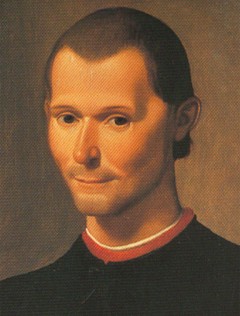


103baswood
Five Italian Renaissance Comedies edited by Bruce Penman
These five plays are a delight from beginning to end, with hardly a dull moment. In the first four plays renaissance society is laid before us and subjected to a satire that is hardly ever gentle and mostly biting. The fifth play is quite different; a pastoral comedy written in rhyming couplets or triplets, which at times reads like a hymn to nature, but a nature full of sensuality.
The Mandragola by Niccolo Machiavelli 1469-1527
This is a very well worked play that has had a number of performances in modern times. It is a dramatisation of a tale that could have come straight out of Boccacio’s Decameron. The story is a popular one: Callimaco has just returned to Florence from Paris after hearing stories of the fabulously beautiful Lucrezia, who is married to Messer Nicia an elderly gentleman. He is driven mad by passion for Nicia’s wife, but she is an honest woman and will have nothing to do with him. Ligurio a parasitical friend of Callimaco comes up with a plan which takes advantage of Lucrezia’s desperation to have children. The plan involves a friar (frate Timoteo), there is much dressing up, there is Ligurio’s ability to think on his feet, when things go wrong and moments of high comedy when Nicia is played for the old fool that he is. It all ends happily for everyone except Messer Nicia who becomes a reluctant cuckold. Machiavelli directs most of his satire towards the clergy, who in the shape of friar Timoteo is easily persuaded to take part in the adulterous schemes, but elderly husbands also come in for some stick.
Lena by Ludovico Ariosto 1474-1533
Another story of the seduction of a young girl, (Licinia) but this time she does not appear as a character in the play. Lena is her protector and has her own axe to grind against her miserly married lover and men in general. However she is happy to go along with plans for the seduction of Licinia if she can profit from it as well. There are plenty of farcical situations involving men hiding in barrels, locked doors, disguises and cunning plans. Much is made of the resourceful Lena and the servants to the gentlemen lovers, who always seem to be one step ahead. Ariosto takes time out to side swipe the judiciary and courtiers in perhaps the most gentle of the satires.
The Stablemaster by Pietro Aretino 1492-1556
This is perhaps the most audacious of the satires, with Aretino going to town on almost all aspects of renaissance life. The plot centres on a particularly cruel and elaborate joke played on the stablemaster to the Prince of the city. The stablemaster has no time for courtiers, fancy women, and anybody else connected to the Princes retinue and his followers and he lets forth a stream of invective against all his tormentors. The Dialogue is witty and fast moving and the satire bites. Aretino must have felt very secure in his position in society to risk the barbs that he delivers here and he also does not miss a chance at self promotion; for example including his own name among the great artists that one of his characters lists.
The Deceived by Gl’Intronati di Siena (A sixteenth century Literary Society)
A play written by a committee perhaps, but they must have had plenty of fun putting this down on paper. A comedy about star crossed lovers and mistaken identity that formed the basic plot that Shakespeare used for his Twelfth Night. It is bawdy, funny and farcical by turns and has some scintillating dialogue. It contains the immortal line from the elderly Virginio who reproaches his wife for saying that a friend of his is too old for a certain woman.
“What does that matter? I’m not far off the same age myself, and you should know whether I can still keep my lance steady in the rest or not”
Nuns and life in the convent is the butt of much satire, with some interesting pointers to the power that an Abbess or Prioress might wield in renaissance society. This bawdy humorous story is fun to read..
The Faithful Shepherd by Giambattista Guarini 1538-1612
The longest play which is very different from the others in this collection. It is the beauty of the language that captures the attention here. The translation by Richard Fanshawe was made in 1647 and he has kept the rhyming couplets and on occasion triplets to produce a text that flows beautifully. The play is set in Arcadia in a sort of Greek antiquity and comes complete with a Greek chorus. The hurly-burly and bawdiness of renaissance Italy has been replaced by a more natural landscape. There is wit and plenty of human nature present in the characters, but the satire has gone. The play sounds gorgeous and works quite well despite a few longueurs.
This penguin classic edition has collected some fine plays from renaissance Italy. They are edited by Bruce Penman who is also responsible for a couple of the translations. He provides a short half page introduction to the authors of each of the plays and a short introduction to the collection as a whole. Really the plays speak for themselves and I was thoroughly entertained. A four star read.
These five plays are a delight from beginning to end, with hardly a dull moment. In the first four plays renaissance society is laid before us and subjected to a satire that is hardly ever gentle and mostly biting. The fifth play is quite different; a pastoral comedy written in rhyming couplets or triplets, which at times reads like a hymn to nature, but a nature full of sensuality.
The Mandragola by Niccolo Machiavelli 1469-1527
This is a very well worked play that has had a number of performances in modern times. It is a dramatisation of a tale that could have come straight out of Boccacio’s Decameron. The story is a popular one: Callimaco has just returned to Florence from Paris after hearing stories of the fabulously beautiful Lucrezia, who is married to Messer Nicia an elderly gentleman. He is driven mad by passion for Nicia’s wife, but she is an honest woman and will have nothing to do with him. Ligurio a parasitical friend of Callimaco comes up with a plan which takes advantage of Lucrezia’s desperation to have children. The plan involves a friar (frate Timoteo), there is much dressing up, there is Ligurio’s ability to think on his feet, when things go wrong and moments of high comedy when Nicia is played for the old fool that he is. It all ends happily for everyone except Messer Nicia who becomes a reluctant cuckold. Machiavelli directs most of his satire towards the clergy, who in the shape of friar Timoteo is easily persuaded to take part in the adulterous schemes, but elderly husbands also come in for some stick.
Lena by Ludovico Ariosto 1474-1533
Another story of the seduction of a young girl, (Licinia) but this time she does not appear as a character in the play. Lena is her protector and has her own axe to grind against her miserly married lover and men in general. However she is happy to go along with plans for the seduction of Licinia if she can profit from it as well. There are plenty of farcical situations involving men hiding in barrels, locked doors, disguises and cunning plans. Much is made of the resourceful Lena and the servants to the gentlemen lovers, who always seem to be one step ahead. Ariosto takes time out to side swipe the judiciary and courtiers in perhaps the most gentle of the satires.
The Stablemaster by Pietro Aretino 1492-1556
This is perhaps the most audacious of the satires, with Aretino going to town on almost all aspects of renaissance life. The plot centres on a particularly cruel and elaborate joke played on the stablemaster to the Prince of the city. The stablemaster has no time for courtiers, fancy women, and anybody else connected to the Princes retinue and his followers and he lets forth a stream of invective against all his tormentors. The Dialogue is witty and fast moving and the satire bites. Aretino must have felt very secure in his position in society to risk the barbs that he delivers here and he also does not miss a chance at self promotion; for example including his own name among the great artists that one of his characters lists.
The Deceived by Gl’Intronati di Siena (A sixteenth century Literary Society)
A play written by a committee perhaps, but they must have had plenty of fun putting this down on paper. A comedy about star crossed lovers and mistaken identity that formed the basic plot that Shakespeare used for his Twelfth Night. It is bawdy, funny and farcical by turns and has some scintillating dialogue. It contains the immortal line from the elderly Virginio who reproaches his wife for saying that a friend of his is too old for a certain woman.
“What does that matter? I’m not far off the same age myself, and you should know whether I can still keep my lance steady in the rest or not”
Nuns and life in the convent is the butt of much satire, with some interesting pointers to the power that an Abbess or Prioress might wield in renaissance society. This bawdy humorous story is fun to read..
The Faithful Shepherd by Giambattista Guarini 1538-1612
The longest play which is very different from the others in this collection. It is the beauty of the language that captures the attention here. The translation by Richard Fanshawe was made in 1647 and he has kept the rhyming couplets and on occasion triplets to produce a text that flows beautifully. The play is set in Arcadia in a sort of Greek antiquity and comes complete with a Greek chorus. The hurly-burly and bawdiness of renaissance Italy has been replaced by a more natural landscape. There is wit and plenty of human nature present in the characters, but the satire has gone. The play sounds gorgeous and works quite well despite a few longueurs.
This penguin classic edition has collected some fine plays from renaissance Italy. They are edited by Bruce Penman who is also responsible for a couple of the translations. He provides a short half page introduction to the authors of each of the plays and a short introduction to the collection as a whole. Really the plays speak for themselves and I was thoroughly entertained. A four star read.
105Linda92007
Great review, Barry. It reminds me that I hardly ever read plays, but should, as I am obviously missing out on some wonderful works.
106dmsteyn
Still busy with Machiavelli, Barry? This collection sounds interesting, though I only really know M and Ariosto. A play written by a committee initially sounded to me like a recipe for disaster, but thinking about it, many English Renaissance plays were also collaborations (for instance, those of Beaumont and Fletcher).
107rebeccanyc
Really enjoying your Renaissance journey!

110baswood
Camus: Elements of a life by Robert Zaretsky
Zaretsky’s introduction informs the reader that he will examine the issues that are more popularly associated with Albert Camus, which he says are: the probing of notions of freedom and justice and the conflict between them, the nature of being an exile and the idea of a man who gave voice to an entire spectrum of silence. His chosen method of examining these subjects is to pick four significant events in Camus life and look at these in some detail.
Chapter 1 takes Camus visit to and reports on Kabylia in 1939, when he was just starting to make a name for himself in his native Algeria as a journalist and essayist. Zaretsky skilfully sketches in Camus early life and influences, setting the scene that would shock the young man when he saw the conditions under which the Arab population were forced to live. He saw injustice at first hand and his reports shaped his early thoughts and honed his skills as a journalist.
Chapter 2 is titled “A Moralist on the Barricades” and takes us to 1945 and describes Camus wrestling with the issues of how to deal with the Collaborationists in Paris at the end of the war. Camus was the editor of Combat a newspaper which had been sympathetic to the resistance movement. President De Gauls’s new government carried out a limited campaign against the more high profile supporters of the Nazis. There were trials and death sentences were given and some were carried out. These actions were supported by Camus, however the post war trial of Robert Brasillach proved to be a watershed for him. Brasillach was the editor of a right wing news paper that had vociferously supported the Nazis campaign against the Jews. Francois Mauriac was a leading campaigner trying to get Brasillachs death sentence commuted and he wrote an open letter to Camus as a fellow journalist to sign a petition to that affect. Camus after much soul searching did eventually admit that Mauriac’s position was right agreeing that France was in need of charity more than blind justice.
Chapter 3 “French Tragedies” focuses on the public debate between Camus and Jean-Paul Sartre, that took place in 1952.. Les Temps Modernes edited by Sartre had become the leading voice of the intellectual left and he and Camus had been good friends, however their views were diverging and when Sartre’s journal finally got around to reviewing Camus book “The Rebel” it was no surprise that it was unfavourable. Camus wrote a public letter explaining his position in reply to the review and Sartre countered this in a very personal and at times vindictive reply. Sartre’s position was supported by many intellectuals on the left and Camus found himself once again out in the cold. Zaretsky does an excellent job in explaining the differences of opinion and the reasons why the break had to come.
Chapter 4 takes us forward to 1956 and Camus stance on the coming war for Algeria. Camus was Algerian and as a leading intellectual involved himself in the politics. He had never shied away from a fight, but on this issue he found himself in an impossible position. He had previously fought for the Arabs of Algeria to be given equal rights with the French colonists, but he was horrified by the escalating violence from both sides. He could not support the French government or the Arab FLN who were both advocating terrorism. His only recourse after a heroic attempt to broker a truce was to stay silent and he refused to talk about the issue. The old arguments with Sartre surfaced once again and it came down to Camus refusing to accept that the end justified the means. .
In selecting these four incidents Zaretsky has managed to cut to the quick into the personality and thoughts of Camus. He interweaves his narrative with extensive references to Camus most famous publications, showing how Camus ideas and thoughts developed through his experiences. Camus was a brave free thinker who never lost sight of his humanity and these selected incidents serve well in providing a lasting impression of the man and his thoughts. Zaretsky also links Camus reflections to other thinkers from history including St Augustine, Thucydides, Rousseau etc, however I found this aspect of the book a little forced, but it did not get in the way of my enjoyment of the book as a whole. At 200 pages including notes and references the book serves as a good introduction to the work of Camus. It is very well written and will hold the interest of anyone interested in its subject. A 3.5 star read
Zaretsky’s introduction informs the reader that he will examine the issues that are more popularly associated with Albert Camus, which he says are: the probing of notions of freedom and justice and the conflict between them, the nature of being an exile and the idea of a man who gave voice to an entire spectrum of silence. His chosen method of examining these subjects is to pick four significant events in Camus life and look at these in some detail.
Chapter 1 takes Camus visit to and reports on Kabylia in 1939, when he was just starting to make a name for himself in his native Algeria as a journalist and essayist. Zaretsky skilfully sketches in Camus early life and influences, setting the scene that would shock the young man when he saw the conditions under which the Arab population were forced to live. He saw injustice at first hand and his reports shaped his early thoughts and honed his skills as a journalist.
Chapter 2 is titled “A Moralist on the Barricades” and takes us to 1945 and describes Camus wrestling with the issues of how to deal with the Collaborationists in Paris at the end of the war. Camus was the editor of Combat a newspaper which had been sympathetic to the resistance movement. President De Gauls’s new government carried out a limited campaign against the more high profile supporters of the Nazis. There were trials and death sentences were given and some were carried out. These actions were supported by Camus, however the post war trial of Robert Brasillach proved to be a watershed for him. Brasillach was the editor of a right wing news paper that had vociferously supported the Nazis campaign against the Jews. Francois Mauriac was a leading campaigner trying to get Brasillachs death sentence commuted and he wrote an open letter to Camus as a fellow journalist to sign a petition to that affect. Camus after much soul searching did eventually admit that Mauriac’s position was right agreeing that France was in need of charity more than blind justice.
Chapter 3 “French Tragedies” focuses on the public debate between Camus and Jean-Paul Sartre, that took place in 1952.. Les Temps Modernes edited by Sartre had become the leading voice of the intellectual left and he and Camus had been good friends, however their views were diverging and when Sartre’s journal finally got around to reviewing Camus book “The Rebel” it was no surprise that it was unfavourable. Camus wrote a public letter explaining his position in reply to the review and Sartre countered this in a very personal and at times vindictive reply. Sartre’s position was supported by many intellectuals on the left and Camus found himself once again out in the cold. Zaretsky does an excellent job in explaining the differences of opinion and the reasons why the break had to come.
Chapter 4 takes us forward to 1956 and Camus stance on the coming war for Algeria. Camus was Algerian and as a leading intellectual involved himself in the politics. He had never shied away from a fight, but on this issue he found himself in an impossible position. He had previously fought for the Arabs of Algeria to be given equal rights with the French colonists, but he was horrified by the escalating violence from both sides. He could not support the French government or the Arab FLN who were both advocating terrorism. His only recourse after a heroic attempt to broker a truce was to stay silent and he refused to talk about the issue. The old arguments with Sartre surfaced once again and it came down to Camus refusing to accept that the end justified the means. .
In selecting these four incidents Zaretsky has managed to cut to the quick into the personality and thoughts of Camus. He interweaves his narrative with extensive references to Camus most famous publications, showing how Camus ideas and thoughts developed through his experiences. Camus was a brave free thinker who never lost sight of his humanity and these selected incidents serve well in providing a lasting impression of the man and his thoughts. Zaretsky also links Camus reflections to other thinkers from history including St Augustine, Thucydides, Rousseau etc, however I found this aspect of the book a little forced, but it did not get in the way of my enjoyment of the book as a whole. At 200 pages including notes and references the book serves as a good introduction to the work of Camus. It is very well written and will hold the interest of anyone interested in its subject. A 3.5 star read
111Linda92007
Excellent review of Camus: Elements of a Life, Barry. The four aspects that Zaretsky chose to focus on are intriguing and your review left me wanting to know more about his life.
112dmsteyn
Happy to read another a great review on Camus, Barry. You must be itching to get to Camus's own writings by now...
113absurdeist
Catching up and hoping I'm not mucking up the flow of your thread too much by touching on that list.
I liked the idea (was it Zs?, couldn't relocate it) of "SF that transcends the genre". I'd be interested in exploring more of that kind of SF beyond the usual suspects. Might make a good thread all its own.
Much has been made of Dune, and rightly so, but little is ever mentioned of Herbert's non-Dune books, most now out of print and long eclipsed by Dune's shadow. But having returned to most of them as an adult, I've found I'm still enamoured of their ideas, if not so much their generally overly-dense prose. The Santaroga Barrier, The Dragon in the Sea (his first), and Soul Catcher (his only novel that wasn't SF, replaced instead by a universe centered in Native American shamanism) are but three examples I could mention.
I'll get to the Camus soon....
I liked the idea (was it Zs?, couldn't relocate it) of "SF that transcends the genre". I'd be interested in exploring more of that kind of SF beyond the usual suspects. Might make a good thread all its own.
Much has been made of Dune, and rightly so, but little is ever mentioned of Herbert's non-Dune books, most now out of print and long eclipsed by Dune's shadow. But having returned to most of them as an adult, I've found I'm still enamoured of their ideas, if not so much their generally overly-dense prose. The Santaroga Barrier, The Dragon in the Sea (his first), and Soul Catcher (his only novel that wasn't SF, replaced instead by a universe centered in Native American shamanism) are but three examples I could mention.
I'll get to the Camus soon....
114avidmom
>110 baswood: That was quite a history lesson! Thanks for posting the SF list. I see that I've read a whopping two off of the list, 1984 and Hitchhiker's. One of my goals for this year is to read at least one SF book.
116zenomax
Interesting contrast between Camus and Sartre. You can imagine if either had inhabited the body and mind of Lenin that the history of Soviet Russia could have taken 2 different turns.
Sartre I can see as mirroring Lenin quite closely. The means justifies the ends Albert! I must do what is best for the revolution. Yeah, right.
Sartre I can see as mirroring Lenin quite closely. The means justifies the ends Albert! I must do what is best for the revolution. Yeah, right.
117rachbxl
Catching up at last. How's the saxophone going? Those backing tracks are great, aren't they? I play the piano (and at one time was quite a competent clarinettist, but I stupidly haven't had it out of its case for years (although it's been creeping up on me recently - the other week I bought some reeds for the first time in about 10 years and I can feel that any day now I'm going to give it a go)) and when I play along to those things I feel like I'm really playing as opposed to doing exercises and practising.
Interesting list of SF; I'll look forward to seeing what you make of any you decide to read. I 'don't like' SF (one of those irrational prejudices) so I haven't read many of them. However, a couple of years ago I had to read Solaris (during one of my stays in Poland I was asked to do an English voice-over for a dance piece based on it, and the people involved insisted I read it beforehand) and to my surprise I really enjoyed it. It's stayed with me too.
Interesting list of SF; I'll look forward to seeing what you make of any you decide to read. I 'don't like' SF (one of those irrational prejudices) so I haven't read many of them. However, a couple of years ago I had to read Solaris (during one of my stays in Poland I was asked to do an English voice-over for a dance piece based on it, and the people involved insisted I read it beforehand) and to my surprise I really enjoyed it. It's stayed with me too.
118baswood
avidmom it's all just absurd. Have you decided on which SF book you're going to read. I am half way through A Journey to the centre of the earth at the moment.
Linda, Dewald thanks. I am going to start my Camus reading with L'Envers et L'Endroit which translates as The wrong side and the Right Side. This was a small book of essays that Camus Wrote in 1935 and 1936 and had published in Algeria. It comes in a 1970 edition of Lyrical and Critical Essays
Merrikay Thanks and nice to see you here.
Brent and Zeno From the Abe list of essential science fiction books there are a few, but only a few that strike me as transcending the genre, I will bear that in mind as I read through the list. I am already puzzling over the first one A Journey to the Centre of the Earth. Is it genre transcending or should it really be in the list in the first place?
Zeno I am much more sympa. with Camus position.
Linda, Dewald thanks. I am going to start my Camus reading with L'Envers et L'Endroit which translates as The wrong side and the Right Side. This was a small book of essays that Camus Wrote in 1935 and 1936 and had published in Algeria. It comes in a 1970 edition of Lyrical and Critical Essays
Merrikay Thanks and nice to see you here.
Brent and Zeno From the Abe list of essential science fiction books there are a few, but only a few that strike me as transcending the genre, I will bear that in mind as I read through the list. I am already puzzling over the first one A Journey to the Centre of the Earth. Is it genre transcending or should it really be in the list in the first place?
Zeno I am much more sympa. with Camus position.
119baswood
Hi Rachel, nice to see you back in club read.
I am still having great fun with the saxophone. I have a friend who is a clarinetist and she came round and we stumbled through a version of the Marseilles together. She plays in a local orchestra and so learning the Marseilles is de rigeur. Buying new reeds is a good start to getting that clarinet out of it's case.
At the moment I am trying to use a metronome to get some sort of timing into my playing. My teacher is a trombone player, but has also played bass guitar among other things, he has now gone out and bought himself a saxophone and so my impromptu lessons/blowing sessions with him are voyages of discovery.
I am still having great fun with the saxophone. I have a friend who is a clarinetist and she came round and we stumbled through a version of the Marseilles together. She plays in a local orchestra and so learning the Marseilles is de rigeur. Buying new reeds is a good start to getting that clarinet out of it's case.
At the moment I am trying to use a metronome to get some sort of timing into my playing. My teacher is a trombone player, but has also played bass guitar among other things, he has now gone out and bought himself a saxophone and so my impromptu lessons/blowing sessions with him are voyages of discovery.
120kidzdoc
Great review of Albert Camus: Elements of a Life, Barry. I've downloaded the Kindle sample, and I'll almost certainly buy it and read it soon.
121SassyLassy
>118 baswood: I would have to reread Journey..., but as I remember it, it must have struck Verne's contemporaries as definitely outside the normal realm of things.
Enjoyed the Zaretsky and Penman reviews. How do you find (discover) your books?
Still working on zeno's take over of Lenin's mind. That might take some time.
Enjoyed the Zaretsky and Penman reviews. How do you find (discover) your books?
Still working on zeno's take over of Lenin's mind. That might take some time.
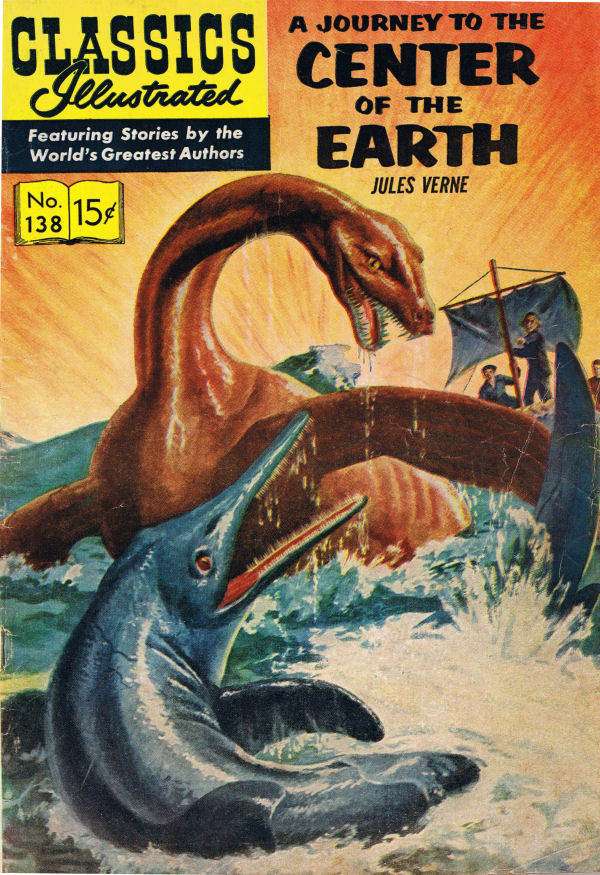
124baswood
Number 1 in Abe books 50 essential science-fiction novels listed chronologically
A Journey to the Centre of the Earth by Jules Verne
“Science fiction is a genre of fiction with imaginative but more or less plausible content such as settings in the future, futuristic science and technology, space travel, parallel universes, aliens, and paranormal abilities. Exploring the consequences of scientific innovations is one purpose of science fiction, making it a "literature of ideas" Science fiction has been used by authors and film/television program makers as a device to discuss philosophical ideas such as identity, desire, morality and social structure etc.”
This definition of Science fiction copied from Wiki does not really apply to Jules Verne’s A Journey to the Centre of the Earth: the action does not take place in the future, there are no aliens, space travel, or paranormal abilities. The book does not attempt to explore the consequences of scientific innovation and there is little evidence of a “literature of ideas” however the book feels like science fiction, because there is a healthy dollop of geology and physics from the mid 19th century that is stretched to breaking point and beyond by Verne’s imagination and there could also be a case made for a sort of parallel universe in that our three heroes discover another world below the earth’s crust.
Abe books’s list of the 50 essential science fiction novels starts with Jules Verne’s classic story: claiming that it pretty much started the whole thing. I think of it more as an adventure story, which uses a scientific background to add some credibility to the fantastic story line, but it is an adventure story first and foremost..
Verne presents us with three very different characters. They are the irascible, brilliant but driven scientist Professor Liedenbrock, Axel, his nephew; enthusiastic, intelligent, frightened and accident prone and Hans, the taciturn Icelander; servant to Liendenbrock who quietly gets on and does everything to ensure the survival of his two companions. They embark on an old fashioned treasure hunt, but without any treasure just Liedenbrock’s desire to travel to the centre of the earth. The story is told from Axel’s point of view and his early portrait of Liedenbrock is both amusing and witty. Axel is a student of geology and his keen interest in the landscape as they travel to an extinct volcano in Iceland gives Verne license to write some excellent prose on both the Icelandic people and their environment and although the adventure proper does not start until the party reach the volcano there are no dull patches in the early part of the book. Once they descend into the crater; Verne ramps up the excitement and there are some extraordinary events to describe; Axel’s sense of doom when he becomes separated from the party, the violent electrical storm on the inland sea and of course the amazing volcanic eruption near the end of the story.
A story that was familiar to me from having read it a long time ago and from the film versions that I had seen did not disappoint when I re-read the novel today. I felt thoroughly entertained. An adventure story that has stood the test of time, but it’s not really science fiction
The version I read was the one published in 1877, which is free in the public domain and the translation by the reverend Frederick Amadeus Malleson reads well enough not to need a more modern translation. Not great literature, but a well told fantasy story that I would rate at 3.5 stars
A Journey to the Centre of the Earth by Jules Verne
“Science fiction is a genre of fiction with imaginative but more or less plausible content such as settings in the future, futuristic science and technology, space travel, parallel universes, aliens, and paranormal abilities. Exploring the consequences of scientific innovations is one purpose of science fiction, making it a "literature of ideas" Science fiction has been used by authors and film/television program makers as a device to discuss philosophical ideas such as identity, desire, morality and social structure etc.”
This definition of Science fiction copied from Wiki does not really apply to Jules Verne’s A Journey to the Centre of the Earth: the action does not take place in the future, there are no aliens, space travel, or paranormal abilities. The book does not attempt to explore the consequences of scientific innovation and there is little evidence of a “literature of ideas” however the book feels like science fiction, because there is a healthy dollop of geology and physics from the mid 19th century that is stretched to breaking point and beyond by Verne’s imagination and there could also be a case made for a sort of parallel universe in that our three heroes discover another world below the earth’s crust.
Abe books’s list of the 50 essential science fiction novels starts with Jules Verne’s classic story: claiming that it pretty much started the whole thing. I think of it more as an adventure story, which uses a scientific background to add some credibility to the fantastic story line, but it is an adventure story first and foremost..
Verne presents us with three very different characters. They are the irascible, brilliant but driven scientist Professor Liedenbrock, Axel, his nephew; enthusiastic, intelligent, frightened and accident prone and Hans, the taciturn Icelander; servant to Liendenbrock who quietly gets on and does everything to ensure the survival of his two companions. They embark on an old fashioned treasure hunt, but without any treasure just Liedenbrock’s desire to travel to the centre of the earth. The story is told from Axel’s point of view and his early portrait of Liedenbrock is both amusing and witty. Axel is a student of geology and his keen interest in the landscape as they travel to an extinct volcano in Iceland gives Verne license to write some excellent prose on both the Icelandic people and their environment and although the adventure proper does not start until the party reach the volcano there are no dull patches in the early part of the book. Once they descend into the crater; Verne ramps up the excitement and there are some extraordinary events to describe; Axel’s sense of doom when he becomes separated from the party, the violent electrical storm on the inland sea and of course the amazing volcanic eruption near the end of the story.
A story that was familiar to me from having read it a long time ago and from the film versions that I had seen did not disappoint when I re-read the novel today. I felt thoroughly entertained. An adventure story that has stood the test of time, but it’s not really science fiction
The version I read was the one published in 1877, which is free in the public domain and the translation by the reverend Frederick Amadeus Malleson reads well enough not to need a more modern translation. Not great literature, but a well told fantasy story that I would rate at 3.5 stars
125dmsteyn
Interesting review of a book I've never considered reading, Barry. Adventure stories haven't been my thing for a few years, but if it's well-told, as you intimate, I might just try it.
126Mr.Durick
I had taken the Ruhmkorff lamp to be a bit of science fiction in Journey to the Center of the Earth, but apparently it was a real thing.
Robert
Robert
128dchaikin
Back at #110 and Zaretsky - I got a lot out of this review. All four instances are quite fascinating. And, terrific review.
Journey to the Center of the Earth reminds that I've read this and that I have no idea when I read it. I really enjoyed your review, taking me back there again.
I thought there was some futuristic technology in this story, for example, I though the electric handheld flashlight was introduced by Vern here, something he got credit for predicting... a quick google search got me nowhere, maybe just my imagination on that one.
Journey to the Center of the Earth reminds that I've read this and that I have no idea when I read it. I really enjoyed your review, taking me back there again.
I thought there was some futuristic technology in this story, for example, I though the electric handheld flashlight was introduced by Vern here, something he got credit for predicting... a quick google search got me nowhere, maybe just my imagination on that one.
129baswood
Dan, if you follow Robert's link at #126 or this one to the induction coil http://en.wikipedia.org/wiki/Induction_coil. There is probably all you need to know about the Ruhmkorff lamp which the intrepid adventurers carried with them.
131avidmom
>122 baswood: Love that picture! I don't know why but it immediately reminded me of Saturday morning cartoons. Also, fifteen cents for a book! WOW!
132zenomax
121 it may be possible I did JPS an injustice, but I stand by my depiction of Lenin himself.
133zenomax
Bas, although I haven't read AJTTCOTE, I did read the underground travels of Niels Klim many years ago. It predates Verne's book by a century, and had some brilliantly imaginative illustrations.it was satirical in the way Gulliver was, but had real elements of imagination and the fantastical.
Wellington library back then was excellent for the more obscure books and music. The combined resources of Victoria university and Wellington libraries held me in good stead as a teenager.
Wellington library back then was excellent for the more obscure books and music. The combined resources of Victoria university and Wellington libraries held me in good stead as a teenager.
134QuentinTom
good stuff on Camus, although I spluttered a bit with your designation of
St Augustine as a 'thinker', nasty little shit that he was.
It's interesting that now all the details of the historical circumstances have faded it's Camus rather than Sartre who comes off as the greater man with his emphasis on enduring, positive human values. An obsesion with realpolitik does rather date one, which I think is what has happened to Sartre's reputation.
Btw, baz, if you get the chance, read Simone's de Beauvoir's novel The Mandarins which works the same ground but from a thinly disguised fictional perspective.
St Augustine as a 'thinker', nasty little shit that he was.
It's interesting that now all the details of the historical circumstances have faded it's Camus rather than Sartre who comes off as the greater man with his emphasis on enduring, positive human values. An obsesion with realpolitik does rather date one, which I think is what has happened to Sartre's reputation.
Btw, baz, if you get the chance, read Simone's de Beauvoir's novel The Mandarins which works the same ground but from a thinly disguised fictional perspective.
135baswood
TC I have read The Mandarins in the dim and distant past, but had no idea that there was a thinly disguised character assassination of Camus therein. Olivier Todd in his biography hints there might have been sexual jealousy involved - (surely not from the sainted de Beauvoir I cry). I am therefore intrigued enough to read it again this year.
There are plenty of nasty little shits with nasty thoughts.
I agree with you that Camus thoughts more easily gel with those of us who like to think of ourselves as humanists, but my readings will probably lead me to Sartre as well, who may at the end of the day have more profound things to say to us.
Zeno, I didn't know about The underground travels of Neils Klim.
I had to make do with Elliott Comprehensive school library, but it was quite good and had almost all of D H Lawrence's novels, for which I am eternally thankful
There are plenty of nasty little shits with nasty thoughts.
I agree with you that Camus thoughts more easily gel with those of us who like to think of ourselves as humanists, but my readings will probably lead me to Sartre as well, who may at the end of the day have more profound things to say to us.
Zeno, I didn't know about The underground travels of Neils Klim.
I had to make do with Elliott Comprehensive school library, but it was quite good and had almost all of D H Lawrence's novels, for which I am eternally thankful
136baswood
A Troubadour's Testament by James Cowan
It is described as a novel, but the way it is written suggests it is a search for historical facts. I found the the uncertainty of whether it was real history or an almost total fiction, confusing and frustrating.
The author writes in the first person about his friend’s discovery of a death roll written by Marcebru a twelfth century troubadour and poet. Cowan claims to have studied the lyrics of twelfth century troubadours and Marcebru’s poetry holds a special place in his heart He is familiar with the poet’s oeuvre and has always been puzzled as to why he suddenly appeared to stop writing and how he met his end. The discovery of the death roll written after his last known work is exciting enough for Cowan to travel to South West France to examine the document in person and to see what more he can discover about Marcebru.
Death rolls were eulogies written about a character who had recently died, rather like an obituary, but they would be taken around to those who had known the deceased so that they could add their thoughts to the roll. Marcebru had fulfilled this task for Amedee de Jois the love of his life according to his poems. It was a love of fin d’amours a love that could not be consummated, but in the tradition of twelfth century courtly love; more of an adoration of the female, where the man’s finest qualities would be enhanced by his undying love. Amedee de Jois was a nun and Cowans says that her relationship to Marcebru had become his obsession.
Cowan’s conveniently finds that the document written in Latin has already been partially translated by the museum chief; a Latin scholar who gives him the document to aid his search. Cowans sets out on the trail of the places that Marcebru visited in order to complete the death roll. Along the way a story unfolds and he discovers that Amedee de Jois would almost certainly have been a secret member of the Cathars: a heretical sect that were ruthlessly exterminated by the Catholics in the twelfth century. This discovery leads Cowans to reflect on how this knowledge would have affected Marcebru and how it could have influenced his poetry. Cowans reaches the end of the trail when he visits the Abbey Saint-Martin-du-Canigou, where he has an audience with the terminally ill Abbess Stephanie which results in a touching discussion on the nature of faith and heresy and the suicide of Amadee du Jois.
The novel masquerades as an historical detective story and in so doing provides this curious mish-mash of fact and fiction. Much of what Cowan’s say about the Cathars is historically correct, the places visited in South West France certainly exist (as I know a few of them). There was a famous twelfth century troubadour poet called Marcabru (Cowans spells the name Marcebru) and poems written by him do exist, however I have no idea about the authenticity of Cowan’s extracts from them. The story of Amedee du Jois could be complete fiction as could be the discovery of the death roll and Cowans trip through France. It is a novel and so he could have made it all up, but the veneer of authenticity just seems to fog the whole issue for me.
It is easy to get pleasantly lost in the book, with its themes of love, faith and mortality and Cowans provides plenty of atmosphere for his travels around South West France, which project back to life and society in the middle ages. I enjoyed his excursions into Catharism and the issues that might have plagued educated people at that time He writes well with at times a dreamy quality that carries one along with his journey into the past. No doubt this book will appeal greatly to some people, but the story is a slight one, covering similar ground to many fictional literary detective story and so a very personal rating of 2.5 stars from me..
It is described as a novel, but the way it is written suggests it is a search for historical facts. I found the the uncertainty of whether it was real history or an almost total fiction, confusing and frustrating.
The author writes in the first person about his friend’s discovery of a death roll written by Marcebru a twelfth century troubadour and poet. Cowan claims to have studied the lyrics of twelfth century troubadours and Marcebru’s poetry holds a special place in his heart He is familiar with the poet’s oeuvre and has always been puzzled as to why he suddenly appeared to stop writing and how he met his end. The discovery of the death roll written after his last known work is exciting enough for Cowan to travel to South West France to examine the document in person and to see what more he can discover about Marcebru.
Death rolls were eulogies written about a character who had recently died, rather like an obituary, but they would be taken around to those who had known the deceased so that they could add their thoughts to the roll. Marcebru had fulfilled this task for Amedee de Jois the love of his life according to his poems. It was a love of fin d’amours a love that could not be consummated, but in the tradition of twelfth century courtly love; more of an adoration of the female, where the man’s finest qualities would be enhanced by his undying love. Amedee de Jois was a nun and Cowans says that her relationship to Marcebru had become his obsession.
Cowan’s conveniently finds that the document written in Latin has already been partially translated by the museum chief; a Latin scholar who gives him the document to aid his search. Cowans sets out on the trail of the places that Marcebru visited in order to complete the death roll. Along the way a story unfolds and he discovers that Amedee de Jois would almost certainly have been a secret member of the Cathars: a heretical sect that were ruthlessly exterminated by the Catholics in the twelfth century. This discovery leads Cowans to reflect on how this knowledge would have affected Marcebru and how it could have influenced his poetry. Cowans reaches the end of the trail when he visits the Abbey Saint-Martin-du-Canigou, where he has an audience with the terminally ill Abbess Stephanie which results in a touching discussion on the nature of faith and heresy and the suicide of Amadee du Jois.
The novel masquerades as an historical detective story and in so doing provides this curious mish-mash of fact and fiction. Much of what Cowan’s say about the Cathars is historically correct, the places visited in South West France certainly exist (as I know a few of them). There was a famous twelfth century troubadour poet called Marcabru (Cowans spells the name Marcebru) and poems written by him do exist, however I have no idea about the authenticity of Cowan’s extracts from them. The story of Amedee du Jois could be complete fiction as could be the discovery of the death roll and Cowans trip through France. It is a novel and so he could have made it all up, but the veneer of authenticity just seems to fog the whole issue for me.
It is easy to get pleasantly lost in the book, with its themes of love, faith and mortality and Cowans provides plenty of atmosphere for his travels around South West France, which project back to life and society in the middle ages. I enjoyed his excursions into Catharism and the issues that might have plagued educated people at that time He writes well with at times a dreamy quality that carries one along with his journey into the past. No doubt this book will appeal greatly to some people, but the story is a slight one, covering similar ground to many fictional literary detective story and so a very personal rating of 2.5 stars from me..
137detailmuse
>2 zenomax:.5 stars, yikes
"Death rolls" -- interesting in a novel and interesting to know more about, did they really exist? Have to dig some more, I've only so far found them associated with boating and alligators!
"Death rolls" -- interesting in a novel and interesting to know more about, did they really exist? Have to dig some more, I've only so far found them associated with boating and alligators!
138dmsteyn
The book seems to have elements that could have worked well (I'm also interested in Catharism and medieval history in general) but it doesn't seem to have gelled for you, Barry. May I ask why you read this right now? Is it because of the connection to South France?
140baswood
Dewald, My interest in the late middle ages and a recommendation from a fellow LTer and it being set in the part of the world where I live were reasons for reading it. Not such good reasons apparently, but you can't win them all and it was a quick read.
141edwinbcn
I am glad that your evaluation of A Troubadour's Testament also resulted is low ratings, because (high) praise by other LT members made me doubt my own assessment.
I read the book before I started writing and posting reviews; the "review" I posted, was a comment I made elsewhere on LT two years on.
I read the book before I started writing and posting reviews; the "review" I posted, was a comment I made elsewhere on LT two years on.
142StevenTX
I'm finally catching up on about three weeks of great reviews, etc.
I've read half of the works on Abe's SF list. I like that it has representative works from a variety of periods and sub-genres and isn't just a "50 greatest" list. On the other hand, it seems to be overly influenced by motion pictures with such choices as Logan's Run and Make Room! Make Room!. And there are some odd selections such as The Illustrated Man instead of Fahrenheit 451. But I'm sure everything on the list is worth reading.
You're setting a fast pace with your Camus reading. I've been reading the biography by Herbert Lottman, which was considered the standard until Todd's supplanted it. I have the Lottman simply because it was what the local book store had in stock. It seems serviceable. I had been planning to read A Happy Death next, but based on others' comments here I think I'll skip ahead to Camus' more prominent works.
I've read half of the works on Abe's SF list. I like that it has representative works from a variety of periods and sub-genres and isn't just a "50 greatest" list. On the other hand, it seems to be overly influenced by motion pictures with such choices as Logan's Run and Make Room! Make Room!. And there are some odd selections such as The Illustrated Man instead of Fahrenheit 451. But I'm sure everything on the list is worth reading.
You're setting a fast pace with your Camus reading. I've been reading the biography by Herbert Lottman, which was considered the standard until Todd's supplanted it. I have the Lottman simply because it was what the local book store had in stock. It seems serviceable. I had been planning to read A Happy Death next, but based on others' comments here I think I'll skip ahead to Camus' more prominent works.

145baswood
No. 2 in Abe books 50 essential science fiction novels listed chronologically
The War of the Worlds by H G Wells
Not quite the first alien invasion novel, or the first dystopian novel, or the first “contact” novel, but certainly the best that combined all three. Serialised beforehand and eventually published as a novel in 1898, this could be seen as the book that launched the whole new genre of science fiction. Sure H G Wells had dabbled before with The Time Machine, The Island of Dr Moreau, The Invisible Man and even The Wonderful Visit, but The War of the Worlds, puts it all together to make a wonderful reading experience. How it must have fired the imagination of Well’s Victorian audience, because it still has the power to resonate today.
The story of the Invaders from Mars is well known to most readers and there have been comic strip versions, radio broadcasts and spectacular film versions, so there is no need to detail the plot here, but re-reading it this week still made some aspects leap off the page at me. For a start most of the action takes place in the south west Home Counties that surround London, I was born and bred in that area and so when Wells places his startling events around Chertsey and Weybridge and then Twickenham, Richmond and Barnes I am right there with him. This gives the whole novel a parochial feel for me and indeed it is parochial because most of the action takes place in those sleepy small towns that in Victorian times were not a part of Greater London. The books big theme is an alien invasion and yet it all appears to be happening next door to where I lived. Of course at the time of writing, England was probably the most powerful of the colonial powers and so setting an invasion of the world around the outskirts of London made perfect sense.
Well’s novel takes place in his present day and so the novel has a wonderfully authentic Victorian feel, here people are fleeing from the monstrous war machines on bicycles and horses and carts, the army is very slow to respond and when it does it feels amateurish, there is no ease of communication and people are unaware of what is happening around them but when they do see the carnage, there is shock, then fright, then confusion It must have felt very real to Well’s Victorian readers and it felt real for me reading it in 2013. Wells uses a first person survivor of the invasion to tell his story and this enhances the reality of the events described.
There are some unforgettable scenes here; the flight from London with the narrators brother trying to cross a small road jam packed with vehicles, the battle between the Martians and the iron clad “Thunderchild” that takes place just off the English coast, the Martian war machine hunting humans along the river Thames and finally the eerie scenes in an almost deserted London when the Martians death calls reverberate around the city.
The book is in two parts and the first part details the dramatic events leading upto the Martian take over. Part two is more reflective, perhaps a little slower, but it is full of atmosphere and a kind of horror. This is dystopia and Wells reinforces the major themes with some telling conversations with the narrator’s two main protagonists. The curate who attaches himself to the narrator is shown as weak, almost helpless, his faith of no use in the circumstances. Then there is the artillery man dreaming of leading a guerrilla war against the Martians, but in practice his methods are foolhardy and he is naïve and quickly becomes disheartened. Wells/the narrator says in the opening chapter when he reflects back on events:
“And before we judge them (the Martians) too harshly we must remember what ruthless and utter destruction our own species has wrought, not only upon animals such as the vanished bison and the dodo, but upon the inferior races. The Tasmanians, in spite of their huiman likeness, were entirely swept out of existence in a war of extermination wages by European immigrants……..”
Survival of the fittest and natural selection are themes that surface throughout this book.
Wells was writing before the advent of the two world wars but at a time when “Invasion literature” was popular, invasion by Germany that is rather than Martians, but some of the devastation and panic amongst people seems prophetic of events that would soon become familiar. This is his description of the flight from London:
“Never before in the history of the world has such a mass of human beings moved and suffered together. The legendary hosts of Goths and Huns, the hugest armies Asia has ever seen would have been but a drop in the current. And this was no disciplined march; it was a stampede - a stampede gigantic and terrible - without order and without a goal, six million people unarmed and unprovisioned, driving headlong. It was the beginning of the rout of civilization, of the massacre of mankind.” .
This has got to be one of the first and one of the best science fiction novels. It is a novel with both a message and a warning: chock full of literary merit. It is still a great read today and if you have never got round to reading it I would encourage you to do so. It is free and in the public domain. A five star book
The War of the Worlds by H G Wells
Not quite the first alien invasion novel, or the first dystopian novel, or the first “contact” novel, but certainly the best that combined all three. Serialised beforehand and eventually published as a novel in 1898, this could be seen as the book that launched the whole new genre of science fiction. Sure H G Wells had dabbled before with The Time Machine, The Island of Dr Moreau, The Invisible Man and even The Wonderful Visit, but The War of the Worlds, puts it all together to make a wonderful reading experience. How it must have fired the imagination of Well’s Victorian audience, because it still has the power to resonate today.
The story of the Invaders from Mars is well known to most readers and there have been comic strip versions, radio broadcasts and spectacular film versions, so there is no need to detail the plot here, but re-reading it this week still made some aspects leap off the page at me. For a start most of the action takes place in the south west Home Counties that surround London, I was born and bred in that area and so when Wells places his startling events around Chertsey and Weybridge and then Twickenham, Richmond and Barnes I am right there with him. This gives the whole novel a parochial feel for me and indeed it is parochial because most of the action takes place in those sleepy small towns that in Victorian times were not a part of Greater London. The books big theme is an alien invasion and yet it all appears to be happening next door to where I lived. Of course at the time of writing, England was probably the most powerful of the colonial powers and so setting an invasion of the world around the outskirts of London made perfect sense.
Well’s novel takes place in his present day and so the novel has a wonderfully authentic Victorian feel, here people are fleeing from the monstrous war machines on bicycles and horses and carts, the army is very slow to respond and when it does it feels amateurish, there is no ease of communication and people are unaware of what is happening around them but when they do see the carnage, there is shock, then fright, then confusion It must have felt very real to Well’s Victorian readers and it felt real for me reading it in 2013. Wells uses a first person survivor of the invasion to tell his story and this enhances the reality of the events described.
There are some unforgettable scenes here; the flight from London with the narrators brother trying to cross a small road jam packed with vehicles, the battle between the Martians and the iron clad “Thunderchild” that takes place just off the English coast, the Martian war machine hunting humans along the river Thames and finally the eerie scenes in an almost deserted London when the Martians death calls reverberate around the city.
The book is in two parts and the first part details the dramatic events leading upto the Martian take over. Part two is more reflective, perhaps a little slower, but it is full of atmosphere and a kind of horror. This is dystopia and Wells reinforces the major themes with some telling conversations with the narrator’s two main protagonists. The curate who attaches himself to the narrator is shown as weak, almost helpless, his faith of no use in the circumstances. Then there is the artillery man dreaming of leading a guerrilla war against the Martians, but in practice his methods are foolhardy and he is naïve and quickly becomes disheartened. Wells/the narrator says in the opening chapter when he reflects back on events:
“And before we judge them (the Martians) too harshly we must remember what ruthless and utter destruction our own species has wrought, not only upon animals such as the vanished bison and the dodo, but upon the inferior races. The Tasmanians, in spite of their huiman likeness, were entirely swept out of existence in a war of extermination wages by European immigrants……..”
Survival of the fittest and natural selection are themes that surface throughout this book.
Wells was writing before the advent of the two world wars but at a time when “Invasion literature” was popular, invasion by Germany that is rather than Martians, but some of the devastation and panic amongst people seems prophetic of events that would soon become familiar. This is his description of the flight from London:
“Never before in the history of the world has such a mass of human beings moved and suffered together. The legendary hosts of Goths and Huns, the hugest armies Asia has ever seen would have been but a drop in the current. And this was no disciplined march; it was a stampede - a stampede gigantic and terrible - without order and without a goal, six million people unarmed and unprovisioned, driving headlong. It was the beginning of the rout of civilization, of the massacre of mankind.” .
This has got to be one of the first and one of the best science fiction novels. It is a novel with both a message and a warning: chock full of literary merit. It is still a great read today and if you have never got round to reading it I would encourage you to do so. It is free and in the public domain. A five star book
146avidmom
Hmmm ... "one of the first and one of the best science fiction novels." Maybe I've found my sci fi read of the year!
Love the picture in 144!
Great review, as always.
Love the picture in 144!
Great review, as always.
147dmsteyn
Excellent review, Barry! Any book that manages a certain verisimilitude for someone familiar with the area in which it is set, is doing something right. I might have read some short stories by Wells, but this was a long time ago. Perhaps I'll give this one a try sometime.
149zenomax
You've convinced me bas. I'm going to try to lever TWOTW in later in the year.
I agree that the image in 144 is excellent.
I agree that the image in 144 is excellent.
150baswood
THanks everyone, I am tempted to read more early H G Wells novel;s and have The Time Machine The Invisible Man and The First Men in the Moon on my kindle.
151Linda92007
Barry - I have of course seen the movie, but before your great review, it never occurred to me to read the book. I did, however, listen to The Invisible Man as an audiobook a few years back.
152cabegley
You've got me interested in reading War of the Worlds, too, Barry.
I am far too late on this, but your review of the Machiavelli letters has put that on my wish list as well. Have you read Salman Rushdie's The Enchantress of Florence? Machiavelli is a main character, and while it's been a few years, I remember thinking that he was portrayed as much more well-rounded and human than I had imagined him.
I am far too late on this, but your review of the Machiavelli letters has put that on my wish list as well. Have you read Salman Rushdie's The Enchantress of Florence? Machiavelli is a main character, and while it's been a few years, I remember thinking that he was portrayed as much more well-rounded and human than I had imagined him.
153janeajones
Interesting forays into H.G. Wells, Barry.
Sorry you found A Troubadour's Testament disappointing -- the premise sounds interesting, and I've been fascinated with the Cathars for a long time. But there is so much to read, and so little time.
I second cabegley's recommendation of Rushdie's The Enchantress of Florence -- interesting picture of Machiavelli and intriguing cross-cultural references with Akbar's Mughal Empire.
Sorry you found A Troubadour's Testament disappointing -- the premise sounds interesting, and I've been fascinated with the Cathars for a long time. But there is so much to read, and so little time.
I second cabegley's recommendation of Rushdie's The Enchantress of Florence -- interesting picture of Machiavelli and intriguing cross-cultural references with Akbar's Mughal Empire.
154SassyLassy
Wonderful review of Wells. It sounds like you are actually enjoying this list. It will be interesting to see if/when chronologically it pales. For now, you have me wanting to reread your first two, originally read when I was a child.
Not so sure on the portrayal of Machiavelli in The Enchantress of Florence but as jane says, intriguing cross- cultural references. However, for me, this was one of Rushdie's weaker books. That said, his writing is usually well above most, so that doesn't mean at all that it is a weak book.
Not so sure on the portrayal of Machiavelli in The Enchantress of Florence but as jane says, intriguing cross- cultural references. However, for me, this was one of Rushdie's weaker books. That said, his writing is usually well above most, so that doesn't mean at all that it is a weak book.
155baswood
Thanks cablegey, jane, SassyLassy for pointing me in the direction of The Enchantress of Florence, which goes straight onto my to buy list.
156Jargoneer
>145 baswood: - couldn't agree more with your review of The War of the Worlds. I'm not from London but Wells skill at evoking at the city is top-notch - you do get a real feel for the breakdown of society. I do think that because this is an SF entertainment the underlining themes (Darwinism, Imperialism, etc) have often been overlooked It is hard to believe that Virginia Woolf decried him as merely dealing with the fabric of things and the type of novelist that good writers, like herself, were rebelling against. Makes you wonder if she actually read him.
What is incredible with Wells is that he wrote so many genre defining (time travel, genetic engineering, alien invasion, etc.) works in such a short period.
>148 henkmet: - why did you hate The Time Machine? I thought the last chapter especially was a real tour de force.
What is incredible with Wells is that he wrote so many genre defining (time travel, genetic engineering, alien invasion, etc.) works in such a short period.
>148 henkmet: - why did you hate The Time Machine? I thought the last chapter especially was a real tour de force.

158henkmet
>156 Jargoneer: I can't clearly recall; it was too long ago. If I remember correctly, I thought the descriptions were too explanatory, as if the reader must be guided through the story. You might be right about the last chapter, I probably never reached it.
159Linda92007
>157 baswood: I cringe when I see books piled on a piano. I will not allow anything to be placed on mine!
161baswood
What to Listen for in Music by Aaron Copland
According to Copland listening to classical music should not be a casual affair; one needs some knowledge of form certainly, but what is most important is that the listening should be an active experience. Aaron Copland makes this point time and time again:
“No listener can afford to ignore this point, for it is fundamental to a more intelligent approach toward listening……………….. Polyphonic textures implies a listener who can hear separate strands of melody sung by separate voices , instead of hearing only the sound of all the voices as they happen from moment to moment, vertical fashion……No point in this book needs direct musical illustration more than this one."
“Chapter 1 began with the premise that it is essential in learning to listen more intelligently, to hear a great deal of music over and over again and no amount of reading could possibly replace the listening.”
“The key to understanding contemporary music is repeated listenings”
“Take seriously your responsibilities as a listener…………….Music can only be really alive when there are listeners who are really alive. To listen intently, to listen consciously, to listen with ones whole intelligence is the least we can do in the furtherance of an art that is one of the glories of mankind”
Copland sets out to provide the listener with the tools to hear exactly what is going on in a piece of classical music, not in so much detail as to be confusing or exhausting but enough for the non musician to benefit from reading his book. On the whole I think he is pretty successful. After a couple of chapters on how we listen and the creative process Copland gets down to the serious business of introducing some music theory. He tackles the four elements of music; Rhythm, Melody, Harmony and Tone Colour using some actual musical examples, this will obviously be the hardest section of the book for anyone without any knowledge of music theory, but I found that I got through them with a clearer idea of how music works.
There are chapters on musical texture and musical structure and then some really excellent pieces on what Copland calls fundamental forms. These are variation forms, fugal forms, sonata forms and free forms and they basically take the reader through the development of modern classical music, without getting bogged down in technical; details. These are very fine chapters indeed, written clearly and concisely with plenty of examples of works that the reader can go away and listen to.
The book finishes with more excellent chapters on Opera and Film music and then some wonderfully intelligent words on contemporary classical music, exhorting the reader not to give up on the sound that the music makes but to keep listening until the patterns or melodies form themselves more clearly in the mind and then enjoyment may follow. Copland originally wrote the book in 1939 and so contemporary music for him was obviously the first part of the 20th century. The book was revised in 1957 with an authors note for that edition and there is an introduction by William Schuman and an epilogue by Alan Rich.
Copland’s book not only lets us into some of the secrets of how music works, but also why it works that way. His enthusiasm for music is infectious and it does what all good books on music should do “make you want to go and hear some music” , but with Copland's wise words ringing in your ears “listen intelligently” - no dozing off to sleep in those overheated concert halls or while listening to your CD’s at home. This is one of those books that I wish I had read 20 years ago, there is a lot of catching up to do. An excellent introduction to music and a five star read.
According to Copland listening to classical music should not be a casual affair; one needs some knowledge of form certainly, but what is most important is that the listening should be an active experience. Aaron Copland makes this point time and time again:
“No listener can afford to ignore this point, for it is fundamental to a more intelligent approach toward listening……………….. Polyphonic textures implies a listener who can hear separate strands of melody sung by separate voices , instead of hearing only the sound of all the voices as they happen from moment to moment, vertical fashion……No point in this book needs direct musical illustration more than this one."
“Chapter 1 began with the premise that it is essential in learning to listen more intelligently, to hear a great deal of music over and over again and no amount of reading could possibly replace the listening.”
“The key to understanding contemporary music is repeated listenings”
“Take seriously your responsibilities as a listener…………….Music can only be really alive when there are listeners who are really alive. To listen intently, to listen consciously, to listen with ones whole intelligence is the least we can do in the furtherance of an art that is one of the glories of mankind”
Copland sets out to provide the listener with the tools to hear exactly what is going on in a piece of classical music, not in so much detail as to be confusing or exhausting but enough for the non musician to benefit from reading his book. On the whole I think he is pretty successful. After a couple of chapters on how we listen and the creative process Copland gets down to the serious business of introducing some music theory. He tackles the four elements of music; Rhythm, Melody, Harmony and Tone Colour using some actual musical examples, this will obviously be the hardest section of the book for anyone without any knowledge of music theory, but I found that I got through them with a clearer idea of how music works.
There are chapters on musical texture and musical structure and then some really excellent pieces on what Copland calls fundamental forms. These are variation forms, fugal forms, sonata forms and free forms and they basically take the reader through the development of modern classical music, without getting bogged down in technical; details. These are very fine chapters indeed, written clearly and concisely with plenty of examples of works that the reader can go away and listen to.
The book finishes with more excellent chapters on Opera and Film music and then some wonderfully intelligent words on contemporary classical music, exhorting the reader not to give up on the sound that the music makes but to keep listening until the patterns or melodies form themselves more clearly in the mind and then enjoyment may follow. Copland originally wrote the book in 1939 and so contemporary music for him was obviously the first part of the 20th century. The book was revised in 1957 with an authors note for that edition and there is an introduction by William Schuman and an epilogue by Alan Rich.
Copland’s book not only lets us into some of the secrets of how music works, but also why it works that way. His enthusiasm for music is infectious and it does what all good books on music should do “make you want to go and hear some music” , but with Copland's wise words ringing in your ears “listen intelligently” - no dozing off to sleep in those overheated concert halls or while listening to your CD’s at home. This is one of those books that I wish I had read 20 years ago, there is a lot of catching up to do. An excellent introduction to music and a five star read.
162mkboylan
Oh 159 Linda! I still haven't recovered from seeing the legs of a Baby Grand chewed up by a Great Dane pup in 1968.
163dmsteyn
Thanks for the informative review of Copland, Barry. Classical music is one of the great lacunas in my cultural knowledge. It's not that I don't know about the musician and the history of classical music; it's that I've never "listened intelligently" to the music. Something to address, perhaps with this book as a guide.
On 20th century classical music, you might like to try The Rest is Noise by Alex Ross, if you haven't come across it already. I haven't read it yet, but I keep hearing excellent things about it.
On 20th century classical music, you might like to try The Rest is Noise by Alex Ross, if you haven't come across it already. I haven't read it yet, but I keep hearing excellent things about it.
164baswood
Dewald, I have The Rest is Noise on my Kindls and I am half way through reading it. It is very good.
165dmsteyn
Glad to hear it, Barry! One more question: do you know about the concerts they are holding in conjunction with the book at the Southbank Centre? I'll post the link in any case: http://therestisnoise.southbankcentre.co.uk/#1
166kidzdoc
Excellent reviews of The War of the Worlds, which I've just downloaded onto my Kindle, and What to Listen for in Music, which I've added to my wish list.
167mkboylan
Ordered The Rest is Noise for my son. Thanks for the review. My son's a rock drummer but loves to learn about all kinds of music and I think he will like it.
I had the coolest anthro prof who had masters in and taught: music, anthro and computers at a very small community college. He was so so cool! and talked about how they meshed. Not that I can remember now!
I had the coolest anthro prof who had masters in and taught: music, anthro and computers at a very small community college. He was so so cool! and talked about how they meshed. Not that I can remember now!
168avidmom
>157 baswood: I want that baby grand!!!! My musical education started in fifth grade with my grade school best friend and her never ending collection of 45s. We would sit and listen to her collection and she would say "I like the music here, not the lyrics," "listen to that piano," and she'd pick the entire song apart. She was 12. Looking back at it now, I think, goodness, that girl was some kind of musical genius! HA!
169rebeccanyc
I've had the Copland (unread) for so many years I can't remember when i bought it. Your review makes me think I should dig it out. As for The Rest Is Noise, I started it and gave up several years ago, but I do mean to go back to it.
170Polaris-
Finally just beginning to catch up with some club reads...wow...what a brilliant thread this is! You have so much going on here - fine reads with first class reviews, great pictures (the 1st Camus photo - is that one of Robert Capa's? - only checking 'cos it popped up in my bag as a postcard at one of the bookshops I visited in Perth the other week), tantalising lists... my cup runneth over!
Excellent review of The War of the Worlds. You have completely reminded me of why I so enjoyed that book, although I think I only read it about roughly ten years ago while still in west London. You're right of course that Wells' setting it in the Home Counties is done so brilliantly, and for me as well as a Croydon kid, it was a little odd initially - all that 'stuff' happening out across the southwest hinterland of what is now Greater London - and then ultimately something that added so much to the experience for me. I found my (1970s paperback in actually reasonable condition) copy literally lying on the Harrow Road one (dry!) afternoon.
Excellent review of The War of the Worlds. You have completely reminded me of why I so enjoyed that book, although I think I only read it about roughly ten years ago while still in west London. You're right of course that Wells' setting it in the Home Counties is done so brilliantly, and for me as well as a Croydon kid, it was a little odd initially - all that 'stuff' happening out across the southwest hinterland of what is now Greater London - and then ultimately something that added so much to the experience for me. I found my (1970s paperback in actually reasonable condition) copy literally lying on the Harrow Road one (dry!) afternoon.
171dchaikin
I can only nod along with Paul about your thread.
Catching up...a very interesting review of A Troubadour's Testament, too bad it didn't work for you. And loved your review of The War of the Worlds. As for the music...it's a foreign language to me. My musical sophistication is somewhere along this level: http://www.youtube.com/watch?v=6ssoBUb2cJk
Catching up...a very interesting review of A Troubadour's Testament, too bad it didn't work for you. And loved your review of The War of the Worlds. As for the music...it's a foreign language to me. My musical sophistication is somewhere along this level: http://www.youtube.com/watch?v=6ssoBUb2cJk
172baswood
Thanks Paul, I used to know Croydon very well. You are a long way from home or perhaps like me home is where you are living now.
Thanks Dan, but Oh no! not the Ramones.
Thanks Dan, but Oh no! not the Ramones.
173StevenTX
Catching up on your great reviews here. I read all of H.G. Wells SF novels as a teenager, but it looks like re-reading them (and Verne's) would be just as rewarding now.
Reading a book on music without audio samples would seem like reading a book on painting without any pictures--an enticing but frustrating experience unless you already had a good CD collection to draw on.
Some years ago a friend loaned me a music appreciation course he had bought on cassette tape, and I benefited a lot from being able to hear what the lecturer was talking about. I haven't gone through it yet, but Yale University has a free online course on "Listening to Music." http://oyc.yale.edu/music/musi-112
I've "taken" a couple of Yale's online courses so far, and they are well worth exploring. Each one is a full semester undergraduate course recorded live in the classroom. There are courses on Milton, Dante, Cervantes, the Bible, and many other subjects. They add a few more every year. Here is the full list: http://oyc.yale.edu/courses
Reading a book on music without audio samples would seem like reading a book on painting without any pictures--an enticing but frustrating experience unless you already had a good CD collection to draw on.
Some years ago a friend loaned me a music appreciation course he had bought on cassette tape, and I benefited a lot from being able to hear what the lecturer was talking about. I haven't gone through it yet, but Yale University has a free online course on "Listening to Music." http://oyc.yale.edu/music/musi-112
I've "taken" a couple of Yale's online courses so far, and they are well worth exploring. Each one is a full semester undergraduate course recorded live in the classroom. There are courses on Milton, Dante, Cervantes, the Bible, and many other subjects. They add a few more every year. Here is the full list: http://oyc.yale.edu/courses
174baswood
You are so right steven, about reading a book on music without audio samples, but my CD collection is big enough to cope with most of the music mentioned in Copland's book, however i did not feel the need to play samples as I read through. I am intending to use the book as a reference point as I listen to more classical music.
That's a great link to the Yale university free online courses. I have been dipping into the Listening to Music course this afternoon - great stuff.
I am tempted to carry on reading some more H G Wells science fiction.
That's a great link to the Yale university free online courses. I have been dipping into the Listening to Music course this afternoon - great stuff.
I am tempted to carry on reading some more H G Wells science fiction.

176baswood
The Time Machine by H G Wells
Although H G Well was not the first novelist to explore the paradox of time travel (Mark Twain’s A Connecticut Yankee in King Arthur’s Court had been published nine years earlier) it was the among the first to be centred on the mechanics of time travel and the invention of a time machine. It was certainly the most popular of the time travel books and has been seen as launching a new sub genre of Science fiction, not bad for an author,
who had published War of the Worlds in the same year.
The Time Machine does not have the same emotional impact as War of the Worlds, its canvas is smaller in both form and subject matter. It is more of a short story or novella and the only person in mortal danger is the Time Traveller himself. Well’s Time traveller goes into the future and so there is an immediate suspense and expectation as to what he will find. This is a deep vein of fiction writing that is still being mined today and Wells does not let his readers down with the world that he creates. 802,701.is the year the time machine first lands and an initially idyllic land is soon shown to be a world that is rapidly plunging into decay:
The Time traveller meets the Eloi a small race of people who seem not to have a care in the world as the land supplies all their needs, but they soon prove to be vacuous in the extreme and when the Time travellers Time machined is captured by the Morlocks who live underground a battle for survival begins. Wells’s adventure story is colourful and fast paced as he lays a template for many such stories that will follow his into publication, however there is more to this novel than a straight forward adventure story. Wells ruminates on how the two races had come into being and what pointers there were in Victorian England as why this should be so:
“Again, the exclusive tendency of richer people - due no doubt to the increasing refinement of their education and the widening gulf between them and the rude violence of the poor - …So in the end above ground you must have the Haves and below ground the Have-nots, the workers getting continually adapted to the conditions of their labour…
“So, as I see it, the Upper-world man had drifted towards his feeble prettiness and the Underworld to mere mechanical industry”
As in War of the Worlds, Wells’s depiction of Victorian England is beautifully done. At the start of the story we are introduced to the Time Traveller: a gentleman scientist and his dinner guests: professional gentlemen and journalists who will need to be convinced of the efficacy of the Time Machine. Wells brings these scenes to life and the experiment holds our attention, until the real story kicks off.
There is much to enjoy here and although the bare bones of this story have served to fuel so many novels since it was published in1898, this one still holds up. Wells’s writing is very good, the novella is nicely balanced and so I would rate it as a 4 star read.
Although H G Well was not the first novelist to explore the paradox of time travel (Mark Twain’s A Connecticut Yankee in King Arthur’s Court had been published nine years earlier) it was the among the first to be centred on the mechanics of time travel and the invention of a time machine. It was certainly the most popular of the time travel books and has been seen as launching a new sub genre of Science fiction, not bad for an author,
who had published War of the Worlds in the same year.
The Time Machine does not have the same emotional impact as War of the Worlds, its canvas is smaller in both form and subject matter. It is more of a short story or novella and the only person in mortal danger is the Time Traveller himself. Well’s Time traveller goes into the future and so there is an immediate suspense and expectation as to what he will find. This is a deep vein of fiction writing that is still being mined today and Wells does not let his readers down with the world that he creates. 802,701.is the year the time machine first lands and an initially idyllic land is soon shown to be a world that is rapidly plunging into decay:
The Time traveller meets the Eloi a small race of people who seem not to have a care in the world as the land supplies all their needs, but they soon prove to be vacuous in the extreme and when the Time travellers Time machined is captured by the Morlocks who live underground a battle for survival begins. Wells’s adventure story is colourful and fast paced as he lays a template for many such stories that will follow his into publication, however there is more to this novel than a straight forward adventure story. Wells ruminates on how the two races had come into being and what pointers there were in Victorian England as why this should be so:
“Again, the exclusive tendency of richer people - due no doubt to the increasing refinement of their education and the widening gulf between them and the rude violence of the poor - …So in the end above ground you must have the Haves and below ground the Have-nots, the workers getting continually adapted to the conditions of their labour…
“So, as I see it, the Upper-world man had drifted towards his feeble prettiness and the Underworld to mere mechanical industry”
As in War of the Worlds, Wells’s depiction of Victorian England is beautifully done. At the start of the story we are introduced to the Time Traveller: a gentleman scientist and his dinner guests: professional gentlemen and journalists who will need to be convinced of the efficacy of the Time Machine. Wells brings these scenes to life and the experiment holds our attention, until the real story kicks off.
There is much to enjoy here and although the bare bones of this story have served to fuel so many novels since it was published in1898, this one still holds up. Wells’s writing is very good, the novella is nicely balanced and so I would rate it as a 4 star read.
177avidmom
Excellent review. That picture reminds me of the "The Nerdvana Annihilation" episode of the Big Bang Theory! http://www.youtube.com/watch?v=EvAtWuYUIQw
But Sheldon's afraid of Morlocks: http://www.youtube.com/watch?v=rbOg-a4H2dA
But Sheldon's afraid of Morlocks: http://www.youtube.com/watch?v=rbOg-a4H2dA
179dmsteyn
Nice review, Barry. The Time Machine sounds interesting, but I've always thought that the paradoxes of time-travel makes books on the subject a tricky proposition.
180kidzdoc
Great review of The Time Machine, Barry. I'll download it onto my Kindle shortly.
181baswood

Kenny Werner Trio: Marciac L'Astrada, 9 February 2013
Having recently read Kenny's book Effortless Mastery: Liberating the Master Musician Within I was keen to see the Master himself and he did not disappoint. His piano trio played two sets with such obvious enjoyment in the small L'Asrada theatre that the good vibes coming from the stage seemed to reach out and envelop us all in the audience. Kenny's trio consisted of long time bass playing partner Johannes Weidenmuller and their new drummer Dan Weiss, the empathy between the piano and bass was palpable, but their drummer fitted right in too. producing some nice tones from his small drum kit. These are people that play together, no grandstanding or histrionics, just solid musicianship that at times rises well above what can be expected from a top class jazz trio.
Kenny's improvisations take in classical, eastern and pop influences and are wonderfully lyrical and would appeal I think to a broad spectrum of music lovers. Gorgeous piano playing that can be mesmerising, particularly on the long eastern influenced "Guru" The trio can swing when they want, but the emphasis tonight seemed to be on the acoustic sounds of the instruments. They closed the set with a Dave Brubeck number, which they took to places that would possibly have made Mr Brubeck smile as the three players coalesced to play music of rare transcendence. Of course there were encores with Kenny waiting in the wings to come back on stage as soon as possible. He said "some musicians wait for the applause to sound out long and hard before coming back on, but I just want to get back on stage to play" He closed his second encore with a solo improvisation of the Beatles song "Blackbird" (from the white album) and those beautiful chords sounded great in Kenny's hands.
A moment of unintentional humour: Kenny doesn't speak French and so he kept his intersong announcements short, however when he introduced the trio, he started off by saying that he had played with his bass player for many years and although he looks young, he is in fact "getting older" Kenny paused at this point and the audience burst into a round of applause, Kenny realised what had happened and said "no that is not his name" - I laughed.
At the end of the show Kenny came out to the vestibule to chat and sign CD's. A lovely evening. My friend e mailed him today to say how much he enjoyed the concert and got a reply almost straight away. Kenny may be back in Marciac in April, if he is I will be there to see him Nice man.
Kenny Werner in concert http://www.youtube.com/watch?v=KBQYc9sZq64

183baswood
The Invisible Man by H G Wells
“Every conceivable sort of silly creature that has ever been created has been sent to cross me. If I have much more of it, I shall go wild. I shall start mowing them” says Griffin: the invisible man. H G Well’s character is unsympathetic in the extreme and this is what in the end gives this book a bit of an edge. When we first meet Griffin he does not come across as a mad scientist, but rather an irascible one, albeit with a vicious streak. His paranoia increasingly takes hold of him and he fights back to such an extent that he comes to believe that his natural place is to rule over the visible fools and dolts that try to apprehend him.
We first meet Griffin as a mysterious character seeking a place of refuge in a seaside town somewhere in the South of England. He rents a room in a small boarding house where he can lock himself away and work. His curious landlady and fellow guests soon interfere with his plans and he uses his invisibility first to frighten them and then to make his escape. This first section of the book has the feel of a slapstick movie as Wells has great fun describing the antics of those trying to apprehend an invisible man. There are fights, chases, robberies, near murders, until finally the invisible man becomes notorious and must now live on his wits to hide from a nation bent on tracking him down.
A wounded Griffin manages to escape and blunders into the house of Mr Kemp an old friend from university days and initially tricks him into giving him some aid. He slowly starts to tell Kemp his story and this is where the novel moves up a gear. Griffin has used himself as a guinea pig to test a chemical that he has invented that can neutralise the colour in skin pigmentation. His aim was to turn himself invisible, so that he could profit from the advantages that this would give him. He had not thought of the problems of being invisible and his first venture out into the streets of London naked in January soon made him feel that he was in a hostile world. Finding shelter and food were soon problematical and Wells description of Griffin in this altogether different environment is both imaginative and exciting. Griffin’s story is told in the first person, which contrasts nicely with the first section of the book which tells of Griffin’s exploits largely in the third person where we see the sometimes comical effects on other people of an aggressive invisible man.
Dr Kemp soon realises that his old friend is now nothing more than a brutally selfish individual, whose only thought is how he can use his invisibility for his own gain and his obvious delight in his ability to hurt other people convinces Kemp he is mad and dangerous. The remainder of the book takes on the appearance of a thriller as Griffin is hunted down
Wells’s novel has plenty of thrills and spills and there is the excitement of the chase, which rounds out the novel nicely. There is also the fantasy of being invisible and Wells brings out this aspect of his story to fire the imagination making it another early entry into the ranks of science fiction. When Wells switches the emphasis from being a mystery adventure story into something more fantastical then the novel started to work for me. Published in 1897; the novel cannot escape it’s British Victorian flavour and so we are not surprised when Doctor Kemp wonders about putting powdered glass on the road to impede the invisible man “It’s cruel I know, it’s unsportsmanlike” For me this adds to the charm and a busy street in London full of Hansom cabs and other horse drawn carriages would be just as dangerous to an invisible person as motor car traffic would be today. A 3.5 star read.
“Every conceivable sort of silly creature that has ever been created has been sent to cross me. If I have much more of it, I shall go wild. I shall start mowing them” says Griffin: the invisible man. H G Well’s character is unsympathetic in the extreme and this is what in the end gives this book a bit of an edge. When we first meet Griffin he does not come across as a mad scientist, but rather an irascible one, albeit with a vicious streak. His paranoia increasingly takes hold of him and he fights back to such an extent that he comes to believe that his natural place is to rule over the visible fools and dolts that try to apprehend him.
We first meet Griffin as a mysterious character seeking a place of refuge in a seaside town somewhere in the South of England. He rents a room in a small boarding house where he can lock himself away and work. His curious landlady and fellow guests soon interfere with his plans and he uses his invisibility first to frighten them and then to make his escape. This first section of the book has the feel of a slapstick movie as Wells has great fun describing the antics of those trying to apprehend an invisible man. There are fights, chases, robberies, near murders, until finally the invisible man becomes notorious and must now live on his wits to hide from a nation bent on tracking him down.
A wounded Griffin manages to escape and blunders into the house of Mr Kemp an old friend from university days and initially tricks him into giving him some aid. He slowly starts to tell Kemp his story and this is where the novel moves up a gear. Griffin has used himself as a guinea pig to test a chemical that he has invented that can neutralise the colour in skin pigmentation. His aim was to turn himself invisible, so that he could profit from the advantages that this would give him. He had not thought of the problems of being invisible and his first venture out into the streets of London naked in January soon made him feel that he was in a hostile world. Finding shelter and food were soon problematical and Wells description of Griffin in this altogether different environment is both imaginative and exciting. Griffin’s story is told in the first person, which contrasts nicely with the first section of the book which tells of Griffin’s exploits largely in the third person where we see the sometimes comical effects on other people of an aggressive invisible man.
Dr Kemp soon realises that his old friend is now nothing more than a brutally selfish individual, whose only thought is how he can use his invisibility for his own gain and his obvious delight in his ability to hurt other people convinces Kemp he is mad and dangerous. The remainder of the book takes on the appearance of a thriller as Griffin is hunted down
Wells’s novel has plenty of thrills and spills and there is the excitement of the chase, which rounds out the novel nicely. There is also the fantasy of being invisible and Wells brings out this aspect of his story to fire the imagination making it another early entry into the ranks of science fiction. When Wells switches the emphasis from being a mystery adventure story into something more fantastical then the novel started to work for me. Published in 1897; the novel cannot escape it’s British Victorian flavour and so we are not surprised when Doctor Kemp wonders about putting powdered glass on the road to impede the invisible man “It’s cruel I know, it’s unsportsmanlike” For me this adds to the charm and a busy street in London full of Hansom cabs and other horse drawn carriages would be just as dangerous to an invisible person as motor car traffic would be today. A 3.5 star read.
184dmsteyn
Exciting review of The Invisible Man, Barry! Makes me think of that excruciating Queen song...

186baswood
Billy Budd Sailor and Selected Tales by Herman Melville
There are eight stories in this World’s Classics edition all written by Melville following the commercial failure of his novels Moby Dick and Pierre, when he needed to earn money from work that could be published in literary magazines. He proved to be a master short story writer with several of these tales acknowledged as classics of their genre. A couple of these stories feel more like sketches or essays, but the quality of the writing remains high throughout.
It is fair to say that when Melville took to writing theses stories in the early 1850’s he was at a low ebb. He was physically and mentally exhausted with a growing family that he found increasingly difficult to support. His novels were not finding favour with the critics and neither were they selling and so if the black moods that sometimes descended on him find their way into the stories then it is hardly surprising. Robert Miller in an excellent introduction to these tales asks “How many of them are tragedies and how many historical, well the short answer is that tragedy looms large in many of them and to a certain degree many of them are historical.
Cock-a-Doodle-Doo seems to me almost perfection as a short story. Written in the first person the, narrator we suspect is Melville himself and he has the blues. His spirits are uplifted by the sound of a cock crowing which in its power and glory seems to defy all of nature. The narrator hears the cock crowing on subsequent walks and vows to find out who owns this “noble cock” so that he can buy it for himself. The narrator is in such a good mood that he is even cheerful with the debt collector the bane of his life. He becomes friendly with Merrymusk his wood cutter a poor hardworking man and when he visits him at his rude shack he finds him the proud owner of that “noble cock”. His wife and children are all sickly living behind a curtained partition but the joyous crowing of the rooster seems to be keeping them all alive. This is a wonderful story enhanced by Melville’s descriptions of the natural world: here he makes the landscape seem just like the sea:
“The old grass and the new grass were striving together. In the low wet swales the verdure peeped out in vivid green; beyond on the mountains, lay light patches of snow, strangely relieved against their russet sides; all the humped hills looked like brindled kine in the shivers. The woods were strewn with dry dead boughs, snapped off by the riotous winds of March, while the young trees skirting the woods were just beginning to show the first yellowish tinge of the nascent spray”
Bartleby, The Scrivener: A Story of Wall Street is equally as good. The narrator here is a bond dealer with offices on Wall street, who hires an additional scrivener(copyist) and says “I can see that figure now - pallidly neat, pitiable respectable, incurably forlorn! It was Bartleby” A partitioned space in the narrators office is found for the new copyist, who is content to remain in that space and when asked to read aloud a document replies “I would prefer not to”.. Bartleby becomes increasingly withdrawn and eventually stops working altogether spending his day staring out of a window at a blank wall a few feet away. All requests for him to do anything are met with his only reply “I would prefer not to” The narrator finds himself being drawn into caring about Bartleby, who seems to have withdrawn from life itself. Bartleby is another tragedy, which in tone seems to echo the futility of Merrymusk in Cock-A-Doodle-Doo.
The Fiddler is a short story of just over six pages. Salvation appears here for the narrator in the form of Hautboy. A child prodigy on the fiddle, who has given up all thoughts of fame to live a more simple life of happiness. Helmstone our narrator like many comes under the spell of the childlike Hautboy, and he hopes to find redemption through him from a life dedicated to fame and fortune. A beautiful little story that has a certain magical quality about it.
The Paradise of Bachelors and the Tartarus of Maids is more of an essay. Melville describes a lunch in the city of London with a group of men dedicated to a life of good food and wine. Juxtaposed to this is a visit to a paper making factory in New England where women are employed in intolerable working conditions. It is the women’s suffering that provide for the Paradise of Bachelors.
The Lightning Rod Man takes us back to the world of the short story. Our narrator describes a sales pitch made to him by a man selling lightning rods. He is scornful of the salesman’s ability to persuade him to make a purchase and gently makes fun of him, however this becomes increasingly personal and sarcastic on both sides. The lightning rod man is preying on the fear of his punters and Melville likens this to the hold of organised religion. The narrator ends the story with these thoughts:
“But spite of my treatment, and spite of my dissuasive talk of him to my neighbours, the lightning-rod man still dwells in the land, still travels in storm-time, and drives a brave trade with the fears of man.”
The Encantadas or enchanted Isles are a series of ten sketches based on the remote and largely barren Galapagos Islands in the middle of the Pacific Ocean. They are a mixture of travelogue and travellers tales, that sparkle with fine writing, but which I found the least enjoyable to read.
Benito Cereno is a very different proposition altogether. Melville has taken a story from Captain Amasa Delanos “Narratives of Voyages and Travels, in the Northern and Southern Hemispheres” and bought to life a chapter that describes a mutiny on a slave ship. Melville eschews the original first person narrative to tell this tale in the third person and paints a picture of events that seem only too real, with violence and unlawful acts taking place by men on both sides of this conflict. Cowardice, bravery, foolishness and insight are all mixed together sometimes in the same person to present a portrait where it is hard to judge right from wrong.. An extraordinary story and the longest of the short stories in this collection
I and My Chimney is a pure delight. Melville likens himself to his grand chimney in his family house, which is constantly under threat from his wife and daughters. Amusing and thoughtful by turns; another gem of a short story.
Billy Budd, Sailor (An insider narrative) was written some thirty years after the last short story in this collection. It was left unfinished and finally published in 1924 three decades after Melville’s death. At first glance it appears to be a compelling tale of injustice or rough justice on the high seas, but there is much more to it than that. A powerful story that shows Melville's skill in creating characters whose thoughts and actions will always give the reader pause for thought. What was Melville doing creating the angelic figure of Billy Budd, How culpable was starry Vere in his execution, why was he persecuted by Claggart. Biblical references abound to present the reader with any number of ambiguities as does the character of Billy Budd himself. In spite of these contradictions and ambiguities the story is strangely satisfying. Melville at his finest and that is very fine indeed.
This is a brilliant selection of stories, which will remain on my bookshelf to be read again and again. Well worth spending time with and a five star read. .
There are eight stories in this World’s Classics edition all written by Melville following the commercial failure of his novels Moby Dick and Pierre, when he needed to earn money from work that could be published in literary magazines. He proved to be a master short story writer with several of these tales acknowledged as classics of their genre. A couple of these stories feel more like sketches or essays, but the quality of the writing remains high throughout.
It is fair to say that when Melville took to writing theses stories in the early 1850’s he was at a low ebb. He was physically and mentally exhausted with a growing family that he found increasingly difficult to support. His novels were not finding favour with the critics and neither were they selling and so if the black moods that sometimes descended on him find their way into the stories then it is hardly surprising. Robert Miller in an excellent introduction to these tales asks “How many of them are tragedies and how many historical, well the short answer is that tragedy looms large in many of them and to a certain degree many of them are historical.
Cock-a-Doodle-Doo seems to me almost perfection as a short story. Written in the first person the, narrator we suspect is Melville himself and he has the blues. His spirits are uplifted by the sound of a cock crowing which in its power and glory seems to defy all of nature. The narrator hears the cock crowing on subsequent walks and vows to find out who owns this “noble cock” so that he can buy it for himself. The narrator is in such a good mood that he is even cheerful with the debt collector the bane of his life. He becomes friendly with Merrymusk his wood cutter a poor hardworking man and when he visits him at his rude shack he finds him the proud owner of that “noble cock”. His wife and children are all sickly living behind a curtained partition but the joyous crowing of the rooster seems to be keeping them all alive. This is a wonderful story enhanced by Melville’s descriptions of the natural world: here he makes the landscape seem just like the sea:
“The old grass and the new grass were striving together. In the low wet swales the verdure peeped out in vivid green; beyond on the mountains, lay light patches of snow, strangely relieved against their russet sides; all the humped hills looked like brindled kine in the shivers. The woods were strewn with dry dead boughs, snapped off by the riotous winds of March, while the young trees skirting the woods were just beginning to show the first yellowish tinge of the nascent spray”
Bartleby, The Scrivener: A Story of Wall Street is equally as good. The narrator here is a bond dealer with offices on Wall street, who hires an additional scrivener(copyist) and says “I can see that figure now - pallidly neat, pitiable respectable, incurably forlorn! It was Bartleby” A partitioned space in the narrators office is found for the new copyist, who is content to remain in that space and when asked to read aloud a document replies “I would prefer not to”.. Bartleby becomes increasingly withdrawn and eventually stops working altogether spending his day staring out of a window at a blank wall a few feet away. All requests for him to do anything are met with his only reply “I would prefer not to” The narrator finds himself being drawn into caring about Bartleby, who seems to have withdrawn from life itself. Bartleby is another tragedy, which in tone seems to echo the futility of Merrymusk in Cock-A-Doodle-Doo.
The Fiddler is a short story of just over six pages. Salvation appears here for the narrator in the form of Hautboy. A child prodigy on the fiddle, who has given up all thoughts of fame to live a more simple life of happiness. Helmstone our narrator like many comes under the spell of the childlike Hautboy, and he hopes to find redemption through him from a life dedicated to fame and fortune. A beautiful little story that has a certain magical quality about it.
The Paradise of Bachelors and the Tartarus of Maids is more of an essay. Melville describes a lunch in the city of London with a group of men dedicated to a life of good food and wine. Juxtaposed to this is a visit to a paper making factory in New England where women are employed in intolerable working conditions. It is the women’s suffering that provide for the Paradise of Bachelors.
The Lightning Rod Man takes us back to the world of the short story. Our narrator describes a sales pitch made to him by a man selling lightning rods. He is scornful of the salesman’s ability to persuade him to make a purchase and gently makes fun of him, however this becomes increasingly personal and sarcastic on both sides. The lightning rod man is preying on the fear of his punters and Melville likens this to the hold of organised religion. The narrator ends the story with these thoughts:
“But spite of my treatment, and spite of my dissuasive talk of him to my neighbours, the lightning-rod man still dwells in the land, still travels in storm-time, and drives a brave trade with the fears of man.”
The Encantadas or enchanted Isles are a series of ten sketches based on the remote and largely barren Galapagos Islands in the middle of the Pacific Ocean. They are a mixture of travelogue and travellers tales, that sparkle with fine writing, but which I found the least enjoyable to read.
Benito Cereno is a very different proposition altogether. Melville has taken a story from Captain Amasa Delanos “Narratives of Voyages and Travels, in the Northern and Southern Hemispheres” and bought to life a chapter that describes a mutiny on a slave ship. Melville eschews the original first person narrative to tell this tale in the third person and paints a picture of events that seem only too real, with violence and unlawful acts taking place by men on both sides of this conflict. Cowardice, bravery, foolishness and insight are all mixed together sometimes in the same person to present a portrait where it is hard to judge right from wrong.. An extraordinary story and the longest of the short stories in this collection
I and My Chimney is a pure delight. Melville likens himself to his grand chimney in his family house, which is constantly under threat from his wife and daughters. Amusing and thoughtful by turns; another gem of a short story.
Billy Budd, Sailor (An insider narrative) was written some thirty years after the last short story in this collection. It was left unfinished and finally published in 1924 three decades after Melville’s death. At first glance it appears to be a compelling tale of injustice or rough justice on the high seas, but there is much more to it than that. A powerful story that shows Melville's skill in creating characters whose thoughts and actions will always give the reader pause for thought. What was Melville doing creating the angelic figure of Billy Budd, How culpable was starry Vere in his execution, why was he persecuted by Claggart. Biblical references abound to present the reader with any number of ambiguities as does the character of Billy Budd himself. In spite of these contradictions and ambiguities the story is strangely satisfying. Melville at his finest and that is very fine indeed.
This is a brilliant selection of stories, which will remain on my bookshelf to be read again and again. Well worth spending time with and a five star read. .
187dmsteyn
Great review of the Melville selections, Barry! Of these, I read Bartleby in a collection years ago, and I also have a Hesperus Classics edition of The Encantadas.
188rebeccanyc
i really should try Melville someday . . .
189Linda92007
Great review of Billy Budd Sailor and Selected Tales, Barry. I read Bartleby, The Scrivener last year in preparation for a discussion of the work by J.M. Coetzee, Paul Auster and a panel of students. The talk was both interesting and disappointing, as it was not what I had hoped for from a talk by Coetzee, but I loved the story and would like to read more of Melville's short works.
190baswood
Thanks Dewald and Linda. If Melville seems a little daunting, rebecca then the short stories may be the best place to start. Is there not a case for him being one of America's greatest authors?
191QuentinTom
YES! The very finest, the fount of American lit.
Copeland's remarks on listening are very salutary in our age of constant background muzac, TV, Radio, and the pushing of what young people nowadays call 'music'. very few people actually listen nowadays. if they did, they would surely go stark raving mad.
Copeland's remarks on listening are very salutary in our age of constant background muzac, TV, Radio, and the pushing of what young people nowadays call 'music'. very few people actually listen nowadays. if they did, they would surely go stark raving mad.
192rebeccanyc
I have to say I've been off Melville since I've completely failed to read Moby Dick many times, starting in my teens and going up through my 30s, and even including a trip I took where I rashly brought only MD with me. I realize this is probably shameful, but I've just given up on him. However, I note your comments, Barry and Murr.
193deebee1
Great review, barry. I only have Bartleby, but it seems I need to get hold of the entire collection. The stories seem delightful.
194avidmom
"The Portent, "Melville's poem about abolitionist John Brown, is mentioned in the section of Team of Rivals that I'm reading now. I have to admit that that poem (which I had to look up) is the only thing I've read by him.
195baswood
Thanks deebee and Hi TC (I love that "grumpy old man" persona)
Melville's not for everybody but he should be for all Americans, so get to it avidmom
Melville's not for everybody but he should be for all Americans, so get to it avidmom
197QuentinTom
Man the topsails and heave ho there!
198mkboylan
191 oh GOD the constant background noise! I was trying to read in my doc's waiting room the other day and I was disturbed by the television on the wall. There was no one else there- I asked the receptionist if she could turn it off and she said they have no control over it. really? Cause I'm pretty sure that's a plug I see! It was all health related ads and junk so I'm thinking it's a deal with some supplier. I should have complained to the doc. Next time.
199QuentinTom
just walk over and pull the plug.
mmm.
Perhaps you can't do that sort of thing over there? lol
There should be some by law or something one can get passed to ban music in public.It really is noise pollution. unless of course they play Bach, then it's different, but they never do. dammit.
Although, and this is god's honest truth, a few years ago I was in my local supermarket, and they were playing a schubert string quartet over the speakers. I was speechless and stood around listening, in awe.
mmm.
Perhaps you can't do that sort of thing over there? lol
There should be some by law or something one can get passed to ban music in public.It really is noise pollution. unless of course they play Bach, then it's different, but they never do. dammit.
Although, and this is god's honest truth, a few years ago I was in my local supermarket, and they were playing a schubert string quartet over the speakers. I was speechless and stood around listening, in awe.
200henkmet
I'd settle for nearly anything in original form. What makes me gag is the Beatles (or whatever) played by some lounge-pianist.
Complaining may help. In the commuter I was 'treated' a few weeks ago to a political ad/patriotic song lasting about two minutes and played on repeat. Just to let off steam I sent a prissy email and ... it's now played without sound.
Complaining may help. In the commuter I was 'treated' a few weeks ago to a political ad/patriotic song lasting about two minutes and played on repeat. Just to let off steam I sent a prissy email and ... it's now played without sound.
201RidgewayGirl
Televisions in waiting rooms send me into an apoplectic rage. I will mute the offending device and then hide the remote somewhere. There's always a button along the side of the television that controls the sound. Have you noticed that if they aren't set to a special advertising channel, then they are almost always set to FOX News?
202Midnight_Louie
Agreed all around, and it seems that more and more, the 'television' shows are ads disguised as news. The only decent waiting room TV is at the kids' pediatrician, who usually has a Disney/Pixar moving playing :)
203mkboylan
well Peach, unless you watch Mickey Mouse Monopoly online, then you'll never be able to let your kids watch Disney again.
Re: FOX: While I was teaching at Cal State Clear Channel donated a huge electronic billboard to the school. Shortly thereafter, I noticed anytime I turned on the a/v equipment in a classroom, up popped FOX news. I could change it, but I couldn't stop it from appearing initially. Dirty dogs. This was during the time period I kept seeing duct taped plumbing in the bathrooms.
Re: FOX: While I was teaching at Cal State Clear Channel donated a huge electronic billboard to the school. Shortly thereafter, I noticed anytime I turned on the a/v equipment in a classroom, up popped FOX news. I could change it, but I couldn't stop it from appearing initially. Dirty dogs. This was during the time period I kept seeing duct taped plumbing in the bathrooms.
204baswood
Me; I would ban all advertising, it must be the root of much of the evil in modern living.
205baswood
The Fears of Henry IV: The Life of England’s Self-Made King by Ian Mortimer
It is not an easy task to write a full scale biography of an early 15th century medieval King, especially one that has been given a bad press by William Shakespeare. There were of course a few chroniclers and writers of events at the time, or a little time afterwards but much of this information would have been written for a patron and would have been biased in accordance with the patron’s views. Shakespeare himself could not have written a play that would in any way be sympathetic to a usurper and murderer of an anointed king, therefore a biographer today, must examine the primary sources: none of which would be in biographical form but would normally be official documents and official letters, in French, Latin or medieval English. A narrative story can be pieced together, but it is Mortimer’s aim to go further: he wants to get to the emotional development of his subject, he wants to bring out the character of the man from the historical background and he wants us to see the world through Henry’s Eyes. This will inevitably mean a somewhat sympathetic view, but Ian Mortimer has convinced me that Henry IV deserves some of our sympathy.
Mortimer has delved deeply into the primary sources, but just as importantly he has presented a believable portrait of Medieval times. He has previously written biographies of Edward III and Sir Roger Mortimer that successfully incorporated the historical background to the earlier Plantagenet Kings into his character studies, he is an author steeped in the history of the times and he has used this to great effect in providing a portrait of a king seen in the terms of a medieval world view.
Henry of Bolingbroke was the son of John of Gaunt Duke of Lancaster son of King Edward III. Edward The Black Prince was the eldest son, and heir to the throne, but he died before his father, but secured the right to have his son Richard to be first in line of succession. Richard became King Richard II, but remained childless, therefore the next in succession in accordance with Edward III’s wishes was Henry Bolingbroke. Richard and Henry grew up together as children and Mortimer does a fine job of piecing together their relationship and development. Richard was just 14 when he became king and court officials were appointed to carry out the kings business until he became of age and Henry’s father John of Gaunt was the first among equals. Richard’s kingship soon started to run into trouble, he was not the strong warrior leader that was sought at the time and his reliance on court favourites led to in-fighting and disputes. Richard became increasingly autocratic and worked towards being an absolute monarch, with a view that if anyone disagreed with him he did so ‘on pain of death’. Henry’s position at court became increasingly tenuous and following a dispute with Mowbray (Duke of Norfolk) Richard had him banished from the realm.
Henry spent nearly a year in France and then learned that Richard had made his banishment permanent. Henry was the leader of the Lancaster family the richest and most powerful landed family in England and his effective disinheritance would fracture the Lancaster dynasty. He took ship back to England and encouraged by popular support overthrew Richard and took the crown for himself. Henry IV had a troubled reign as factions in support of Richard hatched plots against him, the most serious resulted in the battle of Shrewsbury one of the bloodiest battles on English soil. Henry won that one, but was plagued by his inability to subdue the Welsh and the Scots from encroaching on English soil and was always under threat from Invasion from France The treasury could not afford to finance his wars and the Commons resisted his attempts to levy taxes and attempted to curtail the Kings powers at every opportunity.
When Henry died in 1413 he had largely turned things around. He had stayed in power and secured the succession for his sons. He had subdued the Scots and had their King in the Tower of London. The Welsh threat had largely dissipated and France was tearing itself apart in a civil war. He had come to some accommodation with Parliament and his finances were in better order. A successful reign by any yardstick, but not an outstanding one. Mortimer says in a fine summary:
“There is almost no sense in which his reign can be considered great: it was dogged by financial problems and rebellion, so that defeating or outlasting all his enemies is his sole claim to greatness as a ruler. But in terms of his status as a man, those judgements do not apply. His rule may have been characterised by crisis and opposition, but he was one of the most courageous, conscientious, personally committed and energetic man ever to rule England. It is unfortunate that he has historically been judged solely as a king and not as a man”
Mortimer has achieved what he had set out to do he has made the reader see Henry IV as a man. The biography includes notes of all the sources a select bibliography, family trees and an excellent index. There are seven appendices on issues that don’t quite fit into the narrative and an excellent introduction and summary. I have read Mortimer’s previous books on the Plantagenets and to my mind they have got better and better. The narrative flows well and quietly holds the attention. I really cannot fault this and found it a superb read: 5 stars.
It is not an easy task to write a full scale biography of an early 15th century medieval King, especially one that has been given a bad press by William Shakespeare. There were of course a few chroniclers and writers of events at the time, or a little time afterwards but much of this information would have been written for a patron and would have been biased in accordance with the patron’s views. Shakespeare himself could not have written a play that would in any way be sympathetic to a usurper and murderer of an anointed king, therefore a biographer today, must examine the primary sources: none of which would be in biographical form but would normally be official documents and official letters, in French, Latin or medieval English. A narrative story can be pieced together, but it is Mortimer’s aim to go further: he wants to get to the emotional development of his subject, he wants to bring out the character of the man from the historical background and he wants us to see the world through Henry’s Eyes. This will inevitably mean a somewhat sympathetic view, but Ian Mortimer has convinced me that Henry IV deserves some of our sympathy.
Mortimer has delved deeply into the primary sources, but just as importantly he has presented a believable portrait of Medieval times. He has previously written biographies of Edward III and Sir Roger Mortimer that successfully incorporated the historical background to the earlier Plantagenet Kings into his character studies, he is an author steeped in the history of the times and he has used this to great effect in providing a portrait of a king seen in the terms of a medieval world view.
Henry of Bolingbroke was the son of John of Gaunt Duke of Lancaster son of King Edward III. Edward The Black Prince was the eldest son, and heir to the throne, but he died before his father, but secured the right to have his son Richard to be first in line of succession. Richard became King Richard II, but remained childless, therefore the next in succession in accordance with Edward III’s wishes was Henry Bolingbroke. Richard and Henry grew up together as children and Mortimer does a fine job of piecing together their relationship and development. Richard was just 14 when he became king and court officials were appointed to carry out the kings business until he became of age and Henry’s father John of Gaunt was the first among equals. Richard’s kingship soon started to run into trouble, he was not the strong warrior leader that was sought at the time and his reliance on court favourites led to in-fighting and disputes. Richard became increasingly autocratic and worked towards being an absolute monarch, with a view that if anyone disagreed with him he did so ‘on pain of death’. Henry’s position at court became increasingly tenuous and following a dispute with Mowbray (Duke of Norfolk) Richard had him banished from the realm.
Henry spent nearly a year in France and then learned that Richard had made his banishment permanent. Henry was the leader of the Lancaster family the richest and most powerful landed family in England and his effective disinheritance would fracture the Lancaster dynasty. He took ship back to England and encouraged by popular support overthrew Richard and took the crown for himself. Henry IV had a troubled reign as factions in support of Richard hatched plots against him, the most serious resulted in the battle of Shrewsbury one of the bloodiest battles on English soil. Henry won that one, but was plagued by his inability to subdue the Welsh and the Scots from encroaching on English soil and was always under threat from Invasion from France The treasury could not afford to finance his wars and the Commons resisted his attempts to levy taxes and attempted to curtail the Kings powers at every opportunity.
When Henry died in 1413 he had largely turned things around. He had stayed in power and secured the succession for his sons. He had subdued the Scots and had their King in the Tower of London. The Welsh threat had largely dissipated and France was tearing itself apart in a civil war. He had come to some accommodation with Parliament and his finances were in better order. A successful reign by any yardstick, but not an outstanding one. Mortimer says in a fine summary:
“There is almost no sense in which his reign can be considered great: it was dogged by financial problems and rebellion, so that defeating or outlasting all his enemies is his sole claim to greatness as a ruler. But in terms of his status as a man, those judgements do not apply. His rule may have been characterised by crisis and opposition, but he was one of the most courageous, conscientious, personally committed and energetic man ever to rule England. It is unfortunate that he has historically been judged solely as a king and not as a man”
Mortimer has achieved what he had set out to do he has made the reader see Henry IV as a man. The biography includes notes of all the sources a select bibliography, family trees and an excellent index. There are seven appendices on issues that don’t quite fit into the narrative and an excellent introduction and summary. I have read Mortimer’s previous books on the Plantagenets and to my mind they have got better and better. The narrative flows well and quietly holds the attention. I really cannot fault this and found it a superb read: 5 stars.
206dmsteyn
Excellent review, Barry. I would certainly like to read more about the Plantagenets, and this author seems like a knowledgeable source. I always wonder why some people still view Shakespeare's plays as historically accurate depictions of the past, as they obviously aren't. I don't think Shakespeare particularly cared about accuracy. Like all (good) writers of fiction, he took what he wanted from the historical record, and embellished where necessary.
207rebeccanyc
I will almost certainly never read that book, but I definitely enjoyed reading about it and Henry.
208Linda92007
Great review of The Fears of Henry IV, Barry. The ruling dynamics of that period are fascinating.
209mkboylan
What Rebecca said! one of the things I enjoy on this list is reading such great reviews of books I know I won't be able to read just by the sheer math of books to read and years to live!
210baswood
Thanks everybody. Yes biographies of Plantagenet kings is not for everybody. I have become fascinated by the history of late middle ages and the renaissance and so this book really floated my boat, because it was so well written and so well researched.
211StevenTX
I've been reading some general histories of Britain recently, so I was very interested in your review of The Fears of Henry IV. All the Henrys and Edwards tend to run together when you're new to the subject, so I'll need to go back and do more reading on the period.
The Welsh revolt you mentioned is the subject of John Cowper Powys novel Owen Glendower. Have you read it?
The Welsh revolt you mentioned is the subject of John Cowper Powys novel Owen Glendower. Have you read it?
212detailmuse
I enjoyed Bartleby the Scrivener and have it in an edition with Benito Cereno, which I'll probably read due to your comments.
You might be interested in Bartleby & Co, an imagined writer's research into writers who've stopped writing. I admit to putting it aside unfinished two years ago -- but I didn't give it away, and I think of it quite frequently, am almost ready to pick it up again.
You might be interested in Bartleby & Co, an imagined writer's research into writers who've stopped writing. I admit to putting it aside unfinished two years ago -- but I didn't give it away, and I think of it quite frequently, am almost ready to pick it up again.
213baswood
Oh no steven and Mary Jo posting recommendations that I can't possibly ignore. No steven I have not read Owen Glendower, I am still recovering from reading Porius a couple of years ago, which I am still thinking about re-reading.
Owen Glendower goes on the March to buy list
Owen Glendower goes on the March to buy list
214janeajones
"Shakespeare himself could not have written a play that would in any way be sympathetic to a usurper and murderer of an anointed king," -- umm....what about Richard III and Henry Tudor's victory at Bosworth and his accession as Henry VII? Shakespeare certainly bought into and celebrated the Tudor myth of history and vilified Richard.
215StevenTX
I believe Shakespeare wrote whatever would have been most pleasing to his sovereign, and Henry Tudor was, of course, her grandfather. The Tudors may also have viewed Richard II, who legitimized their descent from Edward III more favorably than Henry IV who tried to have their line declared ineligible for succession.
At my used book store's big President's Day sale today I found a copy of Owen Glendower, but they had nothing by Ian Mortimer. His biographies haven't been published in the US
At my used book store's big President's Day sale today I found a copy of Owen Glendower, but they had nothing by Ian Mortimer. His biographies haven't been published in the US
216edwinbcn
>199 QuentinTom:
in my local supermarket, and they were playing a schubert string quartet over the speakers. I was speechless and stood around listening, in awe.
I was in this huge shopping arcade in Nanning (which is basically the middle of nowhere) -- five floors of shops all specialized in lamps -- and they played Vivaldi's Gloria (RV 589).
in my local supermarket, and they were playing a schubert string quartet over the speakers. I was speechless and stood around listening, in awe.
I was in this huge shopping arcade in Nanning (which is basically the middle of nowhere) -- five floors of shops all specialized in lamps -- and they played Vivaldi's Gloria (RV 589).
217AnnieMod
>205 baswood:
Shakespeare had no qualms about new kings killing anointed kings - he was more concerned about who was ruling at the time and what they would have allowed to be shown in the theaters.
Great review though - I need to get around and read that one. The Plantagenets are a pretty interesting bunch (as are most of the medieval royal families...)
Shakespeare had no qualms about new kings killing anointed kings - he was more concerned about who was ruling at the time and what they would have allowed to be shown in the theaters.
Great review though - I need to get around and read that one. The Plantagenets are a pretty interesting bunch (as are most of the medieval royal families...)
218SassyLassy
Wonderful review of the Mortimer book. The early Tudors only make real sense with the Plantagenet background, about which for some reason I have had difficulty finding decent non fiction. Thanks for introducing me to Mortimer.
219baswood
England in the Age of Wycliffe by G M Trevelyan
“It is pleasant to turn from dreary annals of political contest to a thing more vital, the rise among the English of an indigenous Protestantism”
This is the first sentence from Chapter VIII of Trevelyan’s history/text book and it does a pretty good job of explaining the major theme of his book. It was originally published in 1899 and reprinted in several new editions since then, however the text has hardly been updated since its first Victorian publishing date. In a preface to the 1909 edition Trevelyan says that he has abandoned study of this period and so only feels competent to remove one or two positive errors. This is therefore a Victorian author’s history with the predilections of that era; a textbook written for English students. On page three his use of Our instead of England seems rather quaint today:
“Our importance in the Councils of Europe, the prosperity of our commerce and our military hold over France”
Trevelyan tackles the period from 1368 to 1395: a period when England was is decline for want of good leadership and reform of it’s institutions. Edward III was in his dotage and English military might was losing ground in France and at sea. Edward lingered on coming more and more under the influence of a self serving clique of courtiers and his mistress and witnessed the death of his son The Black Prince. He was eventually succeeded by Richard II a minor of 14 years (the son of the Black Prince), which resulted in the most powerful men of the realm jockeying for position around the guardians of the young king. Richard II proved not to be the strong leader that England needed and a worsening political and social climate led to the Peasants Uprising of 1381. This was eventually crushed, but lessons were not learned and England‘s political and social life continued to decline.
Trevelyan writes well and his narrative story flows on very effectively. He is good on describing the political situation particularly the relationship between the fledgling Commons, the Lords and the King and his court. The intrigues of the powerful nobles and the declining military situation are all woven into the narrative to give a fairly accurate account of the history. His bias is against the Catholic Church and while there is little doubt that it was not on the side of progress, Trevelyan uses his most emotive language in describing its effect on society:
“The Papal Inquisition was not a mere name, but a terrible and active instrument of evil”
“The fate which Wycliffe feared for his country actually overtook in later years Italy, Spain, and to some degree France, where the clergy seized the helm of government and crushed underfoot political life and individual liberty”
Trevelyan is very good at describing the religious institutions in England and the power they were able to wield; he also gives a good account of the Peasants Uprising of 1481. He is at his best when telling the story of Wycliffe and the Lollards with his theme being that they were the precursors to the glorious Protestant movement that would sweep through England during the Tudor period. Trevelyan even carries their story beyond the time span of the book well into the sixteenth century.
Trevelyan’s book was written for the University student: my used copy comes from the University of Cambridge Board of Extramural studies, but it so well written that it avoids any dryness and provides today a very good read. I wanted to know more about Wycliffe and the Lollards and this book fulfilled that need. No doubt there is some bias and perhaps a few inaccuracies but I think Trevelyan’s take on this period is pretty near the mark. He has a downer on one or two of the major players; John of Gaunt for example, seems to get the blame for much of what goes wrong politically and of course the influence of the Lollard movement is probably overstressed, however I would not hesitate to recommend this. I gobbled it up 4 stars.
“It is pleasant to turn from dreary annals of political contest to a thing more vital, the rise among the English of an indigenous Protestantism”
This is the first sentence from Chapter VIII of Trevelyan’s history/text book and it does a pretty good job of explaining the major theme of his book. It was originally published in 1899 and reprinted in several new editions since then, however the text has hardly been updated since its first Victorian publishing date. In a preface to the 1909 edition Trevelyan says that he has abandoned study of this period and so only feels competent to remove one or two positive errors. This is therefore a Victorian author’s history with the predilections of that era; a textbook written for English students. On page three his use of Our instead of England seems rather quaint today:
“Our importance in the Councils of Europe, the prosperity of our commerce and our military hold over France”
Trevelyan tackles the period from 1368 to 1395: a period when England was is decline for want of good leadership and reform of it’s institutions. Edward III was in his dotage and English military might was losing ground in France and at sea. Edward lingered on coming more and more under the influence of a self serving clique of courtiers and his mistress and witnessed the death of his son The Black Prince. He was eventually succeeded by Richard II a minor of 14 years (the son of the Black Prince), which resulted in the most powerful men of the realm jockeying for position around the guardians of the young king. Richard II proved not to be the strong leader that England needed and a worsening political and social climate led to the Peasants Uprising of 1381. This was eventually crushed, but lessons were not learned and England‘s political and social life continued to decline.
Trevelyan writes well and his narrative story flows on very effectively. He is good on describing the political situation particularly the relationship between the fledgling Commons, the Lords and the King and his court. The intrigues of the powerful nobles and the declining military situation are all woven into the narrative to give a fairly accurate account of the history. His bias is against the Catholic Church and while there is little doubt that it was not on the side of progress, Trevelyan uses his most emotive language in describing its effect on society:
“The Papal Inquisition was not a mere name, but a terrible and active instrument of evil”
“The fate which Wycliffe feared for his country actually overtook in later years Italy, Spain, and to some degree France, where the clergy seized the helm of government and crushed underfoot political life and individual liberty”
Trevelyan is very good at describing the religious institutions in England and the power they were able to wield; he also gives a good account of the Peasants Uprising of 1481. He is at his best when telling the story of Wycliffe and the Lollards with his theme being that they were the precursors to the glorious Protestant movement that would sweep through England during the Tudor period. Trevelyan even carries their story beyond the time span of the book well into the sixteenth century.
Trevelyan’s book was written for the University student: my used copy comes from the University of Cambridge Board of Extramural studies, but it so well written that it avoids any dryness and provides today a very good read. I wanted to know more about Wycliffe and the Lollards and this book fulfilled that need. No doubt there is some bias and perhaps a few inaccuracies but I think Trevelyan’s take on this period is pretty near the mark. He has a downer on one or two of the major players; John of Gaunt for example, seems to get the blame for much of what goes wrong politically and of course the influence of the Lollard movement is probably overstressed, however I would not hesitate to recommend this. I gobbled it up 4 stars.
220janeajones
Interesting review -- I don't know much about Wycliffe and the Lollards, but generally associate them with the kind of sentiments expressed in Piers Plowman.
221StevenTX
England in the Age of Wycliffe sounds like an impressive work from an author who was only 23 when it was published.
222baswood
Hi jane and steven, what I liked about Trevelyan's book was that he quoted from sections of Piers Plowman and from Chaucer's Canterbury Tales, which gave some authenticity to his views.
223avaland
Sorry to be late to the SF party, Barry. Interesting list of 50, but one of many lists. I can't bear to read old SF these days, but dukedom still will. Of the newer stuff, he wasn't terribly impressed with Scalzi's work, but we both read the Miéville and enjoyed it. I read the Westerfeld when I was curious about what passed for science fiction on the YA shelves. It was a quick, fun read with a good theme...but "essential?"
Must tell dukedom what you are up to. He hasn't started a thread yet this year, but stops in to read threads from time to time.
Must tell dukedom what you are up to. He hasn't started a thread yet this year, but stops in to read threads from time to time.
224Linda92007
Enjoyed your review of England in the Age of Wycliffe, Barry. It's not a period I know much about, but one that sounds quite interesting.
225StevenTX
Also regarding the SF 50 list: I don't know if this applies in Europe but Make Room! Make Room! by Harry Harrison is one of today's Kindle "daily deals" for $1.99.
226baswood
It's never too late avaland. I have started Ender's Game by Orson Scott Card today which is no. 39 in the list. I hate to read it out of chronological order, but it has been chosen by my book club, so I will just have to get on with it.
Bragan on the question and answers thread referred to Orson Scott Card as a "massive homophobic jerk", which might be a basis on which to start a discussion on the book.
Rushed to my kindle to find those "daily deals", but Make Room! Make Room! was not there. I suppose they do not apply in Europe, I was hopeful because all the prices on my kindle are quoted in dollars, which seems a bit strange.
Hi Linda
Bragan on the question and answers thread referred to Orson Scott Card as a "massive homophobic jerk", which might be a basis on which to start a discussion on the book.
Rushed to my kindle to find those "daily deals", but Make Room! Make Room! was not there. I suppose they do not apply in Europe, I was hopeful because all the prices on my kindle are quoted in dollars, which seems a bit strange.
Hi Linda
227S.T.4.L.K.3.R
Nice reviews Baswood, keeping an eye on this thread :)

230dmsteyn
Great review of England in the Age of Wycliffe, Barry! I really enjoyed the book when I read it last year, so I'm glad that it didn't disappoint.
232baswood
And now for No 39 of Abe books 50 essential science fiction novels:
Ender’s Game by Orson Scott Card
A classic of the science fiction genre first published in 1977, which must have astonished back then and still feels reasonably topical today with it’s ideas of news nets, strategic video game simulations and personal I Pads. It is a rattling good story that could appeal to readers who do not usually read science-fiction as themes of childhood, friendship, ethics and love are mixed in with survival of the species, alien invasion and dystopia.
It is a science fiction novel first and foremost, set in the future when humans, with difficulty have fought off two invasions from an insectile alien species and are preparing for the third invasion. A new breed of super intelligent children, have been bred to be trained as military commanders and Ender Wiggin is the last great hope before the anticipated invasion. The book describes his childhood with two elder siblings Peter and Valentine, who have not been selected to attend the elite military command school and then follows him through his training which starts when he is six years old, until he becomes a leader and fully trained commander at 15 and is ready to be pitted against the Buggers (the alien species). On one level it is the story of a boy in a man’s world who must prove himself worthy of the task, there are trials and tribulations with his fellow cadets as Ender must prove his qualities for leadership, he must deal with his feelings of isolation and loss of childhood as well as a paranoia that is all too well founded. He must survive in a brutal regime and be prepared to go to extreme lengths to protect himself and Card does an excellent job of making Ender a character worthy of our sympathy. There is a claustrophobic feel about much of Ender’s life in both the military school and at the command centre, which fits well with the themes and ideas within this novel.
Two elements to the story stand out to set it apart from the more linear sci-fi adventure novel. The first and by far the most interesting is Ender’s own recreational video game, where he is in a world of his own imagination. His object is to get to the end of the game, but it becomes increasingly more personal and takes him to places where he must face his own fears. He becomes appalled by the sometimes violent solutions he has to employ to progress further in the game and Card skilfully interweaves these episodes with Enders more prosaic progress at the military school. It provides a sense of wonder that is essential to most science fiction and becomes an integral part of the story.
The second element is the sub-plot of the fight for control of the Earth, which takes place while Ender is deep in space at the military school. Ender’s two super intelligent adolescent siblings launch themselves over the Internet as political commentators, in an uneasy alliance that is kept secret by the adoption of sock puppet identities. Demosthenes is the name chosen by Valentine; for his powers as an orator and political analyst who was active in Athens in the 5th century BC. He agitated to stimulate his fellow Athenians against a threat of invasion from the Macedonians. Locke his protagonist is more complicated, originally I thought he was representing the English 17th century enlightenment thinker; John Locke who has been characterised as the father of English liberalism, who believed that human nature was more inclined to reason and tolerance, however I am more inclined to believe that Card was thinking more of Edwin A Locke the American psychologist famous for his goal setting theory and an advocate of global capitalism and a follower of Ayn Rand. This element of the novel is not so well developed and while it does not add too much to the main thrust of the story, it does prove to be an interesting side show.
While reading I was asking myself whether the book could be considered a literary novel, does is cross over from its pre-eminent place in the science fiction “Hall of Fame”. The short answer is no. While it does deal with interesting themes, has some good characterisation and is both imaginative and inventive, it does not fulfil other essential criteria for a literary novel. Orson Scott Card’s writing is perfectly adequate; it flows well and is very readable, but there is nothing to lift it out of the ordinary; no language usage, brilliant phrases or use of metaphors that can define a unique writing style. The thoughts behind the themes are pretty one dimensional and rarely rise above the popular homespun American talking points that you might find in your average Star Trek episode. It is basically a plot driven story albeit an interesting and imaginative one. Great science fiction, which has made the best seller lists.
This well crafted book is aimed fairly and squarely at the popular market and so I was not too surprised with its militaristic, capitalist right wing stance, which is no worse than much of the pulp fiction on the market today. If you are not too disturbed by this aspect, which is not intrusive, then an exciting and at times thoughtful science fiction novel, is waiting there for you to read. Classic science fiction indeed and I will be on board to read Speaker for the Dead, which is the next book in the series. A four star read. .
Ender’s Game by Orson Scott Card
A classic of the science fiction genre first published in 1977, which must have astonished back then and still feels reasonably topical today with it’s ideas of news nets, strategic video game simulations and personal I Pads. It is a rattling good story that could appeal to readers who do not usually read science-fiction as themes of childhood, friendship, ethics and love are mixed in with survival of the species, alien invasion and dystopia.
It is a science fiction novel first and foremost, set in the future when humans, with difficulty have fought off two invasions from an insectile alien species and are preparing for the third invasion. A new breed of super intelligent children, have been bred to be trained as military commanders and Ender Wiggin is the last great hope before the anticipated invasion. The book describes his childhood with two elder siblings Peter and Valentine, who have not been selected to attend the elite military command school and then follows him through his training which starts when he is six years old, until he becomes a leader and fully trained commander at 15 and is ready to be pitted against the Buggers (the alien species). On one level it is the story of a boy in a man’s world who must prove himself worthy of the task, there are trials and tribulations with his fellow cadets as Ender must prove his qualities for leadership, he must deal with his feelings of isolation and loss of childhood as well as a paranoia that is all too well founded. He must survive in a brutal regime and be prepared to go to extreme lengths to protect himself and Card does an excellent job of making Ender a character worthy of our sympathy. There is a claustrophobic feel about much of Ender’s life in both the military school and at the command centre, which fits well with the themes and ideas within this novel.
Two elements to the story stand out to set it apart from the more linear sci-fi adventure novel. The first and by far the most interesting is Ender’s own recreational video game, where he is in a world of his own imagination. His object is to get to the end of the game, but it becomes increasingly more personal and takes him to places where he must face his own fears. He becomes appalled by the sometimes violent solutions he has to employ to progress further in the game and Card skilfully interweaves these episodes with Enders more prosaic progress at the military school. It provides a sense of wonder that is essential to most science fiction and becomes an integral part of the story.
The second element is the sub-plot of the fight for control of the Earth, which takes place while Ender is deep in space at the military school. Ender’s two super intelligent adolescent siblings launch themselves over the Internet as political commentators, in an uneasy alliance that is kept secret by the adoption of sock puppet identities. Demosthenes is the name chosen by Valentine; for his powers as an orator and political analyst who was active in Athens in the 5th century BC. He agitated to stimulate his fellow Athenians against a threat of invasion from the Macedonians. Locke his protagonist is more complicated, originally I thought he was representing the English 17th century enlightenment thinker; John Locke who has been characterised as the father of English liberalism, who believed that human nature was more inclined to reason and tolerance, however I am more inclined to believe that Card was thinking more of Edwin A Locke the American psychologist famous for his goal setting theory and an advocate of global capitalism and a follower of Ayn Rand. This element of the novel is not so well developed and while it does not add too much to the main thrust of the story, it does prove to be an interesting side show.
While reading I was asking myself whether the book could be considered a literary novel, does is cross over from its pre-eminent place in the science fiction “Hall of Fame”. The short answer is no. While it does deal with interesting themes, has some good characterisation and is both imaginative and inventive, it does not fulfil other essential criteria for a literary novel. Orson Scott Card’s writing is perfectly adequate; it flows well and is very readable, but there is nothing to lift it out of the ordinary; no language usage, brilliant phrases or use of metaphors that can define a unique writing style. The thoughts behind the themes are pretty one dimensional and rarely rise above the popular homespun American talking points that you might find in your average Star Trek episode. It is basically a plot driven story albeit an interesting and imaginative one. Great science fiction, which has made the best seller lists.
This well crafted book is aimed fairly and squarely at the popular market and so I was not too surprised with its militaristic, capitalist right wing stance, which is no worse than much of the pulp fiction on the market today. If you are not too disturbed by this aspect, which is not intrusive, then an exciting and at times thoughtful science fiction novel, is waiting there for you to read. Classic science fiction indeed and I will be on board to read Speaker for the Dead, which is the next book in the series. A four star read. .
233StevenTX
Great review of Ender's Game. I read it when it was first published, so I don't remember the details of the story, but I recall that I enjoyed it very much.
234Rise
Great assessment of Ender's Game as a sci-fi classic but not, as you point out, literary. I look forward to the movie later this year.
236baswood
I am sure he/she would avidmom. I think that has been part of the books appeal: that video game players can so easily identify with the hero.
238S.T.4.L.K.3.R
I don't think there's a strong link between Ender and video game players;the imagery Orson builds is very different between that when playing video games and it never occurred to me at all reading the novel. I enjoyed Ender's exploits more then anything.
Maybe I'm wrong and I subconsciously did relate to Ender via video games ( I'm an avid video game player) but I doubt it.
I did enjoy the book, loved it actually (I wish the rest of the series had been as good) and it is very shallow as far as themes are concerned. It's a one dimensional book,but the best one dimensional book I've ever read.
Maybe I'm wrong and I subconsciously did relate to Ender via video games ( I'm an avid video game player) but I doubt it.
I did enjoy the book, loved it actually (I wish the rest of the series had been as good) and it is very shallow as far as themes are concerned. It's a one dimensional book,but the best one dimensional book I've ever read.
240detailmuse
bas I read your review of Ender's Game with eyes 90% closed (I have it to read) and still enjoyed it. Many years ago I asked friends what sci-fi novel I should read to sample the genre and it was that. My bookmark shows me at page 124 of 324; I think that's when it became unavoidably sci-fi/military and also may have been when I learned it was in a series (too much else to read!) and put it aside. I'm still planning to read it ... some day.
I do like a quote attributed to Orson Scott Card: "If you look at somebody and think he or she is normal, that often means you don't know them well enough yet."
I do like a quote attributed to Orson Scott Card: "If you look at somebody and think he or she is normal, that often means you don't know them well enough yet."
241baswood
MJ It is worth continuing with Ender's Game, because there are some gorgeous twists and turns in the plot and in the end it has a certain sense of wonder, which is almost essential for good Sci-fi.
242dchaikin
Catching up from all the back at The Invisible Man in post #183. There are so many reviews I just read here, loved them all.
Wonderful stuff on Melville. I have this funny little memory from high school where my literature teacher was explaining the nature of the other two copyists in Barnaby. One stopped working in the afternoon and the other couldn't get going until the afternoon, which was Melville's way of explaining that both were alcoholics...one stopped working when too drunk, and the other couldn't work until he hangover had passed. But...I never read the story! I've been curious about that ever since.
Fascinating stuff on 14th/15th century England and on Ian Mortimer & G M Trevelyan.
It might be too late for me to read Ender's Game...not sure I could take in now.
but, MJ, if you give up on Ender's Game, try Snow Crash.
Wonderful stuff on Melville. I have this funny little memory from high school where my literature teacher was explaining the nature of the other two copyists in Barnaby. One stopped working in the afternoon and the other couldn't get going until the afternoon, which was Melville's way of explaining that both were alcoholics...one stopped working when too drunk, and the other couldn't work until he hangover had passed. But...I never read the story! I've been curious about that ever since.
Fascinating stuff on 14th/15th century England and on Ian Mortimer & G M Trevelyan.
It might be too late for me to read Ender's Game...not sure I could take in now.
but, MJ, if you give up on Ender's Game, try Snow Crash.


246baswood
Giotto to Durer: Early Renaissance Painting in the National Gallery by Jill Dunkerton Published in association with the National gallery in London this book will walk you through most of the exhibits in the Early Renaissance Painting Section. It is not however a book to walk around with, because at over 400 pages of Coffee Table format it is likely to result in a hernia and it will have fallen apart well before the end of your tour. It is a book to buy to take home and look back on, at all those wonderful pictures you glided passed or were too tired to take in with so much else to see.
There are full page beautiful reproductions of the pictures with at least a page of commentary on each one and if this is not enough the first half of the book serves as a primer for early renaissance art: going into some detail about the imagery, techniques, usage and the workshops conditions under which the pictures were made. It is this first half of the book that should be read before you look closely at any of the paintings, because without that knowledge, then so much will be missed. This first part of the book is titled “The Uses of Painting” and Chapter 1 leads out with Christian Worship and Imagery, essential information here that also discusses how and where the pictures were displayed and the construction of the massive altar pieces that many of them were part of. Chapter 2: “Civic Dynastic and Domestic Art” describes the art to be found in public buildings and in private residences and also the thriving market in portraiture. Part 2 of the book is “The Making of Paintings” and Chapter 3 is titled “Craft and Profession” and describes the emergence of the painter/artist from a craftsman to something more like a profession that we would recognise today. Chapter 4 is about the Workshops and how they were organised and the type of work they produced. Chapter 5: “Techniques” is the longest section and the one I found the most fascinating as it gets down to the nitty gritty of how the artist worked; the materials that were used, the pigments that were available and how they were prepared, the techniques of putting the paint onto the surface, the limitations that were the result of the available methods and the regional differences. These first 5 chapters are accompanied by some excellent reproductions of paintings: many of them from the collection in the National Gallery.
Through these pictures the development of renaissance can be traced, and much knowledge can be gained, however it is not the whole story as it is limited by the pictures in the gallery. There are of course none of the great early renaissance frescoes; (for those you will have to go Florence, Venice, Rome or one of the other regional towns in Italy to see them in situ) and there are hardly any paintings from the Iberian peninsula and few from the important German late medieval cities. There is an excellent selection of paintings by masters of the Italian and Netherlands renaissance but even here of course there are gaps; for example nothing by Vittore Carpaccio, Gentile Bellini or Domenico Ghirlandaio, but there are no complaints when you consider what is available; important works by Piero Della Francesca, Boticelli, Jan Van Eyck and Leonardo Da Vinci.
In the magnificent part 3 of the book 69 paintings are reproduced in chronological order with a mini essay about each one mostly on facing pages. The information includes where the painting came from (many are fragments of church altar pieces), who they were painted for, imagery and significance, development of artistic style, techniques and curiosities. Number 1 in the series is The Virgin and Child enthroned by Margarito of Arezzo. This was painted in the 1260’s in egg tempera, probably as a frontal to an altar and features some typical Byzantine icon like images with some smaller scenes with an elementary regard to perspective. The penultimate reproduction No. 68 is of Leonardo Da Vinci’s Virgin of the Rocks, painted in oils, from 1508 and marks a high point of early renaissance art, with its total command of perspective, its delicacy of feeling and naturalism in the portraiture and it’s use of tone to create an atmosphere all of it’s own. Art had come a long way in those 250 years and much of it can be seen in the National Gallery and in this lovely book.
There is also an excellent index, a bibliography, maps and a time line chart. There is a feeling of being in good hands as Jill Dunkerton and her colleagues guide you through the mysteries of Early Renaissance art. It is a superb achievement and a book that is worthy of the great art on show at the National, at least it would be, if only it was better manufactured. My paperback copy is literally falling to pieces and I fear that soon I will be left with a number of loose leaf pages. These books are not cheap to buy and the superb content within deserves better. For that reason it loses a star and so a 4 star book.
There are full page beautiful reproductions of the pictures with at least a page of commentary on each one and if this is not enough the first half of the book serves as a primer for early renaissance art: going into some detail about the imagery, techniques, usage and the workshops conditions under which the pictures were made. It is this first half of the book that should be read before you look closely at any of the paintings, because without that knowledge, then so much will be missed. This first part of the book is titled “The Uses of Painting” and Chapter 1 leads out with Christian Worship and Imagery, essential information here that also discusses how and where the pictures were displayed and the construction of the massive altar pieces that many of them were part of. Chapter 2: “Civic Dynastic and Domestic Art” describes the art to be found in public buildings and in private residences and also the thriving market in portraiture. Part 2 of the book is “The Making of Paintings” and Chapter 3 is titled “Craft and Profession” and describes the emergence of the painter/artist from a craftsman to something more like a profession that we would recognise today. Chapter 4 is about the Workshops and how they were organised and the type of work they produced. Chapter 5: “Techniques” is the longest section and the one I found the most fascinating as it gets down to the nitty gritty of how the artist worked; the materials that were used, the pigments that were available and how they were prepared, the techniques of putting the paint onto the surface, the limitations that were the result of the available methods and the regional differences. These first 5 chapters are accompanied by some excellent reproductions of paintings: many of them from the collection in the National Gallery.
Through these pictures the development of renaissance can be traced, and much knowledge can be gained, however it is not the whole story as it is limited by the pictures in the gallery. There are of course none of the great early renaissance frescoes; (for those you will have to go Florence, Venice, Rome or one of the other regional towns in Italy to see them in situ) and there are hardly any paintings from the Iberian peninsula and few from the important German late medieval cities. There is an excellent selection of paintings by masters of the Italian and Netherlands renaissance but even here of course there are gaps; for example nothing by Vittore Carpaccio, Gentile Bellini or Domenico Ghirlandaio, but there are no complaints when you consider what is available; important works by Piero Della Francesca, Boticelli, Jan Van Eyck and Leonardo Da Vinci.
In the magnificent part 3 of the book 69 paintings are reproduced in chronological order with a mini essay about each one mostly on facing pages. The information includes where the painting came from (many are fragments of church altar pieces), who they were painted for, imagery and significance, development of artistic style, techniques and curiosities. Number 1 in the series is The Virgin and Child enthroned by Margarito of Arezzo. This was painted in the 1260’s in egg tempera, probably as a frontal to an altar and features some typical Byzantine icon like images with some smaller scenes with an elementary regard to perspective. The penultimate reproduction No. 68 is of Leonardo Da Vinci’s Virgin of the Rocks, painted in oils, from 1508 and marks a high point of early renaissance art, with its total command of perspective, its delicacy of feeling and naturalism in the portraiture and it’s use of tone to create an atmosphere all of it’s own. Art had come a long way in those 250 years and much of it can be seen in the National Gallery and in this lovely book.
There is also an excellent index, a bibliography, maps and a time line chart. There is a feeling of being in good hands as Jill Dunkerton and her colleagues guide you through the mysteries of Early Renaissance art. It is a superb achievement and a book that is worthy of the great art on show at the National, at least it would be, if only it was better manufactured. My paperback copy is literally falling to pieces and I fear that soon I will be left with a number of loose leaf pages. These books are not cheap to buy and the superb content within deserves better. For that reason it loses a star and so a 4 star book.
247Linda92007
That sounds like a gorgeous book, Barry. Too bad about it not being more durable. I would love to have the opportunity to visit the National Gallery.
248dchaikin
Every so often I look at our art books and think to myself I really should read one of these, then I page through a few pages...and then it goes back on the shelf for the next decade or so. Glad you made good use of this one.
249henkmet
Great review. You can always have your loose leaves bound again, probably even in hardcover if you like.
250rebeccanyc
Sounds wonderful . . . and beautiful! If only I had time!
251detailmuse
Giotto to Durer -- sounds fascinating and lush, and tsk to the publisher for not matching high-quality printing with durable binding.
>bas gorgeous twists and turns {...and} a certain sense of wonder
hmm, persuasive
>thanks Dan I will tuck away the rec for Stephenson but have not had good luck with Gaiman and have made one false start on a Pratchett...
>bas gorgeous twists and turns {...and} a certain sense of wonder
hmm, persuasive
>thanks Dan I will tuck away the rec for Stephenson but have not had good luck with Gaiman and have made one false start on a Pratchett...

254baswood

As everybody knows the discovery of Cavorite; a material that negates the forces of gravity was invented by Mr Cavor in 1901. It was used successfully for the first manned expedition to the moon, unfortunately Mr Cavor found himself trapped on the moon and the secrets of Cavorite died with him.
257baswood
First Men in the Moon by H G Wells
Following his success with The Invisible Man, The Time Machine and War of the Worlds, H G Wells turned his attention to space travel. Like his three previous novels; First Men in the Moon is firmly set in late Victorian England and it is an unconventional scientist who once again proves to be the catalyst for the story. Mr Cavor working in his country house with a team of untrained assistants, invents a material that negates the effects of gravity, which he names Cavorite. His lonely walks along the sea front attract the attention of Bedford, a bankrupt business man and the two men soon become associates and so starts their mad adventures fuelled by a sort of comic book fantasy that is never remotely believable.
The two men are soon hard at work in Cavor’s backyard building a space capsule which will feature window shutters made of Cavorite with which they will be able to manipulate in such a way as to escape the earth’s gravitational pull and fly to the moon. Today this sounds like pure hokum and it cannot have sounded any better in 1901 when Well’s book was published. This is what Well’s astronaughts were wearing inside their sphere:
“The interior was warm, the thermometer stood at eighty, and as we should lose little or none of this by radiation, we were dressed in shoes and thin flannels. We had however, a bundle of thick woollen clothing and several thick blankets to guard against mischance.”
They did take some oxygen cylinders, but these were not needed when they found breathable atmosphere on the moon. Yes of course they made it to the moon and with some desperate manoeuvrings with the Cavorite blinds managed to land safely enough. This is Mr Cavor on the moon enjoying it’s lesser gravitational pull:
“Good we cried to each other ‘Good’ and Cavor made three steps and went off to a tempting slope of snow a good twenty yards and more beyond. I stood for a moment struck by the grotesque effect of his soaring figure - his dirty cricket cap, and spiky hair, his little round body, his arms and his knicker-bockered legs tucked up tightly - against the weird spaciousness of the lunar scene. A gust of laughter seized me, and then I stepped off to follow. Plump! I dropped beside him.”
Wells is having tremendous fun with his “Boys Own” adventure and this is the main problem with his book. There are some passages where the characters reflect on the folly of man and his rapacious needs and there is the juxtaposition between the two characters, but I never got the sense that this is what the book was really about. The story is told by Bedford in the first person, now safely back on earth and so we realise that at least one of the adventurers lived to tell the tale.
Our two unlikely protagonists find life on the moon which is a honeycomb of tunnels and caves inhabited by the Selenites: sort of intelligent ant like beings. It is Cavor by his dispatches from the moon that describes their society their natural history and finally his meeting with their ruler: The Grand Lunar.
First Men in the Moon has the feel of a pot boiler; Wells seems here to have taken his fantasy writing as far as it would go and is stretching all bounds of possibility with this novel. It is however never dull and Well’s easy flowing style carries the reader along with him. It is amusing and if you don’t mind the silly story it is a fun read. 3 stars.
Following his success with The Invisible Man, The Time Machine and War of the Worlds, H G Wells turned his attention to space travel. Like his three previous novels; First Men in the Moon is firmly set in late Victorian England and it is an unconventional scientist who once again proves to be the catalyst for the story. Mr Cavor working in his country house with a team of untrained assistants, invents a material that negates the effects of gravity, which he names Cavorite. His lonely walks along the sea front attract the attention of Bedford, a bankrupt business man and the two men soon become associates and so starts their mad adventures fuelled by a sort of comic book fantasy that is never remotely believable.
The two men are soon hard at work in Cavor’s backyard building a space capsule which will feature window shutters made of Cavorite with which they will be able to manipulate in such a way as to escape the earth’s gravitational pull and fly to the moon. Today this sounds like pure hokum and it cannot have sounded any better in 1901 when Well’s book was published. This is what Well’s astronaughts were wearing inside their sphere:
“The interior was warm, the thermometer stood at eighty, and as we should lose little or none of this by radiation, we were dressed in shoes and thin flannels. We had however, a bundle of thick woollen clothing and several thick blankets to guard against mischance.”
They did take some oxygen cylinders, but these were not needed when they found breathable atmosphere on the moon. Yes of course they made it to the moon and with some desperate manoeuvrings with the Cavorite blinds managed to land safely enough. This is Mr Cavor on the moon enjoying it’s lesser gravitational pull:
“Good we cried to each other ‘Good’ and Cavor made three steps and went off to a tempting slope of snow a good twenty yards and more beyond. I stood for a moment struck by the grotesque effect of his soaring figure - his dirty cricket cap, and spiky hair, his little round body, his arms and his knicker-bockered legs tucked up tightly - against the weird spaciousness of the lunar scene. A gust of laughter seized me, and then I stepped off to follow. Plump! I dropped beside him.”
Wells is having tremendous fun with his “Boys Own” adventure and this is the main problem with his book. There are some passages where the characters reflect on the folly of man and his rapacious needs and there is the juxtaposition between the two characters, but I never got the sense that this is what the book was really about. The story is told by Bedford in the first person, now safely back on earth and so we realise that at least one of the adventurers lived to tell the tale.
Our two unlikely protagonists find life on the moon which is a honeycomb of tunnels and caves inhabited by the Selenites: sort of intelligent ant like beings. It is Cavor by his dispatches from the moon that describes their society their natural history and finally his meeting with their ruler: The Grand Lunar.
First Men in the Moon has the feel of a pot boiler; Wells seems here to have taken his fantasy writing as far as it would go and is stretching all bounds of possibility with this novel. It is however never dull and Well’s easy flowing style carries the reader along with him. It is amusing and if you don’t mind the silly story it is a fun read. 3 stars.
258rebeccanyc
Love the picture, enjoyed your review, and think I'll skip the book!
261edwinbcn
Matching three stars for First Men in the Moon which I read in 2004.
262amandameale
Hi Bas! I've been very busy changing careers - from music teaching to mortgage broking. Seriously.
Good luck with the saxophone but here's a tip: Don't practice too much in one sitting if you're new to a wind instrument. I once gave myself a 17 minute trumpet lesson and then fainted.
Gosh this thread is entertaining. I'm very interested in the Copland book. I have always liked his music.
Good luck with the saxophone but here's a tip: Don't practice too much in one sitting if you're new to a wind instrument. I once gave myself a 17 minute trumpet lesson and then fainted.
Gosh this thread is entertaining. I'm very interested in the Copland book. I have always liked his music.
263Linda92007
First Men in the Moon - What fun! Thanks for starting my morning with a chuckle, Barry.
264StevenTX
I enjoyed your report on your trip to the moon. Was there no social message at all as there was in The Time Machine? Do the Selenites not represent some utopian or dystopian idea?
Are you going to read Jules Verne's From the Earth to the Moon and compare the two? (I think Cavorite sounds like a more comfortable way to travel than being shot out of a cannon like Verne's travelers.) Then there's Edgar Rice Burroughs's The Moon Maid. I don't recall the method of travel in that one.
Are you going to read Jules Verne's From the Earth to the Moon and compare the two? (I think Cavorite sounds like a more comfortable way to travel than being shot out of a cannon like Verne's travelers.) Then there's Edgar Rice Burroughs's The Moon Maid. I don't recall the method of travel in that one.
265baswood
wow amanda, that is some change of career. I hope it is successful for you. I haven't fainted or knocked myself out in any way with my saxophone practice yet. I think I would faint if I thought I had to get a note out of a trumpet. I believe it is a much harder instrument to play.
steven, I suppose the big social message from First Men in the Moon was that mankind would only fight over it if they got there. Here is Cavor worrying about the future when man does get to the moon:
Governments and powers will struggle to get hither, they will fight against one another, and against these moon people, it will only spread warfare and multiply the occasions of war. In a little while, in a very little while, if I tell my secret, this planet to its deepest galleries will be strewn with human dead.
Thanks everybody for stopping by, steven has mentioned a couple of other early sci-fi books that I am tempted to download to my kindle.
steven, I suppose the big social message from First Men in the Moon was that mankind would only fight over it if they got there. Here is Cavor worrying about the future when man does get to the moon:
Governments and powers will struggle to get hither, they will fight against one another, and against these moon people, it will only spread warfare and multiply the occasions of war. In a little while, in a very little while, if I tell my secret, this planet to its deepest galleries will be strewn with human dead.
Thanks everybody for stopping by, steven has mentioned a couple of other early sci-fi books that I am tempted to download to my kindle.
266henkmet
>265 baswood: We always joked: hold a saxophone out of the window and the wind will do the rest. But seriously, making sound on a trumpet SHOULD not take much effort; never more than speaking conversationally. The resistance of a trumpet is negligible and you don't need a huge flow of air, you need just enough to keep your lips flapping. If someone faints from playing trumpet, more often than not they've blocked the airflow, e.g. by shutting their throat.
on HG Wells; the hokum is putting me off. Suspension of (my) disbelief does ask that things are vraisemblable unless it's really meant for a riotous laugh.
on HG Wells; the hokum is putting me off. Suspension of (my) disbelief does ask that things are vraisemblable unless it's really meant for a riotous laugh.
267baswood
Film: Django Unchained, Directed by Quentin Tarantino http://www.imdb.com/title/tt1853728/?ref_=fn_al_tt_1
Another Tarantino spoof film; this time it is Spaghetti Westerns with an added mix of slavery in the American South, the buddy movie genre, revenge and psychopathic killers. With a running time of 165 minutes it takes some sitting through, but I did not hear any snoring in my small local cinema. From start to finish the film looks marvellous (The Spaghetti Westerns never did) and there are some excellent performances: particularly Chistopher Waltz as Dr King Shultz and Samuel L Jackson as Stephen. The story is a good one: a revenge drama, with plenty of twists and turns and the screenplay is a delight, even the soundtrack is great so why didn't I like it?
It was the violence I did not like. I am used to seeing buckets of blood when people get shot in movies and Tarantino is famed for providing plenty of gore, but here we are encouraged to laugh at the slaughter, People getting shot repeatedly by accident is extremely funny and I lost count of the number of unfortunates who were shot in the balls (this is of course particularly funny). It is all part of a trend of mindless film making and Tarantino packs in the mindlessness. Talking to a friend after the show who was enthusing about the homages to other movies, got me thinking that this film was little more than that 'homages' to other (and for the most part better) movies. The movie has been critically acclaimed and is very popular with movie-goers who seem to have been sucked into this hotch potch of a film that tries to be all things to all men. It has probably succeeded in that respect, but how I longed for some intelligence, some drama, some suspense and above all some originality. This may be the last Tarantino film I will bother to go and see.
Another Tarantino spoof film; this time it is Spaghetti Westerns with an added mix of slavery in the American South, the buddy movie genre, revenge and psychopathic killers. With a running time of 165 minutes it takes some sitting through, but I did not hear any snoring in my small local cinema. From start to finish the film looks marvellous (The Spaghetti Westerns never did) and there are some excellent performances: particularly Chistopher Waltz as Dr King Shultz and Samuel L Jackson as Stephen. The story is a good one: a revenge drama, with plenty of twists and turns and the screenplay is a delight, even the soundtrack is great so why didn't I like it?
It was the violence I did not like. I am used to seeing buckets of blood when people get shot in movies and Tarantino is famed for providing plenty of gore, but here we are encouraged to laugh at the slaughter, People getting shot repeatedly by accident is extremely funny and I lost count of the number of unfortunates who were shot in the balls (this is of course particularly funny). It is all part of a trend of mindless film making and Tarantino packs in the mindlessness. Talking to a friend after the show who was enthusing about the homages to other movies, got me thinking that this film was little more than that 'homages' to other (and for the most part better) movies. The movie has been critically acclaimed and is very popular with movie-goers who seem to have been sucked into this hotch potch of a film that tries to be all things to all men. It has probably succeeded in that respect, but how I longed for some intelligence, some drama, some suspense and above all some originality. This may be the last Tarantino film I will bother to go and see.
268avidmom
Agreed. Don't like gore; don't like mindless. I was within seconds of seeing this movie .... and then my best friend changed her mind (because of a snafu at the theatre, we were allowed to wander around and pick our flick) and we ended up seeing Lincoln. Thank goodness!!!! (In all fairness, though, I did like Pulp Fiction.)
269kidzdoc
Thanks for that useful review of Django Unchained, Barry. I dislike most American blockbuster movies, and this sounds like another "mindless" effort from Hollywood.
Am I the only one who thought the movie would be about the jazz guitarist Django Reinhardt on first hearing about it?
Am I the only one who thought the movie would be about the jazz guitarist Django Reinhardt on first hearing about it?

272baswood
The Myth of Sisyphus by Albert Camus
“The preceding merely defines a way of thinking. But the point is to live”
The final sentence of Camus’s “An Absurd Reasoning” which is the first and longest of this collection of essays; originally published in 1942. In a preface to his essay Camus said that it dealt with “an absurd sensitivity that can be found widespread in the age and not with an absurd philosophy which our time properly speaking has not known” The key word in all this is absurd, just what did Camus mean by the absurd?
This collection of essays along with his first novel L’Etranger and his play Caligula brought Albert Camus literary fame. He advised that for a full effect they should be read together, because they all to a certain extent dealt with his ideas of an absurd sensitivity.. It would appear that the essays are the best place to start, because they define what he meant by the absurd and although the novel and the play certainly stand alone there is much to be gained in understanding the actions and thoughts of his main characters who live in an absurd world.
The essay “An absurd reasoning starts off dramatically with:
“There is but one truly serious philosophical problem and that is suicide. Judging whether life is not worth living amounts to answering the fundamental question of philosophy.” .
Camus may claim that his essay is not philosophy and Jean-Paul Sartre agreed with him claiming that Camus had not read widely enough, but to me it certainly reads like philosophy. A subject that I have often struggled with, but I will attempt to give a very brief outline of the absurd…….
Camus says that the thinking man wants to understand and feel there is a meaning to his life. This basic deep seated need is in most of our hearts, however we live in an irrational and unreasonable universe and when we understand this, then our life becomes absurd, because we realise that we will never discover a meaning to our life.
“The absurd is born of this confrontation between the human need and the unreasonable silence of the world”
Suicide is not the answer because when we realise that life has no meaning, we are better off for that and can get on and live our lives. We should live solely with what we know and always be conscious of the absurd and should revolt against all that we find ridiculous around us. Once we realise that we have no future and our life ends in our death and that death can happen at any time, then we should be courageous in how we choose to live.
Camus then tackles the issues where he stands in opposition to the existential philosophers particularly Jasper, Chestov Kierkegaard and Husserl. Camus claims that their reason leads them all to recognise an irrational world, but they do not leave it there to deal with the issues. They all make some kind of leap to escape from this human condition. They provide hope by deifying the forces that crush them.
In his essay The Absurd Man Camus takes his thoughts further by giving examples of absurd lives: he chooses Don Juanism, Actors and Conquerors. In a further essay he considers the creation of an absurd work of art and plays particular attention to Dostoievsky as he feels that all of Dostioevsky's heroes question themselves as to the meaning of life. The final essay is the brilliant “Myth of Sisyphus” whom Camus casts as the original tragic Absurd hero. Sisyphus who was condemned by the Gods for eternity to push a rock up a mountain only to see it roll back down to the bottom..
In my penguin Modern Classics edition there are in addition five other shorter essays and "Summer in Algiers" which was an early essay written in 1938 already contains much of Camus’s thoughts on the absurd. In fact he makes Algiers sound like an absurd city
“it is completely accessible to the eyes, and you know it the moment you enjoy it. It’s pleasures are without remedy and its joys without hope. Above all it requires clairvoyant souls – that is without solace.”
“Everything here suggests the horror of dying in a country that invites one to live. And yet it is under the very walls of the cemetery that the young of Belcourt have their assignations and that the girls offer themselves to kisses and caresses”
The importance of Camus essays on the absurd should not be underestimated in gaining further insight to his novels and plays. They are interesting and thought provoking and with the addition of the five other essays, this little penguin classic is a winner. A five star read
.
“The preceding merely defines a way of thinking. But the point is to live”
The final sentence of Camus’s “An Absurd Reasoning” which is the first and longest of this collection of essays; originally published in 1942. In a preface to his essay Camus said that it dealt with “an absurd sensitivity that can be found widespread in the age and not with an absurd philosophy which our time properly speaking has not known” The key word in all this is absurd, just what did Camus mean by the absurd?
This collection of essays along with his first novel L’Etranger and his play Caligula brought Albert Camus literary fame. He advised that for a full effect they should be read together, because they all to a certain extent dealt with his ideas of an absurd sensitivity.. It would appear that the essays are the best place to start, because they define what he meant by the absurd and although the novel and the play certainly stand alone there is much to be gained in understanding the actions and thoughts of his main characters who live in an absurd world.
The essay “An absurd reasoning starts off dramatically with:
“There is but one truly serious philosophical problem and that is suicide. Judging whether life is not worth living amounts to answering the fundamental question of philosophy.” .
Camus may claim that his essay is not philosophy and Jean-Paul Sartre agreed with him claiming that Camus had not read widely enough, but to me it certainly reads like philosophy. A subject that I have often struggled with, but I will attempt to give a very brief outline of the absurd…….
Camus says that the thinking man wants to understand and feel there is a meaning to his life. This basic deep seated need is in most of our hearts, however we live in an irrational and unreasonable universe and when we understand this, then our life becomes absurd, because we realise that we will never discover a meaning to our life.
“The absurd is born of this confrontation between the human need and the unreasonable silence of the world”
Suicide is not the answer because when we realise that life has no meaning, we are better off for that and can get on and live our lives. We should live solely with what we know and always be conscious of the absurd and should revolt against all that we find ridiculous around us. Once we realise that we have no future and our life ends in our death and that death can happen at any time, then we should be courageous in how we choose to live.
Camus then tackles the issues where he stands in opposition to the existential philosophers particularly Jasper, Chestov Kierkegaard and Husserl. Camus claims that their reason leads them all to recognise an irrational world, but they do not leave it there to deal with the issues. They all make some kind of leap to escape from this human condition. They provide hope by deifying the forces that crush them.
In his essay The Absurd Man Camus takes his thoughts further by giving examples of absurd lives: he chooses Don Juanism, Actors and Conquerors. In a further essay he considers the creation of an absurd work of art and plays particular attention to Dostoievsky as he feels that all of Dostioevsky's heroes question themselves as to the meaning of life. The final essay is the brilliant “Myth of Sisyphus” whom Camus casts as the original tragic Absurd hero. Sisyphus who was condemned by the Gods for eternity to push a rock up a mountain only to see it roll back down to the bottom..
In my penguin Modern Classics edition there are in addition five other shorter essays and "Summer in Algiers" which was an early essay written in 1938 already contains much of Camus’s thoughts on the absurd. In fact he makes Algiers sound like an absurd city
“it is completely accessible to the eyes, and you know it the moment you enjoy it. It’s pleasures are without remedy and its joys without hope. Above all it requires clairvoyant souls – that is without solace.”
“Everything here suggests the horror of dying in a country that invites one to live. And yet it is under the very walls of the cemetery that the young of Belcourt have their assignations and that the girls offer themselves to kisses and caresses”
The importance of Camus essays on the absurd should not be underestimated in gaining further insight to his novels and plays. They are interesting and thought provoking and with the addition of the five other essays, this little penguin classic is a winner. A five star read
.
273baswood
I have made a slightly longer version of an attempt to outline the absurd on the Literary Centennials threads http://www.librarything.com/topic/145457
274Linda92007
Excellent review of The Myth of Sisyphus, Barry. It has been many years since I last read Camus, although I did buy a used copy of his Notebooks 1935-1951 last year.
275rebeccanyc
Very interesting thoughts about Camus, Barry. Like Linda, it's been many years (decades in fact) since I read Camus, but I do hope to do so for his literary centennial!
276StevenTX
A very thought provoking review of Camus's essays, bas. I'm still just reading a biography and haven't gotten into his works yet. Based on your advice I think I'll start with the essays.
277SassyLassy
Great review and interesting distinction between Camus, and Jasper and co. I should read this before my planned reread of L'Etranger.
278henkmet
Nice review on the essays, something to keep in mind for when things slow down a bit.
>269 kidzdoc: I have never heard of any other Django, it's hardly a common name. So, yes, I would have thought a documentary/biographical movie with lots of music, like the one about Louis Armstrong (that I still need to see).
>269 kidzdoc: I have never heard of any other Django, it's hardly a common name. So, yes, I would have thought a documentary/biographical movie with lots of music, like the one about Louis Armstrong (that I still need to see).
279kidzdoc
Fabulous review of The Myth of Sisyphus, Barry. I'll heed your and Camus' suggestion to read it alongside The Stranger and Caligula later this year.
280baswood
Thanks Darryl, henk, Sassy, steven, rebecca and linda; I have just finished L'etranger and my reading of the essays in The Myth Of Sisyphus added much to my understanding of Camus's first great novel
281dchaikin
Camus says that the thinking man wants to understand and feel there is a meaning to his life. This basic deep seated need is in most of our hearts, however we live in an irrational and unreasonable universe and when we understand this, then our life becomes absurd, because we realise that we will never discover a meaning to our life.
Terrific review. Much to think about in this paragraph alone.
Terrific review. Much to think about in this paragraph alone.
282baswood
L’etranger by Albert Camus
Meursault, the anti-hero of Camus masterpiece L’etranger continually puts the reader on the back foot: as he appears as an intensely self-interested man, but also an innocent abroad, he can be an extremely sensual man, but also a callous individual, he seems to be both a rebel and a man desperately trying to conform, above all he is an absurd man and we witness his growing self-awareness of the world around him that he struggles to come to terms with. The novel takes the form of a bildungsroman, as we witness his growth through adversity following the choices he makes in a life, which he comes to believe is absurd.. I read this back in the 1970’s and found I could identify with Meursault the sensual self-interested young man of part 1 of the novel, however I could not get to grips with his seeming acquiescence to his fate in part 2, putting it down to the establishments vindictiveness towards a young man, who appeared to rebel against society. Re-reading it again last week I discovered along with Meursault, that his fate is signposted from the start and it his own intellectual acknowledgement of his variance to all the people that he comes into contact with, that leads him to accept his destiny..
Camus takes us into the mind of Meursault relating his story in the first person, right from the arresting first couple of lines: “Mother died today, Or maybe , yesterday; I can’t be sure”, until the final paragraph of the novel where he says “No one, no one in the world had any right to weep for her” In between Meursault is launched on a bildungsroman that is so beautifully crafted in just over 100 pages that the reader can look back with ease to the relevant issues in an extraordinary life.
Meursault is a man who does not understand how to fit into the society in which he lives. From the opening scene of his travel and attendance at his mother’s funeral, his missteps are many and his embarrassment leads him to shut himself off from other people. He remains true to his feelings but his inability to adapt to the conventions of daily life forces him to lie to himself and to others. It is Camus skill which enables us to almost see the workings of a mind in turmoil and yet be sympathetic to his struggles. It is Meursalt’s behaviour at his mother’s funeral that will come to haunt him when he is on trial for murder.
The singular event that leads to Meursault’s epiphany is the killing of an Arab on the beach. This is the start of his awareness of who he is and Camus ends part one of the book with some marvellous prose:
“And so with that crisp whip-crack sound, it all began. I shook off my sweat and the clinging veil of light. I knew I’d shattered the balance of the day, the spacious calm of the beach on which I had been happy. But I fired four shots more into the inert body, on which they left no visible trace. And each successive shot was another loud fateful rap on the door of my undoing.”.
Part 2 of the novel describes Meursault’s imprisonment and trial for murder, where his past is examined to ascertain/prove that he is an outsider and as such a monster: a danger to the society in which he lives. Our sympathies are all with Meursault as he stumbles towards an understanding of his situation, that he can do so, is the triumph of this novel. His approaching death forces him to reflect on his life and he realises that he is living in an absurd world. His actions have been that of an absurd man and it is now when he can recognise this fact that he can be free. He says when under immense pressure from a priest to finally believe in God:
“I’d been right, I was still right, I was always right. I’d passed my life in a certain way, and I might have passed it in a different way, if I’d have felt like it……….. From the dark horizons of my future a sort of slow persistent breeze had been blowing towards me, all my life long from the years that were to come”
Camus has taken the reader into the absurd world: A world where life has no meaning and we are all at the mercy of an irrational unfeeling universe. It is only when we can finally accept this and our imminent death that we can truly be free. Free that is to live to the utmost in the years up to our death, because our reason tells us there is nothing else.
Meursault becomes an absurd hero, because he no longer fears death and can get on with the rest of his life, however long or short that might be. An understanding of Camus thoughts on an absurd sensitivity adds much to an understanding of L’etranger.
Albert Camus has written a beautiful thought provoking book which has layers of meaning, but on whatever level you come to it I don’t think you can fail to be moved by the fate of Meursault. I was when I first read it and again for different reason on my recent re-read. I say beautiful because of the powerful descriptive writing that makes us see the town in Algeria where this takes place. We feel the malevolent and benevolent power of the sun; another key theme in the novel as it seems to cajole and then goad Meursault into action and non action. The opening chapter describing his mother’s funeral is a masterful piece of writing. At the end of the novel Meursault has come along way from the man who near the start of the novel confessed that he “didn’t like Sundays”
I read the penguin modern classics edition, which has a translation by Stuart Gilbert dating from 1961. I cannot recommend this as I feel that Gilbert takes too many liberties with the text, for example his translation of the title of the book is The Outsider rather than The Stranger. I read it alongside the original French text and thought that Camus’s words speak for themselves and so a more modern translation like that of Mathew Ward may be better.
A 20th century classic and a must read 5 stars.
Meursault, the anti-hero of Camus masterpiece L’etranger continually puts the reader on the back foot: as he appears as an intensely self-interested man, but also an innocent abroad, he can be an extremely sensual man, but also a callous individual, he seems to be both a rebel and a man desperately trying to conform, above all he is an absurd man and we witness his growing self-awareness of the world around him that he struggles to come to terms with. The novel takes the form of a bildungsroman, as we witness his growth through adversity following the choices he makes in a life, which he comes to believe is absurd.. I read this back in the 1970’s and found I could identify with Meursault the sensual self-interested young man of part 1 of the novel, however I could not get to grips with his seeming acquiescence to his fate in part 2, putting it down to the establishments vindictiveness towards a young man, who appeared to rebel against society. Re-reading it again last week I discovered along with Meursault, that his fate is signposted from the start and it his own intellectual acknowledgement of his variance to all the people that he comes into contact with, that leads him to accept his destiny..
Camus takes us into the mind of Meursault relating his story in the first person, right from the arresting first couple of lines: “Mother died today, Or maybe , yesterday; I can’t be sure”, until the final paragraph of the novel where he says “No one, no one in the world had any right to weep for her” In between Meursault is launched on a bildungsroman that is so beautifully crafted in just over 100 pages that the reader can look back with ease to the relevant issues in an extraordinary life.
Meursault is a man who does not understand how to fit into the society in which he lives. From the opening scene of his travel and attendance at his mother’s funeral, his missteps are many and his embarrassment leads him to shut himself off from other people. He remains true to his feelings but his inability to adapt to the conventions of daily life forces him to lie to himself and to others. It is Camus skill which enables us to almost see the workings of a mind in turmoil and yet be sympathetic to his struggles. It is Meursalt’s behaviour at his mother’s funeral that will come to haunt him when he is on trial for murder.
The singular event that leads to Meursault’s epiphany is the killing of an Arab on the beach. This is the start of his awareness of who he is and Camus ends part one of the book with some marvellous prose:
“And so with that crisp whip-crack sound, it all began. I shook off my sweat and the clinging veil of light. I knew I’d shattered the balance of the day, the spacious calm of the beach on which I had been happy. But I fired four shots more into the inert body, on which they left no visible trace. And each successive shot was another loud fateful rap on the door of my undoing.”.
Part 2 of the novel describes Meursault’s imprisonment and trial for murder, where his past is examined to ascertain/prove that he is an outsider and as such a monster: a danger to the society in which he lives. Our sympathies are all with Meursault as he stumbles towards an understanding of his situation, that he can do so, is the triumph of this novel. His approaching death forces him to reflect on his life and he realises that he is living in an absurd world. His actions have been that of an absurd man and it is now when he can recognise this fact that he can be free. He says when under immense pressure from a priest to finally believe in God:
“I’d been right, I was still right, I was always right. I’d passed my life in a certain way, and I might have passed it in a different way, if I’d have felt like it……….. From the dark horizons of my future a sort of slow persistent breeze had been blowing towards me, all my life long from the years that were to come”
Camus has taken the reader into the absurd world: A world where life has no meaning and we are all at the mercy of an irrational unfeeling universe. It is only when we can finally accept this and our imminent death that we can truly be free. Free that is to live to the utmost in the years up to our death, because our reason tells us there is nothing else.
Meursault becomes an absurd hero, because he no longer fears death and can get on with the rest of his life, however long or short that might be. An understanding of Camus thoughts on an absurd sensitivity adds much to an understanding of L’etranger.
Albert Camus has written a beautiful thought provoking book which has layers of meaning, but on whatever level you come to it I don’t think you can fail to be moved by the fate of Meursault. I was when I first read it and again for different reason on my recent re-read. I say beautiful because of the powerful descriptive writing that makes us see the town in Algeria where this takes place. We feel the malevolent and benevolent power of the sun; another key theme in the novel as it seems to cajole and then goad Meursault into action and non action. The opening chapter describing his mother’s funeral is a masterful piece of writing. At the end of the novel Meursault has come along way from the man who near the start of the novel confessed that he “didn’t like Sundays”
I read the penguin modern classics edition, which has a translation by Stuart Gilbert dating from 1961. I cannot recommend this as I feel that Gilbert takes too many liberties with the text, for example his translation of the title of the book is The Outsider rather than The Stranger. I read it alongside the original French text and thought that Camus’s words speak for themselves and so a more modern translation like that of Mathew Ward may be better.
A 20th century classic and a must read 5 stars.
283Linda92007
Fabulous review of L'etranger, Barry. It is definitely time for me to re-read some Camus.
284kidzdoc
Great review of L'Étranger, Barry. I've read it twice, but both times I've found it difficult to identify with Mersault, beginning with the off putting opening sentence, which made him an unsympathetic and amoral character in my view. I recently read a couple of articles, one in The New Yorker and another in The Guardian about the inadequate past translations of the book in general and the opening sentence in particular, and the opinion that the new translation of The Outsider by Sandra Smith is a much more accurate one. I've just ordered it from AbeBooks via the Book Depository, as it isn't available in the US yet, and I'll plan to read it this spring or early summer.
285rebeccanyc
I'm skipping your review, Barry, because I hope to reread this book this year for the Camus centennial. I last read it in high school so, needless to say, I've forgotten it all.
287avaland
>346 Enjoyed your review of the art book. I would not have thought of reviewing an art book, but I'll have to reconsider now that I've read this review.
I also enjoyed your review of Ender's, a book I did not much like, though I could certainly see the appeal. I agree with Darien, I don't think there is a correlation between current gaming enthusiasts and Ender (the only gaming-related book I got my son to read was William Sleator's Interstellar Pig).To be honest, Ender comes across as a 12 year old, not a futuristic 6 year old as he is described. I think the connection fpr adolescents (or perhaps most) is made through the sense of 'other,' and the bullying (and is not the Golden Age of Science Fiction said to be age 12?).
*it should also be noted that Ender's was published in '77 as a short story, not a novel.
I also enjoyed your review of Ender's, a book I did not much like, though I could certainly see the appeal. I agree with Darien, I don't think there is a correlation between current gaming enthusiasts and Ender (the only gaming-related book I got my son to read was William Sleator's Interstellar Pig).To be honest, Ender comes across as a 12 year old, not a futuristic 6 year old as he is described. I think the connection fpr adolescents (or perhaps most) is made through the sense of 'other,' and the bullying (and is not the Golden Age of Science Fiction said to be age 12?).
*it should also be noted that Ender's was published in '77 as a short story, not a novel.
288RidgewayGirl
Fantastic review, bas.
289StevenTX
Wonderful review.
Free that is to live to the utmost in the years up to our death, because our reason tells us there is nothing else.
But what is that "utmost"? That's what I struggle with. Is it sensual experience, intellectual attainment, accumulating wealth, community service, or watching 12 hours of Weather Channel every day?
Free that is to live to the utmost in the years up to our death, because our reason tells us there is nothing else.
But what is that "utmost"? That's what I struggle with. Is it sensual experience, intellectual attainment, accumulating wealth, community service, or watching 12 hours of Weather Channel every day?
290baswood
I have just finished Albert Camus play Caligula, which only took a couple of hours. My first reaction is that it's not an essential read. It comes in a book that features three other plays by him and so I will review the book when I have finished those.
292Nickelini
just catching up . . . thanks for filling me in on Cavorite (love the illustration!), and I appreciate your review of the Taratino flick--although he does some interesting things, I was done with him at least a few movies ago.
293janeajones
Catching up on your thread, Barry. I read lots of Camus in college and in my early 20's -- but your reviews made me realize how much his philosophy and writings have affected my life outlook. I'm not terribly self-reflective, so it was interesting thinking about where I've come from and gone.
Also really enjoyed your review of From Giotto to Durer.
Also really enjoyed your review of From Giotto to Durer.
294baswood
Glad you enjoyed the Camus Jane. I selected the Stranger for my bookclub and I will be interested to hear what they all say about it.
296baswood
No. 3 in Abe's 50 essential science fiction books
Brave New World by Aldous Huxley
Community Identity Stability
No leisure from pleasure
Was and will make me ill
Ending is better than mending
When the individual feels the community reels
Just some of the slogans from Huxley’s dystopian consumer society, from his Brave New World. Written in 1931 it was a huge leap forward from earlier classics by Jules Verne and H G Wells, whose science fiction had been firmly set at the time when their books were written and featured the adventures of a heroic figure battling against the odds. Huxley imagines a world 600 years into the future, where the science of genetics had given the rulers the power to shape human beings into workers and consumers at the expense of freedom, truth, individuality, privacy and knowledge. In some ways a seductive society where in Mustapha Mond’s view ‘People are happy; they get what they want, and they never want what they can’t get’.
Huxley became passionate about how he saw the world developing, so much so that nearly 30 years later he published a non fiction book entitled “Brave New World Revisited,” where he took stock of developments since he had written Brave New World to see if society was heading towards the dystopia that he had imagined. It will be of no surprise to find that not only did he think he had been on the right track, but also he thought in 1958 that developments had speeded up to such an extent that his dystopia would arrive much sooner than the 600 years he had predicted. In my penguin modern classics edition there is a forward by Huxley written in 1946. He says the need for efficiency and stability had already pointed the way to the nightmare Utopia of Brave New World, which he now predicts would be upon us within 100 years, so therefore by 2046.
The breakthrough for Huxley’s Brave New World is man’s almost total control of genetics and behavioural science with the ability to produce humans from test tubes that can then be adapted and moulded to carry out all the necessary tasks for societies needs. Fittingly the first two chapters are in effect a guided tour around the “Central London Hatchery and Conditioning Centre” and we meet some of the characters that will feature in the story. An entertainment industry and an official drug culture is all that is required to produce a stable, safe and happy world for the humans designed to live and work in it. - Utopia perhaps.
Huxley’s novel is not just an exercise in world building there is a good story involving characters that do not quite fit into the society. They coalesce around John: a savage brought from one of the tribal reservations into the Brave New World. It is their fate when they challenge the cultural norms that provide the momentum for the plot. Huxley gets to tackle some big themes here; a world based on sexual gratification, rather than love, the total breakdown of the family unit, absence of religion, loss of freedom, totalitarianism, the misuse of science and the nature of civilization.
This is a literary novel that has used science fiction to express the fears for a civilization that had barely emerged intact from World War I. The writing is imaginative and modern: an excellent example is the short intercutting paragraphs and sentences in chapter 3, that hammer out the theme of a world where the individual has no importance and no privacy. The title Brave New World comes from Shakespeare’s play The Tempest and Huxley interweaves lines from the Bard into his text to examine the inevitable loss of culture, in the face of an all pervading entertainment industry, that has no place for invention and originality. This is brilliantly done.
This novel is just as relevant today as it was in 1931 and in some respects Huxley’s fears are well founded. A burgeoning entertainment industry linked to a society where consumerism is paramount and where global corporations increasingly control our lives is a start that could lead us all into that Brave New World or something very like it. Huxley has written a book that is imaginative, sexy, and thought provoking.
Just play those sexophones, get out of those zippicaminicks and pass the soma: 5 stars
Brave New World by Aldous Huxley
Community Identity Stability
No leisure from pleasure
Was and will make me ill
Ending is better than mending
When the individual feels the community reels
Just some of the slogans from Huxley’s dystopian consumer society, from his Brave New World. Written in 1931 it was a huge leap forward from earlier classics by Jules Verne and H G Wells, whose science fiction had been firmly set at the time when their books were written and featured the adventures of a heroic figure battling against the odds. Huxley imagines a world 600 years into the future, where the science of genetics had given the rulers the power to shape human beings into workers and consumers at the expense of freedom, truth, individuality, privacy and knowledge. In some ways a seductive society where in Mustapha Mond’s view ‘People are happy; they get what they want, and they never want what they can’t get’.
Huxley became passionate about how he saw the world developing, so much so that nearly 30 years later he published a non fiction book entitled “Brave New World Revisited,” where he took stock of developments since he had written Brave New World to see if society was heading towards the dystopia that he had imagined. It will be of no surprise to find that not only did he think he had been on the right track, but also he thought in 1958 that developments had speeded up to such an extent that his dystopia would arrive much sooner than the 600 years he had predicted. In my penguin modern classics edition there is a forward by Huxley written in 1946. He says the need for efficiency and stability had already pointed the way to the nightmare Utopia of Brave New World, which he now predicts would be upon us within 100 years, so therefore by 2046.
The breakthrough for Huxley’s Brave New World is man’s almost total control of genetics and behavioural science with the ability to produce humans from test tubes that can then be adapted and moulded to carry out all the necessary tasks for societies needs. Fittingly the first two chapters are in effect a guided tour around the “Central London Hatchery and Conditioning Centre” and we meet some of the characters that will feature in the story. An entertainment industry and an official drug culture is all that is required to produce a stable, safe and happy world for the humans designed to live and work in it. - Utopia perhaps.
Huxley’s novel is not just an exercise in world building there is a good story involving characters that do not quite fit into the society. They coalesce around John: a savage brought from one of the tribal reservations into the Brave New World. It is their fate when they challenge the cultural norms that provide the momentum for the plot. Huxley gets to tackle some big themes here; a world based on sexual gratification, rather than love, the total breakdown of the family unit, absence of religion, loss of freedom, totalitarianism, the misuse of science and the nature of civilization.
This is a literary novel that has used science fiction to express the fears for a civilization that had barely emerged intact from World War I. The writing is imaginative and modern: an excellent example is the short intercutting paragraphs and sentences in chapter 3, that hammer out the theme of a world where the individual has no importance and no privacy. The title Brave New World comes from Shakespeare’s play The Tempest and Huxley interweaves lines from the Bard into his text to examine the inevitable loss of culture, in the face of an all pervading entertainment industry, that has no place for invention and originality. This is brilliantly done.
This novel is just as relevant today as it was in 1931 and in some respects Huxley’s fears are well founded. A burgeoning entertainment industry linked to a society where consumerism is paramount and where global corporations increasingly control our lives is a start that could lead us all into that Brave New World or something very like it. Huxley has written a book that is imaginative, sexy, and thought provoking.
Just play those sexophones, get out of those zippicaminicks and pass the soma: 5 stars
297avidmom
Ok. So this one goes on the Sci Fi read for the year!
Some of the high school kids I work with are reading this now; they all like it.
An entertainment industry and an official drug culture
I can't count how many prescription drug commercials come on U.S. TV (and I don't watch TV that much!) for everything from anxiety to rosacea. Love it when they list side effects: swelling, fever, rash ... death. Since when is death a side effect? Is that what "Ending is better than mending" means. O.o Makes you think!
Some of the high school kids I work with are reading this now; they all like it.
An entertainment industry and an official drug culture
I can't count how many prescription drug commercials come on U.S. TV (and I don't watch TV that much!) for everything from anxiety to rosacea. Love it when they list side effects: swelling, fever, rash ... death. Since when is death a side effect? Is that what "Ending is better than mending" means. O.o Makes you think!
299baswood
Not rock and roll, but a sort of sensory muzak. The Brave New Worlders did not go to the movies they went to the "feelies", where all the senses were engaged - you would love them Robert.
It was a trio for hyper-violin, super-cello, and oboe-surrogate that now filled the air with its agreeable langour. Thirty or forty bars - and then, against this instrumental background, a much more than human voice began to warble; now throaty, now from the head, now hollow as a flute, now charged with yearning harmonies, it effortlessly passed from Gaspard Foster's low record on the very frontiers of musical tone to a trilled bat-note high above the highest C to which (in 1770, at he Ducal opera at Parma, and to the astonishment of Mozart) Lucrezia Ajugari, alone of all the singers in history, once piercingly gave utterance
It was a trio for hyper-violin, super-cello, and oboe-surrogate that now filled the air with its agreeable langour. Thirty or forty bars - and then, against this instrumental background, a much more than human voice began to warble; now throaty, now from the head, now hollow as a flute, now charged with yearning harmonies, it effortlessly passed from Gaspard Foster's low record on the very frontiers of musical tone to a trilled bat-note high above the highest C to which (in 1770, at he Ducal opera at Parma, and to the astonishment of Mozart) Lucrezia Ajugari, alone of all the singers in history, once piercingly gave utterance
300StevenTX
Great review as always. Brave New World has been high on my re-read list for some time. When we read it in school in the 1960s we were told it was a warning against communism. Of course we were told that about pretty much everything. A society based on drugs and sex sounds better to me than one based on guns and bibles.
301RidgewayGirl
Having read this in school when I was fourteen or fifteen, I really only remember the sex film scene.
302rebeccanyc
I reread this and 1984 in 1984, after reading both in my teens. Perhaps it's time for another reread.
303JDHomrighausen
> 282
I remember reading The Stranger in high school - we had a teacher who liked to challenge us - and I didn't care for it one bit. Mersault just annoyed me - his apathy felt more studied and effectual, or perhaps I just couldn't believe it was real. Your review was a good refresher.
I remember reading The Stranger in high school - we had a teacher who liked to challenge us - and I didn't care for it one bit. Mersault just annoyed me - his apathy felt more studied and effectual, or perhaps I just couldn't believe it was real. Your review was a good refresher.
304DieFledermaus
Great review of The Stranger. I also read it in high school and only have vague memories of it now. I remember finding it rather alienating though we read it in conjunction with a unit on existentialism, so that helped a bit. My friend said she didn't like it in high school but did so after she read it in the original French.
Also enjoying reading your reviews of sci-fi classics. Very different from the medieval/renaissance themed reads!
When we read it in school in the 1960s we were told it was a warning against communism. Of course we were told that about pretty much everything. A society based on drugs and sex sounds better to me than one based on guns and bibles.
Heh heh.
Also enjoying reading your reviews of sci-fi classics. Very different from the medieval/renaissance themed reads!
When we read it in school in the 1960s we were told it was a warning against communism. Of course we were told that about pretty much everything. A society based on drugs and sex sounds better to me than one based on guns and bibles.
Heh heh.
This topic was continued by Baswood's books, music, films etc. Part 2.

