Mabith's 2014 Reads
This topic was continued by Mabith's 2014 Reads Part II.
Talk Club Read 2014
Join LibraryThing to post.
This topic is currently marked as "dormant"—the last message is more than 90 days old. You can revive it by posting a reply.
1mabith
Here we go again! This year I am thinking about making my reading goal 208 (I've become a bit fixated by the number being divisible by 52, and I hit 156 last year and in 2012).
Also, my prettiest book shelf:
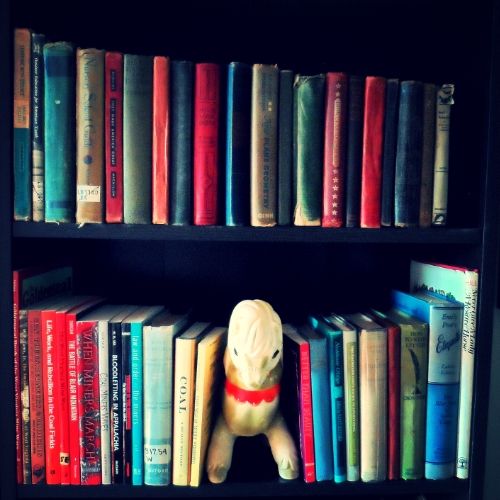
This is my first thread in this group, as I was wondering if I should move on from the 100 Book Challenge with my new goal... I read slightly more non-fiction than fiction (60/40 last year), and my pet subjects are WWI and the West Virginia Coal Mine Wars, among other things. Here's my 2013 list with favorites bolded and titles to avoid struck through.
Ruth by Elizabeth Gaskell
The Path Between the Seas by David McCullough
Raising Steam by Terry Pratchett
The Minor Adjustment Beauty Salon by Alexander McCall Smith
Best American Comics 2010 edited by Neil Gaiman
Games Without Rules by Tamim Ansary
Little Men by Louisa May Alcott
Operation Mincemeat by Ben MacIntyre
The Railway Children by Edith Nesbit
Masters of Sex by Thomas Maier
The Hare With Amber Eyes by Edmund de Waal
The Outsiders by SE Hinton
The El Dorado Adventure by Lloyd Alexander
Fledgling by Octavia E. Butler
Alice's Adventures in Wonderland by Lewis Carroll
The Long Walk by Slavomir Rawicz
Gone-Away Lake by Elizabeth Enright
Dreamland by David K. Randall
Puckoon by Spike Milligan
Charlotte's Web by E.B. White
Breaking the Maya Code by Michael D. Coe
Dorothy Dixon Solves the Conway Case by Dorothy Wayne
The History of Money by Jack Weatherford
The Wolves of Willoughby Chase by Joan Aiken
The King and the Cowboy by David Fromkin
Best American Comics 2011 edited by Alison Bechdel
Women of the Weird edited by Seon Manley
The Rescuers by Margery Sharp
The Rise of Rome by Anthony Everitt
Earth: A Visitor's Guide by Jon Stewart
Miss Bianca by Margery Sharp
The Graveyard Book by Neil Gaiman
Arabian Nights and Days by Naguib Mahfouz
How to Slowly Kill Yourself and Others in America by Kiese Laymon
Cocaine Blues by Kerry Greenwood
Flatland by Edwin Abbott Abbott
1941: The Year That Keeps Returning by Slavko Goldstein
800 Years of Women's Letters edited by Olga Kenyon
Secrets, Sisters, and Sacrifice by Susan Ottaway
The 13 Clocks by James Thurber
Forgotten Voices of the Somme by Joshua Levine
A Wrinkle in Time by Madeleine L'Engle
The Reason I Jump by Naoki Higashida
Archduke Franz Ferdinand Lives by Richard Ned Lebow
Same Sun Here by Silas House and Neela Vaswani
The Martian by Andy Weir
The Diary of Thomas A. Edison by Thomas A. Edison
Pippi Longstocking by Astrid Lindgren
Dave Gorman Vs The Rest of the World by Dave Gorman
Persian Fire by Tom Holland
Two Boys Kissing by David Levithan
Brother, I'm Dying by Edwidge Danticat
The Battle of Blair Mountain by Robert Shogan
The Golden Dream of Carlo Chuchio by Lloyd Alexander
The Canterbury Tales by Geoffrey Chaucer
The Potter's Field by Ellis Peters
The Ghosts of Ashbury High by Jaclyn Moriarty
Memoirs of a Medieval Woman by Louise Collis
The Folklore of Discworld by Jacqueline Simpson and Terry Pratchett
Cloud of Sparrows by Takashi Matsuoka
Esperanza Rising by Pam Munoz Ryan
The Plantagenets by Dan Jones
Unusual Uses for Olive Oil by Alexander McCall Smith
Imagine There's No Heaven by Mitchell Stephens
Adolf Hitler: My Part in his Downfall by Spike Milligan
Master and God by Lindsey Davis
The Rational Optimist by Matt Ridley
Wedding Song by Naguib Mahfouz
The Swiss Family Robinson by Johann David Wyss
Inventing a Nation by Gore Vidal
Over to You by Roald Dahl
The Twits by Roald Dahl
All Our Names by Dinaw Mengestu
Rez Life by David Treuer
The Ides of April by Lindsey Davis
Alice's Piano by Melissa Muller and Reinhard Piechocki
The Lost Prince by Frances Hodgson Burnett
Savage Kingdom by Benjamin Woolley
The Saber-Tooth Curriculum by J. Abner Peddiwell
Paris 1919 by Margaret MacMillan
Infinity Welcomes Careful Drivers by Grant Naylor
Kira-Kira by Cynthia Kadohata
Latino Americans by Ray Suarez
The Gifts of the Crow by John Marzluff
The Good Spy by Kai Bird
Gilead by Marilynne Robinson
Aristotle and Dante Discover the Secrets of the Universe by Benjamin Alire Saenz
The Penguin Atlas of Medieval History by Colin McEvedy
Ancient Egyptian Literature translated by John L. Foster
Misquoting Jesus by Bart D. Ehrman
The Story of Doctor Dolittle by Hugh Lofting
Self-Inflicted Wounds by Aisha Tyler
Purple Hibiscus by Chimamanda Ngozi Adichie
Homage to Catalonia by George Orwell
The Land of Mist by Arthur Conan Doyle
A Tree Grows in Brooklyn by Betty Smith
The Moving Picture Girls by Laura Lee Hope
The Pirate Coast by Richard Zacks
Civil War in West Virginia by Winthrop D. Lane
Queen Lucia by E.F. Benson
99 Poems in Translation edited by Harold Pinter
America's Women by Gail Collins
The Wind in the Willows by Kenneth Grahame
The Night Watch by Sarah Waters
104
Also, my prettiest book shelf:
This is my first thread in this group, as I was wondering if I should move on from the 100 Book Challenge with my new goal... I read slightly more non-fiction than fiction (60/40 last year), and my pet subjects are WWI and the West Virginia Coal Mine Wars, among other things. Here's my 2013 list with favorites bolded and titles to avoid struck through.
Ruth by Elizabeth Gaskell
The Path Between the Seas by David McCullough
Raising Steam by Terry Pratchett
The Minor Adjustment Beauty Salon by Alexander McCall Smith
Best American Comics 2010 edited by Neil Gaiman
Games Without Rules by Tamim Ansary
Little Men by Louisa May Alcott
Operation Mincemeat by Ben MacIntyre
The Railway Children by Edith Nesbit
Masters of Sex by Thomas Maier
The Hare With Amber Eyes by Edmund de Waal
The Outsiders by SE Hinton
The El Dorado Adventure by Lloyd Alexander
Fledgling by Octavia E. Butler
Alice's Adventures in Wonderland by Lewis Carroll
The Long Walk by Slavomir Rawicz
Gone-Away Lake by Elizabeth Enright
Dreamland by David K. Randall
Puckoon by Spike Milligan
Charlotte's Web by E.B. White
Breaking the Maya Code by Michael D. Coe
Dorothy Dixon Solves the Conway Case by Dorothy Wayne
The History of Money by Jack Weatherford
The Wolves of Willoughby Chase by Joan Aiken
The King and the Cowboy by David Fromkin
Best American Comics 2011 edited by Alison Bechdel
Women of the Weird edited by Seon Manley
The Rescuers by Margery Sharp
The Rise of Rome by Anthony Everitt
Earth: A Visitor's Guide by Jon Stewart
Miss Bianca by Margery Sharp
The Graveyard Book by Neil Gaiman
Arabian Nights and Days by Naguib Mahfouz
How to Slowly Kill Yourself and Others in America by Kiese Laymon
Cocaine Blues by Kerry Greenwood
Flatland by Edwin Abbott Abbott
1941: The Year That Keeps Returning by Slavko Goldstein
800 Years of Women's Letters edited by Olga Kenyon
Secrets, Sisters, and Sacrifice by Susan Ottaway
The 13 Clocks by James Thurber
Forgotten Voices of the Somme by Joshua Levine
A Wrinkle in Time by Madeleine L'Engle
The Reason I Jump by Naoki Higashida
Archduke Franz Ferdinand Lives by Richard Ned Lebow
Same Sun Here by Silas House and Neela Vaswani
The Martian by Andy Weir
The Diary of Thomas A. Edison by Thomas A. Edison
Pippi Longstocking by Astrid Lindgren
Dave Gorman Vs The Rest of the World by Dave Gorman
Persian Fire by Tom Holland
Two Boys Kissing by David Levithan
Brother, I'm Dying by Edwidge Danticat
The Battle of Blair Mountain by Robert Shogan
The Golden Dream of Carlo Chuchio by Lloyd Alexander
The Canterbury Tales by Geoffrey Chaucer
The Potter's Field by Ellis Peters
The Ghosts of Ashbury High by Jaclyn Moriarty
Memoirs of a Medieval Woman by Louise Collis
The Folklore of Discworld by Jacqueline Simpson and Terry Pratchett
Cloud of Sparrows by Takashi Matsuoka
Esperanza Rising by Pam Munoz Ryan
The Plantagenets by Dan Jones
Unusual Uses for Olive Oil by Alexander McCall Smith
Imagine There's No Heaven by Mitchell Stephens
Adolf Hitler: My Part in his Downfall by Spike Milligan
Master and God by Lindsey Davis
The Rational Optimist by Matt Ridley
Wedding Song by Naguib Mahfouz
The Swiss Family Robinson by Johann David Wyss
Inventing a Nation by Gore Vidal
Over to You by Roald Dahl
The Twits by Roald Dahl
All Our Names by Dinaw Mengestu
Rez Life by David Treuer
The Ides of April by Lindsey Davis
Alice's Piano by Melissa Muller and Reinhard Piechocki
The Lost Prince by Frances Hodgson Burnett
Savage Kingdom by Benjamin Woolley
The Saber-Tooth Curriculum by J. Abner Peddiwell
Paris 1919 by Margaret MacMillan
Infinity Welcomes Careful Drivers by Grant Naylor
Kira-Kira by Cynthia Kadohata
Latino Americans by Ray Suarez
The Gifts of the Crow by John Marzluff
The Good Spy by Kai Bird
Gilead by Marilynne Robinson
Aristotle and Dante Discover the Secrets of the Universe by Benjamin Alire Saenz
The Penguin Atlas of Medieval History by Colin McEvedy
Ancient Egyptian Literature translated by John L. Foster
Misquoting Jesus by Bart D. Ehrman
The Story of Doctor Dolittle by Hugh Lofting
Self-Inflicted Wounds by Aisha Tyler
Purple Hibiscus by Chimamanda Ngozi Adichie
Homage to Catalonia by George Orwell
The Land of Mist by Arthur Conan Doyle
A Tree Grows in Brooklyn by Betty Smith
The Moving Picture Girls by Laura Lee Hope
The Pirate Coast by Richard Zacks
Civil War in West Virginia by Winthrop D. Lane
Queen Lucia by E.F. Benson
99 Poems in Translation edited by Harold Pinter
America's Women by Gail Collins
The Wind in the Willows by Kenneth Grahame
The Night Watch by Sarah Waters
104
2mabith
I wanted to keep my book total for last year 156, but had days to spare, so I saved up the last bits of these two books.
1 - Ruth by Elizabeth Gaskell
I do not really like Jane Austen but I love Gaskell. Gaskell's books have a modernity that sneaks in quite a lot. Not every bit feels modern but sometimes they feel newer than say, Thomas Hardy.
Ruth is one of her serious books, and deals with (gasp) Fallen Women. She gives Ruth a fair few extenuating circumstances and a lot of innocence but doesn't absolve her of sin quite as completely as Hardy's Tess of the D'urbervilles.
I enjoyed it, but I love Gaskell's writing and observations. Her grip on human nature is a vice, as always.
1 - Ruth by Elizabeth Gaskell
I do not really like Jane Austen but I love Gaskell. Gaskell's books have a modernity that sneaks in quite a lot. Not every bit feels modern but sometimes they feel newer than say, Thomas Hardy.
Ruth is one of her serious books, and deals with (gasp) Fallen Women. She gives Ruth a fair few extenuating circumstances and a lot of innocence but doesn't absolve her of sin quite as completely as Hardy's Tess of the D'urbervilles.
I enjoyed it, but I love Gaskell's writing and observations. Her grip on human nature is a vice, as always.
3mabith
2 - The Path Between the Seas by David McCullough
If I were giving this book a subtitle it would be "Probably More Information Than you Ever Wanted About the Panama Canal." That being said I loved it.
The only thing I really knew about it beforehand was Teddy Roosevelt's interest, which was a shame. The whole thing was fascinating and appealed to my general wide-eyed wonder at any large engineering feat. I'd had no idea that the French were the original force behind the canal and I think I was actually totally ignorant about the fact that Colombia was holding Panama (though it wasn't surprising).
This one made me feel a bit bad about my distrust of engineers (I heard about a certain bridge collapse constantly as a kid), and caused me to vow to read more about South American history.
Highly recommended.
If I were giving this book a subtitle it would be "Probably More Information Than you Ever Wanted About the Panama Canal." That being said I loved it.
The only thing I really knew about it beforehand was Teddy Roosevelt's interest, which was a shame. The whole thing was fascinating and appealed to my general wide-eyed wonder at any large engineering feat. I'd had no idea that the French were the original force behind the canal and I think I was actually totally ignorant about the fact that Colombia was holding Panama (though it wasn't surprising).
This one made me feel a bit bad about my distrust of engineers (I heard about a certain bridge collapse constantly as a kid), and caused me to vow to read more about South American history.
Highly recommended.
4edwinbcn
》1 Gaskell's books have a modernity that sneaks in quite a lot
You've made a good start of the year, Meredith. I have ever only read Lois the witch, not enough to observe the modernity of Gaskell.
Perhaps I should try one of the 11 other Gaskells on my shelves...
You've made a good start of the year, Meredith. I have ever only read Lois the witch, not enough to observe the modernity of Gaskell.
Perhaps I should try one of the 11 other Gaskells on my shelves...
5dchaikin
208!...I'll try to keep up...with your thread. Haven't read Gaskell, but McCullough is terrific on audio.
ETA the missing word "up"
ETA the missing word "up"
6mabith
4 > I love her humor more than her serious books, but her writing is good enough that I enjoy those too. Wives and Daughters does mix the serious and humorous well though. Cranford and North and South are my favorites.
5 > I plan on adding a lot of YA and children's novels in order to get to 208 (I'm disabled and unable to work, so I do have a lot more time than most people). Audio is mainly what I do, as it's hard to hold print books, and yes, McCullough has great readers.
5 > I plan on adding a lot of YA and children's novels in order to get to 208 (I'm disabled and unable to work, so I do have a lot more time than most people). Audio is mainly what I do, as it's hard to hold print books, and yes, McCullough has great readers.
7baswood
I have read North and South recently and loved it, looking forward to keeping up with your reading
8NanaCC
I should read more by Gaskell, as I also loved Cranford and North and South. Wives and Daughters is on my wishlist.
9mabith
7 > Oh yea! It's been my goal for the last year or so to spread the Gaskell love. The BBC did an excellent adaptation of North and South, which I watched somewhat out of nowhere and led to my finding her books.
10arubabookwoman
Hi--Welcome to CR. It looks like you've got some interesting reading ahead of you, and I look forward to following it.
11Polaris-
Hi Meredith! Nice to see you over here in Club Read - welcome! I'll be following your thread with interest.
Got any reading in mind in advance of the World Cup this summer? I have Futebol by Alex Bellos and Pele's autobiography in mind.
Got any reading in mind in advance of the World Cup this summer? I have Futebol by Alex Bellos and Pele's autobiography in mind.
12mabith
Hey! You know, I've never thought much about reading books about football, honestly. I love to watch it, loved to play casual games, and love to moan about how much better I could coach the teams, but I don't know about the books... I should look and see if there's anything about the WWI Christmas football game, since that's quite fitting. Mostly I've just been so excited that my nephew is five now. I've turned on games for him whenever I can, which he seems to enjoy, and I was five during the first World Cup I remember watching.
Although, the book linked to in the Beautiful Game group, about football during WWII sounds really interesting. Actually that book Soccernomics looks interesting too...
Although, the book linked to in the Beautiful Game group, about football during WWII sounds really interesting. Actually that book Soccernomics looks interesting too...
13SassyLassy
Very exciting about The West Virginia Mine Wars; I see that we make up 20% of the LTers who have this book. Have you read Fighting Back in Appalachia?
I'm hoping to take on more Elizabeth Gaskell this year too.
I'm hoping to take on more Elizabeth Gaskell this year too.
14mabith
3 - Raising Steam by Terry Pratchett
This is one of the few Discworld books that I feel a bit lukewarm about. It just felt so full, and so action oriented. There seemed to be a bit less narration (and thus narration humour and pithy quotes) than most of the other Discworld books. It felt more like the balance between pure narration and action that is found in the Tiffany Aching books (which I do love, but are different).
The fullness I think was in part due to the cast of regular characters being larger, or at least it felt like more of the regulars had larger roles (versus the smaller role of the watch in the other two Moist von Lipwig books). I was a bit surprised, as I thought Snuff, the previous books, was up to the highest standard of Discworld. Perhaps it's because I love Lipwig so much that I wanted it to be a bit more like his other titles and unchanging (whereas I like the evolution of Vimes and think it's important).
Still an excellent book, and I think I'll like it a bit more on the reread, but likewise a bit surprising.
This is one of the few Discworld books that I feel a bit lukewarm about. It just felt so full, and so action oriented. There seemed to be a bit less narration (and thus narration humour and pithy quotes) than most of the other Discworld books. It felt more like the balance between pure narration and action that is found in the Tiffany Aching books (which I do love, but are different).
The fullness I think was in part due to the cast of regular characters being larger, or at least it felt like more of the regulars had larger roles (versus the smaller role of the watch in the other two Moist von Lipwig books). I was a bit surprised, as I thought Snuff, the previous books, was up to the highest standard of Discworld. Perhaps it's because I love Lipwig so much that I wanted it to be a bit more like his other titles and unchanging (whereas I like the evolution of Vimes and think it's important).
Still an excellent book, and I think I'll like it a bit more on the reread, but likewise a bit surprising.
15mabith
4 - The Minor Adjustment Beauty Salon by Alexander McCall Smith
Smith certainly has a brilliance for naming his books (and the world within them).
This follows in the usual line of the Number Ladies Detective Agency books. It is light, humorous, thoughtful, and warm. This one focuses on the main mystery a little less than some of the other books, or maybe it was just less of a mystery in general. There's a lot of change afoot in the agency as Mma Makutsi has a baby and both she and Mma Ramotswe struggle to express their feelings about their friendship and partnership.
While I think these books are well-written and interesting, the true draw for me is Lisette Lecat, the reader for the audiobooks. A good reader can add so much to a book, and that's the case with this series. She uses the perfect mix of animation and straight reading, never letting her reading become too theatrical.
Smith certainly has a brilliance for naming his books (and the world within them).
This follows in the usual line of the Number Ladies Detective Agency books. It is light, humorous, thoughtful, and warm. This one focuses on the main mystery a little less than some of the other books, or maybe it was just less of a mystery in general. There's a lot of change afoot in the agency as Mma Makutsi has a baby and both she and Mma Ramotswe struggle to express their feelings about their friendship and partnership.
While I think these books are well-written and interesting, the true draw for me is Lisette Lecat, the reader for the audiobooks. A good reader can add so much to a book, and that's the case with this series. She uses the perfect mix of animation and straight reading, never letting her reading become too theatrical.
16NanaCC
>15 mabith: I have this one to listen to as an ER. I really enjoy these charming stories. I agree that Lisette Lecat is perfect as a reader for the books for the reasons you mentioned. I kept thinking after listening to the first book that I was happy to hear the pronunciations of names and places as she did them. I would have been making those up in my head in a print book. Lecat also did a marvelous job as the reader for Reading Lolita in Tehran.
17mabith
5 - Best American Comics 2010 edited by Neil Gaiman
I decided that I very much needed to own all of the Best American Comics books. Luckily it only goes back to 2007 or 2006. This is a particularly good volume, I think, though I've only read a couple others.
It's a great series to thumb through if you're looking to start reading more graphic novels, as you can have a little taste of numerous titles and figure out which you want to search out further.
I decided that I very much needed to own all of the Best American Comics books. Luckily it only goes back to 2007 or 2006. This is a particularly good volume, I think, though I've only read a couple others.
It's a great series to thumb through if you're looking to start reading more graphic novels, as you can have a little taste of numerous titles and figure out which you want to search out further.
18mabith
6 - Games Without Rules by Tamim Ansary
Despite not reading the series I keep accidentally typing Games Without Thrones. Sigh.
This is a book about the history Afghanistan and a view from the inside of the various invasions of British, Russians, and Americans. It talks about the similarities of all the invasions, of the fate of rulers both conservative and progressive.
It's certainly an important book, especially for Americans, and I think Ansary does the job very well. Having read his Destiny Disrupted I've already developed a great liking for his voice and style. He brings in humor when he can, but it's very much a serious work.
The aspect of "view from the inside" especially comes in towards the end, when you're looking a news coverage of certain events from an especially western point of view and missing the more important part of the story.
Despite not reading the series I keep accidentally typing Games Without Thrones. Sigh.
This is a book about the history Afghanistan and a view from the inside of the various invasions of British, Russians, and Americans. It talks about the similarities of all the invasions, of the fate of rulers both conservative and progressive.
It's certainly an important book, especially for Americans, and I think Ansary does the job very well. Having read his Destiny Disrupted I've already developed a great liking for his voice and style. He brings in humor when he can, but it's very much a serious work.
The aspect of "view from the inside" especially comes in towards the end, when you're looking a news coverage of certain events from an especially western point of view and missing the more important part of the story.
19mabith
Nana, I'm glad to hear that she's the reader for Reading Lolita in Tehran. I keep meaning to get to that one but putting it off. She might be the impetus I need. It does definitely make a huge difference to know you're hearing correct pronunciations.
20fannyprice
>18 mabith:, Sounds fascinating. I have Destiny Disrupted on my radar, but I wasn't aware he'd written about Afghanistan and its invasions as well.
21baswood
Games without Rules sounds interesting Meredith
22mabith
I felt like I was glad I'd read Destiny Disrupted first, for the sense of perspective, but it wasn't necessary. Games Without Rules has definitely given me a better understanding of the situation. He ends with two visits to Afghanistan, in 2002 and then 2012, and compares the two, ending on a pretty optimistic note (thank the gods).
23dchaikin
Destiny Disrupted was such a nice introduction to the full picture of Mid-East history. I'm really happy to have read it. I'll try to keep Games Without Rules (or thrones) in mind.
24mabith
7 - Little Men by Louisa May Alcott
This is the book my favorite blames for ruining him for public school, though I imagine most brainy, bookish kids dislike public school for reasons unrelated to reading about a lovely miniature boarding school.
It follows Jo and Mr. Bhaer running their little ideal school where boys can have freedom to play and mess about so long as they rigorously follow the few rules set out. We see some new children added to the school, inventive methods of discipline, Jo dealing with the boys' sometimes anti-girl feeling, etc...
The book is sweet, and not really all that dated in terms of alternative school philosophies. As is evident in other books Alcott has a bit of a split personality in terms of traditions for women and writing what will sell while trying to slip the more subversive ideas in as well.
This is the book my favorite blames for ruining him for public school, though I imagine most brainy, bookish kids dislike public school for reasons unrelated to reading about a lovely miniature boarding school.
It follows Jo and Mr. Bhaer running their little ideal school where boys can have freedom to play and mess about so long as they rigorously follow the few rules set out. We see some new children added to the school, inventive methods of discipline, Jo dealing with the boys' sometimes anti-girl feeling, etc...
The book is sweet, and not really all that dated in terms of alternative school philosophies. As is evident in other books Alcott has a bit of a split personality in terms of traditions for women and writing what will sell while trying to slip the more subversive ideas in as well.
25mabith
8 - Operation Mincemeat: How a Dead Man and a Bizarre Plan Fooled the Nazis and Assured an Allied Victory by Ben MacIntyre
This is the story of the elaborate ruse set up to make the Nazis think the Allies were not invading Sicily but going for Sardinia instead. When I say elaborate, I mean, ridiculously elaborate.
A fake identity was created and attached to a corpse who was set afloat with military papers implying invasion of Sardinia. He was made the come ashore in Spain where it was hoped the intelligence would be passed on to Germany. They created a girlfriend for the corpse, a back story, gave him club receipts, all this stuff yet also left details unattended so that checking on some minor point would show the identity as fake.
The book details all of that and the men and women behind the plot. It also deals with the declassification of the operation, the fight to publish the story first, the real history of the dead man, and the later clamor to identify him.
It was an interesting book, and well-written, though at times it felt tedious. Not the fault of the writing, but of the elaborate plan and the men working it. Sometimes I just wanted to shout at them as they quibbled over minor details and rewrote the letters that would be with the corpse over and over.
Recommended if you have a deeper interest in WWII.
This is the story of the elaborate ruse set up to make the Nazis think the Allies were not invading Sicily but going for Sardinia instead. When I say elaborate, I mean, ridiculously elaborate.
A fake identity was created and attached to a corpse who was set afloat with military papers implying invasion of Sardinia. He was made the come ashore in Spain where it was hoped the intelligence would be passed on to Germany. They created a girlfriend for the corpse, a back story, gave him club receipts, all this stuff yet also left details unattended so that checking on some minor point would show the identity as fake.
The book details all of that and the men and women behind the plot. It also deals with the declassification of the operation, the fight to publish the story first, the real history of the dead man, and the later clamor to identify him.
It was an interesting book, and well-written, though at times it felt tedious. Not the fault of the writing, but of the elaborate plan and the men working it. Sometimes I just wanted to shout at them as they quibbled over minor details and rewrote the letters that would be with the corpse over and over.
Recommended if you have a deeper interest in WWII.
26mabith
9 - The Railway Children by Edith Nesbit
A classic for a reason. Wonderful book, which I enjoyed all the way through and stayed up rather late to finish.
Nesbit has never disappointed me, though there was one little thing... Towards the end there's rather a long sexist speech by the doctor to Peter about "oh girls are soft and you should be nice to them but obviously they're very brave as well" after Peter had been deliberately trying to make Roberta ill with talk of blood and gore. Roberta and Phyllis then tied him up.
I understand that the point of the speech was probably Nesbit aiming at boys to make them not be so obnoxious, but did it have to be "girls are soft?" Couldn't she have had the doctor say "It's a terrible thing to be deliberately rude or mean to anyone. You and many boys may pretend they don't care, but we all do inside. Plus you just threw a massive hissy fit because they tied you up, so who's soft now you little jerk?"
Sigh.
A classic for a reason. Wonderful book, which I enjoyed all the way through and stayed up rather late to finish.
Nesbit has never disappointed me, though there was one little thing... Towards the end there's rather a long sexist speech by the doctor to Peter about "oh girls are soft and you should be nice to them but obviously they're very brave as well" after Peter had been deliberately trying to make Roberta ill with talk of blood and gore. Roberta and Phyllis then tied him up.
I understand that the point of the speech was probably Nesbit aiming at boys to make them not be so obnoxious, but did it have to be "girls are soft?" Couldn't she have had the doctor say "It's a terrible thing to be deliberately rude or mean to anyone. You and many boys may pretend they don't care, but we all do inside. Plus you just threw a massive hissy fit because they tied you up, so who's soft now you little jerk?"
Sigh.
27AnnieMod
>25 mabith: Very nice review :) That book sounds very interesting. I like these little known stories of the wars - they make the wars look a bit more humane (in a way...)
As for Nesbit - it really shows when some of those books are written. It does not make them worse but at the times, this was considered the normal attitude after all...
As for Nesbit - it really shows when some of those books are written. It does not make them worse but at the times, this was considered the normal attitude after all...
28Polaris-
Two good reviews there. Love your re-imagining of Nesbit's Doctor dialogue!
There was a very good tv doc on Operation Mincemeat a couple of years ago. It could be that the intricacies of the subject lend themselves more to a televisual telling than to a book? The same occurred to me last year when I read Saturday at MI9 - a great story of Airey Neave's experiences running the various NW Europe escape lines for captured/downed servicemen and assorted agents on the run. A lot of very brave and incredibly inspiring individuals, but possibly a subject that became slightly bogged down in the detail inherent in the book form, but one that would be captivating on the screen. Still, Operation Mincemeat was a fascinating episode of WW2 subterfuge which helped lead to an important allied foothold in Europe.
There was a very good tv doc on Operation Mincemeat a couple of years ago. It could be that the intricacies of the subject lend themselves more to a televisual telling than to a book? The same occurred to me last year when I read Saturday at MI9 - a great story of Airey Neave's experiences running the various NW Europe escape lines for captured/downed servicemen and assorted agents on the run. A lot of very brave and incredibly inspiring individuals, but possibly a subject that became slightly bogged down in the detail inherent in the book form, but one that would be captivating on the screen. Still, Operation Mincemeat was a fascinating episode of WW2 subterfuge which helped lead to an important allied foothold in Europe.
29mabith
Annie, oh yeah, different time, but the whole Golden Rule "treat others as you wish to be treated" thing is pretty old... Part of what grated really is the response afterward, with Roberta saying "Oh, I know Peter's still being incredibly condescending, but he's sorry REALLY, I can tell," and that very abusive relationship thinking. The boys are allowed to be immature and cranky and whiny, but the girls, even if younger, are chided for it. Still such an excellent book though, and that kind of hugely sexist overtone is really only present at the end (which is fairly amazing for 1906).
Paul, I think you're right. When it gets that complex and ridiculous a TV special might really make it better/easier to keep track of. I'm sure there could be an entire series of these sorts of stories. With Mincemeat there was an incredibly amount of luck involved, of course. I am glad the entire story is out now, since parts were hidden for so long due to not wanting to antagonize the Spanish. I imagine the next decade will be chock full of such books.
Paul, I think you're right. When it gets that complex and ridiculous a TV special might really make it better/easier to keep track of. I'm sure there could be an entire series of these sorts of stories. With Mincemeat there was an incredibly amount of luck involved, of course. I am glad the entire story is out now, since parts were hidden for so long due to not wanting to antagonize the Spanish. I imagine the next decade will be chock full of such books.
30cabegley
I liked Operation Mincemeat, but I think Macintyre's best is Agent Zigzag. It reads like a novel.
31mabith
Glad to know that about Agent Zigzag! It's been on my list as well, though I'd forgotten he wrote that too.
32Polaris-
Same here - Agent Zigzag is in my local library LT collection. Thanks for the reminder Chris. (By the way I've been meaning to get over to your thread and dive in - I've starred you but not yet had time - see you there soon!)
33rebeccanyc
#30 I agree about Agent Zigzag versus Operation Mincemeat. And it was you, Chris, who got me to read it!
34baswood
I had never heard of Operation Mincemeat and so I found your review fascinating.
35mabith
34 - It was quite interesting, overall, though I probably would have been just as happy with a slightly shorter book.
36mabith
10 - Masters of Sex: The Life and Times of William Masters and Virginia Johnson by Thomas Maier
I've been aware of Masters and Johnson for a long time, and there was a fair bit about them in Mary Roach's book Bonk (which I loved). I certainly didn't know anything about them personally though, or have a deeper look at the therapies they developed. Apparently there's a Showtime series about them, which is... interesting? It struck me as a little odd, I admit. Maybe it will start a trend and HBO will do a show about Dr. Ruth, which would be quite interesting.
The book follows their separate lives and histories, their working relationship, and their working life. It doesn't go into knowledge gained from different experiments all that much, but more into how those impacted their books, how the books were received, their differences, etc...
It was interesting to me all the way through, especially their approaches to therapy and the way the pair formed a far greater whole for many years.
Recommended, but more so if you have an interest in psychology and this kind of research.
I've been aware of Masters and Johnson for a long time, and there was a fair bit about them in Mary Roach's book Bonk (which I loved). I certainly didn't know anything about them personally though, or have a deeper look at the therapies they developed. Apparently there's a Showtime series about them, which is... interesting? It struck me as a little odd, I admit. Maybe it will start a trend and HBO will do a show about Dr. Ruth, which would be quite interesting.
The book follows their separate lives and histories, their working relationship, and their working life. It doesn't go into knowledge gained from different experiments all that much, but more into how those impacted their books, how the books were received, their differences, etc...
It was interesting to me all the way through, especially their approaches to therapy and the way the pair formed a far greater whole for many years.
Recommended, but more so if you have an interest in psychology and this kind of research.
37mabith
11 - The Hare With Amber Eyes by Edmund de Waal
This family memoir centers partly around possessions, particularly a set of 264 netsuke taken from Japan to France in the late 19th century. Netsuke are used on cords for robes, at the top of a pouch or bag. The author traces the purchase and the trend of collecting Japanese art and discusses the first owner, a Parisian, before spending the bulk of the book on the next possessors, his great-great-grandfather and below, who lived in Vienna.
The author talks about his own journey to the places his family had lived, his reactions to those places, the histories of those cities when they lived there, the family reactions to the netsuke, etc... I enjoyed the back and forth, and it made the story more interesting. If this had been told as a strict family history I'm sure it would have still been well-written but far less interesting to read. You get pictures of the pre-war and war period in Austria, as well as the post-war period in Japan. The author is very good at creating the atmosphere of the places as well as the family relationships.
Generally recommended, but I wouldn't rush out to buy it.
This family memoir centers partly around possessions, particularly a set of 264 netsuke taken from Japan to France in the late 19th century. Netsuke are used on cords for robes, at the top of a pouch or bag. The author traces the purchase and the trend of collecting Japanese art and discusses the first owner, a Parisian, before spending the bulk of the book on the next possessors, his great-great-grandfather and below, who lived in Vienna.
The author talks about his own journey to the places his family had lived, his reactions to those places, the histories of those cities when they lived there, the family reactions to the netsuke, etc... I enjoyed the back and forth, and it made the story more interesting. If this had been told as a strict family history I'm sure it would have still been well-written but far less interesting to read. You get pictures of the pre-war and war period in Austria, as well as the post-war period in Japan. The author is very good at creating the atmosphere of the places as well as the family relationships.
Generally recommended, but I wouldn't rush out to buy it.
38mabith
12 -The Outsiders by SE Hinton
Yet another classic I never read growing up. Certainly deserves to be a classic, I think, and the writing is fairly amazing given that Hinton was 16 when she wrote it.
I was annoyed, however, that while the boys are all given the benefit of doubt at the end, that you shouldn't judge on how people look, etc... there's nothing but hatred of girls who don't dress like "nice girls" should, as if they don't have the same pressures on them. Plus there's really nothing bad said about "soc" girls at all. The closest is basically "Oh they don't want to talk to us but why would they given our looks and reputation." Grumble grumble grumble.
Yet another classic I never read growing up. Certainly deserves to be a classic, I think, and the writing is fairly amazing given that Hinton was 16 when she wrote it.
I was annoyed, however, that while the boys are all given the benefit of doubt at the end, that you shouldn't judge on how people look, etc... there's nothing but hatred of girls who don't dress like "nice girls" should, as if they don't have the same pressures on them. Plus there's really nothing bad said about "soc" girls at all. The closest is basically "Oh they don't want to talk to us but why would they given our looks and reputation." Grumble grumble grumble.
39mabith
13 - The El Dorado Adventure by Lloyd Alexander
It's very difficult not to read these in one sitting. We're off again with Vesper Holly, a female amalgam of Sherlock Holmes and Indiana Jones. They books are narrated by her guardian, Brinnie, very much in the style of Sherlock Holmes, and set in the 1870s.
This one gets extra points for throwing in quite a bit of Spanish (and these were originally published before you had all the internet translators, and mostly before the vast majority of Americans had internet access), and for making a number of allusions to authors and real people that would not be part of the usual 9-13 year old's knowledge set (Rousseau, Simon Bolivar, and Adam Smith among others).
Alexander throws around civilized and savage a bit too much for me. While he also sometimes points out that these are false terms, often he doesn't. They may be set in the 1870s, but it's not like Vesper is a realistic 17 year old of the 1870s, so you know... There's also a bit of the white savior air to them, though typically the rescuing goes back and forth and number of times between Vesper and her allies.
This one was great in that Vesper and Acharro (and the chief of an indigenous tribe) don't cut each other any slack, and they call each other on their mistakes. This also deals with land rights, and while not a mirror of the building of the Panama canal, there are sort of parallels.
It's very difficult not to read these in one sitting. We're off again with Vesper Holly, a female amalgam of Sherlock Holmes and Indiana Jones. They books are narrated by her guardian, Brinnie, very much in the style of Sherlock Holmes, and set in the 1870s.
This one gets extra points for throwing in quite a bit of Spanish (and these were originally published before you had all the internet translators, and mostly before the vast majority of Americans had internet access), and for making a number of allusions to authors and real people that would not be part of the usual 9-13 year old's knowledge set (Rousseau, Simon Bolivar, and Adam Smith among others).
Alexander throws around civilized and savage a bit too much for me. While he also sometimes points out that these are false terms, often he doesn't. They may be set in the 1870s, but it's not like Vesper is a realistic 17 year old of the 1870s, so you know... There's also a bit of the white savior air to them, though typically the rescuing goes back and forth and number of times between Vesper and her allies.
This one was great in that Vesper and Acharro (and the chief of an indigenous tribe) don't cut each other any slack, and they call each other on their mistakes. This also deals with land rights, and while not a mirror of the building of the Panama canal, there are sort of parallels.
40mabith
14 - Fledgling by Octavia E. Butler
This book hooked me straight from the get-go. The premise was interesting and remained so. Butler doesn't complicate the book with multiple plots. It's very straightforward, and I appreciated that. The book is more a story of an event than anything else. She did break my heart a little bit, but not too much.
For science-fiction involving vampires it was all very realistic in a way. The actions people take are not surprising or shocking, given the current world reality. She's well set-up for a sequel if she wants to write one, though not in the obnoxious or frustrating way sometimes found in novels.
Recommended for everyone (there was never a genre I was less likely to pick up than sci-fi+vampires).
This book hooked me straight from the get-go. The premise was interesting and remained so. Butler doesn't complicate the book with multiple plots. It's very straightforward, and I appreciated that. The book is more a story of an event than anything else. She did break my heart a little bit, but not too much.
For science-fiction involving vampires it was all very realistic in a way. The actions people take are not surprising or shocking, given the current world reality. She's well set-up for a sequel if she wants to write one, though not in the obnoxious or frustrating way sometimes found in novels.
Recommended for everyone (there was never a genre I was less likely to pick up than sci-fi+vampires).
41mabith
15 - Alice's Adventures in Wonderland by Lewis Carroll
Another classic I never read when I was a child. It was interesting to read it as an adult, having only seen the Disney version when I was a kid. Despite all the changes I think it's one of the strongest Disney films (and certainly one of my favorites as a child).
A very fun read.
Another classic I never read when I was a child. It was interesting to read it as an adult, having only seen the Disney version when I was a kid. Despite all the changes I think it's one of the strongest Disney films (and certainly one of my favorites as a child).
A very fun read.
44avaland
I see you are a busy reader! I love Gaskell. She's one of the few classic authors whose work I could not let go of (classics are available in libraries, so except for antique copies or favorite authors, we let go of the rest).
45mabith
16 - The Long Walk by Slavomir Rawicz
There's a fair bit of controversy surrounding this book, about the escape from a Russian prison camp and took an 11-month trek to British India.
I tried to treat it as a story more than a true account, but couldn't really enjoy it. The writing style was fairly dull and it made the events seem dull, which is quite the feat. The writing mainly left emotional experience out of the picture.
Not really recommended.
There's a fair bit of controversy surrounding this book, about the escape from a Russian prison camp and took an 11-month trek to British India.
I tried to treat it as a story more than a true account, but couldn't really enjoy it. The writing style was fairly dull and it made the events seem dull, which is quite the feat. The writing mainly left emotional experience out of the picture.
Not really recommended.
46avidmom
That's quite a mix of books! I recently bought my own copy of Alice in Wonderland. It is fun, isn't it?
Enjoying reading about your reading!
Enjoying reading about your reading!
47mabith
17 - Gone-Away Lake by Elizabeth Enright
A sweet children's book about some children who discover an abandoned community in a marsh, inhabited by an elderly brother and sister who were there when the community was thriving.
A friend recommended a different book series by Elizabeth Enright, but this and its sequel were all I could find on audio.
The book is sweet, but not an instant favorite the way Swallows and Amazons was for me. I would have really enjoyed it as a child, and I did enjoy it now, but I don't think it's a children's classic with serious staying power.
A sweet children's book about some children who discover an abandoned community in a marsh, inhabited by an elderly brother and sister who were there when the community was thriving.
A friend recommended a different book series by Elizabeth Enright, but this and its sequel were all I could find on audio.
The book is sweet, but not an instant favorite the way Swallows and Amazons was for me. I would have really enjoyed it as a child, and I did enjoy it now, but I don't think it's a children's classic with serious staying power.
48cabegley
Was it the Melendy Family series that was recommended to you? That was one of my favorites as a child, and has stayed with me, particularly their discovery of a secret attic room in their house, which I have dreamed about ever since!
49mabith
Yes, it was the Melendy series! I think they have all of them at my library, so I can get them in print later. Ah, who among us didn't constantly search for secret rooms. Having a basement with very old stone walls was about as exciting as it got for us.
50mabith
19 - Puckoon by Spike Milligan
A humorous novel about the partitioning of a fictional village in Ireland. Mostly I loved this, as a lot of it is the type of humour that really gives me the giggles. "So we'll take the coffin... *cough cough cough* No, not your coughin..."
Worthwhile read, though somewhat marred by the portrayal of a Chinese character (written in 1963, so you can guess the sort of thing). Product of the times blah blah but that really doesn't make it easier to read or cause it to mar an experience less.
I listened to the abridged audio performance as well as reading it in print, since it was read by Milligan himself (my dad's a die-hard Goon Show fan).
A humorous novel about the partitioning of a fictional village in Ireland. Mostly I loved this, as a lot of it is the type of humour that really gives me the giggles. "So we'll take the coffin... *cough cough cough* No, not your coughin..."
Worthwhile read, though somewhat marred by the portrayal of a Chinese character (written in 1963, so you can guess the sort of thing). Product of the times blah blah but that really doesn't make it easier to read or cause it to mar an experience less.
I listened to the abridged audio performance as well as reading it in print, since it was read by Milligan himself (my dad's a die-hard Goon Show fan).
51mabith
20 - Charlotte's Web by E.B. White
A classic for a reason, and I enjoyed it quite well until Wilbur's helplessness started to bug me. I kept thinking of headlines that read "Selfish Pig Kills Spider Through Thoughtlessness" (not true, but you know). Oddly, I think I would have enjoyed this less as a child. Not because of the death or threat of animal death, but just because Wilbur isn't really a likeable character for me. Especially as the youngest of five children, all much older than me, I would have resented that someone just dedicated half their life to helping and soothing this pig, instead of him ever needing to help himself.
Made me wonder how many pigs White did raise, as they're rather intelligent animals and can be very fierce as well. I appreciated the writing and way White used humans to help tells the animals' story, and the characterizations of all the animals.
A classic for a reason, and I enjoyed it quite well until Wilbur's helplessness started to bug me. I kept thinking of headlines that read "Selfish Pig Kills Spider Through Thoughtlessness" (not true, but you know). Oddly, I think I would have enjoyed this less as a child. Not because of the death or threat of animal death, but just because Wilbur isn't really a likeable character for me. Especially as the youngest of five children, all much older than me, I would have resented that someone just dedicated half their life to helping and soothing this pig, instead of him ever needing to help himself.
Made me wonder how many pigs White did raise, as they're rather intelligent animals and can be very fierce as well. I appreciated the writing and way White used humans to help tells the animals' story, and the characterizations of all the animals.
52Linda92007
Meredith, I've fallen a bit behind but just wanted to say that having read your comments, Games Without Rules and Destiny Disrupted are both now high on my wishlist. Thanks!
53mabith
Thank you, Linda! They're excellent books, and have helped my understanding of the current Middle East SO immensely.
54mabith
21 - Breaking the Maya Code by Michael D. Coe
It took me a very long time to finish this book. Usually with library books I commit to reading at least 50 pages a day. This title I just had such a hard time wanting to read though. I read The Riddle of the Labyrinth at the end of last year, about deciphering Linear B, and really enjoyed that. Breaking the Maya Code is a very different animal, however.
It is very technical in terms of language, of course, and I had a hard time following some of the technicalities, which are incredibly numerous for written Mayan. The author wants to sometimes write casually, making light jokes and such, but it's very much a scholarly work, not a popular history, and when the writing strays from that I don't think it helps the reader.
The history of the decipherment of Mayan writing is also very long and annoying in terms of "so-and-so got one thing right, everything else wrong." There are a LOT of those personalities. Of course the person who helped the most was ridiculed and lambasted by the people who got maybe one important thing right and otherwise just muddied the field. Due to the course of things the big accomplishments aren't made to seem very big, and none of the personalities of individual researchers really stand out.
Back to the style of the writing, the author switches indiscriminately between referring to people with first names, last names, both names, three names, and then suddenly first and middle name for one person. It was incredibly annoying and I would like to strangle the editor who let him get away with that. It's also possible that because the author is a scholar in this field, was present for many of the events described, he has been excited about the subject for so long that he is not able to translate the excitement of these events for the casual reader.
I don't know who I'd recommend this to. Definitely don't read it just because you enjoyed The Riddle of the Labyrinth. I am glad I finished it, but slightly wish I hadn't picked it up.
It took me a very long time to finish this book. Usually with library books I commit to reading at least 50 pages a day. This title I just had such a hard time wanting to read though. I read The Riddle of the Labyrinth at the end of last year, about deciphering Linear B, and really enjoyed that. Breaking the Maya Code is a very different animal, however.
It is very technical in terms of language, of course, and I had a hard time following some of the technicalities, which are incredibly numerous for written Mayan. The author wants to sometimes write casually, making light jokes and such, but it's very much a scholarly work, not a popular history, and when the writing strays from that I don't think it helps the reader.
The history of the decipherment of Mayan writing is also very long and annoying in terms of "so-and-so got one thing right, everything else wrong." There are a LOT of those personalities. Of course the person who helped the most was ridiculed and lambasted by the people who got maybe one important thing right and otherwise just muddied the field. Due to the course of things the big accomplishments aren't made to seem very big, and none of the personalities of individual researchers really stand out.
Back to the style of the writing, the author switches indiscriminately between referring to people with first names, last names, both names, three names, and then suddenly first and middle name for one person. It was incredibly annoying and I would like to strangle the editor who let him get away with that. It's also possible that because the author is a scholar in this field, was present for many of the events described, he has been excited about the subject for so long that he is not able to translate the excitement of these events for the casual reader.
I don't know who I'd recommend this to. Definitely don't read it just because you enjoyed The Riddle of the Labyrinth. I am glad I finished it, but slightly wish I hadn't picked it up.
56mabith
22 - Dorothy Dixon Solves the Conway Case by Dorothy Wayne
I have no read all four books in the Dorothy Dixon series. She's a young aviator, and planes play a roll in all of her books. They do use technical terms, which is nice. I slightly collect girls' fiction from 1910s-1930s, and I find it delightfully fun and sometimes quite well done.
These are absolutely silly, insane books. This one only spans about 12 hours. Dorothy runs out of gas, makes an emergency landing with her friend, and then when they find a house they see a young man tied to a chair and being brutally interrogated inside (thank goodness for french windows...). Everything speeds along very quickly after that, they involve two of Dorothy's other friends, there's a perilous rock climb in the dark, and gun play. This volume was harder to read than some, as there are two African American characters. While the characters themselves are presented well and save the day twice, the language used and the heavy dialect writing was very hard to read, just the obvious latent racism of the author even while she writes the characters themselves as important and good people...
I rather admire Dorothy Dixon as a character and role model for girls. She has people, two men especially, who help, and she readily accepts help, but she takes over (and they trust her judgement) when she comes up with a plan. She uses a gun and a has bobbed hair, but she also thinks about her clothes and shoes. She doesn't have to be all tomboy or all feminine, and I think that's pretty important. Too many books and movies make the mistake of pitting stereotypically masculine and feminine things against each other, which pretty much always imply that stereotypically feminine things are bad/weak/unimportant/frivolous.
Her adventures are pretty far fetched (but I bet Nancy Drew's are as well), but they are rather fun. The aviatrix theme of the 20s and 30s is such a fun one.
I have no read all four books in the Dorothy Dixon series. She's a young aviator, and planes play a roll in all of her books. They do use technical terms, which is nice. I slightly collect girls' fiction from 1910s-1930s, and I find it delightfully fun and sometimes quite well done.
These are absolutely silly, insane books. This one only spans about 12 hours. Dorothy runs out of gas, makes an emergency landing with her friend, and then when they find a house they see a young man tied to a chair and being brutally interrogated inside (thank goodness for french windows...). Everything speeds along very quickly after that, they involve two of Dorothy's other friends, there's a perilous rock climb in the dark, and gun play. This volume was harder to read than some, as there are two African American characters. While the characters themselves are presented well and save the day twice, the language used and the heavy dialect writing was very hard to read, just the obvious latent racism of the author even while she writes the characters themselves as important and good people...
I rather admire Dorothy Dixon as a character and role model for girls. She has people, two men especially, who help, and she readily accepts help, but she takes over (and they trust her judgement) when she comes up with a plan. She uses a gun and a has bobbed hair, but she also thinks about her clothes and shoes. She doesn't have to be all tomboy or all feminine, and I think that's pretty important. Too many books and movies make the mistake of pitting stereotypically masculine and feminine things against each other, which pretty much always imply that stereotypically feminine things are bad/weak/unimportant/frivolous.
Her adventures are pretty far fetched (but I bet Nancy Drew's are as well), but they are rather fun. The aviatrix theme of the 20s and 30s is such a fun one.
57mabith
23 - The History of Money by Jack Weatherford
I've really enjoyed the other books I've read by Weatherford, and have been very slowly reading books about financial matters so thought I'd tackle this one. I find his writing easy to follow and and it seems to keep me interested.
This one follows currency, as you'd guess, and the various problems that affect it (inflation, coin to paper, leaving of gold/silver standards, etc..). It goes in chronological order, which I find helpful. It was first published in 1997 though, and while perhaps there was some additional information added for the 1998 paperback, it's a shame there hasn't been a revised edition since Paypal and the huge variety of similar services have risen to such prominence.
Last year I read Debt: The First 5,000 Years by David Graeber, which was an exceptional read. It would be interesting to read those two together, since I think they're quite complimentary.
Recommended to the non-fiction enthusiast, rather than those who only read NF occasionally (for the occasional reader I'd say definitely read Debt, which was quite amusing and incredibly interesting).
I've really enjoyed the other books I've read by Weatherford, and have been very slowly reading books about financial matters so thought I'd tackle this one. I find his writing easy to follow and and it seems to keep me interested.
This one follows currency, as you'd guess, and the various problems that affect it (inflation, coin to paper, leaving of gold/silver standards, etc..). It goes in chronological order, which I find helpful. It was first published in 1997 though, and while perhaps there was some additional information added for the 1998 paperback, it's a shame there hasn't been a revised edition since Paypal and the huge variety of similar services have risen to such prominence.
Last year I read Debt: The First 5,000 Years by David Graeber, which was an exceptional read. It would be interesting to read those two together, since I think they're quite complimentary.
Recommended to the non-fiction enthusiast, rather than those who only read NF occasionally (for the occasional reader I'd say definitely read Debt, which was quite amusing and incredibly interesting).
58fannyprice
Debt does sound interesting. Thanks for posting an alternative suggestion!
59mabith
I just want more people to read Debt. :) It really was fantastic and very relevant information, too.
60mabith
24 - Wolves of Willoughby Chase by Joan Aiken
This is a neat little book, which I'm sure I would have absolutely adored as a kid. As an adult I was a little confused that it was this alternative world where the only difference from Victorian England is that there are a lot of starving wolves around. I wish it had been a little longer, so the pacing was better and there was more character development of the baddies.
All in all, very fun read, and on the list for my nieces and nephews.
This is a neat little book, which I'm sure I would have absolutely adored as a kid. As an adult I was a little confused that it was this alternative world where the only difference from Victorian England is that there are a lot of starving wolves around. I wish it had been a little longer, so the pacing was better and there was more character development of the baddies.
All in all, very fun read, and on the list for my nieces and nephews.
61mabith
25 - The King and the Cowboy: Theodore Roosevelt and Edward the Seventh, Secret Partners by David Fromkin
So, the subtitle and description of this book...TOTAL LIES. As in, you could summarize their partnership in two pages. Also, the reversal of billing in the title versus subtitle annoys me.
The book was largely background on Edward VII, then background on Roosevelt, then background on Wilhelm and the various Entente Cordiale agreements. It was interesting stuff, and a period I have an ongoing interest it, but it should have had a different title and the descriptions which largely talk about the relationship between Roosevelt and Edward VII should be changed.
Not really recommended, as I think there are a better books that cover this subject in more detail. This one wasn't badly written or really boring or anything, but it's short and most of it is just background on the various figures.
So, the subtitle and description of this book...TOTAL LIES. As in, you could summarize their partnership in two pages. Also, the reversal of billing in the title versus subtitle annoys me.
The book was largely background on Edward VII, then background on Roosevelt, then background on Wilhelm and the various Entente Cordiale agreements. It was interesting stuff, and a period I have an ongoing interest it, but it should have had a different title and the descriptions which largely talk about the relationship between Roosevelt and Edward VII should be changed.
Not really recommended, as I think there are a better books that cover this subject in more detail. This one wasn't badly written or really boring or anything, but it's short and most of it is just background on the various figures.
62fannyprice
"Also, the reversal of billing in the title versus subtitle annoys me." awesome. Edward was totally a cowboy, right?
64rebeccanyc
#54 I did enjoy Breaking the Maya Code, which I'd had on the TBR for some 30 years and finally picked it up after reading The Riddle of the Labyrinth last year. I found it fascinating, but I agree that it takes close reading.
65mabith
Rebecca, yeah, I'm mostly disappointed in myself that I didn't find it as fascinating as I thought I would. The sheer level of detail and numbers people involved were just overwhelming (and the fact that it didn't just go in chronological order but jumped around a bit following the various groups made it rougher for me).
66mabith
26 - Best American Comics 2011 edited by Alison Bechdel
I've decided to buy all of these, in part because they're great references for finding graphic novels and memoirs and it's just neat to have a little record of alternative comics. It is really a bit elitist to call them Best American Comics when you're only looking at alternative stuff, no mainstream superhero comics, no strip comics barring rare exceptions like Kate Beaton, no kids' comics.
I only have three of the volumes right now - 2010, 2011, and 2012. They're always a mixed bag, but I loved the 2010, half-loved the 2011, and enjoyed maybe a quarter of 2012. I'm eager to see what 2013's volume was like, and the previous ones. It would be interesting if, as comics get more and more press, I like the Best American series less and less.
I've decided to buy all of these, in part because they're great references for finding graphic novels and memoirs and it's just neat to have a little record of alternative comics. It is really a bit elitist to call them Best American Comics when you're only looking at alternative stuff, no mainstream superhero comics, no strip comics barring rare exceptions like Kate Beaton, no kids' comics.
I only have three of the volumes right now - 2010, 2011, and 2012. They're always a mixed bag, but I loved the 2010, half-loved the 2011, and enjoyed maybe a quarter of 2012. I'm eager to see what 2013's volume was like, and the previous ones. It would be interesting if, as comics get more and more press, I like the Best American series less and less.
67mabith
27 - Women of the Weird: Eerie Stories by the Gentle Sex edited by Seon Manley and Gogo Lewis
This was part of a series of anthologies (some larger than others) focusing on female writers of mystery, crime, fantasy, supernatural, etc... stories. My dad brought this home when the library he worked at discarded it, probably in 1986. He never read it. I kept it in my collection because of the title and the Edward Gorey cover.
This is a really mixed bunch of stories, two of which I don't feel fit with the theme at all. The last story didn't have any eerie or odd element in the least and the preface reference Freud and "Oh it's hard to write about mothers and daughters and they're competitive with each other" really turned me off.
The stories I liked best were rather Thurber-esque tales by Shirley Jackson and Sheila Burnford. There's a terrible one in here by E. Nesbit, which is just a kids' camp fire story in my opinion and more attempting to be horror rather than just eerie.
It includes a literary fairy tale by Madame d'Aulnoy. It also includes a somewhat silly story by Elizabeth Gaskell and a bit of an odd one by Edna St. Vincent Millay
A quick read, with a few highlights, but not a well thought-out collection by any means. I think perhaps the editors had a few stories they really liked which they were unable to fit into the other collections. So they whipped up another title and padded it out with whatever they could find (at least one third were in the public domain).
This was part of a series of anthologies (some larger than others) focusing on female writers of mystery, crime, fantasy, supernatural, etc... stories. My dad brought this home when the library he worked at discarded it, probably in 1986. He never read it. I kept it in my collection because of the title and the Edward Gorey cover.
This is a really mixed bunch of stories, two of which I don't feel fit with the theme at all. The last story didn't have any eerie or odd element in the least and the preface reference Freud and "Oh it's hard to write about mothers and daughters and they're competitive with each other" really turned me off.
The stories I liked best were rather Thurber-esque tales by Shirley Jackson and Sheila Burnford. There's a terrible one in here by E. Nesbit, which is just a kids' camp fire story in my opinion and more attempting to be horror rather than just eerie.
It includes a literary fairy tale by Madame d'Aulnoy. It also includes a somewhat silly story by Elizabeth Gaskell and a bit of an odd one by Edna St. Vincent Millay
A quick read, with a few highlights, but not a well thought-out collection by any means. I think perhaps the editors had a few stories they really liked which they were unable to fit into the other collections. So they whipped up another title and padded it out with whatever they could find (at least one third were in the public domain).
68dchaikin
Catching up a bit. Noting Debt, and I'll pass on The King and the Cowboy.
69mabith
28 - The Rescuers by Margery Sharp
So sad that the automatic touchstone for this title is some Disney illustrated book of the movie... Only recently realized that the movie was based on a book, though it's actually based on the second in the series Miss Bianca, which I'm just starting now.
I'd say this book is among the rank of perfect children's books, that few children could dislike (unless they read it far too late after they've lost too much childlike-ness, which some of us never lose). It's sweet, funny, and the characters are very well done. Miss Bianca is a pampered pet mouse. Bernard helps build her confidence and willingness to help in the mission, and her character develops in lots of pleasing ways throughout the book but she's still flawed.
This is one of the first paragraphs in the book, which immediately made me love the book:
Everyone knows that the mice are the prisoner's friends -- sharing his dry bread crumbs even when they are not hungry, allowing themselves to be taught all manner of foolish tricks, such as no self-respecting mouse would otherwise contemplate, in order to cheer his lonely hours; what is less well known is how splendidly they are organized.
It's an incredibly good book and I highly recommend it. Reminds me a little of Walter R. Brooks' Freddy the Pig books in tone, and in the characters being very good at heart but still flawed and very human.
So sad that the automatic touchstone for this title is some Disney illustrated book of the movie... Only recently realized that the movie was based on a book, though it's actually based on the second in the series Miss Bianca, which I'm just starting now.
I'd say this book is among the rank of perfect children's books, that few children could dislike (unless they read it far too late after they've lost too much childlike-ness, which some of us never lose). It's sweet, funny, and the characters are very well done. Miss Bianca is a pampered pet mouse. Bernard helps build her confidence and willingness to help in the mission, and her character develops in lots of pleasing ways throughout the book but she's still flawed.
This is one of the first paragraphs in the book, which immediately made me love the book:
Everyone knows that the mice are the prisoner's friends -- sharing his dry bread crumbs even when they are not hungry, allowing themselves to be taught all manner of foolish tricks, such as no self-respecting mouse would otherwise contemplate, in order to cheer his lonely hours; what is less well known is how splendidly they are organized.
It's an incredibly good book and I highly recommend it. Reminds me a little of Walter R. Brooks' Freddy the Pig books in tone, and in the characters being very good at heart but still flawed and very human.
71mabith
Oh I know how to change it, and the right work is available in the list. It was just frustrating that the automatic one is Disney (and I had forgotten to change it on that post).
72lesmel
I have no clue what drive the touchstone engine...it is an enigma to me. I generally just force the link instead of fighting with the "others" section. So, yeah, I can understand the frustration.
73witchyrichy
Gaskell is on my list for the year as well. I just finished Villette by Bronte so am going to move on with Gaskell's biography.
74mkboylan
Hi mabith! What a wonderful variety of reading choices. I am a fan of David Graeber but have not been able to get through Debt. I will tho. I loved seeing him on booktv. Have you read anything else by him?
75mabith
73 - She's a really lovely writer! I've never read the Bronte biography but know she was vilified for it. You really weren't supposed to be honest in biographies then, just nice, and she was honest about what a jerk the Brontes father was.
74 - I haven't read anything else by Graeber, no. Debt was the only thing I could find as an audio book (which is how I have to do most of my reading). Some of his others sound really interesting though.
74 - I haven't read anything else by Graeber, no. Debt was the only thing I could find as an audio book (which is how I have to do most of my reading). Some of his others sound really interesting though.
76fannyprice
I must pick up the rescuers books.
77mabith
29 - The Rise of Rome: The Making of the World's Greatest Empire by Anthony Everitt
This is a nice overview of Rome's early history, up to Caesar crossing the Rubicon, including the mythical and rather fanciful stuff. Great for the beginner who's interested in ancient Rome. I like Everitt's writing, and I think he's mindful of pointing out when something is obviously a story, when a story might be motivated by bad will, when deeds are assigned to one person but were probably carried out by numerous people, etc...
The emphasis does usually seem to be on the fall of Rome, or anything post Julius Caesar, so this is a good refresher for previous events. Most of this was refresher for me, but it's nice to see it laid out together and with a lot of context.
Recommended to anyone with an interest, even a tiny budding one. Rome is amazing to study (and never boring).
This is a nice overview of Rome's early history, up to Caesar crossing the Rubicon, including the mythical and rather fanciful stuff. Great for the beginner who's interested in ancient Rome. I like Everitt's writing, and I think he's mindful of pointing out when something is obviously a story, when a story might be motivated by bad will, when deeds are assigned to one person but were probably carried out by numerous people, etc...
The emphasis does usually seem to be on the fall of Rome, or anything post Julius Caesar, so this is a good refresher for previous events. Most of this was refresher for me, but it's nice to see it laid out together and with a lot of context.
Recommended to anyone with an interest, even a tiny budding one. Rome is amazing to study (and never boring).
78rebeccanyc
Recommended to anyone with an interest, even a tiny budding one.
I have a teeny tiny interest, but so many other books to read that I may never get to this. However, I've made a note of it.
I have a teeny tiny interest, but so many other books to read that I may never get to this. However, I've made a note of it.
80mabith
I know what you mean, Rebecca! There are a lot of things I feel I'll never get to, but it's good to have that list, just in case.
Merrikay, ha, thanks!
Merrikay, ha, thanks!
81Polaris-
Thanks Meredith for reviewing The Rise of Rome. From time to time I get very enthusiastic about ancient history and that includes the Roman Empire (and the Republic). I could certainly do with a good primer and this one sounds a good contender. I've had Rome and Jerusalem: The Clash of Ancient Civilizations on my TBR for quite while now, so this one might make a good companion read.
82mabith
30 - Miss Bianca by Margery Sharp
The second book in the Rescuers! There's a reason why on the movie it just says "suggested by" this and the first book...
This one features a little orphan girl kidnapped, a cunning plan by the Prisoner's Aid Society Ladies Guild which goes awry, and twelve clockwork ladies in waiting. Also a diamond palace, a wicked duchess, two amusing bloodhounds, much bravery on the part of Miss Bianca, and a weird mouse disguise.
In this one Sharp has thrown the rules out the window and has the mice talk to all sorts of people. I like children's authors just adapt things. It's like the Freddy books (by Walter R. Brooks), initially the animals can't talk to people, then just the animals on that farm can, but then all animals can talk to everyone. It made the books more amusing and gave them more scope, so why worry about what you've set up before when the kids won't mind the change. Though I find it a bit odd that apparently Miss Bianca never speaks to her boy owner...
It was lots of fun, and again, I like the characters of mice. They are brave and good but they get scared and they doubt themselves and are flawed.
The second book in the Rescuers! There's a reason why on the movie it just says "suggested by" this and the first book...
This one features a little orphan girl kidnapped, a cunning plan by the Prisoner's Aid Society Ladies Guild which goes awry, and twelve clockwork ladies in waiting. Also a diamond palace, a wicked duchess, two amusing bloodhounds, much bravery on the part of Miss Bianca, and a weird mouse disguise.
In this one Sharp has thrown the rules out the window and has the mice talk to all sorts of people. I like children's authors just adapt things. It's like the Freddy books (by Walter R. Brooks), initially the animals can't talk to people, then just the animals on that farm can, but then all animals can talk to everyone. It made the books more amusing and gave them more scope, so why worry about what you've set up before when the kids won't mind the change. Though I find it a bit odd that apparently Miss Bianca never speaks to her boy owner...
It was lots of fun, and again, I like the characters of mice. They are brave and good but they get scared and they doubt themselves and are flawed.
83mabith
31 - Earth: A Visitor's Guide by Jon Stewart
Whoops, forgot to post about this one. A short, humorous look at our planet and the human race, written as a guide to aliens visiting after we've destroyed ourselves.
Randomly amusing, but not enough. Definitely not something I need to own.
Whoops, forgot to post about this one. A short, humorous look at our planet and the human race, written as a guide to aliens visiting after we've destroyed ourselves.
Randomly amusing, but not enough. Definitely not something I need to own.
84mabith
32 - The Graveyard Book by Neil Gaiman
Read this for my online book group. Probably wouldn't have picked it up otherwise, because while I think Gaiman is a fine writer, I'm really not big on fantasy. It's about a very young child whose family is murdered. He escapes and goes into a graveyard, where the dead give him 'the freedom of the graveyard' and raise him, teaching him their tricks and skills along the way.
It was good, though I found the ending annoying, and there's really not a huge amount of plot. The best parts of the book are the random little stories and adventures. I kept imagining it as a picture book series or kids' comic series (definitely not enough good children's comics around).
I'm sure this is shelved in YA but it's just as suitable younger children. I wouldn't hesitate to give it to a nine year old that I knew well enough to know how they'd handle the darker bits.
Re the ending: After being in this graveyard for 90% of his life you're just going to turn him out into the world? Without having finished school or any GCSEs or skills or ANYTHING? Pretty sure he's going to Glasgow to find Scarlet only then he'll become a heroin addict because he knows nothing about the world and can't get a bloody job!
Read this for my online book group. Probably wouldn't have picked it up otherwise, because while I think Gaiman is a fine writer, I'm really not big on fantasy. It's about a very young child whose family is murdered. He escapes and goes into a graveyard, where the dead give him 'the freedom of the graveyard' and raise him, teaching him their tricks and skills along the way.
It was good, though I found the ending annoying, and there's really not a huge amount of plot. The best parts of the book are the random little stories and adventures. I kept imagining it as a picture book series or kids' comic series (definitely not enough good children's comics around).
I'm sure this is shelved in YA but it's just as suitable younger children. I wouldn't hesitate to give it to a nine year old that I knew well enough to know how they'd handle the darker bits.
Re the ending:
85mabith
33 - Arabian Nights and Days by Naguib Mahfouz
These stories begin the day after the thousand and one nights when Scheherazade has saved her life. It was a nice book to duck in and out of.
If there's a focus it is the aspect of good and evil and how easily people can slip between the two. Plus the aspect of evil Djinns and their control of people. I imagine the djinns in modern human terms, alcoholism and the like.
I always enjoy Mahfouz's writing, though this is certainly not my favorite book of his.
These stories begin the day after the thousand and one nights when Scheherazade has saved her life. It was a nice book to duck in and out of.
If there's a focus it is the aspect of good and evil and how easily people can slip between the two. Plus the aspect of evil Djinns and their control of people. I imagine the djinns in modern human terms, alcoholism and the like.
I always enjoy Mahfouz's writing, though this is certainly not my favorite book of his.
86mabith
34 - How to Slowly Kill Yourself and Others in America by Kiese Laymon
The first thing that drew me to this book was the title. I asked my library to order it and they did (best feeling ever), but before it came I saw some negative reviews.
I'm glad I didn't listen to those to the extent of not reading the book. I can't review this book of personal essays in literary terms. Any book that lets me into an experience that is removed from my own is a good book. Any book that is honest about life in the US is a good book. Any book that reminds me of my privilege and reminds me of the aspects of US life that many of us would rather forget (or pretend ended 50 years ago) is a good book.
Laymon is honest about philosophizing, honest about doubting insights, honest about the core truths of his experiences. The concept behind the title, struck me hard with immediate truth.
It was a good and important book for me to read.
The first thing that drew me to this book was the title. I asked my library to order it and they did (best feeling ever), but before it came I saw some negative reviews.
I'm glad I didn't listen to those to the extent of not reading the book. I can't review this book of personal essays in literary terms. Any book that lets me into an experience that is removed from my own is a good book. Any book that is honest about life in the US is a good book. Any book that reminds me of my privilege and reminds me of the aspects of US life that many of us would rather forget (or pretend ended 50 years ago) is a good book.
Laymon is honest about philosophizing, honest about doubting insights, honest about the core truths of his experiences. The concept behind the title, struck me hard with immediate truth.
It was a good and important book for me to read.
87witchyrichy
I listened to the audio version of The Graveyard Book read by Neil himself and loved it. I didn't remember being annoyed by the ending. Bod is such a precocious young man.
88mabith
Witchy - Yeah... I've seen precocious not be such a good trait when it came to incredibly sheltered people (particularly in terms of drugs and sex). It just hit that spot for me. I listened to the audio edition too. Gaiman is certainly the best reader for his work (though I got annoyed at the too-long musical bits between each chapter, and the fact that the volume wasn't faded enough when he starts speaking again, I have issues with sound though).
89NanaCC
I've listened to several of Gaiman's books where he is the reader. I think he's great. I also loved The Graveyard Book.
90baswood
How to Slowly kill Yourself and Others in America sounds interesting. I like what you said about it
91mabith
90 - It was good for me, at least. There were a couple essays or sections that focused on hip hop, which is way out of my knowledge zone. What he said about it and influences from the east versus west coast and music snobbery was easily translatable to things that happened in the punk rock scene when I was in high school, so it wasn't hard to understand the point of the essay or anything.
92mabith
35 - Cocaine Blues by Kerry Greenwood
This can't be a proper review, as I was too busy paying attention to the differences between the book and the TV show based on this series - Miss Fisher's Murder Mysteries. It is basically the perfect TV show for me and I need MORE of it!
So yes, too busy nothing differences to really pay attention to how well the plot hung together, but I think it's a pretty good book. Not the greatest mystery ever but Phryne is a great character. They've changed a fair bit for the TV show, but they were all smart changes and the main character's personality is very much intact.
I think I'll be able to judge the literary quality a bit better with the second (and I do want to read the second, so the first can't have been too dreadful).
This can't be a proper review, as I was too busy paying attention to the differences between the book and the TV show based on this series - Miss Fisher's Murder Mysteries. It is basically the perfect TV show for me and I need MORE of it!
So yes, too busy nothing differences to really pay attention to how well the plot hung together, but I think it's a pretty good book. Not the greatest mystery ever but Phryne is a great character. They've changed a fair bit for the TV show, but they were all smart changes and the main character's personality is very much intact.
I think I'll be able to judge the literary quality a bit better with the second (and I do want to read the second, so the first can't have been too dreadful).
93avaland
Just catching up (I'm sooo behind here in CR). You've read quite a variety of books! re reading the Year's Best Comics, I used to read the Year's Best Poetry for similar reasons, but haven't done it for ages now. Perhaps I should get back to it.
94mabith
Ha, yeah, I got so burnt out when I read this much but was reading almost only fiction. I read so much non-fiction as a kid, more than fiction really, but somehow forgot about that in my early adulthood (well, and working at the bookstore more people wanted to know about fiction titles, so I somewhat conformed my reading to that).
95dchaikin
"Any book that lets me into an experience that is removed from my own is a good book"
Can't argue with that. Impressed on the number of books you have read already. Enjoying your reviews.
Can't argue with that. Impressed on the number of books you have read already. Enjoying your reviews.
97rachbxl
>86 mabith:, 95 'Any book that lets me into an experience...is a good book' - Dan got there before me, but yes, a great way of putting it.
98mabith
36 - Flatland: A Romance of Many Dimensions by Edwin Abbott Abbott
Why on earth this was titled a "Romance of Many Dimensions" I'll never know. It was mostly a fun little read, other than the descriptions of women. I'm not ignorant of how society treated women at the end of the 19th century, and I think Abbott was too extreme in those scenes for his "I'm just parroting society, geeze louise ladies." defense to hold water.
Anyone saying he wasn't a misogynist needs to look at people today, where almost all of us, including women, have latent misogyny issues just from living in our culture and being exposed to any media/most religious institutions/etc...
Glad I read it, really enjoyed parts of it, probably never going to read it again.
Why on earth this was titled a "Romance of Many Dimensions" I'll never know. It was mostly a fun little read, other than the descriptions of women. I'm not ignorant of how society treated women at the end of the 19th century, and I think Abbott was too extreme in those scenes for his "I'm just parroting society, geeze louise ladies." defense to hold water.
Anyone saying he wasn't a misogynist needs to look at people today, where almost all of us, including women, have latent misogyny issues just from living in our culture and being exposed to any media/most religious institutions/etc...
Glad I read it, really enjoyed parts of it, probably never going to read it again.
99valkyrdeath
The use of romance in the title of Flatland comes from an old meaning of the word that's not really used much now. Sci-fi in the 1800s tended to be called "scientific romance" and you see terms like "a romance of adventure" in a lot of old literature writings. It basically meant fiction about something outside of everyday life.
I saw Flatland as an interesting way of introducing the baffling concepts of extra mathematical dimensions, but the social satire aspects didn't interest me as much. I don't think Abbott was misogynistic though considering the time he lived in. He was actually a big advocate of women's rights, vocally supporting the suffrage movement and arguing for educational opportunities for women. I believe the treatment of women in Flatland was intended to be extreme to show the unfairness of things. Whether it was successful, well that's a different matter.
I saw Flatland as an interesting way of introducing the baffling concepts of extra mathematical dimensions, but the social satire aspects didn't interest me as much. I don't think Abbott was misogynistic though considering the time he lived in. He was actually a big advocate of women's rights, vocally supporting the suffrage movement and arguing for educational opportunities for women. I believe the treatment of women in Flatland was intended to be extreme to show the unfairness of things. Whether it was successful, well that's a different matter.
100mabith
Being part of the women's movement is no indicator of lack of misogyny. There's a man who's been prominent in the women's movement today, who has said some great and smart things but also engaged in extremely problematic behavior, including sexual harassment and possibly assault. Again, because of the society that we grow up in we engage in all sorts of latent misogynistic thinking by rote. Given the society Abbott grew up in it's ridiculous to say he definitely wasn't misogynistic.
101mabith
37 - 1941: The Year That Keeps Returning by Slavko Goldstein
This book is about Croatia, past and present. The author was 13 in 1941, the year the Ustasha regime came to power and separated Croatia from the Kingdom of Yugoslavia. In that year his father was jailed and killed, his mother was jailed then released, and they joined the Partisans.
The format is interesting, as most chapters begin with events in 1941, but the author carries through to the implications on later events in Croatia. He always follows up on pretty much everyone involved in the 1941 events. Then the next chapter starts with the next event of 1941. Generally I dislike when books aren't written in pretty strict chronological order, but it works really well with this book and with the author's intent (in showing how the events of 1941 impacted the later big events in the region).
One thing I wished this book had was a map of Croatia's borders in 1941 overlaid over the current country borders in the area.
Highly recommended to anyone with a WWII interest (or interest in the more recent conflicts in that area).
This book is about Croatia, past and present. The author was 13 in 1941, the year the Ustasha regime came to power and separated Croatia from the Kingdom of Yugoslavia. In that year his father was jailed and killed, his mother was jailed then released, and they joined the Partisans.
The format is interesting, as most chapters begin with events in 1941, but the author carries through to the implications on later events in Croatia. He always follows up on pretty much everyone involved in the 1941 events. Then the next chapter starts with the next event of 1941. Generally I dislike when books aren't written in pretty strict chronological order, but it works really well with this book and with the author's intent (in showing how the events of 1941 impacted the later big events in the region).
One thing I wished this book had was a map of Croatia's borders in 1941 overlaid over the current country borders in the area.
Highly recommended to anyone with a WWII interest (or interest in the more recent conflicts in that area).
102rebeccanyc
Glad to see someone else reading 1941: The Year That Keeps Returning. I was very impressed by it.
103mabith
I actually first saw it in your list of favorites from 2013, Rebecca! The title struck me first, and I am always trying to round out my WWII knowledge, for the countries I haven't read much about.
104mabith
38 - 800 Years of Women's Letters edited by Olga Kenyon
A wonderful compilation of women's letters grouped into various categories, though very much focused on westerners. It was great to read through, but I can see why it was remaindered.
The organization, editing, and short commentary on the letters really needs some improvement. Sometimes Kenyon made it sound like a letter would include certain things when it didn't, and sometimes her short blurbs before each letter didn't contain enough background information. The cover was also kind of bad, and that really does matter in books. She also occasionally uses letters from novels, which rather annoyed me.
It was a little depressing at times, given how so many of the women's problems and concerns are still our problems and concerns. It's hard to read these things, and books like A Room of One's Own, and feel like we've made no progress (obviously we have, in many arenas, but prevailing social/cultural attitudes take a lot longer to address).
Really a treasure trove of neat letters and perspectives, but I feel like there are better collections out there.
A wonderful compilation of women's letters grouped into various categories, though very much focused on westerners. It was great to read through, but I can see why it was remaindered.
The organization, editing, and short commentary on the letters really needs some improvement. Sometimes Kenyon made it sound like a letter would include certain things when it didn't, and sometimes her short blurbs before each letter didn't contain enough background information. The cover was also kind of bad, and that really does matter in books. She also occasionally uses letters from novels, which rather annoyed me.
It was a little depressing at times, given how so many of the women's problems and concerns are still our problems and concerns. It's hard to read these things, and books like A Room of One's Own, and feel like we've made no progress (obviously we have, in many arenas, but prevailing social/cultural attitudes take a lot longer to address).
Really a treasure trove of neat letters and perspectives, but I feel like there are better collections out there.
105mabith
39 - Secrets, Sisters, and Sacrifice by Susan Ottaway
A good book about two amazing women, who served in the SOE (Special Operations Executive). Both served in France, helping the resistance, one captured, tortured, and sent to concentration camps, eventually escaping once the allies were on the German's tail.
It's an amazing story, which deserves far more press, and I found the book interesting all the way through, with no lags. Given the events I don't think anyone could find it dry.
A good book about two amazing women, who served in the SOE (Special Operations Executive). Both served in France, helping the resistance, one captured, tortured, and sent to concentration camps, eventually escaping once the allies were on the German's tail.
It's an amazing story, which deserves far more press, and I found the book interesting all the way through, with no lags. Given the events I don't think anyone could find it dry.
106mkboylan
>94 mabith: What kind of non-fiction did you read as a child? My mom enrolled me in a biography book club when I was in second grade and it was SO wonderful. Seems like it was Sears, of all things. I still see them in used bookstores once in awhile. They were mostly historical figures, I remember John Paul Jones, George Washington Carver among others. I remember to this day seeing the book sitting in the mailbox. I was a lucky kid to have a mom that did that.
I think I'd like to flip through the letters book.
I think I'd like to flip through the letters book.
107mkboylan
>100 mabith: and I find it especially horrible when I catch MYSELF in misogynistic behavior or thinking. So much of it is so automatic for me. I should have offered points in class for students who caught me in class with something sexist. That would have been fun. And made it easier for them to learn to catch themselves when they saw me admitting it.
108mabith
Merrikay - I read a lot of biography and history, especially about WWII. Soon after starting to read novels and longer books I read everything I could about the Holocaust (I wanted to be strong so much, and I thought reading about strength would help). Also anything related to ancient Rome or Egypt. My mom had lived in Egypt when she was a kid, so we had pictures of her at the pyramids and such around the house.
It is definitely awful to catch ourselves in misogyny, though at least I know it happens to almost all of us due to media bombardment. That would certainly be a great way to teach students, especially since admitting you've said something problematic and taking responsibility for it is such an important step. The last couple years I've really learned to second-guess my first reactions to most things (well, the important things), especially regarding racism and misogyny.
It is definitely awful to catch ourselves in misogyny, though at least I know it happens to almost all of us due to media bombardment. That would certainly be a great way to teach students, especially since admitting you've said something problematic and taking responsibility for it is such an important step. The last couple years I've really learned to second-guess my first reactions to most things (well, the important things), especially regarding racism and misogyny.
109mabith
40 - The 13 Clocks by James Thurber
A wonderful little children's book. Great for that in-between period when new-readers want something longer than a picture book. The edition I have has lovely illustrations by Marc Simont.
The word play is great in this one, and the villain is nice and evil and just the sort children tend to like best.
I actually listened to an old audiobook of this, recorded in the 1960s, I think. Lauren Bacall reads it absolutely perfectly. It made me wish she'd become a reader for children's book as a full-time job!
A wonderful little children's book. Great for that in-between period when new-readers want something longer than a picture book. The edition I have has lovely illustrations by Marc Simont.
The word play is great in this one, and the villain is nice and evil and just the sort children tend to like best.
I actually listened to an old audiobook of this, recorded in the 1960s, I think. Lauren Bacall reads it absolutely perfectly. It made me wish she'd become a reader for children's book as a full-time job!
110mabith
41 - Forgotten Voices of the Somme: The Most Devastating Battle of the Great War in the Words of Those Who Survived by Joshua Levine
A personal history of the Somme offensive, told by many eyes and many ranks, with different jobs, different battles, and different end view-points.
Levine divides the book into sections, and gives brief commentary at the beginning of each, especially about the different battles and more of an over-view of the situations, but he lets the soldier's words do the rest. It begins with passages about recruitment and general life in the trenches, before sharing some experiences of Verdun, as it led to the Somme offensive being pushed ahead and made more a battle of attrition in order to relieve pressure on the French. Then a short section about the lead up to July 1 and the first attacks before the first experiences of going over the top on July 1, then more of the specific battles and finally a very short section where the soldiers are looking back on their experiences.
There are a few perspectives on the war, Haig's leadership, etc... but they boil down to "bloody butchers," "everything was necessary and correct," and "it was hell but I loved it" (the first camp certainly had the most voices). Very few had anything bad to say about the Germans.
No complaints about this book. First hand testimony is so important for events like this, and I'm extremely glad we have it. I thought Levine laid out everything quite well, gave enough detail on battles but not too much, and never tried to talk over the men. Each bit of testimony includes the man's name, rank, and unit (if that's the word I want), and you hear from some (perhaps most, I didn't pay that much attention) men multiple times.
A personal history of the Somme offensive, told by many eyes and many ranks, with different jobs, different battles, and different end view-points.
Levine divides the book into sections, and gives brief commentary at the beginning of each, especially about the different battles and more of an over-view of the situations, but he lets the soldier's words do the rest. It begins with passages about recruitment and general life in the trenches, before sharing some experiences of Verdun, as it led to the Somme offensive being pushed ahead and made more a battle of attrition in order to relieve pressure on the French. Then a short section about the lead up to July 1 and the first attacks before the first experiences of going over the top on July 1, then more of the specific battles and finally a very short section where the soldiers are looking back on their experiences.
There are a few perspectives on the war, Haig's leadership, etc... but they boil down to "bloody butchers," "everything was necessary and correct," and "it was hell but I loved it" (the first camp certainly had the most voices). Very few had anything bad to say about the Germans.
No complaints about this book. First hand testimony is so important for events like this, and I'm extremely glad we have it. I thought Levine laid out everything quite well, gave enough detail on battles but not too much, and never tried to talk over the men. Each bit of testimony includes the man's name, rank, and unit (if that's the word I want), and you hear from some (perhaps most, I didn't pay that much attention) men multiple times.
111valkyrdeath
The Somme book sounds interesting. I like reading about WWI and I think first hand accounts can tell so much more than simply reading historians looking back at it.
112mabith
42 - A Wrinkle in Time by Madeleine L'Engle
Another classic that I missed as a child. Or rather, there was a copy around which I picked up when I was eight, but the first pages turned me off (and of course didn't reveal what the story was really about). Wish I'd asked my parents read it to me at night, as I probably would have enjoyed it then. I was still a really lazy reader then, and there were a lot of comics to get through...
Anyway, I really enjoyed it, and of course now the beginning caught me straight away. I enjoyed it more before it really got to the big action, and felt like the end was just SO fast and reasonably easy, but it made sense to do it like that and of course left room for the next book in the series.
Another classic that I missed as a child. Or rather, there was a copy around which I picked up when I was eight, but the first pages turned me off (and of course didn't reveal what the story was really about). Wish I'd asked my parents read it to me at night, as I probably would have enjoyed it then. I was still a really lazy reader then, and there were a lot of comics to get through...
Anyway, I really enjoyed it, and of course now the beginning caught me straight away. I enjoyed it more before it really got to the big action, and felt like the end was just SO fast and reasonably easy, but it made sense to do it like that and of course left room for the next book in the series.
113mabith
43 - The Reason I Jump by Naoki Higashida
I remembered this book when I was going through my old ER requests. It's very short, but important. Of course it does not represent all autistic people, but it is first-person, it is not a care-giver or parent or teacher speaking for autistic people and that's the biggest thing. It was a wonderful insight.
I was heartbroken at just how much the word "normal" was used, at how hard people had obviously tried to force the author to conform (and for such silly things as eye-contact). Higashida talked about "tells us if our behaviors are bothering people, we don't want to bother people" when of course allistic (non-autistic) people do annoying things all day long and we just deal with it, we would never approach them to ask that they stop, or feel we could ask them to control their child from doing "normal" things which are annoying. Even more seriously annoying/disturbing behaviors are rarely brought up, as we're taught it's rude to do such things, only suddenly that's okay when the person is autistic or thought to have ADHD etc...
In getting more involved with the disabled activist community and issues of ableism I've learned a lot more about autism in the last two years. That means I came at this book from a different point than I would have three years ago, a better place, I think.
I remembered this book when I was going through my old ER requests. It's very short, but important. Of course it does not represent all autistic people, but it is first-person, it is not a care-giver or parent or teacher speaking for autistic people and that's the biggest thing. It was a wonderful insight.
I was heartbroken at just how much the word "normal" was used, at how hard people had obviously tried to force the author to conform (and for such silly things as eye-contact). Higashida talked about "tells us if our behaviors are bothering people, we don't want to bother people" when of course allistic (non-autistic) people do annoying things all day long and we just deal with it, we would never approach them to ask that they stop, or feel we could ask them to control their child from doing "normal" things which are annoying. Even more seriously annoying/disturbing behaviors are rarely brought up, as we're taught it's rude to do such things, only suddenly that's okay when the person is autistic or thought to have ADHD etc...
In getting more involved with the disabled activist community and issues of ableism I've learned a lot more about autism in the last two years. That means I came at this book from a different point than I would have three years ago, a better place, I think.
114valkyrdeath
A Wrinkle in Time is another book on my wishlist now. I didn't know much about it, but as soon as I searched for it and saw the word "tesseract" I wanted to read it.
116mabith
44 - Archduke Franz Ferdinand Lives! A World Without World War I by Richard Ned Lebow
For me, the best thing about this book was the binding (it lay nice and flat). So that tells you something right away.
What If books are a common thing anymore, and a world without the world wars is a common topic in them. Lebow takes a different tack than I've seen before. What I've read prviously makes me think that Germany and Austria-Hungary would have used any slight pretext for war, and lacking a good one would have created one themselves. Lebow sees them as more cautious but doesn't ever explain way.
Organization is a big problem in this book. The very last chapter "A Look Back at the Real World" actually focuses mainly on the What If world, and rather than summarizing and strengthening his positions he uses it to bring up topics he's barely addressed in the rest of the book.
He switches between the real world and What If world in the middle of paragraphs, and the only real separation comes when he talks about the differing lives of specific people in the middle chapters. He mentions changes as if he's already explained them but that explanation comes chapters later or not at all.
At times he directly contradicts himself. First he mentions in passing that JFK's older brother Joe, killed in WWII, would become president without the world wars. Then later he says JFK never would have been nominated without the wars due to pervasive anti-Catholic bias, then chapters later he's back to Joe as president, nothing about how he overcame the more severe Catholic bias of the imagined world. There were several of these contradictions.
Lebow gives a random date for the creation of a League of Nations in a world without the wars, but no explanation for why it would come about at that time. He speculates that a certain person would have been a patient of Freud solely because they were Jewish and most of Freud's patients "came from Jewish professional families," with no mention of what problems would have brought the patient there. He spends 2 1/2 pages speculating on the possible career of an artist who actually died as a teenager. I made a lot of similar notes throughout the book.
In the end he offers almost no justification for any of his ideas about the world without the wars, even the most basic ones. It almost seems like this book was an outline or proposal for a novel, rather than a stand-alone piece of non-fiction writing.
I do not recommend this to anyone.
For me, the best thing about this book was the binding (it lay nice and flat). So that tells you something right away.
What If books are a common thing anymore, and a world without the world wars is a common topic in them. Lebow takes a different tack than I've seen before. What I've read prviously makes me think that Germany and Austria-Hungary would have used any slight pretext for war, and lacking a good one would have created one themselves. Lebow sees them as more cautious but doesn't ever explain way.
Organization is a big problem in this book. The very last chapter "A Look Back at the Real World" actually focuses mainly on the What If world, and rather than summarizing and strengthening his positions he uses it to bring up topics he's barely addressed in the rest of the book.
He switches between the real world and What If world in the middle of paragraphs, and the only real separation comes when he talks about the differing lives of specific people in the middle chapters. He mentions changes as if he's already explained them but that explanation comes chapters later or not at all.
At times he directly contradicts himself. First he mentions in passing that JFK's older brother Joe, killed in WWII, would become president without the world wars. Then later he says JFK never would have been nominated without the wars due to pervasive anti-Catholic bias, then chapters later he's back to Joe as president, nothing about how he overcame the more severe Catholic bias of the imagined world. There were several of these contradictions.
Lebow gives a random date for the creation of a League of Nations in a world without the wars, but no explanation for why it would come about at that time. He speculates that a certain person would have been a patient of Freud solely because they were Jewish and most of Freud's patients "came from Jewish professional families," with no mention of what problems would have brought the patient there. He spends 2 1/2 pages speculating on the possible career of an artist who actually died as a teenager. I made a lot of similar notes throughout the book.
In the end he offers almost no justification for any of his ideas about the world without the wars, even the most basic ones. It almost seems like this book was an outline or proposal for a novel, rather than a stand-alone piece of non-fiction writing.
I do not recommend this to anyone.
117bragan
>116 mabith: Oh dear, and here I'm about to embark upon that one next. Well, it's an ER book, so there's no help for it. Hopefully I'll find something in it to like...
118mabith
I have a theory that Palgrave Macmillan no longer employs editors, frankly. A good one could have VASTLY improved that book. I've received some others from them that seemed only author-edited.
I seem to have reacted more forcefully and negatively than a lot of the other reviewers, so you might enjoy it more than me! Bad organization really gets to me, and the limited justification he does applies mainly to a few isolated later events rather than his main early changes to history.
I seem to have reacted more forcefully and negatively than a lot of the other reviewers, so you might enjoy it more than me! Bad organization really gets to me, and the limited justification he does applies mainly to a few isolated later events rather than his main early changes to history.
119rebeccanyc
I do not recommend this to anyone.
Well, that's definitive!
Well, that's definitive!
121baswood
Alternative history books can be fun if they are at least convincing, but this one sounds poor.
122mabith
45 - Same Sun Here by Silas House and Neela Vaswani
This is a children's novel about two penpals, River and Meena - a boy in Kentucky and an Indian girl who has recently moved to New York City. He has lived in the same area all of his life, she has been reunited with her parents and older brother after six (or possibly seven) years living with her grandmother back in India. They become swift friends, telling each other things they don't feel they can share with anyone else.
Each has their own issues to deal with, though I would say the book focuses more on mountaintop removal in River's community. As a West Virginian I was overjoyed to see mountaintop removal covered in a children's book. In the scene about a protest against it I actually teared up a bit. If you ever fly over southern West Virginia it's like an alien landscape. It is absolutely heartbreaking, and environmentally devastating, of course.
I do think River was written a little too mature. I can't remember now if he's supposed to be older than Meena, but even if he were a bit older she's had to be more responsible in her life and I think that should show more. Plus, the truth is that girls are expected to be more mature and responsible from an earlier age anyway, cultural and life differences aside.
Excellent book over all, highly recommended. I'm definitely picking up a copy to send to my older nieces and nephews.
This is a children's novel about two penpals, River and Meena - a boy in Kentucky and an Indian girl who has recently moved to New York City. He has lived in the same area all of his life, she has been reunited with her parents and older brother after six (or possibly seven) years living with her grandmother back in India. They become swift friends, telling each other things they don't feel they can share with anyone else.
Each has their own issues to deal with, though I would say the book focuses more on mountaintop removal in River's community. As a West Virginian I was overjoyed to see mountaintop removal covered in a children's book. In the scene about a protest against it I actually teared up a bit. If you ever fly over southern West Virginia it's like an alien landscape. It is absolutely heartbreaking, and environmentally devastating, of course.
I do think River was written a little too mature. I can't remember now if he's supposed to be older than Meena, but even if he were a bit older she's had to be more responsible in her life and I think that should show more. Plus, the truth is that girls are expected to be more mature and responsible from an earlier age anyway, cultural and life differences aside.
Excellent book over all, highly recommended. I'm definitely picking up a copy to send to my older nieces and nephews.
123mabith
46 - The Martian by Andy Weir
This book was the BEST! It is exactly what I want in science fiction - believable space exploration, no inter-galactic wars or aliens. Like a lot of kids, I wanted to be an astronaut as a kid, and this book fed that latent desire so much.
It is also very funny. I laughed a lot and really enjoyed the audiobook reader (though they should have employed two, someone else to do the third person sections). The whole thing felt realistic, especially the reactions of the main character. His comments on 70s TV (his only tv entertainment) and Poirot books were hilarious.
In brief - Mars mission with six astronauts, huge storm means they need to get out, one is hit by debris and left for dead, but he's alive. He works to enrich soil to grow potatoes and to find a way to regain communication with earth. He was a brilliant character.
There was one thing I thought conspicuously missing. The astronauts are out in the first place even though they know a storm is coming because NASA has said "Oh it's fine fine fine, we sent you up there to work every minute you could." Later when there's talk of an investigation to discover if the mission commander did something wrong the topic is only visited once and there's no mention of "Hey NASA, you're the ones who said it was fine to be outside. Jerks." Watney is adamant that the mission commander did nothing wrong but he doesn't think to mention that aspect? I thought he would throw it at them right away and it seems out of character that he didn't. Luckily it was just my memory out of whack. (see >142 lesmel:)
Absolutely loved this book though. Highly recommended for everyone. I'm not a big science fiction person, because most of it isn't like this. For some reason I thought I wouldn't like hard sci-fi as much, but I was surely wrong. I partly blame Souls in the Great Machine, a book I generally enjoyed but I got bogged down in the computer science sections.
I need a second The Martian right away!
Oh, there's a great little epilogue at the end of the audio version which they cut off the new print and ebook versions (because someone lost their mind, I can only assume, as it's a perfectly and characteristic end to the book). Here it is:Leaving the pizzeria he sat on a public bench just outside. Next week would be busy. He'd be meeting the Aries 6 engineer. He'd read her file but never met her in person. He wouldn't get much time to relax after that.
The following six weeks would be filled with constant training, as he tried to impart as much knowledge as he could, but that was something to worry about later. Right now he took a deep breath of the fresh air and watched the people walk by.
“Hey, I know you!” said a voice from behind. A young boy had strayed from his mother. “You're Mark Watney.”
“Sweetie,” his mom said, embarrassed. “don't bother people like that.”
“It's okay” Watney shrugged.
“You went to mars,” the boy said.
“sure did, almost didn't make it back”
“I know,” said the boy, “that was awesome!”
“Sweetie,” his mom scolded, “that's rude.”
“So Mr. Watney,” the boy said, “if you could go to mars again, like if there was another mission and they wanted you to go would you go?”
“Watney scowled at him. “You out of your fucking mind?”
“Okay, time to go,” the mom said, quickly herding the boy away down the crowded sidewalk.
Watney snorted in their direction. The he closed his eyes and felt the sun on his face. It was a nice, boring afternoon.
This book was the BEST! It is exactly what I want in science fiction - believable space exploration, no inter-galactic wars or aliens. Like a lot of kids, I wanted to be an astronaut as a kid, and this book fed that latent desire so much.
It is also very funny. I laughed a lot and really enjoyed the audiobook reader (though they should have employed two, someone else to do the third person sections). The whole thing felt realistic, especially the reactions of the main character. His comments on 70s TV (his only tv entertainment) and Poirot books were hilarious.
In brief - Mars mission with six astronauts, huge storm means they need to get out, one is hit by debris and left for dead, but he's alive. He works to enrich soil to grow potatoes and to find a way to regain communication with earth. He was a brilliant character.
There was one thing I thought conspicuously missing.
Absolutely loved this book though. Highly recommended for everyone. I'm not a big science fiction person, because most of it isn't like this. For some reason I thought I wouldn't like hard sci-fi as much, but I was surely wrong. I partly blame Souls in the Great Machine, a book I generally enjoyed but I got bogged down in the computer science sections.
I need a second The Martian right away!
Oh, there's a great little epilogue at the end of the audio version which they cut off the new print and ebook versions (because someone lost their mind, I can only assume, as it's a perfectly and characteristic end to the book). Here it is:
The following six weeks would be filled with constant training, as he tried to impart as much knowledge as he could, but that was something to worry about later. Right now he took a deep breath of the fresh air and watched the people walk by.
“Hey, I know you!” said a voice from behind. A young boy had strayed from his mother. “You're Mark Watney.”
“Sweetie,” his mom said, embarrassed. “don't bother people like that.”
“It's okay” Watney shrugged.
“You went to mars,” the boy said.
“sure did, almost didn't make it back”
“I know,” said the boy, “that was awesome!”
“Sweetie,” his mom scolded, “that's rude.”
“So Mr. Watney,” the boy said, “if you could go to mars again, like if there was another mission and they wanted you to go would you go?”
“Watney scowled at him. “You out of your fucking mind?”
“Okay, time to go,” the mom said, quickly herding the boy away down the crowded sidewalk.
Watney snorted in their direction. The he closed his eyes and felt the sun on his face. It was a nice, boring afternoon.
124lesmel
>123 mabith: This is on my nightstand RIGHT NOW!! Sadly, it's not the next book in my rotation. LOL I'll have to skip your spoiler until I read it and then come back to see if we think the same thing. *grins*
125mabith
When you get to it I hope you enjoy it as much as I did! The spoiler isn't something that would ruin anyone's reading of the book, but it is more interesting to see if other people notice the same things or if I've missed something that explains it, etc...
126mabith
47 - The Diary of Thomas A. Edison by Thomas A. Edison
Edison only kept a diary (that we know about) for a short period in 1885, basically two weeks in July. This is after his first wife died, and just after he meets the woman who would become his second wife. I slightly wonder if he kept it for her, really (I've done that myself), or perhaps he was just feeling so uplifted finally that he had to write.
The book features a bit of biographical information, quite a few pictures, and then photocopies of the diary pages. His handwriting is so lovely. A mix of script and print, and very neat (once you get used to the loopy Ls and a few other little things).
The really great thing about this work is the humour! Edison was quite the card (lots of puns). It's also interesting for the random scientific observations and the way words have changed. I'm kicking myself for not writing any down, but there will be a word which is not quite in it's current form, with slightly different parts attached but obviously on its way to being our word. Skimming back through I found one - architectualist versus architect. Not my favorite example, but you get the idea. He also recounts his dreams quite frequently.
"...Darwin has it right. They make themselves pretty to attract the insect world who are the transportation agents of their pollen. Pollen freight via Bᵉᵉ line."
(Being raised on a steady diet of Rocky and Bullwinkle shows, I have a weakness for such humour. Rather than groaning at Peabody and Sherman punchlines I love myself laughing.)
Edison only kept a diary (that we know about) for a short period in 1885, basically two weeks in July. This is after his first wife died, and just after he meets the woman who would become his second wife. I slightly wonder if he kept it for her, really (I've done that myself), or perhaps he was just feeling so uplifted finally that he had to write.
The book features a bit of biographical information, quite a few pictures, and then photocopies of the diary pages. His handwriting is so lovely. A mix of script and print, and very neat (once you get used to the loopy Ls and a few other little things).
The really great thing about this work is the humour! Edison was quite the card (lots of puns). It's also interesting for the random scientific observations and the way words have changed. I'm kicking myself for not writing any down, but there will be a word which is not quite in it's current form, with slightly different parts attached but obviously on its way to being our word. Skimming back through I found one - architectualist versus architect. Not my favorite example, but you get the idea. He also recounts his dreams quite frequently.
"...Darwin has it right. They make themselves pretty to attract the insect world who are the transportation agents of their pollen. Pollen freight via Bᵉᵉ line."
(Being raised on a steady diet of Rocky and Bullwinkle shows, I have a weakness for such humour. Rather than groaning at Peabody and Sherman punchlines I love myself laughing.)
127fannyprice
>116 mabith:, and >117 bragan:, Oh dear, me too.
128valkyrdeath
I'm only just approaching the half way point in The Martian but I am really enjoying it so far. Hard sci-fi with a sense of humour is something there just isn't enough of!
The Edison diary sounds surprisingly fun. Might have to give that a go myself sometime.
The Edison diary sounds surprisingly fun. Might have to give that a go myself sometime.
129mabith
>127 fannyprice: I feel bad you had to see my review first! My dad heard something about the book on NPR, though just about his conjectures, not the writing.
Gary, you know I'm waiting with baited breath so we can discuss The Martian!
Gary, you know I'm waiting with baited breath so we can discuss The Martian!
130baswood
>123 mabith: Enjoyed your review of The martian. One for the wish list.
131mabith
48 - Pippi Longstocking by Astrid Lindgren
Well I don't think anyone can dislike Pippi, or any Astrid Lindgren at all. I consider myself quite lucky to have grown up with so many books by Scandinavian authors, all were excellent.
However, I never read Pippi, just watched the movies (the terribly dubbed and smooshed TV series with Inger Nilsson). I don't think I knew there was a book for some time, another thing that goes on my list of "parental reading crimes to fix with time machine." They read us other Lindgren books, just not Pippi.
The amusing thing is, to me, that we love Pippi SO much, but most, I think, would find a friend like that a bit annoying and rather tiresome. I was a little know-it-all child, having much-older siblings made me feel rather worldly and superior, anyone telling Pippi's brand of truth and lies would have been a foe. Perhaps it's because we all just want to BE Pippi, not Tommy or Annika.
A true classic, always recommended.
Well I don't think anyone can dislike Pippi, or any Astrid Lindgren at all. I consider myself quite lucky to have grown up with so many books by Scandinavian authors, all were excellent.
However, I never read Pippi, just watched the movies (the terribly dubbed and smooshed TV series with Inger Nilsson). I don't think I knew there was a book for some time, another thing that goes on my list of "parental reading crimes to fix with time machine." They read us other Lindgren books, just not Pippi.
The amusing thing is, to me, that we love Pippi SO much, but most, I think, would find a friend like that a bit annoying and rather tiresome. I was a little know-it-all child, having much-older siblings made me feel rather worldly and superior, anyone telling Pippi's brand of truth and lies would have been a foe. Perhaps it's because we all just want to BE Pippi, not Tommy or Annika.
A true classic, always recommended.
132mabith
49 - Dave Gorman Vs The Rest of the World by Dave Gorman
A book about Gorman's experiences after he asked Twitter if anyone wanted to play a game. He travels about playing different games with different people. Some are well-known classics, some are oddball niche creations, some barely known vintage offerings, and a couple newer German board games.
It's a neat little book, and Gorman is good at giving us the experience. It was a nice little break and interesting to think about what can build up around playing games ('real' games, not computer games). A nice reading break for me.
(However, Mr. Gorman, Americans are not actually confused by the word autumn.)
A book about Gorman's experiences after he asked Twitter if anyone wanted to play a game. He travels about playing different games with different people. Some are well-known classics, some are oddball niche creations, some barely known vintage offerings, and a couple newer German board games.
It's a neat little book, and Gorman is good at giving us the experience. It was a nice little break and interesting to think about what can build up around playing games ('real' games, not computer games). A nice reading break for me.
(However, Mr. Gorman, Americans are not actually confused by the word autumn.)
133mabith
50 - Persian Fire: The First World Empire and the Battle for the West by Tom Holland
A rather fun book about Xerxes' attempt to conquer Greece. I don't know enough about this period to judge the history. Holland states in the beginning that there are differing views about the events but doesn't point those out through the book. What he's giving you is a story of action and adventure, rather than a detailed history.
For me, that was fine. It's probably a good overview and starting point, plus a nice adventure read. I didn't enjoy it as much as Holland's Rubicon, but ancient Rome is my biggest period of interest and there are more historical sources to use as well.
A rather fun book about Xerxes' attempt to conquer Greece. I don't know enough about this period to judge the history. Holland states in the beginning that there are differing views about the events but doesn't point those out through the book. What he's giving you is a story of action and adventure, rather than a detailed history.
For me, that was fine. It's probably a good overview and starting point, plus a nice adventure read. I didn't enjoy it as much as Holland's Rubicon, but ancient Rome is my biggest period of interest and there are more historical sources to use as well.
134mabith
>123 mabith: Added a note to my review of The Martian regarding a difference between the audio version and print versions. There's a great little epilogue on the audio edition which perfectly ends the book, so I typed it out and put it up there under a spoiler thing.
135mabith
51 - Two Boys Kissing by David Levithan
I listened to the audio edition, which is well-read by the author, but I think in general this book is probably better in print.
It follows several gay, male characters dealing with different issues, as well as the two boys who are trying to break the world record for longest kiss. It is narrated by a "Greek Chorus of the generation of gay men lost to AIDS." Levithan talks, in the afteward, about being part of an in-between generation. After the height of the AIDS crisis (in the gay community) but before the internet was part of childhood and young adulthood. One of the characters is trans, and I think that was a really important inclusion.
The book is beautifully written and presented. I was occasionally distracted because trying to kiss for 32 hours sounds like some form of hell (especially since they were supposed to remain standing and couldn't even use adult diapers...). I kept going into "Why on earth would two teenagers decide this would be a good idea?" because it honestly made no sense to me. Two teenagers actually did this and slightly inspired that part of the book, but yikes. I had way more important things to do as a teenager, like wandering aimlessly around town with friends and starting small fires in my bedroom.
Definitely recommended, possibly a tear-jerker in the end. I'm don't really cry at books, but the heart-strings were certainly tugged.
I listened to the audio edition, which is well-read by the author, but I think in general this book is probably better in print.
It follows several gay, male characters dealing with different issues, as well as the two boys who are trying to break the world record for longest kiss. It is narrated by a "Greek Chorus of the generation of gay men lost to AIDS." Levithan talks, in the afteward, about being part of an in-between generation. After the height of the AIDS crisis (in the gay community) but before the internet was part of childhood and young adulthood. One of the characters is trans, and I think that was a really important inclusion.
The book is beautifully written and presented. I was occasionally distracted because trying to kiss for 32 hours sounds like some form of hell (especially since they were supposed to remain standing and couldn't even use adult diapers...). I kept going into "Why on earth would two teenagers decide this would be a good idea?" because it honestly made no sense to me. Two teenagers actually did this and slightly inspired that part of the book, but yikes. I had way more important things to do as a teenager, like wandering aimlessly around town with friends and starting small fires in my bedroom.
Definitely recommended, possibly a tear-jerker in the end. I'm don't really cry at books, but the heart-strings were certainly tugged.
136mabith
52 - Brother, I'm Dying by Edwidge Danticat
This is Danticat's family memoir which focuses on her father and uncle, who was a second father to her (taking care of her and her brother for the eight years before they joined their parents in the United States).
It's a wonderful book and if you've enjoyed her fiction I think you'll appreciate the chance to know more about the author and her life. It of course involves the political situations in Haiti throughout her family's life.
The book does an excellent job of immersing you in her family and their strong relationships. I enjoyed it for that, temporarily being a part of another family with such different experiences from my own. The ordering of the book was smart and worked well for me and the writing is very good, though of course not the lovely prose of her novels. Recommended.
This is Danticat's family memoir which focuses on her father and uncle, who was a second father to her (taking care of her and her brother for the eight years before they joined their parents in the United States).
It's a wonderful book and if you've enjoyed her fiction I think you'll appreciate the chance to know more about the author and her life. It of course involves the political situations in Haiti throughout her family's life.
The book does an excellent job of immersing you in her family and their strong relationships. I enjoyed it for that, temporarily being a part of another family with such different experiences from my own. The ordering of the book was smart and worked well for me and the writing is very good, though of course not the lovely prose of her novels. Recommended.
137mabith
53 - The Battle of Blair Mountain: The Story of America's Largest Labor Uprising by Robert Shogan
This book mainly focuses on the events leading up to the battle, rather than that event itself. If you've already read most of the books about this subject (as I have) then this one doesn't fill a gap. I don't think it really provides more information about the event than Life, Work, and Rebellion in the Coal Fields, which is the most comprehensive book about the West Virginia Mine Wars.
However, if you've never read about the unionizing of WV's southern coal fields, where the UMWA had their hardest fights, then this book might be a good introduction. It's a relatively short book and gives a good taste of the conflict and some of the largest events. Two books have been released since this was published that would have likely effected the text, I think. Matewan Before the Massacre (which I've started but put on hold for now) and When Miners March which is directly about the Blair mountain incident, written by the son of the principal march and battle leader.
I got this as an ARC about ten years ago, and wow, it had more typos than any ARC I've ever seen (and between working in a bookstore, being a librarian's daughter, and LT I've seen a lot). It was so odd. It got a little better in the second half of the book, but there were a lot of double spaces or lack of space things. They were just odd typos. I mean, it had Welsh instead of Welch (a town) the first five or six times it mentioned the name.
This book mainly focuses on the events leading up to the battle, rather than that event itself. If you've already read most of the books about this subject (as I have) then this one doesn't fill a gap. I don't think it really provides more information about the event than Life, Work, and Rebellion in the Coal Fields, which is the most comprehensive book about the West Virginia Mine Wars.
However, if you've never read about the unionizing of WV's southern coal fields, where the UMWA had their hardest fights, then this book might be a good introduction. It's a relatively short book and gives a good taste of the conflict and some of the largest events. Two books have been released since this was published that would have likely effected the text, I think. Matewan Before the Massacre (which I've started but put on hold for now) and When Miners March which is directly about the Blair mountain incident, written by the son of the principal march and battle leader.
I got this as an ARC about ten years ago, and wow, it had more typos than any ARC I've ever seen (and between working in a bookstore, being a librarian's daughter, and LT I've seen a lot). It was so odd. It got a little better in the second half of the book, but there were a lot of double spaces or lack of space things. They were just odd typos. I mean, it had Welsh instead of Welch (a town) the first five or six times it mentioned the name.
138rebeccanyc
Interesting about the coal mining. My mother, who didn't have a drop of union blood in her, loved an old recording of union songs and one that I remember vividly is "Which Side Are You On?," although it was about Harlan County, Kentucky, not West Virginia. Here is the woman who wrote the song singing it.
139mabith
54 - The Golden Dream of Carlo Chuchio by Lloyd Alexander
I love many of Alexander's books, grew up with them, and I wanted to love this one but it just didn't happen. The plot was meandering, the adventure wasn't gripping, the characters weren't all that interesting, none of them experience much growth throughout the book, and his Middle Eastern-ish (it's technically a fantasy book) characters struck me in an uncomfortable way.
One character was named Baksheesh, a word that means tip in Arabic but was widely used by anyone begging for money from foreigners (at least in Egypt in the 1960s). This character is lazy, ungrateful, conniving, etc... It really rubbed me the wrong way.
It also has the only western character, Carlo (who I took to be from a fictionalized Italy), as the one to help change the 'backwards' culture of one of the desert groups they encounter. Include that kind of thing sure, but it could at least have come from one of the other characters.
And this was Alexander's last book, written in 2007! I'm so depressed by it. He's rather more even-handed towards other cultures in his Vesper Holly books. I know this is supposed to be fantasy, but it's our world in there.
I love many of Alexander's books, grew up with them, and I wanted to love this one but it just didn't happen. The plot was meandering, the adventure wasn't gripping, the characters weren't all that interesting, none of them experience much growth throughout the book, and his Middle Eastern-ish (it's technically a fantasy book) characters struck me in an uncomfortable way.
One character was named Baksheesh, a word that means tip in Arabic but was widely used by anyone begging for money from foreigners (at least in Egypt in the 1960s). This character is lazy, ungrateful, conniving, etc... It really rubbed me the wrong way.
It also has the only western character, Carlo (who I took to be from a fictionalized Italy), as the one to help change the 'backwards' culture of one of the desert groups they encounter. Include that kind of thing sure, but it could at least have come from one of the other characters.
And this was Alexander's last book, written in 2007! I'm so depressed by it. He's rather more even-handed towards other cultures in his Vesper Holly books. I know this is supposed to be fantasy, but it's our world in there.
140lesmel
>123 mabith: -- Ok, I've finished the book and LOOOOOOVE LOVE LOOOOOOOOOOOOOOVE the book. It's a solid 5-stars for me. I'll have to write a review tonight. I still have the book from the library until this evening, so I may have to read a section of it again after reading your thoughts. Offhand, I think two things: 1. The storm was predicted to be within "reasonable limits" -- at least, that's what I remember Watney saying in one of his journal entries. 2. I saw his attitude with NASA (the 'fuck off' response from him) as pretty succinct and covering all bases.
141mabith
Yeah, I remember that reasonable limits line (though with all the money spent and the way the public views it, you'd think they'd keep the astronauts on indoor tasks just to be safe). Watney was clear in his attitude for sure, it just seemed in his character to call it their mistake, and the way it was brought up made me feel like it would be a much larger aspect of the book. With audiobooks of course it's tough to go back and try to check these things again.
So glad you loved it too though! I have a hard time imagining any fiction book replacing it for 2014's top read. I need the hardcore science fiction fans to read it so they can suggest similar books for me.
So glad you loved it too though! I have a hard time imagining any fiction book replacing it for 2014's top read. I need the hardcore science fiction fans to read it so they can suggest similar books for me.
142lesmel
>141 mabith: I re-read the part about the evac. Watney says they actually were huddled in the HAB until NASA ordered the abort. So, the accident happened as a total fluke while on the move between the HAB and the MAV. They weren't doing experiments or collecting samples Maybe that is why Watney's response never struck me as against his character.
143mabith
Ah, good. Glad to know that! Not that it made me love the book any less, but you know how it is. That's partly why I dislike writing reviews, because I'm always sure I've missed something or are mis-remembering.
144mabith
55 - The Canterbury Tales by Geoffrey Chaucer
I listened to a really nice audio production of the Burton Raffel translation of this. It was really a joy to listen to all around. Some of the stories weren't as enjoyable as others, and I got very tired of hearing about penitence in the last section, which I think anyone would. However, it was enough to I'll probably give it another go later. If I could find an audio edition of the middle English that would be the best.
I listened to a really nice audio production of the Burton Raffel translation of this. It was really a joy to listen to all around. Some of the stories weren't as enjoyable as others, and I got very tired of hearing about penitence in the last section, which I think anyone would. However, it was enough to I'll probably give it another go later. If I could find an audio edition of the middle English that would be the best.
145mkboylan
>110 mabith: Forgotten Voices sounds fascinating because of all of the different perspectives and experienes of the same battle.
>113 mabith: I really appreciate your comments about allistic people doing annoying things all day long and we wouldn't dream of asking them to stop. Such an important point and unfortunately one I had not thought about.
>132 mabith: The Gorman book sounds kind of fun. So much can be learned about self and others by playing games.
>135 mabith: - I'm with you on thinking that long of a kiss could get quite annoying, but have you seen the youtube videos of strangers kissing making its way around the internet? I actually am finding some of them rather touching. Not sure why.
>138 rebeccanyc: What a wonderful link Rebecca!
Wonderful reviews mabith!
>113 mabith: I really appreciate your comments about allistic people doing annoying things all day long and we wouldn't dream of asking them to stop. Such an important point and unfortunately one I had not thought about.
>132 mabith: The Gorman book sounds kind of fun. So much can be learned about self and others by playing games.
>135 mabith: - I'm with you on thinking that long of a kiss could get quite annoying, but have you seen the youtube videos of strangers kissing making its way around the internet? I actually am finding some of them rather touching. Not sure why.
>138 rebeccanyc: What a wonderful link Rebecca!
Wonderful reviews mabith!
146mabith
Thanks, Merrikay! I find these kinds of messy mini-reviews are what help me most in deciding whether or not I'll like a book, so hopefully others are the same.
It's only in the last year that I've been more informed about autism, and how often groups that claim to help autistic people have no autistic people on their boards and only look for cures. I think those of us who will find out and accept that there's not much difference between autistic vs allistic habits that can annoy are the ones who were never likely to confront strangers about such things anyway! Once one group is marked as normal and another abnormal though, people find it hard to remember that humanity comes in a lot of varieties.
I haven't seen the kissing videos! I'll have to look it up. With Two Boys Kissing I kept thinking of so many other kiss related displays they could have done which would have been more comprehendable. I imagine there are plenty of other readers like me who would just keep getting distracted from the book by their immediate negative reaction to that event.
It's only in the last year that I've been more informed about autism, and how often groups that claim to help autistic people have no autistic people on their boards and only look for cures. I think those of us who will find out and accept that there's not much difference between autistic vs allistic habits that can annoy are the ones who were never likely to confront strangers about such things anyway! Once one group is marked as normal and another abnormal though, people find it hard to remember that humanity comes in a lot of varieties.
I haven't seen the kissing videos! I'll have to look it up. With Two Boys Kissing I kept thinking of so many other kiss related displays they could have done which would have been more comprehendable. I imagine there are plenty of other readers like me who would just keep getting distracted from the book by their immediate negative reaction to that event.
147mabith
56 - The Potter's Field by Ellis Peters
An excellent Cadfael mystery! This one was especially good in the mystery department, I think, my favorite of the last few books. Unusually it didn't feature a spirited and independent young woman as a really major character, but you get a couple toward the end.
Peters wrote a character who was in severe chronic pain and I got a little misty eyed at how accurately she portrayed that. Books rarely deal with long term chronic pain (unless it's the main theme, which I haven't encountered in fiction) and often get it wrong, I think.
An excellent Cadfael mystery! This one was especially good in the mystery department, I think, my favorite of the last few books. Unusually it didn't feature a spirited and independent young woman as a really major character, but you get a couple toward the end.
Peters wrote a character who was in severe chronic pain and I got a little misty eyed at how accurately she portrayed that. Books rarely deal with long term chronic pain (unless it's the main theme, which I haven't encountered in fiction) and often get it wrong, I think.
148mabith
57 - The Ghosts of Ashbury High by Jaclyn Moriarty (Australian title Dreaming of Amelia)
This is the fourth in a not-quite series of books focusing on Ashbury High, a private school in Sydney Australia (or a suburb thereof). They are all written completely in letters, notes, e-mails, memos, and in this last one, essay exam answers, blog entries and comments. I read the first one, Feeling Sorry for Celia in high school and the second one pretty soon after graduating, absolutely loving both of them. They were sweet and funny and believable. The characters have so much depth and the parents do too. Also the first especially was just beyond funny, it was hilarious.
This one follows the three main characters from the second book (The Year of Secret Assignments/Finding Cassie Crazy), best friends Lydia, Cassie, and Emily. They're in year 12 and two new students have joined their class after winning a scholarship. The minutes from the scholarship committee meetings are quite fun. The two new students are quiet, not interacting with anyone but each other. Emily gets a bit obsessed with them and finding out their story as well as becoming focused on a ghost haunting the art rooms. Some people might find Emily annoying, but I was a total Emily in middle school and high school (excluding her poor vocabulary).
Like her other books, this is funny and interesting and the characters are brilliantly composed. It is pretty believable and realistic barring one element. However, this and the third book (The Murder of Bindy Mckenzie/The Betrayal of Bindy McKenzie) are weaker specimens and Bindy's plot gets majorly ridiculous/unbelievable if I recall (it's been a good few years since I read it).
I know it's sacrilege, but the US title for this book is so much better than the original, likewise for The Year of Secret Assignments. All four books and interesting and fun, but I really really recommend the first two.
This is the fourth in a not-quite series of books focusing on Ashbury High, a private school in Sydney Australia (or a suburb thereof). They are all written completely in letters, notes, e-mails, memos, and in this last one, essay exam answers, blog entries and comments. I read the first one, Feeling Sorry for Celia in high school and the second one pretty soon after graduating, absolutely loving both of them. They were sweet and funny and believable. The characters have so much depth and the parents do too. Also the first especially was just beyond funny, it was hilarious.
This one follows the three main characters from the second book (The Year of Secret Assignments/Finding Cassie Crazy), best friends Lydia, Cassie, and Emily. They're in year 12 and two new students have joined their class after winning a scholarship. The minutes from the scholarship committee meetings are quite fun. The two new students are quiet, not interacting with anyone but each other. Emily gets a bit obsessed with them and finding out their story as well as becoming focused on a ghost haunting the art rooms. Some people might find Emily annoying, but I was a total Emily in middle school and high school (excluding her poor vocabulary).
Like her other books, this is funny and interesting and the characters are brilliantly composed. It is pretty believable and realistic barring one element. However, this and the third book (The Murder of Bindy Mckenzie/The Betrayal of Bindy McKenzie) are weaker specimens and Bindy's plot gets majorly ridiculous/unbelievable if I recall (it's been a good few years since I read it).
I know it's sacrilege, but the US title for this book is so much better than the original, likewise for The Year of Secret Assignments. All four books and interesting and fun, but I really really recommend the first two.
149mabith
58 - Memoirs of a Medieval Woman by Louise Collis
Margery Kempe was a hyper-religious, middle class woman from Norfolk, England. She had conversations with god, visions, screaming and crying fits and went on pilgrimage to Jerusalem, Rome, and Santiago de Compostela, among other places. She eventually dictated a book, which is thought to be the first autobiography written in English.
This book is not a copy of her dictation, and frankly, that would only interest me so much (and in terms of her conversations with god and preachings on how to live, not at all). It's interesting to me for her strength of will to do these things and the obstacles she faced along the way. Collis brings in quotes from Kempe's book several times per page and that's about all the Middle English I can handle. Collis allows you to see the wider picture by talking about what was going on in the world while Kempe was alive, how that affected her actions and actions taken against her, etc... You do get all of Kempe's story, her visions, her travels, how she survived, and the gist of her conversations with god (who always loved and approved of every thing she did). Collis also brings in some quotes from accounts by other travelers in the period, especially to give you a better idea of conditions along the way and how things were done at the sites and in Jerusalem.
It was a really interesting read, and certainly recommended.
Margery Kempe was a hyper-religious, middle class woman from Norfolk, England. She had conversations with god, visions, screaming and crying fits and went on pilgrimage to Jerusalem, Rome, and Santiago de Compostela, among other places. She eventually dictated a book, which is thought to be the first autobiography written in English.
This book is not a copy of her dictation, and frankly, that would only interest me so much (and in terms of her conversations with god and preachings on how to live, not at all). It's interesting to me for her strength of will to do these things and the obstacles she faced along the way. Collis brings in quotes from Kempe's book several times per page and that's about all the Middle English I can handle. Collis allows you to see the wider picture by talking about what was going on in the world while Kempe was alive, how that affected her actions and actions taken against her, etc... You do get all of Kempe's story, her visions, her travels, how she survived, and the gist of her conversations with god (who always loved and approved of every thing she did). Collis also brings in some quotes from accounts by other travelers in the period, especially to give you a better idea of conditions along the way and how things were done at the sites and in Jerusalem.
It was a really interesting read, and certainly recommended.
150baswood
Enjoyed your review of Memoires of a medieval woman. Modern readers certainly need some background information so that they can understand that Margery Kempe was a remarkable woman.
151mabith
She certainly was! It really is astonishing. I love her absolute self-esteem and confidence. Not that you'd see every insecurity in her writing, but she couldn't have done those things without a fair abundance of both things.
152Linda92007
Memoirs of a Medieval Woman sounds fascinating, Meredith.
I was also interested to see that you listened to an audio production of The Canterbury Tales. I bought a copy last year and am thinking that listening and reading together may be a good approach to try.
I was also interested to see that you listened to an audio production of The Canterbury Tales. I bought a copy last year and am thinking that listening and reading together may be a good approach to try.
153mabith
59 - The Folklore of Discworld by Jacqueline Simpson and Terry Pratchett
While I'm sure this book doesn't really annotate all the folklore influences in Discworld, it does a general job of it. Having been brought up on folktales galore, it was already interesting to me. Lots of great stories in here though.
Really I'm not sure what to say about it, other than that I'd recommend it if you also have an interest in folklore and a love of Discworld. If you love Discworld but don't really care about the folklore then I wouldn't read it just to be a completest.
While I'm sure this book doesn't really annotate all the folklore influences in Discworld, it does a general job of it. Having been brought up on folktales galore, it was already interesting to me. Lots of great stories in here though.
Really I'm not sure what to say about it, other than that I'd recommend it if you also have an interest in folklore and a love of Discworld. If you love Discworld but don't really care about the folklore then I wouldn't read it just to be a completest.
154valkyrdeath
I'm definitely planning to read Folklore of Discworld sometime soon. Glad you enjoyed it!
155mabith
60 - Cloud of Sparrows by Takashi Matsuoka
This novel is set in Japan in 1861, about seven years after the 'opening' of Japan to the west.. A local lord has opened the way for some missionaries to establish church, angering many.
While the novel is full of Big Bloody Events - assassination plots, battles, a bombing, conspiracies, etc... it was really quite a calm, lovely read for me. It felt more character and culture driven than plot driven even though there are all those plot events. When the book came out it was praised for cultural and historical accuracy, which I'm not knowledgeable enough to really speak to.
Definitely a good read. The writing was nice (Matsuoka is a first generation Japanese-American so there was no translation involved in this book, in case you were curious). The book flips back and forth from events in the past to visions of the future to the present day quite a bit, but it wasn't hard to follow at all (and I listened to the audiobook).
This novel is set in Japan in 1861, about seven years after the 'opening' of Japan to the west.. A local lord has opened the way for some missionaries to establish church, angering many.
While the novel is full of Big Bloody Events - assassination plots, battles, a bombing, conspiracies, etc... it was really quite a calm, lovely read for me. It felt more character and culture driven than plot driven even though there are all those plot events. When the book came out it was praised for cultural and historical accuracy, which I'm not knowledgeable enough to really speak to.
Definitely a good read. The writing was nice (Matsuoka is a first generation Japanese-American so there was no translation involved in this book, in case you were curious). The book flips back and forth from events in the past to visions of the future to the present day quite a bit, but it wasn't hard to follow at all (and I listened to the audiobook).
156mabith
61 - Esperanza Rising by Pam Munoz Ryan
A privileged, rich girl finds her life completely changed by the death of her father and the uprooting of her family from Mexico to the United States. It takes place during the Great Depression and also deals with labor unions and the difficulty in organizing strikes when it was already so hard to live and feed your family (and when the company owned your house).
I really loved this little book, which is slightly based on the author's own abuelita (grandmother) who went from rich in Mexico to poor in the US. I would happily read an entire series about her, taking her from childhood to adulthood (akin to the Betsy Tacy books). This is certainly one I would have really enjoyed as a child.
A privileged, rich girl finds her life completely changed by the death of her father and the uprooting of her family from Mexico to the United States. It takes place during the Great Depression and also deals with labor unions and the difficulty in organizing strikes when it was already so hard to live and feed your family (and when the company owned your house).
I really loved this little book, which is slightly based on the author's own abuelita (grandmother) who went from rich in Mexico to poor in the US. I would happily read an entire series about her, taking her from childhood to adulthood (akin to the Betsy Tacy books). This is certainly one I would have really enjoyed as a child.
157mabith
62 - The Plantagenets: The Warrior Kings and Queens Who Made England by Dan Jones
I was not very far into this book when I started asking myself why ON EARTH I wanted to read such a long, wide-ranging book focused on kings and queens. It wasn't a bad book by any means, though rather dry, this just isn't a topic I have enough interest in to warrant reading this type of book.
Some really interesting things happened in this period of course, and you can't really read about most of English big-picture history without a royal focus. I think though, what I really wanted was a book focusing on the challenges to royal authority in the period.
If you like a wide-sweeping history book and don't mind it being quite dry, this might be for you. If you're already interested in the Plantagenets then this is probably too broad and too repetitive for you. If you're trying to spree-read all of English history then this would fit that project well.
I was not very far into this book when I started asking myself why ON EARTH I wanted to read such a long, wide-ranging book focused on kings and queens. It wasn't a bad book by any means, though rather dry, this just isn't a topic I have enough interest in to warrant reading this type of book.
Some really interesting things happened in this period of course, and you can't really read about most of English big-picture history without a royal focus. I think though, what I really wanted was a book focusing on the challenges to royal authority in the period.
If you like a wide-sweeping history book and don't mind it being quite dry, this might be for you. If you're already interested in the Plantagenets then this is probably too broad and too repetitive for you. If you're trying to spree-read all of English history then this would fit that project well.
158mkboylan
THAT is a great review! You should post it on the book page because you make it clear who it is for.
160mabith
63 - Unusual Uses for Olive Oil by Alexander McCall Smith
The fourth Professor von Igelfeld novel, and just as funny as the first three. They are at times, hysterical. This was such a nice treat after listening to The Plantagenets. The audio editions are good, though annoyingly the American editions are read by Paul Hecht whereas the Brits get Hugh Laurie. I've heard bits of the Laurie reading and did prefer it (though Hecht is still very good).
From Wikipedia:
"The protagonist is a bitter German professor, Moritz-Maria von Igelfeld, who feels that he is not accorded the scholarly recognition and veneration he deserves. Von Igelfeld is an extremely tall philologist at the Institute of Romance Philology in Regensburg, Germany. His closest peers at the institute are professors Dr Dr Florianus Prinzel and Dr Detlev Amadeus Unterholzer. Von Igelfeld is plagued by envy and suspicion of them."
I have two more reviews to write, but my brain has run down too much tonight.
The fourth Professor von Igelfeld novel, and just as funny as the first three. They are at times, hysterical. This was such a nice treat after listening to The Plantagenets. The audio editions are good, though annoyingly the American editions are read by Paul Hecht whereas the Brits get Hugh Laurie. I've heard bits of the Laurie reading and did prefer it (though Hecht is still very good).
From Wikipedia:
"The protagonist is a bitter German professor, Moritz-Maria von Igelfeld, who feels that he is not accorded the scholarly recognition and veneration he deserves. Von Igelfeld is an extremely tall philologist at the Institute of Romance Philology in Regensburg, Germany. His closest peers at the institute are professors Dr Dr Florianus Prinzel and Dr Detlev Amadeus Unterholzer. Von Igelfeld is plagued by envy and suspicion of them."
I have two more reviews to write, but my brain has run down too much tonight.
161mabith
64 - Imagine There's No Heaven: How Atheism Helped Create the Modern World by Mitchell Stephens
This was a very lukewarm book for me. I was happy and eager to learn about the history of outspoken atheism, and fine with that tying into a bigger picture of modern innovations and lack of faith allowing further prodding into the universe. However, the 'creating the modern world' aspect was not really discussed all that much, and when it was I sometimes found the leaps kind of ridiculous (mostly in regards to modern art movements). I didn't mind that it wasn't addressed much, because the history was the interesting part.
However, there were aspects of this book which truly annoyed me. In the opening chapter the author states that "one of this book's purposes is to search for an ethic of atheism." This came up regularly throughout the book, but not so much that you'd guess this was one of his purposes. While old-time atheists felt the need to come up with proofs and evidence that religion was false, they lived in a very different world, one in which professing disbelief could be a death sentence and religion had a much more prominent role in daily life, not to mention the legal system. I am an atheist but it's simply shorthand for "I don't believe in any gods." I find it disturbing when atheism is turned into a philosophy (just become a Buddhist if you want that).
The author seems, at times, convinced that atheists can't be good, moral people without a specific ethic to refer to. He states that "Most of our conclusions about what is good and what is worthwhile can be connected...to myths, revelations, commandments, prophecies, gospels..." This seems to ignore that humans are communal animals, and that quite a lot of good behavior stems from having to live successfully in communities. I did not grow up with any religion, but learned every important moral lesson just from being part of a family and being in school. "Non-believers must contemplate His (god's) absence," was another line that had me scratching my head, along with we are "just discovering how to find meaning without relying on some external dispenser of meaning."
I could go on point by point, to some other things I found odd and annoying, but this is really long enough. The tone of the book makes me feel like the author must have been a very sincere believer in god at least until age 18 (vs just a body in a pew). These questions are so far removed from my experiences, or those of my parents (who WERE taken to church each week as children, attended Sunday school, went to church camp, etc...).
In the end, the history of early outspoken atheists was very interesting, the writing isn't a joy to read but it isn't (generally) painful to read either (at times it read more like it was meant to be a spoken lecture), and main concern of the book seems to skip around a bit. I feel like there are probably better histories of atheism that are both more complete and don't go on about giving atheism a specific philosophy.
This was a very lukewarm book for me. I was happy and eager to learn about the history of outspoken atheism, and fine with that tying into a bigger picture of modern innovations and lack of faith allowing further prodding into the universe. However, the 'creating the modern world' aspect was not really discussed all that much, and when it was I sometimes found the leaps kind of ridiculous (mostly in regards to modern art movements). I didn't mind that it wasn't addressed much, because the history was the interesting part.
However, there were aspects of this book which truly annoyed me. In the opening chapter the author states that "one of this book's purposes is to search for an ethic of atheism." This came up regularly throughout the book, but not so much that you'd guess this was one of his purposes. While old-time atheists felt the need to come up with proofs and evidence that religion was false, they lived in a very different world, one in which professing disbelief could be a death sentence and religion had a much more prominent role in daily life, not to mention the legal system. I am an atheist but it's simply shorthand for "I don't believe in any gods." I find it disturbing when atheism is turned into a philosophy (just become a Buddhist if you want that).
The author seems, at times, convinced that atheists can't be good, moral people without a specific ethic to refer to. He states that "Most of our conclusions about what is good and what is worthwhile can be connected...to myths, revelations, commandments, prophecies, gospels..." This seems to ignore that humans are communal animals, and that quite a lot of good behavior stems from having to live successfully in communities. I did not grow up with any religion, but learned every important moral lesson just from being part of a family and being in school. "Non-believers must contemplate His (god's) absence," was another line that had me scratching my head, along with we are "just discovering how to find meaning without relying on some external dispenser of meaning."
I could go on point by point, to some other things I found odd and annoying, but this is really long enough. The tone of the book makes me feel like the author must have been a very sincere believer in god at least until age 18 (vs just a body in a pew). These questions are so far removed from my experiences, or those of my parents (who WERE taken to church each week as children, attended Sunday school, went to church camp, etc...).
In the end, the history of early outspoken atheists was very interesting, the writing isn't a joy to read but it isn't (generally) painful to read either (at times it read more like it was meant to be a spoken lecture), and main concern of the book seems to skip around a bit. I feel like there are probably better histories of atheism that are both more complete and don't go on about giving atheism a specific philosophy.
162mabith
65 - Adolf Hitler: My Part in his Downfall by Spike Milligan
A short, largely humorous memoir full of typical Milligan lines but also some serious talk about the war and the fear. The sudden shift to a more serious note can be a little jarring, but that's kind of how life is.
A short, largely humorous memoir full of typical Milligan lines but also some serious talk about the war and the fear. The sudden shift to a more serious note can be a little jarring, but that's kind of how life is.
163valkyrdeath
That atheism book does sound a bit strange. Saying that non-believers have to contemplate the absence of God makes no sense at all to me. Why does something you don't believe in have to be contemplated, and if it is being why is it the non-existence of god rather than the non-existence of the multiple gods of a different theology? You're probably right, it certainly sounds like someone who's been brought up as a strong believer and can't quite escape those thought patterns.
164fannyprice
Just stopping by to say I'm enjoying your reviews. Too bad about the atheism book. It does sound like an interesting idea.
165mabith
Thank you! It was rather a disappointment, but luckily there are other histories of atheism about. Doubt: A History looks good, and it did inform me about some people I wasn't aware of.
166mabith
66 - Master and God by Lindsey Davis
Lindsey Davis is one of my favorite writers, and by far my favorite for ancient Rome. She manages to pack her books full of historical detail without making it feel like a school lesson. In her Falco series you truly feel you are in Rome, as her grip on social/domestic history is like a vice.
Master and God takes place in the reign of Domitian, the third Flavian emperor. She largely goes with the Seutonian view of Domitian, as an increasingly paranoid and cruel leader, though points out some falsehoods. It's now believed that Domitian was a pretty good emperor (though ruthless against the Senate), basically a benevolent despot, and that the ancient writers were pressured to portray him badly due to working for Nerva, Trajan, and Hadrian, the emperors that followed Domitian (who was assassinated and thus they couldn't make him sound very good).
The book revolves around a vigile turned Praetorian guard and a freed-woman, and is encircled by Domitian's reign and events in that period. Davis will sometimes throw a more "here's some historical background" chapter into things, but I enjoyed that. I always love the way Davis writes relationships and this was no exception. It was a wonderful read for me. Recommended if you enjoy the Falco books or historical fiction in general.
There was a line in it which made me laugh like a hyena for a few minutes:
"Do you know any Greek?"
"Enough to be xenophobic."
Lindsey Davis is one of my favorite writers, and by far my favorite for ancient Rome. She manages to pack her books full of historical detail without making it feel like a school lesson. In her Falco series you truly feel you are in Rome, as her grip on social/domestic history is like a vice.
Master and God takes place in the reign of Domitian, the third Flavian emperor. She largely goes with the Seutonian view of Domitian, as an increasingly paranoid and cruel leader, though points out some falsehoods. It's now believed that Domitian was a pretty good emperor (though ruthless against the Senate), basically a benevolent despot, and that the ancient writers were pressured to portray him badly due to working for Nerva, Trajan, and Hadrian, the emperors that followed Domitian (who was assassinated and thus they couldn't make him sound very good).
The book revolves around a vigile turned Praetorian guard and a freed-woman, and is encircled by Domitian's reign and events in that period. Davis will sometimes throw a more "here's some historical background" chapter into things, but I enjoyed that. I always love the way Davis writes relationships and this was no exception. It was a wonderful read for me. Recommended if you enjoy the Falco books or historical fiction in general.
There was a line in it which made me laugh like a hyena for a few minutes:
"Do you know any Greek?"
"Enough to be xenophobic."
167baswood
Enjoyed your review of Master and God and that is a marvellous quote.
168bragan
>165 mabith: I strongly recommend Doubt: A History; it was one of my rare five-star reads, and it sounds like it has a rather different tone from Imagine There's No Heaven. It's a pity that one was so disappointing, though.
169RidgewayGirl
Sorry the atheism book was a bust. I've run into the argument that without God, what is there to stop people from raping babies, etc… It's not a very good argument, but maybe the author is responding to that?
170mabith
Baswood - Glad you liked it! Some books I don't quite know how to review, especially with historical fiction (focus on the history or the fiction...).
Bragan - I put that on my tbr list about halfway through Imagine There's No Heaven, so I'm really glad to hear it was such a great read!
Alison - Yeah, I've run into that too, but this author didn't spend any time talking about where our morals do come from at all, and of course that wasn't supposed to be a focus of the book. I've read books that address that but none of them harp on the absence of god as much as this author did, he honestly sounded lost and like he thought other atheists had trouble finding meaning in their lives. Yet if they did profess a meaning he pounced on it as a Shadow God.
Bragan - I put that on my tbr list about halfway through Imagine There's No Heaven, so I'm really glad to hear it was such a great read!
Alison - Yeah, I've run into that too, but this author didn't spend any time talking about where our morals do come from at all, and of course that wasn't supposed to be a focus of the book. I've read books that address that but none of them harp on the absence of god as much as this author did, he honestly sounded lost and like he thought other atheists had trouble finding meaning in their lives. Yet if they did profess a meaning he pounced on it as a Shadow God.
171mabith
67 - The Rational Optimist: How Prosperity Evolves by Matt Ridley
This is not a good book. This is the definition of bad popular science writing, as it over-simplifies everything to a massive extent and completely ignores some really important things. Seeing just how bad this was in the areas where I am knowledgeable means I couldn't trust a word of what he said in the areas where I'm less knowledgeable.
Matt Ridley thinks everyone is too pessimistic, and while the news does tend to be (probably because it attracts more attention), I feel like people, on a whole, swing the opposite way. But maybe that's because I'm an optimist. Ridley repeatedly states how great your ancestors would find modern life, as if that has any meaning in these debates.
A good example of the book's flaws is his whole section of Wal-Mart and the fact that it's been a good thing for "poor people." Well, no. It's been a good thing for a small section of people, in terms of saving them money shopping (which is also debatable, since these stores thrive on convincing you everything is a great deal but then in fact charging more for certain items, relying on your laziness about actually comparing prices). It's also been instrumental in creating food deserts, so that many low income people who cannot get to the closest Wal-Mart (often 30 miles away in rural areas) now rely on convenience stores and dollar stores for food, all of which is heavily processed, often high in salt, sugar, and fat, and more expensive than raw ingredients.
Ridley largely seems to confuse being concerned about an issue with being pessimistic about humanity's future. He often doesn't seem to understand "the other side's" point of view beyond a newspaper headline simplification.
If you go by what he says then being pessimistic didn't actually hurt us at all, so big whoop. There could be a good book in this, if it had more regard for the complexity of these issues and wasn't so reactive. Not recommended.
This is not a good book. This is the definition of bad popular science writing, as it over-simplifies everything to a massive extent and completely ignores some really important things. Seeing just how bad this was in the areas where I am knowledgeable means I couldn't trust a word of what he said in the areas where I'm less knowledgeable.
Matt Ridley thinks everyone is too pessimistic, and while the news does tend to be (probably because it attracts more attention), I feel like people, on a whole, swing the opposite way. But maybe that's because I'm an optimist. Ridley repeatedly states how great your ancestors would find modern life, as if that has any meaning in these debates.
A good example of the book's flaws is his whole section of Wal-Mart and the fact that it's been a good thing for "poor people." Well, no. It's been a good thing for a small section of people, in terms of saving them money shopping (which is also debatable, since these stores thrive on convincing you everything is a great deal but then in fact charging more for certain items, relying on your laziness about actually comparing prices). It's also been instrumental in creating food deserts, so that many low income people who cannot get to the closest Wal-Mart (often 30 miles away in rural areas) now rely on convenience stores and dollar stores for food, all of which is heavily processed, often high in salt, sugar, and fat, and more expensive than raw ingredients.
Ridley largely seems to confuse being concerned about an issue with being pessimistic about humanity's future. He often doesn't seem to understand "the other side's" point of view beyond a newspaper headline simplification.
If you go by what he says then being pessimistic didn't actually hurt us at all, so big whoop. There could be a good book in this, if it had more regard for the complexity of these issues and wasn't so reactive. Not recommended.
172mkboylan
Very interesting review. Too bad; I liked his Genome although I believe some of the same accusations were made.
You're going to post it, right? on the book page?
EDITED: I just checked many reviews and want to take back what I said about the same accusations being made. I can't remember where I read that and may be confused as I'm seeing nothing like that in other reviews now.
You're going to post it, right? on the book page?
EDITED: I just checked many reviews and want to take back what I said about the same accusations being made. I can't remember where I read that and may be confused as I'm seeing nothing like that in other reviews now.
173mabith
I really liked his book The Agile Gene, so I'm pretty unhappy I read this. There are a number of similar reviews on the page already which are better than mine so I wasn't going to post it. Now I'm undecided about reading Genome though. As a rational person this book felt pretty irrational a lot of the time.
174mkboylan
>173 mabith: - Are take-backs allowed? Please see my edited 172. I recommend Genome but that is not my field. I needed to understand enough to teach some very basic ideas about genetics in Human Development, and in sexuality and gender development, to conservative homophobic groups of college students. This was a small area of the textbooks I was using, and Ridley was a great help and I was able to teach it and respond to challenges and then send them off to a genetics class.
175mabith
Take backs are always good! Maybe someone was mentioning The Rational Optimist in another review and the titles were conflated? I can never keep track of that stuff myself. I'll keep it on the "to-read when I stop being mad at the author" list. :)
176mabith
68 - Wedding Song by Naguib Mahfouz
This is an multi-point-of-view somewhat stream of consciousness novel. It's told in largely conversations. It's fast-paced and a quick read. It's very different than his longer works, and not so much to my taste. It's Mahfouz though, and I don't think he's written anything bad.
This is an multi-point-of-view somewhat stream of consciousness novel. It's told in largely conversations. It's fast-paced and a quick read. It's very different than his longer works, and not so much to my taste. It's Mahfouz though, and I don't think he's written anything bad.
177mabith
69 - The Swiss Family Robinson by Johann David Wyss
This is a pretty ridiculous book. I know it was intended as a teaching book for his sons, a guide to good morals and using the natural world, but I don't think it would have really been very helpful. Mainly it made me think his sons were psychopaths, the way they constantly attempt to kill everything that moves. Page after page of animal death, seriously.
If my parents had read this to me when I was 9 or so, I probably would have liked it. I loved books about self-sufficiency and wilderness survival (still love them), but I think the window of true enjoyment for this one would have been short. I probably wouldn't have been willing to read it myself until I was 11 and by then I think the ridiculousness would have been too apparent.
This is a pretty ridiculous book. I know it was intended as a teaching book for his sons, a guide to good morals and using the natural world, but I don't think it would have really been very helpful. Mainly it made me think his sons were psychopaths, the way they constantly attempt to kill everything that moves. Page after page of animal death, seriously.
If my parents had read this to me when I was 9 or so, I probably would have liked it. I loved books about self-sufficiency and wilderness survival (still love them), but I think the window of true enjoyment for this one would have been short. I probably wouldn't have been willing to read it myself until I was 11 and by then I think the ridiculousness would have been too apparent.
178RidgewayGirl
I read The Swiss Family Robinson when I was around ten and I liked it. It was a survival story without any hardship, really, with everything they needed being provided in abundance by either the shipwreck or the island. I've never been tempted to reread it (although I'm sure I did read it several times as a child) but it's good to know that I should just let that one lie.
179mabith
Yeah, definitely one to leave in childhood. I was a kid who got super excited about the Box Car Children and then horribly disappointed that they were only on their own in the box car for one book. Mostly I'm mulling over whether I'll give The Swiss Family Robinson to my niece or nephew when they're older, but I guess it will be dependent on what they're into then.
180edwinbcn
I recently read The Swiss Family Robinson for the first time, and found it aenemic. I cannot imagine what makes this a classic. I hope to review it on my thread shortly.
181mabith
70 - Inventing a Nation: Washington, Adams, and Jefferson by Gore Vidal
A great first step into early American history. It is definitely just the first step into our history beyond the pap they teach you in high school, as it's quite a short book. Would be a great gift for someone just starting to explore this period of history.
Vidal keeps it pretty punchy and it certainly made me want to go on a founding fathers spree. He gives a fair bit of attention to Hamilton and Madison as well. This is the book I'll buy for each of my nieces and nephews the year they take American history in high school.
A great first step into early American history. It is definitely just the first step into our history beyond the pap they teach you in high school, as it's quite a short book. Would be a great gift for someone just starting to explore this period of history.
Vidal keeps it pretty punchy and it certainly made me want to go on a founding fathers spree. He gives a fair bit of attention to Hamilton and Madison as well. This is the book I'll buy for each of my nieces and nephews the year they take American history in high school.
182mabith
71 - Over to You by Roald Dahl
An astounding book of short stories about flyers and flying, drawn from Dahl's service during WWII. The stories are intense and heartbreaking, and the writing puts you into those situations so successfully. A few of the stories are linked to each other or involve the same characters. Some put me in mind of Johnny Got His Gun.
Well worth reading, highly recommended. Not something you want to shoot through in a couple sittings though.
An astounding book of short stories about flyers and flying, drawn from Dahl's service during WWII. The stories are intense and heartbreaking, and the writing puts you into those situations so successfully. A few of the stories are linked to each other or involve the same characters. Some put me in mind of Johnny Got His Gun.
Well worth reading, highly recommended. Not something you want to shoot through in a couple sittings though.
183valkyrdeath
I wasn't aware of Johnny Got His Gun. I've already got Over to You on my planned reading since I saw it in the library, but would you recommend that one too?
185mabith
72 - The Twits by Roald Dahl
From amazing war stories to children's fiction about a distasteful couple. Lots of fun, perfectly calculated to appeal to children of a certain age. I can see myself reading it to my nephew when he's seven or so.
From amazing war stories to children's fiction about a distasteful couple. Lots of fun, perfectly calculated to appeal to children of a certain age. I can see myself reading it to my nephew when he's seven or so.
186mabith
73 - All Our Names by Dinaw Mengestu
I received this audiobook through the Early Reviewer program. The readers were good (Saskia Maarleveld and Korey Jackson), one for each of the main characters, reading their various sections, but I wonder if there wasn't a more appropriate choice for Helen's sections. The reader is a woman raised in New Zealand and France, known for her ability with accents. I will always prefer that readers naturally have the accent the book demands or have some connection to that accent, rather than just be good at mimicking it. I could not find a profile of Korey Jackson. They were both good readers, though.
The book follows two young men involved in the revolution in Uganda during the 1970s, who take different paths, and a young woman in Kansas. One becoming a more and more ardent revolutionary and the other seeking asylum in the guise of an exchange student in the American midwest. There he and his social worker Helen form a passionate but rocky relationship amid racism and ignorance of the other's true self.
It was an excellent book, one about the world and our lives and interactions with others, without a huge climax or firm conclusion. Our lives so rarely give us neat plot arcs, and I enjoys books without them. Both characters were written so well and felt completely real. It is neither a book that you will want to race through, eager to see the conclusion nor a book that you will need to take slowly. A good medium read to make you think.
I received this audiobook through the Early Reviewer program. The readers were good (Saskia Maarleveld and Korey Jackson), one for each of the main characters, reading their various sections, but I wonder if there wasn't a more appropriate choice for Helen's sections. The reader is a woman raised in New Zealand and France, known for her ability with accents. I will always prefer that readers naturally have the accent the book demands or have some connection to that accent, rather than just be good at mimicking it. I could not find a profile of Korey Jackson. They were both good readers, though.
The book follows two young men involved in the revolution in Uganda during the 1970s, who take different paths, and a young woman in Kansas. One becoming a more and more ardent revolutionary and the other seeking asylum in the guise of an exchange student in the American midwest. There he and his social worker Helen form a passionate but rocky relationship amid racism and ignorance of the other's true self.
It was an excellent book, one about the world and our lives and interactions with others, without a huge climax or firm conclusion. Our lives so rarely give us neat plot arcs, and I enjoys books without them. Both characters were written so well and felt completely real. It is neither a book that you will want to race through, eager to see the conclusion nor a book that you will need to take slowly. A good medium read to make you think.
187mkboylan
>186 mabith: Sounds very intriguing!
188rebeccanyc
I really enjoyed Mengestu's The Beautiful Things That Heaven Bears and I think I read an excerpt from this book in The New Yorker. I'm looking forward to reading it -- will probably wait until it comes out in paperback.
190mabith
74 - Rez Life: An Indian's Journey Through Reservation Life by David Treuer
This book is a combination of memoir, journalism, and history, which allows it to be more effective and forceful than if it were strictly one of those genres. It is an important book, and I were teaching American studies at the high school I attended it would be on the curriculum (a place where teachers actually have complete control over the syllabus and books used).
The most important thing I picked up from it was in regards to judging our progress as a society. Well-meaning people apologizing for past or current crimes of their nation is not the marker, whether or not the bigots are FORCED to apologize for their racist remarks/actions is. That's the real win when you're in a marginalized group (in regard to that specific issue), not that fact that more people behave as they should. It was not something I'd thought of before, but immediately felt its truth in an abstract and a personal sense (as a disabled woman).
This book is a combination of memoir, journalism, and history, which allows it to be more effective and forceful than if it were strictly one of those genres. It is an important book, and I were teaching American studies at the high school I attended it would be on the curriculum (a place where teachers actually have complete control over the syllabus and books used).
The most important thing I picked up from it was in regards to judging our progress as a society. Well-meaning people apologizing for past or current crimes of their nation is not the marker, whether or not the bigots are FORCED to apologize for their racist remarks/actions is. That's the real win when you're in a marginalized group (in regard to that specific issue), not that fact that more people behave as they should. It was not something I'd thought of before, but immediately felt its truth in an abstract and a personal sense (as a disabled woman).
191rebeccanyc
That's a very interesting point, Meredith, and not something I'd thought of before either.
192mabith
75 - The Ides of April by Lindsey Davis
Well, for the first time in 22 books, I have been disappointed in Lindsey Davis. I suppose it had to happen eventually.
This book is a spin-off of the Falco series, and in it Falco's adopted daughter, Flavia Albia is a detective. Falco was getting rather old for those adventures and of course he and Domitian were enemies, so I get the switch.
However, Flavia Albia herself wasn't right for me. She didn't act like a daughter raised by Falco and Helena. She was too trusting and just... Not right. This was a general thing but there were also some jarring lines, some mention of silly thing a young girl had done leading her to say "I was silly once, all girls are silly." Helena would have pointed out that all children are silly at heart but girls are held to a different standard. If she were 21 in this book, then fine, but she's 29 in it, plus grew up on the streets before she was adopted and was widowed at 21.
It wasn't terrible, it just didn't seem like the narration of anyone raised by Falco and Helena. I'll still read the next in the series, but now I know what to expect. It also didn't have the humor of the Falco series.
Well, for the first time in 22 books, I have been disappointed in Lindsey Davis. I suppose it had to happen eventually.
This book is a spin-off of the Falco series, and in it Falco's adopted daughter, Flavia Albia is a detective. Falco was getting rather old for those adventures and of course he and Domitian were enemies, so I get the switch.
However, Flavia Albia herself wasn't right for me. She didn't act like a daughter raised by Falco and Helena. She was too trusting and just... Not right. This was a general thing but there were also some jarring lines, some mention of silly thing a young girl had done leading her to say "I was silly once, all girls are silly." Helena would have pointed out that all children are silly at heart but girls are held to a different standard. If she were 21 in this book, then fine, but she's 29 in it, plus grew up on the streets before she was adopted and was widowed at 21.
It wasn't terrible, it just didn't seem like the narration of anyone raised by Falco and Helena. I'll still read the next in the series, but now I know what to expect. It also didn't have the humor of the Falco series.
193dchaikin
Catching up from way back. Enjoyed scanning over your reading. Interesting criticism on The Rational Optimist and Imagine there's no heaven. Glad you enjoyed Inventing a Nation. I listened to that recently on audio, thought Vidal may have been more interested in Hamilton than in the three in the subtitle. Loved all the quotes.
194mabith
76 - Alice's Piano: The Life of Alice Herz-Sommer by Melissa Muller and Reinhard Piechocki (Also titled A Garden of Eden in Hell)
This is an excellent biography of a fascinating woman, until this past February she was the oldest Holocaust survivor, at 110 years. Born in 1903 she saw an immense amount of change in her life. The book was an easy read, something you just want to keep on with until you're done. If I hadn't been in such an awful state this week I probably wouldn't have finished in a couple of days.
Alice was a concert pianist and piano teacher in Prague, well-regarded by many, imprisoned in Theresienstadt when he son was very young. She credits music with saving her life, and being a talented musician certainly did save her life in a very literal sense. The book brings in many statements from people who heard her perform, in Theresienstadt and out, and the effect her playing had on their will to survive. It also talks of the specific character of certain pieces of music and her relationship to them, including the 24 Chopin etudes, which Alice devoted significant time to mastering after her mother was sent the camps.
The book is well-written and very well constructed. When certain pieces of music were being discussed I had them playing as I read, which adds a lot, especially when they're talking about the etudes. I am so glad she agreed to have this book written. Highly recommended.
This is an excellent biography of a fascinating woman, until this past February she was the oldest Holocaust survivor, at 110 years. Born in 1903 she saw an immense amount of change in her life. The book was an easy read, something you just want to keep on with until you're done. If I hadn't been in such an awful state this week I probably wouldn't have finished in a couple of days.
Alice was a concert pianist and piano teacher in Prague, well-regarded by many, imprisoned in Theresienstadt when he son was very young. She credits music with saving her life, and being a talented musician certainly did save her life in a very literal sense. The book brings in many statements from people who heard her perform, in Theresienstadt and out, and the effect her playing had on their will to survive. It also talks of the specific character of certain pieces of music and her relationship to them, including the 24 Chopin etudes, which Alice devoted significant time to mastering after her mother was sent the camps.
The book is well-written and very well constructed. When certain pieces of music were being discussed I had them playing as I read, which adds a lot, especially when they're talking about the etudes. I am so glad she agreed to have this book written. Highly recommended.
195mkboylan
>190 mabith: Very interesting point. Makes me want to read it to understand that point.
196mabith
>193 dchaikin: It was certainly a mixed month for non-fiction! I've got Vidal's Burr and Chernow's Hamilton biography on my radar, especially since my dad went from being anti-Hamilton to pro-Hamilton sometime in the last ten years.
Merrikay, I really recommend the book. It's a good read for a lot of reasons.
Merrikay, I really recommend the book. It's a good read for a lot of reasons.
197mabith
I was unhappy and restless this morning, so I made a book rainbow (and then immediately put everything back in its proper place after taking pictures).


199mabith
It was a nice little exercise, though my neurotic-about-color-order side is looking at all the things that need tweaking. I did one just for red books the other day, so maybe I'll do all the colors (though I'd have to buy many more purple-spined books).
200mkboylan
>197 mabith: Love the whole idea!
201kidzdoc
>197 mabith: Nice!
202RidgewayGirl
You are clearly much smarter than I am, by returning them to normal immediately afterwards. I find rearranging my books (called "book-fondling" in some circles) is a great activity when I am over stressed. I once sorted all my books by the color of their spines and it looked amazing. And then there came a day when I could not find the book I wanted. The spine was a different color than the cover. So I had to go back to "alphabetical by author", which, while practical, is less aesthetically pleasing. The blue shelves were my favorite.
203mabith
Alison, yeah, I have too many books to leave them by color. In my little tiny sections I arrange them by height though. I very much wish that books were all one standard height, or that at least paperbacks and hardcovers were. It's so pleasing where I get a little run of same-height books.
My poetry shelves are almost accidentally color coordinated. The top shelf has a lot of yellow, green, and brown spines while the bottom shelf has lots of blue, red, white, and black. I admit I'm planning purchases and moving a few things in order to make it sure it stays that way. Thanks, yellow-spined 99 Poems in Translation, for having one editor with a A last name...
My poetry shelves are almost accidentally color coordinated. The top shelf has a lot of yellow, green, and brown spines while the bottom shelf has lots of blue, red, white, and black. I admit I'm planning purchases and moving a few things in order to make it sure it stays that way. Thanks, yellow-spined 99 Poems in Translation, for having one editor with a A last name...
204mabith
77 - The Lost Prince by Frances Hodgson Burnett
A quiet novel of royalty and adventure, originally published in 1915. It features a fictional eastern European country, Samavia, and follows three ex-patriots of the country (father, son, servant). The boy, Marco, is raised to blend in, to hide his Samavian roots, and to be highly observant and intelligent. He meets a street boy who becomes his friend and they play a game of preparing for the lost prince of Samavia and spreading the word for an uprising in the country before living out the game for real.
It's a very pleasing children's book that will still greatly appeal to the young ones. It has undertones of Buddhism and deals with a physical disability relatively well (while there's the typical idea of overcoming the disability, it's done through the use of mobility aids rather than a cure). There was this hilarious bit talking about "well only the lost prince was born a king and these other people are so inferior because they weren't born kings." Oh, Burnett...
I admit I got rather wrapped up in the story and found myself booing the baddies, telling the heroes to run away, etc... Of course Marco is the lost prince, which was obvious in the beginning only then towards the middle Burnett throws you a bit of a loop so I was going "Wait, surely it's him, surely she wouldn't make it someone else..." Lovely book, certainly recommended.
A quiet novel of royalty and adventure, originally published in 1915. It features a fictional eastern European country, Samavia, and follows three ex-patriots of the country (father, son, servant). The boy, Marco, is raised to blend in, to hide his Samavian roots, and to be highly observant and intelligent. He meets a street boy who becomes his friend and they play a game of preparing for the lost prince of Samavia and spreading the word for an uprising in the country before living out the game for real.
It's a very pleasing children's book that will still greatly appeal to the young ones. It has undertones of Buddhism and deals with a physical disability relatively well (while there's the typical idea of overcoming the disability, it's done through the use of mobility aids rather than a cure). There was this hilarious bit talking about "well only the lost prince was born a king and these other people are so inferior because they weren't born kings." Oh, Burnett...
I admit I got rather wrapped up in the story and found myself booing the baddies, telling the heroes to run away, etc... Of course Marco is the lost prince, which was obvious in the beginning only then towards the middle Burnett throws you a bit of a loop so I was going "Wait, surely it's him, surely she wouldn't make it someone else..." Lovely book, certainly recommended.
205dchaikin
I'd thumb your reviews if Alice's Piano and The Lost Prince if the reviews were. Enjoyed reading about both books.
207mabith
78 - Savage Kingdom: The True Story of Jamestown, 1607, and the Settlement of America by Benjamin Woolley
Not a bad book at all, though I wasn't as gripped by it as I should have been. The writing could have been a bit less dry. I have a personal interest, as one of my ancestors was there and survived all his time there (and eventually one of his grandchildren or great-grandchildren had two children, a boy and a girl, and named them Francis and Frances, which I find hilarious).
Mostly this left me thinking how excited I'd be if Candice Millard or Caroline Alexander tackled the Jamestown story.
Not a bad book at all, though I wasn't as gripped by it as I should have been. The writing could have been a bit less dry. I have a personal interest, as one of my ancestors was there and survived all his time there (and eventually one of his grandchildren or great-grandchildren had two children, a boy and a girl, and named them Francis and Frances, which I find hilarious).
Mostly this left me thinking how excited I'd be if Candice Millard or Caroline Alexander tackled the Jamestown story.
208RidgewayGirl
two children, a boy and a girl, and named them Francis and Frances
Being a mother who frequently calls the children by their sibling's name (and sometimes the dog's name) I find this a really good idea.
Being a mother who frequently calls the children by their sibling's name (and sometimes the dog's name) I find this a really good idea.
209mabith
I can certainly see the appeal. I think that's a trait of all parents. As a child with four older siblings I was so baffled/incensed when my parents called me by my brothers' names (all between 7-14 years older than me). Yet, I'd accidentally called my mom dad and vice versa sometimes. Our brains just get a bit stuck I guess, or are taken up with other things.
One of the webcomic artists I like was in basically the same boat as my ancestors. Her name is Erika and her brother is Erik.
One of the webcomic artists I like was in basically the same boat as my ancestors. Her name is Erika and her brother is Erik.
210mabith
79 - The Saber-Tooth Curriculum by J. Abner Peddiwell
A series of satirical essays about education, told through a university professor discoursing on paleolithic educational techniques and reform.
This was first published in 1939 and is still in print today, just as applicable as it was then, and probably applicable in 1839, 1739, and 2139. Problems in education never seem to change.
I got a lot of laughs out of this, though if you don't know any teachers or aren't interested in the educational system you probably won't enjoy it. Definitely get it for the teachers in your life.
A series of satirical essays about education, told through a university professor discoursing on paleolithic educational techniques and reform.
This was first published in 1939 and is still in print today, just as applicable as it was then, and probably applicable in 1839, 1739, and 2139. Problems in education never seem to change.
I got a lot of laughs out of this, though if you don't know any teachers or aren't interested in the educational system you probably won't enjoy it. Definitely get it for the teachers in your life.
211mabith
80 - Paris 1919: Six Months that Changed the World by Margaret MacMillan
A long book, but very worthwhile. I'd had a different WWI book by MacMillan on my list, but read some criticisms that made me give it a miss for now (I've read a lot about the war already, and have plenty of other books about it on my list). I knew almost nothing about the working out of the treaty though, and found this book to be a great study of it.
MacMillan sets out to give us a thorough view of the process, the people involved, the nations involved, good intentions swiftly left behind, and the ferocious scrabbling for new territory. She does not deal in speculations in this book at all, except in terms of refuting those made by others. I appreciated just getting the facts.
I'm in a group where strangers choose books from your TBR list for you to read, and this was the choice. I wasn't exactly in the mood for such a long audiobook (26 hours), but the tapes flew by once I started. Recommended. If you only feel the need to read a couple WWI books in your life, make this one of them.
A long book, but very worthwhile. I'd had a different WWI book by MacMillan on my list, but read some criticisms that made me give it a miss for now (I've read a lot about the war already, and have plenty of other books about it on my list). I knew almost nothing about the working out of the treaty though, and found this book to be a great study of it.
MacMillan sets out to give us a thorough view of the process, the people involved, the nations involved, good intentions swiftly left behind, and the ferocious scrabbling for new territory. She does not deal in speculations in this book at all, except in terms of refuting those made by others. I appreciated just getting the facts.
I'm in a group where strangers choose books from your TBR list for you to read, and this was the choice. I wasn't exactly in the mood for such a long audiobook (26 hours), but the tapes flew by once I started. Recommended. If you only feel the need to read a couple WWI books in your life, make this one of them.
212rebeccanyc
I really enjoyed Paris 1919 too, and it made me something of a Margaret MacMillan fan, although I have not been as much of a fan of her later books (especially Dangerous Games: The Uses and Abuses of History).
And how weird to be in a group where strangers choose books for you!!!
And how weird to be in a group where strangers choose books for you!!!
213mabith
Ha, well, it's sort of like a book club only you know the book you'll need to read that month will be something you actually have some interest in! Each month they choose two books and you're supposed to read one. An effort to read from your actual TBR list rather than whatever other books are around, I guess.
What are your other favorites by MacMillan?
What are your other favorites by MacMillan?
214rebeccanyc
Maybe I overstated my MacMillan fandom; I've only read Paris 1919, Dangerous Games (which I thought was a tad obvious, but maybe more interesting for people who've read less history), and The War That Ended Peace (about which I had mixed feelings).
215mabith
Ah, gotcha! The mixed reviews were why I avoided The War that Ended Peace for now at least. I've read Tuchman's WWI books and that's enough for pre-war background for me (for the moment).
216mabith
81 - Infinity Welcomes Careful Drivers by Grant Naylor (Rob Grant and Doug Naylor)
The first of the Red Dwarf books, covering various events in the first and second season but with lots of added detail and development. Quite a fun break.
After years of meaning to watch Red Dwarf I finally started, and turned to this when I needed a funny audiobook. Chris Barrie who plays Rimmer reads them and does very well of course.
The first of the Red Dwarf books, covering various events in the first and second season but with lots of added detail and development. Quite a fun break.
After years of meaning to watch Red Dwarf I finally started, and turned to this when I needed a funny audiobook. Chris Barrie who plays Rimmer reads them and does very well of course.
217valkyrdeath
It's so long since I read those Red Dwarf books, I really should check out the audiobooks. I've heard samples and Chris Barrie seemed really good at the voices but I've never got the full things.
218mabith
82 - Kira-Kira by Cynthia Kadohata
I'm wondering if I have a knack for picking up children's books that have labor union issues on the periphery. This one does it really well (as did Esperanza Rising, but it was more minor in that book).
This was a wonderful read, beautifully and smartly written. Katie, the middle child of first generation immigrants narrates the story, which takes place mostly in Georgia where they've recently moved (from Iowa). The older sister, Lynn, is smart and good while Katie doesn't work hard at school and is prone to getting into trouble. The main focus is on Lynn becoming ill.
It covers many issues though, and Kadohata writes from a childhood perspective so well. She also amusingly inserts discussion of school book reports and Katie's difficulty understanding what the teacher means by theme. That really amused me, but it wasn't just shunted in for a joke.
Highly recommended.
I'm wondering if I have a knack for picking up children's books that have labor union issues on the periphery. This one does it really well (as did Esperanza Rising, but it was more minor in that book).
This was a wonderful read, beautifully and smartly written. Katie, the middle child of first generation immigrants narrates the story, which takes place mostly in Georgia where they've recently moved (from Iowa). The older sister, Lynn, is smart and good while Katie doesn't work hard at school and is prone to getting into trouble. The main focus is on Lynn becoming ill.
It covers many issues though, and Kadohata writes from a childhood perspective so well. She also amusingly inserts discussion of school book reports and Katie's difficulty understanding what the teacher means by theme. That really amused me, but it wasn't just shunted in for a joke.
Highly recommended.
219mabith
83 - Latino Americans: The 500 Year Legacy That Shaped a Nation by Ray Suarez
This is the companion to a PBS series, apparently, though I didn't know that when I started it.
I found it well-written and organized and my interest certainly never flagged. It covers a lot of bigger events and issues in brief, which was good for me. It's a nice start for some more in-depth reading and certainly worked at filling gaps in my knowledge.
Recommended.
This is the companion to a PBS series, apparently, though I didn't know that when I started it.
I found it well-written and organized and my interest certainly never flagged. It covers a lot of bigger events and issues in brief, which was good for me. It's a nice start for some more in-depth reading and certainly worked at filling gaps in my knowledge.
Recommended.
220Poquette
Enjoyed reading through your thread. I have added Alice's Piano to my wish list.
221mabith
84 - The Gifts of the Crow: How Perception, Emotion, and Thought Allow Smart Birds to Behave like Humans by John Marzluff
I listened to this eight-hour audiobook in a single day while I obsessively worked on my own digital version of Jane Mount's Ideal Bookshelf paintings (sorry Ms. Mount, my mama raised me to think "Hmm, I can do that myself" when looking at most everything).
So yeah, I really enjoyed this one. I love crows, always have. Even though sparrows, starlings, robins, morning doves and such birds freak me out, I've always liked crows (and most big birds). This book gave me an extra respect for them and made me really regret that it's illegal to have them as pets (which I really don't understand, given that people can keep parrots and all manner of other birds). Though, at the same time I've generally felt that if you love birds how could you keep them as pets? Different for injured animals who can't return to the wild though.
This review really shows I've had two beers (being on muscle relaxers = takes nothing to feel tipsy!).
It was really a great book, recommended to everyone whether you like birds or hate them. It's really fascinating stuff, and by god don't ever piss off a crow. If you even suspect there's a dead crow nearby DON'T GO NEAR IT, the crows will blame you and harass you for a seriously long time (one guy moved house!). On the other hand if you're nice to them they'll leave you shiny trinkets!
I listened to this eight-hour audiobook in a single day while I obsessively worked on my own digital version of Jane Mount's Ideal Bookshelf paintings (sorry Ms. Mount, my mama raised me to think "Hmm, I can do that myself" when looking at most everything).
So yeah, I really enjoyed this one. I love crows, always have. Even though sparrows, starlings, robins, morning doves and such birds freak me out, I've always liked crows (and most big birds). This book gave me an extra respect for them and made me really regret that it's illegal to have them as pets (which I really don't understand, given that people can keep parrots and all manner of other birds). Though, at the same time I've generally felt that if you love birds how could you keep them as pets? Different for injured animals who can't return to the wild though.
This review really shows I've had two beers (being on muscle relaxers = takes nothing to feel tipsy!).
It was really a great book, recommended to everyone whether you like birds or hate them. It's really fascinating stuff, and by god don't ever piss off a crow. If you even suspect there's a dead crow nearby DON'T GO NEAR IT, the crows will blame you and harass you for a seriously long time (one guy moved house!). On the other hand if you're nice to them they'll leave you shiny trinkets!
222mabith
85 - The Good Spy: The Life and Death of Robert Ames by Kai Bird
This book contained was comprised of almost entirely new information information for me. Middle-eastern history post-WWII isn't something I've studied even superficially and barring some large events (Iran Contra, Six Days War, etc...) I was in the dark.
That said, this was an excellent book to start me off in that direction. While it follows the life and work of one man, a CIA agent, it does give you a lot of background so you're able to understand his work more. The book is very well-written and incredibly readable. The were moments where I felt the author speculated a little too wildly, but I only had that reaction a couple times out of the entire book.
Though it might be said that Ames' work was in vain, I'm so glad this book was published. It's easy to become cynical, especially when it involves the US government and the middle east, but being reminded of good people who worked hard for a good cause helps. That said, I find it incredibly disturbing that for decades in the CIA being an intellectual was seen as detrimental (and I wouldn't really want to assume that attitude has changed).
Highly recommended. I've been in a bad state lately, so getting myself to pick this up was always hard, but once I did it always gripped me.
This book contained was comprised of almost entirely new information information for me. Middle-eastern history post-WWII isn't something I've studied even superficially and barring some large events (Iran Contra, Six Days War, etc...) I was in the dark.
That said, this was an excellent book to start me off in that direction. While it follows the life and work of one man, a CIA agent, it does give you a lot of background so you're able to understand his work more. The book is very well-written and incredibly readable. The were moments where I felt the author speculated a little too wildly, but I only had that reaction a couple times out of the entire book.
Though it might be said that Ames' work was in vain, I'm so glad this book was published. It's easy to become cynical, especially when it involves the US government and the middle east, but being reminded of good people who worked hard for a good cause helps. That said, I find it incredibly disturbing that for decades in the CIA being an intellectual was seen as detrimental (and I wouldn't really want to assume that attitude has changed).
Highly recommended. I've been in a bad state lately, so getting myself to pick this up was always hard, but once I did it always gripped me.
223rebeccanyc
>222 mabith: Sounds interesting.
224mabith
It was! Makes me simultaneously want to read more about CIA operations and also to never ever read anything about them again.
225mabith
86 - Gilead by Marilynne Robinson
A beautifully written and quiet book. An elderly father writes an extended letter to his son, initially to tell the son about himself and his family but eventually focusing on current events as well. The father is writing in 1957, but describes events going back to the Civil War.
Again, this is a quiet book. It doesn't really go anywhere, it's just exquisitely human. I enjoyed it very much, though it's not something I'll feel the desire to reread and it probably won't top my list of favorite fiction for the year.
A beautifully written and quiet book. An elderly father writes an extended letter to his son, initially to tell the son about himself and his family but eventually focusing on current events as well. The father is writing in 1957, but describes events going back to the Civil War.
Again, this is a quiet book. It doesn't really go anywhere, it's just exquisitely human. I enjoyed it very much, though it's not something I'll feel the desire to reread and it probably won't top my list of favorite fiction for the year.
226mabith
87 - Aristotle and Dante Discover the Secrets of the Universe by Benjamin Alire Saenz
First off, this book has a GORGEOUS cover. Speaking as a former bookstore employee, judging books by their cover is pretty reliable (barring reprints, particularly reprints of children's books).
This book was absolutely amazing. It was meant to be my slow kitchen audio book, but I got hooked and it became my primary book (it's also read very well). It takes place in the mid-80s, focusing on two outsider Mexican-American boys who become each other's first real friend.
It's narrated by Ari, whose mother is strong and sweet and whose father is still dealing with trauma from his time in Vietnam. His brother, eleven years older, is in jail, and his parent refuse to talk about him or have reminders of him in the house. Dante is an only child whose parents are successful professionals.
The book is very full, dealing with complex issues and deep characters. I loved every second of it, especially the end. Highly recommended.
First off, this book has a GORGEOUS cover. Speaking as a former bookstore employee, judging books by their cover is pretty reliable (barring reprints, particularly reprints of children's books).
This book was absolutely amazing. It was meant to be my slow kitchen audio book, but I got hooked and it became my primary book (it's also read very well). It takes place in the mid-80s, focusing on two outsider Mexican-American boys who become each other's first real friend.
It's narrated by Ari, whose mother is strong and sweet and whose father is still dealing with trauma from his time in Vietnam. His brother, eleven years older, is in jail, and his parent refuse to talk about him or have reminders of him in the house. Dante is an only child whose parents are successful professionals.
The book is very full, dealing with complex issues and deep characters. I loved every second of it, especially the end. Highly recommended.
227mabith
88 - The Penguin Atlas of Medieval History by Colin McEvedy
This review is based on the original publication and not the revised version which was published in the 90s. I hope they took out the casual racism along with fixing historical mistakes (and adding sources)...
This book uses a fixed map encompassing Europe, the near east, and a tiny bit of northern Africa. Over this he creates three types of map. One showing the boundaries of countries and dominions, one showing the boundaries of eastern and western Christianity, and the third showing trade routes and goods. It's the kind of book would have ADORED as a kid (particularly the ancient history edition).
McEvedy was not a historian and he does not provide sources. His writing style is relatively interesting, and not dry. He provides commentary on each map page basically catching you up on the changes from the previous map. It starts in 406 AD and most are set about 20 years apart, but it differs a fair bit.
This was written in 1961... "Ireland, which had been slipping from the English grip for over a century, finally drifted to its aboriginally squalid freedom."
Another one that made me blink a bit for the randomness... "It is un-Marxist to suppose that a merely human event some three and a half thousand miles away could influence the inexorable progress of history... Most of us bourgeois, however, feel that the Khan's demise saved central Europe from a very nasty ravage."
I'm going to look through the revised editions and if they check out I'll send them off to my oldest niece and nephew. The niece takes after me and my dad in slightly preferring non-fiction.
This review is based on the original publication and not the revised version which was published in the 90s. I hope they took out the casual racism along with fixing historical mistakes (and adding sources)...
This book uses a fixed map encompassing Europe, the near east, and a tiny bit of northern Africa. Over this he creates three types of map. One showing the boundaries of countries and dominions, one showing the boundaries of eastern and western Christianity, and the third showing trade routes and goods. It's the kind of book would have ADORED as a kid (particularly the ancient history edition).
McEvedy was not a historian and he does not provide sources. His writing style is relatively interesting, and not dry. He provides commentary on each map page basically catching you up on the changes from the previous map. It starts in 406 AD and most are set about 20 years apart, but it differs a fair bit.
This was written in 1961... "Ireland, which had been slipping from the English grip for over a century, finally drifted to its aboriginally squalid freedom."
Another one that made me blink a bit for the randomness... "It is un-Marxist to suppose that a merely human event some three and a half thousand miles away could influence the inexorable progress of history... Most of us bourgeois, however, feel that the Khan's demise saved central Europe from a very nasty ravage."
I'm going to look through the revised editions and if they check out I'll send them off to my oldest niece and nephew. The niece takes after me and my dad in slightly preferring non-fiction.
228mabith
89 - Ancient Egyptian Literature: An Anthology translated/edited by John L. Foster
I've been reading a poem or two most nights for a couple months now and it's been great fun. I love ancient poetry because it just brings home how little we've changed. Plus you get some beautiful poems. Once I have a little more bookshelf space I think I'll get the three volume set of ancient Egyptian literature edited by Miriam Lichtheim and others.
Each poem or section of poems is preceded by a brief explanation of the piece, style, time period, etc... Though there are a few editing lapses where the approximate year of the writing isn't mentioned, which greatly annoyed me.
Here's one of my favorite poems from the book:
I love you through the daytimes,
in the dark,
Through all the long divisions of the night,
those hours,
I, spendthrift, waste away alone,
and lie, and turn, awake ‘til whitened dawn.
And with the shape of you I people night,
and thoughts of hot desire grow live within me.
What magic was it in that voice of yours
to bring such singing vigor to my flesh,
To limbs which now lie listless on my bed without you?
Thus I beseech the darkness:
Where gone, O loving man?
Why gone from her whose love
can pace you, step by step, to your desire?
No loving voice replies.
And I (too well) perceive
how much I am alone.
—Written in the Ramesside Period, ca 1292-1070 BCE
I've been reading a poem or two most nights for a couple months now and it's been great fun. I love ancient poetry because it just brings home how little we've changed. Plus you get some beautiful poems. Once I have a little more bookshelf space I think I'll get the three volume set of ancient Egyptian literature edited by Miriam Lichtheim and others.
Each poem or section of poems is preceded by a brief explanation of the piece, style, time period, etc... Though there are a few editing lapses where the approximate year of the writing isn't mentioned, which greatly annoyed me.
Here's one of my favorite poems from the book:
I love you through the daytimes,
in the dark,
Through all the long divisions of the night,
those hours,
I, spendthrift, waste away alone,
and lie, and turn, awake ‘til whitened dawn.
And with the shape of you I people night,
and thoughts of hot desire grow live within me.
What magic was it in that voice of yours
to bring such singing vigor to my flesh,
To limbs which now lie listless on my bed without you?
Thus I beseech the darkness:
Where gone, O loving man?
Why gone from her whose love
can pace you, step by step, to your desire?
No loving voice replies.
And I (too well) perceive
how much I am alone.
—Written in the Ramesside Period, ca 1292-1070 BCE
229Nickelini
#227 his was written in 1961... "Ireland, which had been slipping from the English grip for over a century, finally drifted to its aboriginally squalid freedom."
Wow, just wow.
Wow, just wow.
230mabith
Seriously! I have a feeling that was supposed to be 1960s upper-class Englishman humor, but still... Definitely not picking up his Penguin Atlas of African History. The very thought scares me (and the one person criticizing it on Amazon, who used direct quotes showing issues, was accused of having an Afrocentric world view compromising their opinion).
231rebeccanyc
>227 mabith: >229 Nickelini: What Joyce said.
The Egyptian poem is lovely, and I am embarrassed to say I never even thought of poetry by the ancient Egyptians!
The Egyptian poem is lovely, and I am embarrassed to say I never even thought of poetry by the ancient Egyptians!
232mabith
There's a nice collection of ancient Sumerian poetry as well, The Harps That Once... if you find you have an interest!
My dad created a little ancient poetry booklet for National Poetry Month when he was a librarian and I've been hooked since.
My dad created a little ancient poetry booklet for National Poetry Month when he was a librarian and I've been hooked since.
233Nickelini
This is one of those weird afternoons--first you post that horrific quotation about the Irish, and then, in my reading of A Short History of England, I learn that in the 1600s hundreds of thousands of Irish were taken by Cromwell (and others) as slaves. Most of them ended up in the West Indies. If I have ever learned this before, it certainly didn't sink in. And it lead to some interesting reading on the internet, and now I have to track down a copy of White Cargo: the Forgotten History of Britain's White Slaves in America. This sounds like a terrible period in history that has been largely forgotten.
234rebeccanyc
Good to know, Meredith, although unlikely I'll get to either book. And very cool about your father!
235baswood
Very interesting about the Ancient Egyptian literature and I loved the poem, which seems to have been written by a woman.
236mabith
>235 baswood: They have quite a few which are at least written from the point of view of women, though of course the majority of work we have from ancient Egypt is anonymous. There are records of letters sent by and received by women but whether or not certain spheres of women were literate still seems to be in debate. At the very least, women and men in love are seen to have equal parts in love and desire and autonomy.
237kidzdoc
I'm glad to read that you liked Latino Americans, Meredith; I bought a copy of it last year.
238mabith
90 - Misquoting Jesus by Bart D. Ehrman
This books delves into the problems with textual analysis of Biblical texts (because there aren't originals and because the oldest copies we have differ, sometimes in key ways). It also deals with why changes happened, whether it was to appeal Pagan critics or because a particular story didn't seem in-character or to edit women out of texts. He spends a good bit of time on how we can tell which version of text is likely to be the changed one.
I am not religious, and I'm not looking to debate religious people, I just like having this information. The Bible has had a huge impact on the world and I think any fan of history reading is interested in religious history too. I really enjoyed Ehrman's book Forged, but Misquoting Jesus didn't me grip quite as much. I think it's probably of more interest to believers, in general, though I'm not sorry I read it.
Of course I left it feeling like he's not said anything particularly shocking or upsetting or radical, since there's scholarly basis for all of it, and then find there are at least two reaction books about how everything he said was wrong. Sigh.
This books delves into the problems with textual analysis of Biblical texts (because there aren't originals and because the oldest copies we have differ, sometimes in key ways). It also deals with why changes happened, whether it was to appeal Pagan critics or because a particular story didn't seem in-character or to edit women out of texts. He spends a good bit of time on how we can tell which version of text is likely to be the changed one.
I am not religious, and I'm not looking to debate religious people, I just like having this information. The Bible has had a huge impact on the world and I think any fan of history reading is interested in religious history too. I really enjoyed Ehrman's book Forged, but Misquoting Jesus didn't me grip quite as much. I think it's probably of more interest to believers, in general, though I'm not sorry I read it.
Of course I left it feeling like he's not said anything particularly shocking or upsetting or radical, since there's scholarly basis for all of it, and then find there are at least two reaction books about how everything he said was wrong. Sigh.
239fannyprice
>224 mabith:, Haha! Great comment.
Also loved your comments on crows. I might have to check that book out.
Also loved your comments on crows. I might have to check that book out.
240mabith
91 - The Story of Doctor Dolittle by Hugh Lofting
A nice little classic, and good to finally read it. You can certainly see why it's gripped children for so long, and there was less casual racism than I was expecting (still some, but it could have been worse). I enjoyed the straight-forwardness of how he learned to talk to the animals.
It's funny how much we love pigs in children's literature, when unlike many farm animals they're ONLY kept for meat.
A nice little classic, and good to finally read it. You can certainly see why it's gripped children for so long, and there was less casual racism than I was expecting (still some, but it could have been worse). I enjoyed the straight-forwardness of how he learned to talk to the animals.
It's funny how much we love pigs in children's literature, when unlike many farm animals they're ONLY kept for meat.
241mabith
92 - Self-Inflicted Wounds: Heartwarming Tales of Epic Humiliation by Aisha Tyler
Well, subtitle is certainly an accurate reflection of the book! This consists largely of very short chapter about the wide variety of humiliating things that have happened to Tyler. In the process we could a general picture of the stages in her life and the beginnings of her comedy career.
I only know Tyler from her voice work, so being familiar with her comedy career isn't necessary for enjoying this book. It was a fun, quick read, and I'm sure there are one or two stories that anyone reading can relate to.
Well, subtitle is certainly an accurate reflection of the book! This consists largely of very short chapter about the wide variety of humiliating things that have happened to Tyler. In the process we could a general picture of the stages in her life and the beginnings of her comedy career.
I only know Tyler from her voice work, so being familiar with her comedy career isn't necessary for enjoying this book. It was a fun, quick read, and I'm sure there are one or two stories that anyone reading can relate to.
242dchaikin
Wow, ancient Egyptian poetry.
>238 mabith: - I didn't pick up Ehrman's Forged because the title seemed pointlessly provocative from an atheist perspective, which led me to conclude it's likely about discrediting certain kinds of easy to undermine religious extremists and therefore probably not venturing into anything very deep or revealing. Yeah, all that from title. Maybe I need to open my mind a bit. Anyway, I'm now thinking I should give it a try.
>225 mabith: I don't re-read much but, funny enough Gilead is one book I did re-read and found that very rewarding. I didn't like it that much the first time I read it. Now I consider it a modern favorite. It was her next book, Home, that led me to reread it.
>238 mabith: - I didn't pick up Ehrman's Forged because the title seemed pointlessly provocative from an atheist perspective, which led me to conclude it's likely about discrediting certain kinds of easy to undermine religious extremists and therefore probably not venturing into anything very deep or revealing. Yeah, all that from title. Maybe I need to open my mind a bit. Anyway, I'm now thinking I should give it a try.
>225 mabith: I don't re-read much but, funny enough Gilead is one book I did re-read and found that very rewarding. I didn't like it that much the first time I read it. Now I consider it a modern favorite. It was her next book, Home, that led me to reread it.
243mabith
I'd say Forged is more straight-forwardly scholarly "these are things we should know." Ehrman is certainly still religious (just not evangelical), and the title I'd guess was more a reaction to certain religious 'scholars' claiming that the ancients viewed forgery differently (ie that it was fine and dandy and totally acceptable), and his anger at those statements. He spends a lot of time on that in the book.
I'll definitely keep Gilead in mind for the reread list when I need something quiet.
I'll definitely keep Gilead in mind for the reread list when I need something quiet.
244Poquette
>243 mabith: I think you'll find that Ehrman has finally concluded that he is an agnostic. He makes a very interesting distinction between knowledge and belief, agnosticism and atheism. See the following Youtube interview in which he bares all very briefly and succinctly.
Bart Ehrman's Personal Beliefs Interview
BTW — Enjoyed Forged. He raised all the right questions.
Bart Ehrman's Personal Beliefs Interview
BTW — Enjoyed Forged. He raised all the right questions.
245mabith
Huh, interesting! In Misquoting Jesus he sounded far more religious than in Forged, and for some reason I thought Forged had been published first (not so). I will have to watch the YouTube interview, as I really don't understand the agnosticism thing. I think when they're compared it's always faulty, because there doesn't seem to be a firm consensus about atheism (for me, it's just "I don't believe in any gods" vs "I know there aren't any for sure!" but for others it seems to be the opposite).
I think it stands that his books don't attack religion, it's really just scholarship. It is hilarious that I enjoy reading these books now when I worked quite hard to take soft, easy religious courses at boarding school vs Old or New Testament courses for that requirement.
I think it stands that his books don't attack religion, it's really just scholarship. It is hilarious that I enjoy reading these books now when I worked quite hard to take soft, easy religious courses at boarding school vs Old or New Testament courses for that requirement.
246Poquette
I agree that with Ehrman it is all about scholarship. There seem to be a lot of people — especially scholars — who are interested in religion but have ended up being nonbelievers. I am one of them (not a scholar, merely a nonbeliever). I do a lot of reading on the subject. Funny enough, I relate to his position very much as he conveys it in the video.
247dchaikin
>244 Poquette: enjoyed the video. Thanks for posting the link.
248Nickelini
Thanks for sharing that link. . . .he explains my view of agnostic vs atheism much better than I can, so I'm so happy to have this resource.
249mabith
93 - Purple Hibiscus by Chimamanda Ngozi Adichie
This is a beautifully written and stunning book. I can see why some people have said they thought it better than Half of a Yellow Sun, though I think the subject matter is just more accessible and the books are certainly tied for me.
Kambili, our narrator, is 15. Her father is wealthy (owning several factories and a newspaper) and she attends an elite private school. Her father is fanatically religious and their home life is ruled harshly. Any slips, perceived or real, are punished harshly. During a military coup they are allowed to stay with their aunt and cousins, where they see a more normal family who are happy despite being poor.
Highly recommended. Content warning for frequent physical abuse and abuse leading to miscarriages.
This is a beautifully written and stunning book. I can see why some people have said they thought it better than Half of a Yellow Sun, though I think the subject matter is just more accessible and the books are certainly tied for me.
Kambili, our narrator, is 15. Her father is wealthy (owning several factories and a newspaper) and she attends an elite private school. Her father is fanatically religious and their home life is ruled harshly. Any slips, perceived or real, are punished harshly. During a military coup they are allowed to stay with their aunt and cousins, where they see a more normal family who are happy despite being poor.
Highly recommended. Content warning for frequent physical abuse and abuse leading to miscarriages.
251mabith
Glad I did! It is a beautiful book, and I think Adichie is very good at painting a full picture of life with the political aspects, the family trouble, the every day aspects. It doesn't feel forced or overloaded with background detail, you just feel very THERE, which many novelists struggle with. My heart was also bound up with Kambili's starting very early in the story.
Adichie was also under 30 when she wrote this, which I find incredible.
Adichie was also under 30 when she wrote this, which I find incredible.
252rebeccanyc
I liked Purple Hibiscus too, and I read it after reading Half of a Yellow Sun. I didn't like it as much at the time I read it, but I thought it was excellent for a first novel. Now I find I still think about it.

254mabith
Wow, SO much spam lately.
I can see that Purple Hibiscus would seem better or worse depending on when one read it. I think my recent reading sort of primed me for it, and my love of the other Adichie works I've read of course.
I can see that Purple Hibiscus would seem better or worse depending on when one read it. I think my recent reading sort of primed me for it, and my love of the other Adichie works I've read of course.
255mabith
94 - Homage to Catalonia by George Orwell
I don't think I've read anything directly about the Spanish Civil War, so this was an interesting start. It's very good writing of course, and the mix of nationalities fighting makes it such an interesting conflict from modern standards.
It is quite an annoyed book in terms of Orwell's feelings about basically everything. Most chapters are "they (militia, press, government, peasants, etc...) should have been THIS but instead they were doing THAT and it is so frustrating!"
I don't think I've read anything directly about the Spanish Civil War, so this was an interesting start. It's very good writing of course, and the mix of nationalities fighting makes it such an interesting conflict from modern standards.
It is quite an annoyed book in terms of Orwell's feelings about basically everything. Most chapters are "they (militia, press, government, peasants, etc...) should have been THIS but instead they were doing THAT and it is so frustrating!"
256mabith
95 - The Land of Mist by Arthur Conan Doyle
DO NOT READ THIS BOOK. Even if you feel like you want to be a total Doyle completist, avoid this. It will just depress you that Doyle believed in spiritualism and was so taken in as to write an awful book as sort of propaganda.
Also, it's just incredibly boring. Nothing interesting happens, the 'logic' is completely ridiculous, professor Challenger is barely even in it (like, 10 pages max, I think).
Seriously, I have a hard time imagining a worse book.
DO NOT READ THIS BOOK. Even if you feel like you want to be a total Doyle completist, avoid this. It will just depress you that Doyle believed in spiritualism and was so taken in as to write an awful book as sort of propaganda.
Also, it's just incredibly boring. Nothing interesting happens, the 'logic' is completely ridiculous, professor Challenger is barely even in it (like, 10 pages max, I think).
Seriously, I have a hard time imagining a worse book.
257rebeccanyc
How frustrating about the Doyle! I love Sherlock Holmes but have never read anything else by Doyle.
258mabith
His other two Professor Challenger books were SO much fun, I loved them, more than Holmes really. They were absolutely ridiculous, but I love that about early science fiction.
260mabith
96 - A Tree Grows In Brooklyn by Betty Smith
I'm rather regretful that it's taken me so long to get to this wonderful novel. It's an amazing snapshot of that time and place, and of the realities of poverty.
There's no comment I can make that hasn't been made, but if you haven't gotten around to this classic yet I suggest you bump it up the list.
I listened to an audio edition read by Anna Fields (aka Kate Fleming), which seems much superior to the Kate Burton edition on Audible. Fields does an excellent job, if a bit cartoony at times and is quite good at singing while remaining in character.
I'm rather regretful that it's taken me so long to get to this wonderful novel. It's an amazing snapshot of that time and place, and of the realities of poverty.
There's no comment I can make that hasn't been made, but if you haven't gotten around to this classic yet I suggest you bump it up the list.
I listened to an audio edition read by Anna Fields (aka Kate Fleming), which seems much superior to the Kate Burton edition on Audible. Fields does an excellent job, if a bit cartoony at times and is quite good at singing while remaining in character.
261mabith
97 - The Moving Picture Girls by (the syndicate of) Laura Lee Hope
This was written in 1914 and I feel very confident in saying that it was commissioned by a movie studio. It's main purpose is to convince you that movies aren't low or crass and that theatre actors are snobby and obnoxious about this wonderful new medium.
It's part of a short (four or five book) series, one of the innumerable girls 'adventure' series (more of those between 1900-1930 than in the last five years!). A stage actor loses his voice when he and his daughters are on the edge of being in the workhouse. His daughter Alice tries to bring up movies but his is a huge snoot until three tradesmen in succession cut off their credit (which he gets annoyed about, I HATED the father so much, "Yes we should starve rather than me degrade my art").
There's a very minor issue of a patent being stolen and the girls help thwart the crime but it's suuuper marginal compared to the main issue of talking about how the movie industry works! One of the stage-turned-movie actors in it is a former Shakespearean actor with the name Wellington Bunn which made me laugh every single time.
I found the second in this series at a local store, but listened to this first one via Librivox. It has a single reader and she's a good one (though it would have benefited more from an American reader). More importantly, it led me to two other girls series The Automobile Girls and The Motor Girls.
This was written in 1914 and I feel very confident in saying that it was commissioned by a movie studio. It's main purpose is to convince you that movies aren't low or crass and that theatre actors are snobby and obnoxious about this wonderful new medium.
It's part of a short (four or five book) series, one of the innumerable girls 'adventure' series (more of those between 1900-1930 than in the last five years!). A stage actor loses his voice when he and his daughters are on the edge of being in the workhouse. His daughter Alice tries to bring up movies but his is a huge snoot until three tradesmen in succession cut off their credit (which he gets annoyed about, I HATED the father so much, "Yes we should starve rather than me degrade my art").
There's a very minor issue of a patent being stolen and the girls help thwart the crime but it's suuuper marginal compared to the main issue of talking about how the movie industry works! One of the stage-turned-movie actors in it is a former Shakespearean actor with the name Wellington Bunn which made me laugh every single time.
I found the second in this series at a local store, but listened to this first one via Librivox. It has a single reader and she's a good one (though it would have benefited more from an American reader). More importantly, it led me to two other girls series The Automobile Girls and The Motor Girls.
262mabith
My reading is suffering a lot this month due to the World Cup. Sorry books, I need to watch three or four games per day and get angry about things that don't matter at all (admittedly that's part of the fun!).
263mabith
98 - The Pirate Coast: Thomas Jefferson, the First Marines, and the Secret Mission of 1805 by Richard Zacks
Well, I didn't pay much attention to the subtitle when I started this book, so I was expecting more pirates and less Jefferson, but it was a very interesting book. This is the same author who wrote Island of Vice by which time he'd refined his style just a bit.
This one covers a fair bit of territory and an interesting, little studied piece of American history. It is rather disturbing just HOW little American history gets covered in an entire year of school here though.
It was interesting, not the best book ever. I didn't feel transported there, or exceptionally eager to commit this to memory. Recommended if you want a random slice of founding fathers history (with hints of scandal!) or if you have a deeper interest on why the marines sing about the shores of Tripoli.
Well, I didn't pay much attention to the subtitle when I started this book, so I was expecting more pirates and less Jefferson, but it was a very interesting book. This is the same author who wrote Island of Vice by which time he'd refined his style just a bit.
This one covers a fair bit of territory and an interesting, little studied piece of American history. It is rather disturbing just HOW little American history gets covered in an entire year of school here though.
It was interesting, not the best book ever. I didn't feel transported there, or exceptionally eager to commit this to memory. Recommended if you want a random slice of founding fathers history (with hints of scandal!) or if you have a deeper interest on why the marines sing about the shores of Tripoli.
264mabith
99 - Civil War in West Virginia by Winthrop D. Lane
This is collection of period writings about the labor struggles in WV in the first few decades of the 20th century. They were written originally for a newspaper series, for the New York Evening Post, and then collected into a book, possibly with a few extra chapters added or just some slight editing to make it feel more like a book. Lane spent six weeks in the area and attempts to present a balanced view of the situation. Sometimes made hard by the company views/actions.
It was very interesting to me since the vast majority of what I've read about the conflict was written in the 1990s. Lane interviews operators, miners, union leaders, etc... and tries to cover as many of the issues as possible, though there's a lot he leaves out. That's especially evident in the disagreements between the UMWA and many WV miners (leading to unofficial work stoppages not sanctioned by the union and a bit of a extra bad blood between union-seekers and companies). The typical things the union fought for weren't necessarily wanted in WV, where some general practices were different, including some major things like the company town aspect that completely dominated the southern mines, where workers did not own their houses and weren't given even a week's notice before eviction, and the fact that they were paid in scrip and could only shop at the company store.
It's such an interesting period in labor history and deserves so much more attention (the whole of it, not just bloodiest bits). Really glad I finally got around to reading this, especially since it took me ages to track down a copy (I bought mine via ebay, the seller was in Yorkshire!).
Large companies are so short-sighted. If they'd simply paid the workers in actual money, let them buy their own houses, and employed checkweighmen, then they wouldn't have had to raise wages for decades or had much union trouble. Walmart could take a hint...
This is collection of period writings about the labor struggles in WV in the first few decades of the 20th century. They were written originally for a newspaper series, for the New York Evening Post, and then collected into a book, possibly with a few extra chapters added or just some slight editing to make it feel more like a book. Lane spent six weeks in the area and attempts to present a balanced view of the situation. Sometimes made hard by the company views/actions.
It was very interesting to me since the vast majority of what I've read about the conflict was written in the 1990s. Lane interviews operators, miners, union leaders, etc... and tries to cover as many of the issues as possible, though there's a lot he leaves out. That's especially evident in the disagreements between the UMWA and many WV miners (leading to unofficial work stoppages not sanctioned by the union and a bit of a extra bad blood between union-seekers and companies). The typical things the union fought for weren't necessarily wanted in WV, where some general practices were different, including some major things like the company town aspect that completely dominated the southern mines, where workers did not own their houses and weren't given even a week's notice before eviction, and the fact that they were paid in scrip and could only shop at the company store.
It's such an interesting period in labor history and deserves so much more attention (the whole of it, not just bloodiest bits). Really glad I finally got around to reading this, especially since it took me ages to track down a copy (I bought mine via ebay, the seller was in Yorkshire!).
Large companies are so short-sighted. If they'd simply paid the workers in actual money, let them buy their own houses, and employed checkweighmen, then they wouldn't have had to raise wages for decades or had much union trouble. Walmart could take a hint...
265rebeccanyc
>263 mabith: Too bad about the pirate book. On my single foray into pirate books, Jewish Pirates of the Caribbean, I had the same problem with the title leading me astray. In fact, the title was the probably the best part of the book. Interesting about the WV book too.
266mabith
That is a book title that would suck me in too! I've got another one on my radar though, Under the Black Flag, which is definitely all pirates.
267rebeccanyc
That does sound like fun!
268mabith
100 - Queen Lucia by E.F. Benson
I've seen these books talked about a fair bit on LT and needed a fun, light novel so I thought I'd give them a go.
It was really enjoyable and if I'd been born of different parents, in another time, in another class, I might have slightly been a Lucia. The leader in me just can't be put down.
Definitely looking forward to the next book. Was this one supposed to end super suddenly or did my audio edition do something odd?
I've seen these books talked about a fair bit on LT and needed a fun, light novel so I thought I'd give them a go.
It was really enjoyable and if I'd been born of different parents, in another time, in another class, I might have slightly been a Lucia. The leader in me just can't be put down.
Definitely looking forward to the next book. Was this one supposed to end super suddenly or did my audio edition do something odd?
269mabith
101 - 99 Poems in Translation edited by Harold Pinter (and others)
First off, the vast majority of these poems are by men. Only eight are definitely by women (with two of three more that could go either way based on name alone). The vast majority of writers are from western Europe and most of the non-European (western or eastern) examples are ancient works. This really bugged me.
A somewhat high percentage of writers featured were born in time to fight in WWI or at least remember it vividly and lived through WWII. I wonder if it was purely accidental that SO many such writers are featured.
The Lilacs and the Roses by Louis Aragon (1897-1982)
O months of blossoming, months of transfigurations,
May without a cloud and June stabbed to the heart,
I shall not ever forget the lilacs or the roses
Nor those the Spring has kept folded away apart.
I shall not ever forget that tragic sleigh-of-hand,
The cavalcade, the cries, the crowd, the sun,
The lorries loaded with love, the Belgian gifts,
The road humming with bees, the atmosphere that spun,
The feckless triumphing before the battle,
The scarlet blood the scarlet kiss bespoke
And those about to die bolt upright in the turrets
Smothered in lilac by a drunken folk.
I shall not ever forget the flower-gardens of France -
Illuminated scrolls from eras more than spent -
Nor forget the trouble of dusk, the sphinx-like silence,
The roses all along the way we went;
Flowers that gave the lie to the soldiers passing
On wings of fear, a fear importunate as a breeze,
And gave the lie to the lunatic push-bikes and the ironic
Guns and the sorry rig of the refugees.
But what I do not know is why this whirl
Of memories always comes to the same point and drops
At Saint-Marthe ... a general ... a black pattern ...
All quiet here, the enemy rests in the night
And Paris has surrendered , so we have just heard -
I shall never forget the lilacs nor the roses
Nor those two loves whose loss we have incurred:
Bouquets of the first day, lilacs, Flanders lilacs,
Soft cheeks of shadow rouged by death - and you,
Bouquets of the Retreat, delicate roses, tinted
Like far-off conflagrations: roses of Anjou.
(translated by Louis MacNiece)
First off, the vast majority of these poems are by men. Only eight are definitely by women (with two of three more that could go either way based on name alone). The vast majority of writers are from western Europe and most of the non-European (western or eastern) examples are ancient works. This really bugged me.
A somewhat high percentage of writers featured were born in time to fight in WWI or at least remember it vividly and lived through WWII. I wonder if it was purely accidental that SO many such writers are featured.
The Lilacs and the Roses by Louis Aragon (1897-1982)
O months of blossoming, months of transfigurations,
May without a cloud and June stabbed to the heart,
I shall not ever forget the lilacs or the roses
Nor those the Spring has kept folded away apart.
I shall not ever forget that tragic sleigh-of-hand,
The cavalcade, the cries, the crowd, the sun,
The lorries loaded with love, the Belgian gifts,
The road humming with bees, the atmosphere that spun,
The feckless triumphing before the battle,
The scarlet blood the scarlet kiss bespoke
And those about to die bolt upright in the turrets
Smothered in lilac by a drunken folk.
I shall not ever forget the flower-gardens of France -
Illuminated scrolls from eras more than spent -
Nor forget the trouble of dusk, the sphinx-like silence,
The roses all along the way we went;
Flowers that gave the lie to the soldiers passing
On wings of fear, a fear importunate as a breeze,
And gave the lie to the lunatic push-bikes and the ironic
Guns and the sorry rig of the refugees.
But what I do not know is why this whirl
Of memories always comes to the same point and drops
At Saint-Marthe ... a general ... a black pattern ...
All quiet here, the enemy rests in the night
And Paris has surrendered , so we have just heard -
I shall never forget the lilacs nor the roses
Nor those two loves whose loss we have incurred:
Bouquets of the first day, lilacs, Flanders lilacs,
Soft cheeks of shadow rouged by death - and you,
Bouquets of the Retreat, delicate roses, tinted
Like far-off conflagrations: roses of Anjou.
(translated by Louis MacNiece)
270mabith
I wanted to find shorter poems to share, but this one hit me so hard in the gut.
A Sad State of Freedom by Nazim Hikmet (1902-1963)
You waste the attention of your eyes,
the glittering labour of your hands,
and knead the dough enough for dozens of loaves
---of which you'll taste not a morsel;
you are free to slave for others -
you are free to make the rich richer.
The moment you're born
---they plant around you
mills that grind lies
lies to last you a lifetime.
You keep thinking in your great freedom
---a finger on your temple
---free to have a free conscience.
Your head bent as if half-cut from the nape,
your arms long, hanging,
you saunter about in your great freedom:
---you're free
---with the freedom of being unemployed.
You love your country
as the nearest, most precious thing to you.
But one day, for example,
---they may endorse it over to America,
and you, too, with your great freedom -
you have the freedom to become an air base.
The tentacles of Wall Street may grab you by the neck;
they could despatch you to Korea
---one of these days
there to fill a hollow with your Great Freedom.
Yes, you're free
---with the freedom of an unknown soldier.
You may proclaim that one must live
not as a tool, a number or a link
but as a human being -
then at once they handcuff your wrists.
You are free to be arrested, imprisoned,
---and even hanged.
There's neither an iron, wooden,
---nor a tulle curtain
--- in your life;
there's no need to choose freedom:
you are free.
But this kind of freedom
---is a sad affair under the stars.
(translated by Taner Baybars)
A Sad State of Freedom by Nazim Hikmet (1902-1963)
You waste the attention of your eyes,
the glittering labour of your hands,
and knead the dough enough for dozens of loaves
---of which you'll taste not a morsel;
you are free to slave for others -
you are free to make the rich richer.
The moment you're born
---they plant around you
mills that grind lies
lies to last you a lifetime.
You keep thinking in your great freedom
---a finger on your temple
---free to have a free conscience.
Your head bent as if half-cut from the nape,
your arms long, hanging,
you saunter about in your great freedom:
---you're free
---with the freedom of being unemployed.
You love your country
as the nearest, most precious thing to you.
But one day, for example,
---they may endorse it over to America,
and you, too, with your great freedom -
you have the freedom to become an air base.
The tentacles of Wall Street may grab you by the neck;
they could despatch you to Korea
---one of these days
there to fill a hollow with your Great Freedom.
Yes, you're free
---with the freedom of an unknown soldier.
You may proclaim that one must live
not as a tool, a number or a link
but as a human being -
then at once they handcuff your wrists.
You are free to be arrested, imprisoned,
---and even hanged.
There's neither an iron, wooden,
---nor a tulle curtain
--- in your life;
there's no need to choose freedom:
you are free.
But this kind of freedom
---is a sad affair under the stars.
(translated by Taner Baybars)
271LolaWalser
Hikmet is wonderful. And for all the years he spent in prison, for all the illness and misery, he never lost his light.
272Poquette
>268 mabith: So glad you enjoyed Queen Lucia! Benson's characters really charm the socks off me.
273rebeccanyc
Thanks for posting those poems.
275mabith
Glad the poems are being enjoyed! I have two other poetry books to read soon for my ROOT project, so expect more. I am definitely going to be searing out more Hikmet, Lola.
>272 Poquette:, It was exactly what I needed to read. Funny, light, well-done (but I knew I wasn't in the mood for the complications of Wodehouse).
>272 Poquette:, It was exactly what I needed to read. Funny, light, well-done (but I knew I wasn't in the mood for the complications of Wodehouse).
276mabith
102 - America's Women: Four Hundred Years of Dolls, Drudges, Helpmates, and Heroines by Gail Collins
I little surprised at the shortness of this book when I first looked at the audio information, though it does say it's 600 pages on Amazon, possibly lots of appendixes and notes? The reader was slow, and I actually increased the speed a bit for my listen.
It stays pretty basic, a good first step for readers, and definitely a good thing to get for the 10-14 year old set to start them off. For me it rarely focused on anything I didn't already know.
I little surprised at the shortness of this book when I first looked at the audio information, though it does say it's 600 pages on Amazon, possibly lots of appendixes and notes? The reader was slow, and I actually increased the speed a bit for my listen.
It stays pretty basic, a good first step for readers, and definitely a good thing to get for the 10-14 year old set to start them off. For me it rarely focused on anything I didn't already know.
277mabith
103 - The Wind in the Willows by Kenneth Grahame
Lovely fun stuff, with imperfect characters. I have a thing about children's literature needing to have very human characters who mostly try their best but still have obvious flaws and weaknesses (Freddy the Pig is GREAT for that).
If you're an American looking for an audio edition for young children you might wantto avoid the Michael Hordern edition. He's got that older gentleman "stringing the words together not exactly phlegm but something similar" thing going on.
Lovely fun stuff, with imperfect characters. I have a thing about children's literature needing to have very human characters who mostly try their best but still have obvious flaws and weaknesses (Freddy the Pig is GREAT for that).
If you're an American looking for an audio edition for young children you might wantto avoid the Michael Hordern edition. He's got that older gentleman "stringing the words together not exactly phlegm but something similar" thing going on.
278mabith
104 - The Night Watch by Sarah Waters
This was a very atmospheric book, and successful at bringing the reader into the time and places (Britain in 1947, 1944, and 1941). Waters works backwards, starting in 1947. We meet a variety of characters and really only know what is going on with them right then, with no knowledge of what led to their current situations. As she works back we get more information.
While it's a good book, a well-written book, and the backwards timeline works well and is an interesting feature, I didn't love it. It may be one that grows on me in time as I continue thinking about it, but I wasn't all that interested in or attached to any of the characters. Since it's a very character driven book and there's not really an over-riding plot, I think I needed to care more about the characters to really love it. The atmosphere was very effective, but these were just fleeting glimpses into lives.
This was a very atmospheric book, and successful at bringing the reader into the time and places (Britain in 1947, 1944, and 1941). Waters works backwards, starting in 1947. We meet a variety of characters and really only know what is going on with them right then, with no knowledge of what led to their current situations. As she works back we get more information.
While it's a good book, a well-written book, and the backwards timeline works well and is an interesting feature, I didn't love it. It may be one that grows on me in time as I continue thinking about it, but I wasn't all that interested in or attached to any of the characters. Since it's a very character driven book and there's not really an over-riding plot, I think I needed to care more about the characters to really love it. The atmosphere was very effective, but these were just fleeting glimpses into lives.
279rebeccanyc
Have you read anything else by Sarah Waters? I haven't read this one but I enjoyed Fingersmith and The Little Stranger.
This topic was continued by Mabith's 2014 Reads Part II.

