lyzard's list: going forward to the past - Part 7
This is a continuation of the topic lyzard's list: going forward to the past - Part 6.
Talk 75 Books Challenge for 2015
Join LibraryThing to post.
This topic is currently marked as "dormant"—the last message is more than 90 days old. You can revive it by posting a reply.


2lyzard

********************************************************
Currently reading:

Cards On The Table by Agatha Christie (1936)
3lyzard
January:
1. Raspberry Jam by Carolyn Wells (1920)
2. Legion by William Peter Blatty (1983)
3. Quintus Servinton: A Tale Founded Upon Incidents Of Real Occurrence by Henry Savery (1831)
4. The Victorian House: Domestic Life From Childbirth To Deathbed by Judith Flanders (2003)
5. The Mystery Of The Evil Eye by Anthony Wynne (Robert McNair Wilson) (1925)
6. The Social Gangster by Arthur B. Reeve (1916)
7. The Perfect Murder Case by Christopher Bush (1929)
8. Stupid Texas: Idiots In The Lone Star State by Leland Gregory (2010)
9. A Forger's Tale: The Extraordinary Story Of Henry Savery, Australia's First Novelist by Rod Howard (2011)
10. A Duchess And Her Daughter by Alfred Bishop Mason (1929)
11. The Hound Of Death And Other Stories by Agatha Christie (1933)
12. Beside The Bonnie Brier Bush by Ian Maclaren (John Watson) (1895)
13. Arabella by Georgette Heyer (1949)
February:
14. The Eustace Diamonds by Anthony Trollope (1873)
15. Death At Breakfast by John Rhode (Cecil J. Street) (1936)
16. La Tête d'un Homme by George Simenon (1931)
17. The Motor Rally Mystery by John Rhode (Cecil J. Street) (1933)
18. Diary Of A Provincial Lady by E. M. Delafield (1930)
19. Tom Grogan by Francis Hopkinson Smith (1895)
20. The Silver Wedding by Ethel M Dell (1931)
21. An Introduction To The Australian Novel, 1830-1930 by Barry Argyle (1972)
22. The Ice House by Minette Walters (1992)
23. The Fiend In You by Charles Beaumont (ed.) (1962)
24. Faulkner's Folly by Carolyn Wells (1917)
25. Darkness At Pemberley by T. H. White (1932)
26. Self-Made Woman by Faith Baldwin (1932)
March:
27. Mansfield Park by Jane Austen (1814)
28. The Saltmarsh Murders by Gladys Mitchell (1932)
29. The Language Of Meditation: Four Studies In Nineteenth-Century Fiction by John Halperin (1973)
30. Elsie's Girlhood by Martha Finley (1872)
31. Sydney St. Aubyn. In A Series Of Letters by John Robinson (1794)
32. Quo Vadis: A Narrative Of The Time Of Nero by Henryk Sienkiewicz (1896)
33. At The Blue Gates by Richard Keverne (Clifford Hosken) (1932)
34. That Was Yesterday by Storm Jameson (1932)
35. Murder On The Orient Express by Agatha Christie (1934)
36. The Grand Sophy by Georgette Heyer (1950)
1. Raspberry Jam by Carolyn Wells (1920)
2. Legion by William Peter Blatty (1983)
3. Quintus Servinton: A Tale Founded Upon Incidents Of Real Occurrence by Henry Savery (1831)
4. The Victorian House: Domestic Life From Childbirth To Deathbed by Judith Flanders (2003)
5. The Mystery Of The Evil Eye by Anthony Wynne (Robert McNair Wilson) (1925)
6. The Social Gangster by Arthur B. Reeve (1916)
7. The Perfect Murder Case by Christopher Bush (1929)
8. Stupid Texas: Idiots In The Lone Star State by Leland Gregory (2010)
9. A Forger's Tale: The Extraordinary Story Of Henry Savery, Australia's First Novelist by Rod Howard (2011)
10. A Duchess And Her Daughter by Alfred Bishop Mason (1929)
11. The Hound Of Death And Other Stories by Agatha Christie (1933)
12. Beside The Bonnie Brier Bush by Ian Maclaren (John Watson) (1895)
13. Arabella by Georgette Heyer (1949)
February:
14. The Eustace Diamonds by Anthony Trollope (1873)
15. Death At Breakfast by John Rhode (Cecil J. Street) (1936)
16. La Tête d'un Homme by George Simenon (1931)
17. The Motor Rally Mystery by John Rhode (Cecil J. Street) (1933)
18. Diary Of A Provincial Lady by E. M. Delafield (1930)
19. Tom Grogan by Francis Hopkinson Smith (1895)
20. The Silver Wedding by Ethel M Dell (1931)
21. An Introduction To The Australian Novel, 1830-1930 by Barry Argyle (1972)
22. The Ice House by Minette Walters (1992)
23. The Fiend In You by Charles Beaumont (ed.) (1962)
24. Faulkner's Folly by Carolyn Wells (1917)
25. Darkness At Pemberley by T. H. White (1932)
26. Self-Made Woman by Faith Baldwin (1932)
March:
27. Mansfield Park by Jane Austen (1814)
28. The Saltmarsh Murders by Gladys Mitchell (1932)
29. The Language Of Meditation: Four Studies In Nineteenth-Century Fiction by John Halperin (1973)
30. Elsie's Girlhood by Martha Finley (1872)
31. Sydney St. Aubyn. In A Series Of Letters by John Robinson (1794)
32. Quo Vadis: A Narrative Of The Time Of Nero by Henryk Sienkiewicz (1896)
33. At The Blue Gates by Richard Keverne (Clifford Hosken) (1932)
34. That Was Yesterday by Storm Jameson (1932)
35. Murder On The Orient Express by Agatha Christie (1934)
36. The Grand Sophy by Georgette Heyer (1950)
4lyzard
April:
37. A Description Of Millenium Hall And The Country Adjacent by Sarah Scott (1762)
38. Ruth Fielding At Sunrise Farm; or, What Became Of The Raby Orphans by "Alice B. Emerson" (1915)
39. The Benson Murder Case by S. S. Van Dine (Willard Huntington Wright) (1926)
40. The Treasure Train: Adventures Of Craig Kennedy, Scientific Detective, Which Ultimately Take Him Abroad by Arthur B. Reeve (1917)
41. The History of Lady Barton, A Novel, In Letters by Elizabeth Griffith (1771)
42. Caleb West, Master Diver by Francis Hopkinson Smith (1898)
43. Dreadful Deeds And Awful Murders: Scotland Yard's First Detectives 1829-1878 by Joan Lock (1990)
44. Virtue In Distress: Studies In The Novel Of Sentiment From Richardson To Sade by R. F. Brissenden (1974)
45. The Provincial Lady Goes Further by E. M. Delafield (1932)
46. Week-End Marriage by Faith Baldwin (1932)
47. The Quiet Gentleman by Georgette Heyer (1951)
48. The Listerdale Mystery by Agatha Christie (1934)
49. Kate, Plus 10 by Edgar Wallace (1917)
May:
50. Death Lights A Candle by Phoebe Atwood Taylor (1932)
51. Castle Rackrent by Maria Edgeworth (1800)
52. The Age Of Agony: The Art Of Healing c. 1700-1800 by Guy R. Williams (1975)
53. They Wouldn't Be Chessmen by A. E. W. Mason (1935)
54. Boomerang by Helen Simpson (1932)
55. Greenbanks by Dorothy Whipple (1932)
56. David Harum: A Story Of American Life by Edward Noyes Westcott (1898)
57. Dusky Night by Victor Bridges (1940)
58. The Cipher by Kathe Koja (1991)
59. The Provincial Lady In America by E. M. Delafield (1934)
60. The Australian Novel, 1830-1980: A Thematic Introduction by John Scheckter (1998)
June:
61. Ashton-Kirk, Investigator by John T. McIntyre (1910)
62. Cleek's Greatest Riddles by Thomas W. Hanshew (1916)
63. The Fellowship Of The Frog by Edgar Wallace (1925)
64. The Maestro Murders by Frances Shelley Wees (1931)
65. Something Wrong At Chillery by R. Francis Foster (1931)
66. The Prison Wall by Ethel M. Dell (1932)
67. Missing From His Home by Clifford Hosken (1932)
68. The Man With The Clubfoot by Valentine Williams (1918)
69. The Beauty Of The British Alps by Mary Leman Grimstone (1825)
70. To Have And To Hold by Mary Johnston (1899)
71. Cotillion by Georgette Heyer (1953)
72. Why Didn't They Ask Evans? by Agatha Christie (1934)
73. The Fatal 5 Minutes by R. A. J. Walling (1932)
37. A Description Of Millenium Hall And The Country Adjacent by Sarah Scott (1762)
38. Ruth Fielding At Sunrise Farm; or, What Became Of The Raby Orphans by "Alice B. Emerson" (1915)
39. The Benson Murder Case by S. S. Van Dine (Willard Huntington Wright) (1926)
40. The Treasure Train: Adventures Of Craig Kennedy, Scientific Detective, Which Ultimately Take Him Abroad by Arthur B. Reeve (1917)
41. The History of Lady Barton, A Novel, In Letters by Elizabeth Griffith (1771)
42. Caleb West, Master Diver by Francis Hopkinson Smith (1898)
43. Dreadful Deeds And Awful Murders: Scotland Yard's First Detectives 1829-1878 by Joan Lock (1990)
44. Virtue In Distress: Studies In The Novel Of Sentiment From Richardson To Sade by R. F. Brissenden (1974)
45. The Provincial Lady Goes Further by E. M. Delafield (1932)
46. Week-End Marriage by Faith Baldwin (1932)
47. The Quiet Gentleman by Georgette Heyer (1951)
48. The Listerdale Mystery by Agatha Christie (1934)
49. Kate, Plus 10 by Edgar Wallace (1917)
May:
50. Death Lights A Candle by Phoebe Atwood Taylor (1932)
51. Castle Rackrent by Maria Edgeworth (1800)
52. The Age Of Agony: The Art Of Healing c. 1700-1800 by Guy R. Williams (1975)
53. They Wouldn't Be Chessmen by A. E. W. Mason (1935)
54. Boomerang by Helen Simpson (1932)
55. Greenbanks by Dorothy Whipple (1932)
56. David Harum: A Story Of American Life by Edward Noyes Westcott (1898)
57. Dusky Night by Victor Bridges (1940)
58. The Cipher by Kathe Koja (1991)
59. The Provincial Lady In America by E. M. Delafield (1934)
60. The Australian Novel, 1830-1980: A Thematic Introduction by John Scheckter (1998)
June:
61. Ashton-Kirk, Investigator by John T. McIntyre (1910)
62. Cleek's Greatest Riddles by Thomas W. Hanshew (1916)
63. The Fellowship Of The Frog by Edgar Wallace (1925)
64. The Maestro Murders by Frances Shelley Wees (1931)
65. Something Wrong At Chillery by R. Francis Foster (1931)
66. The Prison Wall by Ethel M. Dell (1932)
67. Missing From His Home by Clifford Hosken (1932)
68. The Man With The Clubfoot by Valentine Williams (1918)
69. The Beauty Of The British Alps by Mary Leman Grimstone (1825)
70. To Have And To Hold by Mary Johnston (1899)
71. Cotillion by Georgette Heyer (1953)
72. Why Didn't They Ask Evans? by Agatha Christie (1934)
73. The Fatal 5 Minutes by R. A. J. Walling (1932)
5lyzard
July:
74. Evelina; or, The History Of A Young Lady's Entrance Into The World by Fanny Burney (1778)
75. Grasp Your Nettle by Eliza Lynn Linton (1865)
76. The Provincial Lady In Wartime by E. M. Delafield (1940)
77. Roger Sheringham And The Vane Mystery by Anthony Berkeley (1927)
78. The Six Proud Walkers by Francis Beeding (Hilary Saint George Saunders and John Palmer) (1928)
79. The Island Forbidden To Man by Muriel Hine (1946)
80. The Hunger And Other Stories: A Collection Of Violent Entertainments by Charles Beaumont (1958)
81. The Crisis by Winston Churchill (1901)
82. Nothing Venture by Patricia Wentworth (1932)
83. Parker Pyne Investigates by Agatha Christie (1934)
84. The Toll-Gate by Georgette Heyer (1954)
85. Red Pepper Burns by Grace S. Richmond (1910)
86. Bellamy by Elinor Mordaunt (1914)
87. The Magic Casket by R. Austin Freeman (1927)
88. The Hanging Of Constance Hillier by Sydney Fowler Wright (1931)
August:
89. The Tragedy At Freyne by Anthony Gilbert (Lucy Beatrice Malleson) (1927)
90. Printer's Devil by Clemence Dane and Helen Simpson (1930)
91. No. 17 by J. Jefferson Farjeon (1926)
92. Mystery In Kensington Gore by Martin Porlock (Philip MacDonald) (1932)
93. A Matter Of Millions by Anna Katharine Green (1890)
94. The Amateur Gentleman by Jeffery Farnol (1913)
95. The Mask Of Fu-Manchu by Sax Rohmer (Arthur Henry Sarsfield Ward) (1932)
96. Le Chien Jaune by Georges Simenon (1931)
97. The Virginian by Owen Wister (1902)
98. Mrs Tim Of The Regiment by D. E. Stevenson (1932)
99. Young Barbara by May Edginton (1948)
100. The Famous And Renowned History Of Sir Bevis Of Southampton by Anonymous (1689)
101. Three Act Tragedy by Agatha Christie (1934)
102. Bath Tangle by Georgette Heyer (1955)
103. Tish Plays The Game by Mary Roberts Rinehart (1926)
104. The Sinister Mark by Lee Thayer (1923)
September:
105. Phineas Redux by Anthony Trollope (1874)
106. Golden Days: Further Leaves From Mrs Tim's Journal by D. E. Stevenson (1934)
107. Lisa Vale by Olive Higgins Prouty (1938)
108. Men And Women; or, Manorial Rights by Catharine Crowe (1843)
109. Bricks And Mortar by Helen Ashton (1932)
110. The Fortnight In September by R. C. Sherriff (1931)
111. Lady Rose's Daughter by Mary Augusta Ward (1903)
112. Simpson: A Life by Edward Sackville-West (1931)
113. Sprig Muslin by Georgette Heyer (1956)
114. Charles Beaumont: Selected Stories by Charles Beaumont (1988)
115. Death In The Clouds by Agatha Christie (1935)
116. Jimmie Rezaire by Anthony Armstrong (1927)
117. Ruth Fielding And The Gypsies; or, The Missing Pearl Necklace by Alice B. Emerson (1915)
74. Evelina; or, The History Of A Young Lady's Entrance Into The World by Fanny Burney (1778)
75. Grasp Your Nettle by Eliza Lynn Linton (1865)
76. The Provincial Lady In Wartime by E. M. Delafield (1940)
77. Roger Sheringham And The Vane Mystery by Anthony Berkeley (1927)
78. The Six Proud Walkers by Francis Beeding (Hilary Saint George Saunders and John Palmer) (1928)
79. The Island Forbidden To Man by Muriel Hine (1946)
80. The Hunger And Other Stories: A Collection Of Violent Entertainments by Charles Beaumont (1958)
81. The Crisis by Winston Churchill (1901)
82. Nothing Venture by Patricia Wentworth (1932)
83. Parker Pyne Investigates by Agatha Christie (1934)
84. The Toll-Gate by Georgette Heyer (1954)
85. Red Pepper Burns by Grace S. Richmond (1910)
86. Bellamy by Elinor Mordaunt (1914)
87. The Magic Casket by R. Austin Freeman (1927)
88. The Hanging Of Constance Hillier by Sydney Fowler Wright (1931)
August:
89. The Tragedy At Freyne by Anthony Gilbert (Lucy Beatrice Malleson) (1927)
90. Printer's Devil by Clemence Dane and Helen Simpson (1930)
91. No. 17 by J. Jefferson Farjeon (1926)
92. Mystery In Kensington Gore by Martin Porlock (Philip MacDonald) (1932)
93. A Matter Of Millions by Anna Katharine Green (1890)
94. The Amateur Gentleman by Jeffery Farnol (1913)
95. The Mask Of Fu-Manchu by Sax Rohmer (Arthur Henry Sarsfield Ward) (1932)
96. Le Chien Jaune by Georges Simenon (1931)
97. The Virginian by Owen Wister (1902)
98. Mrs Tim Of The Regiment by D. E. Stevenson (1932)
99. Young Barbara by May Edginton (1948)
100. The Famous And Renowned History Of Sir Bevis Of Southampton by Anonymous (1689)
101. Three Act Tragedy by Agatha Christie (1934)
102. Bath Tangle by Georgette Heyer (1955)
103. Tish Plays The Game by Mary Roberts Rinehart (1926)
104. The Sinister Mark by Lee Thayer (1923)
September:
105. Phineas Redux by Anthony Trollope (1874)
106. Golden Days: Further Leaves From Mrs Tim's Journal by D. E. Stevenson (1934)
107. Lisa Vale by Olive Higgins Prouty (1938)
108. Men And Women; or, Manorial Rights by Catharine Crowe (1843)
109. Bricks And Mortar by Helen Ashton (1932)
110. The Fortnight In September by R. C. Sherriff (1931)
111. Lady Rose's Daughter by Mary Augusta Ward (1903)
112. Simpson: A Life by Edward Sackville-West (1931)
113. Sprig Muslin by Georgette Heyer (1956)
114. Charles Beaumont: Selected Stories by Charles Beaumont (1988)
115. Death In The Clouds by Agatha Christie (1935)
116. Jimmie Rezaire by Anthony Armstrong (1927)
117. Ruth Fielding And The Gypsies; or, The Missing Pearl Necklace by Alice B. Emerson (1915)
6lyzard
October:
118. The Silver Star by Jackson Gregory (1931)
119. The Gray Phantom's Return by Herman Landon (1922)
120. The Green Shadow by Herman Landon (1927)
121. Murder By Formula by J. H. Wallis (1931)
122. The White Crow by Philip MacDonald (1928)
123. The Blatchington Tangle by G. D. H. and Margaret Cole (1926)
124. Re-Enter Sir John by Clemence Dane and Helen Simpson (1932)
125. The Black Band; or, The Mysteries Of Midnight by Mary Elizabeth Braddon (1862)
126. The Crossing by Winston Churchill (1904)
127. Red-Headed Woman by Katharine Brush (1931)
128. The ABC Murders by Agatha Christie (1936)
129. Crinolines And Crimping Irons. Victorian Clothes: How They Were Cleaned And Cared For by Christina Walkley and Vanda Foster (1978)
130. The Victorian Heroine: A Changing Ideal, 1837-1873 by Patricia Thomson (1956)
131. The Case Is Closed by Patricia Wentworth (1937)
November:
132. Cecilia; or, The Memoirs Of An Heiress by Fanny Burney (1782)
133. Once A Week Is Ample; or, The Moderately Sensual Victorian's Guide To Restraint Of The Passions by Gerard Macdonald (1981)
134. Search Your Soul, Eustace: A Survey Of The Religious Novel In The Victorian Age by Margaret Maison (1961)
135. The Marriage Of William Ashe by Mary Humphry Ward (1905)
136. The Mystery Of The Sycamore by Carolyn Wells (1921)
137. A Certain Dr Thorndyke by R. Austin Freeman (1927)
138. The Secret Hand by Valentine Williams (1919)
139. The Merriweather Girls On Campers' Trail by Lizette Edholm (1932)
140. The Rise Of The Egalitarian Family: Aristocratic Kinship And Domestic Relations In Eighteenth-Century England by Randolph Trumbach (1978)
141. Amazing Grace: The Great Days Of Dukes by E. S. Turner (1975)
142. The Westwood Mystery by Charles J. Dutton (1926)
143. Murder In Mesopotamia by Agatha Christie (1936)
December:
144. Death Traps by Kay Cleaver Strahan (1932)
145. The Tragedy Of Y by Barnaby Ross (1932)
146. Love, Mystery, And Misery: Feeling In Gothic Fiction by Coral Ann Howells (1978)
147. Women And Marriage In Victorian Fiction by Jenni Calder (1976)
148. The Colonel's Daughter by Richard Aldington (1931)
149. Coniston by Winston Churchill (1906)
150. Hargrave by Frances Trollope (1843)
151. The Blind Side by Patricia Wentworth (1939)
152. The Milk-Churn Murder by Miles Burton (1935)
153. Forget-Me-Not by Joseph Shearing (1932)
154. Dark Rosaleen by Marjorie Bowen (1932)
155. The Poison Plague by Will Levinrew (1929)
156. The Silk Stocking Murders by Anthony Berkeley (1928)
157. Cards On The Table by Agatha Christie (1936)
118. The Silver Star by Jackson Gregory (1931)
119. The Gray Phantom's Return by Herman Landon (1922)
120. The Green Shadow by Herman Landon (1927)
121. Murder By Formula by J. H. Wallis (1931)
122. The White Crow by Philip MacDonald (1928)
123. The Blatchington Tangle by G. D. H. and Margaret Cole (1926)
124. Re-Enter Sir John by Clemence Dane and Helen Simpson (1932)
125. The Black Band; or, The Mysteries Of Midnight by Mary Elizabeth Braddon (1862)
126. The Crossing by Winston Churchill (1904)
127. Red-Headed Woman by Katharine Brush (1931)
128. The ABC Murders by Agatha Christie (1936)
129. Crinolines And Crimping Irons. Victorian Clothes: How They Were Cleaned And Cared For by Christina Walkley and Vanda Foster (1978)
130. The Victorian Heroine: A Changing Ideal, 1837-1873 by Patricia Thomson (1956)
131. The Case Is Closed by Patricia Wentworth (1937)
November:
132. Cecilia; or, The Memoirs Of An Heiress by Fanny Burney (1782)
133. Once A Week Is Ample; or, The Moderately Sensual Victorian's Guide To Restraint Of The Passions by Gerard Macdonald (1981)
134. Search Your Soul, Eustace: A Survey Of The Religious Novel In The Victorian Age by Margaret Maison (1961)
135. The Marriage Of William Ashe by Mary Humphry Ward (1905)
136. The Mystery Of The Sycamore by Carolyn Wells (1921)
137. A Certain Dr Thorndyke by R. Austin Freeman (1927)
138. The Secret Hand by Valentine Williams (1919)
139. The Merriweather Girls On Campers' Trail by Lizette Edholm (1932)
140. The Rise Of The Egalitarian Family: Aristocratic Kinship And Domestic Relations In Eighteenth-Century England by Randolph Trumbach (1978)
141. Amazing Grace: The Great Days Of Dukes by E. S. Turner (1975)
142. The Westwood Mystery by Charles J. Dutton (1926)
143. Murder In Mesopotamia by Agatha Christie (1936)
December:
144. Death Traps by Kay Cleaver Strahan (1932)
145. The Tragedy Of Y by Barnaby Ross (1932)
146. Love, Mystery, And Misery: Feeling In Gothic Fiction by Coral Ann Howells (1978)
147. Women And Marriage In Victorian Fiction by Jenni Calder (1976)
148. The Colonel's Daughter by Richard Aldington (1931)
149. Coniston by Winston Churchill (1906)
150. Hargrave by Frances Trollope (1843)
151. The Blind Side by Patricia Wentworth (1939)
152. The Milk-Churn Murder by Miles Burton (1935)
153. Forget-Me-Not by Joseph Shearing (1932)
154. Dark Rosaleen by Marjorie Bowen (1932)
155. The Poison Plague by Will Levinrew (1929)
156. The Silk Stocking Murders by Anthony Berkeley (1928)
157. Cards On The Table by Agatha Christie (1936)
7lyzard
Unwritten reviews (aka The Shame File):
Unwritten blog posts:
Grasp Your Nettle by Eliza Lynn Linton
The Famous And Renowned History Of Sir Bevis Of Southampton by Anonymous
The Black Band; or, The Mysteries Of Midnight by Mary Elizabeth Braddon
Search Your Soul, Eustace by Margaret Maison
Hargrave by Frances Trollope
Unwritten book reviews:
Sprig Muslin by Georgette Heyer
Charles Beaumont: Selected Stories by Charles Beaumont
Death In The Clouds by Agatha Christie
Jimmie Rezaire by Anthony Armstrong
Ruth Fielding And The Gypsies; or, The Missing Pearl Necklace by Alice B. Emerson
The Silver Star by Jackson Gregory
The Gray Phantom's Return by Herman Landon
The Green Shadow by Herman Landon
Murder By Formula by J. H. Wallis
The White Crow by Philip MacDonald
The Blatchington Tangle by G. D. H. and Margaret Cole
Re-Enter Sir John by Clemence Dane and Helen Simpson
The Crossing by Winston Churchill
Red-Headed Woman by Katharine Brush
The ABC Murders by Agatha Christie
Crinolines And Crimping Irons. Victorian Clothes: How They Were Cleaned And Cared For by Christina Walkley and Vanda Foster
The Victorian Heroine: A Changing Ideal, 1837-1873 by Patricia Thomson
The Case Is Closed by Patricia Wentworth
Cecilia by Fanny Burney
Once A Week Is Ample by Gerard Macdonald
The Marriage Of William Ashe by Mary Humphry Ward
The Mystery Of the Sycamore by Carolyn Wells
A Certain Dr Thorndyke by R. Austin Freeman
The Secret Hand by Valentine Williams
The Merriweather Girls On Campers' Trail by Lizette Edholm
The Rise Of The Egalitarian Family by Randolph Trumbach
Amazing Grace: The Great Days Of Dukes by E. S. Turner
The Westwood Mystery by Charles J. Dutton
Murder In Mesopotamia by Agatha Christie
Death Traps by Kay Cleaver Strahan
The Tragedy Of Y by Barnaby Ross
Love, Mystery, And Misery by Coral Ann Howells
Women And Marriage In Victorian Fiction by Jenni Calder
The Colonel's Daughter by Richard Aldington
Coniston by Winston Churchill
The Blind Side by Patricia Wentworth
The Milk-Churn Murder by Miles Burton
Forget-Me-Not by Joseph Shearing
Dark Rosaleen by Marjorie Bowen
The Poison Plague by Will Levinrew
The Silk Stocking Murders by Anthony Berkeley
Unwritten blog posts:
Grasp Your Nettle by Eliza Lynn Linton
The Famous And Renowned History Of Sir Bevis Of Southampton by Anonymous
Search Your Soul, Eustace by Margaret Maison
Hargrave by Frances Trollope
Unwritten book reviews:
The Milk-Churn Murder by Miles Burton
Forget-Me-Not by Joseph Shearing
Dark Rosaleen by Marjorie Bowen
The Poison Plague by Will Levinrew
The Silk Stocking Murders by Anthony Berkeley
8lyzard
On interlibrary loan / branch transfer / storage request:
The Lady Of The Decoration by Frances Little
The Princess Passes by Ruby M. Ayres
All This, And Heaven Too by Rachel Field
Purchased and shipped:
On loan:
**The Blind Side by Patricia Wentworth (07/01/2016)
*Search Your Soul, Eustace by Margaret Maison (16/02/2016)
Follow up:
The Holy Lover by Marie Conway Oemler {academic loan / State Library NSW, held}
The Sign Of the Glove by Carlton Dawe {academic loan / State Library NSW, held}
Daylight Murder by Paul McGuire {academic loan / State Library NSW, held}
Hatter's Castle by A. J. Cronin {interlibrary loan}
Hunting Shirt by Mary Johnston {online}
One-Man Girl by Maysie Greig {interlibrary loan}
The Avenging Parrot by Anne Austin {rare, expensive}
Mystery Stories For Girls by Agnes Miller {Michigan?}
The Lady Of The Decoration by Frances Little
The Princess Passes by Ruby M. Ayres
All This, And Heaven Too by Rachel Field
Purchased and shipped:
On loan:
**The Blind Side by Patricia Wentworth (07/01/2016)
*Search Your Soul, Eustace by Margaret Maison (16/02/2016)
Follow up:
The Holy Lover by Marie Conway Oemler {academic loan / State Library NSW, held}
The Sign Of the Glove by Carlton Dawe {academic loan / State Library NSW, held}
Daylight Murder by Paul McGuire {academic loan / State Library NSW, held}
Hatter's Castle by A. J. Cronin {interlibrary loan}
Hunting Shirt by Mary Johnston {online}
One-Man Girl by Maysie Greig {interlibrary loan}
The Avenging Parrot by Anne Austin {rare, expensive}
Mystery Stories For Girls by Agnes Miller {Michigan?}
9lyzard
Series and sequels 1866 - 1925:
(1866 - 1876) **Emile Gaboriau - Monsieur Lecoq - The Widow Lerouge (1/6) {ManyBooks}
(1867 - 1905) **Martha Finley - Elsie Dinsmore - Elsie's Womanhood (4/28) {ManyBooks}
(1867 - 1872) **George MacDonald - The Seaboard Parish - Annals Of A Quiet Neighbourhood (1/3) {ManyBooks}
(1878 - 1917) **Anna Katharine Green - Ebenezer Gryce - The Doctor, His Wife And The Clock (7/12) {Project Gutenberg}
(1896 - 1909) **Melville Davisson Post - Randolph Mason - The Corrector Of Destinies (3/3) {Internet Archive}
(1894 - 1898) **Anthony Hope - Ruritania - Rupert Of Hentzau (3/3) {Project Gutenberg}
(1895 - 1901) **Guy Newell Boothby - Dr Nikola - Dr Nikola (2/5) {ManyBooks}
(1897 - 1900) **Anna Katharine Green - Amelia Butterworth - That Affair Next Door (1/3) {Fisher Library}
(1898 - 1915) **Kate Douglas Wiggins - Penelope - Penelope's Progress (1/4) {Project Gutenberg}
(1899 - 1909) **E. W. Hornung - Raffles - Raffles: The Amateur Cracksman (1/4) {ManyBooks}
(1899 - 1919) **Finley Peter Dunne - Mr Dooley - Mr Dooley In Peace And In War (1/8) {Internet Archive}
(1900 - 1974) *Ernest Bramah - Kai Lung - Kai Lung's Golden Hours (2/6) {ManyBooks}
(1901 - 1919) **Carolyn Wells - Patty Fairfield - Patty In Paris (5/17) {ManyBooks}
(1901 - 1927) **George Barr McCutcheon - Graustark - Graustark (1/6) {Project Gutenberg}
(1903 - 1904) **Louis Tracy - Reginald Brett - The Albert Gate Mystery (2/2) {ManyBooks}
(1905 - 1925) **Baroness Orczy - The Old Man In The Corner - Unravelled Knots (3/3) {Project Gutenberg Australia}}
(1905 - 1928) **Edgar Wallace - The Just Men - The Law Of The Four Just Men (4/6) {Project Gutenberg Australia}
(1906 - 1930) **John Galsworthy - The Forsyte Saga - Indian Summer Of A Forsyte (short story) (2/11) {Project Gutenberg}
(1907 - 1912) **Carolyn Wells - Marjorie - Marjorie's Vacation (1/6) {ManyBooks}
(1907 - 1942) *R. Austin Freeman - Dr John Thorndyke - As A Thief In The Night (16/26) {Roy Glashan's Library}
(1907 - 1941) *Maurice Leblanc - Arsene Lupin - Arsène Lupin contre Herlock Sholmès (2/21) {ManyBooks}
(1908 - 1924) **Margaret Penrose - Dorothy Dale - Dorothy Dale: A Girl Of Today (1/13) {ManyBooks}
(1909 - 1942) *Carolyn Wells - Fleming Stone - The Mystery Girl (13/49) {Kindle}
(1910 - 1936) *Arthur B. Reeve - Craig Kennedy - The Treasure-Train (6/11) {ManyBooks}
(1910 - 1946) A. E. W. Mason - Inspector Hanaud - The Ginger King (short story) (5/6) {Roy Glashan's Library}
(1910 - ????) *Edgar Wallace - Inspector Smith - Kate Plus Ten (3/?) {Project Gutenberg Australia}
(1910 - 1930) **Edgar Wallace - Inspector Elk - The Joker (3/6?) {ManyBooks}
(1910 - ????) *Thomas Hanshew - Cleek - The Riddle Of The Night (3/?) {Internet Archive}
(1910 - 1918) **John McIntyre - Ashton-Kirk - Ashton-Kirk, Secret Agent (2/4) {Project Gutenberg}
(1910 - 1931) *Grace S. Richmond - Red Pepper Burns - Mrs Red Pepper (2/6) {Project Gutenberg}
(1910 - ????) *Jeffery Farnol - The Vibarts - The Way Beyond (3/?) {Project Gutenberg Canada}
(1911 - 1935) G. K. Chesterton - Father Brown - The Scandal Of Father Brown (5/5) {branch transfer}
(1911 - 1937) Mary Roberts Rinehart - Letitia Carberry - Tish Marches On (5/5) {Kindle}
(1911 - 1919) **Alfred Bishop Mason - Tom Strong - Tom Strong, Washington's Scout (1/5) {Internet Archive}
(1912 - 1928) **Louis Tracy (aka Gordon Holmes) - Winter and Furneaux - No Other Way (1/9) {Amazon domestic}
(1913 - 1934) *Alice B. Emerson - Ruth Fielding - Ruth Fielding In Moving Pictures (9/30) {feedbooks}
(1913 - 1973) Sax Rohmer - Fu-Manchu - The Bride Of Fu-Manchu (6/14) {interlibrary loan}
(1913 - 1952) *Jeffery Farnol - Jasper Shrig - Peregrine's Progress (2/9) {ManyBooks}
(1914 - 1950) Mary Roberts Rinehart - Hilda Adams - Episode Of The Wandering Knife (5/5) Better World Books}
(1914 - 1934) *Ernest Bramah - Max Carrados - The Eyes Of Max Carrados (2/4) {Roy Glashan's Library}
(1916 - 1941) John Buchan - Edward Leithen - Sick Heart River (5/5) {Fisher Library}
(1915 - 1936) *John Buchan - Richard Hannay - The Thirty-Nine Steps (1/5) {Fisher Library / Project Gutenberg / branch transfer}
(1916 - 1917) **Carolyn Wells - Alan Ford - Faulkner's Folly (2/2) {owned}
(1916 - 1927) **Natalie Sumner Lincoln - Inspector Mitchell - I Spy (1/10) {Project Gutenberg}
(1917 - 1929) **Henry Handel Richardson - Dr Richard Mahony - Australia Felix (1/3) {Fisher Library / City of Sydney}
(1918 - 1923) **Carolyn Wells - Pennington Wise - The Room With The Tassels (1/8) {Project Gutenberg}
(1918 - ????) *Valentine Williams - Okewood / Clubfoot - The Return Of Clubfoot (3/?) {ManyBooks}
(1919 - 1966) *Lee Thayer - Peter Clancy - The Key (6/60) {expensive / Rare Books}
(1920 - 1939) E. F. Benson - Mapp And Lucia - Lucia's Progress (5/6) {Fisher Library}
(1920 - 1948) *H. C. Bailey - Reggie Fortune - Mr Fortune, Please (4/23) {State Library NSW, interlibrary loan}
(1920 - 1949) William McFee - Spenlove - The Beachcomber - (3/6) {AbeBooks / Better World Books}
(1920 - 1932) *Alice B. Emerson - Betty Gordon - Betty Gordon At Bramble Farm (1/15) {ManyBooks}
(1920 - 1975) Agatha Christie - Hercule Poirot - Cards On The Table (14/39) {owned}
(1920 - 1921) **Natalie Sumner Lincoln - Ferguson - The Red Seal (1/2) {Project Gutenberg}
(1921 - 1929) ** / ***Charles J. Dutton - John Bartley - The Second Bullet (5/9) {expensive}
(1921 - 1925) **Herman Landon - The Gray Phantom - Gray Terror (3/5) {Amazon}
(1922 - 1973) *Agatha Christie - Tommy and Tuppence - N. Or M.? (3/5) {owned}
(1922 - 1927) *Alice MacGowan and Perry Newberry - Jerry Boyne - The Mystery Woman (2/5) {Amazon, eBay?}
(1922 - 1931) *Valentine Williams - Inspector Manderton - The Yellow Streak (1/4) {Project Gutenberg}
(1923 - 1937) Dorothy L. Sayers - Lord Peter Wimsey - Hangman's Holiday (9/15) {Fisher Library}
(1923 - 1924) **Carolyn Wells - Lorimer Lane - The Fourteenth Key (2/2) {eBay}
(1923 - 1931) *Agnes Miller - The Linger-Nots - The Linger-Nots And The Mystery House (1/5) {AbeBooks / Amazon}
(1923 - 1927) **Annie Haynes - Inspector Furnival - The Abbey Court Murder (1/3) {expensive}
(1924 - 1959) Philip MacDonald - Colonel Anthony Gethryn - Persons Unknown (aka "The Maze") (5/24) {academic loan / State Library NSW, held}
(1924 - 1957) *Freeman Wills Crofts - Inspector French - The Cheyne Mystery (2/30) {Fisher Library}
(1924 - 1935) *Francis D. Grierson - Inspector Sims and Professor Wells - The Double Thumb (2/13) {rare, expensive}
(1924 - 1940) *Lynn Brock - Colonel Gore - Colonel Gore's Second Case (2/12) {AbeBooks / State Library NSW, held}
(1924 - 1933) *Herbert Adams - Jimmie Haswell - The Crooked Lip (2/9) {Rare Books}
(1924 - 1944) *A. Fielding - Inspector Pointer - The Charteris Mystery (2/23) {AbeBooks / Rare Books}
(1924 - 1928) **Ford Madox Ford - Parade's End - Some Do Not... (1/4) {interlibrary loan}
(1925 - 1961) ***John Rhode - Dr Priestley - Death In The Hopfields (25/72) {HathiTrust / State Library NSW, held}
(1925 - 1953) *G. D. H. Cole / M. Cole - Superintendent Wilson - The Murder At Crome House (4/?) {academic loan / State Library NSW, held}
(1925 - 1937) *Hulbert Footner - Madame Storey - Madame Storey (2/10) {mobilereads / Project Gutenberg Canada}
(1925 - 1932) *Earl Derr Biggers - Charlie Chan - The Chinese Parrot (2/6) {feedbooks}
(1925 - 1944) *Agatha Christie - Superintendent Battle - Cards On The Table (3/5) {owned}
(1925 - 1934) *Anthony Berkeley - Roger Sheringham - The Poisoned Chocolates Case (5/10) {City Of Sydney, on loan}
(1925 - 1950) *Anthony Wynne (Robert McNair Wilson) - Dr Eustace Hailey - The Double-Thirteen Mystery (2/27) (aka "The Double Thirteen") {AbeBooks / Rare Books}
(1925 - 1939) *Charles Barry (Charles Bryson) - Inspector Lawrence Gilmartin - The Smaller Penny (1/15) {AbeBooks}
(1925 - 1929) **Will Scott - Will Disher - Disher--Detective (aka "The Black Stamp") (1/3) {AbeBooks, expensive}
(1866 - 1876) **Emile Gaboriau - Monsieur Lecoq - The Widow Lerouge (1/6) {ManyBooks}
(1867 - 1905) **Martha Finley - Elsie Dinsmore - Elsie's Womanhood (4/28) {ManyBooks}
(1867 - 1872) **George MacDonald - The Seaboard Parish - Annals Of A Quiet Neighbourhood (1/3) {ManyBooks}
(1878 - 1917) **Anna Katharine Green - Ebenezer Gryce - The Doctor, His Wife And The Clock (7/12) {Project Gutenberg}
(1894 - 1898) **Anthony Hope - Ruritania - Rupert Of Hentzau (3/3) {Project Gutenberg}
(1895 - 1901) **Guy Newell Boothby - Dr Nikola - Dr Nikola (2/5) {ManyBooks}
(1897 - 1900) **Anna Katharine Green - Amelia Butterworth - That Affair Next Door (1/3) {Fisher Library}
(1898 - 1915) **Kate Douglas Wiggins - Penelope - Penelope's Progress (1/4) {Project Gutenberg}
(1899 - 1909) **E. W. Hornung - Raffles - Raffles: The Amateur Cracksman (1/4) {ManyBooks}
(1899 - 1919) **Finley Peter Dunne - Mr Dooley - Mr Dooley In Peace And In War (1/8) {Internet Archive}
(1900 - 1974) *Ernest Bramah - Kai Lung - Kai Lung's Golden Hours (2/6) {ManyBooks}
(1901 - 1919) **Carolyn Wells - Patty Fairfield - Patty In Paris (5/17) {ManyBooks}
(1901 - 1927) **George Barr McCutcheon - Graustark - Graustark (1/6) {Project Gutenberg}
(1905 - 1928) **Edgar Wallace - The Just Men - The Law Of The Four Just Men (4/6) {Project Gutenberg Australia}
(1906 - 1930) **John Galsworthy - The Forsyte Saga - Indian Summer Of A Forsyte (short story) (2/11) {Project Gutenberg}
(1907 - 1912) **Carolyn Wells - Marjorie - Marjorie's Vacation (1/6) {ManyBooks}
(1907 - 1942) *R. Austin Freeman - Dr John Thorndyke - As A Thief In The Night (16/26) {Roy Glashan's Library}
(1907 - 1941) *Maurice Leblanc - Arsene Lupin - Arsène Lupin contre Herlock Sholmès (2/21) {ManyBooks}
(1908 - 1924) **Margaret Penrose - Dorothy Dale - Dorothy Dale: A Girl Of Today (1/13) {ManyBooks}
(1909 - 1942) *Carolyn Wells - Fleming Stone - The Mystery Girl (13/49) {Kindle}
(1910 - 1936) *Arthur B. Reeve - Craig Kennedy - The Treasure-Train (6/11) {ManyBooks}
(1910 - 1946) A. E. W. Mason - Inspector Hanaud - The Ginger King (short story) (5/6) {Roy Glashan's Library}
(1910 - ????) *Edgar Wallace - Inspector Smith - Kate Plus Ten (3/?) {Project Gutenberg Australia}
(1910 - 1930) **Edgar Wallace - Inspector Elk - The Joker (3/6?) {ManyBooks}
(1910 - ????) *Thomas Hanshew - Cleek - The Riddle Of The Night (3/?) {Internet Archive}
(1910 - 1918) **John McIntyre - Ashton-Kirk - Ashton-Kirk, Secret Agent (2/4) {Project Gutenberg}
(1910 - 1931) *Grace S. Richmond - Red Pepper Burns - Mrs Red Pepper (2/6) {Project Gutenberg}
(1910 - ????) *Jeffery Farnol - The Vibarts - The Way Beyond (3/?) {Project Gutenberg Canada}
(1911 - 1937) Mary Roberts Rinehart - Letitia Carberry - Tish Marches On (5/5) {Kindle}
(1911 - 1919) **Alfred Bishop Mason - Tom Strong - Tom Strong, Washington's Scout (1/5) {Internet Archive}
(1912 - 1928) **Louis Tracy (aka Gordon Holmes) - Winter and Furneaux - No Other Way (1/9) {Amazon domestic}
(1913 - 1934) *Alice B. Emerson - Ruth Fielding - Ruth Fielding In Moving Pictures (9/30) {feedbooks}
(1913 - 1973) Sax Rohmer - Fu-Manchu - The Bride Of Fu-Manchu (6/14) {interlibrary loan}
(1913 - 1952) *Jeffery Farnol - Jasper Shrig - Peregrine's Progress (2/9) {ManyBooks}
(1914 - 1934) *Ernest Bramah - Max Carrados - The Eyes Of Max Carrados (2/4) {Roy Glashan's Library}
(1915 - 1936) *John Buchan - Richard Hannay - The Thirty-Nine Steps (1/5) {Fisher Library / Project Gutenberg / branch transfer}
(1916 - 1927) **Natalie Sumner Lincoln - Inspector Mitchell - I Spy (1/10) {Project Gutenberg}
(1917 - 1929) **Henry Handel Richardson - Dr Richard Mahony - Australia Felix (1/3) {Fisher Library / City of Sydney}
(1918 - 1923) **Carolyn Wells - Pennington Wise - The Room With The Tassels (1/8) {Project Gutenberg}
(1918 - ????) *Valentine Williams - Okewood / Clubfoot - The Return Of Clubfoot (3/?) {ManyBooks}
(1919 - 1966) *Lee Thayer - Peter Clancy - The Key (6/60) {expensive / Rare Books}
(1920 - 1939) E. F. Benson - Mapp And Lucia - Lucia's Progress (5/6) {Fisher Library}
(1920 - 1948) *H. C. Bailey - Reggie Fortune - Mr Fortune, Please (4/23) {State Library NSW, interlibrary loan}
(1920 - 1949) William McFee - Spenlove - The Beachcomber - (3/6) {AbeBooks / Better World Books}
(1920 - 1932) *Alice B. Emerson - Betty Gordon - Betty Gordon At Bramble Farm (1/15) {ManyBooks}
(1920 - 1975) Agatha Christie - Hercule Poirot - Cards On The Table (14/39) {owned}
(1920 - 1921) **Natalie Sumner Lincoln - Ferguson - The Red Seal (1/2) {Project Gutenberg}
(1921 - 1929) ** / ***Charles J. Dutton - John Bartley - The Second Bullet (5/9) {expensive}
(1921 - 1925) **Herman Landon - The Gray Phantom - Gray Terror (3/5) {Amazon}
(1922 - 1973) *Agatha Christie - Tommy and Tuppence - N. Or M.? (3/5) {owned}
(1922 - 1927) *Alice MacGowan and Perry Newberry - Jerry Boyne - The Mystery Woman (2/5) {Amazon, eBay?}
(1922 - 1931) *Valentine Williams - Inspector Manderton - The Yellow Streak (1/4) {Project Gutenberg}
(1923 - 1937) Dorothy L. Sayers - Lord Peter Wimsey - Hangman's Holiday (9/15) {Fisher Library}
(1923 - 1931) *Agnes Miller - The Linger-Nots - The Linger-Nots And The Mystery House (1/5) {AbeBooks / Amazon}
(1923 - 1927) **Annie Haynes - Inspector Furnival - The Abbey Court Murder (1/3) {expensive}
(1924 - 1959) Philip MacDonald - Colonel Anthony Gethryn - Persons Unknown (aka "The Maze") (5/24) {academic loan / State Library NSW, held}
(1924 - 1957) *Freeman Wills Crofts - Inspector French - The Cheyne Mystery (2/30) {Fisher Library}
(1924 - 1935) *Francis D. Grierson - Inspector Sims and Professor Wells - The Double Thumb (2/13) {rare, expensive}
(1924 - 1940) *Lynn Brock - Colonel Gore - Colonel Gore's Second Case (2/12) {AbeBooks / State Library NSW, held}
(1924 - 1933) *Herbert Adams - Jimmie Haswell - The Crooked Lip (2/9) {Rare Books}
(1924 - 1944) *A. Fielding - Inspector Pointer - The Charteris Mystery (2/23) {AbeBooks / Rare Books}
(1924 - 1928) **Ford Madox Ford - Parade's End - Some Do Not... (1/4) {interlibrary loan}
(1925 - 1961) ***John Rhode - Dr Priestley - Death In The Hopfields (25/72) {HathiTrust / State Library NSW, held}
(1925 - 1953) *G. D. H. Cole / M. Cole - Superintendent Wilson - The Murder At Crome House (4/?) {academic loan / State Library NSW, held}
(1925 - 1937) *Hulbert Footner - Madame Storey - Madame Storey (2/10) {mobilereads / Project Gutenberg Canada}
(1925 - 1932) *Earl Derr Biggers - Charlie Chan - The Chinese Parrot (2/6) {feedbooks}
(1925 - 1944) *Agatha Christie - Superintendent Battle - Cards On The Table (3/5) {owned}
(1925 - 1934) *Anthony Berkeley - Roger Sheringham - The Poisoned Chocolates Case (5/10) {City Of Sydney, on loan}
(1925 - 1950) *Anthony Wynne (Robert McNair Wilson) - Dr Eustace Hailey - The Double-Thirteen Mystery (2/27) (aka "The Double Thirteen") {AbeBooks / Rare Books}
(1925 - 1939) *Charles Barry (Charles Bryson) - Inspector Lawrence Gilmartin - The Smaller Penny (1/15) {AbeBooks}
(1925 - 1929) **Will Scott - Will Disher - Disher--Detective (aka "The Black Stamp") (1/3) {AbeBooks, expensive}
10lyzard
Series and sequels 1926 - 1953:
(1926 - 1968) * / ***Christopher Bush - Ludovic Travers - Dead Man Twice (3/63) {AbeBooks}
(1926 - 1939) *S. S. Van Dine - Philo Vance - The Canary Murder Case (2/12) {owned}
(1926 - 1952) *J. Jefferson Farjeon - Ben the Tramp - The House Opposite (2/8) {Kindle, upcoming}
(1926 - ????) *G. D. H. Cole / M. Cole - Everard Blatchington - Burglars In Bucks (aka "The Berkshire Mystery") (2/6) {Fisher Library}
(1927 - 1933) *Herman Landon - The Picaroon - The Picaroon Does Justice (2/7) {Book Searchers}
(1927 - 1932) *Anthony Armstrong - Jimmie Rezaire - The Secret Trail (2/5) {Kindle}
(1927 - 1937) *Ronald Knox - Miles Bredon - The Three Taps (1/5) {owned, Kindle}
(1927 - 1958) *Brian Flynn - Anthony Bathurst - The Billiard-Room Mystery (1/54) {Rare Books / AbeBooks}
(1927 - 1947) *J. J. Connington - Sir Clinton Driffield - Murder In The Maze (1/17) {owned, Kindle}
(1927 - 1935) *Anthony Gilbert (Lucy Malleson) - Scott Egerton - The Murder Of Mrs Davenport (2/10) {State Library NSW, interlibrary loan}
(1928 - 1961) Patricia Wentworth - Miss Silver - Lonesome Road (3/33) {branch transfer}
(1928 - 1936) ***Gavin Holt - Luther Bastion - The Garden Of Silent Beasts (5/17) {academic loan / State Library NSW, held}
(1928 - ????) Trygve Lund - Weston of the Royal North-West Mounted Police - In The Snow: A Romance Of The Canadian Backwoods (4/?) {AbeBooks}
(1928 - 1936) *Kay Cleaver Strahan - Lynn MacDonald - October House (4/7) {AbeBooks}
(1928 - 1937) *John Alexander Ferguson - Francis McNab - Murder On The Marsh (2/5) {Internet Archive}
(1928 - 1960) *Cecil Freeman Gregg - Inspector Higgins - The Murdered Manservant (aka "The Body In The Safe") (1/35) {rare, expensive}
(1928 - 1959) *John Gordon Brandon - Inspector Patrick Aloysius McCarthy - Red Altars (aka "The Secret Brotherhood") (1/?) {ordered}
(1928 - 1935) *Roland Daniel - Inspector Saville - The Society Of The Spiders (1/?) {unavailable}
(1928 - 1946) *Francis Beeding - Alistair Granby - The Five Flamboys (2/18) {State Library NSW, interlibrary loan}
(1928 - 1930) **Annie Haynes - Inspector Stoddart - The Man With The Dark Beard (1/4) {expensive, upcoming rerelease}
(1927 - 1932) *William Blair Morton Ferguson (aka William Morton) - Daniel "Biff" Corrigan - Masquerade (1/4) {expensive}
(1928 - 1930) **Elsa Barker - Dexter Drake and Paul Howard - The Cobra Candlestick (aka "The Cobra Shaped Candlestick") (1/3) {AbeBooks / Rare Books}
(1929 - 1947) Margery Allingham - Albert Campion - Sweet Danger (5/35) {Fisher Library}
(1929 - 1984) Gladys Mitchell - Mrs Bradley - Death At The Opera (5/67) {interlibrary loan}
(1929 - 1937) ***Patricia Wentworth - Benbow Smith - Walk With Care (3/4) {expensive}
(1929 - ????) Mignon Eberhart - Nurse Sarah Keate - Murder By An Aristocrat (aka "Murder Of My Patient") (5/8) {Rare Books / Kindle US / academic loan}
(1929 - ????) Moray Dalton - Inspector Collier - ???? (3/?) - Death In The Cup {unavailable}, The Wife Of Baal {unavailable}
(1929 - ????) * / ***Charles Reed Jones - Leighton Swift - The King Murder (1/?) {AbeBooks}
(1929 - 1931) Carolyn Wells - Kenneth Carlisle - Sleeping Dogs (1/3) {Amazon / eBay / Rare Books}
(1929 - 1967) *George Goodchild - Inspector McLean - McLean Of Scotland Yard (1/65) {State Library NSW, held}
(1929 - 1979) *Leonard Gribble - Anthony Slade - The Case Of The Marsden Rubies (1/33) {AbeBooks / Rare Books}
(1929 - 1932) *E. R. Punshon - Carter and Bell - The Unexpected Legacy (1/5) {expensive, omnibus / Rare Books}
(1929 - 1971) *Ellery Queen - Ellery Queen - The Roman Hat Mystery (1/40) {interlibrary loan}
(1929 - 1966) *Arthur Upfield - Bony - The Barrakee Mystery (1/29) {Fisher Library}
(1929 - 1931) *Ernest Raymond - Once In England - A Family That Was (1/3) {State Library NSW, interlibrary loan}
(1929 - 1937) *Anthony Berkeley - Ambrose Chitterwick - The Poisoned Chocolates Case (1/3) {City of Sydney / Fisher Library}
(1929 - 1940) *Jean Lilly - DA Bruce Perkins - The Seven Sisters (1/3) {AbeBooks / expensive shipping}
(1929 - 1935) *N. A. Temple-Ellis (Nevile Holdaway) - Montrose Arbuthnot - The Inconsistent Villains (1/4) {AbeBooks / expensive shipping}
(1929 - 1943) *Gret Lane - Kate Clare Marsh and Inspector Barrin - The Cancelled Score Mystery (1/9) {unavailable?}
(1929 - 1961) *Henry Holt - Inspector Silver - The Mayfair Mystery (aka "The Mayfair Murder") (1/16) {AbeBooks}
(1929 - 1930) *J. J. Connington - Superintendent Ross - The Eye In The Museum (1/2) {Kindle}
(1929 - 1941) *H. Maynard Smith - Inspector Frost - Inspector Frost's Jigsaw (1/7) {AbeBooks, omnibus}
(1929 - ????) *Armstrong Livingston - Jimmy Traynor - The Doublecross (1/?) {AbeBooks}
(1929 - 1932) Clemence Dane and Helen Simpson - Sir John Saumarez - Re-Enter Sir John (3/3) {Fisher Library storage}
(1929 - 1940) *Rufus King - Lieutenant Valcour - Murder By The Clock (1/11) {AbeBooks / omnibus}
(1929 - 1933) *Will Levinrew (Will Levine) - Professor Brierly - Murder On The Palisades (2/5) {Rare Books}
(1929 - 1932) *Nancy Barr Mavity - Peter Piper - The Body On The Floor (1/5) {AbeBooks / Rare Books / State Library NSW, held}
(1929 - 1934) *Charles J. Dutton - Professor Harley Manners - Streaked With Crimson (1/6) {AbeBooks / Amazon}
(1930 - ????) Moray Dalton - Hermann Glide - ???? (3/?) {see above}
(1930 - 1932) Hugh Walpole - The Herries Chronicles - The Fortress (3/4) {Fisher Library}
(1930 - 1932) Faith Baldwin - The Girls Of Divine Corners - Myra: A Story Of Divine Corners (4/4) {owned}
(1930 - 1960) ***Miles Burton - Desmond Merrion - Death In The Tunnel (11/57) {Poison Pen Press, May 2016}
(1930 - 1960) ***Miles Burton - Inspector Henry Arnold - Death In The Tunnel (12/60) {Poison Pen Press, May 2016}
(1930 - 1933) Roger Scarlett - Inspector Kane - Murder Among The Angells (4/5) {online shopping}
(1930 - 1941) *Harriette Ashbrook - Philip "Spike" Tracy - The Murder Of Sigurd Sharon (3/7) {AbeBooks}
(1930 - 1943) Anthony Abbot - Thatcher Colt - About The Murder Of The Night Club Lady (3/8) {AbeBooks}
(1930 - ????) * / ***David Sharp - Professor Henry Arthur Fielding - My Particular Murder (2/?) {AbeBooks}
(1930 - 1950) *H. C. Bailey - Josiah Clunk - Garstons aka The Garston Murder Case (1/11) {AbeBooks}
(1930 - 1968) *Francis Van Wyck Mason - Captain North - Seeds Of Murder (1/41) {rare, expensive}
(1930 - 1976) *Agatha Christie - Miss Jane Marple - The Body In The Library (3/12) {owned}
(1930 - ????) *Anne Austin - James "Bonnie" Dundee - The Avenging Parrot (1/?) - {AbeBooks, expensive shipping}
(1930 - 1950) *Leslie Ford (as David Frome) - Mr Pinkerton and Inspector Bull - The Hammersmith Murders (1/11) {AbeBooks / Rare Books}
(1930 - 1935) *"Diplomat" (John Franklin Carter) - Dennis Tyler - Murder In The State Department (1/7) {expensive}
(1930 - 1962) *Helen Reilly - Inspector Christopher McKee - The Diamond Feather (1/31) {AbeBooks, expensive shipping / Rare Books}
(1930 - 1933) *Mary Plum - John Smith - The Killing Of Judge MacFarlane (1/4) {AbeBooks / Rare Books}
(1930 - 1945) *Hulbert Footner - Amos Lee Mappin - The Mystery Of The Folded Paper (aka The Folded Paper Mystery (1/10) {mobilereads / omnibus}
(1930 - 1940) *E. M. Delafield - The Provincial Lady - The Provincial Lady In Wartime (4/4) {Fisher Library}
(1930 - 1933) *Monte Barrett - Peter Cardigan - The Pelham Murder Case (1/3) {Amazon}
(1930 - ????) Vernon Loder - Inspector Brews and Ned Hope - The Essex Murders (aka "The Death Pool") (1/?) {Kindle}
(1931 - 1940) Bruce Graeme - Superintendent Stevens and Pierre Allain - The Imperfect Crime (2/8) {owned}
(1931 - 1951) Phoebe Atwood Taylor - Asey Mayo - The Mystery Of The Cape Cod Players (3/24) {AbeBooks / State Library NSW, held}
(1931 - 1955) Stuart Palmer - Hildegarde Withers - Murder On Wheels (2/18) {Kindle?}
(1931 - 1951) Olive Higgins Prouty - The Vale Novels - Now, Voyager (3/5) {interlibrary loan}
(1931 - 1933) Sydney Fowler - Inspector Cleveland - Arresting Delia (4/4) {Book Depository / Rare Books}
(1931 - 1934) J. H. Wallis - Inspector Wilton Jacks - The Capital City Mystery (2/6) {AbeBooks, expensive}
(1931 - ????) Paul McGuire - Inspector Cummings - Daylight Murder (aka "Murder At High Noon") (3/5) {academic loan / State Library NSW, held}
(1931 - 1937) Carlton Dawe - Leathermouth - The Sign Of The Glove (2/13) {academic loan / State Library NSW, held}
(1931 - 1947) R. L. Goldman - Asaph Clume and Rufus Reed - The Murder Of Harvey Blake (1/6) {AbeBooks}
(1931 - 1959) E. C. R. Lorac (Edith Caroline Rivett) - Inspector Robert Macdonald - The Murder On The Burrows (1/46) {rare, expensive}
(1931 - ????) Clifton Robbins - Clay Harrison - Dusty Death (1/?) {owned}
(1931 - 1972) Georges Simenon - Inspector Maigret - La Nuit du Carrefour (7/75) {branch transfer}
(1931 - 1934) T. S. Stribling - The Vaiden Trilogy - The Store (2/3) {academic loan / State Library, held}
(1931 - 1935) Pearl S. Buck - The House Of Earth - Sons (2/3) {Fisher Library}
(1931 - 1942) R. A. J. Walling - Garstang - The Stroke Of One (1/3) {Amazon}
(1931 - ????) Francis Bonnamy (Audrey Boyers Walz) - Peter Utley Shane - Death By Appointment (1/8){AbeBooks / Rare Books}
(1932 - 1954) Sydney Fowler - Inspector Cambridge and Mr Jellipot - The Bell Street Murders (1/11) {AbeBooks / Rare Books}
(1932 - 1935) Murray Thomas - Inspector Wilkins - Buzzards Pick The Bones (1/3) {AbeBooks, expensive}
(1932 - ????) R. A. J. Walling - Philip Tolefree - Follow The Blue Car (2/?) {expensive}
(1932 - 1962) T. Arthur Plummer - Detective-Inspector Andrew Frampton - Shadowed By The C. I. D. (1/50) {unavailable?}
(1932 - 1936) John Victor Turner - Amos Petrie - Death Must Have Laughed (1/7) {Rare Books}
(1932 - 1944) Nicholas Brady (John Victor Turner) - Ebenezer Buckle - The House Of Strange Guests (1/4) {unavailable?}
(1932 - 1932) Lizette M. Edholm - The Merriweather Girls - The Merriweather Girls In Quest Of Treasure (3/4) {ManyBooks}
(1932 - 1933) Barnaby Ross (aka Ellery Queen) - Drury Lane - The Tragedy Of Z (3/4) {Rare Books}
(1932 - 1952) D. E. Stevenson - Mrs Tim - Mrs Tim Carries On (3/5) {expensive / State Library NSW, held}
(1933 - 1959) John Gordon Brandon - Arthur Stukeley Pennington - West End! (1/?) {AbeBooks / State Library, held}
(1933 - 1940) Lilian Garis - Carol Duncan - The Ghost Of Melody Lane (1/9) {AbeBooks}
(1933 - 1934) Peter Hunt (George Worthing Yates and Charles Hunt Marshall) - Allan Miller - Murders At Scandal House (1/3) {AbeBooks / Amazon}
(1933 - 1968) John Dickson Carr - Gideon Fell - Hag's Nook (1/23) {Better World Books / State Library NSW, interlibrary loan}
(1933 - 1939) Gregory Dean - Deputy Commissioner Benjamin Simon - The Case Of Marie Corwin (1/3) {AbeBooks / Amazon}
(1933 - 1956) E. R. Punshon - Detective-Sergeant Bobby Owen - Information Received (1/35) {academic loan / State Library NSW, held / Rare Books}
(1933 - 1970) Dennis Wheatley - Duke de Richlieu - The Forbidden Territory (1/11) {Fisher Library}
(1933 - 1934) Jackson Gregory - Paul Savoy - A Case For Mr Paul Savoy (1/3) {AbeBooks / Rare Books}
(1934 - 1936) Storm Jameson - The Mirror In Darkness - Company Parade (1/3) {Fisher Library}
(1934 - 1953) Leslie Ford (Zenith Jones Brown) - Colonel John Primrose and Grace Latham - The Clock Strikes Twelve (aka "The Supreme Court Murder") (NB: novella) {owned}
(1934 - 1949) Richard Goyne - Paul Templeton - Strange Motives (1/13) {unavailable?}
(1934 - 1941) N. A. Temple-Ellis (Nevile Holdaway) - Inspector Wren - Three Went In (1/3) {unavailable?}
(1934 - 1953) Carter Dickson (John Dickson Carr) - Sir Henry Merivale - The Plague Court Murders (1/22) {Fisher Library}
(1934 - 1968) Dennis Wheatley - Gregory Sallust - Black August (1/11) {interlibrary loan / omnibus}
(1935 - 1939) Francis Beeding - Inspector George Martin - The Norwich Victims (1/3) {AbeBooks / Book Depository / State Library NSW, held}
(1935 - 1976) Nigel Morland - Palmyra Pym - The Moon Murders (1/28) {State Library NSW, held}
(1935 - 1941) Clyde Clason - Professor Theocritus Lucius Westborough - The Fifth Tumbler (1/10) {unavailable?}
(1935 - ????) G. D. H. Cole / M. Cole - Dr Tancred - Dr Tancred Begins (1/?) (AbeBooks, expensive / State Library NSW, held / Rare Books}
(1935 - ????) George Harmon Coxe - Kent Murdock - Murder With Pictures (1/22) {AbeBooks}
(1935 - 1959) Kathleen Moore Knight - Elisha Macomber - Death Blew Out The Match (1/16) {AbeBooks / Amazon}
(1936 - 1974) Anthony Gilbert (Lucy Malleson) - Arthur Crook - Murder By Experts (1/51) {interlibrary loan}
(1936 - 1952) Helen Dore Boylston - Sue Barton - Sue Barton, Student Nurse (1/7) {interlibrary loan}
(1939 - 1942) Patricia Wentworth - Inspector Lamb - Who Pays The Piper? (aka "Account Rendered") (2/3) {State Library NSW, interlibrary loan}
(1947 - 1974) Dennis Wheatley - Roger Brook - The Launching Of Roger Brook (1/12) {Fisher Library storage}
(1953 - 1960) Dennis Wheatley - Molly Fountain and Colonel Verney - To The Devil A Daughter (1/2) {Fisher Library storage}
*** Incompletely available series
** Series complete pre-1931
* Present status pre-1931
(1926 - 1968) * / ***Christopher Bush - Ludovic Travers - Dead Man Twice (3/63) {AbeBooks}
(1926 - 1939) *S. S. Van Dine - Philo Vance - The Canary Murder Case (2/12) {owned}
(1926 - 1952) *J. Jefferson Farjeon - Ben the Tramp - The House Opposite (2/8) {Kindle, upcoming}
(1926 - ????) *G. D. H. Cole / M. Cole - Everard Blatchington - Burglars In Bucks (aka "The Berkshire Mystery") (2/6) {Fisher Library}
(1927 - 1933) *Herman Landon - The Picaroon - The Picaroon Does Justice (2/7) {Book Searchers}
(1927 - 1932) *Anthony Armstrong - Jimmie Rezaire - The Secret Trail (2/5) {Kindle}
(1927 - 1937) *Ronald Knox - Miles Bredon - The Three Taps (1/5) {owned, Kindle}
(1927 - 1958) *Brian Flynn - Anthony Bathurst - The Billiard-Room Mystery (1/54) {Rare Books / AbeBooks}
(1927 - 1947) *J. J. Connington - Sir Clinton Driffield - Murder In The Maze (1/17) {owned, Kindle}
(1927 - 1935) *Anthony Gilbert (Lucy Malleson) - Scott Egerton - The Murder Of Mrs Davenport (2/10) {State Library NSW, interlibrary loan}
(1928 - 1961) Patricia Wentworth - Miss Silver - Lonesome Road (3/33) {branch transfer}
(1928 - 1936) ***Gavin Holt - Luther Bastion - The Garden Of Silent Beasts (5/17) {academic loan / State Library NSW, held}
(1928 - ????) Trygve Lund - Weston of the Royal North-West Mounted Police - In The Snow: A Romance Of The Canadian Backwoods (4/?) {AbeBooks}
(1928 - 1936) *Kay Cleaver Strahan - Lynn MacDonald - October House (4/7) {AbeBooks}
(1928 - 1937) *John Alexander Ferguson - Francis McNab - Murder On The Marsh (2/5) {Internet Archive}
(1928 - 1960) *Cecil Freeman Gregg - Inspector Higgins - The Murdered Manservant (aka "The Body In The Safe") (1/35) {rare, expensive}
(1928 - 1959) *John Gordon Brandon - Inspector Patrick Aloysius McCarthy - Red Altars (aka "The Secret Brotherhood") (1/?) {ordered}
(1928 - 1935) *Roland Daniel - Inspector Saville - The Society Of The Spiders (1/?) {unavailable}
(1928 - 1946) *Francis Beeding - Alistair Granby - The Five Flamboys (2/18) {State Library NSW, interlibrary loan}
(1928 - 1930) **Annie Haynes - Inspector Stoddart - The Man With The Dark Beard (1/4) {expensive, upcoming rerelease}
(1927 - 1932) *William Blair Morton Ferguson (aka William Morton) - Daniel "Biff" Corrigan - Masquerade (1/4) {expensive}
(1928 - 1930) **Elsa Barker - Dexter Drake and Paul Howard - The Cobra Candlestick (aka "The Cobra Shaped Candlestick") (1/3) {AbeBooks / Rare Books}
(1929 - 1947) Margery Allingham - Albert Campion - Sweet Danger (5/35) {Fisher Library}
(1929 - 1984) Gladys Mitchell - Mrs Bradley - Death At The Opera (5/67) {interlibrary loan}
(1929 - 1937) ***Patricia Wentworth - Benbow Smith - Walk With Care (3/4) {expensive}
(1929 - ????) Mignon Eberhart - Nurse Sarah Keate - Murder By An Aristocrat (aka "Murder Of My Patient") (5/8) {Rare Books / Kindle US / academic loan}
(1929 - ????) Moray Dalton - Inspector Collier - ???? (3/?) - Death In The Cup {unavailable}, The Wife Of Baal {unavailable}
(1929 - ????) * / ***Charles Reed Jones - Leighton Swift - The King Murder (1/?) {AbeBooks}
(1929 - 1931) Carolyn Wells - Kenneth Carlisle - Sleeping Dogs (1/3) {Amazon / eBay / Rare Books}
(1929 - 1967) *George Goodchild - Inspector McLean - McLean Of Scotland Yard (1/65) {State Library NSW, held}
(1929 - 1979) *Leonard Gribble - Anthony Slade - The Case Of The Marsden Rubies (1/33) {AbeBooks / Rare Books}
(1929 - 1932) *E. R. Punshon - Carter and Bell - The Unexpected Legacy (1/5) {expensive, omnibus / Rare Books}
(1929 - 1971) *Ellery Queen - Ellery Queen - The Roman Hat Mystery (1/40) {interlibrary loan}
(1929 - 1966) *Arthur Upfield - Bony - The Barrakee Mystery (1/29) {Fisher Library}
(1929 - 1931) *Ernest Raymond - Once In England - A Family That Was (1/3) {State Library NSW, interlibrary loan}
(1929 - 1937) *Anthony Berkeley - Ambrose Chitterwick - The Poisoned Chocolates Case (1/3) {City of Sydney / Fisher Library}
(1929 - 1940) *Jean Lilly - DA Bruce Perkins - The Seven Sisters (1/3) {AbeBooks / expensive shipping}
(1929 - 1935) *N. A. Temple-Ellis (Nevile Holdaway) - Montrose Arbuthnot - The Inconsistent Villains (1/4) {AbeBooks / expensive shipping}
(1929 - 1943) *Gret Lane - Kate Clare Marsh and Inspector Barrin - The Cancelled Score Mystery (1/9) {unavailable?}
(1929 - 1961) *Henry Holt - Inspector Silver - The Mayfair Mystery (aka "The Mayfair Murder") (1/16) {AbeBooks}
(1929 - 1930) *J. J. Connington - Superintendent Ross - The Eye In The Museum (1/2) {Kindle}
(1929 - 1941) *H. Maynard Smith - Inspector Frost - Inspector Frost's Jigsaw (1/7) {AbeBooks, omnibus}
(1929 - ????) *Armstrong Livingston - Jimmy Traynor - The Doublecross (1/?) {AbeBooks}
(1929 - 1940) *Rufus King - Lieutenant Valcour - Murder By The Clock (1/11) {AbeBooks / omnibus}
(1929 - 1933) *Will Levinrew (Will Levine) - Professor Brierly - Murder On The Palisades (2/5) {Rare Books}
(1929 - 1932) *Nancy Barr Mavity - Peter Piper - The Body On The Floor (1/5) {AbeBooks / Rare Books / State Library NSW, held}
(1929 - 1934) *Charles J. Dutton - Professor Harley Manners - Streaked With Crimson (1/6) {AbeBooks / Amazon}
(1930 - ????) Moray Dalton - Hermann Glide - ???? (3/?) {see above}
(1930 - 1932) Hugh Walpole - The Herries Chronicles - The Fortress (3/4) {Fisher Library}
(1930 - 1960) ***Miles Burton - Desmond Merrion - Death In The Tunnel (11/57) {Poison Pen Press, May 2016}
(1930 - 1960) ***Miles Burton - Inspector Henry Arnold - Death In The Tunnel (12/60) {Poison Pen Press, May 2016}
(1930 - 1933) Roger Scarlett - Inspector Kane - Murder Among The Angells (4/5) {online shopping}
(1930 - 1941) *Harriette Ashbrook - Philip "Spike" Tracy - The Murder Of Sigurd Sharon (3/7) {AbeBooks}
(1930 - 1943) Anthony Abbot - Thatcher Colt - About The Murder Of The Night Club Lady (3/8) {AbeBooks}
(1930 - ????) * / ***David Sharp - Professor Henry Arthur Fielding - My Particular Murder (2/?) {AbeBooks}
(1930 - 1950) *H. C. Bailey - Josiah Clunk - Garstons aka The Garston Murder Case (1/11) {AbeBooks}
(1930 - 1968) *Francis Van Wyck Mason - Captain North - Seeds Of Murder (1/41) {rare, expensive}
(1930 - 1976) *Agatha Christie - Miss Jane Marple - The Body In The Library (3/12) {owned}
(1930 - ????) *Anne Austin - James "Bonnie" Dundee - The Avenging Parrot (1/?) - {AbeBooks, expensive shipping}
(1930 - 1950) *Leslie Ford (as David Frome) - Mr Pinkerton and Inspector Bull - The Hammersmith Murders (1/11) {AbeBooks / Rare Books}
(1930 - 1935) *"Diplomat" (John Franklin Carter) - Dennis Tyler - Murder In The State Department (1/7) {expensive}
(1930 - 1962) *Helen Reilly - Inspector Christopher McKee - The Diamond Feather (1/31) {AbeBooks, expensive shipping / Rare Books}
(1930 - 1933) *Mary Plum - John Smith - The Killing Of Judge MacFarlane (1/4) {AbeBooks / Rare Books}
(1930 - 1945) *Hulbert Footner - Amos Lee Mappin - The Mystery Of The Folded Paper (aka The Folded Paper Mystery (1/10) {mobilereads / omnibus}
(1930 - 1933) *Monte Barrett - Peter Cardigan - The Pelham Murder Case (1/3) {Amazon}
(1930 - ????) Vernon Loder - Inspector Brews and Ned Hope - The Essex Murders (aka "The Death Pool") (1/?) {Kindle}
(1931 - 1940) Bruce Graeme - Superintendent Stevens and Pierre Allain - The Imperfect Crime (2/8) {owned}
(1931 - 1951) Phoebe Atwood Taylor - Asey Mayo - The Mystery Of The Cape Cod Players (3/24) {AbeBooks / State Library NSW, held}
(1931 - 1955) Stuart Palmer - Hildegarde Withers - Murder On Wheels (2/18) {Kindle?}
(1931 - 1951) Olive Higgins Prouty - The Vale Novels - Now, Voyager (3/5) {interlibrary loan}
(1931 - 1933) Sydney Fowler - Inspector Cleveland - Arresting Delia (4/4) {Book Depository / Rare Books}
(1931 - 1934) J. H. Wallis - Inspector Wilton Jacks - The Capital City Mystery (2/6) {AbeBooks, expensive}
(1931 - ????) Paul McGuire - Inspector Cummings - Daylight Murder (aka "Murder At High Noon") (3/5) {academic loan / State Library NSW, held}
(1931 - 1937) Carlton Dawe - Leathermouth - The Sign Of The Glove (2/13) {academic loan / State Library NSW, held}
(1931 - 1947) R. L. Goldman - Asaph Clume and Rufus Reed - The Murder Of Harvey Blake (1/6) {AbeBooks}
(1931 - 1959) E. C. R. Lorac (Edith Caroline Rivett) - Inspector Robert Macdonald - The Murder On The Burrows (1/46) {rare, expensive}
(1931 - ????) Clifton Robbins - Clay Harrison - Dusty Death (1/?) {owned}
(1931 - 1972) Georges Simenon - Inspector Maigret - La Nuit du Carrefour (7/75) {branch transfer}
(1931 - 1934) T. S. Stribling - The Vaiden Trilogy - The Store (2/3) {academic loan / State Library, held}
(1931 - 1935) Pearl S. Buck - The House Of Earth - Sons (2/3) {Fisher Library}
(1931 - 1942) R. A. J. Walling - Garstang - The Stroke Of One (1/3) {Amazon}
(1931 - ????) Francis Bonnamy (Audrey Boyers Walz) - Peter Utley Shane - Death By Appointment (1/8){AbeBooks / Rare Books}
(1932 - 1954) Sydney Fowler - Inspector Cambridge and Mr Jellipot - The Bell Street Murders (1/11) {AbeBooks / Rare Books}
(1932 - 1935) Murray Thomas - Inspector Wilkins - Buzzards Pick The Bones (1/3) {AbeBooks, expensive}
(1932 - ????) R. A. J. Walling - Philip Tolefree - Follow The Blue Car (2/?) {expensive}
(1932 - 1962) T. Arthur Plummer - Detective-Inspector Andrew Frampton - Shadowed By The C. I. D. (1/50) {unavailable?}
(1932 - 1936) John Victor Turner - Amos Petrie - Death Must Have Laughed (1/7) {Rare Books}
(1932 - 1944) Nicholas Brady (John Victor Turner) - Ebenezer Buckle - The House Of Strange Guests (1/4) {unavailable?}
(1932 - 1932) Lizette M. Edholm - The Merriweather Girls - The Merriweather Girls In Quest Of Treasure (3/4) {ManyBooks}
(1932 - 1933) Barnaby Ross (aka Ellery Queen) - Drury Lane - The Tragedy Of Z (3/4) {Rare Books}
(1932 - 1952) D. E. Stevenson - Mrs Tim - Mrs Tim Carries On (3/5) {expensive / State Library NSW, held}
(1933 - 1959) John Gordon Brandon - Arthur Stukeley Pennington - West End! (1/?) {AbeBooks / State Library, held}
(1933 - 1940) Lilian Garis - Carol Duncan - The Ghost Of Melody Lane (1/9) {AbeBooks}
(1933 - 1934) Peter Hunt (George Worthing Yates and Charles Hunt Marshall) - Allan Miller - Murders At Scandal House (1/3) {AbeBooks / Amazon}
(1933 - 1968) John Dickson Carr - Gideon Fell - Hag's Nook (1/23) {Better World Books / State Library NSW, interlibrary loan}
(1933 - 1939) Gregory Dean - Deputy Commissioner Benjamin Simon - The Case Of Marie Corwin (1/3) {AbeBooks / Amazon}
(1933 - 1956) E. R. Punshon - Detective-Sergeant Bobby Owen - Information Received (1/35) {academic loan / State Library NSW, held / Rare Books}
(1933 - 1970) Dennis Wheatley - Duke de Richlieu - The Forbidden Territory (1/11) {Fisher Library}
(1933 - 1934) Jackson Gregory - Paul Savoy - A Case For Mr Paul Savoy (1/3) {AbeBooks / Rare Books}
(1934 - 1936) Storm Jameson - The Mirror In Darkness - Company Parade (1/3) {Fisher Library}
(1934 - 1953) Leslie Ford (Zenith Jones Brown) - Colonel John Primrose and Grace Latham - The Clock Strikes Twelve (aka "The Supreme Court Murder") (NB: novella) {owned}
(1934 - 1949) Richard Goyne - Paul Templeton - Strange Motives (1/13) {unavailable?}
(1934 - 1941) N. A. Temple-Ellis (Nevile Holdaway) - Inspector Wren - Three Went In (1/3) {unavailable?}
(1934 - 1953) Carter Dickson (John Dickson Carr) - Sir Henry Merivale - The Plague Court Murders (1/22) {Fisher Library}
(1934 - 1968) Dennis Wheatley - Gregory Sallust - Black August (1/11) {interlibrary loan / omnibus}
(1935 - 1939) Francis Beeding - Inspector George Martin - The Norwich Victims (1/3) {AbeBooks / Book Depository / State Library NSW, held}
(1935 - 1976) Nigel Morland - Palmyra Pym - The Moon Murders (1/28) {State Library NSW, held}
(1935 - 1941) Clyde Clason - Professor Theocritus Lucius Westborough - The Fifth Tumbler (1/10) {unavailable?}
(1935 - ????) G. D. H. Cole / M. Cole - Dr Tancred - Dr Tancred Begins (1/?) (AbeBooks, expensive / State Library NSW, held / Rare Books}
(1935 - ????) George Harmon Coxe - Kent Murdock - Murder With Pictures (1/22) {AbeBooks}
(1935 - 1959) Kathleen Moore Knight - Elisha Macomber - Death Blew Out The Match (1/16) {AbeBooks / Amazon}
(1936 - 1974) Anthony Gilbert (Lucy Malleson) - Arthur Crook - Murder By Experts (1/51) {interlibrary loan}
(1936 - 1952) Helen Dore Boylston - Sue Barton - Sue Barton, Student Nurse (1/7) {interlibrary loan}
(1939 - 1942) Patricia Wentworth - Inspector Lamb - Who Pays The Piper? (aka "Account Rendered") (2/3) {State Library NSW, interlibrary loan}
(1947 - 1974) Dennis Wheatley - Roger Brook - The Launching Of Roger Brook (1/12) {Fisher Library storage}
(1953 - 1960) Dennis Wheatley - Molly Fountain and Colonel Verney - To The Devil A Daughter (1/2) {Fisher Library storage}
*** Incompletely available series
** Series complete pre-1931
* Present status pre-1931
11lyzard
Timeline of detective fiction:
Pre-history:
Things As They Are; or, The Adventures Of Caleb Williams by William Godwin (1794)
Mademoiselle de Scudéri by E.T.A. Hoffmann (1819)
Richmond: Scenes In The Life Of A Bow Street Officer by Anonymous (1827)
Memoirs Of Vidocq by Eugene Francois Vidocq (1828)
Le Pere Goriot by Honore de Balzac (1835)
Passages In The Secret History Of An Irish Countess by J. Sheridan Le Fanu (1838); The Purcell Papers (1880)
The Murders In The Rue Morgue: The Dupin Tales by Edgar Allan Poe (1841, 1842, 1845)
Serials:
The Mysteries Of Paris by Eugene Sue (1842 - 1843)
The Mysteries Of London - Paul Feval (1844) (Internet Archive, R. Stephenson)
The Mysteries Of London - George Reynolds (1844 - 1848)
The Mysteries Of The Court Of London - George Reynolds (1848 - 1856)
John Devil by Paul Feval (1861)
Early detective novels:
Recollections Of A Detective Police-Officer by "Waters" (William Russell) (1856)
The Widow Lerouge by Emile Gaboriau (1866)
Under Lock And Key by T. W. Speight (1869)
Checkmate by J. Sheridan LeFanu (1871)
Is He The Man? by William Clark Russell (1876)
Devlin The Barber by B. J. Farjeon (1888)
Mr Meeson's Will by H. Rider Haggard (1888)
The Mystery Of A Hansom Cab by Fergus Hume (1889)
The Queen Anne's Gate Mystery by Richard Arkwright (1889)
The Ivory Queen by Norman Hurst (1889) (Check Julius H. Hurst 1899)
The Big Bow Mystery by Israel Zangwill (1892)
Female detectives:
The Diary Of Anne Rodway by Wilkie Collins (1856)
The Female Detective by Andrew Forrester (1864)
Revelations Of A Lady Detective by William Stephens Hayward (1864)
The Law And The Lady by Wilkie Collins (1875)
Madeline Payne; or, The Detective's Daughter by Lawrence L. Lynch (Emma Murdoch Van Deventer) (1884)
Mr Bazalgette's Agent by Leonard Merrick (1888)
Moina; or, Against The Mighty by Lawrence L. Lynch (Emma Murdoch Van Deventer) (sequel to Madeline Payne?) (1891)
The Experiences Of Loveday Brooke, Lady Detective by Catherine Louisa Pirkis (1893)
Dorcas Dene, Detective by George Sims (1897)
- Amelia Butterworth series by Anna Katharine Grant (1897 - 1900)
Miss Cayley's Adventures by Grant Allan (1899)
Hilda Wade by Grant Allan (1900)
Dora Myrl, The Lady Detective by M. McDonnel Bodkin (1900)
The Investigators by J. S. Fletcher (1902)
Lady Molly Of Scotland Yard by Baroness Orczy (1910)
Constance Dunlap, Woman Detective by Arthur B. Reeve (1913)
Related mainstream works:
Adventures Of Susan Hopley by Catherine Crowe (1841)
Men And Women; or, Manorial Rights by Catherine Crowe (1843)
Hargrave by Frances Trollope (1843)
Clement Lorimer by Angus Reach (1849)
True crime:
Clues: or, Leaves from a Chief Constable's Note Book by Sir William Henderson (1889)
Dreadful Deeds And Awful Murders by Joan Lock
Pre-history:
Serials:
The Mysteries Of London - Paul Feval (1844) (Internet Archive, R. Stephenson)
The Mysteries Of London - George Reynolds (1844 - 1848)
The Mysteries Of The Court Of London - George Reynolds (1848 - 1856)
John Devil by Paul Feval (1861)
Early detective novels:
Recollections Of A Detective Police-Officer by "Waters" (William Russell) (1856)
The Widow Lerouge by Emile Gaboriau (1866)
Under Lock And Key by T. W. Speight (1869)
Checkmate by J. Sheridan LeFanu (1871)
Is He The Man? by William Clark Russell (1876)
Devlin The Barber by B. J. Farjeon (1888)
Mr Meeson's Will by H. Rider Haggard (1888)
The Mystery Of A Hansom Cab by Fergus Hume (1889)
The Queen Anne's Gate Mystery by Richard Arkwright (1889)
The Ivory Queen by Norman Hurst (1889) (Check Julius H. Hurst 1899)
The Big Bow Mystery by Israel Zangwill (1892)
Female detectives:
The Diary Of Anne Rodway by Wilkie Collins (1856)
The Female Detective by Andrew Forrester (1864)
Revelations Of A Lady Detective by William Stephens Hayward (1864)
Madeline Payne; or, The Detective's Daughter by Lawrence L. Lynch (Emma Murdoch Van Deventer) (1884)
Mr Bazalgette's Agent by Leonard Merrick (1888)
Moina; or, Against The Mighty by Lawrence L. Lynch (Emma Murdoch Van Deventer) (sequel to Madeline Payne?) (1891)
The Experiences Of Loveday Brooke, Lady Detective by Catherine Louisa Pirkis (1893)
Dorcas Dene, Detective by George Sims (1897)
- Amelia Butterworth series by Anna Katharine Grant (1897 - 1900)
Miss Cayley's Adventures by Grant Allan (1899)
Hilda Wade by Grant Allan (1900)
Dora Myrl, The Lady Detective by M. McDonnel Bodkin (1900)
The Investigators by J. S. Fletcher (1902)
Lady Molly Of Scotland Yard by Baroness Orczy (1910)
Constance Dunlap, Woman Detective by Arthur B. Reeve (1913)
Related mainstream works:
Hargrave by Frances Trollope (1843)
Clement Lorimer by Angus Reach (1849)
True crime:
Clues: or, Leaves from a Chief Constable's Note Book by Sir William Henderson (1889)
12lyzard
Reading projects 2015:
Blog reads:
Chronobibliography: The Famous And Renowned History Of Sir Bevis Of Southampton / Lisarda; or, The Travels Of Love And Jealousy
Authors In Depth: The Mother-In-Law by E.D.E.N. Southworth
Reading Roulette: Grasp Your Nettle by Eliza Lynn Linton / The Holy Lover by Marie Conway Oemler
Australian fiction: The Hermit In Van Diemen's Land by Henry Savery
Gothic novel timeline: Miscellaneous Pieces, In Prose by John and Anna Laetitia Aikin
Group / tutored reads:
Completed: Italian Mysteries by Francis Lathom - thread here
Completed: The Eustace Diamonds by Anthony Trollope - thread here
Completed: Mansfield Park by Jane Austen - thread here
Completed: Millenium Hall by Sarah Scott - thread here
Completed: Castle Rackrent by Maria Edgeworth - thread here
Completed: Evelina by Fanny Burney - thread here
Completed Phineas Redux by Anthony Trollope - thread here
Now: Cecilia by Fanny Burney - thread here
The evolution of detective fiction:
Next up: The Mysteries Of London by Paul Feval (R. Stephenson, translator)
Virago chronological reading project:
Next up: Marriage by Susan Ferrier
America's best-selling novels (1895 - ????):
Next up: The Lady Of The Decoration by Frances Little
Agatha Christie mysteries in chronological order:
Next up: Cards On The Table
Georgette Heyer historical romances in chronological order:
Next up: April Lady
Random reading 1940 - 1969:
Next up: Jenny Devlin by Sophie Kerr / Amberwell by D. E. Stevenson
Potential decommission:
Next up: Strange Wine by Harlen Ellison
Possible future reading projects:
- Nobel Prize winners who won for fiction
- Daily Telegraph's 100 Best Novels, 1899
- 1898 C.K. Shorter List of Best 100 Novels
- James Tait Black Memorial Prize
- Berkeley "Books Of The Century"
- Mystery League books (and their covers)
- Collins White Circle Crime Club / Green Penguins
- Dell paperbacks
Blog reads:
Chronobibliography: The Famous And Renowned History Of Sir Bevis Of Southampton / Lisarda; or, The Travels Of Love And Jealousy
Authors In Depth: The Mother-In-Law by E.D.E.N. Southworth
Reading Roulette: Grasp Your Nettle by Eliza Lynn Linton / The Holy Lover by Marie Conway Oemler
Australian fiction: The Hermit In Van Diemen's Land by Henry Savery
Gothic novel timeline: Miscellaneous Pieces, In Prose by John and Anna Laetitia Aikin
Group / tutored reads:
Completed: Italian Mysteries by Francis Lathom - thread here
Completed: The Eustace Diamonds by Anthony Trollope - thread here
Completed: Mansfield Park by Jane Austen - thread here
Completed: Millenium Hall by Sarah Scott - thread here
Completed: Castle Rackrent by Maria Edgeworth - thread here
Completed: Evelina by Fanny Burney - thread here
Completed Phineas Redux by Anthony Trollope - thread here
Now: Cecilia by Fanny Burney - thread here
The evolution of detective fiction:
Next up: The Mysteries Of London by Paul Feval (R. Stephenson, translator)
Virago chronological reading project:
Next up: Marriage by Susan Ferrier
America's best-selling novels (1895 - ????):
Next up: The Lady Of The Decoration by Frances Little
Agatha Christie mysteries in chronological order:
Next up: Cards On The Table
Georgette Heyer historical romances in chronological order:
Next up: April Lady
Random reading 1940 - 1969:
Next up: Jenny Devlin by Sophie Kerr / Amberwell by D. E. Stevenson
Potential decommission:
Next up: Strange Wine by Harlen Ellison
Possible future reading projects:
- Nobel Prize winners who won for fiction
- Daily Telegraph's 100 Best Novels, 1899
- 1898 C.K. Shorter List of Best 100 Novels
- James Tait Black Memorial Prize
- Berkeley "Books Of The Century"
- Mystery League books (and their covers)
- Collins White Circle Crime Club / Green Penguins
- Dell paperbacks


16lyzard
...and although my internet connection fought me every inch of the way, I think we're finally open for business...
19Helenliz
I'll leave you to tell the cheaters that they aren't big cats. They're somewhat bigger than a domestic cat, so I think that makes them big.
Happy new thread. >:-)
Happy new thread. >:-)

23lyzard
Finished Re-Enter Sir John for TIOLI #17...which also means that I have FINISHED A SERIES!!
Well...a trilogy...
...or at least, a novel, its sequel, and another book where the series character has a bit part...
...but the important thing is, I have crossed something off the list!!
Now reading The Black Band; or, The Mysteries Of Midnight by Mary Elizabeth Braddon.
Well...a trilogy...
...or at least, a novel, its sequel, and another book where the series character has a bit part...
...but the important thing is, I have crossed something off the list!!
Now reading The Black Band; or, The Mysteries Of Midnight by Mary Elizabeth Braddon.
24scaifea
Oh, there's nothing quite like the feeling of crossing something off a list, eh? *happy sigh*
25lyzard
Books and reading are all very well, but let's be honest---what we're really all here for is THE LIST-CROSSING!! :D
26lyzard
Copying my "unavailable books that may in fact be available" list from the previous thread; I really want to follow some of these up:
The Ellerby Case (Dr Priestley #3) - Rare Books
Peril At Cranbury Hall (Dr Priestley #8) - Rare Books
Tragedy On The Line (Dr Priestley #10) - Rare Books
Mystery At Greycombe Farm (Dr Priestley #12) - Rare Books
Dead Men At The Folly (Dr Priestley # 13) - Rare Books
The Robthorne Mystery (Dr Priestley #17) - State Library
Poison For One (Dr Priestley #18) - State Library
Shot At Dawn (Dr Priestley #19) - Rare Books
Hendon's First Case (Dr Priestley #21) - Rare Books
Mystery At Olympia (Dr Priestley #22) - State Library
In The Face Of The Verdict (Dr Priestley #23) - State Library
The Hardway Diamonds Mystery (Desmond Merrion #2) - Rare Books {not Desmond Merrion!}
The White Crow (Anthony Gethryn #2) - State Library, available for borrowing? {available and borrowed!}
Six Minutes Past Twelve (Luther Bastion #1) - State Library
The White-Faced Man (aka "The Praying Monkey") (Luther Bastion #2) - State Library
The Ellerby Case (Dr Priestley #3) - Rare Books
Peril At Cranbury Hall (Dr Priestley #8) - Rare Books
Tragedy On The Line (Dr Priestley #10) - Rare Books
Mystery At Greycombe Farm (Dr Priestley #12) - Rare Books
Dead Men At The Folly (Dr Priestley # 13) - Rare Books
The Robthorne Mystery (Dr Priestley #17) - State Library
Poison For One (Dr Priestley #18) - State Library
Shot At Dawn (Dr Priestley #19) - Rare Books
Hendon's First Case (Dr Priestley #21) - Rare Books
Mystery At Olympia (Dr Priestley #22) - State Library
In The Face Of The Verdict (Dr Priestley #23) - State Library
The Hardway Diamonds Mystery (Desmond Merrion #2) - Rare Books {not Desmond Merrion!}
The White Crow (Anthony Gethryn #2) - State Library, available for borrowing? {available and borrowed!}
Six Minutes Past Twelve (Luther Bastion #1) - State Library
The White-Faced Man (aka "The Praying Monkey") (Luther Bastion #2) - State Library
27lyzard

Sprig Muslin - After losing his beautiful young fiancée in a tragic accident some years before, Sir Gareth Ludlow has given up any idea of falling in love again. However, as the last male of his name he knows it is his duty to marry, and finally decides upon a marriage of convenience with an old friend, Lady Hester Theale, whom he likes and respects. Having received the somewhat stunned consent of Lady Hester's father who, like the rest of her family, has written her off as an old maid, Gareth sets out for the country seat of the Brancasters in order to formally propose. On the road, however, he encounters a lovely young girl calling herself Amanda Smith, who has run away from home in an attempt to force her grandfather to consent to her marriage to a young soldier before he is sent back to the Peninsula. Recognising that Amanda is too young, too pretty and too ignorant of the world to be left to her own devices, Sir Gareth appoints himself her protector---only to discover how very difficult it is to keep out of trouble a girl as determined as Amanda is to get into it... This 1956 publication finds Georgette Heyer once again playing games with the romantic conventions, and very charming games they are, too. If Amanda were actually our heroine, her hair-raising plan of campaign (drawing equally upon imperfectly understood military strategy and the plots of novels she shouldn't have been allowed to read) might have become a little tiresome, but Heyer has other and more subtle fish to fry, namely, the unexpected blossoming of Lady Hester Theale. When Amanda ropes a romantically minded young man into her schemes, the result is an accident that seriously injures Sir Gareth and leaves the party stranded at an isolated inn. In desperate need of help and support, Amanda sends for Hester who, escaping for the first time from the family that bullies and exploits her, begins to display some hitherto unsuspected qualities---and to Sir Gareth, some very attractive ones. But this delightful country interlude cannot last. Garbled word of the exploits of Sir Gareth and Amanda has reached the world at large, and bearing down simultaneously upon the party at the inn are an outraged brother, an indignant clergyman, a panicky grandfather, and a very determined young soldier...
"Hester, I wish you will explain to me how you came to be here! Amanda had no business to ask it of you, and how you can have prevailed upon your family to consent to such a thing I can't conceive."
"Oh, I didn't! They think I have gone to be with my sister Susan, because her children have the measles. Don't look so dismayed! I never enjoyed anything half so much, I assure you. You cannot think what a relief it is to have shaken off every one of my relations! I don't feel like myself at all, and that is a relief, too."
"But, my dear, it is the craziest thing to have done!" Gareth expostulated, half-laughing.
"Yes, isn't it?" Hester agreed cordially. "That is what makes it so delightful, for I have never done anything crazy before..."
28lyzard
Sprig Muslin seems to bring out the boring / generic impulse in cover designers; even our retina-burning friends have toned it down for this one.
Though we might wonder why Gareth and Hester - I assume that is supposed to be Gareth and Hester - are both playing "Shut your eyes and count to one hundred".

Though we might wonder why Gareth and Hester - I assume that is supposed to be Gareth and Hester - are both playing "Shut your eyes and count to one hundred".

29cbl_tn
>15 lyzard: That's one smart red-head in your cover lineup. By opting for a head shot she entirely avoided the difficulty of keeping her clothes from falling off!
30lyzard
I gather she spends most of the book dodging other people's attempts to help her clothes along their way...
This is the ur-novel for red-heads! I had it on my 1931 list but originally passed it over because of the expense; then when I was chasing up red-heads on covers I discovered by accident a local book-seller that had a copy at a reasonable price. Clearly it was Meant To Be. :)
This is the ur-novel for red-heads! I had it on my 1931 list but originally passed it over because of the expense; then when I was chasing up red-heads on covers I discovered by accident a local book-seller that had a copy at a reasonable price. Clearly it was Meant To Be. :)
31harrygbutler
>26 lyzard: Liz, The Hardway Diamonds Mystery isn't actually a Desmond Merrion series novel. I just read it about two weeks ago, and the amateur detective who is involved is one Dick Penhampton.
32lyzard
Ooh, thanks for that information, Harry - I have been misinformed!
In that case I will drop it down the list but keep an eye on it. :)
In that case I will drop it down the list but keep an eye on it. :)
33lyzard

Charles Beaumont: Selected Stories (reissue title: The Howling Man) - This 1988 volume edited by Roger Anker and with a preface by author Christopher Beaumont pays tribute to the writing career of Charles Beaumont, which was cut short in 1967 due to his tragically premature death. This is a bumper collection of Beaumont's short stories - in fact, as a book it's rather overwhelming, consisting of 24 published stories, 5 more from his formative years as a writer that he did not publish, and an excerpt chapter of his racial integration novel, The Intruder: almost 600 pages in total. In addition, a number of the stories are introduced by genre authors including Harlen Ellison, Ray Bradbury, Richard Matheson and Robert Bloch, among others, who describe the impact of the story in question and their memories of Beaumont as a friend, colleague and teacher. All of Beaumont's best known stories are collected here, including The Howling Man, famously adapted for The Twilight Zone (for which he was one of the primary writers); Last Rites, which ponders the true nature of humanity; The Crooked Man, Beaumont's daring gay science fiction story; Mourning Song, about a wanderer with the ability to foresee the death of others, and the one man who refuses to believe in him---but there are literally too many to name. What is again striking, however, is that while Beaumont was always most famous as a writer of horror and fantasy, it is those stories featuring real-life horrors, wholly without supernatural content, that tend to have the most lasting impact. This was true of the story that most affected me from the earlier Beaumont collection, The Fiend In You - Black Country, about a jazz band, which is reproduced here - and it is true of this volume, where I would highlight another music story, Night Ride, about a ruthless band leader who gets the best out of his musicians by exploiting their pain; The Magic Man, about a magician who makes the fatal error of showing them how it's done; and A Death In The Country, about an ageing stock-car driver on the country circuit who is desperate for one more place finish.
When he was certain that the race was nearing its finish, he realised that other tactics would have to be used. He clung to 14's bumper through traffic on the straight; then, as they dived into the south turn, he hung back for a fraction of a second---long enough to put a bit of space between them. Then he pulled down onto the inside and pushed the accelerator flat. The Chevy jumped forward; in a moment it was nearly even with the Pontiac.
Buck considered nothing whatever except keeping his car in control; he knew that the two of them were at that spot, right there, where one would have to give, but he didn't consider any of this.
The two cars entered the turn together, and the crowd screamed and some of the people got to their feet and some of them closed their eyes. Because neither car was letting off.
Neither car was slowing...
35lyzard
Thank you, Terri!
(Psst... There should be more red-heads showing up here over the weekend!)
(Psst... There should be more red-heads showing up here over the weekend!)
36lyzard
Speaking of red-heads, it seems I was wrong in proclaiming Katharine Brush's Red-Headed Woman as their ur-novel: it turns out that Elinor Gynn's 1905 novel The Vicissitudes Of Evangeline was published in America under the rather more straightforward title, Red Hair.
Glyn herself had red hair, and often gave it to her heroines---simultaneously promoting the idea that red hair meant "passion" and not merely "temper".
Alas, contemporary publishers don't seem to have got into the spirit of things with their cover art, but the recent Kindle edition has the right idea:

Glyn herself had red hair, and often gave it to her heroines---simultaneously promoting the idea that red hair meant "passion" and not merely "temper".
Alas, contemporary publishers don't seem to have got into the spirit of things with their cover art, but the recent Kindle edition has the right idea:

37lyzard

Death In The Clouds (US title: Death In The Air) - A woman dies on a flight between Paris and Croydon. A wasp is killed in the cabin, and at first it seems as if the dead woman has been stung; but further investigation suggests that, incredibly, murder has been committed using a blow-pipe and a poisoned dart: a method that no-one has ever seen outside of the pages of a book. It is perhaps just as well that one of the passengers on the fatal flight is Hercule Poirot... In this work from 1935, Agatha Christie finds yet another variation on the "closed circle" mystery, with murder committed on a plane, under circumstances that make it almost certain that the killer is to be found amongst the other ten passengers in that section and the two stewards serving them...although for a long time it seems impossible that murder could have been committed at all: those with opportunity have no motive, and vice-versa. Apart from the complications of its setting, Death In The Clouds is notable for its humour: there is plenty of banter between Poirot and Inspector Japp, reunited for the first time since the events of Lord Edgware Dies (which are briefly referenced), and in addition we have the meta-humour of one of the suspects being a prolific writer of mysteries; the Inspector - who doesn't like the way policemen are depicted in detective stories - would like nothing better than to slap the handcuffs on Mr Clancy, purely on principle. The murder method itself is quite absurd - an indignant Japp calls it "an insult" - while there is also the fact that suspicion in the case initially falls upon none other than - quelle horreur! - Hercule Poirot... But though the surface of this story is humorous, the murder at its centre is completely cold-blooded. It is discovered that the dead woman was Marie Morisot, better known as Madame Giselle, a professional money-lender dealing chiefly with the upper-classes, whose ruthless methods of ensuring repayment made her many enemies. Poirot teams up with two of his fellow passengers, Jane Grey and Norman Gale, a hairdresser's assistant and a dentist, respectively, whose social and financial situations make them unlikely suspects, and together they begin searching for the killer's motive---motive because, as Poirot insists to the incredulous Inspector Japp, he knows who the killer is, and has done so since looking through the detailed lists of items found on the passengers and in their cabin luggage...
"I don't believe that a steward could shoot a poisoned dart out of a blowpipe in a car full of people without someone noticing him do it. I know by experience that most people are blind as bats; but there are limits. Of course, in a way, the same thing applies to every blessed person. It was madness, absolute madness, to commit a crime that way. Only about a chance in a hundred that it would come off without being spotted. The fellow that did it must have had the luck of the devil. Of all the damn fool ways to commit a murder---"
Poirot, who had been sitting with his eyes down, smoking quietly, interposed a question.
"You think it was a foolish way of committing murder, yes?"
"Of course it was. It was absolute madness."
"And yet---it succeeded. We sit here, we three, we talk about it, but we have no knowledge of who committed the crime..."
38lyzard
Finished The Black Band; or, The Mysteries Of Midnight for TIOLI #8, which is #125 for the year!
Now reading The Crossing by Winston Churchill.
Now reading The Crossing by Winston Churchill.
39lyzard

Jimmie Rezaire (US / reissue title: The Trail Of Fear) - This is a weird one. The closest point of comparison I can come up with is the "Four Just Men" stories by Edgar Wallace, which - at least at the outset of the series - are disturbingly amoral, since the "heroes" are effectively vigilantes. However, the Just Men can at least make a cogent argument for what they do. On the other hand, this short work from 1927, the first in the series by "Anthony Armstrong" (George Anthony Armstrong Willis), gives us a---well, a protagonist who is a drug trafficker, for whom we are apparently supposed to feel some sympathy because of his lightning intelligence and his bravado, and because he personally eschews violence...although he is accessory to plenty, including cop-killing. There is at this early point in the series a mere hint that Jimmie Rezaire has been a victim of some grave injustice in his past, but it hardly excuses his current choice of profession. All that being said, we must nevertheless admire the skill with which Anthony Armstrong builds suspense in this novel, and how he does in fact succeed in luring his readers into identifying with Jimmie...at least at until they stop and think about it: the trick is that Armstrong offers very little opportunity for anyone to do so. Jimmie Rezaire is not merely a story of pursuit, it is entirely a story of pursuit. It covers the twenty-four hours in the life of Jimmie Rezaire and his gang-members after their operation is betrayed to the police and they must go on the run. The entire narrative is a series of confrontations and escapes, as Jimmie must out-think and out-manoeuvre his lawful pursuers, all the while trying to separate himself from the vicious-tempered and physically intimidating "Long Sam", who knows that Jimmie has an escape route and a bolt-hole, and has no intention of letting him out of his sight. The situation is further complicated by the involvement of a girl called Viv, with whom Jimmie was involved in the past, and for whom, he realises at the worst possible time, he still has feelings. The breathless narrative carries Jimmie from the initial breakup of his organisation through every moment of his desperate flight to what looks like escape...and then leaves the reader in the lurch, offering no resolution but instead ending on a cliff-hanger. What...you thought that was a recent ploy by series writers??
Safety at last. He was at the launch now, he could almost see into the little cabin, dimly lit, but at the same moment he realised in an instant one thing. He could yet save Vivienne---but only by sacrificing himself. He could see it all in a flash. He would rush madly down the river bank to where the other detectives were slowly advancing, would be captured; the chase would be called off, Vivienne, well hidden, would be left alone, and could escape afterward, for, as far as the police knew, they had only one quarry in their net. For him, capture, ignominious capture, and prison---but Viv would be safe. He could save her---if he sacrificed himself.
He stood on the plank leading to the launch. To turn back meant the end of all the struggle, which he had at last brought to success; it meant imprisonment, failure---and all to save Viv. To go forward meant safety---freedom---life...
40lyzard

Ruth Fielding And The Gypsies; or, The Missing Pearl Necklace - This is the eighth entry in the young adult series by "Alice B. Emerson", and a rather disappointing one. Until now this series has been notable for championing the underdog, and for giving everyone a fair hearing, but this short work embraces every negative stereotype about gypsies, with the only "good" gypsy being the one who eventually turns his back upon his people and separates himself from them entirely. Thus (among other adventures) we find Ruth and Helen Cameron being literally kidnapped by gypsies, during which time they discover that the matriarch of the tribe is in possession of a stolen pearl necklace. That necklace eventually becomes the focus of this novel's far more interesting B-plot, in which Uncle Jabez Potter's miserly ways and his repeated reminders to Ruth of how much she "costs" him (never mind how much she has done for him) begins to wear her down psychologically, until she becomes fixated upon finding a way of earning enough money that she can, if not pay him back, at least pay for her own education and pleasures in the future. Even more so, she swears to herself that she will not touch a penny of the money that Jabez gives her - along with the usual complaints and criticisms - as she prepares to return to school: a determination that sees her wrestling bitterly with temptation and doubt, when she must spend some of the money or let down her friends. Seeing the cheerful and resilient Ruth becoming withdrawn and frustrated, and neglecting her school work, is an interesting turn of events; although needless to say, things have sorted themselves out for her by the end of the story...even to the point of this novel suggesting that, yes, money can buy happiness.
She was losing her standing, and worrying everybody who cared, because of this temptation. She knew she was doing wrong in falling behind in her studies.
Surely that was not the way to give Uncle Jabez the best return possible for his investment. If she fell back in her books this year, Ruth knew she would never be able to make it up. She must either be prepared for college half a year later, or skip some work that would be found wanting at a later time---would be a thorn in her flesh, indeed, for the remainder of her school life.
One hour Ruth told herself that she would be decisive---she would be brave---she would not move in her determination to keep the fifty dollars intact. And then, the next hour, her heart would sink, as she looked forward to what would be said and thought by her companions...
41lyzard
September reading stats:
Works read: 13
TIOLI: 13, in 10 different challenges, with 3 shared reads
Contemporary drama: 4
Mystery / thriller: 3
Classic: 2
Historical romance: 1
Young adult: 1
Humour: 1
Short stories: 1
Series works: 5
Blog reads: 1
1932: 1
Virago / Persephone: 2
Potential decommission: 1
Owned: 5
Library: 4
Ebook: 4
Male : female : anonymous authors: 5 : 7 : 1
Oldest work: Men And Women; or, Manorial Rights by Catharine Crowe (1843)
Newest work: Sprig Muslin by Georgette Heyer (1956) / Charles Beaumont: Selected Stories by Charles Beaumont (collection published 1988, stories first published between 1954 - 1988)
Works read: 13
TIOLI: 13, in 10 different challenges, with 3 shared reads
Contemporary drama: 4
Mystery / thriller: 3
Classic: 2
Historical romance: 1
Young adult: 1
Humour: 1
Short stories: 1
Series works: 5
Blog reads: 1
1932: 1
Virago / Persephone: 2
Potential decommission: 1
Owned: 5
Library: 4
Ebook: 4
Male : female : anonymous authors: 5 : 7 : 1
Oldest work: Men And Women; or, Manorial Rights by Catharine Crowe (1843)
Newest work: Sprig Muslin by Georgette Heyer (1956) / Charles Beaumont: Selected Stories by Charles Beaumont (collection published 1988, stories first published between 1954 - 1988)

43lyzard

The Silver Star - While like so many writers of the 20s and 30s, Jackson Gregory dabbled in mysteries and crime writing (which is how he came to my attention), he was famous chiefly as a prolific author of westerns, many of which were adapted into films. Published in 1931, The Silver Star is set in the foothills of the mountains of northern California, where an uneasy balance of power exists between the local ranchers who own most of the surrounding land and the gang of gamblers and outlaws that controls what began as a mining town. An election for sheriff will tip the balance finally, one way or another, with the ranchers' representative, Stephen Randall Cody, standing against Vargas, the leader of the criminal faction. To the relief of the ranchers, in particular Judge William Henry Bull, who convinced him to run, Cody is elected...except that word then comes that he has been found shot dead, and that he was dead when the election took place. The resulting impasse is broken by Cody’s son, Steve, who claims the position of sheriff on the grounds that when the election was held, he was the only Stephen Randall Cody in the district---and such is Steve's skill with a gun, no-one cares to dispute his claim. Steve was long estranged from his father, having turned his back on ranching for the life of a gambler; his time and money are spent with Vargas, in Vargas's saloon; his local reputation is that of a cold, dangerous man; and now no-one is quite sure on which side of the law he stands... The Silver Star is an engaging western story, but one whose action and suspense are unfortunately undermined by a fulsome romantic subplot straight out of Mills and Boon (and I may be doing Mills and Boon an injustice: matching symbolic dreams? really?). As long as the narrative sticks to the ambiguous conduct of Sheriff Steve Cody, which leaves honest and dishonest men alike unnervingly unsure of his motives, this is an effective piece of story-telling; but whenever that narrative shifts to focus upon the impossibly beautiful and irritatingly over-emotional Corinna Lee, and the burgeoning love triangle between herself, Steve and young rancher David Larribee, or upon Steve’s efforts to prevent Corinna’s half-brother, Tad, falling victim to his own stupidity, the reader can only sigh and twiddle their thumbs. Otherwise, although the story is hardly short of western clichés, they are well and deftly used; and there is some interesting rumination upon the passage of time in this isolated corner of California, and the changing mores that go with it: the men who are so determined now to see their community governed by the rule of law were the same ones resorting to rough frontier justice not so many years ago. But whether Steve Cody can be trusted to bring the rule of law to High Town and its environs remains a tantalisingly uncertain question---particularly when the proceeds of a payroll robbery, known to have been found in their hiding-place by Steve, are not returned to their rightful owner; and when a stage carrying a second payroll is held up after Grady, the manager of the mining company, confided the details of the transport to Steve. It is true that the hold-up man was fully masked, but no-one has any doubt about the identity of the thief---certainly not the mortified Corinna Lee, who was one of the passengers...
Vargas grinned broadly... "It was a plant, of course, like Grady tol' you. Me an' him framed it together. You see, Steve, ol' horse, we sort of itched to know jus' where you lined up."
Steve nodded and made himself a cigarette.
"Now we know... The point," said Vargas, "is this: We know where you line up. That's one thing: the big thing, after all. But there's another, the little thing, an' it ain't so terrible little at that. It's a matter of ten thousand bones, Steve, ol'-timer. We done our part, Grady an' me; an' we're in line for our share. Split it three ways, an' we're with you.”
For the first time Steve laughed. It was a soft, chuckling laugh, and it made Grady's flushed face go redder while Vargas's eyes narrowed swiftly. The two waited for him to speak: Vargas, for one, should have known better. Steve did not trouble to add anything to the laugh...
44cbl_tn
>42 lyzard: Aww! How cute! He's looking for something. Maybe a redhead from a book cover? ;)
46lyzard
Yes, it's true: I have been neglecting my red-heads; or rather, I told myself "No more red-heads until you get some reviews written!" And so...
But now I've tidied up September, so I think that means it's time for:
Secret Red-Head Rule #3
When red-heads do bother to put some clothes on, they nearly always wear red.


But now I've tidied up September, so I think that means it's time for:
Secret Red-Head Rule #3
When red-heads do bother to put some clothes on, they nearly always wear red.


47lyzard
...and while these two do technically fit into Secret Red-Head Rule #3, I prefer to put them into a separate category on the basis of their wonderful obliviousness:


...while this one, well, just check out that caption (the 25th century seems strangely regressive):


...while this one, well, just check out that caption (the 25th century seems strangely regressive):

48lyzard
...and I've just been watching a bit of Towards Zero (only a bit, because I really don't like these shove-Miss-Marple-in-where-she-doesn't -belong adaptations), and was amused to notice that the red-headed second wife wears red in almost every scene...
49lyzard

The Gray Phantom's Return - This second entry in Herman Landon's series about a super-criminal-turned-crime-stopper is slightly less stupid than its predecessor, and while in theory that should be a good thing, what it means in practice is that it is also slightly less entertaining. The series' overriding stupidity remains, however, in that everyone, and I mean everyone, knows who the Gray Phantom is, so what's the point of a "secret" identity? (Okay. His real name is "Cuthbert Vanardy". I'd change it too.) Anyway, we have something resembling a coherent plot here. Antiques dealer - and fence - Sylvanus Gage is murdered in the wake of a public feud with the Phantom, and accuses him with his dying breath; at least according to the first policeman on the scene, whose own behaviour is more than a little odd. The murder occurs in Gage's bolt-hole at the back of his house, which was securely locked, and where the only window (also locked) is too small to let a man out; and the very fact that the murder seems impossible confirms the Phantom's guilt for many. On the other hand, for all his previous crimes, most of which were directed against the criminal classes anyway, the Phantom never used violence. This in itself is enough to make some people doubt his guilt now, in spite of the evidence. Among them is Lieutenant Culligore, who has charge of the case; he also has an embarrassing man-crush on the Phantom, which tends to make him---well, let's say careless, in his dealings with his adversary. The events of The Gray Phantom saw the Phantom give up his life of crime and retire to his isolated villa, mostly because he fell in love with Helen Hardwick and wanted to be "worthy" of her. Now, however, he comes out of retirement to clear his name, even though he realises that's exactly what his enemies want. The master-criminal known as "the Duke", in prison because of the Phantom, has taken this course of revenge; and the Phantom must not only find the real killer of Sylvanus Gage, and prove how the crime was really committed, but discover the identity of the Duke's new right-hand man, who is running his gang in its leader's absence. More urgently still, he must rescue Helen from the clutches of the gang, who use her as bait to draw the Phantom into a trap...
The Phantom perceived he was trapped. The amazing luck that had attended him in the past had made him reckless and indiscreet... In a few minutes he would be hemmed in on all sides and pounced upon by overwhelming numbers of policemen, and in a little while the newspapers would shriek the sensation that at last the Gray Phantom had been captured.
It surprised him that he could view the end of his career with philosophical calm, unaffected by vain regrets. He had always suspected that some day an overbold play on his part would result in his undoing, and he had trained himself to look upon his ultimate defeat with the indifference of a cynic and fatalist, but he had never guessed that the crisis would come like this. He smiled faintly as it dawned on him that the disaster which now stared him in the face was the direct result of his determination to vindicate himself in the eyes of a woman...
50lyzard

The Green Shadow - Herman Landon's later series is a pretty bald-faced reworking of his "Gray Phantom" stories, and it is every bit as stupid, albeit with a better central premise. Here we follow the exploits of Martin Dale, who calls himself "the Picaroon". Years earlier, Dale was jailed for a crime he didn't commit, which also cost him the love of his life. Now he revenges himself upon society (and embarrasses the police) via a Robin-Hood-esque series of robberies: he steals jewellery and other valuables from the very wealthy, leaving behind a card stating that he will return the items when their owners make a significant donation to charity. Though the general attitude to the Picaroon's exploits is one of amusement, Captain John Summers of the police is determined to capture him, to the point of being obsessed. Summers is certain he knows who the Picaroon is - and he is right - but he has never been able to prove it. (That he cannot can only be put down to sheer incompetence: in the course of this story, someone discovers that Martin Dale is the Picaroon by following him around. Gee, lucky for Dale THE POLICE never thought of that...) In the course of his secret activities, the Picaroon becomes aware of strange goings-on in a certain, supposedly deserted house. His discoveries cause him to join forces with Adèle Castle, whose father has unwittingly become involved in a huge embezzlement scandal. So far his role as the silent partner of the real criminal has not been revealed, but Adèle has been contacted by someone calling himself "Doctor Moffett", who threatens to expose Mr Castle unless he is paid off with a small fortune. The so-called Moffett has a unique way of hiding his real identity: he floods his rooms with a green light while wearing a disguise that causes him to blend in with his surroundings---thus earning him the nickname "the Green Shadow". Drawn to Adèle because she reminds him of his lost love, the Picaroon strives to thwart and expose the Green Shadow, who will stop at nothing, including murder, in pursuing his ends...
The ugly outlines of an automatic emerged out of the green mist. The doctor's arms, legs and torso came into clearer relief, but still the face was only a green blur... Still closer came the doctor, the bluish steel of the automatic gleaming menacingly in the verdant light. At length there was only the width of the table between him and the other two. He leaned forward. Out of the green smudge blazed a pair of eyes, scrutinising the visitor's face. The doctor's shoulders jerked back.
"The Picaroon!" he exclaimed.
51weird_O
Just thinkin'...and wonderin'... Perhaps this has come up in the past and I missed it. Is there any chance, Liz, that you are a red-head? Do you have a red dress? Drive a red car?
52lyzard
No, it isn't *me* that's the red-head around here (at least not naturally: I've sometimes strayed that way artificially). I do have a regular visitor who is, though, and who tends to take understandable umbrage at the unfair depiction of her hair-fellows... :D
No, my current obsession with red-heads was an accidental consequence of a browse through various libraries of paperback covers, in which I was really looking for inappropriately sexed-up cover art for perfectly respectable novels. As I did browse, I simply couldn't help noticing how very prevalent red-heads were in the cover art of the 40s and 50s, and also the amusing patterns of their use, which is what I'm trying to illustrate via my "red-head secrets".
No, my current obsession with red-heads was an accidental consequence of a browse through various libraries of paperback covers, in which I was really looking for inappropriately sexed-up cover art for perfectly respectable novels. As I did browse, I simply couldn't help noticing how very prevalent red-heads were in the cover art of the 40s and 50s, and also the amusing patterns of their use, which is what I'm trying to illustrate via my "red-head secrets".
53lyzard

Murder By Formula - Alas! - this 1931 mystery by J. H. Wallis promises so much, and delivers so little! In a surprisingly early and highly amusing piece of meta-fiction, a group of New York club-men sit around discussing what they do and do not like about the mystery genre, stating their preferences regarding such things as the identity of the detective (a police detective rather than an amateur, and from Scotland Yard for choice); how many murders should occur in any given mystery, and at what interval; how the clues should be offered up; and that the murderer should be a significant character---concluding with agreement over the author's obligation to "play fair" with the reader. Furthermore, this conversation is studded with examples from real contemporary mysteries, to the extent of including spoilers! But as I say, alas---even as we reading this hugely entertaining passage, we begin to suspect that the novel that contains it will fail to live up to its opening; though we are hardly prepared for how badly it fails to do so. Now, I should say that, technically, Murder By Formula does follow the "formula" for a successful mystery as outlined in its first chapter; it just does it very poorly indeed. Most of this failure can be laid at the feet of this novel's alleged detective, Inspector Wilton Jacks (the NYPD was the readers' second choice, after Scotland Yard), who is the most astonishingly ineffective series character I have yet come across. We're assured that Jacks is a gentleman and a college graduate; this translates in practice to a deep reluctance to get his hands dirty. Jacks declares more than once that standard police investigative techniques are basically useless---which I guess explains why he does no investigating whatsoever. "Character" is the only thing that matters when it comes to spotting a murderer, we're told, but Jacks does precious little about understanding that, either. Instead, he spends the entire narrative mooning over the pretty young widow of the first victim (we find her, in turn, a week after her husband's brutal murder, wondering "if she would ever meet that boyish, bright-eyed, college-trained policeman again") while two more murders are committed---one of them the murder of a policewoman, killed by mistake in place of the widow; it is the latter detail only that concerns Our Hero. Ultimately one of Jacks' subordinates sees something that puts the police on the right trail, and the case concludes with a flurry of bullets and a dying confession---which somehow translates to "brilliant work" by Jacks. And as if this isn't bad enough, two of the three murders, which are both locked-room mysteries, are explained away in a single outrageous sentence. All of which together tends to suggest that J. H. Wallis was a much better critic of mysteries than he was a writer of them, which didn't stopping penning another five featuring the stunningly incompetent Wilton Jacks. Still---that first chapter's worth reading...
"The formula for a successful murder story," Fellowes went on, "includes certain rules regarding the relation between author and reader. Of course, there is always a detective---who may have assistants and who may be a professional or an amateur like Van Dine's Philo Vance. If a professional, he may be either of the regular force or head of a private organisation. Now, in any event, there is an implied contract between the author and the reader that the detective gets no more information than the reader. Of course, he may draw shrewder and wiser conclusions; that's fair. But it's not fair if he has any inside information.
"Another thing: the guilty person or persons in a murder-detective story should be in plain sight for at least a good share of the book. The guilty should be mentioned in the story with sufficient prominence to make him or them salient and real. The murderer should never be an obscure, shadowy, unseen person..."
54lyzard

The White Crow - Sometimes being a completist really sucks. I was originally forced to pass over this second book in Philip MacDonald's series featuring Colonel Anthony Gethryn, but when I was recently searching for books I had previously thought unavailable, I discovered that there was in fact a borrowable copy of this work out there. Now---well, as I say, the completist in me is happy, the rest not so much. To be fair, The White Crow offers an excellent story, one which switches unexpectedly from locked-room murder mystery to crime thriller, as it emerges that the brutal murder of businessman Sir Albert Lines-Bower is only one aspect of the killer, or killers', activities. The unravelling of the crime is gripping, and the dirty secret in the victim's past quite astonishing considering the vintage of this work; while the novel climaxes with a clever twist on the traditional "detective gathers his suspects and expounds his theory" scene. So what's wrong with The White Crow? Everything else. Philip MacDonald did eventually soften the character, thankfully, but at this point in the series Anthony Gethryn is one big bundle of exasperating, sub-Peter-Wimsey affectation. More annoying still is that in this novel we find Scotland Yard begging for Gethryn's help before its people have even tried to solve the murder of Sir Albert Lines-Bower; and that for most of the narrative we are confronted by the unedifying sight of three supposedly intelligent, competent Scotland Yard detectives running after Gethryn like a pack of slavish dogs. But this only scratches the surface of this novel's unedifying content. Those of us who read frequently in this era know that we're likely to encounter some distasteful attitudes and language, but I've come across nothing quite so comprehensively ugly as the views expressed in The White Crow where, in a nutshell, it's, "Niggers, and dagos, and Japs, oh my!" Furthermore, the novel's title turns out to have a nasty double-meaning, while a strange amount of emphasis is given to the fact that Sir Albert was German by birth, and Anglicised his name; I think we're supposed to link his non-English background to his dirty secret (because, you know, Englishmen don't do that sort of thing...much). And just to top all this off, this novel climaxes with a furious rant from its alleged hero, in which he argues that the death penalty isn't enough for the guilty parties in this case, and they should be tortured first. I'm sure Philip MacDonald meant The White Crow to be a confronting work, and so it is; in fact, when I'd finished reading it, I felt like I needed a shower---just not for the reasons its author intended...
Anthony saw a sight sufficiently horrible. The body, that of a man whose age was anything between forty-eight and sixty, was seated with a posture most dreadfully natural, but across the left side of the neck, running from a point two inches behind the jugular to one three inches before it, was a great, clean-edged, gaping cut, deep and crimson. The head lolled, in a way curiously awful, to the side far from the wound.
And---the crowning horror---this thing which had been a man was clad only, here in this great, vulgar, and palatial room, in an underwear of heavy pink silk, short drawers of the same material and grey silk socks stretched taut by suspenders of the same shade. There was much blood. The face was an ashen mask of fear, the mouth grotesque, the eyes wide and staring...
55lkernagh
De-lurking to say:
- Awesome setup for your latest thread.
- Congrats on 125 books read so far this year. Whoot!
- SLOTH!!!
- Awesome setup for your latest thread.
- Congrats on 125 books read so far this year. Whoot!
- SLOTH!!!
57lyzard

The Blatchington Tangle - This is the third entry in George and Margaret Cole's series featuring Superintendent Wilson of Scotland Yard---except that, due to the events of The Death Of A Millionaire, he is no longer "Superintendent Wilson of Scotland Yard", but Mr Henry Wilson, private investigator. (Typical of the Coles' mixture of wry humour and social commentary, we learn in passing that the corrupt and criminal politician who forced Wilson to resign is now Prime Minister!) Wilson has found success in his new career, but when he is summoned to Blatchington Towers, he finds himself confronted by a case that both taxes his ingenuity, and confronts him with a serious moral dilemma... Things begin when Dick Prescot, a guest at the Towers, literally stumbles over the dead body of Horace Treadgold lying almost in the outer doorway of the library---as if the killer, or killers, were interrupted while carrying it away. Treadgold was a tenant of the Blatchingtons, living in their grounds, and a most unpleasant individual, a dishonest businessman and a money-lender with a sideline in blackmail; no-one pretends to be sorry that he's dead. Police suspicion immediate focuses upon Vernon Roberts, a young cousin of the Blatchingtons, who was reluctantly employed as Treadgold's secretary: Roberts turned up in the middle of the night with a weak story to account for his movements, and some papers he admits to carrying were found on the dead man. The threat of Roberts' arrest prompts the summoning of Wilson---not to find the killer, his clients stress, but only to clear the young man's name. Wilson soon realises that the situation at Blatchington is even more complicated than it appears, and that the murder of Horace Treadgold may or may not be mixed up with a staged jewel-robbery meant as a cover for Lady Blatchington's attempt to pay her gambling debts by secretly selling a ruby necklace of great value and significance. Furthermore, it is evident to Wilson that several of the people staying at the Towers have not been honest with him, either about their movements on the night of the murder, or about their involvement in the staging - and the thwarting - of the "robbery"; and that even those who had no direct involvement in the crime, or crimes, are covering for those who did. Wilson is soon sure to his own satisfaction that Vernon Roberts is innocent---but can he prove it to the police without pointing the finger at someone else? Where does he stand as a private investigator when, self-evidently, his clients do not want the crime solved? What is his responsibility to the law now that he is no longer an officer of the law?
"I may say at the start," said Wilson, "that my reconstruction of this crime began with the discovery that Treadgold's body had lain under that table, wrapped in the rug, during the time that Mr Roberts was in the library; and that the murderers, on making a second attempt to dispose of the body, were disturbed so suddenly that they had no time to remove the string with which they had tied the revolver to the corpse's hand, in the hope of making the death look like suicide. These two facts, coupled with the hasty visit of one of the murderers to London, and other information with which some of you provided me, have made it possible to piece together a story complete in all but a few details. No doubt some of you will be able to fill those in as we go along."
After this impressive exordium, Wilson made a pause, during which he gazed blandly round the ring of discomfited faces, and smiled inwardly as he wondered what Inspector Peascod, who had commented earlier in the day on the suspicious behaviour of the house-party, would have thought if he could have seen them now. Surely he would have wanted to hang the lot of them...
58lyzard

Re-Enter Sir John - This is the second and last mystery by Clemence Dane and Helen Simpson featuring actor-manager turned amateur detective, Sir John Saumarez (who also appears as a supporting bit player in Printer's Devil). Though egotistical and self-absorbed - and often accused of being a better performer off-stage than on - Sir John is capable of great kindness and generosity, and when Peter Varley, an American actor he has taken under his wing, becomes the target of unprovoked critical hostility, he makes it his business to publicly champion the young man. However, Peter's problems magnify beyond anyone's control when he accused of cheating at cards while a guest at Sir John's club; the following evening, he is booed and heckled while on stage. In the wake of these twin humiliations, Peter drops out of sight. Certain that Peter has been framed, Sir John begins to investigate who could possibly have a grudge against this harmless young actor, and slowly uncovers a scheme of displaced revenge that has been many years in the making... As was the case with the earlier Enter Sir John, this 1932 mystery is an odd but engaging mixture of stage-craft, character study and amateur detection; however, its structure is stronger, in that Sir John is involved in the events from the outset, rather than intruding himself upon them from the outside as he does in the earlier work. There is an unnerving quality about the unfolding drama, which escalates inexplicably from seemingly trivial spite to character assassination---and perhaps worse. Eventually Sir John determines that the motive for the campaign against Peter Varley is a secret from his past---but a secret that Peter himself does not know---a situation that drives Sir John into some unlikely social situations, as he tries to uncover relationships hidden by time and guilt, and to prove that a sudden death, initially ruled heart failure, was really murder. While there is a strong investigative plot in Re-Enter Sir John, the story itself tends to wind around and diverge, being given over at certain times to the various facets of Sir John's career, and at others to the various feints to which he resorts in his search for information. Thus, the narrative diverts unexpectedly through a séance in which - as we realise after the event - the medium is genuine, and so are the spirits she contacts; it also diverts into Sir John's own guilty secret: that this bastion of the stage is dabbling in - gasp! - motion pictures. This latter detour starts out looking simply like an amusing piece of character revelation, but in fact it is finally through the use of motion-picture technology that Sir John is able to expose a killer...
"Frankly, I can't see it. I can't imagine a feud going on like that for twenty years. Besides, decent fellows, nod to each other in the club, go to the same houses; where's your feud? Claye possibly dopes; you say he does. Kekewich drinks, we all know that. But take the two men all round, their records, their families; damn it," exploded Traill, "their schools!"
"Armstrong the poisoner was a Cambridge man," returned Sir John, unmoved. "Take the whole business together, Ruthven. Don't look at this point or that; see it as the infernally ingenious pattern it is."
"I'll see it that way if you'll offer me a scintilla of proof... At present it's sheerest assumption. If I were to go to the Home Office with this story they'd send me to have my bumps felt. And I shouldn't blame 'em," ended Traill, leaning back once more. "Two murders in a lifetime don't come the amateur's way..."
59lyzard
After it was pointed out to me that The Hardway Diamonds Mystery is not a part of the Desmond Merrion series by "Miles Burton" (aka "John Rhode" aka Cecil Street), I thought I should re-visit the series page - where it was listed as such - and do some tidying up.
Boy, that was quite a rabbit-hole to disappear down... :D
However, I think I have now sorted out the listings for both the Desmond Merrion series and the parallel series featuring Inspector Henry Arnold: these two investigators appeared together in more than fifty books; there are also three works with Arnold but not Merrion, and one with Merrion but not Arnold.
Sorting this out served to emphasise the disappointing rarity of the early books in the series. The first book, The Secret Of High Eldersham, was for some reason revived and reissued fairly recently, however the next 9 Arnold / 8 Merrion books are unavailable, or exorbitantly expensive.
Then the 10th / 9th book, The Milk-Churn Murder, is available as a free ebook, which seems rather arbitrary---particularly since after that we go straight back to unavailable / exorbitant.
Anyway, having read The Secret Of High Eldersham, I am being forced to skip:
The Menace On The Downs (Arnold #2)
The Three Crimes (Arnold #3 / Merrion #2)
Death Of Mr Gantley (Arnold #4 / Merrion #3)
Death At The Cross-Roads (Arnold #5 / Merrion #4)
Fate At The Fair (Arnold #6 / Merrion #5)
Tragedy At The Thirteenth Hole (Arnold #7 / Merrion #6)
The Charabanc Mystery (Arnold #8 / Merrion #7)
To Catch A Thief (Arnold #9 / Merrion #8)
Boy, that was quite a rabbit-hole to disappear down... :D
However, I think I have now sorted out the listings for both the Desmond Merrion series and the parallel series featuring Inspector Henry Arnold: these two investigators appeared together in more than fifty books; there are also three works with Arnold but not Merrion, and one with Merrion but not Arnold.
Sorting this out served to emphasise the disappointing rarity of the early books in the series. The first book, The Secret Of High Eldersham, was for some reason revived and reissued fairly recently, however the next 9 Arnold / 8 Merrion books are unavailable, or exorbitantly expensive.
Then the 10th / 9th book, The Milk-Churn Murder, is available as a free ebook, which seems rather arbitrary---particularly since after that we go straight back to unavailable / exorbitant.
Anyway, having read The Secret Of High Eldersham, I am being forced to skip:
The Menace On The Downs (Arnold #2)
The Three Crimes (Arnold #3 / Merrion #2)
Death Of Mr Gantley (Arnold #4 / Merrion #3)
Death At The Cross-Roads (Arnold #5 / Merrion #4)
Fate At The Fair (Arnold #6 / Merrion #5)
Tragedy At The Thirteenth Hole (Arnold #7 / Merrion #6)
The Charabanc Mystery (Arnold #8 / Merrion #7)
To Catch A Thief (Arnold #9 / Merrion #8)

61souloftherose
Hi Liz!
>36 lyzard: Well, Elinor Glyn's Red Hair clearly has to be added to my kindle.
>38 lyzard: 'Finished The Black Band; or, The Mysteries Of Midnight for TIOLI #8, which is #125 for the year!' Woot! Both for the number and that particular book :-)
>46 lyzard: 'Secret Red-Head Rule #3
When red-heads do bother to put some clothes on, they nearly always wear red.'
I love red but I have a very strong voice in my head that says I 'can't' wear red. The voice in my head allows red accessories though so I my handbag is red.
>47 lyzard: Wow.
>52 lyzard: 'I do have a regular visitor who is, though, and who tends to take understandable umbrage at the unfair depiction of her hair-fellows... :D'
You called? :-)
>57 lyzard: When I read The Blatchington Tangle I was struck by the scene where Wilson gathers all the suspects into a room to explain his theories - that's a technique I associate with Christie's novels but was Christie the first to do this? Was it already a common trope of detective novels by 1926?
>60 lyzard: :-)
>36 lyzard: Well, Elinor Glyn's Red Hair clearly has to be added to my kindle.
>38 lyzard: 'Finished The Black Band; or, The Mysteries Of Midnight for TIOLI #8, which is #125 for the year!' Woot! Both for the number and that particular book :-)
>46 lyzard: 'Secret Red-Head Rule #3
When red-heads do bother to put some clothes on, they nearly always wear red.'
I love red but I have a very strong voice in my head that says I 'can't' wear red. The voice in my head allows red accessories though so I my handbag is red.
>47 lyzard: Wow.
>52 lyzard: 'I do have a regular visitor who is, though, and who tends to take understandable umbrage at the unfair depiction of her hair-fellows... :D'
You called? :-)
>57 lyzard: When I read The Blatchington Tangle I was struck by the scene where Wilson gathers all the suspects into a room to explain his theories - that's a technique I associate with Christie's novels but was Christie the first to do this? Was it already a common trope of detective novels by 1926?
>60 lyzard: :-)
62lyzard
Well, well - speak of the red-headed devil! :D
I'll be downloading Red Hair too! I did wonder whether I might not fit it in this month, before Red-Headed Woman, but I've just got too much on the menu.
Oh, it was a relief to finally get to The Black Band! - it's been sitting there looking at me reproachfully for---how long!? I'm trying to blog it now but with these convoluted narratives that's always tricky.
Yes, there's definitely a "red-heads don't wear red" convention, which is why this struck me so forcibly - really, the same way that the red-heads themselves jumped out at me: once I'd gathered the cover images, the preponderance of red clothing then jumped out. (And note I've only gone with red, but there's a spectrum from almost-orange to wine shades.)
I don't know who first did the "gathering of the suspects" scene, but that's a very interesting question and one worth keeping an eye open about. I don't imagine Agatha invented it, though she may have been the one to set it in concrete. BUT---all that said, I think this is another of the things that we believe happens more than it does in detective fiction; TV and film adaptations nearly always include such a scene whether or not the book has one.
The one in The Blatchington Tangle is interesting because it's less "Whodunit?" and more "What are we going to do with this information?" - because of course, everyone in the room already has a fair idea of whodunit! This is why I like the Coles: there's always something a bit different about their books.
You've reminded me about one of the stories in Theodore Sturgeon's Visions And Venturers, The Nail And The Oracle, which isn't a detective story, but does end with the main character calling his employers together and explaining something they've asked him to look into:
Looking at these bright eager angry sullen faces, Jones let himself realize for the first time why detectives in whodunnits assemble all the suspects and make speeches. Why they personally do it---why the author has them do it. It's because it's fun...
I'll be downloading Red Hair too! I did wonder whether I might not fit it in this month, before Red-Headed Woman, but I've just got too much on the menu.
Oh, it was a relief to finally get to The Black Band! - it's been sitting there looking at me reproachfully for---how long!? I'm trying to blog it now but with these convoluted narratives that's always tricky.
Yes, there's definitely a "red-heads don't wear red" convention, which is why this struck me so forcibly - really, the same way that the red-heads themselves jumped out at me: once I'd gathered the cover images, the preponderance of red clothing then jumped out. (And note I've only gone with red, but there's a spectrum from almost-orange to wine shades.)
I don't know who first did the "gathering of the suspects" scene, but that's a very interesting question and one worth keeping an eye open about. I don't imagine Agatha invented it, though she may have been the one to set it in concrete. BUT---all that said, I think this is another of the things that we believe happens more than it does in detective fiction; TV and film adaptations nearly always include such a scene whether or not the book has one.
The one in The Blatchington Tangle is interesting because it's less "Whodunit?" and more "What are we going to do with this information?" - because of course, everyone in the room already has a fair idea of whodunit! This is why I like the Coles: there's always something a bit different about their books.
You've reminded me about one of the stories in Theodore Sturgeon's Visions And Venturers, The Nail And The Oracle, which isn't a detective story, but does end with the main character calling his employers together and explaining something they've asked him to look into:
Looking at these bright eager angry sullen faces, Jones let himself realize for the first time why detectives in whodunnits assemble all the suspects and make speeches. Why they personally do it---why the author has them do it. It's because it's fun...
63lyzard
Finished The Crossing by Winston Churchill for TIOLI #5.
Now reading Red-Headed Woman by Katharine Brush.
Now reading Red-Headed Woman by Katharine Brush.
65lyzard
I have posted a blog-piece on The Black Band; or, The Mysteries Of Midnight by Mary Elizabeth Braddon, a penny dreadful first serialised between July 1861 and June 1862, featuring more crime and mystery and general wickedness than you can poke a stick at.
The post is here.
The post is here.
66PaulCranswick
>63 lyzard: That is quite a rare and difficult to find book by Churchill, Liz. Of course not that Churchill, of course!
Have a splendid Sunday.
Have a splendid Sunday.
67lyzard
Hi, Paul - thanks for visiting!
"The American Winston Churchill"...though of course in the early days, the other one was referred to as "the British Winston Churchill". :)
Project Gutenberg has been a good friend to Steve and myself during our best-sellers journey; many of Churchill's books are available that way, including both The Crisis and The Crossing.
Thank you, I did have a lovely Sunday - my niece got married!
"The American Winston Churchill"...though of course in the early days, the other one was referred to as "the British Winston Churchill". :)
Project Gutenberg has been a good friend to Steve and myself during our best-sellers journey; many of Churchill's books are available that way, including both The Crisis and The Crossing.
Thank you, I did have a lovely Sunday - my niece got married!
68lyzard
Finished The ABC Murders for TIOLI #1.
Now reading Crinolines And Crimping Irons. Victorian Clothes: How They Were Cleaned And Cared For by Christina Walkley and Vanda Foster...
...which, punctuation-wise, is the most awkward book-title I've come across in some time. What's wrong with the subtitle, "How Victorian Clothes Were Cleaned And Cared For"?
Now reading Crinolines And Crimping Irons. Victorian Clothes: How They Were Cleaned And Cared For by Christina Walkley and Vanda Foster...
...which, punctuation-wise, is the most awkward book-title I've come across in some time. What's wrong with the subtitle, "How Victorian Clothes Were Cleaned And Cared For"?
69rosalita
I've been reading your thread all along, Liz, but I'm de-lurking now because I've just noticed the blurb you put under your opening photo — cheetahs aren't "big cats"? I had no idea!
70lyzard
I missed you when I posted my sloth... {*sniff*}
Cheetahs' throat structure means they can't roar, therefore they are not considered a true "big cat" or "great cat"; they are one of the "lesser cats".
Of course, a less rigorous interpretation is used by some, namely, "They're cats, they're big, they're big cats!" :)
Cheetahs' throat structure means they can't roar, therefore they are not considered a true "big cat" or "great cat"; they are one of the "lesser cats".
Of course, a less rigorous interpretation is used by some, namely, "They're cats, they're big, they're big cats!" :)
71rosalita
I did see the sloth, and may have made a little "squee" noise, but work has been hellishly busy leaving me only time to read LT, not to post! Hopefully, that's all easing up a bit now.
And thanks for dropping some cheetah knowledge on me! I didn't know that about their inability to roar, or that that was the criteria for a "big cat". I prefer the less rigorous interpretation myself. Plus, they are just beautiful, which has to count for something.
And thanks for dropping some cheetah knowledge on me! I didn't know that about their inability to roar, or that that was the criteria for a "big cat". I prefer the less rigorous interpretation myself. Plus, they are just beautiful, which has to count for something.
72lyzard
I can only sympathise with "hellishly busy". :(
Oh, yes, cheetahs are gorgeous! (And while they can't roar, they have an amazingly loud purr.)
Oh, yes, cheetahs are gorgeous! (And while they can't roar, they have an amazingly loud purr.)
73souloftherose
>62 lyzard: I like the Theodore Sturgeon quote :-)
>65 lyzard: I saw your blogpost pop up at the weekend but only managed to get round to reading it on the train on the way home tonight. It was a good reminder of an enjoyable book (I confess I had forgotten most of the details of the plot since reading it). Does this mean we can line up another Braddon for 2016?? (No pressure :-) )
>65 lyzard: I saw your blogpost pop up at the weekend but only managed to get round to reading it on the train on the way home tonight. It was a good reminder of an enjoyable book (I confess I had forgotten most of the details of the plot since reading it). Does this mean we can line up another Braddon for 2016?? (No pressure :-) )
74lyzard
That's a funny story in that respect: it's "futuristic science fiction", but people are still reading and writing detective stories!
I confess I had forgotten most of the details of the plot since reading it
Not the tiger, I hope! :D
I would *like* to be reading more than one Braddon a year! - my blog has gotten a bit out of control so my Braddon reading has too; both of which need fixing!
So short answer, yes, absolutely! Of course, the tricky thing is figuring out the correct order, since she was often serialising three or four different things at once. I think her next book is The Lady Lisle, which appears to be available here through an academic library...if they'll lend it. (How's your French, BTW? The Lady Lisle was recently reissued but no English-language edition! How annoying is that??) Anyway, I'll look into that and let you know.
I confess I had forgotten most of the details of the plot since reading it
Not the tiger, I hope! :D
I would *like* to be reading more than one Braddon a year! - my blog has gotten a bit out of control so my Braddon reading has too; both of which need fixing!
So short answer, yes, absolutely! Of course, the tricky thing is figuring out the correct order, since she was often serialising three or four different things at once. I think her next book is The Lady Lisle, which appears to be available here through an academic library...if they'll lend it. (How's your French, BTW? The Lady Lisle was recently reissued but no English-language edition! How annoying is that??) Anyway, I'll look into that and let you know.
75lyzard
Best-selling books in the United States for 1904:
1. The Crossing by Winston Churchill
2. The Deliverance by Ellen Glasgow
3. The Masquerader by Katherine Cecil Thurston
4. In the Bishop's Carriage by Miriam Michelson
5. Sir Mortimer by Mary Johnston
6. Beverly of Graustark by George Barr McCutcheon
7. The Little Shepherd of Kingdom Come by John Fox, Jr.
8. Rebecca of Sunnybrook Farm by Kate Douglas Wiggin
9. My Friend Prospero by Henry Harland
10. The Silent Places by Stewart Edward White
1904 finds Winston Churchill back on the top of the best-sellers list with The Crossing, another work of historical fiction (following 1901's The Crisis); in this he is joined by another "repeat offender", Mary Johnston, whose Sir Mortimer is set in Elizabethan England. In addition we have a work of faux-historical fiction in George McCutcheon Barr's Ruritanian romance, Beverly of Graustark.
Regional novels retain their popularity: The Little Shepherd of Kingdom Come, set in Kentucky, was also on the 1903 list; Ellen Glasgow's The Deliverance is a study of post-Reconstruction agricultural life in Virginia; and The Silent Places is an adventure story set in the wilds of Canada. We can also include here what would have to be classified as the most lastingly popular book on the 1904 list, Kate Douglas Wiggins' Rebecca of Sunnybrook Farm, which is set in Maine. Meanwhile, My Friend Prospero is set in an English "colony" in Italy.
Lighter works are more prominent in 1904 than we have see previously, though at the same time there is a trend towards the examination of social conditions: The Masquerader is about a British politician who swaps places with his working-class double, while In the Bishop's Carriage is about the reformation of a young female thief.
1. The Crossing by Winston Churchill
2. The Deliverance by Ellen Glasgow
3. The Masquerader by Katherine Cecil Thurston
4. In the Bishop's Carriage by Miriam Michelson
5. Sir Mortimer by Mary Johnston
6. Beverly of Graustark by George Barr McCutcheon
7. The Little Shepherd of Kingdom Come by John Fox, Jr.
8. Rebecca of Sunnybrook Farm by Kate Douglas Wiggin
9. My Friend Prospero by Henry Harland
10. The Silent Places by Stewart Edward White
1904 finds Winston Churchill back on the top of the best-sellers list with The Crossing, another work of historical fiction (following 1901's The Crisis); in this he is joined by another "repeat offender", Mary Johnston, whose Sir Mortimer is set in Elizabethan England. In addition we have a work of faux-historical fiction in George McCutcheon Barr's Ruritanian romance, Beverly of Graustark.
Regional novels retain their popularity: The Little Shepherd of Kingdom Come, set in Kentucky, was also on the 1903 list; Ellen Glasgow's The Deliverance is a study of post-Reconstruction agricultural life in Virginia; and The Silent Places is an adventure story set in the wilds of Canada. We can also include here what would have to be classified as the most lastingly popular book on the 1904 list, Kate Douglas Wiggins' Rebecca of Sunnybrook Farm, which is set in Maine. Meanwhile, My Friend Prospero is set in an English "colony" in Italy.
Lighter works are more prominent in 1904 than we have see previously, though at the same time there is a trend towards the examination of social conditions: The Masquerader is about a British politician who swaps places with his working-class double, while In the Bishop's Carriage is about the reformation of a young female thief.
76lyzard

The writing career of Winston Churchill fell into three distinct phases. After early efforts as a journalist, an essayist and a poet, he found immediate and enormous success with a series of historical romances chronicling vital events in 18th and 19th century America. Published in 1899 and set against the Revolutionary War, Richard Carvel was Churchill's most successful novel overall, while The Crisis and The Crossing both topped the American best-seller lists, in 1901 and 1904, respectively.
Curiously, despite both critical and popular success, Churchill soon afterwards gave up writing historical fiction, and turned his attention to contemporary fiction dealing with social and political issues. After entering politics he gave up writing fiction altogether, although he did publish several non-fiction works addressing politics and religion.
77lyzard

The Crossing - Winston Churchill's 1904 best-seller is a sweeping historical novel of 17th century America; its first third deals with the western expansion, in particular the fight for and settling of Kentucky; while the other two-thirds focus upon the struggle for ownership of the Louisiana Territory. The narrator is David Ritchie, who when the story opens is a boy living with his father in an isolated cabin in the Blue Hills. Events entirely beyond Davy's ken sweep him first to Charleston, in time for the clash between British naval forces and the colonists led by William Moultrie, then over the mountains to the new frontier, then into militia led by George Rogers Clark, where he is adopted as drummer boy and mascot, and forms part of the perilous quest to seize the territory that would become the state of Kentucky. As a man, Davy's reputation for shrewdness and honesty sees him chosen for several secret missions made necessary by the political turmoil of the day, with tensions mounting between American traders desperate for access to the Mississippi, French settlers appalled by the ceding of Louisiana, and the Spanish governors determined to maintain their possession and authority... The Crossing is a very long but consistently engaging account of a period of American history with which I am not very familiar; consequently, for me this was a story full of suspense and surprises, although not without some issues. Davy himself is one of these, at least during the first section of the story, where his precociousness and infallibility become tiresome. (In his review, Steve rightly calls Davy a "Mary Sue".) There is also, at least to the modern reader, a distinct and unpleasant odour of "manifest destiny" about this novel; though I suppose that was to be expected, given the times it describes, and perhaps too given when it was written. Despite these drawbacks, The Crossing offers an absorbing story; the first third of the novel is a rousing adventure story, the latter two-thirds full of political intrigue. The two sections are held together both by the constant presence of Davy, and via the supporting story arc of George Rogers Clark, who undergoes a tragic degeneration from celebrated young military hero conquering by his willpower and the force of his personality, to delusional alcoholic plotting futile schemes of rebellion, after the western settlers are effectively abandoned by the federal government. (This novel's negative attitude to George Washington is interesting.) As an adult, Davy is recruited to investigate the activities of James Wilkinson, a high-ranking American soldier suspected of being in private league with the Spanish. This mission reunites him with his cousin, Nick Temple, who is every bit as reckless and headstrong as Davy is cautious and restrained. The unwelcome task of trying to keep Nick out of trouble - or at least, rescue him from the consequences of his actions - drags Davy into negotiating the dangerous terrain of New Orleans, where conspiracy flourishes in spite of the iron fist of the Spanish governor, and where both young men find their destiny...
Yes, here was the gate, and now we were in the fort, and an empire was gained, never to be lost again. The Stars and Stripes climbed the staff, and the folds were caught by an eager breeze. Thirteen cannon thundered from the blockhouses---one for each colony that had braved a king.
There, in the miry square within the Vincennes fort, thin and bronzed and travel-stained, were the men who had dared the wilderness in its ugliest mood. And yet none by himself would have done it---each had come here compelled by a spirit stronger than his own, by a master mind that laughed at the body and its ailments.
Colonel George Rogers Clark stood in the centre of the square, under the flag to whose renown he had added three stars. Straight he was, and square, and self-contained. No weakening tremor of exultation softened his face as he looked upon the men by whose endurance he had been able to do this thing. He waited until the white smoke of the last gun had drifted away on the breeze, until the snapping of the flag and the distant village sounds alone broke the stillness. "We have not suffered all things for a reward," he said, "but because a righteous cause may grow...."
78lyzard
Finished Crinolines And Crimping Irons. Victorian Clothes: How They Were Cleaned And Cared For for TIOLI #2.
Now reading The Victorian Heroine: A Changing Ideal, 1837-1873 by Patricia Thomson.
Now reading The Victorian Heroine: A Changing Ideal, 1837-1873 by Patricia Thomson.
79swynn
>77 lyzard: The chunk of American history covered by The Crossing was also unfamiliar to me, and I appreciated Churchill's lively introduction to it. Especially John Sevier: I've been to Sevierville, Tennessee and had a vague idea it was named after a settler, but wow is there a story there. The State of Franklin? Who knew?
80souloftherose
>74 lyzard: Sadly, my French would not be up to Lady Lisle. Stupidly I checked Braddon's bibliography on wikipedia (forgetting wikipedia would probably miss out lots of her books) and got very excited to see Lady Audley's Secret looked like it would be our next Braddon read.
>78 lyzard: Both of those sound interesting...
>78 lyzard: Both of those sound interesting...
81lyzard
>79 swynn:
How cool that you've been to Sevierville! I wonder if there's a novel just about that? I did find it all very interesting, though I was aware that in addition to the actual events we were getting Churchill's interpretation of things and that in my ignorance I was having to take things at face value (as opposed to The Crisis, where I had several, "Hey, wait a minute - !" moments). Still, I guess that's true of all historical fiction.
BTW, when I was scanning the new TIOLI to see where my various November challenge-reading might fit, it did occur to me that you might list The Marriage Of William Ashe in my "challenging book" challenge?? :D
>80 souloftherose:
There are about five different works by Braddon given loosely as "1862"; of course, I can't just pick one, I have to see if I can construct any kind of order. :)
The other point is that Lady Audley's Secret is a Virago, so do we deal with it in that context or as part of our Braddon read? (I'm going all Devo: Freedom of choice is what we got, Freedom from choice is what we want...)
Both of those sound interesting
Briefly, the second one is, the first one not so much.
How cool that you've been to Sevierville! I wonder if there's a novel just about that? I did find it all very interesting, though I was aware that in addition to the actual events we were getting Churchill's interpretation of things and that in my ignorance I was having to take things at face value (as opposed to The Crisis, where I had several, "Hey, wait a minute - !" moments). Still, I guess that's true of all historical fiction.
BTW, when I was scanning the new TIOLI to see where my various November challenge-reading might fit, it did occur to me that you might list The Marriage Of William Ashe in my "challenging book" challenge?? :D
>80 souloftherose:
There are about five different works by Braddon given loosely as "1862"; of course, I can't just pick one, I have to see if I can construct any kind of order. :)
The other point is that Lady Audley's Secret is a Virago, so do we deal with it in that context or as part of our Braddon read? (I'm going all Devo: Freedom of choice is what we got, Freedom from choice is what we want...)
Both of those sound interesting
Briefly, the second one is, the first one not so much.
82lyzard
Finished The Victorian Heroine: A Changing Ideal, 1837-1873 for TIOLI #2.
Now reading The Case Is Closed by Patricia Wentworth.
Now reading The Case Is Closed by Patricia Wentworth.
83swynn
>81 lyzard: Ah, but would you join me there? I'm thinking of something else for the "challenging book" challenge, though I don't know whether I'm up to it.
84lyzard
I would; I added a "matched read" permission just in case! :D
However (as I've just mentioned on your thread), The Marriage Of William Ashe fits the "year a war ended" challenge - the Russo-Japanese War ended in 1905 - so I'm happy to go with that, if nothing else suggests itself when the challenges are locked in.
However (as I've just mentioned on your thread), The Marriage Of William Ashe fits the "year a war ended" challenge - the Russo-Japanese War ended in 1905 - so I'm happy to go with that, if nothing else suggests itself when the challenges are locked in.
85lyzard

Red-Headed Woman - Katharine Brush achieved a significant success from the 1920s into the 1940s with somewhat "racy" novels (or novels that were considered so) examining the social mores of the time and contrasting small-town life with that in The Big City. Her 1931 work, Red-Headed Woman, was one of her successes, though the book is now not so much remembered as its film version, which starred Jean Harlow. This is the story of Lillian Andrews, a small-town girl from the wrong side of the tracks, who is determined to climb the social ladder. She eventually succeeds in luring her rather thick-headed young boss into an affair and wrecking his marriage; but life as "the second Mrs William H. Legendre" is not what she expected, as the town collectively turns its back and sides with the injured wife. Lillian, however, is not about to give up without a fight... Red-Headed Woman is rather a curious book, and most curious of all is the shift in sympathy that occurs about halfway through it. The narrative makes no bones about Lillian's selfish and grasping ways, her crudity and ignorance; we wince at her interactions with the long-suffering Bill (though the situation was too much his own stupid fault for this reader to think of him as "poor Bill"), and at her crass efforts to "crash" society; but then, it is also clear that she genuinely knows no better. However, after Lillian gets her most desperate wish and hosts a party for the local elite, only to suffer calculated and relentless humiliation at the hands of the Renwood ladies (using the term loosely), a faint suggestion creeps into the narrative that perhaps the only real difference between the so-called "nice" people and the Lillians of this world is better grammar. And when Lillian escapes Renwood for a time, holidaying in New York (her father-in-law pays for her to go away, and then pays her again to stay away), we get this novel's most pleasant surprise in the shape of Carl G. Gaerste. In this case there's no doubt of where Katharine Brush's sympathies lie: she offers a charming, if not unamused, sketch of an immigrant success story, a man whose millions have bought his way into New York society, or at least one section of it; and if Gaerste is little less ignorant than Lillian, it's only because he's smart enough to know what he doesn't know, and quick to learn. Not only is Gaerste rich, he likes it to be seen that he's rich, and to be acknowledged for it; nothing hurts him more than people "politely" ignoring his extravagance, his gifts, his rampant conspicuous consumption. So when he meets Lillian Legendre, all wide-eyed amazement and unabashed enjoyment, it's a match made in, well, maybe not heaven... And perhaps this is the most curious thing of all about Red-Headed Woman: though for most of its narrative it's a book about the different ways human beings can find to make themselves and others miserable, it finally manages to give everyone their own idea of a happy ending.
They had their familiar little flippancies, jocular allusions, that were quite meaningless to Lillian. She laughed, but she did not know why, and once or twice they looked at her like they didn't, either; and once or twice their laughter died before hers. When she failed to laugh she felt that she seemed disapproving. It was hard to know just what to do.
They weren't very polite, she thought at last, for all their breeding. She was their hostess, and they left her out. Didn't they realise, didn't Louise, who led the conversation, realise that she took no part in it because she could not? Topics like golf and tennis, winter resorts, roulette, horse races called the Preakness and the Kentucky Derby, betting, the stock market, astrology and horoscopes, the stadium at Ohio State, and Somebody Hemingway's novel---what could she say of these, or of their endless reminiscences...
Was it because she knew so little that they never seemed to hit on anything she knew and could discuss? Or---she began wondering---was this intentional?...
86cbl_tn
>79 swynn: I'm glad John Sevier is getting some exposure outside of Tennessee! 7th grade social studies was entirely Tennessee history so I learned about the state of Franklin then. I had to pass Marble Springs (John Sevier's home) every day on the bus on my way to middle school and high school. The closest elementary school to his home is Bonny Kate, named after his wife. Gov. John Sevier Highway is a major connector between South Knoxville and the airport. He's kind of hard to ignore around here!
My father grew up near Vincennes, Indiana, site of the George Rogers Clark memorial. I loved to visit the memorial when we were at my grandmother's house.
My father grew up near Vincennes, Indiana, site of the George Rogers Clark memorial. I loved to visit the memorial when we were at my grandmother's house.
87casvelyn
>86 cbl_tn: We always stayed in Sevierville when visiting the Smoky Mountains when I was a kid because the hotels were cheaper than Pigeon Forge or Gatlinburg.
My dad is from the Vincennes area as well, and I grew up watching the fireworks display at the George Rogers Clark memorial every Fourth of July.
My dad is from the Vincennes area as well, and I grew up watching the fireworks display at the George Rogers Clark memorial every Fourth of July.
88lyzard
>86 cbl_tn:, >87 casvelyn:
One person's interesting new story is another person's day-to-day reality. :)
Vincennes is an important place in The Crossing, too.
That's really interesting, thanks!
One person's interesting new story is another person's day-to-day reality. :)
Vincennes is an important place in The Crossing, too.
That's really interesting, thanks!
89cbl_tn
>87 casvelyn: Sevierville is 20-30 minutes away from me. I shop there a lot!
90lyzard
Mary Elizabeth Braddon: one insanely busy lady.
Braddon may be one of my favourite authors but she taunts my OCD like few others, via her habit of simultaneous serialisation. My attempt to sort out the order of her early works has already revealed that - gasp! - I was premature in taking a look at The Black Band; or, The Mysteries Of Midnight; there were other works technically before it.
Here's how Braddon occupied herself across 1861 - 1862:
The Lady Lisle (serialised May 1861 - September 1861 / book 1862)
The Black Band; or, The Mysteries Of Midnight (serialised July 1861 - June 1862 / book 1998) {already read / blogged}
Captain Of The Vulture aka "Darrell Markham; or, The Captain Of The Vulture" (serialised September 1861 - March 1862 / book 1862)
The Octoroon; or, The Lily Of Louisiana (serialised November 1861 - March 1862 / book 1895) {already read / blogged}
The White Phantom (serialised May 1862 - January 1863 / book 1868)
There were also quite a number of short stories, collected (and then later added to) as Ralph The Bailiff, And Other Tales aka "Dudley Carleon; or The Brother's Secret, and Other Tales"; and an historical novel attributed to Braddon by an early biographer, although no-one seems to know why: Woman's Revenge; or, The Captain Of The Guard (serialised March 1862 - August 1862)
The wild card in all this is Lady Audley's Secret: Braddon's first best-seller and still her best-known and most popular work. She began serialising it in July 1861, but the magazine it was appearing in went bust and she put it aside until pleas from the public made her pick it up again, and the serialisation was begun over and ran from January 1862 - December 1862 in a different magazine. Its immense popularity led to the rights being bought by the publisher William Tinsley, and Lady Audley's Secret appeared in three-volume form in September 1862 (before the serial finished, in other words; presumably Tinsley anticipated profits from those who couldn't wait).
Braddon may be one of my favourite authors but she taunts my OCD like few others, via her habit of simultaneous serialisation. My attempt to sort out the order of her early works has already revealed that - gasp! - I was premature in taking a look at The Black Band; or, The Mysteries Of Midnight; there were other works technically before it.
Here's how Braddon occupied herself across 1861 - 1862:
The Lady Lisle (serialised May 1861 - September 1861 / book 1862)
The Black Band; or, The Mysteries Of Midnight (serialised July 1861 - June 1862 / book 1998) {already read / blogged}
Captain Of The Vulture aka "Darrell Markham; or, The Captain Of The Vulture" (serialised September 1861 - March 1862 / book 1862)
The Octoroon; or, The Lily Of Louisiana (serialised November 1861 - March 1862 / book 1895) {already read / blogged}
The White Phantom (serialised May 1862 - January 1863 / book 1868)
There were also quite a number of short stories, collected (and then later added to) as Ralph The Bailiff, And Other Tales aka "Dudley Carleon; or The Brother's Secret, and Other Tales"; and an historical novel attributed to Braddon by an early biographer, although no-one seems to know why: Woman's Revenge; or, The Captain Of The Guard (serialised March 1862 - August 1862)
The wild card in all this is Lady Audley's Secret: Braddon's first best-seller and still her best-known and most popular work. She began serialising it in July 1861, but the magazine it was appearing in went bust and she put it aside until pleas from the public made her pick it up again, and the serialisation was begun over and ran from January 1862 - December 1862 in a different magazine. Its immense popularity led to the rights being bought by the publisher William Tinsley, and Lady Audley's Secret appeared in three-volume form in September 1862 (before the serial finished, in other words; presumably Tinsley anticipated profits from those who couldn't wait).
91swynn
>86 cbl_tn: I have an aunt who lives in Knoxville and attends church in Sevierville. I think I may have noticed the highway name as well and asked about this Sevier guy and gotten the response about him being a settler. But Churchill's novel piqued my interest, and I'll probably seek out a book about Sevier or about Franklin sometime next year.
Iowa has nothing to compare, not even any Civil War battles. Back when we studied state history in high school, one of my classmates snarked that there was a reason our state was named for a yawn.
Iowa has nothing to compare, not even any Civil War battles. Back when we studied state history in high school, one of my classmates snarked that there was a reason our state was named for a yawn.
92cbl_tn
>91 swynn: Our local public library has an excellent local history collection. I looked in their catalog and found a couple of older novels about John Sevier:
The Sound of Chariots: A Novel of John Sevier and the State of Franklin by Helen Topping Miller
Nolichucky Jack by John Faris
Wilma Dykeman's The French Broad includes a chapter that covers John Sevier. It's a very good book. Other non-fiction options include Arrows to Atoms: The Story of East Tennessee by Betsy Creekmore and John Sevier, Pioneer of the Old Southwest by Carl Samuel Driver. I also found The Lost State of Franklin: America's First Secession by Kevin T. Barksdale.
The Sound of Chariots: A Novel of John Sevier and the State of Franklin by Helen Topping Miller
Nolichucky Jack by John Faris
Wilma Dykeman's The French Broad includes a chapter that covers John Sevier. It's a very good book. Other non-fiction options include Arrows to Atoms: The Story of East Tennessee by Betsy Creekmore and John Sevier, Pioneer of the Old Southwest by Carl Samuel Driver. I also found The Lost State of Franklin: America's First Secession by Kevin T. Barksdale.
93souloftherose
>81 lyzard: I hadn't spotted there was another Mrs Humphrey Ward novel coming up in the best-selling American novels challenge. I have downloaded it and may join in for November.
'The other point is that The Secret Of Lady Audley is a Virago, so do we deal with it in that context or as part of our Braddon read?'
Hmm. Whichever way means we get to read it sooner?
'Briefly, the second one is, the first one not so much.' But the title of the first one sounds so fun! Oh well.
>85 lyzard: But, but... her hair is orange on that cover, not red!
>90 lyzard: Didn't we think that The Octoroon might have been written earlier than its publication date when we read it? And interesting to know about the break in publication for Lady Audley's Secret - I hadn't realised that before.
'The other point is that The Secret Of Lady Audley is a Virago, so do we deal with it in that context or as part of our Braddon read?'
Hmm. Whichever way means we get to read it sooner?
'Briefly, the second one is, the first one not so much.' But the title of the first one sounds so fun! Oh well.
>85 lyzard: But, but... her hair is orange on that cover, not red!
>90 lyzard: Didn't we think that The Octoroon might have been written earlier than its publication date when we read it? And interesting to know about the break in publication for Lady Audley's Secret - I hadn't realised that before.
94lyzard
>91 swynn:
I think there's something to be said for a peaceful past, Steve. Remember that "May you live in interesting times" is a curse. :)
>92 cbl_tn:
Thank you very much for those recommendations, Carrie - duly noted.
I think there's something to be said for a peaceful past, Steve. Remember that "May you live in interesting times" is a curse. :)
>92 cbl_tn:
Thank you very much for those recommendations, Carrie - duly noted.
95lyzard
>93 souloftherose:
I have downloaded it and may join in for November.
Whoo-hoo!
Whichever way means we get to read it sooner?
The answer to that would be "Braddon-reading"; there are many more intervening Virago works.
Have you checked into the English-language availability of The Lady Lisle? If I can get a library copy (that's still an 'if', of course), you might be able to as well.
But the title of the first one sounds so fun!
Yes, it was disappointing. (For one thing, there are no crimping irons in the text!)
her hair is orange on that cover, not red!
I think the cover is meant to be art deco; her hair is very red in the book, I can assure you! (My copy's not to hand, but I'll post a quote later.)
Didn't we think that The Octoroon might have been written earlier than its publication date when we read it?
And I still think that may have been the case; we only know when it appeared in print, not when she wrote it. It's the shortest of her serialised works (consider the difference in length between that and The Black Band in their Sensation Press editions), and I suspect it was written as a novel first. The lack of connection between her 'A' plot and 'B' plot may because she had to pad it out for serialisation.
I have downloaded it and may join in for November.
Whoo-hoo!
Whichever way means we get to read it sooner?
The answer to that would be "Braddon-reading"; there are many more intervening Virago works.
Have you checked into the English-language availability of The Lady Lisle? If I can get a library copy (that's still an 'if', of course), you might be able to as well.
But the title of the first one sounds so fun!
Yes, it was disappointing. (For one thing, there are no crimping irons in the text!)
her hair is orange on that cover, not red!
I think the cover is meant to be art deco; her hair is very red in the book, I can assure you! (My copy's not to hand, but I'll post a quote later.)
Didn't we think that The Octoroon might have been written earlier than its publication date when we read it?
And I still think that may have been the case; we only know when it appeared in print, not when she wrote it. It's the shortest of her serialised works (consider the difference in length between that and The Black Band in their Sensation Press editions), and I suspect it was written as a novel first. The lack of connection between her 'A' plot and 'B' plot may because she had to pad it out for serialisation.
96lyzard
Finished The Case Is Closed for TIOLI #16.
That will be it for October, with 14 books completed; not bad, considering there were two chunksters in the middle of the month!
And speaking of chunksters...
Now reading Cecilia; or, The Memoirs Of An Heiress by Frances Burney, in preparation for next month's group read. (I'll be setting the thread up tomorrow - all welcome!)
That will be it for October, with 14 books completed; not bad, considering there were two chunksters in the middle of the month!
And speaking of chunksters...
Now reading Cecilia; or, The Memoirs Of An Heiress by Frances Burney, in preparation for next month's group read. (I'll be setting the thread up tomorrow - all welcome!)
97swynn
>94 lyzard: I think there's something to be said for a peaceful past, Steve. Remember that "May you live in interesting times" is a curse.
No argument. And for all its lack of rousing action my home state tends to get a lot of things right. Iowa has tended to be among the first states in achieving civil rights milestones for instance. There are much worse things than having a history that puts adolescents to sleep.
No argument. And for all its lack of rousing action my home state tends to get a lot of things right. Iowa has tended to be among the first states in achieving civil rights milestones for instance. There are much worse things than having a history that puts adolescents to sleep.
100souloftherose
>95 lyzard: English language availability of The Lady Lisle is not looking good unfortunately so I may have to skip this one.
101weird_O
>86 cbl_tn: >87 casvelyn: etcetera. My dad was born in Johnson City, lived his early years in Boone's Creek. I used the internets a few years ago to explore that area and came across the State of Franklin story. Interesting. Named for Ben Franklin. And I'm reading a bio of him: Benjamin Franklin by Edmund S. Morgan.
102souloftherose
I saw this on the abebooks website and thought of you. (Also a number of red-haired damsels on the covers).
103lyzard
>100 souloftherose:
That's a shame. :(
As I say, I don't know if I can get it yet either, though it is listed in the general collection of a couple of academic libraries, so there's a reasonable chance for an interlibrary loan.
On the other hand, The Captain Of The Vulture is available through the Internet Archive; I'm not sure it's downloadable, but at least it can be read online.
>101 weird_O:
Hi, Bill - I'm finding all these geographical backgrounds very interesting! :)
>102 souloftherose:
Well, of course there are red-heads!
A scary number of those are already on The List - pretty much all the 30s ones, I think. I was delighted to see the Coles heading the pack!
That's a shame. :(
As I say, I don't know if I can get it yet either, though it is listed in the general collection of a couple of academic libraries, so there's a reasonable chance for an interlibrary loan.
On the other hand, The Captain Of The Vulture is available through the Internet Archive; I'm not sure it's downloadable, but at least it can be read online.
>101 weird_O:
Hi, Bill - I'm finding all these geographical backgrounds very interesting! :)
>102 souloftherose:
Well, of course there are red-heads!
A scary number of those are already on The List - pretty much all the 30s ones, I think. I was delighted to see the Coles heading the pack!
104lyzard

The ABC Murders - Captain Arthur Hastings returns from the Argentine to find his old friend, Hercule Poirot, in a state of deep concern over an abusive letter forewarning of a murder to be committed in Andover, and signed 'ABC'. The police take some notice, as they do to all crank letters, but even when an elderly woman called Alice Ascher is killed in Andover on the date given, there is a reluctance to take the threat seriously---despite the presence of a new ABC railway guide at the scene. However, when a second letter arrives, and a girl called Betty Barnard is murdered at Bexhill - and an ABC is found with her body - there is no longer any doubt. The police are mobilised, and the public alerted; but when the third letter goes astray in the post, there is no warning for the people of Churston, where the body of Sir Carmichael Clark is found... In his preface to The ABC Murders, Arthur Hastings calls this "a problem unlike any which had previously come {Poirot's} way". This 1936 work by Agatha Christie is one of a small clutch of British mysteries from this time dealing with what we would today call a "serial killer", and from which we can gauge that the phenomenon was well-recognised, though its psychology was imperfectly understood. (The term "serial killer" was not coined until 1977; the text here refers to "the 'chain' or 'series' type of murder".) It is a different kind of case for Poirot; consequently, it is investigated in a different manner from most, and narrated differently too. Witnesses are questioned again and again, and their statements minutely sifted, in an effort to find some recurrent detail that might point to a suspect; meanwhile, the text sometimes leaves Poirot for inserts in the third person, most of which follow the actions of an otherwise insignificant individual with the improbable name of Alexander Bonaparte Cust... Eventually, between the efforts of those close to the victims, who have been organised into an amateur detective force by Poirot, the intense activity of the police, and information received from the public, the net begins to close; but Poirot is not satisfied. Again and again he returns to the warning letters - boastful, sneering, jingoistic - convinced that until he truly understands the mind of the killer, there can be no real solution to the case...
"It seems that the woman was on bad terms with her husband. He drinks and is by way of being a rather nasty customer. He's threatened to take her life more than once. Nevertheless," continued Poirot, "in view of what has happened, the police there would like to have another look at the anonymous letter I received. I have said that you and I will go down to Andover at once."
My spirits revived a little. After all, sordid as this crime seemed to be, it was a crime, and it was a long time since I had had any association with crime and criminals.
I hardly listened to the next words Poirot said. But they were to come back to me with significance later.
"This is the beginning," said Hercule Poirot...
105lyzard
Oh, Agatha, Agatha, Agatha...
I've noticed an interesting pattern in Christie's novels, namely that the grimmer the case, the more humour she includes in the early part of the novel. To provide balance, or to put the reader off-guard? Who knows?
Anyway, the point is that if you read Christie's novels in order, you are rewarded with a whole extra level of entertainment.
The reunion of Hercule Poirot and Inspector Japp in Death In The Clouds provoked an interchange of jibes, with the further meta-humour of a mystery writer coming under suspicion. With Arthur Hastings back on the scene in The ABC Murders, there is a positive explosion of references.
In his preface, Hastings comments that:
"Hercule Poirot once taught me in a very dramatic manner that romance can be a by-product of crime."
...which is an allusion to Hastings' own experiences in The Murder On The Links.
Meanwhile, Poirot has this to say about his abortive retirement, which ended with The Murder Of Roger Ackroyd; about all of his abortive retirements---a passage which we may read as Agatha's rueful acceptance of the fact that she would never be allowed to retire him:
"To grow the vegetable marrows! And immediately a murder occurs---and I send the vegetable marrows to promenade themselves to the devil. And since then---I know very well what you will say---I am like the prima donna who makes positively the farewell performance! That farewell performance, it repeats itself an indefinite number of times!"
(Note that Poirot says this in Book #12 of a 39 book series!)
Then Jimmie Japp arrives:
"Coming into the limelight, too, in his old age. Mixed up in all the celebrated cases of the day. Train mysteries, air mysteries, high society deaths---oh, he's here, there and everywhere. Never been so celebrated as since he retired."
...in other words, Murder On The Orient Express, Death In The Clouds, Lord Edgware Dies.
Poirot himself refers to the events of Three Act Tragedy:
"Not long ago I had a narrow escape."
"Of failure?"
"No, no." Poirot looked shocked. "But I---I, Hercule Poirot, was nearly exterminated."
I whistled. "An enterprising murderer!"
"Not so much enterprising as careless."
In The ABC Murders, poor Hastings ends up the butt of Poirot's joking, as usual; also as usual, he doesn't realise it:
"I believe in luck---in destiny, if you will. It is your destiny to stand beside me and prevent me from committing and unforgiveable error."
"What do you call the unforgiveable error?"
"Overlooking the obvious."
I turned this over in my mind without quite seeing the point.
...though in this case, the joke's on Poirot: it is Hastings' gift for the obvious that finally puts him on the right track.
I have drawn attention previously to those allusions in Agatha's novels that indicate that she already had later works in development, or at least was working out her ideas. When I quoted Poirot's marvellous explanation in Three Act Tragedy of why his English tends to come and go (because being "foreign" puts insular Brits off their guard), The ABC Murders was the work I had in mind, where the killer's taunting of the Belgian detective reveals just such an attitude.
The reference to a future work in The ABC Murders is far less obscure. Poirot and Hastings each describe their perfect crime; the latter's is, unsurprisingly, a compendium of cheap thriller clichés, while Poirot's is more abstract:
"Supposing," murmured Poirot, "that four people sit down to play bridge and one, the odd man out, sits in a chair by the fire. At the end of the evening the man in the chair is found dead. One of the four, while he is dummy, has gone over and killed him, and, intent on the play of the hand, the other three have not noticed. Ah, there would be a crime for you!"
...which is a neat synopsis of Cards On The Table, published ten months after The ABC Murders.
I've noticed an interesting pattern in Christie's novels, namely that the grimmer the case, the more humour she includes in the early part of the novel. To provide balance, or to put the reader off-guard? Who knows?
Anyway, the point is that if you read Christie's novels in order, you are rewarded with a whole extra level of entertainment.
The reunion of Hercule Poirot and Inspector Japp in Death In The Clouds provoked an interchange of jibes, with the further meta-humour of a mystery writer coming under suspicion. With Arthur Hastings back on the scene in The ABC Murders, there is a positive explosion of references.
In his preface, Hastings comments that:
"Hercule Poirot once taught me in a very dramatic manner that romance can be a by-product of crime."
...which is an allusion to Hastings' own experiences in The Murder On The Links.
Meanwhile, Poirot has this to say about his abortive retirement, which ended with The Murder Of Roger Ackroyd; about all of his abortive retirements---a passage which we may read as Agatha's rueful acceptance of the fact that she would never be allowed to retire him:
"To grow the vegetable marrows! And immediately a murder occurs---and I send the vegetable marrows to promenade themselves to the devil. And since then---I know very well what you will say---I am like the prima donna who makes positively the farewell performance! That farewell performance, it repeats itself an indefinite number of times!"
(Note that Poirot says this in Book #12 of a 39 book series!)
Then Jimmie Japp arrives:
"Coming into the limelight, too, in his old age. Mixed up in all the celebrated cases of the day. Train mysteries, air mysteries, high society deaths---oh, he's here, there and everywhere. Never been so celebrated as since he retired."
...in other words, Murder On The Orient Express, Death In The Clouds, Lord Edgware Dies.
Poirot himself refers to the events of Three Act Tragedy:
"Not long ago I had a narrow escape."
"Of failure?"
"No, no." Poirot looked shocked. "But I---I, Hercule Poirot, was nearly exterminated."
I whistled. "An enterprising murderer!"
"Not so much enterprising as careless."
In The ABC Murders, poor Hastings ends up the butt of Poirot's joking, as usual; also as usual, he doesn't realise it:
"I believe in luck---in destiny, if you will. It is your destiny to stand beside me and prevent me from committing and unforgiveable error."
"What do you call the unforgiveable error?"
"Overlooking the obvious."
I turned this over in my mind without quite seeing the point.
...though in this case, the joke's on Poirot: it is Hastings' gift for the obvious that finally puts him on the right track.
I have drawn attention previously to those allusions in Agatha's novels that indicate that she already had later works in development, or at least was working out her ideas. When I quoted Poirot's marvellous explanation in Three Act Tragedy of why his English tends to come and go (because being "foreign" puts insular Brits off their guard), The ABC Murders was the work I had in mind, where the killer's taunting of the Belgian detective reveals just such an attitude.
The reference to a future work in The ABC Murders is far less obscure. Poirot and Hastings each describe their perfect crime; the latter's is, unsurprisingly, a compendium of cheap thriller clichés, while Poirot's is more abstract:
"Supposing," murmured Poirot, "that four people sit down to play bridge and one, the odd man out, sits in a chair by the fire. At the end of the evening the man in the chair is found dead. One of the four, while he is dummy, has gone over and killed him, and, intent on the play of the hand, the other three have not noticed. Ah, there would be a crime for you!"
...which is a neat synopsis of Cards On The Table, published ten months after The ABC Murders.
106rosalita
I recently read The ABC Murders myself, Liz, so I read your review with even more interest than usual. I am thinking I should go back to reading the Poirot and Marple series in order, rather than cherry-picking here and there as I find them on the library shelf. I love that you've pointed out the way they tend to build on each other. Thanks for pointing that out!
107lyzard
Hi, Julia!
It's not that it's necessary to read these mysteries in order, rather that Agatha includes these little joking references for those that do. There's a subtler humour about her references to future works, since obviously her readers cannot spot those until after the event; those touches reward re-reading. :)
It's not that it's necessary to read these mysteries in order, rather that Agatha includes these little joking references for those that do. There's a subtler humour about her references to future works, since obviously her readers cannot spot those until after the event; those touches reward re-reading. :)
108lyzard
Well, we haven't wandered through the Wonderful World Of Red-Heads for a while, so let's take a look at:
Secret Red-Head Rule #4
Red-heads keep fit chiefly by doing stretching exercises


Secret Red-Head Rule #4
Red-heads keep fit chiefly by doing stretching exercises


109lyzard
...and for some reason I now have an urge to chant, I must, I must, I must increase my bust!
110lyzard

Crinolines And Crimping Irons. Victorian Clothes: How They Were Cleaned And Cared For - This 1978 work by Christina Walkley and Vanda Foster was a bit of a disappointment (and a case of false advertising, given that the text doesn't mention crimping irons!). The book is broken into chapters dedicated to the various components of the voluminous clothing considered 'proper' for middle- and upper-class Victorian women - men's clothing, being uniform and dark for most of the period, rates only a single chapter - which describe the clothes in detail, along with various cleaning 'recipes' and techniques. The problem is, there is simply too much description; I was eventually put in mind of certain works by Jules Verne (20,000 Leagues Under The Sea, in particular), where for page after page the narrator simply lists the species of animals encountered by the explorers. At this distance, many more illustrations (there are a few) would have been more helpful. I was also disappointed that the 'recipes' were predominantly sourced from magazines, so that we don't know if these were the cleaning techniques that were actually used - I would have preferred the sourcing of personal letters and papers, with real hints and advice. Overall, however, this book does what most historical works about women's lives do---it makes you very glad as a woman that you were born when you were! The amount of time and the sheer physical effort that went into cleaning clothes in the mid-19th century is mindboggling; so too the constant use of dangerous chemicals and poisons as cleaning agents. The point is made repeatedly that looking after her clothing was something that a Victorian woman usually did personally, closely overseeing her servants at the very least, and often doing much of the cleaning herself. Like many books of this type, the authors dwell upon the horrors of Victorian clothes-washing, which could take up to a week for a full cycle and often disrupted the entire household for days on end. (The point is made that the richer you were, the more seldom you washed; it was poor people, with few changes of clothes, who had to do it all the time, instead of in one enormous load.) There are also constant reminders of the layers upon layers of underwear worn by women even in hot weather, the pains associated with the corset (don't burn your bra, ladies - embrace it!), and the suffocatingly restrictive nature of certain fashions, which almost prevented walking. The cumulative effect of all of this was to instil in me a new and passionate appreciation for my tracky dacks.
The question 'How did the Victorian woman clean her clothes?' is too often answered either by 'She gave them to her servants to clean,' or by 'She didn't.' The first answer is only partially correct - the average Victorian housewife was far more actively involved in the running of her home than is generally recognised - and in any case merely invites the further question, 'How did the servants manage?' The second is grossly unjust to the age which above all placed cleanliness next to godliness. The truth is that the Victorian woman maintained the most scrupulous standards of clothes care, and expended an energy and patience in pursuit of her aim which seem astounding to her great-granddaughters.
111swynn
>110 lyzard:: What a great time to be a redhead and not expected to wear clothing!
112rosalita
>110 lyzard: That one sounds like great fun if someone could do some severe editing. One of the things I liked best about Longbourn was that we got an idea of how much work it took to get the misses Barrett ready for those balls! It exhausted me just reading it.
113lyzard
>111 swynn:
Yes, I am rather going from one extreme to the other here, aren't I!?
>112 rosalita:
Apparently this was the first book of its kind so I guess we have to cut them a little slack. It does have some interesting information, particularly around the sheer difficulty of cleaning; but on the other hand there's too much of "dresses were made of this, this, this or this, lined with that, that, that or that, trimmed with this, this, this or this"...all of which made no clear picture in my head.
Yes, I am rather going from one extreme to the other here, aren't I!?
>112 rosalita:
Apparently this was the first book of its kind so I guess we have to cut them a little slack. It does have some interesting information, particularly around the sheer difficulty of cleaning; but on the other hand there's too much of "dresses were made of this, this, this or this, lined with that, that, that or that, trimmed with this, this, this or this"...all of which made no clear picture in my head.
114rosalita
One of the things I always wish for when I'm reading Heyer are illustrations to give me an idea of what they're wearing. I really need pictures of most of this stuff. And then of course I have those goofy e-book covers that have paintings that don't seem to correspond to anything in the books so they're not much help, eitherf. Googling helps some but not with specific outfits.
My google-fu has done wonders for my knowledge of the differences in how men tied their cravats, however. Also, types of carriage, though that lies outside the scope of this book. :-)
My google-fu has done wonders for my knowledge of the differences in how men tied their cravats, however. Also, types of carriage, though that lies outside the scope of this book. :-)
115lyzard

The Victorian Heroine: A Changing Ideal, 1837-1873 - Patricia Thomson's 1956 work is a fascinating examination of the changes that occurred in women's lives during the first decades of the Victorian period, and the way in which those changes were reflected in the literature of the time. The study is bookended by the ascension of Queen Victoria, and the death of John Stuart Mill, author of The Subjection Of Women and the era's leading feminist; although as Thomson adds, by 1873, "Almost every important emancipation movement had been set afoot." Thomson illustrates the progressive gains by women across the decades - most of which were achieved in the teeth of opposition, scorn and ridicule - and discusses how those same gains were treated by novelists; pointing out that literature was often well behind reality, as writers, particularly female writers, hesitated over how far to commit their heroines to "progressive" ideas and behaviours. (Novels of this time often had two main female characters, one who was willing to get her hands dirty, the other who hesitated and was "rewarded" with marriage.) The book's chapters address the shift from philanthropy-as-time-filler to philanthropy-as-vocation; acceptable - and not - careers for women; educational opportunities; women's ownership of property; the marriage and divorce laws; and attitudes to unmarried motherhood, prostitution and venereal disease. Each discussion is accompanied by extensive quotes from contemporary fiction, which illustrate the feminist, anti-feminist and just-plain-bewildered reactions to these hot-button issues. And while Thomson often quotes the leading novelists of the time, including Charles Dickens, Charlotte Bronte, George Eliot, Elizabeth Gaskell and Anthony Trollope (who doesn't come off well here; too smug about marriage as a female cure-all!), she also makes a deliberate point of highlighting many minor, now-forgotten novelists who also dealt these controversial issues, and often did so in a much franker - we might say "less cowardly" - way.
As the age swings back into focus, the value of the airing given to these forgotten heroines of forgotten Victorian novelists should not be underestimated. For two things are quite clear. First, that the interplay between the feminist movement and the Victorian novel was far more considerable than any cursory reading of the great novelists alone would lead one to suspect: that all aspects of feminism had a certain contemporary effect on the novel; and that neither the appearance, the character nor the intellect of the heroine was proof against the insidious influence of emancipation.
A second conclusion can, however, be drawn of more general significance. There is no evidence at all, in the novel, of one widely shared Victorian ideal of womanhood...
116lyzard
I owe Patricia Thomson a vote of thanks. When I picked up The Victorian Heroine: A Changing Ideal, 1837-1873 I was fairly sure that I had read it before, though I could not specifically remember when; pre-LT, in other words. I was confirmed in this suspicion less from the text than from the list of relevant novels given in the back; I used to photocopy and collect such lists quite avidly---never anticipating, of course, a time when many of those books would be available to me electronically.
But in particular, it must have been Patricia Thomson who brought to my attention The Gilberts And Their Guests by Julia Day, a text-book example of a minor novelist being far more outspoken and daring than her more celebrated contemporaries. I blogged about this novel some time ago, and wrapped up the post with the following observation:
So—to recapitulate, we have: the humiliation of dependence; a woman’s right to support herself through her own labour; the iniquity of the double standard; a plea for the revision of the divorce laws; and a smattering of religious scepticism. Not too shabby, for a novel that bills itself simply as “A Story Of Homely English Life“.
But in particular, it must have been Patricia Thomson who brought to my attention The Gilberts And Their Guests by Julia Day, a text-book example of a minor novelist being far more outspoken and daring than her more celebrated contemporaries. I blogged about this novel some time ago, and wrapped up the post with the following observation:
So—to recapitulate, we have: the humiliation of dependence; a woman’s right to support herself through her own labour; the iniquity of the double standard; a plea for the revision of the divorce laws; and a smattering of religious scepticism. Not too shabby, for a novel that bills itself simply as “A Story Of Homely English Life“.
117lyzard
>114 rosalita:
Though Regency clothing was a lot less complex than Victorian clothing; it was about showing off the body, not hiding it!
Yes, I think it is helpful to have the right pictures in your head---that's exactly why I struggled with Crinolines And Crimping Irons.
(Don't talk to me about ebook covers, grr!)
Though Regency clothing was a lot less complex than Victorian clothing; it was about showing off the body, not hiding it!
Yes, I think it is helpful to have the right pictures in your head---that's exactly why I struggled with Crinolines And Crimping Irons.
(Don't talk to me about ebook covers, grr!)
118lyzard

The Case Is Closed - After Grey Mask, Patricia Wentworth waited eight years before bringing back Miss Maud Silver (almost as long as it's taken me to get from #1 to #2!); once the dam was broken, however, another thirty books followed. People tend to speak of Miss Marple and Miss Silver in the same breath, but in fact, the resemblance is superficial: despite her old-lady-ish demeanour and her perpetual knitting, Miss Silver is a professional private detective who works for a living, with an office for consultations and a loyal client base. One of these clients is Charles Moray, who Miss Silver saved from wrongful conviction in Grey Mask; it is he who recommends her to Captain Henry Cunningham, who conversely wants a conviction proved correct. More than a year earlier, Geoffrey Grey was imprisoned for the murder of his uncle, James Everton, a verdict that neither Grey's wife, Marion, nor her young cousin, Hilary Carew, can accept. When Hilary has a strange encounter with the dead man's housekeeper, Mrs Mercer, who was one of the main witnesses for the prosecution: the woman's hysterical and apologetic manner, and her terror of her husband and co-witness, it suggests a wealth of possibilities. Though they have broken their engagement, Hilary finally consults Henry Cunningham, who is dismayed by her determination to stir things up again. In hiring Miss Silver, Henry hopes that Geoffrey Grey's guilt will be confirmed; but between Miss Silver's shrewd inquiries and Hilary's reckless confrontations with the witnesses in the case, it seems that at the very least there has been a miscarriage of justice... The Case Is Closed resembles Grey Mask in that is as much a thriller as a mystery. The good news here is that the Jerkass Men who tend to feature in Wentworth's novels are refreshingly absent; the bad news is that Hilary's amateur detection is in the style often designated "stupidly putting herself in danger"; although given that her fits and starts do tend to produce information, perhaps we should qualify "stupidly" to "recklessly". How far the reader enjoys this novel will probably depend on their tolerance of Hilary, and likewise of the prominence given to her opposites-attract relationship with Henry. As for the mystery itself, it is interestingly handled. It is evident fairly quickly that Geoffrey Grey has been framed, and that false evidence from the Mercers helped to convict him: how to prove it is another matter. Ignoring Henry's pleas to keep out of things, Hilary tries to track down the Mercers, sure that she can pressure the remorseful Mrs Mercer into speaking the truth, and narrowly escapes with her life when a car carrying two men tries to run her down. One of them, Hilary is certain, was Mercer; the other, surely, was his co-conspirator in the murder. Checking up on the other most likely suspects, ne'er-do-well Frank Everton and his dilettante brother, Bertie, reveals that the latter has a solid alibi for the time of the attempt on Hilary, just as he had a solid alibi for the murder of James Everton. In fact, Bertie has so many alibis, it begins to draw attention to itself...
"Miss Silver, it has been suggested that these people committed perjury at the trial. I can't see the reason why they should, but if they did commit perjury, they must have had a reason. I want to know if they're any better off. In fact, I want to know anything you can find out about them. I don't expect you to find out anything damaging, but---well, the fact is I want to convince---someone---that there's nothing to be gained by trying to re-open the case. Do you see?"
Miss Silver dropped her knitting in her lap and folded her hands upon it. "Let us understand one another, Captain Cunningham," she said in her quiet voice. " If you employ me, you will be employing me to discover facts. If I discover anything about these people, you will have the benefit of my discovery. It may be what you are expecting, or it may not. People are not always pleased to know the truth... You've no idea how often that happens. Very few people want to know the truth. They wish to be confirmed in their own opinions, which is a very different thing."
119lyzard
Everyone here knows how I feel about bad covers. Just the same, I'm not sure I don't prefer a bad cover to an outright boring one.
Just look at this---it's the cover of the recent large-print reissue of The Case Is Closed:

I mean, wow! - they must have spent all of five minutes coming up with that! And it's so informative about the novel itself, which does have a man and a woman in it!
Sigh.
Just look at this---it's the cover of the recent large-print reissue of The Case Is Closed:

I mean, wow! - they must have spent all of five minutes coming up with that! And it's so informative about the novel itself, which does have a man and a woman in it!
Sigh.
120rosalita
So, a book about a man AND a woman. Revolutionary.
At least she's not a redhead. Well, obviously; she has all her clothes on.
At least she's not a redhead. Well, obviously; she has all her clothes on.
123lyzard
October reading stats:
Works read: 14
TIOLI: 14, in 7 different challenges, with 2 shared reads
Mystery / thriller: 9
Non-fiction: 2
Contemporary drama: 1
Historical fiction: 1
Western: 1
Series works: 8
Blog reads: 1
1932: 1
Virago / Persephone: 0
Potential decommission: 0
Owned: 6
Library: 6
Ebook: 2
Male : female authors: 7 : 10
Oldest work: The Black Band; or, The Mysteries Of Midnight by Mary Elizabeth Braddon (1862)
Newest work: Crinolines And Crimping Irons. Victorian Clothes: How They Were Cleaned And Cared For by Christina Walkley and Vanda Foster (1978)
Works read: 14
TIOLI: 14, in 7 different challenges, with 2 shared reads
Mystery / thriller: 9
Non-fiction: 2
Contemporary drama: 1
Historical fiction: 1
Western: 1
Series works: 8
Blog reads: 1
1932: 1
Virago / Persephone: 0
Potential decommission: 0
Owned: 6
Library: 6
Ebook: 2
Male : female authors: 7 : 10
Oldest work: The Black Band; or, The Mysteries Of Midnight by Mary Elizabeth Braddon (1862)
Newest work: Crinolines And Crimping Irons. Victorian Clothes: How They Were Cleaned And Cared For by Christina Walkley and Vanda Foster (1978)
124lyzard
My reviews up to date and only four days into the new month!?
This demands---
---A SLOTH!!
...or two...

This demands---
---A SLOTH!!
...or two...

125cbl_tn
>124 lyzard: Two of them! ***Swoons***.
128rosalita
And now that I have that out of my system ...
NPR (the entity formerly known as National Public Radio around these parts) had a story today on their history blog that fairly screamed "Lyzard!" to me. I present a link forthwith:
5 Best-Selling Female Writers You May Not Have Heard Of
Pity it is confined to American authors only, but still an interesting list. I'd love to know if you're familiar with these ladies and what you think of their works if you are.
NPR (the entity formerly known as National Public Radio around these parts) had a story today on their history blog that fairly screamed "Lyzard!" to me. I present a link forthwith:
5 Best-Selling Female Writers You May Not Have Heard Of
Pity it is confined to American authors only, but still an interesting list. I'd love to know if you're familiar with these ladies and what you think of their works if you are.
129lyzard
I have heard of all of them; I have four out of the five on my Wishlist (my apologies to Frances Harper); and E.D.E.N. Southworth is one of the "Authors In Depth" at my blog. :)
At the present time Southworth is the only one whose work I am really familiar with. She wrote the American equivalent of British "sensation fiction" and can best be compared with Mary Elizabeth Braddon, although she was perhaps less deliberately "shocking".
At the present time Southworth is the only one whose work I am really familiar with. She wrote the American equivalent of British "sensation fiction" and can best be compared with Mary Elizabeth Braddon, although she was perhaps less deliberately "shocking".
130rosalita
See, I knew you'd know! Poor Ms. Harper to not make your wishlist. I'll have to check out your Southworth writings on the blog. "Sensation fiction" sounds like a guilty pleasure.
131lyzard
Ms Harper is predominantly a poet which is probably why she slipped off my radar, though I will certainly add her novel to The List.
Sensation fiction is great fun! It's the bridge between the Gothic novel and the detective story, so you get all sorts of shocking things going on, but usually in a domestic setting.
Sensation fiction is great fun! It's the bridge between the Gothic novel and the detective story, so you get all sorts of shocking things going on, but usually in a domestic setting.
132cammykitty
LOL on the Victorian Clothing Care book! Of course it had too much description! That sounds like a steampunk writer's reference manual!
& yes, the sloths are tooooo cute and they are making me think it is time for a good snooze.
& yes, the sloths are tooooo cute and they are making me think it is time for a good snooze.
134lyzard
>132 cammykitty:
Hi, Katie - lovely to get a visit from you!
I hadn't thought of Crinolines And Crimping Irons like that, but you're quite right!
Aw, glad you like my sloths too. :)
>133 lkernagh:
Hi, Lori - I know you're a big sloth-fan. :)
My review efficiency surprised even me!
Hi, Katie - lovely to get a visit from you!
I hadn't thought of Crinolines And Crimping Irons like that, but you're quite right!
Aw, glad you like my sloths too. :)
>133 lkernagh:
Hi, Lori - I know you're a big sloth-fan. :)
My review efficiency surprised even me!
135lyzard
Well! Since I have been a good girl and caught up my reviews, and since we're into a new month, I think it's time to update the image-lists!
Because you simply cannot have too many book images...
Because you simply cannot have too many book images...


139lyzard
Hmm... Not much progress on the TBR; much better work clearing the "books on loan and renewed forever" pile.
Must get some blogging done this weekend...
Must get some blogging done this weekend...
140lyzard
...and having done all that, I was scrolling through birthplaces hoping to find a Scottish-born author on my TBR for TIOLI, and despite the prevalence of British authors not one is a natural born Scot!
The one really that made me clutch my hair was Jenni Calder, who is a Scottish literary historian...and was born in Chicago!
The one really that made me clutch my hair was Jenni Calder, who is a Scottish literary historian...and was born in Chicago!
141weird_O
Sorry, Liz. Wharton can't win. I'm still breathing. She's not.
Ah ha ha ha ha.
(Ah, psst. You don't really think she's winning, do you?)
Ah ha ha ha ha.
(Ah, psst. You don't really think she's winning, do you?)
143lkernagh
>136 lyzard: - Is Love, Mystery and Misery a gothic read, by chance? The cover has a gothic look about it and I love stormy winter nights for reading gothic stories.
ETA - never mind, the touchstone provided more information on the book. ;-)
Overall, a very interesting reading line up.
ETA - never mind, the touchstone provided more information on the book. ;-)
Overall, a very interesting reading line up.
145lyzard
>143 lkernagh:
Yes, as you've seen, it's a study of the Gothic novel - its title is taken from an actual Gothic novel, Love, Mystery And Misery!, from 1810; though it sounds to me like the author of that was having a bit of fun with the genre.
>144 weird_O:
To an outsider, it's hilarious! :)
Yes, as you've seen, it's a study of the Gothic novel - its title is taken from an actual Gothic novel, Love, Mystery And Misery!, from 1810; though it sounds to me like the author of that was having a bit of fun with the genre.
>144 weird_O:
To an outsider, it's hilarious! :)
146lyzard
Oh. Dear.
I went to the library to return ONE book, and pick up ONE book.
So naturally I came away with the following freebies:
The Master Of Ballantrae by Robert Louis Stevenson
Bread Upon The Waters by Irwin Shaw
Hybrids by Whitley Strieber
A Dark Matter by Peter Straub
In The Night Room by Peter Straub
AND
Death's Darkest Face by Julian Symons---which I am looking forward to reviewing in a sniffily negative way, with some snark and smugness mixed in. Mostly smugness.
I went to the library to return ONE book, and pick up ONE book.
So naturally I came away with the following freebies:
The Master Of Ballantrae by Robert Louis Stevenson
Bread Upon The Waters by Irwin Shaw
Hybrids by Whitley Strieber
A Dark Matter by Peter Straub
In The Night Room by Peter Straub
AND
Death's Darkest Face by Julian Symons---which I am looking forward to reviewing in a sniffily negative way, with some snark and smugness mixed in. Mostly smugness.
147lyzard
Finished Cecilia; or, The Memoirs Of An Heiress for TIOLI #4.
Phew!
Now reading...
{ahem}
...Once A Week Is Ample; or, The Moderately Sensual Victorian's Guide To Restraint Of The Passions by Gerard Macdonald.
Phew!
Now reading...
{ahem}
...Once A Week Is Ample; or, The Moderately Sensual Victorian's Guide To Restraint Of The Passions by Gerard Macdonald.
148souloftherose
>105 lyzard: I noticed that mention of Cards on the Table and was quite amused to see it was published very shortly afterwards!
>108 lyzard: Wow! Those readheads, eh?
>110 lyzard: Crinolines and Crimping Irons does sound disappointing. And I share your frustration when it comes to the fabrics used - I can google them and read a description but I still struggle to imagine what a crepe dress would look or feel like, for example.
>115 lyzard: The Victorian Heroine: A Changing Ideal, 1837-1873 sounds very interesting and the library has a copy in reserve stock - hurrah!
>124 lyzard: Double sloth goodness!
>130 rosalita: '"Sensation fiction" sounds like a guilty pleasure.'
Definitely!
>138 lyzard: That's a great cover for Fear Stalks the Village.
>146 lyzard: Oh dear, that always seems to happen to me too.
'which I am looking forward to reviewing in a sniffily negative way, with some snark and smugness mixed in. Mostly smugness.' :-D
If I can find copies I may join in with the Ethel Line White (got to find out what that weird monster on the cover of the book is) and Victor L. Whitechurch.
>108 lyzard: Wow! Those readheads, eh?
>110 lyzard: Crinolines and Crimping Irons does sound disappointing. And I share your frustration when it comes to the fabrics used - I can google them and read a description but I still struggle to imagine what a crepe dress would look or feel like, for example.
>115 lyzard: The Victorian Heroine: A Changing Ideal, 1837-1873 sounds very interesting and the library has a copy in reserve stock - hurrah!
>124 lyzard: Double sloth goodness!
>130 rosalita: '"Sensation fiction" sounds like a guilty pleasure.'
Definitely!
>138 lyzard: That's a great cover for Fear Stalks the Village.
>146 lyzard: Oh dear, that always seems to happen to me too.
'which I am looking forward to reviewing in a sniffily negative way, with some snark and smugness mixed in. Mostly smugness.' :-D
If I can find copies I may join in with the Ethel Line White (got to find out what that weird monster on the cover of the book is) and Victor L. Whitechurch.
149souloftherose
>147 lyzard: Once A Week Is Ample; or, The Moderately Sensual Victorian's Guide To Restraint Of The Passions by Gerard Macdonald'
I'm going to take a shot in the dark and guess this one doesn't have a red-head on the cover?
I'm going to take a shot in the dark and guess this one doesn't have a red-head on the cover?
150lyzard
Hi, Heather!
>148 souloftherose:
Yes, I figured you would be the one person who would get my Julian Symons joke! :D
The Whites are now (almost?) all available on Kindle---thankfully, because they are ridiculously hard to get hold of otherwise---and so is Murder At The College.
>149 souloftherose:
Being a Victorian woman, she is of course wearing a hat, but the answer would seem to be "light brunette":


However, it does occur to me that you may have put your finger on the reason for the unpopularity of red hair in the 19th century---the demand for women to bury themselves in ten different pieces of underwear and a full-length dress doesn't exactly coincide with the "We don't need no stinkin' clothes!" attitude of your average red-head. :)
>148 souloftherose:
Yes, I figured you would be the one person who would get my Julian Symons joke! :D
The Whites are now (almost?) all available on Kindle---thankfully, because they are ridiculously hard to get hold of otherwise---and so is Murder At The College.
>149 souloftherose:
Being a Victorian woman, she is of course wearing a hat, but the answer would seem to be "light brunette":


However, it does occur to me that you may have put your finger on the reason for the unpopularity of red hair in the 19th century---the demand for women to bury themselves in ten different pieces of underwear and a full-length dress doesn't exactly coincide with the "We don't need no stinkin' clothes!" attitude of your average red-head. :)
151lyzard
Finished Once A Week Is Ample for TIOLI #16.
Now reading Search Your Soul, Eustace: A Survey Of The Religious Novel In The Victorian Age by Margaret Maison.
Now reading Search Your Soul, Eustace: A Survey Of The Religious Novel In The Victorian Age by Margaret Maison.
152lyzard
Finished Search Your Soul, Eustace for TIOLI #6.
Now reading The Marriage Of William Ashe by Mary Humphry Ward.
Now reading The Marriage Of William Ashe by Mary Humphry Ward.
153lyzard
Once a Week is Ample; or, The Moderately Sensual Victorian's Guide To Restraint Of The Passions. Being Quotations Compiled by Gerard Macdonald from the Most Respected Sources of Advice to the Male and Female, Written with Delicacy and Refinement
My best guess would be that this slender, humorous volume by academic Gerard Macdonald came about as a result of some research that required the reading of Victorian "health books": it consists of some of the most jaw-droppingly misguided advice and opinions ever offered about, ahem, the human condition, extracted from about two dozen different such works, and made even funnier by Macdonald's presentation of the material as a solemn Q&A, with the 'A' preceded by an exceedingly leading 'Q'. For example:
Q: Is not the Amazonian Woman, who wishes to depart from All that is Traditionally Feminine, in Contravention of the Natural, as well as Moral Law? And is she not, therefore, Doomed to fail in her Futile Struggle?
A: Nature has so wrought its opinions into the tissue of women's physical constitution and function that any feminine attempt to mutiny against wifehood, motherhood and domestic limitations is a hopeless and rather imbecile attempt to escape the inevitable.
In this helpful way we discover the late 19th century's views on health, love, sex, marriage, and the natural inferiority - physical, mental, emotional - of the female of the species; noting, among other things, that old chestnut about women deriving no pleasure from sex sitting oddly side-by-side with what we can only call an obsession with masturbation, male and female. (For what it's worth, the Americans seem less bothered by the thought that women might enjoy sex that their British counterparts.)
Of course, with books like this, once you start quoting it can be hard to stop. I will therefore - in the spirit of the book itself - practice restraint, and offer for your delectation only a few of its more surprising offerings about "the weaker sex".
Did you know, for example, that female delicacy sometimes goes so far as a refusal to poop?
Q: Certain Young Ladies, of a refined sort, neglect the Movement of the Bowels. Is this Practice to be recommended?
A: Many girls feel that it is more delicate to neglect the care of the bowels than attend to a daily evacuation, but if they remember that it is just as indelicate to carry effete or dead matter about in the bowels as it would be to carry it upon the person in any other way, they would realise that it is only politeness and refinement to see that this part of their bodily housekeeping is attended to.
Or that menstruation should have "evolved out" by now?
Q: It seems that many Respectable Ladies are discommoded by the Menstrual Habit. Is this inelegant Manifestation a Necessary Part of Life's Purpose?
A: Menstruation is not an indispensable requisite of either health or maternity... Indeed the menstrual habit - at any rate in its present conspicuous and wearisome form - seems to have been gradually induced and evolved by long ages of ancient unwise and savage enforcement of sexual functions and maternity while still immature: under more rational procedure it should again gradually disappear...
And of course, it must be remembered at all times that as women, we're here for one purpose only; so none of that dangerous thinking!
Q: Should the Girl who wishes to fulfil her Maternal Duties avoid the influence of Education?
A: Girls who are natural and would like to be well married, would do well to avoid education, remembering that the personal advantage to the highly educated woman impairs her usefulness as a mother.
But of course, it's not just formal education we're talking about: mothers, don't let your daughters grow up to be novel-readers!
Q: My Daughters are given to the Reading of Novels and Romances. Will this Habit unduly accelerate the Physical Development of the Bodily Organs?
A: Romance-reading by young girls will, by excitement of the bodily organs, tend to create their premature development, and the child becomes physically a woman months, or even years, before she should.
But there are things a woman can do that cast even the evils of novel-reading into the shade. Allow me to leave you with this thought:
Q: Can you comment on the Relationship of the Woman and the Poodle?
A: Quite often, ladies who are in every way adorable, whom we look upon with envy and desire, and who move in the highest realms of civilised European Society, secretly adore their poodle for reasons which they would not confess to a living soul. More rarely, the dog is not a poodle; and then, perversion takes a still lower form.
154swynn
>153 lyzard: Hm. I wonder whether there was a Victorian market for manuals on the care and maintenance of poodles?
155lyzard
It sure puts a different spin on the expression "lap-dog"!
If the ladies never confess this to a living soul, one wonders how the (male) writer knows about it...
If the ladies never confess this to a living soul, one wonders how the (male) writer knows about it...
156countrylife
That was painful!
158lyzard
Finished The Marriage Of William Ashe for TIOLI #14.
Now reading The Mystery Of The Sycamore by Carolyn Wells.
Now reading The Mystery Of The Sycamore by Carolyn Wells.
159souloftherose
>150 lyzard: I'd read that the kindle versions of Whitechurch's novels are horribly formatted, but they don't seem readily available anywhere else so I will probably get the kindle version anyway.
>153 lyzard: I honestly don't know whether I want to read that or not.....
>153 lyzard: I honestly don't know whether I want to read that or not.....
160lyzard
Hi, Heather!
That's not good to hear, but you're right, we don't have many options.
Trust me, it's not a major time commitment! :D
That's not good to hear, but you're right, we don't have many options.
Trust me, it's not a major time commitment! :D
161lyzard
Hmm, curious. I've either just discovered a series work I didn't know about, or a retitling that no-one seems to know about.
Our State Library holds a copy of The Westwood Mystery by Charles J. Dutton, which I can find on no series list, but which based upon contemporary reviews definitely is part of Dutton's John Bartley series (notable chiefly for the astonishing stupidity of the sidekick / narrator). Since I can only find reviews published in British and Australian papers, I suspect that The Westwood Mystery is a retitling of The Crooked Cross, particularly since both were published in 1926. Perhaps 'cross' was considered inappropriate?
The Crooked Cross was apparently influenced by the Scopes Monkey Trial and sounds rather interesting, so if it is that, I'm happy to have relatively easy access to what is otherwise a fairly obscure (and consequently expensive) work.
Our State Library holds a copy of The Westwood Mystery by Charles J. Dutton, which I can find on no series list, but which based upon contemporary reviews definitely is part of Dutton's John Bartley series (notable chiefly for the astonishing stupidity of the sidekick / narrator). Since I can only find reviews published in British and Australian papers, I suspect that The Westwood Mystery is a retitling of The Crooked Cross, particularly since both were published in 1926. Perhaps 'cross' was considered inappropriate?
The Crooked Cross was apparently influenced by the Scopes Monkey Trial and sounds rather interesting, so if it is that, I'm happy to have relatively easy access to what is otherwise a fairly obscure (and consequently expensive) work.
162lyzard
Finished The Mystery Of The Sycamore for TIOLI #17.
Now reading A Certain Dr Thorndyke by R. Austin Freeman.
Now reading A Certain Dr Thorndyke by R. Austin Freeman.
164cbl_tn
>163 lyzard: I didn't know you were a palm reader! ;-)
I haven't dipped into the Dr. Thorndyke series yet. I have an ebook copy of The Red Thumb Mark waiting whenever I get around to it...
I haven't dipped into the Dr. Thorndyke series yet. I have an ebook copy of The Red Thumb Mark waiting whenever I get around to it...
165lyzard
Hi, Carrie!
I guess I am now! - I see...I see...a book filled with heroic Brits and dastardly Germans! And the fact that I've read the first in this spy-series has nothing to do with my prediction! :D
I always recommend the Thorndykes, although this was an odd one, half-adventure story, half-detective story (Dr Thorndyke in London proving the innocence of the man having adventures in Africa). Interesting, but I prefer the more medical / science focused ones.
I guess I am now! - I see...I see...a book filled with heroic Brits and dastardly Germans! And the fact that I've read the first in this spy-series has nothing to do with my prediction! :D
I always recommend the Thorndykes, although this was an odd one, half-adventure story, half-detective story (Dr Thorndyke in London proving the innocence of the man having adventures in Africa). Interesting, but I prefer the more medical / science focused ones.
166souloftherose
>164 cbl_tn: 'I haven't dipped into the Dr. Thorndyke series yet. I have an ebook copy of The Red Thumb Mark waiting whenever I get around to it...'
I've been saying the same thing for years now. One day I will get round to it!
I've been saying the same thing for years now. One day I will get round to it!
168lyzard
Finished The Secret Hand for TIOLI #2.
Now reading The Merriweather Girls On Campers' Trail by Lizette Edholm.
Now reading The Merriweather Girls On Campers' Trail by Lizette Edholm.
169lyzard
Finished The Merriweather Girls On Campers' Trail for TIOLI #8.
Now Reading The Rise Of The Egalitarian Family: Aristocratic Kinship And Domestic Relations In Eighteenth-Century England by Randolph Trumbach.
Now Reading The Rise Of The Egalitarian Family: Aristocratic Kinship And Domestic Relations In Eighteenth-Century England by Randolph Trumbach.
170lyzard
...and now reading also The Westwood Mystery by Charles J. Dutton.
Yesterday evening after work I went for the first time to our State Library, to see how my idea of accessing books not generally for loan would work. The matter is slightly complicated by significant road-works in the city, which means it takes longer to get to the library from work, and reduces my available reading time.
Since The Westwood Mystery is stored off-site, I put in a request last week. It was held for me in the Governor Marie Bashir Reading Room, which required both the navigation of the library itself and the hiring of a locker, since bags are not allowed (too many valuable books and documents!). I found myself a pleasant seat by a large glass window, overlooking a lush garden and settled in...
I got 90 pages read in the time available to me, which indicates that another two visits will be necessary. This eats fairly significantly into my spare time during the week, since in addition to the reading time it takes longer to get home afterwards; so this is not something I would want to do all the time. However, it is certainly feasible as an occasional event, and opens up a delicious range of possibilities as far as rare books go. Since the library is open later on weekdays, and on weekends, it is also much more practical than the alternative, the Rare Books Collection at Sydney University, which is open only 9.00-5.00 on weekdays.
Yesterday evening after work I went for the first time to our State Library, to see how my idea of accessing books not generally for loan would work. The matter is slightly complicated by significant road-works in the city, which means it takes longer to get to the library from work, and reduces my available reading time.
Since The Westwood Mystery is stored off-site, I put in a request last week. It was held for me in the Governor Marie Bashir Reading Room, which required both the navigation of the library itself and the hiring of a locker, since bags are not allowed (too many valuable books and documents!). I found myself a pleasant seat by a large glass window, overlooking a lush garden and settled in...
I got 90 pages read in the time available to me, which indicates that another two visits will be necessary. This eats fairly significantly into my spare time during the week, since in addition to the reading time it takes longer to get home afterwards; so this is not something I would want to do all the time. However, it is certainly feasible as an occasional event, and opens up a delicious range of possibilities as far as rare books go. Since the library is open later on weekdays, and on weekends, it is also much more practical than the alternative, the Rare Books Collection at Sydney University, which is open only 9.00-5.00 on weekdays.
171lyzard
Best-selling books in the United States for 1905:
1. The Marriage of William Ashe by Mary Augusta Ward
2. Sandy by Alice Hegan Rice
3. The Garden of Allah by Robert Hichens
4. The Clansman by Thomas Dixon, Jr.
5. Nedra by George Barr McCutcheon
6. The Gambler by Katherine Cecil Thurston
7. The Masquerader by Katherine Cecil Thurston
8. The House of Mirth by Edith Wharton
9. The Princess Passes by C.N. Williamson and A.M. Williamson
10. Rose o' the River by Kate Douglas Wiggin
In 1905, the American best-sellers lists were topped once again by Mary Humphry Ward; romances were popular that year - and the more melodramatic, the better, it seems - with Ward joined by Robert Hichens with The Garden of Allah, George Barr McCutcheon with Nedra, Kate Douglas Wiggins (writing for adults this time) with Rose o' the River, and Katherine Cecil Thurston's The Gambler; Thurston's previous novel, The Masquerader, also held its place on the list.
The rest of the best-selling works are an eclectic mix: The Princess Passes is subtitled "The Romance Of A Motor Car" and is one of numerous American works to focus on the new form of transportation; while Sandy, by Alice Hegan Rice, is the story of an Irish boy who stows away on a ship bound for America.
The most significant work on the 1905 list is undoubtedly Edith Wharton's The House of Mirth---even though I know the very mention of this novel makes some people shriek. However, if it's okay with you, I'll save my shrieks for Thomas Dixon Jr's The Clansman: this jaw-dropping work, part of a trilogy, is subtitled "An Historical Romance of the Ku Klux Klan" - yes, that's right: they're the heroes! - and was the basis of D. W. Griffith's controversial film, The Birth Of A Nation.
1. The Marriage of William Ashe by Mary Augusta Ward
2. Sandy by Alice Hegan Rice
3. The Garden of Allah by Robert Hichens
4. The Clansman by Thomas Dixon, Jr.
5. Nedra by George Barr McCutcheon
6. The Gambler by Katherine Cecil Thurston
7. The Masquerader by Katherine Cecil Thurston
8. The House of Mirth by Edith Wharton
9. The Princess Passes by C.N. Williamson and A.M. Williamson
10. Rose o' the River by Kate Douglas Wiggin
In 1905, the American best-sellers lists were topped once again by Mary Humphry Ward; romances were popular that year - and the more melodramatic, the better, it seems - with Ward joined by Robert Hichens with The Garden of Allah, George Barr McCutcheon with Nedra, Kate Douglas Wiggins (writing for adults this time) with Rose o' the River, and Katherine Cecil Thurston's The Gambler; Thurston's previous novel, The Masquerader, also held its place on the list.
The rest of the best-selling works are an eclectic mix: The Princess Passes is subtitled "The Romance Of A Motor Car" and is one of numerous American works to focus on the new form of transportation; while Sandy, by Alice Hegan Rice, is the story of an Irish boy who stows away on a ship bound for America.
The most significant work on the 1905 list is undoubtedly Edith Wharton's The House of Mirth---even though I know the very mention of this novel makes some people shriek. However, if it's okay with you, I'll save my shrieks for Thomas Dixon Jr's The Clansman: this jaw-dropping work, part of a trilogy, is subtitled "An Historical Romance of the Ku Klux Klan" - yes, that's right: they're the heroes! - and was the basis of D. W. Griffith's controversial film, The Birth Of A Nation.
172lyzard

The Marriage Of William Ashe was America's best-selling work of 1905, the second time in three years that the British novelist, Mary Humphry Ward, had topped the American charts. However, this novel was also Ward's last major success.
Like her previous best-seller, Lady Rose's Daughter, The Marriage Of William Ashe is set some thirty years before its publication date, amongst the English aristocracy at the height of Victorianism. Many important novels of the 19th century were set a generation or so prior to their writing, with the wisdom of historical perspective adding to the drama; however, Ward's constant return to the earlier time was interpreted by critics not as historical perspective, but an inability to move on.
The backlash against Victorianism in the early 20th century was abrupt and violent, and contributed to a growing perception of Ward as "old-fashioned": a view that her stance against female suffrage only confirmed. The very thing that had made her novels so popular in America, her depiction of the social intricacies of high English society, then began to work against her, and contributed to a waning of her popularity.
173lyzard

The Marriage Of William Ashe - Mary Humphry Ward's 1905 best-seller is a peculiar but interesting book. Like its predecessor, this novel is based upon a true story: in the case of Lady Rose's Daughter, there was precious little left of the original by the time Ward was done, but this time she stays closer to the bone. The Marriage Of William Ashe is a re-telling of the story of William Lamb - later Lord Melbourne, and Queen Victoria's first Prime Minister - and his wife, Lady Caroline Ponsonby, whose open affair with Lord Byron was one of the Regency's greatest scandals; these events have been transposed to Victorian England, and play out within a framework of Victorian morality. (Ward scatters her novel with allusions to the originals of her narrative, which I found annoying: if the reader recognises the story, they're not necessary, and if not, what's the point?) William Ashe's life changes completely when his elder brother dies, and he becomes heir to his invalid father's title and fortune. A great marriage is hoped for, but Ashe falls in love with eighteen-year-old Lady Kitty Bristol, the daughter of a notorious mother. Ashe recognises from the beginning that life with the beautiful but impulsive and highly-strung Kitty will be a challenge, and when they marry he promises her solemnly that he will never try to control her: a promise he keeps until his political ambition is awakened, and Kitty's erratic behaviour becomes a liability; and until Kitty finds herself drawn to Geoffrey Cliffe, an adventurer and poet who positions himself as Ashe's political rival... Though melodramatic in the extreme, The Marriage Of William Ashe offers another of Ward's intriguing portraits of Victorian society, with its intricacies, influences and rivalries, with the emphasis this time upon the making and breaking of political careers. For those with an interest in 19th century social history, Ward's transposition of her story acts as a fascinating illustration of the dramatic shift in social mores that occurred between the Regency period and the Victorian era, with Lady Kitty's indiscretions bringing upon her more extreme social punishment than Lady Caroline's open sins did upon her. Both ladies are finally ruined by writing an indiscreet novel; but whereas Lady Caroline's Glenarvon dwelt upon her affair with Byron, Lady Kitty's book is shocking for its revelations of political secrets and confidences; and so on the differences go. Beyond the real-life aspects of the story, however, The Marriage Of William Ashe offers a thoughtful examination of the nature of marriage, and the relations between the sexes---and how changing circumstances can play havoc with good intentions. Ignoring both his mother's dismay and society's mingled disapproval and scorn, William Ashe keeps his promise to his young wife and allows her to behave as she will, even when her conduct impacts his career, and when she and Geoffrey Cliffe become the subject of gossip. Despite everything there is a sincere love between Ashe and Lady Kitty, as well as the shared grief of a disabled child. However, when Ashe's political ambition begins to grow, when high office and real power are within his grasp, he is forced to recognise the threat Kitty's behaviour poses to him, and that he can no longer afford to tolerate her rash behaviour... Mary Ward's dissection of the Ashe marriage is painful but insightful. Kitty's behaviour is, in truth, often beyond stupid; but Ashe walked into the relationship with eyes wide open, having seen for himself beforehand the signs of Kitty's emotional and, perhaps, mental instability, and made his promises to her freely. Does he, therefore, have the right to break those promises because his views in life have altered? Because he has changed, has he the right to demand that Kitty change also? The real value in The Marriage Of William Ashe lies, I think, in Ward's hesitancy over the answers to those questions. By the standards of her day Lady Kitty is wholly at fault, and Ashe wholly within his rights; but the narrative declines to take such a black-and-white view. Rather, Ward implies that it takes two to make a failed marriage, and that in a society where men hold all the power, the balance of responsibility does not lie with the wife.
That he should begin now to play the tyrannous or jealous husband would make him ridiculous both in his own eyes and other people's. And yet Kitty must somehow be protected from herself!... Then---as to politics? Once, in talking with his mother, he had said to her that he was Kitty's husband first, and a public man afterwards. Was he prepared now to make the statement with the same simplicity, the same whole-heartedness?
Involuntarily he moved closer to the bed and looked down on Kitty. Little, delicate face!---always with something mournful and fretful in repose.
He loved her surely as much as ever---ah! yes, he loved her. His whole nature yearned over her, as the wife of his youth, the mother of his poor boy. Yet, as he remembered the mood in which he had proposed to her, that defiance of the world and life which had possessed him when he had made her marry him, he felt himself---almost with bitterness---another and a meaner man. No!---he was not prepared to lose the world for her...
174lyzard
...and having said all that, it occurs to me I can offer a much more succinct summation of Mary Ward's novel. I'm not sure you could find two popular works otherwise less similar, but while I was reading I kept thinking of the scene early in Legally Blonde, when Elle gets dumped: "I need a Jackie, not a Marilyn."
So---"The Marriage Of William Ashe is the story of a man who needs a Jackie, but marries a Marilyn."
So---"The Marriage Of William Ashe is the story of a man who needs a Jackie, but marries a Marilyn."
175lyzard
Went to the library to return some books, and didn't come away with more!
Score!
On the other hand, I also had to renew some books. The first appearance of this is always scary:
DUE 25-11-15 Renewal successful Now due 16-02-16
Score!
On the other hand, I also had to renew some books. The first appearance of this is always scary:
DUE 25-11-15 Renewal successful Now due 16-02-16
176rosalita
>170 lyzard: How nice that you have a (somewhat inconvenient, true) option to access those rare books, Liz. It does sound a bit cumbersome but there's something lovely about getting to read in a place where that's all you can do. So much of my reading time is spent fighting with distractions, even when I am home alone.
177lyzard
Hi, Julia! Good grief, a non-sloth-related visit!? :D
Yes, I can imagine myself using this option particularly for series works, to avoid leaving a gap. I may also need to curb my book-buying a bit next year, so having the option of reading for free, even if my movements are restricted, is appealing. I ended up sharing a long reading table with a bunch of kids doing their homework; as they finished their work the whispering and giggling increased, which was a bit distracting, but it's still a very nice location.
Yes, I can imagine myself using this option particularly for series works, to avoid leaving a gap. I may also need to curb my book-buying a bit next year, so having the option of reading for free, even if my movements are restricted, is appealing. I ended up sharing a long reading table with a bunch of kids doing their homework; as they finished their work the whispering and giggling increased, which was a bit distracting, but it's still a very nice location.
178rosalita
Good grief, a non-sloth-related visit!? :D
I like to keep you on your toes by showing up when you least expect me. Although I'll never turn down a cute sloth pic. In fact ...

I like to keep you on your toes by showing up when you least expect me. Although I'll never turn down a cute sloth pic. In fact ...

180lyzard

The Mystery Of The Sycamore - After Daniel Wheeler was convicted of forgery in spite of his protestations of innocence, then-Governor of Massachusetts Samuel Appleby granted him a conditional pardon in the form of a peculiar kind of perpetual house-arrest. Both men, political rivals of longstanding, were aware that this seeming clemency was another kind of punishment, as it brought Wheeler's business activities to a halt and almost cost his wife a large inheritance. It did not, however, negate Dan Wheeler's political influence; and now that Appleby is trying to get his son, Sam, elected to the governorship, he is determined to gain Wheeler's backing---by any means necessary. Accompanied by his secretary, Curtis Keefe, and his stenographer, Genevieve Lane, Samuel Appleby intrudes himself upon the Wheeler family wielding both bribes and threats: a full pardon for Wheeler on one hand, and the identity of the lost heir to Mrs Wheeler's property on the other. It is perhaps not surprising that, during his visit, Samuel Appleby is shot dead. What is surprising is that all three Wheelers - Dan, his wife, and their lovely young daughter, Maida - confess to the murder... This 12th book in Carolyn Wells' series featuring private investigator Fleming Stone is one of her middling works: the ideas are good, but they are not particularly well worked out; and there is far, far too much female crying and collapsing. This is also one of Wells' books where the homicide detectives scratch their heads for a day or two, and then just give it up. Perhaps they are a bit more justified than usual, given the limited evidence and the tenacity of the Wheelers in clinging to their confessions: two of them are lying, but which? Wells here re-works a situation from here earlier novel, Faulkner's Folly, in which two people are found standing over a dead body; but whereas there, each accused the other, here Dan and Maida Wheeler are both determined to take the guilt upon themselves; while Mrs Wheeler insists she was outside the open library door and shot Samuel Appleby from there. It is young Sam who summons Fleming Stone: he wants his father's killer caught, but does not believe any of the Wheelers guilty. It is up to Stone to convince the three stubborn Wheelers to speak the truth, and to find out who else may have wanted Samuel Appleby dead...
"We know that the murder was committed by one of you three Wheelers," said Burden brutally. "Now, both your parents have confessed to being the criminal---"
"What?" Maida cried, her face white and her eyes big and frightened.
"Yes, ma'am, just that! Now, what have you to say? Are you going to confess also?"
"Of course I am! For I am the real criminal. Can't you see that my father and mother are both trying to shield me? I did it, because of that awful man's hold on my father! Take my confession, and do with me what you will!"
"Here's a state of things!" cried Burden.
181lyzard

A Certain Dr Thorndyke - This 15th book in R. Austin Freeman's Dr Thorndyke series is a strangely structured book, one literally of two halves; perhaps Freeman felt he had too much material for a short story, but not enough for a novel. Thorndyke appears not at all in the first half, which instead follows the adventures of a man called John Osmond, who is on the run from the police following a jewel robbery. Landing on the west coast of Africa, circumstances allow Osmond to fake his death and assume the identity of a local trader, before he gets mixed up in a ship-board mutiny and a native uprising---and falls in love with Betty Burleigh, an independent and strong-minded young woman, who believes him innocent of the robbery charge and is quite ready to take her chances as his wife. (And we, the readers, certainly want the relationship to work out: when Osmond asks Betty is she understands enough mathematics to learn navigation, she responds calmly that she studied mathematics at Oxford...) Osmond, however, refuses to allow her to make such a sacrifice...so it is just as well for the lovers that, back in England, Dr Thorndyke has involved himself in the affair... In the second half of A Certain Dr Thorndyke, the narrative backtracks to describe the events that caused John Osmond to flee England in the first place, and how Dr Thorndyke was, rather belatedly, asked to take a hand. Mr Hollis, a collector of fine jewels, left some of his collection in the safe of his lawyer, in boxes wrapped in paper, tied up with ribbon, and formally sealed. When the boxes were re-opened, it was found that the real jewels had been replaced by paste copies---even though there was no sign of the seals having been broken or the boxes opened. Thorndyke's task is to determine when the substitution took place, and how; since it is really only John Osmond's abrupt disappearance that points to him specifically, and the lawyer's office generally, as being culpable in the theft. And this, in fact, is what strikes Thorndyke most forcibly: there is no evidence at all against Osmond, and none is found; so why did he run...?
"Innocent!" exclaimed Osmond, staring at the officer in amazement.
"Yes, innocent. Had nothing whatever to do with the robbery. No one can make out why on earth he scooted."
As Cockeram made his astounding statement, Betty turned deathly pale. "Is it quite certain that he was innocent?" she asked in a low, eager tone.
"Perfectly," he replied, turning an astonished blue eye on the white-faced girl and then hastily averting it... "There is no doubt whatever. It seems that they employed a criminal lawyer chap---a certain Dr Thorndyke---to work up the case against Osmond. So this lawyer fellow got to work. And the upshot of it was that he proved conclusively that Osmond couldn't possibly be the guilty party..."
182lyzard
Finished The Rise Of The Egalitarian Family for TIOLI #9.
Now reading Amazing Grace: The Great Days Of Dukes by E. S. Turner.
Now reading Amazing Grace: The Great Days Of Dukes by E. S. Turner.
183lyzard

The Secret Hand (US title: Okewood Of The Secret Service) - This second book in Valentine Williams' series featuring the Okewood brothers finds military man Desmond, on leave from the front in WWI, seconded into the British Secret Service: an agent is needed urgently and Francis, away on a secret mission, cannot be contacted in time. The events of The Man With The Clubfoot demonstrated to those high up in military intelligence that Desmond was capable of "speaking, acting, even thinking like a German"; his task now is to impersonate a German-born, American-raised spy operating on British soil, in order to facilitate the capture of a group of foreign agents whose gathering of information about troop movements has been disastrous... Like its predecessor, The Secret Hand is a briskly written tale of espionage and secret identities, with Desmond moving from hair's-breadth escape to hair's-breadth escape as he tries to identify the leader of the spy-gang. Desmond is not a trained agent, and he is a little too inclined to rely on his own judgement rather than follow orders uber alles; his impulsiveness in this respect (which is, by the way, put down to him being half-Irish) is eventually responsible for the abduction and torture of a young female operative, whose rescue becomes his obsession both because of his culpability, and because of his growing feeling for her. But Barbara Mackwayte is not the only woman with whom Desmond becomes entangled. A beautiful foreign dancer who calls herself Nur-el-Din is suspected of being involved in the spy ring, possibly as its leader. Desmond's interaction with her while posing as Basil Bellward convinces him that although she has been dangerously indiscreet, she is not guilty. When, during a raid, Nur-el-Din is arrested and found in possession of incriminating papers, Desmond finds himself in a doubly desperate race against time, first to rescue Barbara from captivity, then to expose the real leader of the foreign agents in time to prevent Nur-el-Din being shot as a spy...
Desmond sat listless, preoccupied with his own thoughts. They were sombre enough. The sinister atmosphere of the house, weighing upon him, seemed to deepen his depression.
About his own position he was not concerned at all. This is not an example of unselfishness: it is simply an instance of the force of discipline which trains a man to reckon the cause as everything and himself as naught. And Desmond was haunted by the awful conviction that he had at length reached the end of his tether and that nothing could now redeem the ignominious failure he had made of his mission.
He had sacrificed Barbara Mackwayte; he had sacrified Nur-el-Din; he had not even been clever enough to save his own skin. And a spy and a murderer had escaped and was now free to reorganise his band after he had put Barbara and Desmond out of the way...
184lyzard

The Merriweather Girls On Campers' Trail - This second book in Lizette Edholm's young adult series is a distinct improvement over its predecessor. The characterisations are still annoyingly one-note - Bet is impulsive and impatient, Joy is flighty and a bit of an air-head, Shirley is the serious one and Kit is the outdoorsy one - but the story is much stronger here. In particular, it offers a glimpse into the realities of the Depression, with the subplot about Tilly and Tommy, two young orphans fending for themselves up in the mountains: a situation which no-one feels compelled to intervene in, despite their ages and Tommy's serious illness, until Bet Baxter takes a hand. The four "Merriweather Girls", as they call themselves, after an ancestor of Bet's whom they idolise, spend their summer at a camp in the mountains. Their excitement in their holiday is somewhat tempered when they discover that their rival, Edith Whalen, is staying at the same camp, and is as jealous as ever; but the four make a pact not to allow this to spoil their fun---although Edith's spiteful behaviour will eventually have serious consequences. The girls enjoy activities including hiking, riding and picnicking, and are interested witnesses to the blossoming romance between camp counsellor Natalie Worth and park ranger Grant Armstrong, who also happens to be Bet's cousin. However, Bet's focus is upon a girl who lives alone in a shack near the camp, who she dubs "The Waif Of The Woods". The girl, Tilly, is wary at first and repulses her overtures; but Bet's persistent friendliness begins to win her over. When the Merriweather Girls learn that in addition to keeping herself through the sale of handmade curios, Tilly has made herself responsible for a small boy, Tommy, another orphan, they become determined to help her in any way they can. The little Tilly remembers of her own early childhood suggests to Bet that she may have been the victim of a kidnapping, and she appeals to her father, Colonel Baxter, for help. He takes steps to establish Tilly's true identity, but it may be too late: a dangerous man called Sol Collins has begun to persecute the girl, and when she disappears her friends fear the worst...
As they neared the camp on the steep trail, Bet exclaimed: "There are the girls now! Kit and Shirley and Joy. Do let me out, I must see them at once!"
Bet jumped quickly from the car as it slowed down and ran towards her friends, then stopped in fear as she caught sight of their faces. Something was wrong! Kit was white as death. And Joy was crying, while Shirley tried to comfort them both.
"What's the matter, girls?" Bet cried nervously.
"It's Tilly! She's gone! Kit burst into tears and threw herself into Bet's arms...
185lyzard
Oh, well. I guess a 1:1 ratio is an improvement.
I went to the library to return ONE book, and came away with ONE freebie:
The End Of Longing by Ian Reid
I went to the library to return ONE book, and came away with ONE freebie:
The End Of Longing by Ian Reid
186lyzard
Most hilarious retitling ever!
When the British novel The Woman Who Didn't by "Victoria Cross" (Vivian Cory) was released in the US, it was retitled The Woman Who Did Not. Whether the fact that it was published in Boston had anything to do with it, I reallycouldn't could not say...
When the British novel The Woman Who Didn't by "Victoria Cross" (Vivian Cory) was released in the US, it was retitled The Woman Who Did Not. Whether the fact that it was published in Boston had anything to do with it, I really
187lyzard
I made my second visit to the State Library yesterday evening---it now emerges that eight days is permitted to access material requested from off-site (seven, but if you pick it up after 4.00pm they date-stamp it for the next day) before it gets returned and you have to re-request. Something else to keep in mind.
I am now about three-quarters of the way through The Westwood Mystery and I am now certain that my first theory was wrong and this is *not* a retitling of The Crooked Cross---instead, it would appear that this one book in the John Bartley series (an American series) was published in the UK but not in the US; I can find no evidence of an American edition. Why omit this one book? It's true that the narrative is blunt about official corruption (re: Prohibition) but that was hardly uncommon in crime stories of the time.
So apparently I know about a book and no-one else in the world does!---not so unusual in the general sense, given my taste for the obscure, but very unusual when dealing with a mystery series, where obsessive list-making is standard.
Of course, the annoying thing is that now I'll have to buy The Crooked Cross after all...
I am now about three-quarters of the way through The Westwood Mystery and I am now certain that my first theory was wrong and this is *not* a retitling of The Crooked Cross---instead, it would appear that this one book in the John Bartley series (an American series) was published in the UK but not in the US; I can find no evidence of an American edition. Why omit this one book? It's true that the narrative is blunt about official corruption (re: Prohibition) but that was hardly uncommon in crime stories of the time.
So apparently I know about a book and no-one else in the world does!---not so unusual in the general sense, given my taste for the obscure, but very unusual when dealing with a mystery series, where obsessive list-making is standard.
Of course, the annoying thing is that now I'll have to buy The Crooked Cross after all...
188lyzard

The Rise Of The Egalitarian Family: Aristocratic Kinship And Domestic Relations In Eighteenth-Century England - This 1978 study by Randolph Trumbach uses the letters and other documents of thirty aristocratic English families to chart the changes in beliefs and practices with respect to "the family" which occurred in England across the 18th century. Trumbach argues that the modern concept of the "nuclear family" had its origins here, with a critical shift occurring from "patriarchy" to "domesticity": from "the family" as a male-only network that consisted of aristocratic men, their male cousins and uncles, and based upon social and political power, to a narrower construct consisting of parents, children and siblings of both sexes, and based upon "natural instincts"; with cousins and uncles no longer viewed as members of the family. (This is why cousin-marriage, and occasionally uncle-niece marriage, was permissible.) The Rise Of The Egalitarian Family is by no means an easy read: the prose is dense and jargon-heavy, and Trumbach has a habit of repeating himself to make his points. However, if you can get past that, there is a wealth of information here about 18th-century life amongst the English aristocracy, with chapters examining the altering views on money, marriage, family size, childbearing and childrearing, education, romantic love, and the relations between the sexes. Unexpectedly, Trumbach argues that far from being a middle-class concept, as is often asserted, the idea of marriage for love began amongst the aristocracy, and that by the end of the century the majority of aristocratic marriages were based upon mutual attraction, not - or not just - money; although marriage across class lines was still out of the question. The changing position and treatment of women is also a major theme of this work, particularly the underlying irony that as the domestic model took hold and women became more valued both in themselves and as wives and mothers, their lives narrowed dramatically---because if "the family" is all-important, why would a woman need to leave the house?
The ideal of domesticity held that it was a woman's role in life to love her husband, bear his children, and remain at home to care for them. It also held, though more tenuously, that it was legitimate for a man to take an interest in his children because they were children and not simply because they were his heirs. It encouraged him to view them as independent human beings rather than as extensions of himself. The best evidence for this is the new efforts that husbands made before 1720 to ensure that their wives would survive the rigors of childbearing, and their greater success after 1750 in ensuring that their children survived infancy. Domesticity encouraged the view, in consonance with the eighteenth century's prevailing ideology, that childbearing was a natural and healthy process; and the equality of the sexes produced an effort to protect women from the dangers of childbirth. But the still considerable power of patriarchy required that human intelligence be applied to such problems by the rational part of creation---that is, by men...
189lyzard
Some redheads?
Why not!
Secret Red-Head Rule #5
Red-heads are often mixed up in "cases"...


...usually because of their hair...


...and frequently involving Perry Mason:


Why not!
Secret Red-Head Rule #5
Red-heads are often mixed up in "cases"...


...usually because of their hair...


...and frequently involving Perry Mason:


190lyzard
Finished Amazing Grace: The Great Days Of Dukes for TIOLI #1.
Now reading Murder In Mesopotamia by Agatha Christie...
...which I don't think I'm going to finish this month, considering that I have to finish The Westwood Mystery today... {*hyperventilates*}
Now reading Murder In Mesopotamia by Agatha Christie...
...which I don't think I'm going to finish this month, considering that I have to finish The Westwood Mystery today... {*hyperventilates*}
191rosalita
>186 lyzard: Definitely weirdest retitling on that one! What the heck?! If anything, I would have expected it to be the other way around, as I think the US gets dinged for being overly informal language-wise vs the "veddy correct" Brits.
BTW, I think I may have read a few Victoria Cross novels back in high school. Are they sort of suspense-y romances, or am I mixing her up with someone else?
BTW, I think I may have read a few Victoria Cross novels back in high school. Are they sort of suspense-y romances, or am I mixing her up with someone else?
192lyzard
Snottiness index: Boston > Britain > US :D
I haven't read Ms Cross but she published between 1895 - 1937; does that sound right for you?
ETA: Wikipedia describes her as "the author of popular, racy, exotic novels"...perhaps I *should* have read her!?
I haven't read Ms Cross but she published between 1895 - 1937; does that sound right for you?
ETA: Wikipedia describes her as "the author of popular, racy, exotic novels"...perhaps I *should* have read her!?
193souloftherose
>171 lyzard: - >173 lyzard: Interesting comments on The Marriage of William Ashe - I, erm, completely failed to read it this month but enjoyed your comments anyway!
>178 rosalita: Sloth!
>187 lyzard: 'So apparently I know about a book and no-one else in the world does!'
Neat!
>189 lyzard: Excellent! I'm not surprised the bishop stuttered if she was posed like that.....
>190 lyzard: Re Murder in Mesopotamia, that's good because I haven't even started it....
>178 rosalita: Sloth!
>187 lyzard: 'So apparently I know about a book and no-one else in the world does!'
Neat!
>189 lyzard: Excellent! I'm not surprised the bishop stuttered if she was posed like that.....
>190 lyzard: Re Murder in Mesopotamia, that's good because I haven't even started it....
194DeltaQueen50
>189 lyzard: Loving the Secret Red-Head Rules. If only I had known these when my hair was still red!
195lyzard
>193 souloftherose:
Never mind! - no obligation, though of course I would have loved to have you along; I'm very short on shared reads this month. (I thought one of you would have finished Cecilia!)
"...said the actress to the bishop." ?? I'm curious whether all those Perry Mason red-heads are actually red-heads in the text (presumably the "restless" one is), or whether this was just "artistic licence".
Uhh-ooops...I did finish Murder In Mesopotamia yesterday, right under the wire last night - sorry!
>194 DeltaQueen50:
Hi, Judy! It's never too late - we all know you've still got the spirit of a red-head! :D
Never mind! - no obligation, though of course I would have loved to have you along; I'm very short on shared reads this month. (I thought one of you would have finished Cecilia!)
"...said the actress to the bishop." ?? I'm curious whether all those Perry Mason red-heads are actually red-heads in the text (presumably the "restless" one is), or whether this was just "artistic licence".
Uhh-ooops...I did finish Murder In Mesopotamia yesterday, right under the wire last night - sorry!
>194 DeltaQueen50:
Hi, Judy! It's never too late - we all know you've still got the spirit of a red-head! :D
196lyzard
So, yeah:
Finished The Westwood Mystery for TIOLI #10...
...and...
...finished Murder In Mesopotamia for TIOLI #18.
Now reading Death Traps by Kay Cleaver Strahan...
...which, about four chapters in, is seriously creeping me out. Strahan is such an interesting writer, and one who was both popular and prize-winning in her day; I can't think why she's so obscure now---except, perhaps, that her books are far enough from the mystery "formula" to make people uncomfortable?
Finished The Westwood Mystery for TIOLI #10...
...and...
...finished Murder In Mesopotamia for TIOLI #18.
Now reading Death Traps by Kay Cleaver Strahan...
...which, about four chapters in, is seriously creeping me out. Strahan is such an interesting writer, and one who was both popular and prize-winning in her day; I can't think why she's so obscure now---except, perhaps, that her books are far enough from the mystery "formula" to make people uncomfortable?
197rosalita
Now that I think on it, I believe I was confusing Victoria Cross with Victoria ... Holt, maybe?
198lyzard
"Victoria Holt" is one of Eleanor Burford Hibbert's many pseudonyms, the one she used when she was writing Gothic-y romances (as opposed to "Jean Plaidy" for historical fiction, "Philippa Carr" for family dramas, etc.). That does sound more likely.
200lyzard
Well, now I need to read a "Victoria Cross" novel and find out for myself how "popular, racy, exotic" they are! (Did read a few "Victoria Holt"-s, back in the day...)
201lyzard

Amazing Grace: The Great Days Of Dukes - This 1975 work is another of E. S. Turner's popular histories, this one tracing the rise and fall of the British duke, from the pinnacle of their existence in the 18th century, to the low point of David Lloyd George's mocking attack upon the institution in 1909, when introducing his "People's Budget", as a shocking waste of public funds. ("A fully-equipped duke costs as much to keep up as two dreadnoughts. They are just as great a terror and they last longer.") Turner starts by tracing the early history of the creation of dukedoms in England, before describing in detail the two great waves of creation that followed, first, the Reformation, with Charles II ennobling most of his bastards, and second, the Glorious Revolution, as William and Mary sought to consolidate power. (Mind you, Turner, the unabashed sexist, never bothers to mention Mary, though she was joint monarch.) The bulk of the text is devoted to mind-boggling descriptions of the fortunes, land and houses thought "necessary" to support the dignity of your average duke, and the conspicuous consumption that made up the lives of most, with literally millions of pounds squandered on houses that were never lived in, art treasures that were never displayed, and jewellery that was never worn, among many other, more eccentric extravagances: the word that kept going through my mind in this section of the book was "obscene". Though dukedoms were theoretically granted for services to the nation, this was rarely true in practice, with family and/or political influence and shameless pestering of royalty having far more to do with it. Of those profiled, only two, both military heroes - the Duke of Marlborough and the Duke of Wellington - can truly be said to have earned their titles. The only other to stand out in the narrative is the third Duke of Richmond who, more the fifty years before the passing of the controversial First Reform Bill, began campaigning in the House of Lords for electoral reform, proportional representation, and the abolition of rotten and pocket boroughs: he didn't get anywhere, but that he did it at all is remarkable. Otherwise, these "great men" are a pretty sorry bunch. As always, Turner's own political bent is fairly obvious from his text, and he describes the crumbling of dukedom as an institution with obvious regret, clearly feeling that the nation was losing more than it was gaining through the eventual breaking up of the monstrous ducal estates. For myself, when I closed this book my sympathies were firmly with Lloyd George.
In the hundred years following the Civil War the creation and remodelling of noblemen's seats was a considerable industry; a selfish industry which did nothing to help the nation's balance of payments but yielded splendour, elegance and beauty unabashed, with only occasional lapses into ugliness and ostentation. It involved not only quarrying and felling, but the 'serpentining' or strangling of rivers, the creation of lakes, the removal or redistribution of hills, the planting of parklands, the displacement of communities, the opening up of vistas and, not least, the erection of enclosing walls (the proud Duke of Somerset had a thirteen mile rampart round his Petworth estate, using enough bricks to build a string of model villages). This quest for grace, amplitude and privacy was produced only at a nightmare cost...
202lyzard
I think I can, I think I can...
...fit my remaining three library books into TIOLI this month, get them read, reviewed and returned, and start the new year with a clean slate.
...fit my remaining three library books into TIOLI this month, get them read, reviewed and returned, and start the new year with a clean slate.
203susanj67
>201 lyzard: Ooh, that looks so good that I've just bought it from Amazon marketplace :-) There was a good programme on here a month or so ago called "The Last Dukes", which looked at the current state of some Dukes - not the super-rich ones but some who lived more modestly. The Duke of St Albans and his Duchess were interviewed in their teeny tiny flat somewhere in the middle of London (I suspect they went for the address rather than the space, because they had to get the ducal robes down from the attic) and the interviewer asked whether he had ever worked. "Oh yes!" said the Duke, going on to explain: "I'm a chartered accountant." Quite a change from the great days!
204lyzard
Hi, Susan - lovely to get a visit from you!
Yes, it's interesting but very exasperating! I don't think we've had that program here, but I will keep an eye out for it. It's rather ironic that one of the descendants of these squanderers of millions of pounds should have become an accountant! - pity we didn't have a few more like him centuries ago. :)
Yes, it's interesting but very exasperating! I don't think we've had that program here, but I will keep an eye out for it. It's rather ironic that one of the descendants of these squanderers of millions of pounds should have become an accountant! - pity we didn't have a few more like him centuries ago. :)
205lyzard

The Westwood Mystery - This seventh book in Charles J. Dutton's series featuring private investigator John Bartley seems to have been published only in Britain, though I'm not sure why: it is no weaker than the rest and better than some; and yes, I'm afraid that damning with faint praise is about the best we can do for this series. When The Westwood Mystery opens, Bartley and his dim-witted sidekick / narrator, Pelt (who always makes me think of The Simpsons' Sherlock Holmes parody, wherein Detective Eliza Simpson introduces her "easily-amazed assistant"), are trying yet again to have a holiday, but things go about as well as they did in The House By The Road. This time, Pelt opens the door of their beach house to have a dead man fall into his arms---evidently shot from the cover of a hedge across the road. The victim is George Westwood, a local businessman known as a quiet, principled man, and who had no enemies. Although the evidence is weak and motive non-existent, the dead man's son is arrested and charged. Bartley, however, begins to look into the twinned issues of who knew Westwood was coming to consult him, and what the consultation might have been about, his attention focusing upon a series of jewel robberies committed in the district... The Westwood Mystery suffers from all the usual faults of this series: the writing style is bland, jerky and repetitious, and Pelt is just too stupid for words; while the solution to the mystery turns on a piece of information that Bartley withholds from Pelt and therefore from the reader. However, there are some compensations along the way, including passages highlighting the contemporary state of ballistics evidence, and an amusing interlude wherein Pelt is mistaken for Bartley and kidnapped, and finds himself enjoying the company of the rather charming leader of a gang of rum-runners, whose boats anchor brazenly just outside the twelve-mile limit. Furthermore, the case is broken open by the discovery, not of a fingerprint, but the nose-print of a dog! The Westwood Mystery is dedicated to Charles Dutton's own Airedale, "Trouble", whose name is shared by his in-print alter-ego who plays a crucial role in the eventual capture of George Westwood's killer.
In our careers we had seen some startling things, yet, perhaps, nothing more startling than the mystery that now confronted us. The man was dead, and, though nothing had been said by Bartley, yet there was no doubt he had been murdered---and murdered on our very doorstep. Furthermore, he must have been killed at the very moment his finger pressed the button of our bell...
206lyzard
Yes, well.
Haven't we always had our suspicions about these detective / assistant roommate arrangements??
From The Westwood Mystery:
I started to explain, when he said that I had better get my clothes off before I came into his room...
Haven't we always had our suspicions about these detective / assistant roommate arrangements??
From The Westwood Mystery:
I started to explain, when he said that I had better get my clothes off before I came into his room...
207lyzard
Finished Death Traps for TIOLI #14.
Now reading The Tragedy Of Y by "Barnaby Ross" (Ellery Queen, aka Frederic Dannay and Manfred Lee).
---but, since The Tragedy Of Y is only available online---
Also reading Love, Mystery And Misery: Feeling In Gothic Fiction by Coral Ann Howells.
Now reading The Tragedy Of Y by "Barnaby Ross" (Ellery Queen, aka Frederic Dannay and Manfred Lee).
---but, since The Tragedy Of Y is only available online---
Also reading Love, Mystery And Misery: Feeling In Gothic Fiction by Coral Ann Howells.
208lyzard
While it's nice that Kay Cleaver Strahan's publishers wanted to highlight her prize-winning writing:

...it would have been even nicer if they'd spelled her detective's name correctly:

It's MAC-Donald, not MC-Donald...

...it would have been even nicer if they'd spelled her detective's name correctly:

It's MAC-Donald, not MC-Donald...
209cbl_tn
Please forgive the interruption, but I have something to add to the State of Franklin discussion earlier in this thread. As I left my doctor's office this afternoon, I noticed a historical marker in front of my parking space:

Here's the text from the marker:
Newell's Station
Sevier County, State of Franklin held its first court on this site at the home of Samuel Newell in 1785. Newell's Station became Sevier County's first seat of government. The county was named for Colonel John Sevier, the first governor of the State of Tennessee. In honor of Tennessee's Homecoming '86 this monument was dedicated by the community of Seymour May 17, 1986.
I've been a patient at this doctor's office longer than the marker has been there and I'm not sure I've ever even noticed it before, let alone read it.
*Hangs head in shame.*
Edited to correct a typo in the year. It was 1785, not 1875!

Here's the text from the marker:
Newell's Station
Sevier County, State of Franklin held its first court on this site at the home of Samuel Newell in 1785. Newell's Station became Sevier County's first seat of government. The county was named for Colonel John Sevier, the first governor of the State of Tennessee. In honor of Tennessee's Homecoming '86 this monument was dedicated by the community of Seymour May 17, 1986.
I've been a patient at this doctor's office longer than the marker has been there and I'm not sure I've ever even noticed it before, let alone read it.
*Hangs head in shame.*
Edited to correct a typo in the year. It was 1785, not 1875!
210lyzard

Murder In Mesopotamia - Nurse Amy Leatheran is hired by the head of an archaeological team, Dr Eric Leidner, to care for his wife, Louise, who is suffering from nerves. Having dealt with "nerves" before, Nurse Leatheran assumes drink or drugs, but when she arrives at the headquarters of the dig, which is situated in the desert several hours from Baghdad, she finds herself dealing with something more complex. Though it is clear that the other members of the party, the devoted Dr Leidner excepted, think that Mrs Leidner is simply dramatising herself in a bid for attention, events reveal to her nurse that she genuinely fears for her life. Moreover, Nurse Leatheran realises that Mrs Leidner's case of nerves extends right through the party, with the entire group on edge and a strange tension in the air. Matters come to a crisis when Mrs Leidner is found dead in her room, struck down by a blow to the head, the circumstances of the crime and the narrow window of opportunity the timing of her death making it all but certain that no outsider could have committed the murder... This 1936 mystery by Agatha Christie is simultaneously an autobiographical in-joke by the author, drawing upon her memories of her time in the Middle East with her archaeologist husband, Max Mallowan, and including amongst the cast of characters sketches of several friends and acquaintances, none of whom had much trouble recognising themselves---except, apparently, the egotistical victim. But while she deals out some smart blows in the character of "Louise Leidner", Agatha does not spare herself: this is the first of her novels to contain a piece of self-portraiture, and she pokes plenty of fun at herself via the novel's narrator, Nurse Amy Leatheran, the outsider amongst a group of archaeologists, who at first views everything "foreign" with stern British disapproval, before being reluctantly won over---first by the Middle East itself, then by Hercule Poirot, who recruits the level-headed nurse as his assistant, and quickly comes to rely upon her clear, unbiased judgement. She, in turn, is at first taken aback by the Belgian detective ("He looked like a hairdresser in a comic play!" she confides to the reader), but before long the respect is mutual. The events of Murder In Mesopotamia are explicitly set just prior to those of Murder On The Orient Express, which found Hercule Poirot resolving a diplomatic crisis in Syria before returning to England by train. Having heard that Poirot will be passing through Baghdad, Dr Reilly and Captain Maitland of the local police suggest asking for his help in solving Mrs Leidner's murder. As he questions the members of the team, Poirot becomes certain that the key to the case is the character of Mrs Leidner herself. An image emerges of a woman beautiful, charming and clever, but cold and self-absorbed; a woman of "calamitous magic", who enjoyed gaining and exercising power over others. Did she drive one member of the expedition to breaking point---or was a secret from her past responsible for her death? As Poirot investigates, more than one alibi is broken; but it will take the gruesome death of another member of the expedition to reveal the tragic truth...
Poirot's voice went quietly running on. It was like a river running evenly between its banks...running to the sea...
"From the very beginning, I have felt that to understand this case one must seek not for external signs or clues, but for the truer clues of the clash of personalities and the secrets of the heart.
"And I may say that though I have now arrived at what I believe to be the true solution of the case, I have no material proof of it. I know it is so, because it must be so, because in no other way can every single fact fit into its ordered and recognised place.
"And that, to my mind, is the most satisfying solution there can be..."
211lyzard
Max Mallowan is among those sketched in Murder In Mesopotamia: he appears as David Emmott, an intelligent, self-contained young archaeologist who, when Poirot tells him that he has "the character and capability" to have committed the murder, thanks him not-quite-solemnly.
Emmott is, perhaps not surprisingly, the only member of the team who meets with Nurse Leatheran's unqualified approval:
"I had taken rather a fancy to Mr Emmott, his taciturnity was not, I felt sure, unfriendly. There was something about him that seemed very steadfast and reassuring..."
Poirot's trip home by the Orient Express is another autobiographical touch: Agatha and Max returned to England the same way after that first dig; at the end of the journey, Max proposed.
Emmott is, perhaps not surprisingly, the only member of the team who meets with Nurse Leatheran's unqualified approval:
"I had taken rather a fancy to Mr Emmott, his taciturnity was not, I felt sure, unfriendly. There was something about him that seemed very steadfast and reassuring..."
Poirot's trip home by the Orient Express is another autobiographical touch: Agatha and Max returned to England the same way after that first dig; at the end of the journey, Max proposed.
213cbl_tn
>212 lyzard: I just corrected a typo I belatedly realized I made in the year. My fingers don't always cooperate when I'm typing!
214lyzard
Heh!
I know all about what was going on in England at that time but not nearly enough about what was going on in America: I have the books you mentioned on The List now, so maybe I'll do something about that. :)
The next book on the best-sellers list is also by Winston Churchill, but this one is set in New Hampshire---do we have anyone here from New Hampshire?? I'm hoping for another drop-in history lesson!
I know all about what was going on in England at that time but not nearly enough about what was going on in America: I have the books you mentioned on The List now, so maybe I'll do something about that. :)
The next book on the best-sellers list is also by Winston Churchill, but this one is set in New Hampshire---do we have anyone here from New Hampshire?? I'm hoping for another drop-in history lesson!
215cbl_tn
>214 lyzard: Let me know when you're ready to read one of the State of Franklin books and I'll join you!
217lyzard
Finished The Tragedy Of Y for TIOLI #4.
Still reading Love, Misery And Mystery: Feeling In Gothic Fiction by Coral Ann Howells.
Still reading Love, Misery And Mystery: Feeling In Gothic Fiction by Coral Ann Howells.
218lyzard
Well, I usually prefer to wait until the group read is finished, but in the interest of wrapping up November---
219lyzard

Cecilia; or, Memoirs Of An Heiress - Fanny Burney's 1782 novel is a landmark work not only in the annals of women's fiction, but in the development of the English novel. Though deeply imbued with the didactic aspects demanded of the fiction of its day, Cecilia breaks new ground in terms of its moral complexity and the mixed nature of its characters, operating in shades of grey rather than the black-and-white with which readers of the time were more familiar. Consequently, though this novel was hailed by critics and the public alike, it was also a book that made people very uncomfortable. Less than a year away from attaining her majority, Cecilia Beverley is the possessor of an outright fortune and heiress to a profitable estate. Complying with the terms of her late uncle's will, Cecilia leaves her country home to take up residence in London with one of her three appointed guardians, a Mr Harrel, the husband of a childhood friend. At first amused, if somewhat overwhelmed, by the fashionable whirl in which the Harrels live, their life of empty diversion soon palls upon Cecilia, who begins to plan an independent existence for herself in which she may use her fortune for the benefit of others. However, her dreams founder upon a very different reality. Though an orphan and in possession of a fortune, Cecilia finds herself anything but independent: against her will and her judgement, she is drawn into the maelstrom of the Harrels' wasteful extravagance, while being beset on all sides by unscrupulous men who will stop at nothing to make her property and fortune their own. Meanwhile, a clause in her uncle's will, whereby Cecilia will only inherit her estate if her husband takes her name, threatens to destroy in perpetuity her chance at real happiness... Cecilia is a remarkable piece of writing, offering a fascinating if disturbing portrait of 18th century society. Cecilia herself is beautiful, intelligent and high-principled, but these qualities mean little in a dog-eat-dog world that talks loudly of "honour" but runs on hypocrisy, deceit and self-interest. Consequently, Cecilia's quest for a "rational" way of life founders again and again as she finds herself hemmed in by social convention and the weight of expectation placed upon her as an heiress: this novel's subtitle progressively acquires a painfully ironic aspect. Modern readers sometimes complain that Cecilia is "too perfect", but the truth is that she makes plenty of mistakes along the way, particularly with regard to the handling of her fortune; that she makes some of them with eyes wide open, acting against her own better judgement, is a new and intriguing touch in the fiction of this era, where proper young women were expected always to recognise "the right thing to do" and to do it without hesitation or heart-burning. Another innovation is the often unsatisfactory nature of the novel's central romance, which is shot through with a sense of compromise light-years away from the conventional marriage-plot. This novel is also highlighted by Burney's exceptional ability to convey character through dialogue, and to craft scenes that make the reader squirm. Though its sheer length makes this novel something of a gruelling experience, it also places the reader in the position of sharing Cecilia's own long and often painful journey. Fanny Burney's influence upon Jane Austen is well-documented, and is evident both explicitly and implicitly in Austen's own novels; but it was Cecilia to which she most often referred---not least in the lifting of her most famous title from its text.
Cecilia was determined to think and to live for herself, without regard to unmeaning wonder or selfish remonstrances; she had neither ambition for splendour, nor spirits for dissipation; the recent sorrow of her heart had deadened it for the present to all personal taste of happiness, and her only chance for regaining it, seemed through the medium of bestowing it upon others. She had seen, too, by Mr Harrel, how wretchedly external brilliancy could cover inward woe, and she had learned at Delvile Castle to grow sick of parade and grandeur. Her equipage, therefore, was without glare, though not without elegance, her table was plain, though hospitably plentiful, her servants were for use, though too numerous to be for labour. The system of her economy, like that of her liberality, was formed by rules of reason, and her own ideas of right, and not by compliance with example, nor by emulation with the gentry in her neighbourhood.
220lyzard
November reading stats:
Works read: 12
TIOLI: 12, in 12 different challenges (my second-best outcome!), with 2 shared reads
Mystery / thriller: 5
Non-fiction: 4
Classic: 2
Young adult: 1
Series works: 6
Blog reads: 0
1932: 1
Virago / Persephone: 1
Potential decommission: 0
Owned: 3
Library: 5
Ebook: 4
Male : female authors: 6 : 6
Oldest work: Cecilia; or, Memoirs Of An Heiress by Fanny Burney (1782)
Newest work: Once A Week Is Ample; or, The Moderately Sensual Victorian's Guide To Restraint Of The Passions by Gerard Macdonald (1981)
Works read: 12
TIOLI: 12, in 12 different challenges (my second-best outcome!), with 2 shared reads
Mystery / thriller: 5
Non-fiction: 4
Classic: 2
Young adult: 1
Series works: 6
Blog reads: 0
1932: 1
Virago / Persephone: 1
Potential decommission: 0
Owned: 3
Library: 5
Ebook: 4
Male : female authors: 6 : 6
Oldest work: Cecilia; or, Memoirs Of An Heiress by Fanny Burney (1782)
Newest work: Once A Week Is Ample; or, The Moderately Sensual Victorian's Guide To Restraint Of The Passions by Gerard Macdonald (1981)
221lyzard
And I love to live so pleasantly
Live this life of luxury
Lazing on a sunny afternoon
In the summertime
In the summertime
In the summertime...

Live this life of luxury
Lazing on a sunny afternoon
In the summertime
In the summertime
In the summertime...

224rosalita
It's uncanny, really. I've been away from LT all week, and what's virtually the first thing i see when I click on a thread??
227rosalita
>226 lyzard: Kismet, dear Liz. Those psychic links are strong!
228Smiler69
Well, I had fun catching up with you Liz. It never occurred to me before that people might interpret me having a poodle as anything else than simply having a liking for cute cuddly dogs!
As I've mentioned on the GR thread, I've been enjoying Cecilia tremendously and rather thought I'd find references to other group reads and tutorials here... but seemed to have missed them if there are any. Have you kept track of what has been proposed somewhere?
As I've mentioned on the GR thread, I've been enjoying Cecilia tremendously and rather thought I'd find references to other group reads and tutorials here... but seemed to have missed them if there are any. Have you kept track of what has been proposed somewhere?
229cbl_tn
>221 lyzard: Ah, that's the life!

231lyzard
>228 Smiler69:
Hi, Ilana! - thanks for visiting.:)
No, I can't say I've ever come across that particular piece of canine information before!!!! I think I really must try to find a copy of that particular, ahem, "health manual" and see what other insights it offers into female behaviour. (I hope there's something for the cat owner!)
I'm very glad you're enjoying Cecilia! I have had some talks about tutored / group reads for next year but haven't committed to anything in writing yet, but I guess this is the time. I will add a full post below.
>230 Smiler69:
EEEEEEEEEEEEEEE!!!!!!!!!!
Thank you!!!!!!
Hi, Ilana! - thanks for visiting.:)
No, I can't say I've ever come across that particular piece of canine information before!!!! I think I really must try to find a copy of that particular, ahem, "health manual" and see what other insights it offers into female behaviour. (I hope there's something for the cat owner!)
I'm very glad you're enjoying Cecilia! I have had some talks about tutored / group reads for next year but haven't committed to anything in writing yet, but I guess this is the time. I will add a full post below.
>230 Smiler69:
EEEEEEEEEEEEEEE!!!!!!!!!!
Thank you!!!!!!
233lyzard
Potential tutored / group reads for 2016:
I have had discussions with various people about what novels might be tackled next year. First on the agenda is to wrap up Anthony Trollope's Palliser series:
The Prime Minister
The Duke's Children
The "Virago Chronological Read Project" will be moving into the 19th century:
Marriage by Susan Ferrier
...but meanwhile it has diverted into "The Complete Works Of Fanny Burney". This year we read Evelina before launching into the depths of Cecilia; next year we would like to take on Burney's two remaining novels:
Camilla
The Wanderer
Finally, there may be a tutored read of Jane Austen's Emma; but this could depend upon who survives the group read of War And Peace. :)
I will post here when there is any definite word about scheduling.
I have had discussions with various people about what novels might be tackled next year. First on the agenda is to wrap up Anthony Trollope's Palliser series:
The Prime Minister
The Duke's Children
The "Virago Chronological Read Project" will be moving into the 19th century:
Marriage by Susan Ferrier
...but meanwhile it has diverted into "The Complete Works Of Fanny Burney". This year we read Evelina before launching into the depths of Cecilia; next year we would like to take on Burney's two remaining novels:
Camilla
The Wanderer
Finally, there may be a tutored read of Jane Austen's Emma; but this could depend upon who survives the group read of War And Peace. :)
I will post here when there is any definite word about scheduling.
234lyzard
Finished Love, Mystery, And Misery: Feeling In Gothic Fiction for TIOLI #15.
Now reading Women And Marriage In Victorian Fiction by Jenni Calder.
Now reading Women And Marriage In Victorian Fiction by Jenni Calder.
235lyzard
Death Traps - Real estate agent Gerald Dexter is shot from behind inside his father's San Francisco house; and although the only eyewitness, the victim's brother, Bob, insists that the shot came from outside, no-one has any trouble believing that Bob himself was the gunman. As Gerald is carried off to hospital, he swears that Bob will pay; while Bob's own lawyer, the Dexters' neighbour, Justin Veerneg, urges him to run. When they receive word that Gerald's wound is not serious, the Dexters and the Veernegs have a celebratory party in which too much liquor is consumed. The next morning, Justin and his wife, Sallyann, are found dead in their beds: their room is locked, and there are no signs of violence; the autopsy reveals no drug or poison. Two young, healthy people seemed to have died inexplicably of natural causes---exactly as the previous owner of the house, a Mr Tedlow, died only months earlier... This is the third book in Kay Cleaver Strahan's series featuring female private investigator---oops, sorry: make that "crime analyst and criminologist"---Lynn MacDonald, and describes a case that hardly ranks amongst Ms MacDonald's triumphs, though this is not her fault: circumstances simply overwhelm her investigation. In fact, Lynn plays a fairly minor role in Death Traps, entering the action late and under an assumed identity (though series readers will have no trouble spotting her), while her work occurs mostly off-stage. Meanwhile, the focus of this novel is elsewhere. As a rule Strahan's mysteries are anything but conventional, and this one is frankly disturbing. Set in an upper-middle-class section of San Francisco, Death Traps is a startlingly early example of the "horrors lurking in suburbia" school of crime writing, with two "nice" families becoming the victims of violence, and with a plethora of ugly secrets surfacing in the aftermath. Justin is exposed as a sadist, who torments the elderly uncle who lives with him, and uses his young son as a weapon against his first wife, Cora. The child is emotionally damaged, while after her death Sallyann's drug addiction is revealed. Meanwhile, Amos Dexter is wasting his family's inheritance in a late-life flurry of wine, women and song; Gerald and Bob are at loggerheads over the former's attempt to have their father declared incompetent, and himself put in charge of the family fortune; Bob's wife, Eve, flirts openly with Gerald in an attempt to attract her husband's attention; while the neurotic Rhoda, scarred as a child by the discovery of her father's reputation as a hanging judge, broods over the nature of evil. Also dragged into the mess are Amos' sister, Felicia Lucky, and her husband, Bezaleel, who are visiting from Washington. The self-important Mr Lucky begins playing amateur detective, recruiting Justin's uncle, the hangdog Mr Fisbee, as a sounding-board; while Felicia, certain that the Dexters are far too nice to be guilty of anything, decides to hire a detective to clear Bob's name---only to fall out with her private investigator when she finds Ms MacDonald disinclined to take her word about the Dexters' niceness...
"I don't know what you mean by your 'deep water'. Unless you believe that a member of the Dexter family is guilty of the crime and feel that you must find some way to help him, or her, to escape arrest and conviction."
"No," Mr Lucky denied loudly. "No. It's like you yourself told me, Fisbee, at the outset. Get some of these smart-aleck, moron, cocksure, ignorant, low-minded, unprincipled, snooping detectives to working, you said, and they'll prove anything they want to prove. Feather in their caps and everything. Now, from what Mamma says, it kind of looks like this nurse was liable to pick on---well, on some innocent party---innocent as a lamb in the fold---and make one of those terrible, gruesome mistakes."
"Lynn MacDonald," Mr Fisbee said, "is not famous for making mistakes..."
236lyzard

The Tragedy Of Y - The wealthy Hatters of New York - the "Mad Hatters", as the papers like to call them, for their various notorieties - ends up in the headlines again when the disfigured body of the family patriarch, amateur chemist York Hatter, is fished out of the river. Though not physically recognisable, York is identified by his clothing and jewellery; a suicide note is found on the body, and the autopsy discovers poison. Not long afterwards, there is an attempt on the life of Louisa Campion, the deaf, blind and mute daughter of Mrs Hatter from her first marriage. When young Jackie Hatter takes a drink from Louisa's egg-nog to infuriate his grandmother, he almost dies of strychnine poisoning. When the police arrive, they find a great deal of hostility directed towards Louisa, some of it sheer personal enmity, the rest the fear of what Mrs Hatter might do now that she controls the family fortune. In spite of efforts to protect her, there is a second attempt upon Louisa's life---but it is Mrs Hatter who dies. The official cause is heart attack, in the wake of being violently struck with her late husband's mandolin... This is the second work in the series by "Barnaby Ross" (Ellery Queen, aka Frederic Dannay and Manfred Lee; which weren't their real names either...), featuring the former Shakespearean actor, Drury Lane, who retired from the stage after losing his hearing. After some success as an amateur detective, Lane is often consulted by Inspector Thumm of the NYPD when he finds himself in difficulties---and with respect to the Hatter case, Thumm is in way over his head. The Tragedy Of Y is a difficult book to assess. In a number of ways it is quite a daring work---for example, it is implied that the "madness" of the Hatters is the result of infection with syphilis, brought into the family by Mrs Hatter after a licentious youth: the result is physical disability, moral lack, mental imbalance and, in one exceptional case, genius. The mystery itself is satisfyingly complex, offering a combination of family hatreds, secret identities and a long-laid murder plan; while the solving of Emily Hatter's murder turns on the testimony of Louisa, who conveys through a combination of sign language and Braille the evidence of her senses of touch and smell. On the other hand, it is unlikely that modern readers will find the revelation of the killer's identity quite as shocking as it was evidently intended to be. This "shockingness" leads directly to the novel's main flaw: it's much too long, with an exasperating tendency to write its subject matter into the ground. In particular, Lane's explanation of how he identified the murderer goes on and on---not content with making Points A, B, C and D, he also finds it necessary to spell out Points Ai, Aii, Aiii, and so on---but instead of being horrified and only slowly won over to the truth, as are Inspector Thumm and District Attorney Walter Bruno, I would expect the reader to be way ahead of the detectives, and to react to this lengthy recreation with an impatient, "Yeah, yeah - get on with it!" The result is a mystery that has quite a lot of offer, but is ultimately frustrating.
It will be observed that from the beginning the Hatter case struck a leisurely note. This was no business of crime following hotly on the heels of crime, a swift series of events, a rapid pounding of the fatal hammer. It was slow, slow, almost indolent in its pace, and because of its very slowness there was something remorseless about it, like the march of Jagannath.
In a way, this tardy evolution of events seemed significant, although at the time no one, including Mr Drury Lane, came within guessing distance of the truth. York Hatter's disappearance in December, the discovery of his dead body in February, the attempt to poison the deaf-and-dumb-and-blind woman in April, and then, very little less than two months later, on a sunny afternoon in June...
237lyzard
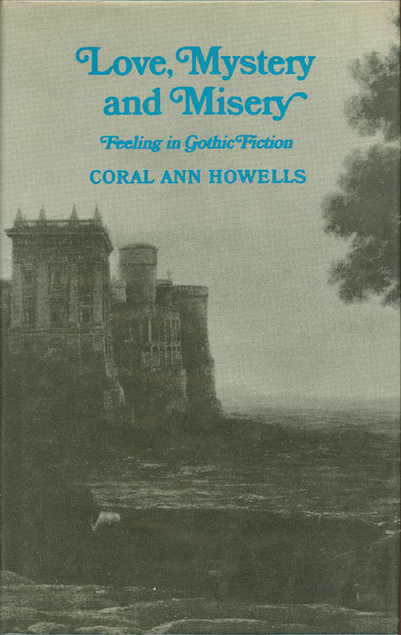
Love, Mystery, And Misery: Feeling In Gothic Fiction - Coral Ann Howells' 1978 study traces the depiction of emotion in the Gothic novel from its early high point, Ann Radcliffe's The Mysteries Of Udolpho, through to Charlotte Bronte's Jane Eyre. In this branch of fiction, imagination and emotion are often treated ambiguously: most Gothic novels operate as cautionary tales, warning against the indulgence of passion and the dangers of an unrestrained imagination, and arguing for control if not repression; yet there is a simultaneous sense that the authors recognised the frustration and dissatisfaction likely to stem from the very behaviours they were promoting. Furthermore, the exaggerated romanticism that made the genre popular was forced to operate within the confines of conventional morality: the result, too often, was compromise, though the novels themselves are often still absurdly entertaining. Howells makes her points by close analysis of a number of Gothic texts, starting, inevitably, with those twinned but opposing bookends of the genre, Radcliffe's Udolpho and Matthew Lewis's The Monk: the first about the absolute need to subject the emotions to the judgement, the latter showing the terrifying and violent consequences of passion unrestrained. She further then uses Maria Regina Roche's The Children Of The Abbey and Mary-Ann Radcliffe's Manfrone; or, The One-Handed Monk to illustrate the scope of the genre: the former is a domestic / sentimental story within a Gothic framework, making use of the tropes without buying into them; while the latter is one of the most wildly irrational and full-blooded of the Gothics, at least before it descends into the bathos of a tacked-on happy ending. (For all their violence, Gothic novels rarely end unhappily; though they do often end unconvincingly.) Howells then offers a close reading of Northanger Abbey, showing how in fact Austen recognised and celebrated the imagination, but required that it be balanced by the exercise of reason; pointing out, too, that the events of the novel do not, in fact, support Henry Tilney's view of the world, but rather that of Catherine who, if not faced with true Gothic villainy, suffers both cruelty and deceit at the hands of others. This study concludes with lengthy analyses of Charles Robert Maturin's Melmoth The Wanderer, the Gothic novel to end all Gothic novels, and Jane Eyre, which took many of the conventions of the Gothic form and domesticated them in England, offering a vision wherein the rational and irrational are not opposing forces but part of a unified approach to life.
For all their daring, Gothic novels lack frankness... They wanted to explore and exploit violent emotions, but at the same time they were not certain enough of their own values to revolt against eighteenth-century moral and literary conventions. The world of emotions was the real centre of their interest, but they treated it with such a mixture of coyness and hysteria that the impact of genuine insights into the springs of feeling is too often buried.
Perhaps the real embarrassment to Gothic writers was their sense of their duty as moralists, for as writers of quasi-romance they were caught in the difficult position of trying to satisfy two entirely different demands: on the one hand the claims of orthodox Christian morality and its extension into social propriety, and on the other their own imaginative imperatives leading them in the opposite direction into the dynamics of impulse and irrationality, aided and abetted, of course, by their reading public's appetite for excitement. The effect of these two conflicting pressures is frequently quite disastrous, robbing their work both of moral conviction and of imaginative truth...
238lyzard
Finished Women And Marriage In Victorian Fiction for TIOLI #7.
Now reading The Colonel's Daughter by Richard Aldington.
Now reading The Colonel's Daughter by Richard Aldington.
240lyzard
I have now read all of my library books; I have two for short review, and one for a blog post; and then I can return the lot!
Is it stupid to be excited about that?
Is it stupid to be excited about that?
241cbl_tn
>240 lyzard: Not stupid at all. Does this mean you can get more library books? Or can you focus all your attention on your TBRs? I find that I can get excited about either possibility!
242lyzard
I can always get more library books - that's the problem! Some of this current crop I have had sitting around and getting renewed for literally months---just because they could be renewed, they kept being put aside.
So I suppose it's mostly about list-ticking and fresh starts. :)
So I suppose it's mostly about list-ticking and fresh starts. :)
243kac522
>242 lyzard: I'm on my 14th renewal of a library book (our library allows 15 renewals), so I guess I have to actually read it.
244lyzard
Impressive! :D
As far as I know, the academic library I use sets no limits on number of renewals, unless someone recalls a book. I don't think I've held a book for longer than a year but, boy, I must have gone close!
As far as I know, the academic library I use sets no limits on number of renewals, unless someone recalls a book. I don't think I've held a book for longer than a year but, boy, I must have gone close!
245ronincats
Our library just moved from one renewal allowed to two this year--which I have been using! Can't fathom limitless (or even 15) renewals--if someone else is waiting for the book, will they call it in?
246lyzard
Hi, Roni! I have a "Community Borrower" account at the academic library, which means that if a student or lecturer wants a book, I will be issued with a recall notice and have to return it within a few days. Otherwise (I've just checked the fine print), a loan is twelve weeks, with unlimited renewals.
Most of our ordinary libraries have only a three-week borrowing period, but allow repeat renewal unless the book has been requested. It can be tricky getting a renewal on an ILL, though.
Most of our ordinary libraries have only a three-week borrowing period, but allow repeat renewal unless the book has been requested. It can be tricky getting a renewal on an ILL, though.
247casvelyn
My public library allows you to have a book out for up to 48 weeks (the initial 3 week loan period + 15 renewals). The library where I work allows only 12 weeks total, but because I'm staff, I can have up to 16 weeks (technically I could override the system and keep books indefinitely, but that's against the rules). I usually get books from work despite the shorter loan period because I'm at work every day, whereas I live in a "service gap" of the public library where I'm rarely near any of the branches.
>245 ronincats: For both my work and public libraries, patrons can place their own "holds" on checked out books via the online catalog. The person who has the book is allowed the rest of their current loan period, but cannot have further renewals on the book. Holds are also used by the public library so that patrons can have books that are checked in moved from one branch to another, free of charge. That way you don't have to drive 45 minutes across town to get the book you want. (And let me tell you, the book you want is never at the branch you want, when you want it!)
>245 ronincats: For both my work and public libraries, patrons can place their own "holds" on checked out books via the online catalog. The person who has the book is allowed the rest of their current loan period, but cannot have further renewals on the book. Holds are also used by the public library so that patrons can have books that are checked in moved from one branch to another, free of charge. That way you don't have to drive 45 minutes across town to get the book you want. (And let me tell you, the book you want is never at the branch you want, when you want it!)
248kac522
>245 ronincats: Yes, if someone requests the book, it can't be renewed--but apparently I'm the only one in the City of Chicago who wants to read a book on Spinoza in the past 45 weeks. What a surprise.
249lyzard
All very interesting, thank you!
Our public libraries are broken up into groups by local government council; the number of libraries in a group and the population served varies enormously across the country. When you join one library, you have access to everything within that group via free branch transfer.
Otherwise, our ILL system will get you a book from anywhere in the country for $5.00. However, if you need an item from an academic library, that costs $20.00 (one reason I've been checking out options other than academic loan!).
>248 kac522:
Heh! Yes, that's true of me too, Kathy: I don't think I've ever requested a book where I wasn't the only person doing so, and it was a horrible shock on those one or two occasions when I did get a book recalled!
Our public libraries are broken up into groups by local government council; the number of libraries in a group and the population served varies enormously across the country. When you join one library, you have access to everything within that group via free branch transfer.
Otherwise, our ILL system will get you a book from anywhere in the country for $5.00. However, if you need an item from an academic library, that costs $20.00 (one reason I've been checking out options other than academic loan!).
>248 kac522:
Heh! Yes, that's true of me too, Kathy: I don't think I've ever requested a book where I wasn't the only person doing so, and it was a horrible shock on those one or two occasions when I did get a book recalled!
250lyzard
...and after all that, what should I do yesterday evening but join another library and borrow a book? :)
(3 weeks + 3 x renewals)
(3 weeks + 3 x renewals)
251tymfos
Our library system's book policy is 2 weeks with two renewals as the standard rule, but if a book isn't on hold or in high demand, we will allow extra renewals. (Books with holds can't be renewed.)
253lyzard
>251 tymfos:
Hi, Terri! It's interesting how many different systems are out there.
>252 Smiler69:
Well, let's see: I have health issues, work issues and computer issues; not sure if that counts as "special". :)
Also trying to unmask my Secret Santa...
Hi, Terri! It's interesting how many different systems are out there.
>252 Smiler69:
Well, let's see: I have health issues, work issues and computer issues; not sure if that counts as "special". :)
Also trying to unmask my Secret Santa...
254Smiler69
Santa is known to wear many faces... What did he bring you this time, and how did he come to visit you this early in the month?
255ronincats
pageaday.com sent me an ad for their Sloths Wall Calendar 2016--for some reason, you came to mind!
256lyzard
>254 Smiler69:
Well, I'm sure you'll be astonished to hear that Santa brought me a book!---a very wonderful book, which he was apparently unwilling to trust to his reindeer: he chose FedEx instead, hence the early arrival. :D
>255 ronincats:
Aww, I'm flattered, Roni!
Well, I'm sure you'll be astonished to hear that Santa brought me a book!---a very wonderful book, which he was apparently unwilling to trust to his reindeer: he chose FedEx instead, hence the early arrival. :D
>255 ronincats:
Aww, I'm flattered, Roni!
258cbl_tn
>256 lyzard: You're obviously not on Santa's naughty list if he's bringing you books! Maybe you could put in a good word for me?!
259lyzard
Ah, no, I'm not the one with influence over Santa---we have someone around here with much more pull... :D
260rosalita
The problem with the reindeer is they always want to stop off in Melbourne and take a flyer around the Flemington Racecourse, pretending they're running in the Cup! That's why Santa sometimes has to use more modern and less playful methods to deliver the goods to the most worthy among us.
261Smiler69
I felt this might be the appropriate place for the following; I just wanted to share what I think is a beautiful cover because of Gainsborough's painting. I've just finished scanning and retouching the image so the cover will appear as good on LT as it does on the copy sitting next to me:

(let me know if you find it too large for your thread Liz, and I will reduce it if you wish)
eta: can you tell I'm ready for this one?? ;-)

(let me know if you find it too large for your thread Liz, and I will reduce it if you wish)
eta: can you tell I'm ready for this one?? ;-)
262lyzard
>260 rosalita:
Considering how this year's Melbourne Cup turned out, perhaps Mrs Claus was with the reindeer??
>261 Smiler69:
Good grief, woman!!
Hey, I'm glad you're enthusiastic but we should let everyone finish Cecilia first, don't you think?? :D
Considering how this year's Melbourne Cup turned out, perhaps Mrs Claus was with the reindeer??
>261 Smiler69:
Good grief, woman!!
Hey, I'm glad you're enthusiastic but we should let everyone finish Cecilia first, don't you think?? :D
263lyzard

Women And Marriage In Victorian Fiction - Jenni Calder's 1976 study uses close readings of the Victorian novel to chart the shifting of attitudes towards the nature of marriage and the position of women in society across the decades of the Victorian era---and how in some quarters this attitude did not change at all, with adherents of "the angel in the house", the "doll in the doll's house", continuing to campaign vigorously for female subjection even as the world at large was being forced to yield new opportunities and develop new views. In pursuit of her aim, Calder employs a generally chronological approach, examining depictions of marriage and the family in the works of William Thackeray, Charlotte Bronte, Elizabeth Gaskell, Charles Dickens, George Eliot, George Meredith, George Gissing and Thomas Hardy---and her conclusions are sometimes surprising. She is, for instance, very critical of George Eliot, for never allowing her rebellious women - Maggie Tulliver, Dorothea Brooke, Gwendolen Harleth - the slightest measure of personal success; particularly in light of Eliot's personal rebellion. She also offers a disturbing reading of Dickens, showing that his marriages are either depicted as essentially sexless (Calder draws an unnerving comparison between the brother-and-sister pairing of Tom and Ruth Pinch in Martin Chuzzlewit and Arthur Clennam and Amy Dorrit in Little Dorrit) or, where there is sex, there is simultaneously the implication of domestic abuse. She further argues that Thackeray, though a great believer in romantic marriage, was quite incapable of depicting it convincingly; finds Bronte most interesting in her self-contradictions; praises Gaskell for her appreciation of the unconventional family and her understanding of community; and, though she embraces Meredith's overt feminism, concludes that he undermined his stance by depicting marriages too far out of the ordinary. The novels of Gissing and Hardy, meanwhile, are unsurprisingly offered as the case against conventional marriage. Calder's main arguments are further illustrated by quotes from a number of more minor novelists and from the writers of "conduct" books, while the fiction is placed in the context of real-life changes in such areas as the divorce laws, women's ownership of property and the increasing awareness of birth control. And although the bulk of Calder's study is confined to the works of the English novelists, she bookends it with references to two stories by Tolstoy: Family Happiness, which concludes with the self-subjection of its wife-narrator, and The Kreutzer Sonata, which offers the justification of a wife-murderer.
In Victorian fiction almost the whole of human life could in a sense be contained in the family, for that part of life which lay beyond the confines of the family was usually considered to be incompatible with a moral view of human relations. 'Goodness' required a home, a wife, children, and servants. It needed a door to shut against temptation, corruption and threat. The Victorian novel may be said to be about men and women, but particularly women, seeking protection and fulfilment...
The situation of women is what makes marriage not only of central importance in Victorian fiction but also of vital interest. Denied for the most part opportunities for an identity other than of wife and mother, women's attempts to find their own level in the fiction of Victorian life provides endless fascination. Quiescent, ambitious, immoral, peculiar, like dolls or dragons, women are seen to be multifariously engaged in a contest with an overwhelmingly paternalistic society.
264lyzard

The Colonel's Daughter - Poet, biographer and novelist Richard Aldington was a controversial figure, pouring his disillusionment with the British establishment into all forms of his writing. His first novel, Death Of A Hero, about the war experiences of a young man, ran into censorship problems and had to be expurgated before it could be published. The dust had barely settled when Aldington published The Colonel's Daughter, an excoriating picture of post-WWI England. The focus of the story is Georgina Smithers, only child of a retired soldier and his wife, who are faced with the impossible task of keeping up appearances on a tightly straitened income. Rather plain and not very intelligent, Georgie's stiflingly narrow life has kept her childishly ignorant and emotionally immature. She longs for marriage and motherhood, partly as an escape, partly because no-one has ever suggested to her any possible alternative fate. Deprived by the lack of the necessary income of everything else she knows her social position should offer her, the thought that marriage too may be beyond her cannot be borne. However, suitable men are in extremely short supply; and after some clumsy and embarrassing false starts in her effort to find a potential husband, Georgie hails with relief a visit from a distant relative home from the plantations of Malaysia. Here, surely, is the answer to her prayers... The Colonel's Daughter is an uncomfortable yet sickly fascinating work, one shot through with mordant humour but ultimately too cruel - or perhaps simply too honest - to be easily enjoyed. Most of Aldington's venom is directed at the class represented by Colonel Smithers, the "pukka Sahibs", finding consolation for a failed and disregarded existence in thoughts of "the Empire"---but no-one escapes this novel unscathed: social climbing war profiteers, corrupt politicians, hypocritical reformers, uncaring medical professionals, spineless clergymen and crassly moral-less Bright Young Things each take their turn under Aldington's satirical lash. Even the working-classes, whose pragmatic approach to life comes closest to winning at least a measure of their author's approval, suffer for their instinctive forelock-tugging reaction to "the gentry". Meanwhile, Georgie - the natural product of this unnatural social arrangement - drifts aimlessly through life, bored and unhappy, until Geoffrey Hunter-Payne arrives for a visit. The young man is sufficiently good looking, sufficiently well-bred, and above all "pukka" to the core. As the entire village looks on with interest, Georgie waits breathlessly for the moment when all her dreams are to come true...
Life was dull for Alvina, and very, very dull for Georgie. Where were the Hunt Balls, the country-house parties, the brilliant gatherings of which Georgie had dreamed? Where were the skating parties, the hunting, the race-going, the County events, the golf, the bridge, the motoring? Six hundred a year is the answer. And where were the young men who should have come a-wooing the Colonel's lovely daughter, for she is grown so fair, so fair? Georgie wasn't pretty, Georgie wasn't rich, and thousands of young men lay dead in rows, or they lived on a couple of hundred a year with no prospects, or they were rich and she never saw them, or they were flabby and wanted to be kept, or they were scattered from Honduras to Hong-Kong, from Labrador to the Straits administering the Greatest-Empire-in-the-World...
265weird_O
>240 lyzard: through >251 tymfos:
All that is too much for my faltering brain to hold on to. Just buy the damn book! Then I make the rules, the basic one being: I can hold it until I die. No renewals, no 50 mile trips so someone else can read it, just because... It's mine, mine, all mine.
And then I discover my wife has had a copy for years. Oh the horror...
Happy Holidays, y'all.
All that is too much for my faltering brain to hold on to. Just buy the damn book! Then I make the rules, the basic one being: I can hold it until I die. No renewals, no 50 mile trips so someone else can read it, just because... It's mine, mine, all mine.
And then I discover my wife has had a copy for years. Oh the horror...
Happy Holidays, y'all.
266rosalita
>262 lyzard: Ah, yes. The lady jockey triumphed, didn't she? Good on her!
267lyzard
>265 weird_O:
Nice theory, Bill, but my obscure tastes mean that most of my books aren't available for purchase---or are so rare and expensive they might as well not be.
Which does at least protect me from the horrors of duplication! :)
>266 rosalita:
She did, much to the horror of The Establishment. Apparently that's not how the world's supposed to work. :D
Nice theory, Bill, but my obscure tastes mean that most of my books aren't available for purchase---or are so rare and expensive they might as well not be.
Which does at least protect me from the horrors of duplication! :)
>266 rosalita:
She did, much to the horror of The Establishment. Apparently that's not how the world's supposed to work. :D
268lyzard
Finished Hargrave for TIOLI #20...
...which is #150 for the year---whoo!!
Now reading The Blind Side by Patricia Wentoworth.
...which is #150 for the year---whoo!!
Now reading The Blind Side by Patricia Wentoworth.
269cbl_tn
>268 lyzard: Congrats on reaching the 150 milestone! And with a member of the Trollope family, too!
270lyzard
Thanks, Carrie - it's very exciting!
And mea culpa, I had not actually read a novel by Frances Trollope before. Hargrave is a strange but rather interesting book, another from my "evolution of crime fiction" list.
And mea culpa, I had not actually read a novel by Frances Trollope before. Hargrave is a strange but rather interesting book, another from my "evolution of crime fiction" list.
271lyzard
Best-selling books in the United States for 1906:
1. Coniston by Winston Churchill
2. Lady Baltimore by Owen Wister
3. The Fighting Chance by Robert W. Chambers
4. The House of a Thousand Candles by Meredith Nicholson
5. Jane Cable by George Barr McCutcheon
6. The Jungle by Upton Sinclair
7. The Awakening of Helena Richie by Margaret Deland
8. The Spoilers by Rex Beach
9. The House of Mirth by Edith Wharton
10. The Wheel of Life by Ellen Glasgow
Social drama (and melodrama) dominated the American best-seller lists of 1906, where we find many familiar authors but perhaps not so many familiar books. The exceptions are The Jungle, Upton Sinclair's notorious expose of the meat industry, and The House of Mirth, with Edith Wharton holding her place in the Top Ten from the year before. She is joined by Ellen Glasgow, whose The Wheel of Life is also about New York society, though set a generation later. Meanwhile, Rex Beach's The Spoilers, a story of political corruption set in the Alaska goldfields, is probably better known these days for its repeated adaptations to the big screen.
Both Jane Cable and The Awakening Of Helena Ritchie are about women battling for their rights against the prejudices of society and the law, while The Fighting Chance is the story of a man's struggle against a family history of alcoholism.
Considerably lighter fare was offered by Meredith Nicholson: The House of a Thousand Candles is a mystery-adventure about a young man forced to fulfil some unusual conditions in order to receive an inheritance.
Two historical novels complete our Top Ten for 1906: Owen Wister's Lady Baltimore is a pro-South story of the Reconstruction (and the origin of "the Lady Baltimore cake"), while topping the best-sellers for the third time in six years is Winston Churchill, whose Coniston is a transitional work for the author, marking his shift in interest from history to politics, and which like The Spoilers is a tale of political corruption.
1. Coniston by Winston Churchill
2. Lady Baltimore by Owen Wister
3. The Fighting Chance by Robert W. Chambers
4. The House of a Thousand Candles by Meredith Nicholson
5. Jane Cable by George Barr McCutcheon
6. The Jungle by Upton Sinclair
7. The Awakening of Helena Richie by Margaret Deland
8. The Spoilers by Rex Beach
9. The House of Mirth by Edith Wharton
10. The Wheel of Life by Ellen Glasgow
Social drama (and melodrama) dominated the American best-seller lists of 1906, where we find many familiar authors but perhaps not so many familiar books. The exceptions are The Jungle, Upton Sinclair's notorious expose of the meat industry, and The House of Mirth, with Edith Wharton holding her place in the Top Ten from the year before. She is joined by Ellen Glasgow, whose The Wheel of Life is also about New York society, though set a generation later. Meanwhile, Rex Beach's The Spoilers, a story of political corruption set in the Alaska goldfields, is probably better known these days for its repeated adaptations to the big screen.
Both Jane Cable and The Awakening Of Helena Ritchie are about women battling for their rights against the prejudices of society and the law, while The Fighting Chance is the story of a man's struggle against a family history of alcoholism.
Considerably lighter fare was offered by Meredith Nicholson: The House of a Thousand Candles is a mystery-adventure about a young man forced to fulfil some unusual conditions in order to receive an inheritance.
Two historical novels complete our Top Ten for 1906: Owen Wister's Lady Baltimore is a pro-South story of the Reconstruction (and the origin of "the Lady Baltimore cake"), while topping the best-sellers for the third time in six years is Winston Churchill, whose Coniston is a transitional work for the author, marking his shift in interest from history to politics, and which like The Spoilers is a tale of political corruption.
272lyzard

After three best-sellers in six years, there's not much left for me to say about Winston Churchill, except to reiterate that Coniston marks a turning-point in his personal and literary career. While, like the author's earlier novels, this is a work of historical fiction, being set some forty years before its writing, this is a book less about history than politics. That it is specifically a story of political corruption explains why its framework is far more oblique than is the case in Churchill's other works, and why far fewer real-life identities wander through its pages (the exception being President Ulysses S. Grant).
Though he goes out of his way to disguise his scene and his characters, to the extent of giving his state a new capital, most readers at the time were able to recognise the setting of Coniston as New Hampshire, where Churchill spent most of his adult life and was elected to the legislature, and its central character, Jethro Bass, as a portrait of political "boss" Ruel Durkee. A controversy broke out over this depiction, with a faction led by Senator William E. Chandler protesting the characterisation as slanderous, while others insisted that it was exaggerated but not inaccurate. The state of New Hampshire itself and the town of Croydon, on which the novel's town of Coniston was based, seem to have taken Churchill's intended expose in their stride, naming and re-naming various things and places "Coniston" after his novel.
273lyzard

Coniston - Winston Churchill's 1906 best-seller is the story of Jethro Bass, a poor tanner by trade, not formally educated but with a shrewd grasp of men and means, who rises from obscurity to become the leading political power of his state. Jethro suffers a blow in his youth when Cynthia Ware, the girl he loves, recoils in moral horror from his unscrupulous manoeuvring, but this does not turn him from the path he has chosen. When, years later, Cynthia's widower, William Wetherell, and their young daughter move to Coniston for the former's health, Jethro is strangely drawn to them, befriending Wetherell against his will and focusing all that is best in himself upon the young Cynthia. When her father dies, Cynthia becomes Jethro's ward, and grows up in an atmosphere of love and sheltering care, shielded most of all from any knowledge of Jethro's real life. But as Cynthia becomes a young woman, intelligent and high-principled like her mother, she must face the fact that "the best and greatest of men", as she has always believed him to be, is the controlling force of a corrupt political system built on threats, bribery and manipulation of the law... Coniston is a very enjoyable but rather peculiar book. On the surface it is an expose of political corruption and a plea for America to live up to the purity of its democratic theory, and it foregrounds Cynthia Wetherell's moral agonies and her attempt to save Jethro Bass from himself, but none of this is what the reader takes away. Rather than horror at Jethro's behaviour, what we sense from Winston Churchill is a wicked sort of enjoyment. The novel's two most gripping set-pieces are built around Jethro in crisis, with his enemies believing that they have him cornered at last, only for "the boss" to slip through their fingers and triumph once again. We should note, too, that in one of these Jethro borrows his tactics from William Wilberforce and the British anti-slavery movement!---while the fact that he uses a stage production of Uncle Tom's Cabin as a distraction can only mean that the reference was intentional on Churchill's part. It is ultimately impossible to believe that the reader is not supposed to enjoy Jethro's victories, or to want his main opponent, railway magnate Isaac D. Worthington, to get squashed like a bug. The combination of this tacit attitude with the novel's lip-service to political purity makes for a very strangely toned book indeed, and one that builds to a most uncomfortable climax. Cynthia finally does bring Jethro to the point of washing his own hands clean, with the result that control of the state is handed over to a faction every bit as corrupt, and potentially a lot more damagingly self-serving; yet this is supposed to be a happy ending! The truth of the matter is that Jethro Bass is not unique, but merely one cog in the political wheel: he starts by wresting power away from one corrupt faction, and eventually he hands it over to another. In fact, whether it was intentional or not, the message that Coniston finally conveys is that political corruption is unavoidable, and that the best you can hope for is to end up with the "right" kind of corruption.
The answers sorely tried Mr Satterlee's conscience, albeit he was not a man of the world. It set him thinking. He liked Jethro, this man of rugged power whose word had become law in the state. He knew best that side of him which Cynthia saw; and---if the truth be told---as a native of Coniston Mr Satterlee felt in the bottom of his heart a certain pride in Jethro. The minister's opinions well represented the attitude of his time. He had not given thought to the subject---for such matters had came to be taken for granted. A politician now was a politician, his ways and standards set apart from those of other citizens, and not to be judged by men without the pale of public life. Mr Satterlee in his limited vision did not then trace the matter to its source, did not reflect that Jethro Bass himself was almost wholly responsible in that state for the condition of politics and politicians. Coniston was proud of Jethro, prouder of him than ever since his last great victory in the Legislature, which brought the Truro Railroad through to Harwich and settled their townsman more firmly than ever before in the seat of power. Every statesman who drove into their little mountain village and stopped at the tannery house made their blood beat faster. Senators came, and representatives, and judges, and governors, "to git their orders," as Rias Richardson briefly put it, and Jethro could make or unmake them at a word...
274cbl_tn
>271 lyzard: I've read The House of a Thousand Candles! I think it's one of the Indiana University Press reprints of Indiana classics.
279lyzard
I downloaded a free ebook of The Milk-Churn Murder some time ago - commenting at the time how strange it was that one of the "Miles Burton" books should be available that way, when nearly all the others are rare to the point of being unobtainable.
Stupidly I didn't note the ebook's origin at the time, and I've just been hunting around to get those details...and I can't find it anywhere. I can only conclude that The Milk-Churn Murder *should not* have been available that way, and that it has since been taken down. An unusually good bit timing on my part, which usually works the other way.
Stupidly I didn't note the ebook's origin at the time, and I've just been hunting around to get those details...and I can't find it anywhere. I can only conclude that The Milk-Churn Murder *should not* have been available that way, and that it has since been taken down. An unusually good bit timing on my part, which usually works the other way.
280lyzard
I also commented earlier on the tortuous publication history of my current read, Forget-Me-Not by Joseph Shearing: this book has been published under five different titles, and as by two different authors - "Joseph Shearing" and "Marjorie Bowen", both pseudonyms for Gabrielle Campbell.
Having concluded to my satisfaction that "Forget-Me-Not by Joseph Shearing" was the original title and author, naturally I went with this cover image:

...even though, for obvious reasons, I was sorely tempted by the cover of this American reissue:

Having concluded to my satisfaction that "Forget-Me-Not by Joseph Shearing" was the original title and author, naturally I went with this cover image:

...even though, for obvious reasons, I was sorely tempted by the cover of this American reissue:

281rosalita
>280 lyzard: A quick scroll-down look at the first cover of Forget-Me-Not made me think that you were reading Mockingjay, which startled me for a variety of reasons.
As for the second ... redheads, amirite?
As for the second ... redheads, amirite?
282lyzard
Hi, Julia!
That hadn't occurred to me, but you're quite right; interesting!
Red-heads who can't get their clothes to stay on, yes! :D
That hadn't occurred to me, but you're quite right; interesting!
Red-heads who can't get their clothes to stay on, yes! :D
284lyzard

The Blind Side - No-one is altogether surprised when Ross Craddock is found shot dead: he was a cold-blooded, selfish man with a knack for making enemies. The problem is that the apartment block that housed him also housed various members of his family, all of whom find themselves under suspicion, and not without cause. Lee Fenton swears that the blood on her feet and nightgown on the morning after the murder were from a sleepwalking episode, but how can anyone be sure? Mavis Grey, meanwhile, involved with Craddock against the frantic pleas of her family, was forced to ward off his advances by wielding a brandy decanter---which does not explain why she was later seen leaving his apartment in the middle of the night. Lucinda Craddock seems like a harmless elderly lady, but between her interference for Mavis's sake and Craddock's threat to evict her, could she have taken drastic action? And why would Peter Renshaw have been so foolish as to handle the gun in the wake of the murder, when as a former soldier he must have known better? Faced with a phalanx of cousins, all of whom swear their innocence and alibi each other, Inspector Lamb is not a happy man... Inspector Lamb is, I gather, a regular supporting character in Patricia Wentworth's Miss Silver mysteries: I haven't got far enough along in that series to have encountered him in that context. However, Wentworth also wrote three novels in which the inspector appears in his own right---except that in this, the first of them, from 1939, he again finds himself playing second fiddle. This time it is to Peter Renshaw, who turns amateur detective chiefly to protect Lee Fenton, with whom he is in love. The case itself turns less upon motive---everyone had a motive; Craddock was that kind of man---and more upon opportunity, as the two opposed detectives try to determine who had access to the building, and to establish a timeline of the night's events: their joint efforts revealing a reductio ad absurdum situation in which almost everyone found a reason to wander through the crime scene on the fatal night, either before or after the murder. Inspector Lam clings to his instinct that someone closely connected to Craddock is the killer, while Renshaw is equally convinced that no member of the family is guilty. The question is---could both men be right?
He switched on the sitting-room light, and for a moment his only thought was that Mr Craddock had done it again. And done it properly this time. The little table on which he set out the drinks had been pushed over, and a chair was overturned. Broken glass too---well, that would account for the blood. There'd been a girl here, and she'd cut her foot. Nasty stuff, broken glass. Lord---what a blind it must have been! And Mr Craddock dead to the world, sprawling there on the floor with the bits of a smashed decanter all about him.
With a reproving click of the tongue, Peterson stepped forward. And then he saw the revolver---Mr Craddock's own revolver, the one he kept in the second drawer of the writing-table. And it lay on the hearth-rug a couple of yards away from Mr Craddock's outstretched left hand. And Mr Craddock lay in a pool of blood. And Mr Craddock was dead...
285lyzard
2016 group up already!?---yike!!
I think I'll be puddling along here until closer to the New Year...
I think I'll be puddling along here until closer to the New Year...
286lyzard
I was doing some much-needed tidying up over the weekend and was appalled to realise how many books had made their way into the house, apparently without my knowledge or volition. (This is one of the side-effects of having to import everything, with slow shipping: it's dangerously easy to forget what you've ordered, and even that you've ordered anything.)
I'm thinking that January might need to be devoted to working my way through some of these intruders.
I'm thinking that January might need to be devoted to working my way through some of these intruders.

289cbl_tn
>288 lyzard: I guess if your whole body is red, you don't need clothes at all?
291ronincats

For my Christmas/Hanukkah/Solstice/Holiday image this year (we are so diverse!), I've chosen this photograph by local photographer Mark Lenoce of the pier at Pacific Beach to express my holiday wishes to you: Peace on Earth and Good Will toward All!
292souloftherose
>263 lyzard: Women And Marriage In Victorian Fiction definitely sounds like one for the list!
>276 lyzard: 'Five library books returned and none borrowed---clear those decks, yeah!!' Oh well done!
Bookish Christmas/holiday wishes to you, Liz!

>276 lyzard: 'Five library books returned and none borrowed---clear those decks, yeah!!' Oh well done!
Bookish Christmas/holiday wishes to you, Liz!


294PaulCranswick
Have a lovely holiday, Liz

296SqueakyChu
Happy holidays, Liz! I'm still around but reading toddler books instead of gothic novels. Haha! Hope your new year is terrific.
297luvamystery65

Merry Christmas
301lyzard
Meanwhile...
Finished The Poison Plague for TIOLI #21.
Now reading The Silk Stocking Murders by Anthony Berkeley.
Finished The Poison Plague for TIOLI #21.
Now reading The Silk Stocking Murders by Anthony Berkeley.
304PaulCranswick

Have a wonderful bookfilled 2016, Liz.
305souloftherose
>302 lyzard: 'Now reading Cards On The Table by Agatha Christie.' Oh dear, I think I will have to make an effort to catch up on the Agatha Christie reading in 2016....
Happy new year Liz! Hope to see you in the 2016 group in the next few days (I'm also still trying to finish off my 2015 thread).
Happy new year Liz! Hope to see you in the 2016 group in the next few days (I'm also still trying to finish off my 2015 thread).
306lyzard
>303 Helenliz:
I will be setting up my thread today, Helen, and will post a link here when I do. :)
>304 PaulCranswick:
Thanks, Paul - you, too!
>305 souloftherose:
Agatha I've kept up with; Georgette I owe an apology. :D
I will be setting up my thread today, Helen, and will post a link here when I do. :)
>304 PaulCranswick:
Thanks, Paul - you, too!
>305 souloftherose:
Agatha I've kept up with; Georgette I owe an apology. :D

