1KeithChaffee
Hello!
This is my fourth full year at Library Thing. I have previously posted my home thread in the Club Read group, and I expect to keep following a lot of people there. But more than half of what I read is now chosen, at least in part, to fill some part of a Category Challenge, so it made sense to move my home base over here. (I tried doing threads in both places one year; I found it cumbersome.)
I'm a retired librarian. Grew up in Vermont; educated at Washington University in St. Louis (they get mildly annoyed if you don't say the whole name) and the University of Michigan; worked in the acquisitions department of the Los Angeles Public Library for 31 years.
I read more fiction than non, and am hoping that the ArtsCat and NonfictionCat will help me add more NF to my diet in 2026. I read a lot of SF and mystery, popular fiction, and books about film/TV/music. Not a big classic literature guy.
On to my challenges!
This is my fourth full year at Library Thing. I have previously posted my home thread in the Club Read group, and I expect to keep following a lot of people there. But more than half of what I read is now chosen, at least in part, to fill some part of a Category Challenge, so it made sense to move my home base over here. (I tried doing threads in both places one year; I found it cumbersome.)
I'm a retired librarian. Grew up in Vermont; educated at Washington University in St. Louis (they get mildly annoyed if you don't say the whole name) and the University of Michigan; worked in the acquisitions department of the Los Angeles Public Library for 31 years.
I read more fiction than non, and am hoping that the ArtsCat and NonfictionCat will help me add more NF to my diet in 2026. I read a lot of SF and mystery, popular fiction, and books about film/TV/music. Not a big classic literature guy.
On to my challenges!
2KeithChaffee
ArtsCat
I don't always do the new Cats each year, but since this one was my suggestion, I feel somewhat obliged to join in. Not that it will be an unpleasant thing done grudgingly; I look forward to it, and I like the mix of monthly themes the group came up with. I don't expect it will be too difficult to find interesting books for each month. I'm hosting in October.
JAN: painting -- The Music Lesson, Katharine Weber
FEB: artists' biographies -- Pick Yourself Up, Charlotte Greenspan
MAR: motion pictures -- Viva Hollywood, Luis I. Reyes
APR: museums -- Let's Play Dead, Sheila Connolly
MAY: color and light -- True Color, Kory Stamper
JUN: ballet & Broadway
JUL: fiber arts
AUG: blues music
SEP: rock and roll
OCT: classical music
NOV: culinary arts
DEC: folk arts
I don't always do the new Cats each year, but since this one was my suggestion, I feel somewhat obliged to join in. Not that it will be an unpleasant thing done grudgingly; I look forward to it, and I like the mix of monthly themes the group came up with. I don't expect it will be too difficult to find interesting books for each month. I'm hosting in October.
JAN: painting -- The Music Lesson, Katharine Weber
FEB: artists' biographies -- Pick Yourself Up, Charlotte Greenspan
MAR: motion pictures -- Viva Hollywood, Luis I. Reyes
APR: museums -- Let's Play Dead, Sheila Connolly
MAY: color and light -- True Color, Kory Stamper
JUN: ballet & Broadway
JUL: fiber arts
AUG: blues music
SEP: rock and roll
OCT: classical music
NOV: culinary arts
DEC: folk arts
3KeithChaffee
MysteryKit
A standard part of my year; I'm hosting in February
JAN: female detectives, amateur or professional -- Vera Wong's Unsolicited Advice for Murderers, Jesse Q. Sutanto
FEB: clerical sleuths -- A Morbid Taste for Bones, Ellis Peters
MAR: Nordic mysteries -- The Burning Stones, Antti Tuomainen (trans. by David Hackston)
APR: private eyes -- Shadow of a Broken Man, George C. Chesbro
MAY: hardboiled/noir -- One Deadly Dawn, Harry Whittington
JUN: police procedurals
JUL: less than lawful
AUG: Grand Master Award winner
SEP: now a major film/TV series
OCT: from your favorite author list
NOV: guns for hire
DEC: wild card/reader’s choice
A standard part of my year; I'm hosting in February
JAN: female detectives, amateur or professional -- Vera Wong's Unsolicited Advice for Murderers, Jesse Q. Sutanto
FEB: clerical sleuths -- A Morbid Taste for Bones, Ellis Peters
MAR: Nordic mysteries -- The Burning Stones, Antti Tuomainen (trans. by David Hackston)
APR: private eyes -- Shadow of a Broken Man, George C. Chesbro
MAY: hardboiled/noir -- One Deadly Dawn, Harry Whittington
JUN: police procedurals
JUL: less than lawful
AUG: Grand Master Award winner
SEP: now a major film/TV series
OCT: from your favorite author list
NOV: guns for hire
DEC: wild card/reader’s choice
4KeithChaffee
SFFKit
Couldn't not do ths one! I'm hosting in June.
JAN: books that have been adapted for film/TV: Second Foundation, Isaac Asimov
FEB: romantic SF: A Fine and Private Place, Peter S. Beagle; Under the Whispering Door, TJ Klune
MAR: pre-1975 SFF: Dangerous Visions (1967), Harlan Ellison, ed.; Isaac Asimov Presents the Great SF Stories 10 (1948), Isaac Asimov & Martin H. Greenberg, eds.
APR: parallel worlds: A Spindle Splintered and A Mirror Mended, Alix E. Harrow
MAY: Western inspired: Six-Gun Snow White, Catherynne M. Valente
JUN: religion in SFF
JUL: humorous SFF
AUG: favorite authors/books
SEP: not a novel
OCT: fantastic beasts
NOV: cozy SFF
DEC: rebels and renegades
Couldn't not do ths one! I'm hosting in June.
JAN: books that have been adapted for film/TV: Second Foundation, Isaac Asimov
FEB: romantic SF: A Fine and Private Place, Peter S. Beagle; Under the Whispering Door, TJ Klune
MAR: pre-1975 SFF: Dangerous Visions (1967), Harlan Ellison, ed.; Isaac Asimov Presents the Great SF Stories 10 (1948), Isaac Asimov & Martin H. Greenberg, eds.
APR: parallel worlds: A Spindle Splintered and A Mirror Mended, Alix E. Harrow
MAY: Western inspired: Six-Gun Snow White, Catherynne M. Valente
JUN: religion in SFF
JUL: humorous SFF
AUG: favorite authors/books
SEP: not a novel
OCT: fantastic beasts
NOV: cozy SFF
DEC: rebels and renegades
5KeithChaffee
AlphaKit
Another regular favorite.
JAN:
F: Second Foundation, Isaac Asimov
E/F: Future Home of the Living God, Louise Erdrich
FEB:
B: A Fine and Private Place, Peter S. Beagle; A Morbid Taste for Bones, Ellis Peters
B/O: Only This Beautiful Moment, Abdi Nazemian
MAR:
V: Dangerous Visions, Harlan Ellison, ed.
R/V: Viva Hollywood, Luis I. Reyes
APR:
J: Glitz, Glam, and a Damn Good Time, Jennifer Wright
P: Let's Play Dead, Sheila Connolly; The Paper Menagerie and Other Stories, Ken Liu; "Dr. Werthless", Harold Schechter & Eric Powell
MAY:
A: Brave New Ballet, Robyn McGrath (Alexander Mostov, illustrator); A Particularly Nasty Case, Adam Kay
W: The Summer War, Naomi Novik; The Merge, Grace Walker; Six-Gun Snow White, Catherynne M. Valente; One Deadly Dawn, Harry Whittington; The Grand Scheme of Things, Warona Jay
JUN: H, T
JUL: G, U
AUG: C, Q
SEP: M, Y
OCT: D, N
NOV: I, K
DEC: L, S
Year-long:
X: The Tragedy of X, Ellery Queen
Z: Believing , Zenna Henderson
Another regular favorite.
JAN:
F: Second Foundation, Isaac Asimov
E/F: Future Home of the Living God, Louise Erdrich
FEB:
B: A Fine and Private Place, Peter S. Beagle; A Morbid Taste for Bones, Ellis Peters
B/O: Only This Beautiful Moment, Abdi Nazemian
MAR:
V: Dangerous Visions, Harlan Ellison, ed.
R/V: Viva Hollywood, Luis I. Reyes
APR:
J: Glitz, Glam, and a Damn Good Time, Jennifer Wright
P: Let's Play Dead, Sheila Connolly; The Paper Menagerie and Other Stories, Ken Liu; "Dr. Werthless", Harold Schechter & Eric Powell
MAY:
A: Brave New Ballet, Robyn McGrath (Alexander Mostov, illustrator); A Particularly Nasty Case, Adam Kay
W: The Summer War, Naomi Novik; The Merge, Grace Walker; Six-Gun Snow White, Catherynne M. Valente; One Deadly Dawn, Harry Whittington; The Grand Scheme of Things, Warona Jay
JUN: H, T
JUL: G, U
AUG: C, Q
SEP: M, Y
OCT: D, N
NOV: I, K
DEC: L, S
Year-long:
X: The Tragedy of X, Ellery Queen
Z: Believing , Zenna Henderson
6KeithChaffee
Other Cats and Kits
I don't dare commit to actually completing any more of the Cats and Kits -- need to save some reading space for other choices and spontaneity -- but some of the others seem as if I might well happen across something suitable in a given month. (Or perhaps something I'm reading for another Cat/Kit will also fit one of these; I am happy to count one book for multiple challenges.) So you might occasionally see something pop up from DecadeCat, NonfictionCat, or RandomKit. When that happens, I'll make note of it here.
January
DecadeCat: 50s -- Second Foundation, Isaac Asimov
RandomKit: secrets --The Music Lesson, Katharine Weber
NonfictionCat: science -- Women in Science, Rachel Ignotofsky
February
DecadeCat: 10s/RandomKit: hospitals/NonfictionCat: medicine and disease -- Five Days at Memorial, Sheri Fink
March
DecadeCat: 80s -- The Devil's Arithmetic, Jane Yolen
RandomKit: person's name in title -- A History of the African-American People (Proposed) by Strom Thurmond, Percival Everett & James Kincaid
NonfictionCat: something you've always wanted to know about -- Alternate Channels, Steven Capsuto
April
DecadeCat: 00s/NonfictionCat: history -- Glitz, Glam, and a Damn Good Time, Jennifer Wright
RandomKit: royalty -- A Spindle Splintered & A Mirror Mended, Alix E. Harrow
May
DecadeCat: 30s -- The Tragedy of X, Ellery Queen
RandomKit: dance -- Brave New Ballet, Robyn McGrath (Alexander Mostov, illustrator)
NonfictionCat: archaeology -- Archaeology: A Very Short Introduction, Paul Bahn
I don't dare commit to actually completing any more of the Cats and Kits -- need to save some reading space for other choices and spontaneity -- but some of the others seem as if I might well happen across something suitable in a given month. (Or perhaps something I'm reading for another Cat/Kit will also fit one of these; I am happy to count one book for multiple challenges.) So you might occasionally see something pop up from DecadeCat, NonfictionCat, or RandomKit. When that happens, I'll make note of it here.
January
DecadeCat: 50s -- Second Foundation, Isaac Asimov
RandomKit: secrets --The Music Lesson, Katharine Weber
NonfictionCat: science -- Women in Science, Rachel Ignotofsky
February
DecadeCat: 10s/RandomKit: hospitals/NonfictionCat: medicine and disease -- Five Days at Memorial, Sheri Fink
March
DecadeCat: 80s -- The Devil's Arithmetic, Jane Yolen
RandomKit: person's name in title -- A History of the African-American People (Proposed) by Strom Thurmond, Percival Everett & James Kincaid
NonfictionCat: something you've always wanted to know about -- Alternate Channels, Steven Capsuto
April
DecadeCat: 00s/NonfictionCat: history -- Glitz, Glam, and a Damn Good Time, Jennifer Wright
RandomKit: royalty -- A Spindle Splintered & A Mirror Mended, Alix E. Harrow
May
DecadeCat: 30s -- The Tragedy of X, Ellery Queen
RandomKit: dance -- Brave New Ballet, Robyn McGrath (Alexander Mostov, illustrator)
NonfictionCat: archaeology -- Archaeology: A Very Short Introduction, Paul Bahn
7KeithChaffee
BingoDog
This might be the challenge I enjoy the most each year. It always forces me to stretch beyond my usual reading and pick a few books that I wouldn't have considered otherwise. I am somewhat nervous about "great first sentence," as it's the one thing on the card you can't really plan for; you don't know a book's got a great first sentence until you read the book. Sometimes you don't know until you finish the book; some first sentences don't fully reveal their greatness until you understand the whole.
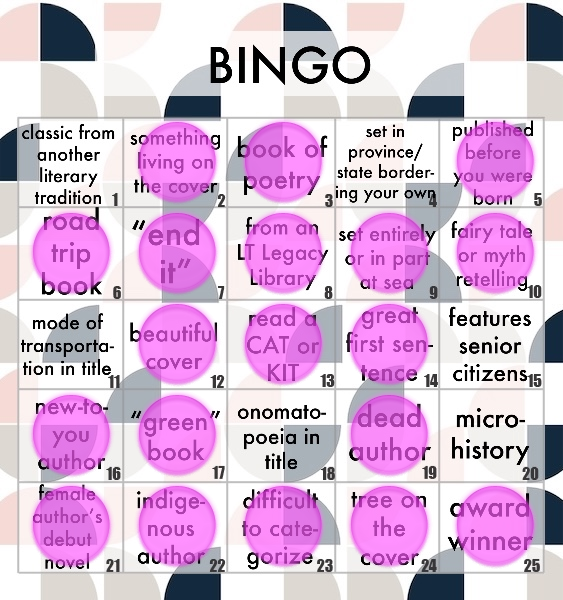
1. classic from another literary tradition
2. something living on the cover: Impossible Things, Connie Willis
3. book of poetry: Baseball Haiku, Cor van den Heuvel & Nanae Tamura, eds.
4. set in province/state bordering your own
5. published before you were born: Isaac Asimov Presents the Great SF Stories 10 (1948), Isaac Asimov & Martin H. Greenberg, eds.
6. road trip: I'm Starting to Worry About This Black Box of Doom, Jason Pargin
7. "end it" (involves an ending in some way): Five Days at Memorial, Sheri Fink, in which several lives are ended
8. from an LT Legacy Library: A Fine and Private Place, Peter S. Beagle (in the library of Carl Sandburg)
9. set entirely or partly at sea: Cherry Ames, Cruise Nurse, Helen Wells
10. fairy tale or myth retelling: A Spindle Splintered, Alix E. Harrow
11. mode of transportation in title
12. beautiful cover: Believing, Zenna Henderson
13. read a CAT or KIT: The Music Lesson, Katharine Weber (January ArtsCAT/RandomKIT)
14. great first sentence: Women in Science, Rachel Ignotofsky ("Nothing says trouble like a woman in pants.")
15. features senior citizens
16. new-to-you author: Vera Wong's Unsolicited Advice for Murderers, Jesse Q. Sutanto
17. green book: Dangerous Visions, Harlan Ellison, ed.
18. onomatopoeia in title
19. dead author: Second Foundation, Isaac Asimov
20. microhistory
21. female author's debut novel: The Merge, Grace Walker
22. indigenous author: Future Home of the Living God, Louise Erdrich
23. difficult to categorize: Six-Gun Snow White, Catherynne M. Valente
24. tree on the cover: Only This Beautiful Moment, Abdi Nazemian
25. award winner: The Devil's Arithmetic, Jane Yolen (National Jewish Book Award)
This might be the challenge I enjoy the most each year. It always forces me to stretch beyond my usual reading and pick a few books that I wouldn't have considered otherwise. I am somewhat nervous about "great first sentence," as it's the one thing on the card you can't really plan for; you don't know a book's got a great first sentence until you read the book. Sometimes you don't know until you finish the book; some first sentences don't fully reveal their greatness until you understand the whole.
1. classic from another literary tradition
2. something living on the cover: Impossible Things, Connie Willis
3. book of poetry: Baseball Haiku, Cor van den Heuvel & Nanae Tamura, eds.
4. set in province/state bordering your own
5. published before you were born: Isaac Asimov Presents the Great SF Stories 10 (1948), Isaac Asimov & Martin H. Greenberg, eds.
6. road trip: I'm Starting to Worry About This Black Box of Doom, Jason Pargin
7. "end it" (involves an ending in some way): Five Days at Memorial, Sheri Fink, in which several lives are ended
8. from an LT Legacy Library: A Fine and Private Place, Peter S. Beagle (in the library of Carl Sandburg)
9. set entirely or partly at sea: Cherry Ames, Cruise Nurse, Helen Wells
10. fairy tale or myth retelling: A Spindle Splintered, Alix E. Harrow
11. mode of transportation in title
12. beautiful cover: Believing, Zenna Henderson
13. read a CAT or KIT: The Music Lesson, Katharine Weber (January ArtsCAT/RandomKIT)
14. great first sentence: Women in Science, Rachel Ignotofsky ("Nothing says trouble like a woman in pants.")
15. features senior citizens
16. new-to-you author: Vera Wong's Unsolicited Advice for Murderers, Jesse Q. Sutanto
17. green book: Dangerous Visions, Harlan Ellison, ed.
18. onomatopoeia in title
19. dead author: Second Foundation, Isaac Asimov
20. microhistory
21. female author's debut novel: The Merge, Grace Walker
22. indigenous author: Future Home of the Living God, Louise Erdrich
23. difficult to categorize: Six-Gun Snow White, Catherynne M. Valente
24. tree on the cover: Only This Beautiful Moment, Abdi Nazemian
25. award winner: The Devil's Arithmetic, Jane Yolen (National Jewish Book Award)
8KeithChaffee
On to a pair of more personal challenges.
During my years at LA Public Library, I wrote weekly posts for the library's blog. My assignment was to help drive traffic to our digital collections. Many of the posts I wrote were in honor of famous people born that week, and a lot of those were authors. They were chosen with an eye towards broad representation of gender, era, ethnicity, and genre, though I'm sure that my favorites are more strongly represented.
I thought it would be an interesting challenge to read something by each of the authors I wrote about. I hope to get to three or four of them each year.
I've already read: Margaret Atwood, Lawrence Block, Ray Bradbury, Arthur C. Clarke, Beverly Cleary, Joseph Conrad, Alexandre Dumas, Dave Eggers, Neil Gaiman, Thomas Hardy, Frank Herbert, Nick Hornby, P. D. James, Ursula K. Le Guin, Madeleine L'Engle, Jonathan Lethem, H. P. Lovecraft, George R. R. Martin, China Mieville, Edgar Allan Poe, Beatrix Potter, Thomas Pynchon, Mary Roach, Dr. Seuss, Jane Smiley, Harry Turtledove, Kurt Vonnegut, Laura Ingalls Wilder, P. G. Wodehouse, and Tom Wolfe.
But that leaves still to be read: Louisa May Alcott, Isabel Allende, Eric Ambler, Jeffrey Archer, Lester Bangs, J. M. Barrie, L. Frank Baum, Michael Bond, Rita Mae Brown, James M. Cain, Truman Capote, Raymond Chandler, Mary Higgins Clark, Philip K. Dick, Emily Dickinson, W. E. B. du Bois, Ralph Ellison, Ian Fleming, Richard Ford, Dick Francis, Gabriel Garcia Marquez, Henry Louis Gates, Jr., Nikolai Gogol, Stephen Jay Gould, Graham Greene, W. E. B. Griffin, Lorraine Hansberry, Ernest Hemingway, Zora Neale Hurston, Pauline Kael, Rudyard Kipling, Mark Kurlansky, Mercedes Lackey, John le Carre, Elmore Leonard, Debbie Macomber, Naguib Mahfouz, Cormac McCarthy, Ian McEwan, Haruki Murakami, Iris Murdoch, Walter Dean Meyers, Vladimir Nabokov, Joyce Carol Oates, Eugene O'Neill, Dorothy Parker, Mary Renault, Ruth Rendell, Nora Roberts, Oliver Sacks, Dorothy L. Sayers, Rex Stout, Alfred, Lord Tennyson, Studs Terkel, Leo Tolstoy, Barbara W. Tuchman, Evelyn Waugh, and Edith Wharton.
Read in 2026: Louise Erdrich.
During my years at LA Public Library, I wrote weekly posts for the library's blog. My assignment was to help drive traffic to our digital collections. Many of the posts I wrote were in honor of famous people born that week, and a lot of those were authors. They were chosen with an eye towards broad representation of gender, era, ethnicity, and genre, though I'm sure that my favorites are more strongly represented.
I thought it would be an interesting challenge to read something by each of the authors I wrote about. I hope to get to three or four of them each year.
I've already read: Margaret Atwood, Lawrence Block, Ray Bradbury, Arthur C. Clarke, Beverly Cleary, Joseph Conrad, Alexandre Dumas, Dave Eggers, Neil Gaiman, Thomas Hardy, Frank Herbert, Nick Hornby, P. D. James, Ursula K. Le Guin, Madeleine L'Engle, Jonathan Lethem, H. P. Lovecraft, George R. R. Martin, China Mieville, Edgar Allan Poe, Beatrix Potter, Thomas Pynchon, Mary Roach, Dr. Seuss, Jane Smiley, Harry Turtledove, Kurt Vonnegut, Laura Ingalls Wilder, P. G. Wodehouse, and Tom Wolfe.
But that leaves still to be read: Louisa May Alcott, Isabel Allende, Eric Ambler, Jeffrey Archer, Lester Bangs, J. M. Barrie, L. Frank Baum, Michael Bond, Rita Mae Brown, James M. Cain, Truman Capote, Raymond Chandler, Mary Higgins Clark, Philip K. Dick, Emily Dickinson, W. E. B. du Bois, Ralph Ellison, Ian Fleming, Richard Ford, Dick Francis, Gabriel Garcia Marquez, Henry Louis Gates, Jr., Nikolai Gogol, Stephen Jay Gould, Graham Greene, W. E. B. Griffin, Lorraine Hansberry, Ernest Hemingway, Zora Neale Hurston, Pauline Kael, Rudyard Kipling, Mark Kurlansky, Mercedes Lackey, John le Carre, Elmore Leonard, Debbie Macomber, Naguib Mahfouz, Cormac McCarthy, Ian McEwan, Haruki Murakami, Iris Murdoch, Walter Dean Meyers, Vladimir Nabokov, Joyce Carol Oates, Eugene O'Neill, Dorothy Parker, Mary Renault, Ruth Rendell, Nora Roberts, Oliver Sacks, Dorothy L. Sayers, Rex Stout, Alfred, Lord Tennyson, Studs Terkel, Leo Tolstoy, Barbara W. Tuchman, Evelyn Waugh, and Edith Wharton.
Read in 2026: Louise Erdrich.
9KeithChaffee
My major personal project is a survey of award-nominated short SF stories. For those awards that give multiple awards for short fiction, I include shorts of all lengths -- short story, novella, novelette -- anything shorter than a novel.
I made the decision a few months ago to shrink the list of awards I consider to US awards It's not that Canadian, Australian, British, and African SF isn't worth reading, but there's only so many years in a life, and even the US-only project is likely too large to ever finish.
My current list of Awards includes the Hugo, Nebula, Ignyte (POC authors), Eugie, Otherwise (SF/fantasy exploring gender issues; doesn't pop up a lot, because most of its winners are novels), and Sturgeon awards. While I don't hold with the theory that all alternate history is by definition science fiction, I do add to my list those titles from the Sidewise Awards that have sufficient SF content to be worth looking at.
Last year, I read almost 200 stories; at that pace, I could finish the project within a decade. (ETA Feb 28: I will not meet that pace this year, because I've decided to prioritize clearing my shelf of my backlog of SF magazine subscriptions, and most of those issues don't have award stories in them. I'll still get to some award stories through anthologies and author best-of collections that I read during the year, but it'll be a smaller number.)
SF STORIES READ JAN-MAR
1. "Jack," Connie Willis -- 1991 Nebula novella nominee; 1992 Hugo novella nominee
2. "And Now You Don't," Isaac Asimov -- 1951 Retro Hugo novella nominee
3. "The Ghost Pit," Stephen Baxter -- 2002 Hugo short story nominee
4. "Magic's Price," Bud Sparhawk -- 2002 Nebula novella nominee
5. "Moon Dogs," Michael Swanwick -- 2001 Hugo short story nominee
6. "Loose Ends," Paul Levinson -- 1997 Nebula novella nominee; 1998 Hugo novella nominee, Sturgeon nominee
7. "Riders of the Purple Wage," Philip Jose Farmer -- 1967 Nebula novella nominee, 1968 Hugo novella winner (tie)
8. "The Jigsaw Man," Larry Niven -- 1968 Hugo short story nominee
9. "If All Men Were Brothers, Would You Let One Marry Your Sister?," Theodore Sturgeon -- 1967 Nebula novella nominee
10. "Aye, and Gomorrah," Samuel R. Delany -- 1967 Nebula short story winner, 1968 Hugo short story nominee
11. The Devil's Arithmetic, Jane Yolen -- 1988 Nebula novella nominee
I made the decision a few months ago to shrink the list of awards I consider to US awards It's not that Canadian, Australian, British, and African SF isn't worth reading, but there's only so many years in a life, and even the US-only project is likely too large to ever finish.
My current list of Awards includes the Hugo, Nebula, Ignyte (POC authors), Eugie, Otherwise (SF/fantasy exploring gender issues; doesn't pop up a lot, because most of its winners are novels), and Sturgeon awards. While I don't hold with the theory that all alternate history is by definition science fiction, I do add to my list those titles from the Sidewise Awards that have sufficient SF content to be worth looking at.
Last year, I read almost 200 stories; at that pace, I could finish the project within a decade. (ETA Feb 28: I will not meet that pace this year, because I've decided to prioritize clearing my shelf of my backlog of SF magazine subscriptions, and most of those issues don't have award stories in them. I'll still get to some award stories through anthologies and author best-of collections that I read during the year, but it'll be a smaller number.)
SF STORIES READ JAN-MAR
1. "Jack," Connie Willis -- 1991 Nebula novella nominee; 1992 Hugo novella nominee
2. "And Now You Don't," Isaac Asimov -- 1951 Retro Hugo novella nominee
3. "The Ghost Pit," Stephen Baxter -- 2002 Hugo short story nominee
4. "Magic's Price," Bud Sparhawk -- 2002 Nebula novella nominee
5. "Moon Dogs," Michael Swanwick -- 2001 Hugo short story nominee
6. "Loose Ends," Paul Levinson -- 1997 Nebula novella nominee; 1998 Hugo novella nominee, Sturgeon nominee
7. "Riders of the Purple Wage," Philip Jose Farmer -- 1967 Nebula novella nominee, 1968 Hugo novella winner (tie)
8. "The Jigsaw Man," Larry Niven -- 1968 Hugo short story nominee
9. "If All Men Were Brothers, Would You Let One Marry Your Sister?," Theodore Sturgeon -- 1967 Nebula novella nominee
10. "Aye, and Gomorrah," Samuel R. Delany -- 1967 Nebula short story winner, 1968 Hugo short story nominee
11. The Devil's Arithmetic, Jane Yolen -- 1988 Nebula novella nominee
10KeithChaffee
SF STORIES READ APR-JUN
12. A Spindle Splintered, Alix E. Harrow -- 2022 Hugo novella nominee
13. A Mirror Mended, Alix E. Harrow -- 2023 Hugo novella nominee
14. "Seasons of Glass and Iron," Amal El-Mohtar -- 2016 Nebula short story winner; 2017 Hugo short story winner, Sturgeon nominee, Aurora short fiction nominee, Eugie nominee
15. "Madeleine," Amal El-Mohtar -- 2015 Nebula short story nominee
16. 'The Green Book," Amal El-Mohtar -- 2010 Nebula short story nominee
17. "The Bookmaking Habits of Select Species," Ken Liu -- 2013 Nebula short story nominee; 2013 Sturgeon nominee
18. "The Regular," Ken Liu -- 2014 Nebula novella nominee; 2015 Sturgeon nominee
19. "The Paper Menagerie," Ken Liu -- 2011 Nebula short story winner; 2012 Hugo short story winner, Sturgeon nominee
20. "Mono no aware," Ken Liu -- 2013 Hugo short story winner, Sturgeon nominee
21. "The Waves," Ken Liu -- 2012 Nebula novelette nominee
22. "All the Flavors," Ken Liu -- 2012 Nebula novella nominee
23. "The Litigation Master and the Monkey King," Ken Liu -- 2011 Nebula novella nominee; 2012 Hugo novella nominee, Sturgeon nominee
24. "The Man Who Ended History: A Documentary," Ken Liu -- 2013 Nebula novelette nominee
25. To Be Taught, if Fortunate, Becky Chambers -- 2020 Hugo novella nominee
26. The Summer War, Naomi Novik -- 2026 Hugo novella nominee
27. Passing Strange, Ellen Klages -- 2017 Nebula novella nominee
28. "Helicopter Story," Isabel Fall -- 2021 Hugo novelette nominee
29. Six-Gun Snow White, Catherynne M. Valente -- 2013 Nebula novella nominee; 2014 Hugo novella nominee
12. A Spindle Splintered, Alix E. Harrow -- 2022 Hugo novella nominee
13. A Mirror Mended, Alix E. Harrow -- 2023 Hugo novella nominee
14. "Seasons of Glass and Iron," Amal El-Mohtar -- 2016 Nebula short story winner; 2017 Hugo short story winner, Sturgeon nominee, Aurora short fiction nominee, Eugie nominee
15. "Madeleine," Amal El-Mohtar -- 2015 Nebula short story nominee
16. 'The Green Book," Amal El-Mohtar -- 2010 Nebula short story nominee
17. "The Bookmaking Habits of Select Species," Ken Liu -- 2013 Nebula short story nominee; 2013 Sturgeon nominee
18. "The Regular," Ken Liu -- 2014 Nebula novella nominee; 2015 Sturgeon nominee
19. "The Paper Menagerie," Ken Liu -- 2011 Nebula short story winner; 2012 Hugo short story winner, Sturgeon nominee
20. "Mono no aware," Ken Liu -- 2013 Hugo short story winner, Sturgeon nominee
21. "The Waves," Ken Liu -- 2012 Nebula novelette nominee
22. "All the Flavors," Ken Liu -- 2012 Nebula novella nominee
23. "The Litigation Master and the Monkey King," Ken Liu -- 2011 Nebula novella nominee; 2012 Hugo novella nominee, Sturgeon nominee
24. "The Man Who Ended History: A Documentary," Ken Liu -- 2013 Nebula novelette nominee
25. To Be Taught, if Fortunate, Becky Chambers -- 2020 Hugo novella nominee
26. The Summer War, Naomi Novik -- 2026 Hugo novella nominee
27. Passing Strange, Ellen Klages -- 2017 Nebula novella nominee
28. "Helicopter Story," Isabel Fall -- 2021 Hugo novelette nominee
29. Six-Gun Snow White, Catherynne M. Valente -- 2013 Nebula novella nominee; 2014 Hugo novella nominee
11KeithChaffee
And let's end this series of intro posts with a place to keep a running list of all the books I read during the year.
BOOKS READ JAN-MAR
1. Impossible Things, Connie Willis
2. Future Home of the Living God, Louise Erdrich
3. Second Foundation, Isaac Asimov
4. The Music Lesson, Katharine Weber
5. Vera Wong's Unsolicited Advice for Murderers, Jesse Q. Sutanto
6. Believing, Zenna Henderson
7. Women in Science, Rachel Ignotofsky
8. I'm Starting to Worry About This Black Box of Doom, Jason Pargin
9. A Fine and Private Place, Peter S. Beagle
10. A Morbid Taste for Bones, Ellis Peters
11. Five Days at Memorial, Sheri Fink
12. Pick Yourself Up, Charlotte Greenspan
13. Only This Beautiful Moment, Abdi Nazemian
14. Under the Whispering Door, TJ Klune
15. Through Gates of Garnet and Gold, Seanan McGuire
16. Dangerous Visions, Harlan Ellison, ed.
17. Viva Hollywood, Luis I. Reyes
18. The Burning Stones, Antti Tuomainen (trans. by David Hackston)
19. A History of the African-American People (Proposed) by Strom Thurmond, Percival Everett & James Kincaid
20. Alternate Channels, Steven Capsuto
21. The Devil's Arithmetic, Jane Yolen
22. Everyone in This Bank Is a Thief, Benjamin Stevenson
23. Cherry Ames, Cruise Nurse, Helen Wells
24. Isaac Asimov Presents the Great SF Stories 10 (1948), Isaac Asimov & Martin H. Greenberg, eds.
BOOKS READ JAN-MAR
1. Impossible Things, Connie Willis
2. Future Home of the Living God, Louise Erdrich
3. Second Foundation, Isaac Asimov
4. The Music Lesson, Katharine Weber
5. Vera Wong's Unsolicited Advice for Murderers, Jesse Q. Sutanto
6. Believing, Zenna Henderson
7. Women in Science, Rachel Ignotofsky
8. I'm Starting to Worry About This Black Box of Doom, Jason Pargin
9. A Fine and Private Place, Peter S. Beagle
10. A Morbid Taste for Bones, Ellis Peters
11. Five Days at Memorial, Sheri Fink
12. Pick Yourself Up, Charlotte Greenspan
13. Only This Beautiful Moment, Abdi Nazemian
14. Under the Whispering Door, TJ Klune
15. Through Gates of Garnet and Gold, Seanan McGuire
16. Dangerous Visions, Harlan Ellison, ed.
17. Viva Hollywood, Luis I. Reyes
18. The Burning Stones, Antti Tuomainen (trans. by David Hackston)
19. A History of the African-American People (Proposed) by Strom Thurmond, Percival Everett & James Kincaid
20. Alternate Channels, Steven Capsuto
21. The Devil's Arithmetic, Jane Yolen
22. Everyone in This Bank Is a Thief, Benjamin Stevenson
23. Cherry Ames, Cruise Nurse, Helen Wells
24. Isaac Asimov Presents the Great SF Stories 10 (1948), Isaac Asimov & Martin H. Greenberg, eds.
12KeithChaffee
BOOKS READ APR-JUN
25. Shadow of a Broken Man, George C. Chesbro
26. Baseball Haiku, Cor van den Heuvel & Nanae Tamura, eds.
27. A Spindle Splintered, Alix E. Harrow
28. A Mirror Mended, Alix E. Harrow
29. Glitz, Glam, and a Damn Good Time, Jennifer Wright
30. A Meatloaf in Every Oven, Frank Bruni & Jennifer Steinhauer
31. Stews, Xavier Bramble
32. Let's Play Dead, Sheila Connolly
33. Seasons of Glass and Iron, Amal El-Mohtar
34. Mel Fell, Corey R. Tabor
35. Don't Think of Tigers, Alex Latimer
36. The Paper Menagerie and Other Stories, Ken Liu
37. "Dr. Werthless", Harold Schechter & Eric Powell
38. To Be Taught, if Fortunate, Becky Chambers
39. The Summer War, Naomi Novik
40. Brave New Ballet, Robyn McGrath (Alexander Mostov, illustrator)
41. Passing Strange, Ellen Klages
42. True Color, Kory Stamper
43. The Merge, Grace Walker
44. The Tragedy of X, Ellery Queen
45. Six-Gun Snow White, Catherynne M. Valente
46. One Deadly Dawn, Harry Whittington
47. A Particularly Nasty Case, Adam Kay
48. On Michael Jackson, Margo Jefferson
49. A Death in the Rainforest, Don Kulick
50. The Grand Scheme of Things, Warona Jay
51. Archaeology: A Very Short Introduction, Paul Bahn
25. Shadow of a Broken Man, George C. Chesbro
26. Baseball Haiku, Cor van den Heuvel & Nanae Tamura, eds.
27. A Spindle Splintered, Alix E. Harrow
28. A Mirror Mended, Alix E. Harrow
29. Glitz, Glam, and a Damn Good Time, Jennifer Wright
30. A Meatloaf in Every Oven, Frank Bruni & Jennifer Steinhauer
31. Stews, Xavier Bramble
32. Let's Play Dead, Sheila Connolly
33. Seasons of Glass and Iron, Amal El-Mohtar
34. Mel Fell, Corey R. Tabor
35. Don't Think of Tigers, Alex Latimer
36. The Paper Menagerie and Other Stories, Ken Liu
37. "Dr. Werthless", Harold Schechter & Eric Powell
38. To Be Taught, if Fortunate, Becky Chambers
39. The Summer War, Naomi Novik
40. Brave New Ballet, Robyn McGrath (Alexander Mostov, illustrator)
41. Passing Strange, Ellen Klages
42. True Color, Kory Stamper
43. The Merge, Grace Walker
44. The Tragedy of X, Ellery Queen
45. Six-Gun Snow White, Catherynne M. Valente
46. One Deadly Dawn, Harry Whittington
47. A Particularly Nasty Case, Adam Kay
48. On Michael Jackson, Margo Jefferson
49. A Death in the Rainforest, Don Kulick
50. The Grand Scheme of Things, Warona Jay
51. Archaeology: A Very Short Introduction, Paul Bahn
13KeithChaffee
And with that, we're off for another year of reading!
15lowelibrary
Great blessings to you and your reading in the new year.
16dudes22
I hope you have a good year of reading, Keith. I really need to read more short stories so I'm looking forward to your reading that.
17NinieB
Happy to see you setting up home base here, Keith! I did an internship in the History and Genealogy Department of LAPL when I was finishing up library school, and for almost a year after I graduated I was an employed floating librarian at branches mainly in South LA. Both were great learning experiences.
20MissWatson
Happy reading to you, Keith. I am looking forward to see which of the authors in >8 KeithChaffee: you’re going to read!
22KeithChaffee
I started that project this year, and knocked off Dumas, Lovecraft, and Wodehouse, an unlikely trio. (The rest of the “already done” list were authors I had already read at some point before making this project A Thing.)
23DeltaQueen50
You have some vey interesting categories. Enjoy your 2026 reading!
24thornton37814
Hope you enjoy your 2026 reading!
25beebeereads
Thank you for hosting the ArtsCAT. I look forward to that challenge this year.
I've dropped my star here to follow you on your 2026 readerly journeys.
I've dropped my star here to follow you on your 2026 readerly journeys.
26mstrust
You have set some big goals for yourself, but after so many years in the L.A. library system, you're used to working towards big goals ;-D
I look forward to your reviews. Happy reading in 2026!
I look forward to your reviews. Happy reading in 2026!
27MissBrangwen
Happy reading in 2026, Keith! Your personal challenges sound really ambitious, but also very worthwhile.
28RidgewayGirl
Dropping my star here. I've done the same thing you have, just in reverse -- leaving the Category Challenge after 16 years to just have the one thread on Club Read. Good luck with all of your reading challenges!
29KeithChaffee
Thanks to all for the kind welcome! Looking forward to having my first book of the new year to post about tomorrow.
30KeithChaffee

1: Impossible Things, Connie Willis
(Categories: BingoDog: something living on the cover)
1993 collection of stories originally published between 1986 and 1991.
This one starts with a bang, placing two of Willis's finest stories at the front. "The Last of the Winnebagos" is set in the near future; it's not quite post-apocalyptic, but climate change and various epidemics have led to some major changes in society. The major change at the heart of this story is that dogs are now extinct, and the objects of mournful nostalgia. "Even the Queen" strikes a very different tone; it's not quite one of Willis's homages to screwball comedy, but there's a similar energy as a group of women discuss their lives since the medical breakthrough that made it possible to avoid the pains and inconveniences of menstruation.
There are some full-on screwball stories here, of which the most successful is "At the Rialto," in which the attendees at a scientific conference discover the weird uncertainties of quantum physics leaking into the conference itself. They're meeting in Hollywood, a place that is already no stranger to weirdness and artificiality.
With the film version of Hamnet currently in theaters, it was an interesting moment to discover Willis's "Winter's Tale," which is also about the life of Shakespeare's wife; here, she finds her marriage facing an existential mystery that is cleverly tied in to various Shakespearean conspiracy theories.
Shakespeare pops up again in "Ado," a short comic tale of teachers trying to plan the year's reading without upsetting any of the many (many, many, many) interest groups who are devoted to the art of performative outrage.
Willis visits one of her favorite settings -- London during the Blitz -- in "Jack," a very effective tale of air-raid wardens with a touch of horror that is rare in her work.
Not everything here works. "Chance" and "Time Out" are both playing with time travel tropes, and in both, the interaction between timelines is confusing. "Schwarzschild Radius" is a thoroughly muddled WWII story in which black holes are used as a metaphor.
But as a whole, it's a strong collection. Perhaps not the starting point for a Willis newbie -- that would be her "best of" collection -- but certainly worthwhile for her fans.
31cindydavid4
>30 KeithChaffee: which is also about the life of Shakespeare's wife; i had no idea ill need to read that
32lowelibrary

Glad to have you over here in the 2026 Category Challenge. Looking forward to following your reading.
33christina_reads
>30 KeithChaffee: I adore Connie Willis and am glad you mostly enjoyed Impossible Things. She's supposed to be working on a new novel called The Spanner in the Works, but I have no idea when it's coming out and I want it now!
34KeithChaffee

2: Future Home of the Living God, Louise Erdrich
(Categories: AlphaKit: E/F; BingoDog: by an indigenous author; LAPL blog author)
First, a note on categories. Obviously, I have no objection to letting a single book fill multiple challenges. If I didn't do that, I'd read nothing but challenge books during a year, and I need at least a little room for flexibility and spontaneity. I do restrict myself on the BingoDog; those 25 squares have to be filled by 25 different books. But beyond that, overlap away, say I!
I didn't love this book. It's one of those awkward books we usually get when a "literary" author writes an SF novel, is obviously embarrassed to have done so, and spends most of the book running frantically away from the "science" part of the premise, filling the pages instead with heavy layers of something that the litcrit world will find more respectable. In this case, that's Catholic theology.
Erdrich's premise is that evolution seems to be running backwards. Babies -- not just human, but all animals -- are being born who appear to be from earlier points in evolutionary history. (There are hints late in the book that something similar is happening to plant life, too.) Many, maybe even most, children and mothers are dying in childbirth; it's hard to say for sure because the government has severely clamped down on the flow of information.
And as the novel opens, they're about to clamp down on pregnant woman, with plans to take them all to special birthing facilities. Our protagonist is one such woman, Cedar Songmaker. She's unmarried and in her mid-20s, and this is her first pregnancy. Most of the novel takes the form of the journal/letter she is writing to her unborn child.
Cedar is not a cleric, and she's never studed theology academically, but she has a serious amateur's interest in the subject. Most of her recreational reading is theological in nature, and she edits/publishes a newsletter on Catholic thought. When Erdrich reveals this side of Cedar a few chapters in, it came as rather a shock to me because in the opening section of the book, Cedar doesn't seem intelligent or sophisticated enough to be interested in such things, much less to be writing semi-professionally about them. Not that she's stupid or ignorant, but her intellect does seem to take a sudden leap at that moment in the narrative. Character consistency, at least in this book, is not one of Erdrich's strengths.
Another significant thread in the novel is Cedar's Native American heritage. She's the adopted child of a white couple, and meets her birth family for the first time early in the story; as the government crackdown on pregnant women drives her into hiding, she makes her way back to the reservation to live with her birth family. Erdrich seems to be drawing a parallel between the backwards evolution of humaniy and Cedar's return to the somewhat more traditional reservation life, and I was bothered by the implication that Native communities are somehow a regression from urban civilization.
What annoyed me most, though, is that the biggest question raised by the premise is almost entirely dismissed. If you tell me that people have started giving birth to earlier hominid forms of life, the first thing I want to know is why. And aside from a few throwaway references to the idea that the government has scientists looking into it -- that's part of the reason for the roundup of women -- Erdrich has no interest in that question. She'd rather bury us in a few more paragraphs of incomprehensibly dense apologetics than actually deal with the science part of her science fiction.
I recognize Erdrich's strength as a writer, and I imagine that I might enjoy one of her more straightforward novels better. But in this one, her discomfort with the genre implications of her premise is palpable, and when the author doesn't want to engage fully with her own story, it's hard for me as the reader to do so.
35KeithChaffee

3: Second Foundation, Isaac Asimov
(Categories: AlphaKit: F; BingoDog: by a dead author; DecadeCat: 50s; SF award nominee)
1953 fixup of shorter works originally published between 1948 and 1950.
The final volume of the original Foundation series, to which Asimov would return thirty years later to write sequels and prequels in a rather misguided attempt to tie his multiple novel series into a single fictional universe.
My major problem with the series to date has been that because Asimov's psychohistory -- a fictional science based on the idea that while individual human behavior is unpredictable, the behavior of large enough masses of humanity can be predicted -- is all about mass behavior, it's virtually impossible for the choices of any individual character to have much impact on the story. That means that they are largely reduced to mouthpieces for opposing stances in political and philosophical debates, without much personality or agency.
That's still a problem here, and there a lot of chapters in which (for instance) a mentor and a protege debate the current state of political affairs, but Asimov has at least given each half of the book a single protagonist we can follow through the story. Even if they are still mostly being pushed around by larger forces that they can neither see nor understand, they at least have more personality than usual for this series, and more awareness that those larger forces exist.
The second half of the book, originally published as a three-part magazine serial, is the best part of the trilogy. Fourteen-year-old Arkady finds herself knowing just enough about those larger forces to put her in danger, but not quite enough to do anything about that risk. Watching her scheme and manipulate her way to safety in a universe filled with people whose own manipulative skills border on the superhuman is entertaining.
I was both amused and distracted by the farm couple who Arkady winds up hiding out with for a while; Asimov's written them as a pair of Borscht Belt Jews. Take this conversation, for instance, which begins with Mamma complaining to her husband about his boss:
"It's bad enough they pay you what I'm ashamed to tell my friends, but at least on time they could be!"
"Time; shmime," said Pappa.
Ultimately, while this book is a significant improvement on the first two installments in the trilogy, it's still a work built on a fascinating, but inherently undramatic, idea. Asimov comes closer than ever to finding a way around that, but it still doesn't quite work.
36KeithChaffee
Joining in the flurry of meme posts with books read in 2025.
Describe yourself: Replaceable You
Describe how you feel: Burn This
Describe where you currently live: All Systems Red
If you could go anywhere, where would you go: Across the Universe
Your favourite form of transportation is: The Local
Your favourite food is: One Pot, One Portion
Your favourite time of day is: When the Moon Hits Your Eye
Your best friend is: Tigerheart
You and your friends are: How Lucky
What’s the weather like: Cue the Sun
You fear: The Shattering Peace
What is the best advice you have to give: Objects in Mirror Are Closer Than They Appear
Thought for the day: Bubblegum Music Is the Naked Truth
What is life for you: The Worst Trickster Story Ever Told
How you would like to die: Exhalation
Your soul’s present condition: Scorched Grace
What was 2025 like for you? Rough Cut
What do you want from 2026? A Marvellous Light
(I promise I'm not nearly as depressed and gloomy as that list makes it sound, but goodness, do I read a lot of books with bleak titles!)
Describe yourself: Replaceable You
Describe how you feel: Burn This
Describe where you currently live: All Systems Red
If you could go anywhere, where would you go: Across the Universe
Your favourite form of transportation is: The Local
Your favourite food is: One Pot, One Portion
Your favourite time of day is: When the Moon Hits Your Eye
Your best friend is: Tigerheart
You and your friends are: How Lucky
What’s the weather like: Cue the Sun
You fear: The Shattering Peace
What is the best advice you have to give: Objects in Mirror Are Closer Than They Appear
Thought for the day: Bubblegum Music Is the Naked Truth
What is life for you: The Worst Trickster Story Ever Told
How you would like to die: Exhalation
Your soul’s present condition: Scorched Grace
What was 2025 like for you? Rough Cut
What do you want from 2026? A Marvellous Light
(I promise I'm not nearly as depressed and gloomy as that list makes it sound, but goodness, do I read a lot of books with bleak titles!)
37christina_reads
>36 KeithChaffee: Haha, those answers are definitely a mood!
38thornton37814
>36 KeithChaffee: Maybe you need to read a book or two with a more cheerful title before next year? LOL
39Charon07
>36 KeithChaffee: Life is the worst trickster story ever told!
40KeithChaffee

4: The Music Lesson, Katharine Weber
(Categories: ArtsCAT: painting; RandomKIT: secrets; BingoDOG: read a CAT/KIT)
Published in 1999, and set at more or less the same time.
Patricia Dolan, an American art historian, is holed up in a cottage in a small Irish village, with a stolen Vermeer. She's waiting to be contacted by her distant cousin/lover, Mickey, who has roped her into a plot to ransom the painting to its owner, the English government, in order to help fund the activities of the IRA.
You could imagine that as the setup for a rollicking thriller, with car chases and shootouts and a thrilling heist sequence. But that is not what Weber gives us. The novel is set almost entirely in that cottage, which Patricia leaves only for short walks into the village or around the countryside. The painting has already been stolen as the story opens, and we never get many details about how the theft was accomplished.
We are reading the journal that Patricia keeps during her days in the cottage, a contemplative set of thoughts on Irish history, her own family, and the relationship between the two, as well as the Vermeer, a miniature masterpiece with which she is growing increasingly obsessed.
(The painting is a fictional Vermeer, created by Weber for her story. Buckingham Palace does own a Vermeer, but Weber tells us in an introductory note that she has "no reason to believe that it has ever been the object of a ransom plot.")
The prose is lovely and tightly controlled. This is a spare, tightly written book, more interested in mood and atmosphere than in plot; it's surprisingly late in the book when we finally learn why Patricia is in Ireland, and most of what you'd normally think of as plot is crammed into the final third of the novel.
But I am a reader who is more interested in plot than in atmosphere, well crafted though it may be. I was impatient for Weber to get on with the story already, and when other characters finally arrive on the scene, the action of the final pages felt rushed, crammed into too few pages.
Admirable skill on display, to be sure, and it might be just your cup of tea, but not my style, I'm afraid.
41RidgewayGirl
>40 KeithChaffee: Oh, this does sound like my cup of tea. I love when I add books to my wishlist based on reviews of people who disliked a book.
42KeithChaffee
>41 RidgewayGirl: I look forward to your thoughts if/when you get around to reading it.
43MissBrangwen
>40 KeithChaffee: Fantastic review! I'm adding this one to my wish list. Even though you didn't really like it, it sounds like a book I might enjoy.
44KeithChaffee

5: Vera Wong's Unsolicited Advice for Murderers, Jesse Q. Sutanto
(Categories: MysteryKit: female detectives; BingoDog: new-to-you author)
Vera Wong is 60, the proprietor of Vera Wang's World-Famous Teahouse in San Francisco's Chinatown. It's called Vera Wang's because Vera thinks that she'll draw more customers with a recognizable name. Sadly, that's not the case; the teahouse is barely clinging to life, with only one semi-regular customer.
So when she arrives at the shop one morning and finds a dead body on the floor, leading to the temporary shutdown of the shop, Vera is even more at loose ends than usual. What is a clever old lady to do under such circumstances? Why, solve the murder, of course.
And Vera is convinced that this is a murder, police opinions to the contrary notwithstanding. As she ingratiates herself into the lives of the suspects, including the widow and young daughter of the deceased, the sheer force of her positive outlook, determination, and energy turn them into a sort of chosen family, changing everyone's lives for the better.
My biggest problem with this book is Vera. She's such a trite figure, the adorable little old lady whose steamrolling bossiness everyone somehow finds charming. And Sutanto writes her as if she's a lot older than she is. I mean, I'm 62, for pete's sake, and Vera feels a decade or two older than I am.
(I was reminded of the jaw-dropping moment in the movie Marty when Marty's aunt enters, made up to look like the Cryptkeeper's widow, one foot seemingly in the grave, and announces that she is 56; her tone suggests that no one has ever before been cruelly forced to live so long and that she surely will soon be sent to a gerontology lab so that scientists can figure out how she's still alive.)
I liked the rest of the characters, who are vividly drawn; Sutanto has even created a toddler who doesn't (as children in books often do) make my skin crawl with how vewy vewy adowable they are. It's charming to watch the developing closeness among them. The dead guy is, from what we learn about him, suitably evil, and the assorted motives are plausible.
The solution is perhaps too easily spotted; I knew who the killer was about halfway through, and I never know who the killer is. The law of the most unnecessary character is your friend in this book.
But I found it hard to get past the twee twinkliness of Vera, bossing everyone around with a smile, barging into people's homes with endless pots of food, convinced that she alone knows what is best for everyone, and lecturing the world in offensively stereotypical broken English. (Vera's fluency in English seems to come and go at the whim of the author.) A mystery series lives or dies on the strength of its detective, and despite the novel's many strengths, Vera annoyed me so that I won't be going back for the sequel.
45Charon07
>44 KeithChaffee: Alas! I’ve already got the audiobook, even though I suspected Vera Wong might be too cutesy an old lady for my taste.
46cindydavid4
read that for RL book group and felt as you did. the others thought it charmig. I certainly didnt
47RidgewayGirl
>44 KeithChaffee: I minded this book less than you did, but it was for a book club where I was dreading having to read a cozy (I like my crime novels gritty) and so was surprised to not hate it. I did wonder about some of the broad stereotyping, though, and the mystery was not very mysterious.
48cindydavid4
>40 KeithChaffee: last book I read of Weber was the triangle fire. it was good but didnt really bring anything new to the story. long time
49KeithChaffee
>48 cindydavid4: Oh, Triangle is one of my favorite of her novels. The plotline about the composer really understands how it feels to be preparing a new piece of music for its first performance.
50thornton37814
>44 KeithChaffee: I thought it was funny. It's not the greatest mystery of all time, but it was funny.
51KeithChaffee

6: Believing, Zenna Henderson
(Categories: AlphaKit: Z; BingoDog: beautiful cover)
2020 collection of stories originally published between 1951 and 1982.
About a year and a half ago, I read a collection of Henderson's stories about "The People," a group of human-passing aliens living in a remote corner of Arizona after the destruction of their home world. (My comments on that book are here.)
Here's the second volume of Henderson's collected works, containing all of her non-People stories. Most of these stories had been gathered in two previous collections, published in 1965 and 1971; this collection adds a few other stories published after the '71 collection.
My reaction to that first re-visit of Henderson was a warm nostalgia for what the People stories had meant to me as a kid, mixed with an adult recognition of her limitations as an author. In these non-People stories, I'm afraid the limitations outweigh the nostalgia.
Henderson's style and themes are absolutely recognizable. The prose is simple and straightforward, the settings are bucolic small towns; and Henderson is absolutely convinced of the basic goodness of people, a belief that may derive from the Christian faith that tinges all of her work and is occasionally made explicit. There are a lot of stories about teachers dealing with extraordinary students (Henderson was a first-grade teacher for many years), and even when we're not in a classroom, most of the stories involve children in some way.
Most of those themes are less effective taken out of the context of The People, I find. All of those small kids with extraordinary powers and/or artifacts are more credible when they're actually alien, and Henderson can't quite convince us that they're actually happening in our mundane world. The Christianity is a bit more palatable as filtered through (and slightly modified by) the People's own beliefs; in our world, her characters come across as a bit too preachy. To be sure, it's never as painfully intrusive as so many of today's believers can make it.
And the certainty of her trust in human decency is easier to buy when it comes from an alien species who don't know much about humanity, and whose own culture might actually have earned such complete trust. In the human world, even in the relatively peaceful world of rural America in the 1950s and early 1960s, that certainty often feels like willfully blind naivete.
I'm not sure whether it's that I grew more tired of the style as I went along, or that Henderson's writing grew less inspired with time, but I generally preferred the stories from 1965's The Anything Box to those from 1971's Holding Wonder. "Hush!" is an effective story of a child and a babysitter, sitting right on the edge of horror, territory it shares with "Walking Aunt Daid," about a young man and his very elderly aunt. "The Anything Box" is the best of this collection's stories about a teacher and the odd child in her class.
If Henderson appeals, and she certainly has her charms, I'd recommend sticking to the People stories, which show off her style and strengths far more effectively.
52Charon07
>51 KeithChaffee: I adored Zenna Henderson’s People stories when I was a kid. It’s probably best if I don’t re-read her and let my fond, vague memories remain untouched.
53jjmcgaffey
I still like both her People and non-People stories (They had eggs for breakfast! Every day!). I should read some again, it's been a few years.
54KeithChaffee
It's a new year, so on the chance that anyone here hasn't followed me in earlier years, an explanation of what this reading report is about: As I mentioned above, one of my long-term projects is to read all of the award-nominated short SF stories. Most of those stories can be found fairly easily in a "year's best SF" volume, authors' "best of" volumes, or other anthologies.
But roughly 10-15% of them haven't been reprinted anywhere since their original magazine appearances (or are only reprinted in very hard-to-find or expensive books), so I go shopping on the used book market for those back issues, and every month or so, I read a few of those stories and report on them.
This month's batch come from between 1997 and 2001, and somewhat unusually for these "orphan" stories, all come from veteran authors with long careers.
"Loose Ends," Paul Levinson
"Moon Dogs," Michael Swanwick
"Magic's Price," Bud Sparhawk
"The Ghost Pit," Stephen Baxter
Paul Levinson's been writing SF for about 25 years now, and has been a consistently solid writer without ever quite breaking through into the top tier of "star" authors. "Loose Ends" is a novella about a time traveler who's been sent back to save the US space program by preventing the Challenger explosion, but instead finds himself "at the edge of the oldest cliche in science fiction" by arriving in November 1963; it is a typical Levinson work -- well-written and entertaining, but lacking the sense of genuine surprise or innovation that would bump it up to truly memorable.
Michael Swanwick has been a regular of award ballots for more than 40 years. I've never quite connected to his work -- a touch more literary ambition than I like in my SF -- but what he does, he does very well, and I admire his ambition, ability to adapt to changes in the genre, and longevity. "Moon Dogs" is the story of a wilderness meeting between a nomadic man and a female hunter, who prove to be connected more deeply than we initially suspect. Swanwick's withholding of crucial information is less graceful here than it ought to be.
I haven't read much Stephen Baxter, whose work is mostly hard SF -- not my favorite sub-genre --but he's been a significant presence in the genre for about 30 years. "The Ghost Pit" is the story of two scientist/explorers forced to cooperate when they crashland on a distant planet. A familiar theme, and Baxter doesn't bring anything particularly new to the idea, but it's a well crafted piece.
Bud Sparhawk's SF is lighter in tone, and often humorous, which is still a rarity in the genre. He is a populist, and I suspect he'd tell you that entertaining the audience matters more to him than impressing the critics. In "Magic's Price," a boy in his mid-teens waits with excitement for one of the irregular visits to his village from a group of traveling magicians, who turn out to be "magicians" only in the Arthur C. Clarke sense ("Any sufficiently advanced technology is indistinguishable from magic"). It's another familiar idea, but Sparhawk's characters are well written, and the man knows how to hook an audience into a story. My favorite of this batch.
But roughly 10-15% of them haven't been reprinted anywhere since their original magazine appearances (or are only reprinted in very hard-to-find or expensive books), so I go shopping on the used book market for those back issues, and every month or so, I read a few of those stories and report on them.
This month's batch come from between 1997 and 2001, and somewhat unusually for these "orphan" stories, all come from veteran authors with long careers.
"Loose Ends," Paul Levinson
"Moon Dogs," Michael Swanwick
"Magic's Price," Bud Sparhawk
"The Ghost Pit," Stephen Baxter
Paul Levinson's been writing SF for about 25 years now, and has been a consistently solid writer without ever quite breaking through into the top tier of "star" authors. "Loose Ends" is a novella about a time traveler who's been sent back to save the US space program by preventing the Challenger explosion, but instead finds himself "at the edge of the oldest cliche in science fiction" by arriving in November 1963; it is a typical Levinson work -- well-written and entertaining, but lacking the sense of genuine surprise or innovation that would bump it up to truly memorable.
Michael Swanwick has been a regular of award ballots for more than 40 years. I've never quite connected to his work -- a touch more literary ambition than I like in my SF -- but what he does, he does very well, and I admire his ambition, ability to adapt to changes in the genre, and longevity. "Moon Dogs" is the story of a wilderness meeting between a nomadic man and a female hunter, who prove to be connected more deeply than we initially suspect. Swanwick's withholding of crucial information is less graceful here than it ought to be.
I haven't read much Stephen Baxter, whose work is mostly hard SF -- not my favorite sub-genre --but he's been a significant presence in the genre for about 30 years. "The Ghost Pit" is the story of two scientist/explorers forced to cooperate when they crashland on a distant planet. A familiar theme, and Baxter doesn't bring anything particularly new to the idea, but it's a well crafted piece.
Bud Sparhawk's SF is lighter in tone, and often humorous, which is still a rarity in the genre. He is a populist, and I suspect he'd tell you that entertaining the audience matters more to him than impressing the critics. In "Magic's Price," a boy in his mid-teens waits with excitement for one of the irregular visits to his village from a group of traveling magicians, who turn out to be "magicians" only in the Arthur C. Clarke sense ("Any sufficiently advanced technology is indistinguishable from magic"). It's another familiar idea, but Sparhawk's characters are well written, and the man knows how to hook an audience into a story. My favorite of this batch.
55KeithChaffee

7: Women in Science, Rachel Ignotofsky
(Categories: NonfictionCat: science; BingoDog: great first sentence -- "Nothing says trouble like a woman in pants.")
Middle-school book featuring capsule summaries of the careers of 50 women scientists. Each gets a 2-page spread; on the left is Ignotofsky's drawing, surrounded by short phrases summarizing some of their career highlights, and on the left is a page of text with some additional quick sketches and highlight phrases on the margins. I'm including a picture of one such spread.

The color scheme changes from spread to spread, but each drawing is done in black, white, and shades of one color. The portraits are fun and cheerful, though the style doesn't allow for much fine detail, and I doubt you'd actually be able to recognize most of these women if you ran across them on the streets. (Well, most of them are dead, so you won't be running into them anywhere, but you take my point.) One text page, for instance, mentions that that the subject was frequented teased and mocked about her weight, but her portrait doesn't look any heavier than any of the others.
The subjects are arranged chronologically by birth from the Egyptian astronomer/mathematician Hypatia (born somewhere between 350 and 370) to the Iranian mathematician Maryam Mirzakhani (born 1977). It's only by chance that the book begins and ends with mathematician; the subjects cover a broad range of science -- entomology, psychiatry, chemistry and physics, medicine, genetics, geology, industrial design.
The subjects range from the widely known (Rachel Carson, Mae Jemison, Jane Goodall) through the "I've heard the name, but couldn't really tell you what they've done" (Lise Meitner, Marjory Stoneman Douglas) to women whose work is so current that they aren't yet very well known outside of scientific circles (Sau Lan Wu, Katia Krafft).
Ignotofsky doesn't ignore the sexism these scientists faced -- it is a part of almost every profile -- but she manages to keep the book from feeling like nothing but a parade of "aren't men awful" tirades; the emphasis is (as it should be) more on their persistence and their accomplishments in the face of such obstacles than on the obstacles themselves.
My favorite new-to-me scientist from the book is Lillian Gilbreth, a psychologist and industrial engineer who worked with her husband as a workplace efficiency consultant. After his death, she shifted her company's focus to efficiency in the home, hoping to make daily life easier for homemakers. She redesigned the layout of kitchens, invented the garbage can foot pedal, and came up with the idea of putting shelves in the refrigerator.
Charming book, and it's not just the kids who will learn something from it. Ignotofsky also wrote/illustrated similar books on women in sports and the arts.
56dudes22
>55 KeithChaffee: - That sounds like a great book. I wish I had a person in that age group to give it to.
57cindydavid4
i need to get this for the art work alone! be qn interesting read as well
58KeithChaffee

8: I'm Starting to Worry About This Black Box of Doom, Jason Pargin
(BingoDog: road trip book)
Pargin's earliest books were published under the pseudonym David Wong, and they include the John Dies at the End series of comic horror novels for which he is best known. This dark comedy/thriller is his first stand-alone novel.
Abbott is a Los Angeles Uber driver who finds his latest passenger waiting in a parking lot, sitting on a road case, one of those big black boxes that bands pack equipment in when they're on tour. She tells him that she wants to hire him for a special off-the-app ride: she and her black box need to get to Washington, DC in four days. She'll pay him $100,000 to drive them there, but he can't look inside the box, he can't ask questions, and he can't tell anyone what he's doing. And they have to leave right now.
Through a combination of persuasion and bullying, Ether gets Abbott to take the job. But someone else whatever is in that box, and his pursuit of them gets enough attention that the road trip and the box become the top story on the Internet, generating conspiracy theories galore. It's a nuclear bomb! It's a corpse! It's an alien! It's an alien corpse!
And since Abbott is a Twitch streamer and Ether has her own social media history, the friends and foes of both of them get caught up in the drama, as do Abbott's father and a retired FBI agent who has been expecting something like this to happen.
The novel is, in part, Pargin's statement on social media and what it's doing to us. There are a lot of arguments between Abbott and Ether about whether it's to blame for our current state of affairs and (if it is) what we might do about it.
Having recently read Isaac Asimov's Foundation trilogy, I was understandably wary of another book in which characters serve as mouthpieces for various sides of political and social debates. The difference is that Pargin gives us more than those debates. He takes the time to develop his characters as people, so that when the debates begin, the arguments are informed and made richer by what we know about the people making them; and he puts his characters into an entertaining story that goes beyond the philosophical bickering.
Best of all, he treats all sides of the debates fairly. All of the characters are allowed to present their arguments, even those to which we are likely to be instinctively opposed, in a way that we can at least begin to understand the logic that got them there, even as we can still see the flaws in that logic. To be sure, I think it's fairly clear which side of the debates he takes, and to which of his characters he is the most sympathetic, and I suspect that he and I would disagree on the perceived evils of social media, but I think he presents even the views that he disagrees with honestly.
His characters are an appealing mix of types, including types who often exist in fiction only to make a point. One character uses a wheelchair, and his subplot isn't primarily about the chair. Abbott's seemingly stuffy father talks about how his neurodiversity has affected their relationship in a way that shows a self-awareness that neurodiverse characters are almost never allowed.
When we finally find out what's in the box, it is a particularly anticlimactic McGuffin, even given that it is the nature of McGuffins to be anticlimactic. But the silliness of it feels in keeping with the book, which does a skillful job of juggling apocalyptic terror, comic action set pieces, and serious wrestling with contemporary social issues. I enjoyed this a lot, and even though I am not a horror guy, I am tempted to pick up John Dies at the End.
59KeithChaffee
January's reading summary:
1. Impossible Things, Connie Willis
2. Future Home of the Living God, Louise Erdrich
3. Second Foundation, Isaac Asimov
4. The Music Lesson, Katharine Weber
5. Vera Wong's Unsolicited Advice for Murderers, Jesse Q. Sutanto
6. Believing, Zenna Henderson
7. Women in Science, Rachel Ignotofsky
8. I'm Starting to Worry About This Black Box of Doom, Jason Pargin
Pages read: 2,879; total: 2,879. (I don't usually comment on unfinished books here, but I do count the pages read towards my total count, and the scattered SF stories that I read each month also get counted.)
Cats, Kits, and Dogs completed: DecadeCat (1/12); NonfictionCat (1/12); ArtsCat (1/12); AlphaKit (2/26); MysteryKit (1/12); SFFKit (1/12); RandomKit (1/12); BingoDog (8/25).
Award-winning short SF: 6 stories, for a total of 6.
Tentative plans for February:
Only This Beautiful Moment, Abdi Nazemian (Alpha B/O; Bingo: tree on cover)
A Morbid Taste for Bones, Ellis Peters (Alpha B; MysteryKit: clerical sleuths)
A Fine and Private Place, Peter S. Beagle (Alpha B; SFFKit: romantic SFF; Bingo: in an LT Legacy Library {Carl Sandburg})
Pick Yourself Up, Charlotte Greenspan (ArtsCat; artists' biographies)
Five Days at Memorial, Sheri Fink (DecadeCat: '10s; NFCat: medicine and disease; RandomKit: hospitals)
1. Impossible Things, Connie Willis
2. Future Home of the Living God, Louise Erdrich
3. Second Foundation, Isaac Asimov
4. The Music Lesson, Katharine Weber
5. Vera Wong's Unsolicited Advice for Murderers, Jesse Q. Sutanto
6. Believing, Zenna Henderson
7. Women in Science, Rachel Ignotofsky
8. I'm Starting to Worry About This Black Box of Doom, Jason Pargin
Pages read: 2,879; total: 2,879. (I don't usually comment on unfinished books here, but I do count the pages read towards my total count, and the scattered SF stories that I read each month also get counted.)
Cats, Kits, and Dogs completed: DecadeCat (1/12); NonfictionCat (1/12); ArtsCat (1/12); AlphaKit (2/26); MysteryKit (1/12); SFFKit (1/12); RandomKit (1/12); BingoDog (8/25).
Award-winning short SF: 6 stories, for a total of 6.
Tentative plans for February:
Only This Beautiful Moment, Abdi Nazemian (Alpha B/O; Bingo: tree on cover)
A Morbid Taste for Bones, Ellis Peters (Alpha B; MysteryKit: clerical sleuths)
A Fine and Private Place, Peter S. Beagle (Alpha B; SFFKit: romantic SFF; Bingo: in an LT Legacy Library {Carl Sandburg})
Pick Yourself Up, Charlotte Greenspan (ArtsCat; artists' biographies)
Five Days at Memorial, Sheri Fink (DecadeCat: '10s; NFCat: medicine and disease; RandomKit: hospitals)
60KeithChaffee

9: A Fine and Private Place, Peter S. Beagle
(AlphaKit: B; SFFKit: romantic SFF; BingoDog: from an LT Legacy Library Carl Sandburg)
It's always interesting when you see lives overlapping that you wouldn't have thought overlapped, moments like learning that Mark Twain and Helen Keller were good friends, or that Bruce Dern and Mary Astor were in a movie together (though they didn't share any scenes). I would never have thought that this book would be part of Carl Sandburg's library, but the book was published earlier than I'd thought (in 1960), and Sandburg lived longer than I thought (until 1967).
This was Beagle's first novel, written when he was 19 and published just after his 21st birthday. It's a remarkably confident work for a first novel, especially from so young an author.
It is set almost entirely in a cemetery, where Jonathan Rebeck has lived for almost twenty years, hiding from the guards when the cemetery is closed and sleeping in a mausoleum with a broken lock. Most of his food is delivered to him by a cynical, wisecracking raven, to whom Rebeck is able to speak.
He can also see and speak to the cemetery's ghosts. In Beagle's afterlife, ghosts do not roam the world for eternity; they are tied to the place where their bodies lie, and they slowly forget everything they knew in life, gradually fading away into nothingness.
Rebeck himself has been living in the cemetery so long that there are a lot of things about life in the outside world that he's forgotten. I like Beagle's suggestion that this is part of why Rebeck is able to talk to the ghosts; like them, he's forgetting his own life and fading away. In some ways, he's practically a ghost himself.
There are two actual ghosts in this novel, each of whom died young, within a few years of 30. Michael's widow is about to go on trial for his murder, though she claims he committed suicide, and Michael has already forgotten which is the truth. Laura was hit by a car, ending a life that seems to have been rather lonely and unhappy. The fourth principal member of our cast is Gertrude Knapper, who meets Rebeck on one of her many visits to the grave of her recently deceased husband.
Beagle has written a philosophical novel about death, but even more about love. Michael and Laura are drawn to one another, and they debate whether love can mean anything for ghosts who cannot touch and will likely not be able to cling to even their attenuated form of life for more than a few months. Rebeck and Knapper are finding romance later in life -- they're about twenty years older than the young ghosts -- and Rebeck has to decide whether to tell Gertrude about his unusual life; even more terrifying, a real relationship might call on him to leave the cemetery.
(Beagle almost always refers to his ghosts by first name, and to his living characters by last name. Perhaps it's a generational thing; a 19-year-old in the late 1950s might on some level feel uncomfortable referring to his elders by their first name?)
The novel is perhaps slightly too long, and some of the philosophical musings are repetitious, with a hint of dorm room "aren't these thoughts deep?" pomposity. (Not entirely unexpected from a 19-year-old, of course.) A modern reader might find it hard to connect with Knapper; her speech patterns are strongly New York Jewish, reminiscent of the Catskill comics of the era. That dialect has never died out entirely, but someone who hasn't heard it much might think that Beagle is making fun of her.
But this is a lovely novel. The prose is a delight to read, graceful and elegant. If the ghost characters are a bit thinner and less developed than the humans, that makes sense in Beagle's narrative; they are, after all, fading from the world and losing bits of their personalities from the instant we meet them.
Highly recommended.
61cindydavid4
>60 KeithChaffee: Keith i purchased the book from Readerville a galaxy ago. I loved it reread it many times and went on to read his other books i see by my outfit was anogther fav. funny I wasnt that eamored with the unicorn books, but i loved the dragon ones, esp his latesest im afraid you have dragons glad to see he is still writing
62FlorenceArt
>60 KeithChaffee: >61 cindydavid4: This sounds like an author I might like, but I prefer dragons to ghosts, so maybe I’ll check out his other books.
63lowelibrary
>60 KeithChaffee: Taking a BB for this one.
64KeithChaffee

10: A Morbid Taste for Bones, Ellis Peters
(AlphaKit: B; MysteryKit: clerical detectives)
The first of 21 volumes featuring as detective the 12th-century monk Brother Cadfael, a former soldier and sailor who has come relatively late to the monastic life and uses the skills developed in secular life to solve murders.
In this one, Cadfael and several of his fellow monks journey into Wales, hoping to retrieve the bones of St. Winifred and take them back to their own abbey as a tourist attraction. They have the permission of the local bishop and of the local lord, but the townfolk are reluctant to lose their saint, and the monks set out to persuade them. As negotiations get underway in earnest, the leader of the town's opposition is found murdered.
A perfectly fine mystery -- well plotted, interesting array of suspects, appealing detective -- though the medieval setting didn't hold much appeal for me, and I probably won't go back for more.
65cindydavid4
>64 KeithChaffee: oh my fav time period to read. I know its not everyones taste, but try the next in the series; the cumuption* of a certain monk is rather enjoyable
* i know thats not the right spellin but cant find it any one help
wait cumupance?
* i know thats not the right spellin but cant find it any one help
wait cumupance?
66lowelibrary
>65 cindydavid4: Perhaps you mean comeuppance
67cindydavid4
thank you!
68jjmcgaffey
I do enjoy the medieval era, though I didn't know much about this specific period before I met Brother Cadfael. I adore all of his books, particularly the first (a short explaining how he came to be a monk, A Rare Benedictine) and the last, Brother Cadfael's Penance. It's a complete arc - references forward and back, and Cadfael develops over the course of the series.
Ellis Peters is a pen name for Edith Pargeter, who writes very strong historical novels. But as Ellis Peters, she also writes more recent mysteries - you might check out her Felse Investigations series, since you liked this one. Also excellent, and semi-modern (50s? 70s? Twentieth century, anyway).
Ellis Peters is a pen name for Edith Pargeter, who writes very strong historical novels. But as Ellis Peters, she also writes more recent mysteries - you might check out her Felse Investigations series, since you liked this one. Also excellent, and semi-modern (50s? 70s? Twentieth century, anyway).
69cindydavid4
i had fun last year reading all 21 cadfael books in order; it had been awhile but I thought I remembered more than I did ! really lovely getting to know and his world again, theres so much pure history here because the time is what they called 'when christ and his saints slept' when HenryI died and left his daughter the empress as heir. her cousin stephen fought back and the war they fought lasted 20 years, until Henry the II came of aged. that makes a great background to cadfael books.
70cindydavid4
>68 jjmcgaffey: she also wrote the marriage of megotta takes place during king henry III time its a tale of star crossed lovers
also if you interested in more background about steven and maudes civil war, read when christ and his saints slept by one of my fave HF writers ever, Sharon Kay Penman
also if you interested in more background about steven and maudes civil war, read when christ and his saints slept by one of my fave HF writers ever, Sharon Kay Penman
71KeithChaffee

10: Five Days at Memorial, Sheri Fink
(DecadeCat: 10s (book published in 2013); NonfictionCat: medicine & disease; RandomKit: hospitals; BingoDog: "end it" (involves an ending of some sort; several lives are ended in this book))
Thoroughly reported nonfiction about a New Orleans hospital in the days during and immediately following Hurricane Katrina, and the following legal investigation into those events. Given that we're talking about well-reported historical events here, I'm not worrying much about spoilers.
Like most of New Orleans, Memorial Hospital was struggling in the immediate aftermath of the hurricane. Parts of the building were flooded, including several of the backup generators. Staffing was limited, and everyone was exhausted. Evacuation efforts by the state and federal governments were poorly coordinated, and whether through indifference or incompetence, Memorial's corporate owners weren't providing any help, either.
The flooding had disabled the building's elevators, making it more difficult and complicated to get patients to the loading dock or the helipad, where boats and helicopters were (slowly) arriving to evacuate patients. The hospital's staff weren't sure that some of their sicker patients could be safely moved; in the case of some unusually heavy patients, it was possible that staff wouldn't be capable of moving them.
And so, it seems clear, at least one doctor and two nurses took part in euthanizing patients, injecting them with a mix of medications that they knew would end the patients' lives.
Fink tries awfully hard to generate sympathy for those hospital staff members, who were, to be sure, faced with unimaginable difficulties. But despite her best efforts, I remain unsympathetic to doctors and nurses who decide that murder is their best option, no matter how horrific the circumstances.
I found the second half of the book more involving, but I have always enjoyed legal stories more than medical ones. The growing frustration of the state's investigators is palpable as they realize that the New Orleans district attorney is reluctant to bring charges at all, and as they watch him present a weak case to the grand jury, with relatively few witnesses. The DA gets what he seems to have wanted, as the grand jury returns no indictment.
But, Fink's interviews with some of the grand jurors suggest, the failure to indict wasn't because the grand jury believed that no crime had been committed; it was only because the DA hadn't presented a witness who could confirm that the doctor being charged had actually injected the medicines herself.
We're meant, I think, to be moved by the impossible position of the Memorial staff; I was far more saddened by the willingness of the legal system and the public to let murderers go free.
72christina_reads
>71 KeithChaffee: Great review! This book would definitely enrage me, for the reasons you pointed out.
73KeithChaffee

12: Pick Yourself Up, Charlotte Greenspan
(ArtsCat: artist biographies)
Even if you don't recognize Dorothy Fields by name, you probably know her work: "On the Sunny Side of the Street," "I'm in the Mood for Love," "Pick Yourself Up," "Don't Blame Me."
Fields' career as a Broadway lyricist began with Blackbirds of 1928 and ended with 1973's Seesaw; her standards span the decades from "I Can't Give You Anything But Love" to "Hey, Big Spender." She was the first woman to win the Academy Award for Best Song (for "The Way You Look Tonight"), and she is surely the only lyricist whose composer collaborators include both Sigmund Romberg and Quincy Jones. In addition to her songs, she wrote the book for several musicals she didn't compose, most notably Annie Get Your Gun.
She deserves a better biography than this.
My hunch is that this book began life as a doctoral dissertation, which would explain the repetitive padding, the excessive attention to the lives and careers of Fields' collaborators at the expense of telling us more about her ostensible subject ("I researched this, dammit, and I'm going to put it in!"), and the dreadful prose style. At its best, Greenspan's writing is functional; more often, it is clunky, without the slightest hint of grace, style, or wit. In her preface, Greenspan explains that she has included relatively few of Fields' lyrics because it would have been too expensive to do so; one could be forgiven for thinking she just didn't want to set her own clomping words on paper next to those of Fields.
Skip this one. You're better off spending some time listening to her music.
74cindydavid4
>73 KeithChaffee: such a sad bio.
The Way You Look Tonight
didnt realize when it was writen .thought eric clampton wrote it
song used for our first dance ar our wedding
The Way You Look Tonight
didnt realize when it was writen .thought eric clampton wrote it
song used for our first dance ar our wedding
75Charon07
>74 cindydavid4: You might be thinking of Eric Clapton’s “Wonderful Tonight,” another lovely and romantic—but different—song.
76cindydavid4
ok, thought so. coulnt imagine how it would sound sung by Sinatra! thanks
77KeithChaffee
>75 Charon07: Oh, I'm glad you could make the connection. I was pretty sure that Clapton hadn't gotten to his Great American Songbook phase yet (and let us pray that he never does).
78cindydavid4
LOL
79KeithChaffee

13: Only This Beautiful Moment, Abdi Nazemian
(AlphaKit: B, O; BingoDog: tree on the cover)
Nazemian follows three generations of young men in a single Iranian/Iranian-American family, all of them about the same age, either finishing high school or beginning college.
In 1939, Bobby is a talented young pianist living in Los Angeles. But his mother, Margaret, sees bigger possibilities for him, and stage-moms her way into getting him a screen test at MGM.
Saeed lives in Tehran in 1978. Khomeini's revolution against the Shah is underway, and Saeed wants to take part in the protests. His parents forbid it, and his father seems particularly worried about what might happen to Saeed at the hands of the police.
We're back in Los Angeles for Moud's story (he prefers that shortened form to "Mahmoud"). It's 2019, and Moud is looking forward to spending the holidays with his boyfriend. But his father announces that they'll be traveling to Tehran, where Moud's grandfather is dying of cancer.
We've got parallel stories of children and parents and the secrets they keep from one another. (This book is a winner of the American Library Association's Stonewall Book Award (YA category), so you should be able to guess the nature of some of those secrets.) First love plays an important role in each story, and as you might expect from stories of first love, emotions are strong, especially when relationships end.
This is a lovely book about the ways the gay experience (and the Iranian experience) has changed over the generations, and the ways in which they haven't. It's written for a young adult audience, but there's enough depth and sophistication here to make the book worthwhile for adult readers, too.
The cutting among the storylines is effective, largely because Nazemian allows us to stay with each story for a good long time before jumping to another. Each plotline gets time to breathe, and each set of characters is allowed to grow and develop.
The climax of the book, when the three generations of men are united for the first time, is powerfully moving. Each finally begins to acknowledge the things they've failed to say, and conversations begin to happen that had been needed for years.
80KeithChaffee
There are two separate shelves of SF magazines on my bookshelves. One is an assortment of issues that contain SF award-nominated stories that I could not easily find elsewhere. The other is the unread backlog from my subscriptions to Asimov's and Analog.
That second shelf got a major pruning last year, when I realized that I was never going to get around to reading the 150+ issues that were sitting there. I pulled out the issues that had stories by a group of authors I particularly like, and tossed the rest, then I gave myself permission to read only those stories by favorite authors. That cut the shelf to a more manageable 60 or 70 issues, and I have decided that in this year's short SF reading, I'm prioritizing getting through that shelf.
Each issue has only one or two stories from that group of chosen authors (though there are surprisingly few short stories among them; I seem to lean to authors who work at novella/novelette length), so six or seven issues is about the length of a slim anthology. I should be able to manage that each month, which will clear the shelf by the end of the year.
So, batch one: seven issues of Asimov's (Jun 13, Oct/Nov 14, Mar 15, Aug 15, Apr/May 16, Jan/Feb 18, Mar/Apr 18), from which I read the following stories:
James Patrick Kelly: "Uncanny"
Mary Robinette Kowal" "Artisanal Trucking, LLC"
Robert Reed: "The Days of Hamelin," "Love Songs for the Very Awful"
Kristine Kathryn Rusch: "Skylight," "Playing with Reality," "Inhuman Garbage," "The First Step," "Matilda," "The Rescue of the Renegat," "Dix"
Best of the bunch is Rusch's "Inhuman Garbage," a police procedural set in her Retrieval Artist universe. I've read all of the novels in that series, and this story felt vaguely familiar in a way that makes me think it might have been later incorporated into one of them. "Rescue" and "Dix" are from her other major series, the Diving Universe, which I've read none of; they're solid "crisis in space" stories with a slightly retro feel.
(Just did a quick check of ISFDB, and yes, "Inhuman Garbage" was modified to be part of the novel Starbase Human.)
I also very much enjoyed Reed's "Days of Hamelin," a story of a particularly cruel epidemic, and Kowal's tale of a near-future trucker dealing with a once-common highway problem that has been nearly eliminated in his era of self-driving vehicles.
That second shelf got a major pruning last year, when I realized that I was never going to get around to reading the 150+ issues that were sitting there. I pulled out the issues that had stories by a group of authors I particularly like, and tossed the rest, then I gave myself permission to read only those stories by favorite authors. That cut the shelf to a more manageable 60 or 70 issues, and I have decided that in this year's short SF reading, I'm prioritizing getting through that shelf.
Each issue has only one or two stories from that group of chosen authors (though there are surprisingly few short stories among them; I seem to lean to authors who work at novella/novelette length), so six or seven issues is about the length of a slim anthology. I should be able to manage that each month, which will clear the shelf by the end of the year.
So, batch one: seven issues of Asimov's (Jun 13, Oct/Nov 14, Mar 15, Aug 15, Apr/May 16, Jan/Feb 18, Mar/Apr 18), from which I read the following stories:
James Patrick Kelly: "Uncanny"
Mary Robinette Kowal" "Artisanal Trucking, LLC"
Robert Reed: "The Days of Hamelin," "Love Songs for the Very Awful"
Kristine Kathryn Rusch: "Skylight," "Playing with Reality," "Inhuman Garbage," "The First Step," "Matilda," "The Rescue of the Renegat," "Dix"
Best of the bunch is Rusch's "Inhuman Garbage," a police procedural set in her Retrieval Artist universe. I've read all of the novels in that series, and this story felt vaguely familiar in a way that makes me think it might have been later incorporated into one of them. "Rescue" and "Dix" are from her other major series, the Diving Universe, which I've read none of; they're solid "crisis in space" stories with a slightly retro feel.
(Just did a quick check of ISFDB, and yes, "Inhuman Garbage" was modified to be part of the novel Starbase Human.)
I also very much enjoyed Reed's "Days of Hamelin," a story of a particularly cruel epidemic, and Kowal's tale of a near-future trucker dealing with a once-common highway problem that has been nearly eliminated in his era of self-driving vehicles.
81KeithChaffee

14: Under the Whispering Door, TJ Klune
(SFFKit: romantic SFF)
Klune's strengths are outweighed here by elements that are so cringe-inducing that by the end, I was mostly hate-reading.
Chapter 1 introduces us to Wallace, a partner in a high-powered law firm, as he brings one of his employees into the office to be fired. Klune swiftly sketches Wallace's basic personality: He is so cold and heartless as to make Ebenezer Scrooge look like Mister Rogers. He is so loathsome a person that it feels like a cosmic joke when the chapter ends with "two days later, Wallace Price died."
But death will not be the end for Wallace. At his funeral, he is approached by Mei, who explains that she is his Reaper, here to help him begin his journey to what comes next. She takes him to Charon's Crossing, a tea shop on the very outskirts of town, where he meets Hugo, the Ferryman who will prepare him to go through the door to the afterlife. Also present at the tea shop is Nelson, the ghost of Hugo's grandfather who has declined for many years to go through the door, and a ghost dog named Apollo.
That door will lead one of the vaguely defined non-denominational afterlives that are so popular in fantasy. Mei and Hugo will only tell thim that it will be glorious, but they can't say any more than that because they don't know any more than that even though preparing people to go through that door is their only job.
You may have guessed from her name that Mei is of Asian ancestry; it is less obvious that Hugo and Nelson are Black. That means that our four main characters are an emotionally stunted white guy and three people of color -- one of them literally a Magical Negro -- whose sole purpose is to help the white guy complete his emotional journey. That might not have surprised me in a book published forty or fifty years ago, but in 2021? As if that weren't bad enough, Klune then throws in a romance subplot so syrupy and saccharine that I feared I'd go into a diabetic coma.
Klune's plotting and foreshadowing aren't subtle, and by the midpoint, it seemed clear how the final chapters would play out. Much of what kept me reading was a faint hope that Klune might somehow surprise me with an unexpected plot twist or suprising development. Dear Reader, he did not.
There are things that Klune does very well. His characters are vivid, and even the minor supporting players come sharply to life. Heck, even the dog has a pretty well-defined personality. And as predictable as the story might be, it's well structured, with a strong narrative propulsion that keeps you involved from moment to moment. But the cloying romance and the outdated "let's all help the white guy grow" vibes overwhelm those strengths. I'm not likely to return to Klune.
82cindydavid4
i liked his first book tried and failed to read the second. i dont plan to reae more
83KeithChaffee

15: Through Gates of Garnet and Gold, Seanan McGuire
With any long-running series of narratives -- movies, TV, books -- as the series gets longer, the danger grows that the creators will wind up going down the rabbit hole of the series' own lore. We've seen that most dramatically in recent years with the Marvel Cinematic Universe, in which every new movie is preceded by articles telling the audience which three previous movies and four TV series they'll need to review on in order to follow all the plot twists.
There's nothing necessarily wrong with long story arcs, or with referencing your own past. But it is, I believe, incumbent on the creator either to provide enough internal information in each new installment that that chapter of the story can stand on its own, or to clearly indicate from the beginning that this will be a multi-part story. No book should require its reader to do homework.
With this eleventh volume in the Wayward Children series, McGuire has fallen prey to Marvel-itis, tying the backstories of at least three different characters into this story, which is itself a continuation of another character's story from earlier volumes. And she has provided only the vaguest hints about where we left any of those characters, what happened when last we dropped in on their stories, or why those stories are relevant to this one. She's assuming that we remember every detail of every previous volume better than most readers, I think, will be able to do. (Certainly better than I can do.)
The central character this time is Nancy, who has returned to Eleanor West's Home for Wayward Children in the hopes that her former schoolmates will go with her to her portal world, the Halls of the Dead, to help her solve a crisis that threatens its existence.
This raises another of my grumbles about this book. We've been told repeatedly in earlier volumes that if you somehow stumble back into this world from your portal world, it will be difficult -- maybe even impossible -- for you to ever get back. But here's Nancy, returning from the Halls to the real world for the second time, and just assuming that she and her friends will easily be able to get back to the Halls, and her friends to easily return to reality.
This was, once upon a time, my favorite ongoing series of books. But the last few have been disappointing in a variety of ways, and I think it really is time to wrap it up.
84KeithChaffee
February's reading summary:
9. A Fine and Private Place, Peter S. Beagle
10. A Morbid Taste for Bones, Ellis Peters
11. Five Days at Memorial, Sheri Fink
12. Pick Yourself Up, Charlotte Greenspan
13. Only This Beautiful Moment, Abdi Nazemian
14. Under the Whispering Door, TJ Klune
15. Through Gates of Garnet and Gold, Seanan McGuire
Pages read: 2,428; total: 5,307.
Cats, Kits, and Dogs completed: DecadeCat (2/12); NonfictionCat (2/12); ArtsCat (2/12); AlphaKit (4/26); MysteryKit (2/12); SFFKit (2/12); RandomKit (2/12); BingoDog (11/25).
Award-winning short SF: 1 story, for a total of 7.
Tentative plans for March:
Dangerous Visions, Harlan Ellison, ed. (AlphaKit V; SFFKit: pre-1975; BingoDog: green book)
Viva Hollywood, Luis I. Reyes (AlphaKit R/V; ArtsCat: motion pictures)
Far North, Michael Ridpath ((AlphaKit R; MysteryKit: Nordic mysteries)
Ratification, Pauline Maier (AlphaKit R; DecadeCat: 80s; NonfictionCat: topic you've always been curious about)
A History of the African-American People (Proposed) by Strom Thurmond, as Told to Percival Everett and James Kincaid, Percival Everett (RandomKit: person's name in title)
9. A Fine and Private Place, Peter S. Beagle
10. A Morbid Taste for Bones, Ellis Peters
11. Five Days at Memorial, Sheri Fink
12. Pick Yourself Up, Charlotte Greenspan
13. Only This Beautiful Moment, Abdi Nazemian
14. Under the Whispering Door, TJ Klune
15. Through Gates of Garnet and Gold, Seanan McGuire
Pages read: 2,428; total: 5,307.
Cats, Kits, and Dogs completed: DecadeCat (2/12); NonfictionCat (2/12); ArtsCat (2/12); AlphaKit (4/26); MysteryKit (2/12); SFFKit (2/12); RandomKit (2/12); BingoDog (11/25).
Award-winning short SF: 1 story, for a total of 7.
Tentative plans for March:
Dangerous Visions, Harlan Ellison, ed. (AlphaKit V; SFFKit: pre-1975; BingoDog: green book)
Viva Hollywood, Luis I. Reyes (AlphaKit R/V; ArtsCat: motion pictures)
Far North, Michael Ridpath ((AlphaKit R; MysteryKit: Nordic mysteries)
Ratification, Pauline Maier (AlphaKit R; DecadeCat: 80s; NonfictionCat: topic you've always been curious about)
A History of the African-American People (Proposed) by Strom Thurmond, as Told to Percival Everett and James Kincaid, Percival Everett (RandomKit: person's name in title)
85KeithChaffee

16: Dangerous Visions, Harlan Ellison, ed.
(AlphaKit: V; SFFKit: pre-1975; BingoDog: green book)
1967 anthology, the first in what would (after many many years) become a trilogy. Ellison's stated goal was to publish collections of original stories that were "dangerous" enough that they couldn't be published anywhere else, stories that pushed boundaries and shattered taboos. Each story gets an introduction from Ellison and a short afterword from the author. The collection was (as SF goes) enormously successful, and well received critically as well; six of its thirty-three stories were nominated for one or both of the (then two) major SF awards. So let's start with those.
Two of them I've already encountered in my journey through SF awards history. Fritz Leiber's "Gonna Roll the Bones" is a fine tale of gambling with the devil, an early incursion of horror into the SF awards; Philip K. Dick's "Faith of Our Fathers," like a lot of Dick's work in this era is too trippy and drug-influenced for its own good.
Theodore Sturgeon's "If All Men Were Brothers, Would You Let One Marry Your Sister?" is one of the few stories in the collection that still feels "dangerous" sixty years later, bluntly challenging the taboo against incest. "Riders of the Purple Wage" by Philip Jose Farmer is perhaps the most 1967 story in the book, written at the height of SF's "new age" experimenting with literary technique and form; it demonstrates that you may be able to imitate the style of James Joyce, but that doesn't make you James Joyce. Samuel R. Delany's "Aye, and Gomorrah" is weighed down a bit by the same "look ma, I'm experimenting!" attitude, but holds up better than the Farmer; who but Delany could manage to invent an entirely new sexual kink? Larry Niven's "The Jigsaw Man" imagines one possible consequence of advances in organ transplant technology; it's a rather far-fetched extrapolation, even for a book in which far-fetched was sort of the point, but it's well written and still entertaining.
Other highlights: Robert Bloch's "A Toy for Juliette" was written (at Ellison's request) as a sequel to his "Yours Truly, Jack the Ripper;" Ellison's own story, "The Prowler in the City at the Edge of the World," is a direct response to Bloch's story. Both are creepy horror tales riffing on the Ripper legend. "Land of the Great Horses" is R. A. Lafferty's explanation of the worldwide diaspora of (what were then called) Gypsies; Norman Spinrad's "Carcinoma Angels" is, of all improbable things, a cancer comedy; and in "Auto-da-Fe," Roger Zelazny imagines a futuristic variant on bullfighting.
As for the book as a whole, a lot of things seemed dangerous in 1967 that don't seem so scary now, so this book can't possibly land with the same "OMG!" impact that it might have had then. It reflects the excesses of its era; Farmer and Delany aren't the only authors getting carried away with bravado stylistic flourishes.
But Ellison has gathered a remarkable array of authors, ranging from Niven, who was then a newbie only two years into his career, to Miriam Allen deFord, who was in her late 70s and a veteran of the women's suffrage movement of the 1910s. (Weirdly enough, both of those authors at the extreme ends of the experience gap offered stories about the penal system.) Silverberg, del Rey, Aldiss, Knight, Brunner, Ballard, Laumer -- it's a late 1960s Murderer's Row. And even if the stories can't offer the same sense of danger they once did, most of them are still pretty good stories, with more to offer than just their shock value.
86KeithChaffee

17: Viva Hollywood, Luis I. Reyes
(AlphaKit: R/V; ArtsCat: movies)
An overview of the contributions to Hollywood film by Latino/Hispanic artists, mostly actors with a handful of directors and other craftspeople.
Reyes goes through Hollywood history in order, devoting a chapter to each decade or two. Chapters begin with a few pages of summary text, capturing the overall trends of each era, then move on to highlight individual artists and films in sketches that range from a few paragraphs to four or five pages.
The switching back and forth between focus on films and focus on artists means that there's a lot of repetition here, and I was able to spot at least a couple of factual errors in a book on a topic I don't know particularly well. That always makes me wonder how many errors are lurking that I don't know enough to spot.
And Reyes's prose is generally on the clunky side, filled with awkward phrasing and so many dangling modifiers that I had to re-read some sentences a couple of times to figure out exactly what he was trying to say.
A disappointment, especially since this is part of the ongoing series of books from Turner Classic Movies/Running Press, and as such, it will probably be more widely read than any other book on the topic. I expect (and usually get) better than this from TCM.
87KeithChaffee
The shelf clearing continues, with another batch of short SF from old magazines. This month's selection:
"Killer Advice," Kristine Kathryn Rusch (Asimov's Jan 2011): Murder mystery in space, with the manager of a rundown resort teaming with a junior crewmember of a sabotaged spaceship to figure out who's trying to kill a group of tourists and why. Sort of a noir/comedy, vaguely reminiscent of The Thin Man; nicely done.
"Waiting at the Altar," Jack McDevitt (Asimov's Jun 2012): From his series about ship's captain Priscilla Hutchins, a first contact tale about how narrow some opportunities can be and the consequences of failing to take advantage of them. Pleasant enough.
"The Girl in the Park," Robert Reed (Asimov's Jul 2012): A young man tries to resolve a mystery from his father's past before the older man slips too far into dementia to appreciate the answer. Minor stuff.
"The Wizard of West 34th Street," Mike Resnick (Asimov's Dec 2012): Familiar theme -- the mysterious man with a gift for telling the future -- and resolution, but as always with Resnick, the execution is so polished and skillful that it almost feels new again.
"The Black Feminist's Guide to Science Fiction Film Editing," Sandra McDonald (Asimov's Dec 2012): Very clever story about dueling editors, in the not-too-distant futue, revising classic films to fit their preferred political standards; they're forced to compete for the chance to restore a legendary lost film. My favorite of this month's batch.
"The Gorilla in a Tutu Principle; or, Pecan Pie at Minnie and Earl's," Adam-Troy Castro (Analog, Sep/Oct 2019): From a series of stories about Minnie and Earl, aliens who take the form of a sweet old Southern couple living on the moon as Earth's first settlements are being made. Too many glancing references to earlier stories in the series, but a nicely entertaining story, and not nearly as silly as it might sound if I summarize it as "Laurel and Hardy in space."
"Selfless," James Patrick Kelly (Asimov's, Nov/Dec 2019): Psychological compartmentalization taken to an extreme in an effectively creepy story of a novel form of emotional vampirism.
"Christmas Truce," Harry Turtledove (Asimov's, Nov/Dec 2019): Minor alt-history imagining Hitler as a German soldier during the famous WWI Christmas truce of 1914.
"Killer Advice," Kristine Kathryn Rusch (Asimov's Jan 2011): Murder mystery in space, with the manager of a rundown resort teaming with a junior crewmember of a sabotaged spaceship to figure out who's trying to kill a group of tourists and why. Sort of a noir/comedy, vaguely reminiscent of The Thin Man; nicely done.
"Waiting at the Altar," Jack McDevitt (Asimov's Jun 2012): From his series about ship's captain Priscilla Hutchins, a first contact tale about how narrow some opportunities can be and the consequences of failing to take advantage of them. Pleasant enough.
"The Girl in the Park," Robert Reed (Asimov's Jul 2012): A young man tries to resolve a mystery from his father's past before the older man slips too far into dementia to appreciate the answer. Minor stuff.
"The Wizard of West 34th Street," Mike Resnick (Asimov's Dec 2012): Familiar theme -- the mysterious man with a gift for telling the future -- and resolution, but as always with Resnick, the execution is so polished and skillful that it almost feels new again.
"The Black Feminist's Guide to Science Fiction Film Editing," Sandra McDonald (Asimov's Dec 2012): Very clever story about dueling editors, in the not-too-distant futue, revising classic films to fit their preferred political standards; they're forced to compete for the chance to restore a legendary lost film. My favorite of this month's batch.
"The Gorilla in a Tutu Principle; or, Pecan Pie at Minnie and Earl's," Adam-Troy Castro (Analog, Sep/Oct 2019): From a series of stories about Minnie and Earl, aliens who take the form of a sweet old Southern couple living on the moon as Earth's first settlements are being made. Too many glancing references to earlier stories in the series, but a nicely entertaining story, and not nearly as silly as it might sound if I summarize it as "Laurel and Hardy in space."
"Selfless," James Patrick Kelly (Asimov's, Nov/Dec 2019): Psychological compartmentalization taken to an extreme in an effectively creepy story of a novel form of emotional vampirism.
"Christmas Truce," Harry Turtledove (Asimov's, Nov/Dec 2019): Minor alt-history imagining Hitler as a German soldier during the famous WWI Christmas truce of 1914.
88KeithChaffee

18: The Burning Stones, Antti Tuomainen (trans. by David Hackston)
(MysteryKit: Nordic mysteries)
About a year ago, I read a different novel by this author (you'll find those comments here), and mostly enjoyed it. My only serious reservations were about the main character's neurodiversity, which Tuomainen presented as a series of cute quirks for the amusement of the reader. After bouncing hard off a couple of different Nordic mystery authors this month, I decided to go back to Tuomainen and see if his work comes off better with a different protagonist.
We open with a murder. A man is trapped in his sauna, which is set on fire. He had just been named to be the new CEO of a small company that manufactures sauna stoves. Anni Korpinen, the company's top salesperson, is next in line for the promotion, which makes her the main suspect in the case. She's afraid that the police won't be too interested in finding an alternate solution -- the senior officer on the case has long had a grudge against her family -- so she starts investigating herself.
One of my small weaknesses as a reader is that I find it difficult to adjust to and remember unfamiliar names. I can keep track of a dozen suspects named Bob, Maria, Latoya, and Fritz; give me Erkki, Porkka, Mirka, and Kaarlo, on the other hand, and I'm going to struggle to keep them sorted. I have to stop for a few seconds to remember that Mirka's in charge of inventory management and Porkka's the inventor of new sauna stove technology.
But Tuomainen's characters are sharply enough drawn that I found that less of an obstacle than usual, and Anni's company is small enough that I was able to follow her investigation into her coworkers fairly easily. A subplot involving Anni's romantic history with one of the officers on the case doesn't add much to the story, but neither does it get in the way. The killer's motive is unusual and clever, very much in keeping with that character's personality.
The tone is relatively light, tinged with comedy. There's just enough on-page murder to keep it out of cozy territory, but it's closer to that than to the hard-boiled/violent end of the crime spectrum.
Overall, it's an OK book. Better than mediocre, but not by so much that I'll rush back to read more of Tuomainen's work.
89KeithChaffee

19: A History of the African-American People (Proposed) by Strom Thurmond, Percival Everett & James Kincaid
(RandomKit: person's name in title)
For the youngs among us who might not remember Strom Thurmond, a quick recap. Born 1902; governor of South Carolina from 1947 to 1951; presidential candidate who won four states on the Dixiecrat ticket in 1948, the Dixiecrats being a Southern splinter party who thought the Democrats weren't quite racist enough. Served in the US Senate (with one two-year gap) from 1954 until his death at the age of 100 in 2003, jumping to the Republican party in 1964 as the parties realigned on racial politics. After his death, a 78-year-old woman revealed that she was Thurmond's daughter; her mother had been one of the Thurmond family's Black servants, and only 16 when Thurmond got her pregnant. TL,DR: One of the vilest figures in 20th-century American political history.
This epistolary novel begins when a staffer in Thurmond's office writes to a junior editor at Simon & Schuster with the news that Thurmond wants to write a book on African-American history. Everett (a novelist) & Kincaid (a historian) write themselves into the novel as the ghost writers hired to help put Thurmond's thoughts into coherent form. (Everett, Kincaid, Thurmond, and Simon & Schuster are real entities; all of the other characters are fictional, as is the entire story.)
No one knows exactly what Thurmond wants to write, and his staffer insists that all correspondence must go through him and not directly to the Senator, so no one's entirely certain that Thurmond actually wants to write a book at all. And since the staffer and everyone at S&S seem to be at least slightly deranged, Everett & Kincaid grow ever more panicked about what they've gotten themselves into.
This is a weird, experimental novel, and it didn't work for me. There are too many varieties of disorder among the characters, and it becomes increasingly hard to believe that Everett & Kincaid wouldn't simply back out of this deal as quietly and quickly as possible (the GIF of Homer Simpson backing through the hedge comes to mind) to get away from all of these lunatics.
90KeithChaffee

20: Alternate Channels, Steven Capsuto
(NonfictionCat: something you've always to know about)
A history of LGBT representation on American television in the 20th century. One could mostly leave the "T" off of that initialism, though, because trans people were even more rarely seen on pre-2000 TV than gay, lesbian, or bisexual people.
Capsuto begins with a quick overview of representation in radio, pre-television, which was mostly limited to "sissy" characters whose homosexuality might be inferred by sophisticated listeners, but certainly couldn't be directly stated. Those characters were men, part of what would be a long history of lesbian representation lagging behind that of gay men.
The obvious point of comparison here is Vito Russo's magnificent The Celluloid Closet, a 1981 history of homosexuality in the movies. Capsuto's prose is less graceful and more utilitarian than Russo's, but his history is just as comprehensive.
Capsuto is very good at pointing out how changes in the broader LGBT rights movement impact the community's presence on TV. It might seem fairly obvious, for instance, that the relative spike in lesbian visibility in the 1990s had a lot to do with the fear of gay men at the height of the AIDS pandemic. But Capsuto also notes that there was an additional indirect layer to the impact of AIDS; as gay male activists shifted their focus to AIDS activism (or, in too many cases, died), the leadership of the media activist groups was increasingly female, and unsurprisingly, lesbian leaders made a stronger case for lesbian visibility than gay male leaders ever had.
He's also good at returning to specific issues to let us see the development over time. We see, for instance, that TV was faster to allow same-sex kisses for women than for men (most executives are straight men, who see two women kissing as sexy and two men kissing as scary), and that for both genders, the first kisses allowed were either (a) accidental or assaultive kisses between a gay person and a straight person, or (b) kisses in which at least one of the couple was clearly evil (sooooooo many killer lesbians...). The last type of kiss to be allowed was that between two decent people of the same sex who actually loved one another.
I read the 2020 updated edition, and was disappointed that the updates seem to be limited to correcting a few typos and incorrect quotes. I would have expected, at the very least, a chapter on the changes and major developments in the media landscape in the twenty years since the book was originally published.
A solid history. It would be nice to have a real updated edition, but things have moved so fast in the last quarter century that an update might make the book too large to manage.
91FlorenceArt
>90 KeithChaffee: Interesting about kisses!
92KeithChaffee
I'm planning another train trip vacation for the end of May/beginning of June. I'll be spending a few days each in Chicago, Cleveland, and Philadelphia. Any particularly interesting bookstores (or other attractions/restaurants) I should try to see?
93Charon07
>92 KeithChaffee: I haven’t been to Exile in Bookville in Chicago, https://www.librarything.com/venue/115932/Exile-in-Bookville, but it’s on my list next time I’m in Chicago. It’s one of @RidgewayGirl’s favorite bookstores.
94RidgewayGirl
>92 KeithChaffee: Seconding Exile in Bookville obviously! It's a short walk from the Art Institute, if you like art, and there's a good place to grab a Chicago dog when the weather's good nearby, too. Also, since it's a thing, the Bean is nearby. Do you want company? I'm due for a day trip to the big city.
95KeithChaffee

21: The Devil's Arithmetic, Jane Yolen
(DecadeCat: 80s; BingoDog: award winner)
A time travel/Holocaust novel for middle schoolers. It was a Nebula nominated novella, an unusual honor for a work of juvenile fiction, and won the National Jewish Book Award for children's literature. It was adapted for film by Showtime in 1999, with Kirsten Dunst in the lead role.
Hannah is a 12-year-old girl who is bored by pretty much everything, especially her family. She's bored by her family, and certainly bored by having to sit with them through another Passover Seder.
But this will not be an ordinary Seder. When Hannah opens the front door to let the prophet Elijah enter, she walks through it and finds herself in a Polish village in 1942. She doesn't know where she is or how she got there, and everyone is calling her Chaya. Chaya, it turns out, is still recovering from the cholera that killed her parents, and the aunt and uncle who have taken her in assume that her confusion and disorientation are due to her recent illness.
Hannah gradually pieces together where and when she is. Memories of her real life come and go, but she remembers enough to know what it means when Nazi soldiers arrive and herd the entire village into boxcars.
Yolen has set herself a diffcult task here. How do you capture the horrors of life in a concentration camp, and of the broader Holocaust, in a way that is honest but won't leave your tween readers completely traumatized for life? I think she threads that needle remarkably well. As she explains in a note at the end of the book ("What Is True About This Book," and would that more authors of historical fiction for all age levels included such notes), her camp is a composite and her characters made up, but the events are all firmly based in reality. She never takes her readers all the way to the ultimate horror -- we hear rumors of piles of corpses, and of the gas chambers, but we never actually see them -- but the challenges and evils of simply surviving from day to day in such a place are quite horrific enough.
A lovely and important book.
96KeithChaffee
>94 RidgewayGirl: Yes, that sounds like fun. I'll be in Chicago May 25-28. Shall I drop you a note closer to the date to work out the details?
97RidgewayGirl
>96 KeithChaffee: Yes, absolutely!
98KeithChaffee

22: Everyone in This Bank Is a Thief, Benjamin Stevenson
Fourth in Stevenson's series about author/amateur detective Earnest Cunningham.
As the book opens, that "amateur" status might be about to change. Earnest has been so successful in solving the murders he's stumbled into -- the subjects of Stevenson's first three books, which are presented as Ern's memoirs of the cases -- that he's trying to get a bank loan to set up a private detective business. None of the banks in Sydney will take him seriously, though, and that's why he finds himself in the small town of Huxley, where the owner of Huxley's Bank has agreed to consider the matter.
Ern being the crime magnet that he is, he really sholdn't be surprised when his visit to Winston Huxley is interrupted by the arrival of a bank robber, who takes everyone hostage. And as the title tells us, all ten of the hostages, including Ern and his fiancee, either have stolen or will steal something from the bank.
As always, Stevenson's style has a lot of meta in it. Ern is a huge fan of the "fair play" style of the Golden Age of mystery novels, and insists that he is playing entirely fair with us, giving us all the information we need to solve the crime. He points to the obvious tropes of the mystery -- for instance, where there is a heist, there must be an inside man and some sort of a switch -- and promises us that they will pop up here. That level of winking can wear thin awfully fast, and it is one of the marvels of these books that Stevenson gets the balance just right.
He's also good at finding novel ways for people to die; here, he comes up with two different solutions for the same apparent (and impossible) cause of death.
Clever mystery and solution, entertaining array of suspects and victims, and a smart comic touch -- light mystery doesn't get much better than this.
99MissWatson
>98 KeithChaffee: I’ve seen the books piled in the shops and was a bit wary of this phenomenon. But your review makes me think they’re worth the reading time.
100KeithChaffee
>99 MissWatson: Yeah, every now and then something is popular because it's actually good!
101KeithChaffee

23: Cherry Ames, Cruise Nurse, Helen Wells
(BingoDog: set at sea)
This one comes with some nostalgic digression.
I grew up in a very small town of about 700 people. The library was one small room at the back of the town hall, and since the town didn't have the budget to hire a librarian, whether the library was open during any stretch of time depended on whether there was a volunteer willing to come in and open it up for a few hours a week.
Fortunately, for most of my childhood there was Ellen Stackelburg. Miss Stackelburg was a tall, wiry woman who never married and who ran her own dairy farm just outside the village. Dairy farming is hard work, and farmers age fast, especially in a place and time where the obsession with youthful appearance wasn't really a thing; and when you're ten, everyone older than your parents is just "old," but I'd guess that she was somewhere in her late 50s.
She came in and opened up the library every Saturday afternoon for a few hours, and I was one of her most regular visitors. She wasn't a hands-on librarian, and usually sat quietly at her desk while I wandered around the room looking for something interesting that I hadn't already read. That wandering was not limited to the children's section, and Miss Stackelburg would never have attempted to confine me there; monitoring my reading, if anyone was going to do so, was a job for my parents. (They weren't much interested in doing so, either; my mother's philosophy was "if it's too mature for him, he'll get bored and stop reading.")
There were shelves of books down the two long walls of the room, and about ten small free-standing shelving units scattered about. Two of those made up the children's collection.
The town did give the library a small annual budget, but it was usually only enough to pay for the wood to heat the place during the winter, so the collection was, shall we say, eclectic, made up of whatever books local readers had donated.
On the children's shelves, that mostly meant sets of the series novels that had been popular with my parents' generation. The obvious ones, of course -- Nancy Drew and the Hardy Boys and the Bobbsey Twins -- but a few less well-remembered series as well. Even at ten, I recognized Trixie Belden as the second-rate Nancy Drew knockoff that she was, and the Three Investigators books were my introduction to the name of Alfred Hitchcock, whose movies I would be delighted by later in life.
And there was Cherry Ames.
Cherry Ames was a young nurse who starred in 27 mystery novels written mostly by Helen Wells (Julie Campbell Tatham wrote a few of them) between 1943 and 1968. Each one found her with a different job, which gave the book its title. The first few came out during the war, and often found her in military setting -- Cherry Ames, Army Nurse, Cherry Ames, Flight Nurse -- but her nursing moved on to less obvious locations: Department Store Nurse, Rest Home Nurse, Jungle Nurse, Ski Nurse. I often wondered how she kept getting work when she couldn't hold any job for more than a few months, and people kept dying every place she went.
Her name crossed my path recently -- don't remember exactly where -- and I thought it would be interesting to pick up one of her books and see how they look. And since "set at sea" was the one square on this year's Bingo card that I didn't have a book picked out for, I settled on Cherry Ames, Cruise Nurse.
The book was published in 1948, so it was already 25 or 30 years old when I first read it. That shows mostly in the overwhelming whiteness of its characters, though one of Cherry's roommates is named Mei Lee and appears to be a Chinese-American, a rather unexpected choice in 1948. She doesn't play much of a role in this one, since Cherry spends most of the book away from home.
She's taken a temporary gig as a cruise ship nurse, filling in for an absent nurse over the Christmas holidays. Much of her time is spent caring for young Timmy Crane, who's suffering from the flu. Two of the other passengers on the cruise keep popping in to visit Timmy, but they seem more interested in searching his suite than in worrying about his health, which sets up the mystery for this volume.
She reports to the handsome doctor Kirk Monroe. ("Kirk" is an odd choice here. The name was just beginning its rise to popularity in the late 1940s; there might have been a lot of toddlers named Kirk, but there wouldn't have been many men in their early 30s.) They become friends and do some very gentle flirting, this being a book for young teens in 1948. When they agree at the end of the book to spend an evening together -- dinner and dancing -- you just know that Dr. Kirk will walk her home and politely shake her hand; neither of them would contemplate so much as a kiss on the cheek until at least the third date.
The book is gentle, kind, and wholesome. The mystery is free of violence, and while Wells doesn't develop any of her supporting players into fully dimensional characters, she sketches out their basic traits with efficient skill.
I don't know exactly why I enjoyed Cherry Ames so much, but I still have fond memories of liking the books. Maybe it was that she was a career woman instead of a teenaged hero; that was still an unusual thing in rural Vermont in the 1970s. My own mother didn't start working outside the home until I was in my early teens. And despite their age, the wholesome small-town atmosphere that dominated the books (even the ones set in cities) felt famliar and not dated to me.
I can't imagine that today's tweens would find these books remotely interesting, unless they have an unusual interest in retro lit. But the couple of hours I spent reading this brought back some pleasant memories.
102RidgewayGirl
>101 KeithChaffee: What a lovely review! Growing up in Edmonton, AB, I had access to a large public library and my mother hauled my brother and I there every weekend, and she was as interested in monitoring my reading as your parents were, except for the months where I systematically worked my way through the Lang collection of fairy tales, which seemed endless to me at the time, but I see now only number 25 volumes. But as a voracious young reader, I worked my way through the family collection of Reader's Digest Condensed Books and once someone gave my Dad a box of library discards of children's chapter books, which was a very random assortment indeed, but I certainly remember at least one book about a nurse named Cherry, which at the time seemed quite a beautiful name.
103cindydavid4
>101 KeithChaffee: OMG i Had several of those from the library, this is when i thought id be a nurse. being a candy stripper changed my mind but still loved reading them
104MissWatson
>100 KeithChaffee: Good to know!
>101 KeithChaffee: Lovely story. Your mother had the same attitude as mine, and she was right about it.
>101 KeithChaffee: Lovely story. Your mother had the same attitude as mine, and she was right about it.
105christina_reads
>98 KeithChaffee: I just read this one as well! I also enjoyed it, though the constant audience-winking did wear on me a bit in this installment. But it's a fun series that plays with the various mystery tropes in clever and inventive ways.
>101 KeithChaffee: Slightly off topic, but your observations on the name "Kirk" still ring true today -- authors tend to use names that they find appealing, which are generally the names currently being used for today's babies. It's so rare to find a heroine in her late 30s/early 40s with an age-appropriate name like Jessica or Michelle; they're all called Mabel and Nora and Sophie, which are popular for kids now but would have been extreme outliers at the time.
>101 KeithChaffee: Slightly off topic, but your observations on the name "Kirk" still ring true today -- authors tend to use names that they find appealing, which are generally the names currently being used for today's babies. It's so rare to find a heroine in her late 30s/early 40s with an age-appropriate name like Jessica or Michelle; they're all called Mabel and Nora and Sophie, which are popular for kids now but would have been extreme outliers at the time.
106KeithChaffee
>105 christina_reads: You can occasionally run into the opposite situation, what Jo Walton calls the "Tiffany problem," where a name that actually could have been in use in a historic period has to be avoided because the audience will think it's anachronistic. The name "Tiffany" appears as early as 1600, but if you give that name to a character in, let's say, an Edwardian romance, the audience will think you're crazy because the name reads to us as so 1980s.
107KeithChaffee

24: Isaac Asimov Presents the Great SF Stories 10 (1948), Isaac Asimov & Martin H. Greenberg, eds.
(SFKit: pre-1975 SF; BingoDog: published before you were born)
Some interesting trends in this installment of the series. The nuclear bomb continues to be a preoccupation, though the emphasis has shifted away from sheer destructive power to the secondary effects, with three stories about the fear of mutated children. And we have three stories by authors who are essentially "one-hit wonders," the stories on which those authors' reputations rest almost entirely.
Two stories fall into both trends, and they are the collection's two stories written by women -- Judith Merril's "That Only a Mother" and Wilmar H. Shiras's "In Hiding." Merril, who would go on to be one of the genre's major editors in the 1950s and 1960s, gave up fiction writing after only a few years; the climactic moment of her story, while easier to see coming than it must have been at the time, is still effectively creepy. Shiras continued writing into the 1980s, but was never prolific, and never again came close to matching the impact of this story of a child super-genius; the final sentence is a gorgeous capper.
The third one-hit story is "Dreams Are Sacred" by Peter Phillips, in which a doctor attempts to cure a mentally ill patient by inserting himself into the patient's dreams and snap him back into reality. And the third mutant kid story is "A Child Is Crying" by John D. MacDonald; he's better remembered these days as a mystery writer, but wrote a fair amount of SF early in his career. He's got two stories in this collection. "Ring Around the Redhead" also has a nuclear bomb in it, but it's much lighter than any of the mutant stories, telling a comic tale of a man on trial for murder.
Also notable: Ray Bradbury's "Mars Is Heaven," which would later become part of The Martian Chronicles; "Thang," a comic short-short by Martin Gardner; and "Don't Look Now," a nice bit of "the Martians are among us" paranoia from Henry Kuttner.
The incomprehensible waste of carbon that is A. E. van Vogt continues to exist, with two stories in this volume that are just as painfully insufferable as everything else he wrote, but we can't ask for perfection, now, can we?
On the whole, a very strong installment in the series.
108KeithChaffee
March's reading summary:
16. Dangerous Visions, Harlan Ellison, ed.
17. Viva Hollywood, Luis I. Reyes
18. The Burning Stones, Antti Tuomainen (trans. by David Hackston)
19. A History of the African-American People (Proposed) by Strom Thurmond, Percival Everett and James Kincaid
20. Alternate Channels, Steven Capsuto
21. The Devil's Arithmetic, Jane Yolen
22. Everyone in This Bank Is a Thief, Benjamin Stevenson
23. Cherry Ames, Cruise Nurse, Helen Wells
24. Isaac Asimov Presents the Great SF Stories 10 (1948), Isaac Asimov & Martin H. Greenberg, eds.
Pages read: 3,442; total: 8,749.
Cats, Kits, and Dogs completed: DecadeCat (3/12); NonfictionCat (3/12); ArtsCat (3/12); AlphaKit (7/26); MysteryKit (3/12); SFFKit (3/12); RandomKit (3/12); BingoDog (15/25).
Award-winning short SF: 4 stories, for a total of 11.
Tentative plans for April:
Self-Portrait with Nothing, Aimee Pokwatka (AlphaKit: P, SFFKit: parallel worlds)
Shadow of a Broken Man, George C. Chesbro (MysteryKit: private eyes)
The Art Thief, Michael Finkel (ArtsCat: museums)
Glitz, Glam, and a Damn Good Time, Jennifer Wright (AlphaKit: J; DecadeCat: 00s; NonfictionCat: history)
A Spindle Splintered & A Mirror Mended, Alix E. Harrow (RandomKit: royalty)
16. Dangerous Visions, Harlan Ellison, ed.
17. Viva Hollywood, Luis I. Reyes
18. The Burning Stones, Antti Tuomainen (trans. by David Hackston)
19. A History of the African-American People (Proposed) by Strom Thurmond, Percival Everett and James Kincaid
20. Alternate Channels, Steven Capsuto
21. The Devil's Arithmetic, Jane Yolen
22. Everyone in This Bank Is a Thief, Benjamin Stevenson
23. Cherry Ames, Cruise Nurse, Helen Wells
24. Isaac Asimov Presents the Great SF Stories 10 (1948), Isaac Asimov & Martin H. Greenberg, eds.
Pages read: 3,442; total: 8,749.
Cats, Kits, and Dogs completed: DecadeCat (3/12); NonfictionCat (3/12); ArtsCat (3/12); AlphaKit (7/26); MysteryKit (3/12); SFFKit (3/12); RandomKit (3/12); BingoDog (15/25).
Award-winning short SF: 4 stories, for a total of 11.
Tentative plans for April:
Self-Portrait with Nothing, Aimee Pokwatka (AlphaKit: P, SFFKit: parallel worlds)
Shadow of a Broken Man, George C. Chesbro (MysteryKit: private eyes)
The Art Thief, Michael Finkel (ArtsCat: museums)
Glitz, Glam, and a Damn Good Time, Jennifer Wright (AlphaKit: J; DecadeCat: 00s; NonfictionCat: history)
A Spindle Splintered & A Mirror Mended, Alix E. Harrow (RandomKit: royalty)
109KeithChaffee

25: Shadow of a Broken Man, George C. Chesbro
(MysteryKit: private eyes)
You don't find a lot of private eyes like Dr. Robert Frederickson. He's a criminology professor with a genius-level IQ, a master of karate, and a former circus acrobat who performed as "Mongo the Magnificent". And he is, to use the terminology of this 1977 novel, a dwarf.
Mongo, as he's still known to his friends, is approached by contractor Mike Foster and asked to look into the reported death, five years earlier, of Victor Rafferty, an architect with whom Foster had frequently worked. A newly completed museum building, Foster says, was designed by Rafferty, and no one else could have had access to Rafferty's plans for the building. Is it possible that Rafferty is somehow still alive?
The story Chesbro seems to be setting up -- who stole Rafferty's plans and how? -- is quickly revealed to be a red herring, with the real story being a more complex tale of international intrigue that involves federal agents, a Russian assassin, and the Secretary-General of the United Nations.
For the first half of this novel, I was completely hooked. Terrific main character, interesting mystery, genuine menace, and some smart detective work. But when Chesbro reveals the motive for everything that's going on, it's a disastrous choice that takes the book out of the (relatively) real world of private eye novel into an entirely different genre.
I'll hide that key revelation:
This is the first in a fairly long series, with 14 novels published between 1977 and 1996; a 15th has never been published in the US, but was published in French translation in 2003. There is so much that's good about it that I'm tempted to pick up a second volume, hoping that future Mongo stories stay more firmly grounded in reality than this one does.
110KeithChaffee

26: Baseball Haiku, Cor van den Heuvel & Nanae Tamura, eds.
(BingoDog: book of poetry)
A collection of roughly 200 haiku about baseball, by both American and Japanese authors. The Japanese poems are presented in English translation, followed by two versions of the original Japanese, one in Japanese characters and one in the Roman alphabet.
I don't know much about poetry in general, and even less about haiku. All I really know is the third-grade classroom oversimplified version (three lines, 5-7-5 syllables), so I don't feel qualified to over any comments on whether or not this book or the poems in it are actually good.
But it was pleasant reading, and a few of the poems stood out to me for various reasons. So in lieu of any sort of review, I'll just quote three of the haiku that I particularly liked.
two from Ed Markowski:
winter reverie
the faint scent of bubblegum
on an old baseball card
box scores
the taste
of a breakfast sausage
and one from Brenda Gannam:
handsome pitcher
my eyes drift down
to the mound
Interesting, now that I look at them as a group, that none of them are about the game as such; they're all about ancillary pleasures associated with baseball.
111KeithChaffee


27: A Spindle Splintered, Alix E. Harrow
28: A Mirror Mended, Alix E. Harrow
(BingoDog: fairy tale retelling; SFFKit: parallel worlds; RandomKit: royalty)
These two books make up Harrow's Fractured Fables series.
As a result of an industrial accident during her mother's pregnancy, Zinnia Gray has a rare disease with no cure and few treatment options. No one with this disease has ever lived to see their 22nd birthday, and as A Spindle Splintered begins, it is Zinnia's 21st.
Her best friend throws her a Sleeping Beauty-themed birthday party. It's Zinnia's favorite fairy tale, and it's easy to see how a story about a young woman whose life will end due to an irrevocable curse would resonate with her. At the party, as a sort of ironic tempting-fate joke, Zinnia pricks her finger with a spindle, and finds herself in the bedroom of a medieval castle.
It's the room of Princess Primrose, who is also turning 21, and who is living the actual fairy tale; she's been cursed to prick her finger and fall into a century-long sleep. If she somehow avoids that curse, the fate that awaits her isn't much better -- betrothal to a prince she does not love. Zinnia sets out to save her, to find a way to give at least one Sleeping Beauty a happier ending than the one she's been born into.
It's hard to talk about the second book without a few tiny spoilers for the first, but then again, how much of a spoiler is it to tell you that the protagonist survives? A Mirror Mended finds Zinnia five years older, and she's spent that time traveling through the Sleeping Beauty multiverse, helping young women escape their fates. She's beginning to think it's time to retire from the job and get on with living her own life when she is yanked through a mirror into another fairy tale.
But the woman who's brought her here is no Sleeping Beauty. This is the Evil Queen from Snow White, and through her magic mirror, she's been watching Zinnia for a while now. And the Queen demands that Zinnia help her find a happier ending, just as she's helped so many Sleeping Beauties.
These are explicitly feminist re-imaginings of two fairy tales, sometimes a bit too explicitly. I like the idea of giving trapped heroines a path to a happier ending, but Harrow occasionally pounds the feminist drum so heavily that it gets in the way of entertaining. The word "agency" gets more of a workout than it needs in stories this light.
But that's a relatively small quibble, and I liked these books very much. If you had to pick just one, I think Spindle is slightly stronger than Mirror.
112lowelibrary
>111 KeithChaffee: Taking a BB for A Spindle Splintered
113KeithChaffee

29: Glitz, Glam, and a Damn Good Time, Jennifer Wright
(AlphaCat: J; DecadeCat: 00s; NonfictionCat: history)
I am not, generally speaking, a huge fan of biographies. With a handful of exceptions, what I want to know about a person is their work. Unless a biography is extremely well written, it's not going to tell me anything I need to know to understand their career.
This biography is very well written, and I found it fascinating. I think that's because the life of Mamie Fish was, in a very real way, her career.
Mamie Fish was the ruling queen of New York society at the end of the Gilded Age. If you're a fan of the HBO series The Gilded Age, you'll recognize the name, though that series is set slightly earlier than Mamie's peak years.
Mamie entered society through her marriage to Stuyvesant Fish. The Fish (and Wright stresses that the family was always referred to as "the Fish," never "the Fishes") were, and still are, an important family in society and politics. Stuyvesant's grandfather, Hamilton, had been Secretary of State; Hamiltons II, III, and IV served in Congress; and Hamilton V is the current publisher of The Nation.
When Mamie and Stuyvesant were married, society was controlled by Lina Astor and her friend, Ward McCallister, who filled in for Lina's usually absent husband. Mr. Astor wasn't interested in social events; frankly, he wasn't all that interested in Lina, and spent most of his time on his yacht with his string of mistresses. (Unhappy marriages are a running theme in this book.)
Social events under Mrs. Astor meant formal dress, dinner parties, and perhaps some tasteful post-meal entertainment in the form of classical music. Mamie thought that was a bore, and set out to make parties fun. She threw splashy, expensive parties. At one event, puppies were given out as party favors; at another, the guest of honor, who had been announced as an obscure Italian prince, turned out to be a monkey in a tuxedo. By the 1890s and 1900s, it was Mamie Fish, not Lina Astor, whose parties were the must-attend events of the year.
This might all sound frivolous, but in an era when women couldn't vote, very few women worked outside the home, and many women had surprisingly little education, controlling the social circle was an important avenue to real power.
When a young Miss Harriman committed the sin of being, in Mamie's eyes, boring at one of her parties, Mamie cut the entire Harriman family from her invitation list. This would prove to be one of her few social missteps. Miss Harriman's mother was offended, and Miss Harriman's father was a board member of the Illinois Central Railroad, of which Stuyvesant Fish had been the president for twenty years. Mr. Harriman trumped up some embezzlement charges, and Mr. Fish lost his job.
Wright's style here is casual, informal, and witty. It's a lively book to read. Mamie Fish is a delightful character, with a sharp tongue and a remarkably keen sense of social dynamics. She didn't always win friends, but she certainly knew how to influence people.
Happily recommended.
114KeithChaffee

30: A Meatloaf in Every Oven, Frank Bruni & Jennifer Steinhauer
New York Times reporters Bruni and Steinhauer have gathered 50 meatloaf recipes from friends, family, and famous chefs. They range from traditional to recipes that (I would argue) aren't even meatloaves, "vegetarian meatloaf" being an oxymoron.
There are chapters dedicated to international flavors, poultry, lamb, and "guilty pleasures" that are filled with either exotic or expensive ingredients, and because Steinhauer is a Washington-based reporter, a chapter collecting recipes from a few members of Congress (Paul Ryan's venison loaf, anyone?). There are recipes basic enough for beginning cooks, and a few that call for more time and experience.
Whether you're looking something as traditional as the "sweet nostalgic" recipe from Bruni's mother, or you're looking for something more unusual -- jerk chicken loaf, tuna melt loaf, Israeli-stye meatloaf with sumac and couscous -- almost any home cook should be able to find at least one recipe here to suit their needs. I've added nearly a dozen to my "I should try this someday" file.
115KeithChaffee
Another month, another few issues of old SF magazines cleared off the shelf. Six issues of Asimov's, with cover dates between Oct/Nov 2013 and Jan 2015, from which I read these stories by favorite authors:
"The Time Travel Club," Charlie Jane Anders -- a group of misfits find community in sharing their fantastic stories of being time travelers. What happens when they get hold of an actual time machine?
"The Common Good," Nancy Kress -- a meditation on political polarization, in which people disagree about how to move forward in the wake of an alien attack/apocalypse.
"The Plantimal," Ken Liu & Mike Resnick --Resnick really did write a lot of stories about older people in grief in the second half of his career; this one is a fairly predictable treatment of the idea, but it's well constructed and beautifully written.
"Declaration," James Patrick Kelly -- centered on the rise of a political movement among young people who demand the right to live entirely plugged into virtual reality, without being forced to ever emerge into the physical world.
"Someday," James Patrick Kelly -- a young woman prepares to have a child under a set of very different gender and reproductive roles. Feels more like Kelly is developing ideas for the background of a larger work than it does like a stand-alone story.
"Writer's Block," Nancy Kress -- as a writer struggles to get going on a new story, the characters from his various attempts begin to intrude on his daily life. The meta elements are handled somewhat clumsily.
"The Low Hum of Her," Sarah Pinsker -- a sort of steampunk/alt-Holocaust/golem story. Interesting, but I think it would have been more effective at slightly longer length; it's cramming a few too many ideas into too few pages.
"Songs in the Key of You," Sarah Pinsker -- another story about a kid who doesn't fit in at school because they can't afford the latest tech, made even more painful because the tech is something she has the gifts to make better use of than her classmates do. I have a soft spot for SF stories about music, and this one is quite good.
The Anders and Pinsker's "Songs" are the standouts of this bunch.
"The Time Travel Club," Charlie Jane Anders -- a group of misfits find community in sharing their fantastic stories of being time travelers. What happens when they get hold of an actual time machine?
"The Common Good," Nancy Kress -- a meditation on political polarization, in which people disagree about how to move forward in the wake of an alien attack/apocalypse.
"The Plantimal," Ken Liu & Mike Resnick --Resnick really did write a lot of stories about older people in grief in the second half of his career; this one is a fairly predictable treatment of the idea, but it's well constructed and beautifully written.
"Declaration," James Patrick Kelly -- centered on the rise of a political movement among young people who demand the right to live entirely plugged into virtual reality, without being forced to ever emerge into the physical world.
"Someday," James Patrick Kelly -- a young woman prepares to have a child under a set of very different gender and reproductive roles. Feels more like Kelly is developing ideas for the background of a larger work than it does like a stand-alone story.
"Writer's Block," Nancy Kress -- as a writer struggles to get going on a new story, the characters from his various attempts begin to intrude on his daily life. The meta elements are handled somewhat clumsily.
"The Low Hum of Her," Sarah Pinsker -- a sort of steampunk/alt-Holocaust/golem story. Interesting, but I think it would have been more effective at slightly longer length; it's cramming a few too many ideas into too few pages.
"Songs in the Key of You," Sarah Pinsker -- another story about a kid who doesn't fit in at school because they can't afford the latest tech, made even more painful because the tech is something she has the gifts to make better use of than her classmates do. I have a soft spot for SF stories about music, and this one is quite good.
The Anders and Pinsker's "Songs" are the standouts of this bunch.
116KeithChaffee
A side note about two of those stories, which share a somewhat unusual distinction. Kelly's "Declaration" and Kress's "Writer's Block" are not making their debut in these issues. They originally appeared in an Audible audio-only anthology called Ripoff, and make their print debut here.
The anthology, which was edited by Gardner Dozois and did eventually appear in print with the much better title Mash Up, had a clever theme: Each author was asked to begin a story with a famous first line from another work. Kress used "It was a dark and stormy night" from Edward Bulwer-Lytton (and Snoopy); Kelly used "When in the course of human events" from the Declaration of Independence.
It's a solid collection. My strongest memory from it is a character name. Mike Resnick used the opening line of Pride and Prejudice to begin a story in his ongoing series of Damon Runyon homages, and gave one of the story's floozies the magnificent name Mimsy Borogove.
The anthology, which was edited by Gardner Dozois and did eventually appear in print with the much better title Mash Up, had a clever theme: Each author was asked to begin a story with a famous first line from another work. Kress used "It was a dark and stormy night" from Edward Bulwer-Lytton (and Snoopy); Kelly used "When in the course of human events" from the Declaration of Independence.
It's a solid collection. My strongest memory from it is a character name. Mike Resnick used the opening line of Pride and Prejudice to begin a story in his ongoing series of Damon Runyon homages, and gave one of the story's floozies the magnificent name Mimsy Borogove.
117FlorenceArt
>116 KeithChaffee: Mash Up sounds intriguing and it’s included in the Kobo Plus subscription. I have added it to my books, like dozens of other anthologies 😅
118KeithChaffee

31: Stews, Xavier Bramble
Recipes for one-pot meals from around the world.
This one is for a more ambitious and skilled chef than I am, I'm afraid. It may be true that toasting and grinding your own spices will give you more powerful flavors than even the best pre-packaged spices, but when I see a recipe that calls for 7 allspice berries and 2 black cardamom pods, I turn the page. Surely it couldn't be that difficult to offer a ground spice equivalent?
And many of the recipes call for unusual and exotic ingredients -- I had never before heard of Persian dried black limes, which pop up in multiple recipes -- that the average home cook will have trouble finding, and will almost certainly have to buy in larger amounts than are needed for one recipe, then have no idea what to do with the rest of it.
But if you are an ambitious and skilled chef, there's a lot here that looks really interesting. It's an international collection of recipes, with particular emphasis on the Caribbean and the Middle East. Recipes are well written, though it is a pet peeve of mine when a recipe does not include an instruction to remove the bay leaf (or cinnamon stick, or whatever inedible whole spice one is using for flavor) before serving; not every cook is experienced enough to take that step for granted.
Not a cookbook for me, but it may well be for you.
119KeithChaffee

32: Let's Play Dead, Sheila Connolly
Second of seven volumes in Connolly's A Museum Mystery series.
I don't usually like diving into a mystery series midstream, but this in only the second, and we get another background gracefully filled in to get the gist of where we are. We're at the Pennsylvania Antiquarian Society, a small private museum in Philadelphia, where our protagonist/narrator, Nell Pratt, has recently been promoted to president, her predecessor being one of several staffers who either died/quit/committed murder in the first book.
The death this time takes place at Let's Play, the city's hands-on children's museum, where an electrician is killed by a short while setting up a new exhibit. (Philadelphia does have a similar children's museum, Please Touch; Connolly acknowledges that it's her inspiration, though the two have nothing in common beyond the hands-on concept.)
Suspects pile up quickly. Could it be the director of Let's Play? Her daughter, who was taking the lead on her first exhibit? The abrasive children's book author whose characters are the basis of the exhibit? One of the other electricians? Perhaps the director's estranged husband, a one-time IRA activist? And Nell has hired a couple of new staff members at her own museum, quickly enough that there might be something off in their history, so let's toss them into the mix, too.
I was enjoying this book pretty well for most of the way. It's not so good that I'd rush out to pick up the rest of the series, but the characters are likeable; the writing is graceful enough, despite being somewhat blandly generic; and the suspects were an interesting and colorful group.
And then the resolution came, and it destroys the book entirely. I can't talk about the problem without talking about the ending, so click on the spoiler text if you want to know more.
The mild goodwill and pleasant feeling I had was utterly shattered, and I wouldn't pick up another book by this author if you paid me. A disgraceful cheat.
120RidgewayGirl
>119 KeithChaffee: There are RULES involved in a mystery! I just listened to one, written in the first person, in which the murderer was the narrator, which is also an abandonment of the rules--to write from inside a character's brain while keeping secrets that character would be thinking of constantly is another insult to the reader. We should compile all the ways authors can insult their readers.
121KeithChaffee
>120 RidgewayGirl: If we're thinking of the same book -- and there really is only one very famous one that uses that device -- I think it works because it's told in the first person. If it were a third person narrative, and it were the author/narrator lying to us, that would be unfair. But the first person murderer/narrator obviously has good reason to keep the truth from us, and while they certainly commit a major lie of omission, they never actually tell us an untruth.
122RidgewayGirl
>121 KeithChaffee: I can't believe you're thinking about The Perfect Marriage by Jeneva Rose, because by every single metric, it was a terrible, terrible book.
123cindydavid4
>119 KeithChaffee: youza! that s not right! is the author satirizing the genre? if no, is an author who does not want their book to be read
124KeithChaffee
>122 RidgewayGirl: No, I was thinking of a very different book, well enough known that I don’t even want to hide a spoiler.
125RidgewayGirl
>124 KeithChaffee: I know what you're referring to and, if my memory serves the author was clever enough to allow the protagonist to never say directly that he was a murderer, but his comments, viewed in retrospect, showed who he was throughout.
126jjmcgaffey
I think I just read the famous book in question and finished it feeling quite betrayed by the author. Lots of clever tricks, and yes not _quite_ an outright lie...but still, unacceptable. I read a short story years ago with the same twist and felt the same way. Cheat!
127KeithChaffee

33: Seasons of Glass and Iron, Amal El-Mohtar
Fourteen stories and four poems from one of the fastest-rising stars in SF, written between 2008 and 2023.
There are recurring themes and images -- owls, magic books which cannot be (or are not meant to be) read, Welsh and Islamic cultures, and above all, relationships between women, ranging from supportive acquantance to romance.
The prose leans to the poetic, often stressing imagery over narrative, which I think is a large part of why I mostly struggled to connect to the stories. I recognize and admire El-Mohtar's talent, but she's never going to be a writer I love.
That said, while much of the book bounced off me, there are two stories here that I adored. "Seasons of Glass and Iron" is a mash-up of two fairy tales, neither of which I know ("The Glass Mountain" and "The Black Bull of Norroway"). Each is about a young woman cursed to a cruel fate, and El-Mohtar imagines what happens when their paths cross.
In "And Their Lips Rang With the Sun," we are given a forbidden romance between a daughter of the Sun and a son of the Moon, set against a marvelously imagined culture/theology.
Interesting ideas, skillfully crafted stories, and it's easy to understand why she's become so popular. Just not my cuppa.
128cindydavid4
oh ive been meanig to read that! im on it
129KeithChaffee


34: Mel Fell, Corey R. Tabor
35: Don't Think of Tigers, Alex Latimer
I'll be visiting my family in Vermont in early June, and while I'm there, my great-nephew will celebrate his fourth birthday. His main present is going to be a toddler-sized crocheted blanket with a picture of a monster truck -- he's obsessed with them at the moment -- but he won't have much need to use that for a few months, and a kid should get something on his birthday that he can enjoy right away. So I've picked out a couple of picture books that I think he'll enjoy.
The distinctive feature of Mel Fell is that the book is read with the spine horizontal instead of vertical. Mel is a baby bird, bravely taking her first flight. When she jumps off the branch, she falls. And falls and falls, past all of the other animals living in the tree, each new animal revealed by turning the page up. At the midpoint, Mel splashes into the water and catches a fish, because Mel turns out to be a kingfisher, a diving bird.
The reader is instructed to turn the book upside down at this point, and the pages are turned down from the top as Mel flies back up, passing all of the same animals on the way back.
In Don't Think of Tigers, the author/narrator explains that "this book is magic," and that whatever the reader thinks of will appear on the next page. But please, he says, don't think of tigers, because that's the one thing he can't draw.
So because he's constantly begging "don't think of tigers," that's all the reader can think about, and every page turn reveals a new silly tiger picture. But they're gradually getting better, because the moral of the book is not to be afraid of the things you're not good at; the only way to get better is to keep doing them.
I don't have a lot of experience with kids, but the age recommendations for these were the right range, so I'm hopeful that they'll go over well.
130lowelibrary
>129 KeithChaffee: If your nephew is into monster trucks like my grandson, he may enjoy this book Elbow Grease by John Cena
131KeithChaffee
>130 lowelibrary: Thanks for the tip!
132KeithChaffee

36: The Paper Menagerie and Other Stories, Ken Liu
(AlphaKit: P)
Fifteen stories, originally published between 2010 and 2014.
Liu's career had begun about a decade earlier, but this collection represents his peak years as a short fiction writer; more than half of these stories were nominated for the Hugo, the Nebula, or both. Since these stories were published, Liu has mostly shifted away from short fiction and now mostly works as a novelist.
Most of the stories reflect Liu's Chinese ancestry, and several end with a short author's note on the actual historical events being referenced -- the large Chinese presence in Idaho during the Gold Rush ("All the Flavors"), the specific pains and atrocities of the WWII relationship between China and Japan ("The Man Who Ended History: A Documentary"). He often explores parent-child relationships, especially in immigrant families.
The stories I liked the best happened to be bunched together at the beginning of the book. "The Bookmaking Habits of Select Species" is a collection of vignettes imagining various alien methods of preserving information for later generations. In one of Liu's cultures, books are so fragile that the greatest works of literature are rarely allowed to be read by most people; only the greatest critics are allowed to read them, and even they have access only rarely. Everyone else can only try to reconstruct the book in their mind from the commentary and analysis those critics produce, which are of course equally fragile; after a few hundred years, all the average reader is a new set of commentaries on the analysis of earlier generations. It's an intellectual Plato's Cave, with people trying to imagine the original from the shadows it has cast over hundreds of years.
"State Change" gives us a world in which every birth is accompanied by some small object, a physical embodiment of a person's soul, and imagines the particular challenge of a woman whose soul is an ice cube that she constantly worries might melt. In "The Perfect Match," a man is recruited to join a rebellion against the AI/app that controls an increasingly large part of society.
A good solid collection. The history-based stories occasionally come off as somewhat didactic history lessons, but the story itself is usually strong enough to keep me going through the lecture-y section.
133KeithChaffee

37: "Dr. Werthless", Harold Schechter & Eric Powell
(AlphaKit: P)
I picked this one off the library's new books shelf mostly because I was amused by the juxtaposition of subject and style. It's a biography of Fredric Wertham in graphic novel format.
If you recognize Wertham's name, you probably get the irony. Wertham (1895-1981) was a psychiatrist best remembered for his 1954 book Seduction of the Innocent, a vitriolic screed about the dangers of comic books, which he saw as largely responsible for all types of juvenile delinquency from mild to murderous. (One of many absurd social campaigns based on the idea that whatever the kids are into must be dangerous, be it comics or rock'n'roll. These days, we're seeing the same "logic" in the crusade to keep children away from social media.)
Even in his day, the research at the heart of his book was viewed by other doctors as methodologically suspect. But his crusade was largely responsible for pushing the comics industry to create the Comics Code, which for a quarter century kept comics as a medium for children only.
Schechter & Powell (they are co-authors, and Powell is the illustrator) argue that while his comics crusade has understandably overshadowed the rest of his career, there is also much to be praised. As a therapist, he was capable of extraordinary empathy for his patients, and worked with a lot of accused serial killers and sexual criminals. He often testified on their behalf in court, arguing that they were not deserving of the death penalty because they were ill men in the grasp of compulsions they could not control, and deserved to be institutionalized and treated.
In the late 1940s, Wertham founded a psychiatric clinic in Harlem, offering therapy on a pay-what-you-can basis. His testimony about the psychological damage done to Black children by segregation was an important part of some of the court cases that led to the 1954 Brown v. Board of Education ruling.
But he was a difficult man to work with. His tendency to turn court testimony into a self-aggrandizing commercial for his latest book was a large part of why he wasn't invited to test in Brown. He often treated his colleagues with contempt, and didn't seem to understand why they didn't understand his brilliance; he'd certainly explained it to them often enough.
And there was a fair amount of hypocrisy in his campaign against the violence of comics. Some of his early books, collections of case studies about some of the criminals he'd worked with, were precursors to today's true crime genre, and filled with more lurid violence than any horror story EC Comics ever produced.
Powell's black-and-white illustrations are in the style of 1950s magazine advertising, and his faces teeter on the edge of caricature. The typeface used for dialogue is comics-standard, but the narrative text is set in an unattractive jittery type that's not pleasant to read.
As a biography, this makes a solid argument that Wertham deserves to be remembered for more than his campaign of censorship; as a graphic novel, it's not particularly interesting.
134cindydavid4
>133 KeithChaffee: interesting, i did recognize his name (didnt tom lehre do a song about him?)
135KeithChaffee
>134 cindydavid4: Not that I remember, but he does pop up occasionally in films and TV about the period.
136KeithChaffee
DNF: Moo, Jane Smiley. An unnamed Midwestern university, known as "Moo U" for its agricultural programs, is not only the setting, but the closest thing there is to a protagonist. Smiley bounces back and forth among a dozen points of view -- students, professors, the provost's secretary -- giving us a pointillist look at the school. But the characters' lives and stories (such as they are) intersect only rarely, and around the halfway point, I finally lost patience waiting for the mosaic to cohere into something more than a bunch of mildly interesting fragments.
137KeithChaffee

38: To Be Taught, if Fortunate, Becky Chambers
We're a few decades into the future, and we are reading a report from the crew of an Earth space mission, one in a series with the goal of exploring distant planets that might have life on them. The four members of the Lawki 6 mission have been seen to explore three planets and a moon roughly fourteen light years from Earth.
This is the least successful of what I've read from Chambers so far. The crew visits its destinations; life is found or not, depending on the world; they move on to the next planet. The characters, while nicely distinct from one another, aren't terribly interesting people. Perhaps we are seeing here one of the limits of Chambers' trademark style, in which everyone is basically a decent person who just wants to get along with everyone else; a story without conflict is always going to fall flat.
At the end of the story, the crew is faced with a difficult decision, which Chambers refuses to make. The crew asks its readers on Earth -- that is, asks us -- to make the decision for us, and pressures us to do so by declaring that if we do not, they will all commit suicide. And that's where we are left with everything hanging in the balance of an unanswered question. I didn't like that nonsense when they foisted "The Lady, or the Tiger?" on me in junior high, and I don't like it now.
138cindydavid4
>137 KeithChaffee: i read her first one and found it to be a space opera. glad ill not attempt that one
139KeithChaffee
April's reading summary:
25. Shadow of a Broken Man, George C. Chesbro
26. Baseball Haiku, Cor van den Heuvel & Nanae Tamura, eds.
27. A Spindle Splintered, Alix E. Harrow
28. A Mirror Mended, Alix E. Harrow
29. Glitz, Glam, and a Damn Good Time, Jennifer Wright
30. A Meatloaf in Every Oven, Frank Bruni & Jennifer Steinhauer
31. Stews, Xavier Bramble
32. Let's Play Dead, Sheila Connolly
33. Seasons of Glass and Iron, Amal El-Mohtar
34. Mel Fell, Corey R. Tabor
35. Don't Think of Tigers, Alex Latimer
36. The Paper Menagerie and Other Stories, Ken Liu
37. "Dr. Werthless", Harold Schechter & Eric Powell
38. To Be Taught, if Fortunate, Becky Chambers
Pages read: 3,355; total: 12,104.
Cats, Kits, and Dogs completed: DecadeCat (4/12); NonfictionCat (4/12); ArtsCat (4/12); AlphaKit (9/26); MysteryKit (4/12); SFFKit (4/12); RandomKit (4/12); BingoDog (17/25).
Award-winning short SF: 14 stories, for a total of 25.
Tentative plans for May:
Six-Gun Snow White, Catherynne M. Valente (AlphaKit: W, SFFKit: Western inspired; BingoDog: hard to categorize)
Fires That Destroy, Harry Whittington (AlphaKit: W; MysteryKit: hardboiled/noir)
True Color, Kory Stamper (ArtsCat: color and light)
The Tragedy of X, Ellery Queen (AlphaKit: X; DecadeCat: 30s)
Four Lost Cities, Annalee Newitz (AlphaKit: A, NonfictionCat: archaeology)
Brave New Ballet, Robyn McGrath, illustrated by Alexander Mostov (AlphaKit: A; RandomKit: dance)
25. Shadow of a Broken Man, George C. Chesbro
26. Baseball Haiku, Cor van den Heuvel & Nanae Tamura, eds.
27. A Spindle Splintered, Alix E. Harrow
28. A Mirror Mended, Alix E. Harrow
29. Glitz, Glam, and a Damn Good Time, Jennifer Wright
30. A Meatloaf in Every Oven, Frank Bruni & Jennifer Steinhauer
31. Stews, Xavier Bramble
32. Let's Play Dead, Sheila Connolly
33. Seasons of Glass and Iron, Amal El-Mohtar
34. Mel Fell, Corey R. Tabor
35. Don't Think of Tigers, Alex Latimer
36. The Paper Menagerie and Other Stories, Ken Liu
37. "Dr. Werthless", Harold Schechter & Eric Powell
38. To Be Taught, if Fortunate, Becky Chambers
Pages read: 3,355; total: 12,104.
Cats, Kits, and Dogs completed: DecadeCat (4/12); NonfictionCat (4/12); ArtsCat (4/12); AlphaKit (9/26); MysteryKit (4/12); SFFKit (4/12); RandomKit (4/12); BingoDog (17/25).
Award-winning short SF: 14 stories, for a total of 25.
Tentative plans for May:
Six-Gun Snow White, Catherynne M. Valente (AlphaKit: W, SFFKit: Western inspired; BingoDog: hard to categorize)
Fires That Destroy, Harry Whittington (AlphaKit: W; MysteryKit: hardboiled/noir)
True Color, Kory Stamper (ArtsCat: color and light)
The Tragedy of X, Ellery Queen (AlphaKit: X; DecadeCat: 30s)
Four Lost Cities, Annalee Newitz (AlphaKit: A, NonfictionCat: archaeology)
Brave New Ballet, Robyn McGrath, illustrated by Alexander Mostov (AlphaKit: A; RandomKit: dance)
140KeithChaffee
>138 cindydavid4: I liked the first two volumes of her Wayfarers series very much.
141cindydavid4
so i should try her then? ok will do
142KeithChaffee

39: The Summer War, Naomi Novik
(AlphaKit: W)
A rarity for me, to get to an award-nominated novella so quickly after the nominations are announced that we don't yet know whether it will win the award or not.
The Summer War has only recently ended, and it's a tense and uneasy peace, likely to explode into battle again at any minute. Well, not any minute, because the opponent, the people of the Summer Lands, are only accessible during the summer, when the mist surrounding the Green Bridge fades and travel between the two realms is possible. Think of it as Brigadoon as reimagined by George R. R. Martin.
Celia is twelve, and her beloved brother Argent has chosen to leave home. Furious at being abandoned, Celia yells as he goes, "I hope no one else is ever stupid enough to love you again!" Later that day, she discovers, as women in her line occasionally do, that she is a sorceress; she is horrified to realize that her angry shout actually carried the weight of a curse.
Can she find her brother, and find a way to break the curse she has laid on him?
Kings and dukes and fey people (the Summerlanders can be killed, but it seems that in the ordinary course of events, they do not die) and power-based arranged marriages -- this is precisely the type of fantasy that I don't have much patience for. And in my previous attempts to read Novik, I've always found her prose bloated, in need of having 10% or so edited out. So I didn't go into this with much optimism.
But it's fine. It's less padded than Novik usually is, and it's more inclusive than this type of fantasy has traditionally been, with same-sex love and romance central to the story. I still can't really bring myself to care all that much about who's being forced to marry whom in order to attain which throne, but that stuff is mostly secondary here to the weight of familial love.
I don't have any personal vendetta against fantasy and horror -- if that's your thing, I wish you many happy hours with it -- but I do miss the days when the Hugo and Nebula were science fiction awards. The lines that separate those genres may be blurry, but there are lines, and this clearly falls outside the boundaries of SF. Fantasy and horror have their own genre-specific awards; it would be nice if science fiction still did, too.
143KeithChaffee
Another list/meme making the rounds:
1. The last book you gave five-stars to: Glitz, Glam, and a Damn Good Time, Jennifer Wright
2. The last book you were unable to finish: Moo, Jane Smiley
3. The last book you bought: True Color, Kory Stamper
4. The last book that made you cry: Only This Beautiful Moment, Abdi Nazemian (I'm not really a cryer, but if I were, this would have)
5. The last book you borrowed: Passing Strange, Ellen Klages
6. The last book you received as a gift: Parting the Waters, Taylor Branch
7. The last book you found disturbing: Let's Play Dead, Sheila Connolly ("disturbing" is an awfully vague word, isn't it? this one made me angry, which I suppose is close enough)
8. The last book you read that made you laugh: Don't Think of Tigers, Alex Latimer
9. The last book you really felt you got lost in (the good kind of lost): A Fine and Private Place, Peter S. Beagle
10. The last book you reread: Cherry Ames, Cruise Nurse, Helen Wells
1. The last book you gave five-stars to: Glitz, Glam, and a Damn Good Time, Jennifer Wright
2. The last book you were unable to finish: Moo, Jane Smiley
3. The last book you bought: True Color, Kory Stamper
4. The last book that made you cry: Only This Beautiful Moment, Abdi Nazemian (I'm not really a cryer, but if I were, this would have)
5. The last book you borrowed: Passing Strange, Ellen Klages
6. The last book you received as a gift: Parting the Waters, Taylor Branch
7. The last book you found disturbing: Let's Play Dead, Sheila Connolly ("disturbing" is an awfully vague word, isn't it? this one made me angry, which I suppose is close enough)
8. The last book you read that made you laugh: Don't Think of Tigers, Alex Latimer
9. The last book you really felt you got lost in (the good kind of lost): A Fine and Private Place, Peter S. Beagle
10. The last book you reread: Cherry Ames, Cruise Nurse, Helen Wells
144cindydavid4
it took a while but i finally tracked down Scazi's time travel tale. enjoyed it quite a bit i like how the narrator explains how it works and how other realities are what stops the clients wishes to come true. fun story now to go back to the other stories in the series thanx for the rec
145KeithChaffee

40: Brave New Ballet, Robyn McGrath (Alexander Mostov, illustrator)
(AlphaKit: A; RandomKit: dance)
For the older end of the picture book audience, kids from 7-9 ish, this is the story of the founding of the all-male ballet troupe Les Ballets Trockadero de Monte Carlo, which celebrated its 50th anniversary in 2024.
The Trocks (as they are known) perform their own comedy pieces, but they also perform pieces from the standard ballet repertoire, with men dancing the female roles. They're not striving for convincing female drag -- very hard to give that kind of illusion when you're wearing only a tutu and pointe shoes -- and they bring a sense of campy playfulness even to the standard works. To tell their story in a children's book presents two challenges, neither of which has been met successfully here.
For the illustrator, there is the fact that dance is the art least amenable to still illustrations. It's all about motion, and while Mostov does a lovely job of capturing instants, his charming work can't capture what's magical about dance.
The author's challenge is even bigger. Share with book with any 8-year-old, and their first question is going to be "Why?" Why did these men want to create an all-male troupe?
That is a complicated question with a lot of different answers, most of which risk stomping on various sets of easily offended toes. If you talk about the fact that most, if not all, of the Trocks were gay men, for whom the project was a way to express a campy gay sense of humor about something often treated as a sacred art form, then you're going to anger the professional phobes on the right. (And good lord, if even Susan Sontag couldn't really explain camp to adults, how the hell is anyone supposed to explain it to kids?)
And if you talk about the project as an artistic/athletic challenge, then you have to acknowledge that male and female bodies are, broadly speaking, different, and that ballet generally asks very different things of male and female dancers, and that's going upset the "you can't say that!" crowd on the left.
So McGrath is in a bind; she can address those realities only very indirectly, when she choose to address them at all, and she mostly doesn't. The language is all about self-fulfillment and "being who they really were," without any acknowledgement of what those words actually mean, or of the forces that made that difficult.
It may be that under the ferocious political winds coming from both directions in this era, this was the best children's book on the Trocks that could be written, and even to make the attempt is a sign of progress from the era of my own childhood, when no publisher would have even thought to publish such a book.
146KeithChaffee

41: Passing Strange, Ellen Klages
Historical lesbian romance with a small but significant touch of fantasy.
After a short present-day prologue, the bulk of the story is set in 1940 San Francisco, and centers on the meeting and romance between a painter and a cabaret singer. Haskel paints cover illustrations for the more lurid horror pulps of the era; Emily performs in drag as Spike at one of the city's lesbian bars, which gets a bit less scrutiny from the cops (though certainly not no scrutiny) because it's popular with small-town tourists who want to be amused/horrified by the sight of gosh-darn actual homosexuals.
Klages does not fall into the trap so common in historical same-sex romance, which is to pretend that homophobia just doesn't exist, or at least that our characters never run into it. It's a very real presence here. Importantly, though, while her characters recognize it as something that they have to contend with and have strategies for managing, they do not let it overwhelm them or keep them from joy and love in their lives.
The story is tinged with hints of magic and other supernatural forces. One of the supporting characters is an Asian-American woman with the ability to fold shortcuts into paper, creating a sort of origami wormhole across the city. There's not a lot of that in the story, but there's just enough so that when magic plays a more significant role in the denouement, it doesn't feel like a cheap deus ex machina.
This sits on the border of novel and novella. I read it as an e-book, but Amazon tells me that the paperback is 224 pages long; I would have guessed that it was shorter. Klages's prose is brisk and flowing, and her characters well developed, with even the supporting players reasonably well detailed in their brief appearances. While I am certainly no expert on 1940 San Francisco, Klages appears to have done her homework -- many of her historical sources are cited and thanked in her acknowledgements -- and her San Francisco feels authentic.
Lovely, charming book.
147KeithChaffee
Warning: This will be a long one. Feel free to skip.
As I make my way through the history of award-nominated short SF, I don't often dive too deep into any particular story, but the turbulent history of Isabel Fall's "Helicopter Story" is worth some attention.
The story originally appeared in the January 2020 issue of Clarkesworld, one of the best of the new generation of SF magazines. Clarkesworld exists only digitally -- online and as an e-magazine -- with no print edition.
It was Fall's first story to be published, and her author bio was unusually brief: "Isabel Fall was born in 1988." The original title of the story was going to push a lot of buttons; it was "I Sexually Identify as an Attack Helicopter."
That phrase derived from an internet meme used to disparage trans people and the very idea of transness. Add in the fact that "88" is often used as a code by neo-Nazis (H is the 8th letter of the alphabet, so 88 = HH = "Heil Hitler"), and a lot of people assumed (very likely without having read the story) that this was a nasty bit of anti-trans trolling from a right-winger.
Fall, her story, Clarkesworld, and editor Neil Clarke instantly began taking a flood of online abuse, with the worst of it aimed at Fall. It reached the point where Fall felt she had no point but to reveal that she was still grappling with her own trans identity, a fact that she had not previously shared. She and Clarke agreed to take the unusual step of deleting the story from the website, and Clark wrote an editorial explaining the decision. Fall has essentially disappeared, and has published no further work, at least under that name.
The internet being what it is, of course, the story is archived in a variety of places, and since Fall has allowed it to be included in a 2023 anthology, I don't feel like I'm crossing any boundaries in talking about it.
Had the critics taken the time to read and grapple with the ideas in the story, they could not, I think, have been so outraged. It's a thoughtful and provocative exploration of gender and gender roles, and I find it difficult to see anything anti-trans in it. That might, of course, be due to my cis-ness and lack of specific experience in the area, but I really think that if the story had originally appeared under its anthologized title, "Helicopter Story," the people who felt attacked by the title itself would have reacted to it very differently.
Fall starts with the premise that gender is a construct. What we meand by female (or male, but for simplicity's sake, I'm going to stick to just one word for this discussion) behavior is that behavior which conforms with what the culture has decided is "correct" or "appropriate" behavior for women. Those expectations vary from one culture to another; appropriate female behavior in 21st-century California, Edwardian England, and the Roman Empire have had some commonalities, but also differed in significant ways. And most women, whatever set of cultural expectations they live under, take on those assumptions and perform those behaviors instinctively and, if not always happily, at least with no particularly severe distress about them.
So if gender is socially constructed, Fall asks, might we not someday have the ability to deliberately construct genders other than male and female? Might we not be able to somehow reassign someone's gender to, let's say, grocer, creating a person who would perform everything expected of a grocer without needing much training, without boredom, with skill and competent efficiency?
Fall's narrator, Barb, is a military helicopter pilot. As part of military service, she (*) and her gunner, Axis, have both undergone mandatory gender reassignment; their gender is now attack helicopter. They perform that role instinctively, without having to think about where and when to fire, and with no angst about the results of their actions.
(* - I don't believe the story ever assigns a particular pronoun to the new gender of Barb and Axis. Pre-reassignment, they were male and female, respectively, so I'm using the traditional pronouns for those genders.)
As Barb and Axis are sent out on their next mission, Barb reflects on her new behaviors, emotions, thoughts, and personality, and what has changed or been left behind from her previous life as a woman.
The story does what SF is supposed to do -- extrapolate from current social and scientific trends -- in a clever, thoughtful, and entertaining way. It is provocative, and I think deliberately so, but nothing in it deserves the levels of abuse that Fell received for it. The reception of the story stands as an embarrassment to both the SF fan community and the trans community.
As I make my way through the history of award-nominated short SF, I don't often dive too deep into any particular story, but the turbulent history of Isabel Fall's "Helicopter Story" is worth some attention.
The story originally appeared in the January 2020 issue of Clarkesworld, one of the best of the new generation of SF magazines. Clarkesworld exists only digitally -- online and as an e-magazine -- with no print edition.
It was Fall's first story to be published, and her author bio was unusually brief: "Isabel Fall was born in 1988." The original title of the story was going to push a lot of buttons; it was "I Sexually Identify as an Attack Helicopter."
That phrase derived from an internet meme used to disparage trans people and the very idea of transness. Add in the fact that "88" is often used as a code by neo-Nazis (H is the 8th letter of the alphabet, so 88 = HH = "Heil Hitler"), and a lot of people assumed (very likely without having read the story) that this was a nasty bit of anti-trans trolling from a right-winger.
Fall, her story, Clarkesworld, and editor Neil Clarke instantly began taking a flood of online abuse, with the worst of it aimed at Fall. It reached the point where Fall felt she had no point but to reveal that she was still grappling with her own trans identity, a fact that she had not previously shared. She and Clarke agreed to take the unusual step of deleting the story from the website, and Clark wrote an editorial explaining the decision. Fall has essentially disappeared, and has published no further work, at least under that name.
The internet being what it is, of course, the story is archived in a variety of places, and since Fall has allowed it to be included in a 2023 anthology, I don't feel like I'm crossing any boundaries in talking about it.
Had the critics taken the time to read and grapple with the ideas in the story, they could not, I think, have been so outraged. It's a thoughtful and provocative exploration of gender and gender roles, and I find it difficult to see anything anti-trans in it. That might, of course, be due to my cis-ness and lack of specific experience in the area, but I really think that if the story had originally appeared under its anthologized title, "Helicopter Story," the people who felt attacked by the title itself would have reacted to it very differently.
Fall starts with the premise that gender is a construct. What we meand by female (or male, but for simplicity's sake, I'm going to stick to just one word for this discussion) behavior is that behavior which conforms with what the culture has decided is "correct" or "appropriate" behavior for women. Those expectations vary from one culture to another; appropriate female behavior in 21st-century California, Edwardian England, and the Roman Empire have had some commonalities, but also differed in significant ways. And most women, whatever set of cultural expectations they live under, take on those assumptions and perform those behaviors instinctively and, if not always happily, at least with no particularly severe distress about them.
So if gender is socially constructed, Fall asks, might we not someday have the ability to deliberately construct genders other than male and female? Might we not be able to somehow reassign someone's gender to, let's say, grocer, creating a person who would perform everything expected of a grocer without needing much training, without boredom, with skill and competent efficiency?
Fall's narrator, Barb, is a military helicopter pilot. As part of military service, she (*) and her gunner, Axis, have both undergone mandatory gender reassignment; their gender is now attack helicopter. They perform that role instinctively, without having to think about where and when to fire, and with no angst about the results of their actions.
(* - I don't believe the story ever assigns a particular pronoun to the new gender of Barb and Axis. Pre-reassignment, they were male and female, respectively, so I'm using the traditional pronouns for those genders.)
As Barb and Axis are sent out on their next mission, Barb reflects on her new behaviors, emotions, thoughts, and personality, and what has changed or been left behind from her previous life as a woman.
The story does what SF is supposed to do -- extrapolate from current social and scientific trends -- in a clever, thoughtful, and entertaining way. It is provocative, and I think deliberately so, but nothing in it deserves the levels of abuse that Fell received for it. The reception of the story stands as an embarrassment to both the SF fan community and the trans community.
148KeithChaffee

42: True Color, Kory Stamper
(ArtsCat: color and light)
Stamper is a lexicographer, which means that she's among the nameless horde of people responsible for writing the definitions in a dictionary. Her subject here is the challenges of defining and standardizing color.
When you stop to think about it, the challenge is enormous. Could you write a definition for red? How do you explain in words the differences between coral, salmon, and peach? Are coral, salmon, and peach even single colors that everyone would agree on?
If you're a scientist, you might talk about wavelengths and frequencies and other technical measurements, but as Stamper notes:
...our main vocabularic interaction with color is through color names, not terms of color science or optics or chemistry. How often do you go into a paint store and ask for them to mix up samples by handing them a sheet of paper with trichroatic measurements and diffuse spectral reflectance ratios? "Never" is the correct answer, though I will also accept "what are you talking about?"
Early dictionaries didn't do a very good job of defining color. One early dictionary defined "puce" as "'of a flea-color,' which is only helpful if you have excellent vision and fleas."
Stamper's main focus is the work of the Merriam-Webster staff as they worked on the second (1934) and third (1961) editions of Webster's New International Directory, and their relationship with I. H. Godlove, the consultant hired to come up with a consistent format for the color definitions, and to write those definitions. That is the most interesting part of the book.
But before and after that middle section, Stamper wanders somewhat aimlessly through other attempts to standardize and define color. The US government first recognized this as a significant challenge during World War I, when they needed to acquire matching camouflage gear, regardless of what product was being made or how many factories were making it.
And we follow several generations of color scientists through their attempts to create scientific schemes to identify and standardize color names, often with jargon-y codes that no one would ever use outside a technical setting. Computers, for instance, generally use a hexadecimal code, but we don't run around admiring the sky's lovely shade of 87CEFA.
The acronyms and scientific lingo in those sections of the book run a bit too deep and thick for me to entirely keep up with, and my eyes glazed over rather frequently.
In recent years, publishers have been more willing to publish fiction at novella length, books that run 100-150 pages or so. What Stamper has given us is, among other things, an argument to extend that length into the nonfiction realm. At a tight 150 pages, the Godlove/Webster's section of the book would have been delightful. The book we've been given, on the other hand, wraps that material in a less well-made jacket that doesn't quite fit.
149cindydavid4
>148 KeithChaffee: fascinating. thought the making of the oed was hard. and how do accounnt for the way different cultures look at things
150RidgewayGirl
>148 KeithChaffee: Ooh, that sounds amazing. Incidentally, I knew a guy who worked as a Lexicographer on the OED when I lived in England. His stories were fascinating.
151KeithChaffee

43: The Merge, Grace Walker
(AlphaKit: W; BingoDog: debut novel by female author)
And isn't that a hideous cover?
We are some time in the future, perhaps 50 or 100 years, and the planet's resources are being stretched too thin to sustain the existing population. A new technology has been developed in hopes of reducing the number of people who must be fed and supported. The Merge combines two minds into one body; many of the resulting Combines report that the Merge is so successful that they eventually stop thinking of themselves as containing two separate people, and become one fused mind and personality.
Amelia and her mother Laurie are beginning the Merge process as part of a test group, attempting to use the Merge as a way around medical problems. Laurie is in the early stages of Alzheimer's, and the Merge doctors promise that her mind and memories will be restored when she is transferred into her daughter's mind. Their group also includes teenage brothers, one with terminal leukemia; a newly married couple who hope that Merging will allow them to keep the child they're expecting; and a father forcing his minor daughter to Merge in order to control her drug addiction, despite her unwillingness to Merge and her claims that she has gotten clean.
The first half of the novel alternates between Amelia's and Laurie's POV up to the point of their Merge. The second follows the now-combined mind of Laurie-Amelia (the names of Combines take the form of Transfer-Host) as they begin to suspect that they are not getting the level of care they were promised.
Until the last 40 pages or so, this is a strong debut. The characters are vividly developed and the story is well told. Walker does a nice job of laying in the ulterior agendas of both Laurie and Amelia, and of suggesting that their increasing wariness about the process may be justified.
But in the final pages, Walker fails to meet the challenge she has set for herself. Laurie's steadily worsening memory, and Laurie-Amelia's fear that their newly Merged memory might continue to suffer from similar memory gaps, make those characters unwittingly unreliable narrators. And as the story becomes more and more about the possibility that the Merge staff might be gaslighting them, Walker's job is to communicate the characters' uncertainty about what is actually happening while granting the readers more certainty. And the one thing I didn't have much of in the final pages was certainty; the characters' own confusion dominates the narrative to the point that I was having trouble following which revelations were real and which were Laurie-Amelia's growing paranoia.
This is 80% of a solid novel, and I'll be curious to see what Walker does next. In particular, given this book's location at the intersection of genres -- it sits where SF meets women's book club fiction -- I wonder if she's more interested in following one of those paths that the other.
152KeithChaffee

44: The Tragedy of X, Ellery Queen
(AlphaKit: X; DecadeCat: 30s)
The first of four novels published in 1932-33 featuring retired actor-turned-detective Drury Lane, and as usual when the name "Ellery Queen" comes up, things aren't straightforward.
"Ellery Queen" was the pseudonym used by cousins Frederic Dannay and Manfred Lee (and those names were themselves pseudonyms), as well as the detective character who starred in most of their books. When they came up with a second character, their publisher should that Queen-authored books that didn't have Queen as a character would confuse readers, so these novels were originally published under the name "Barnaby Ross." Dannay and Lee occasionally did joint appearances -- masked, to preserve their true identities -- as Queen and Ross, discussing and debating issues about mystery writing.
The Ross pseudonym didn't last long; by 1940, new editions of the Drury Lane novels included a letter to the reader from Ellery Queen explaining that Queen and Ross were the same author. The same authors, actually, because the letter even spells out that Queen is a joint pseudonym used by a pair of writers.
In the 1960s, the Barnaby Ross name was revived by Don Tracy (with permission from Dannay and Lee), who wrote several historical romances as Ross.
As for the book at hand: Drury Lane is a 60-year-old Shakespearean actor, now retired due to deafness, though he reads lips well enough that his deafness is rarely an issue. We're told as the novel opens that Lane was recently of some help to the police in solving a difficult murder, and they've come back to him for assistance on a new case. A stockbroker, traveling on the streetcar with a group of family and friends, has been poisoned; it's clear enough how it was done, but by whom is a harder question. (There is at least one more murder in the novel, and it is mildly amusing that all of the murders take place on some form of public transportation.)
Inspector Thumm and District Attorney Bruno, representing the police here, are less interesting characters, and are often reduced to bickering about jurisdiction with their counterparts in New Jersey. There's a lot of commuting between Manhattan offices and Jersey homes in this book.
The ultimate solution pulls too many characters and motives out of thin air late in the game to be truly satisfying, but the journey is pleasant enough. No horrible moments of early-1930s racism on display here; easy to avoid them, of course, by simply not having non-white characters in the story, but even when we pay a visit to the Uruguayan consul, the South American characters are treated respectfully.
153KeithChaffee

45: Six-Gun Snow White, Catherynne M. Valente
(AlphaKit: W; SFFKit: Western inspired; BingoDog: difficult to categorize)
Snow White reimagined as an Old West gunslinger.
In this version, her father made his money in the Nevada silver mines; her mother is a Crow woman who died giving birth to her. The "Snow White" name is given to her by her stepmother as a mocking reference to the one thing she, as a half-Native girl, will never be.
The elements of the story are all here -- a magic mirror, seven unusual living companions, a huntsman, a glass coffin, and oh, so many apples. But they're rethought and tinged throughout with Native mythology.
And the narrative voice is a delight to read, a fusion of simple, direct prose and unexpectedly lyrical turns of phrase. Take this passage, when the girl who will be Snow White peeks beneath a muslin cover to see the mirror for the first time:
It was not like any of the mirrors Mr. H had brought over from Italy and France, with gold all over them and fat babies holding up the corners. It did not have any roses or lilies or ribbons cut out of silver. It was like a door into nothing. The glass did not show the buttery light of the house behind me. It did not show the forest or the meadows. It did not even show me. The glass was so full up of dark, it looked like someone had tripped over the night and spilled it all into that mirror. The frame was wood, but wood so old and hard and cold, it felt like stone. I reckoned if it came from a tree, that tree was the oldest, meanest tree in a forest so secret, not even birds knew about it. That tree saw dinosaurs and did not think much of them. I touched the mirror and my fingers went hot and cold, like candles melting.
The moon came on inside the mirror. I could see the craters and the mountains on it clear and true. But the night above my head was moonless as a sack of wool. I dropped the muslin but I did not scream. I do not scream generally or cry very much. But I can run powerful fast.
A gloriously creative retelling of the story, filled with surprise and delight at every turn. Highly recommended.
154FlorenceArt
>153 KeithChaffee: Love the excerpt ! I think I read a short story by Valente that I liked (could be wrong though), and she is also in the list of Hugo finalists. I will wishlist this.
155lowelibrary
>153 KeithChaffee: That sounds like an interesting twist - taking a BB
156KeithChaffee

46: One Deadly Dawn, Harry Whittington
(AlphaKit: W; MysteryKit: hardboiled/noir)
In the 1950s and 1960s, Harry Whittington was known as the "King of Pulps." Under his own name and at least a dozen pseudonym, he wrote more than 200 novels, mostly crime and suspense. His style was terse and to the point, and his titles left no doubt what you were in for: God's Back Was Turned; A Night for Screaming; Cora Is a Nympho.
This one dates from 1957, and it's set in Hollywood. In those days, every movie studio had a "public relations" guy, but that was just the polite euphemism for what he actually did. The real job of Sam Howell (our protagonist), who is the PR guy for Twenty Grand Studios, is to be a fixer, to cover up any potential scandals that might derail the career or reputation of the studio's stars.
Jack Roland isn't exactly a star anymore when he calls Sam; he's a decade beyond his heyday. But he's got nowhere else to turn when he's arrested for murdering the publisher of a Hollywood scandal sheet, who was apparently planning to publish a story about Jack.
Because he's no longer signed to Twenty Grand, Jack's problem isn't really Sam's responsibility, and since Jack is also the second husband of Sam's ex-wife, Sam's not all that interested in helping solve Jack's crisis. But the studio head still has a soft spot for Jack, and he begs Sam to offer whatever help he can.
You get everything you expect from a novel like this -- gangsters, armed standoffs, beautiful dames. The story moves crisply along, and while the prose is not at the very best level of noir punchiness, it's not bad. Even the semi-obligatory scene in which Sam discovers that one Hollywood power player keeps a houseful of handsome young men who spend most of their time working out is less viciously homophobic than a lot of similar books from the era. (Note that I'm not saying it's not homophobic; it's just not quite so grotesquely so.
Whittington cranked these books out remarkably quickly. This is one of five novels his Wikipedia page lists for 1957, and that wasn't even a particularly busy year for him. It's not great literature, to be sure, but it's a pretty nifty little thriller.
157cindydavid4
>153 KeithChaffee: oh i love retellings and thi would be perfect cant wait to read it
158DeltaQueen50
>156 KeithChaffee: I do love "pulp fiction" so you inspired me to go and look to see what is offered for the Kindle. I ended up picking up a quite a few - a couple of Harry Whittington,some David Goodis and a few more. When thinking of how to fit them into my reading schedule, I have decided that next year I will have a Pulp Fiction Category!
159KeithChaffee

47: A Particularly Nasty Case, Adam Kay
(AlphaKit: A)
Comic mystery.
Eitan Rose is a London doctor returning to work after recuperating from an emotional and mental health crisis. Some of his colleagues aren't sure he should have been allowed to come back; the hospital's medical director, Dr. Moran, is actively hostile to the idea.
When Dr. Moran dies of a heart attack, that could be good news for Eitan. But Eitan sees a few things about the death that don't add up, and he believes that the police are ignoring the strong likelihood that Moran was murdered.
That sends Eitan down a rabbit hole as he resolves to solve the case himself. The investigation puts a lot of stress on his still-shaky mental health, as well as on his new romance with Cole, a handsome young porter at the hospital. That stress is only exacerbated by the fact that if Moran's death was murder, Eitan would certainly be one of the primary suspects.
The comedy here is very broad and very gay -- there are bits of dialogue that play like sketches from RuPaul's Drag Race -- which makes it even more surprising and impressive how skillfully Kay handles Eitan's mental health challenges. Amidst all the antics, his health issues are treated seriously, respectfully, and (so far as I can tell) realistically.
This is a lively romp and a fairly plotted mystery. The suspects could have been given a bit more characterization, but they are given enough personality that we can keep track of them easily.
Kay's specific sense of humor will not appeal to all, but he makes his tone clear at the very beginning of the book, with an opening chapter set mostly in a gay bathhouse. If that chapter doesn't put you off, I think you'll have a lot of fun with this.
160KeithChaffee

48: On Michael Jackson, Margo Jefferson
It is, I think, impossible not to have a complicated relationship with Michael Jackson and his music. He was an extraordinarily gifted singer and songwriter, and one of the best dancers who ever lived. When his best songs pop up on the radio, it's still impossible not to marvel at their perfection.
But I could not bring myself to see the recent family-authorized biopic, mostly because of its willful refusal to acknowledge the numerous reports of child sexual abuse that will always taint his legacy, or the many other things that made him in his final years a strange and disturbing figure -- the endless plastic surgeries, the skin bleaching, Bubbles the chimp.
Jefferson's collection of five essays on Jackson was originally published in 2006; the later reprint edition that I read adds a 2019 introduction written shortly after the release of the devastating documentary Leaving Neverland, which tore to shreds whatever credibility was left in the denials of Jackson and his family.
This is a remarkable piece of cultural analysis, exploring how Jackson became the man he was, how the cultural reaction to him shifted over the years, and the cultural predecessors that shaped the man and the reaction. It's smartly written in graceful, playful prose. Jefferson acknowledges both the genius and the evil, refusing to let either obliterate our memory of the other.
161KeithChaffee
I'm currently on one of my occasional vacations where I travel by train, spending a few days in 3 or 4 cities. I flew to Chicago yesterday, so today was my first day in town.
I always like to see some of a city's better bookstores when I visit, and -- especially with indie stores -- I always try (if my luggage will allow) to buy at least one book while I'm there.
Today took me to Evanston, where I visited three nice stores: Bookends & Beginnings (where I bought Steve Oney's history of NPR, On Air; its neighbor and sister store, Middles Used Books (Boyfriend Material, Alexis Hall); and Squeezebox Books & Music (Monk and Robot, Becky Chambers). Back in the Northalsted neighborhood where I'm staying, I visited Unabridged Bookstore (Archaeology: A Very Short Introduction, Paul Bahn.
I don't expect to focus quite so heavily on bookstores for the rest of my stay, but may drop by if there's one near something else I plan to see. I'm meeting Kay/ridgewaygirl on Wednesday for a visit to the Art Institute, and I think we're planning a stop at Exile in Bookville.
Planning on taking a look at the Harold Washington Library Center tomorrow; as a retired public librarian, visiting a city's main library is another usual part of my trips. And I have tickets to see Second City tomorrow night! The rest of my visit will be put together on the spur of the moment, as is my wont, before I leave on Thursday evening, headed for Cleveland and Philadelphia.
I always like to see some of a city's better bookstores when I visit, and -- especially with indie stores -- I always try (if my luggage will allow) to buy at least one book while I'm there.
Today took me to Evanston, where I visited three nice stores: Bookends & Beginnings (where I bought Steve Oney's history of NPR, On Air; its neighbor and sister store, Middles Used Books (Boyfriend Material, Alexis Hall); and Squeezebox Books & Music (Monk and Robot, Becky Chambers). Back in the Northalsted neighborhood where I'm staying, I visited Unabridged Bookstore (Archaeology: A Very Short Introduction, Paul Bahn.
I don't expect to focus quite so heavily on bookstores for the rest of my stay, but may drop by if there's one near something else I plan to see. I'm meeting Kay/ridgewaygirl on Wednesday for a visit to the Art Institute, and I think we're planning a stop at Exile in Bookville.
Planning on taking a look at the Harold Washington Library Center tomorrow; as a retired public librarian, visiting a city's main library is another usual part of my trips. And I have tickets to see Second City tomorrow night! The rest of my visit will be put together on the spur of the moment, as is my wont, before I leave on Thursday evening, headed for Cleveland and Philadelphia.
162RidgewayGirl
You've done several bookstores already, but if you're at the Harold Washington library, you're a short walk from Sandmeyer's. It's not like you're limited on the train, although getting your luggage to the train eventually could be an ordeal. See you Wednesday!
163KeithChaffee
It’s just a matter of how many new books I can squeeze into my suitcase before (a) there’s no more room, or (b) I can’t lift the thing.
164KeithChaffee

49: A Death in the Rainforest, Don Kulick
Between 1985 and 2014, Kulick spent a total of 32 months living in Gapun, a remote village in Papua New Guinea, researching and writting a grammar of Tayap, the village's language, which was dying out. That's happening to a lot of languages in Papua New Guinea, which is estimated to have nearly a thousand separate languages -- not, Kulick stresses, separate dialects or variations, but fully distinct languages -- many of which are gradually being replaced by Tok Pisin, the pidgin that is becoming the de facto national language.
The Gapuners were extremely welcoming to Kulick, building him a new home (and replacing it if it had become unliveable while he was away) and treating him as a member of the community. There was the odd belief among the villagers, shaped by a combination of a slightly distorted Catholicism and the remnants of various old cargo cult, that Kulick was actually a ghost, but that doesn't seem to have bothered any of them.
The story of Tayap and its decline is here, but it's mostly secondary to a series of stories and anecdotes about life among the Gapuners. Kulick mostly avoids "noble savage" stereotyping, and occasionally complimens himself profusely for doing so.
Pleasant enough book, though I would have liked more linguistics and less "my adventures in the jungle" storytelling.
165KeithChaffee
Back from a lovely visit with Kay/ridgewaygirl. We went to the Art Institute of Chicago, where we focused on the Impressionist and Contemporary wings. We stopped, of course, to see Seurat's A Sunday Afternoon on the Island of La Grande Jatte; as a Sondheim fan, I couldn't pass that up.
These were three of my favorites: a 1927 chess set by Man Ray, Katharina Frisch's 2004 "Woman with Dog," and Kazuo Shiraga's 1960 "Golden Wings Brushing the Clouds Incarnated from Earthly Wide Star." Like much of Shiraga's work (I was informed by the wall placard), he painted it suspended from a rope, spreading pools of paint across the canvas with his feet. Early in his career, he did that as a form of public exhibition/entertainment, but by the time of this piece, he was mostly working in his private studio.


Then we grabbed hot dogs at a cozy little stand on the corner and paid a visit to Exile in Bookville. I think my tastes are generally a bit more mainstream than Exile's, but it's a lovely little shop, and I did pick up two books -- Barry Walters's Mighty Real: A History of LGBTQ Music, 1969-2000; and Michael Tomasky's Killing Baby Hitler, which the book flap tells me is "part sci-fi thriller, part biting satire." (I am slightly wary when a book uses "sci-fi" instead of "SF," as it suggests a failure to keep up with current trends, but we'll see...)
It was delightful to meet Kay and have a face to go with the name!
These were three of my favorites: a 1927 chess set by Man Ray, Katharina Frisch's 2004 "Woman with Dog," and Kazuo Shiraga's 1960 "Golden Wings Brushing the Clouds Incarnated from Earthly Wide Star." Like much of Shiraga's work (I was informed by the wall placard), he painted it suspended from a rope, spreading pools of paint across the canvas with his feet. Early in his career, he did that as a form of public exhibition/entertainment, but by the time of this piece, he was mostly working in his private studio.


Then we grabbed hot dogs at a cozy little stand on the corner and paid a visit to Exile in Bookville. I think my tastes are generally a bit more mainstream than Exile's, but it's a lovely little shop, and I did pick up two books -- Barry Walters's Mighty Real: A History of LGBTQ Music, 1969-2000; and Michael Tomasky's Killing Baby Hitler, which the book flap tells me is "part sci-fi thriller, part biting satire." (I am slightly wary when a book uses "sci-fi" instead of "SF," as it suggests a failure to keep up with current trends, but we'll see...)
It was delightful to meet Kay and have a face to go with the name!
166KeithChaffee

50: The Grand Scheme of Things, Warona Jay
There has been a small flurry of late of novels about authors pretending to be of different ancestry/gender/orientation than they actually are as a way of manipulating the minefields, both real and perceived, of their actual a/g/o; here's the latest entry to the growing sub-genre.
Relebogile Naledi Mpho Moruakgomo -- Eddie to her friends -- is a Batswana (*) immigrant to England. She's recently gotten her degree in drama and creative writing, and has finished a play that she thinks is strong enough to get a professional production.
(* -- "Batswana" is the demonym for people from Botswana, at least according to Wikipedia. I would have guessed "Botswanan," so I'm glad I checked.)
But every time she submits the play anywhere, she gets a rejection. Oh, they're all very polite and encouraging -- "good stuff, just not for us" and such -- but they're rejections nonetheless. And Eddie strongly suspects that her gender, race, and especially that name, so unwieldy to the average Brit, has a lot to do with it.
So she suggests to a fairly recent new friend, who is in both name and reality a nice white guy from a good family, that they should submit the play under his name: Hugo Lawrence Smith. "Hugo's" play gets accepted, is given a high profile production, and becomes the talk of the town. Complications, as you might expect, ensue.
I mostly liked the book, with a couple of strong reservations. Hugo and Eddie aren't close friends as the story begins; they're acquaintances on the way to being friends after having a couple of meet-cute coffee shop conversations. So it's a bit leap for Hugo to agree to take part in this scheme, and Jay never really convinced me that he had a good enough reason to do so.
That's a relatively small glitch, though, compared with the narrative voice. Jay alternates between Eddie and Hugo as narrators, with each narrating as if they are directly addressing the other. That works reasonably well for some scenes -- when Hugo is reporting back to Eddie about how certain casting and production choices were made in early meeting of the play's creative team, for instance -- but it's more awkward when the scene is between the two of them. When Hugo is narrating to Eddie (or vice versa) a conversation that they've just had, it left me with the impression that each character thinks the other is a bit stupid.
Characterizations are solid; the story is entertaining, and once you're past that initial hurdle, the complications and twists feel logical enough. That awkward narrative style was so distracting, though, that I can only offer a mild recommendation and some curiosity to see what Jay does next.
167RidgewayGirl
>165 KeithChaffee: The Kazuo Shiraga was a stand out, it was fun roaming the contemporary art rooms with you. I hope the rest of your trip is perfect. You won't run out of books to read.
168KeithChaffee

51: Archaeology: A Very Short Introduction, Paul Bahn
(AlphaKit: A; NonfictionCat: archaeology)
I almost skipped over the NonfictionCat for this month, archaeology being a subject that doesn't much interest me. But when I saw a rack of all (well, lots of, at any rate) the Very Short Introductions at a bookstore earlier this week, I figured maybe I could at least get through that.
It was my introduction to the series, though I've certainly seen them around for a very long time. The series list at the beginning of this volume lists 300 books in the series, and it's a 2012 edition, so I can only imagine how many there are now. And if this one is any example, they do what they do very well.
This was a concise (under 120 pages) introduction to some of the basic concepts in archaeology, presently clearly and crisply. Bahn has a very British dry sense of humor; when approaching one issue that has presented some moral controversy, he doesn't mind saying (more or less -- don't have the book in front of me to quote exactly) "but the nice thing about writing an introductory book this short is that we don't have time to dive too deeply into all of that."
That occasionally gets him into some iffy moral territory, I think. He dismisses recent objections from Native Americans (among others) about having their sacred sites disturbed, or about the relatively limited role of women in the field, in an glibly dismissive way that doesn't come off well.
But when he's on more sturdy factual ground, this is an entertaining quick intro to the field, and I will surely keep the VSI series in mind when I next find myself in need of an overview of some important topic.
169FlorenceArt
>168 KeithChaffee: I’ve only read one book from the collection (The Palestinian-Israeli Conflict: A Very Short Introduction) but I have two on my wishlist (Politics : A Very Short Introduction and Revolutions : A Very Short Introduction) and quite a few more sound interesting. In French we have the Que sais-je collection, but it can be very dry reading. And they don’t have one on Palestine, which I found very strange.
170KeithChaffee
When I'm on one of my "visit a few cities by train" vacations, as I am now, I generally bring a bunch of my old SF magazines with me. They're easy to dispose of along the way, and doing so leaves room in my luggage for whatever small souvenirs (or, as on the current trip, whatever far too large number of books) I might buy.
As I've mentioned before, I'm no longer trying to clear the backlog by reading every story in every issue; I've only kept those issues that have stories by some of my favorite authors, and have freed myself from the commitment to read anything else.
On this trip, I've dispensed with eight issues of Asimov's and Analog dated between July 2015 and September/October 2018. This is the time period in which both magazines shifted from publishing monthly issues of about 120 pages to publishing 200-page issues every other month.
I read the following stories, not all of which are worth commenting on in particular:
"Like Native Things," Mary Robinette Kowal
"The Great Pan American Airship Mystery, or, Why I Murdered Robert Benchley," David Gerrold
"Clearance," Sarah Pinsker
"The Mutants Men Don't See," James Alan Gardner
"Lucite," Susan Palwick
"The Ones Who Know Where They Are Going," Sarah Pinsker
"Cost of Doing Business," Nancy Kress
"Attachment Unavailable," Leah Cypess
"The Unnecessary Parts of the Story," Adam-Troy Castro
Some interesting accidental pairings here. "Clearance" and "Lucite" both have significant scenes set in gift shops selling tchotchkes to the tourist; Palwick's story, which begins in the gift shop in Hell, is the better of the two.
We have a pair of stories that are, to some degree, responses to classics from a generation ago. Gardner's story is playing with themes similar to those of James Tiptree, Jr.'s "The Women Men Don't See;" it's also part of his Dark/Spark superhero stories, though in a far less madcap style than the comic novels which make up the rest of the series. Pinsker's "The Ones Who Know..." is a direct response to Ursula K. LeGuin's "The Ones Who Walk Away from Omelas," the first in a line of stories by various authors dealing with Le Guin's classic in some way; it's a stunner, centered on one person who chooses not to walk away and their very specific reasons for that choice.
The other highlights from this batch are the stories by Kress, who gives us a journalist invited to follow a tech billionaire as he implements a plan that he says will get the world to abandon fossil fuels for good, and Castro, with a nifty deconstruction of the "infection by alien parasite" story.
As I've mentioned before, I'm no longer trying to clear the backlog by reading every story in every issue; I've only kept those issues that have stories by some of my favorite authors, and have freed myself from the commitment to read anything else.
On this trip, I've dispensed with eight issues of Asimov's and Analog dated between July 2015 and September/October 2018. This is the time period in which both magazines shifted from publishing monthly issues of about 120 pages to publishing 200-page issues every other month.
I read the following stories, not all of which are worth commenting on in particular:
"Like Native Things," Mary Robinette Kowal
"The Great Pan American Airship Mystery, or, Why I Murdered Robert Benchley," David Gerrold
"Clearance," Sarah Pinsker
"The Mutants Men Don't See," James Alan Gardner
"Lucite," Susan Palwick
"The Ones Who Know Where They Are Going," Sarah Pinsker
"Cost of Doing Business," Nancy Kress
"Attachment Unavailable," Leah Cypess
"The Unnecessary Parts of the Story," Adam-Troy Castro
Some interesting accidental pairings here. "Clearance" and "Lucite" both have significant scenes set in gift shops selling tchotchkes to the tourist; Palwick's story, which begins in the gift shop in Hell, is the better of the two.
We have a pair of stories that are, to some degree, responses to classics from a generation ago. Gardner's story is playing with themes similar to those of James Tiptree, Jr.'s "The Women Men Don't See;" it's also part of his Dark/Spark superhero stories, though in a far less madcap style than the comic novels which make up the rest of the series. Pinsker's "The Ones Who Know..." is a direct response to Ursula K. LeGuin's "The Ones Who Walk Away from Omelas," the first in a line of stories by various authors dealing with Le Guin's classic in some way; it's a stunner, centered on one person who chooses not to walk away and their very specific reasons for that choice.
The other highlights from this batch are the stories by Kress, who gives us a journalist invited to follow a tech billionaire as he implements a plan that he says will get the world to abandon fossil fuels for good, and Castro, with a nifty deconstruction of the "infection by alien parasite" story.
171KeithChaffee
May's reading summary:
39. The Summer War, Naomi Novik
40. Brave New Ballet, Robyn McGrath; Alexander Mostov, illustrator
41. Passing Strange, Ellen Klages
42. True Color, Kory Stamper
43. The Merge, Grace Walker
44. The Tragedy of X, Ellery Queen
45. Six-Gun Snow White, Catherynne M. Valente
46. One Deadly Dawn, Harry Whittington
47. A Particularly Nasty Case, Adam Kay
48. On Michael Jackson, Margo Jefferson
49. A Death in the Rainforest, Don Kulick
50. The Grand Scheme of Things, Warona Jay
51. Archaeology: A Very Short Introduction, Paul Bahn
Pages read: 2,848; total: 14,952.
Cats, Kits, and Dogs completed: DecadeCat (5/12); NonfictionCat (5/12); ArtsCat (5/12); AlphaKit (12/26); MysteryKit (5/12); SFFKit (5/12); RandomKit (5/12); BingoDog (20/25).
Award-winning short SF: 4 stories, for a total of 29.
Tentative plans for June:
Him, Geoff Ryman (SFFKit: religion in SFF; AlphaKit: H)
Stephen Sondheim, Daniel Okrent (ArtsCat: ballet & Broadway)
The Best Science Fiction Stories 1949, E. F. Bleiler & T. E. Dikty, eds. (DecadeCat: choose your own; AlphaKit: T; RandomKit: numbers or symbols in title)
Supersize Crochet Animals, Kristi Simpson (NonfictionCat: animals)
Death at La Fenice, Donna Leon (MysteryKit: police procedurals)
39. The Summer War, Naomi Novik
40. Brave New Ballet, Robyn McGrath; Alexander Mostov, illustrator
41. Passing Strange, Ellen Klages
42. True Color, Kory Stamper
43. The Merge, Grace Walker
44. The Tragedy of X, Ellery Queen
45. Six-Gun Snow White, Catherynne M. Valente
46. One Deadly Dawn, Harry Whittington
47. A Particularly Nasty Case, Adam Kay
48. On Michael Jackson, Margo Jefferson
49. A Death in the Rainforest, Don Kulick
50. The Grand Scheme of Things, Warona Jay
51. Archaeology: A Very Short Introduction, Paul Bahn
Pages read: 2,848; total: 14,952.
Cats, Kits, and Dogs completed: DecadeCat (5/12); NonfictionCat (5/12); ArtsCat (5/12); AlphaKit (12/26); MysteryKit (5/12); SFFKit (5/12); RandomKit (5/12); BingoDog (20/25).
Award-winning short SF: 4 stories, for a total of 29.
Tentative plans for June:
Him, Geoff Ryman (SFFKit: religion in SFF; AlphaKit: H)
Stephen Sondheim, Daniel Okrent (ArtsCat: ballet & Broadway)
The Best Science Fiction Stories 1949, E. F. Bleiler & T. E. Dikty, eds. (DecadeCat: choose your own; AlphaKit: T; RandomKit: numbers or symbols in title)
Supersize Crochet Animals, Kristi Simpson (NonfictionCat: animals)
Death at La Fenice, Donna Leon (MysteryKit: police procedurals)
172KeithChaffee
Having a lovely day in Philadelphia, with visits to two very small, but delightful, museums. A couple of favorites from each follow.
From the Museum for Art in Wood, "Mountain Men" (1963-65) by C. R. (Skip) Johnson; the tallest of them is about 5 inches, and the floppy brims on those hats are fabric. And an untitled 2013 piece by Neil Turner, about 8 or 9 inches tall. Most of this museum's pieces are on the small side, and arranged in crowded display cases, so it was sometimes hard to get a good shot of individual pieces.


And from the Fabric Workshop and Museum, we have "Incidents in the Life of a Slave Girl (After Harriet Jacobs)," a 1999 piece produced by Tim Rollins working with K.O. S. (Kids of Survival), one of the Museum's many workshop groups. The backing behind those colorful ribbons is made up of pages from Jacobs' slavery memoir. And "Marion" (2022) is from Jesse Krimes' series of "Elegy Quilts." Each piece is named for an American prison where Krimes, who was once incarcerated himself, collaborated with an inmate to create the quilt. The animal was chosen by Krimes' partner to represent himself, and the setting of the quilt is a place where he remembers feeling the safest. Many of the quilts feature an empty chair, symbolizing the absence of the subject, and Krimes adds his quilting to the surface of antique quilts.


From the Museum for Art in Wood, "Mountain Men" (1963-65) by C. R. (Skip) Johnson; the tallest of them is about 5 inches, and the floppy brims on those hats are fabric. And an untitled 2013 piece by Neil Turner, about 8 or 9 inches tall. Most of this museum's pieces are on the small side, and arranged in crowded display cases, so it was sometimes hard to get a good shot of individual pieces.


And from the Fabric Workshop and Museum, we have "Incidents in the Life of a Slave Girl (After Harriet Jacobs)," a 1999 piece produced by Tim Rollins working with K.O. S. (Kids of Survival), one of the Museum's many workshop groups. The backing behind those colorful ribbons is made up of pages from Jacobs' slavery memoir. And "Marion" (2022) is from Jesse Krimes' series of "Elegy Quilts." Each piece is named for an American prison where Krimes, who was once incarcerated himself, collaborated with an inmate to create the quilt. The animal was chosen by Krimes' partner to represent himself, and the setting of the quilt is a place where he remembers feeling the safest. Many of the quilts feature an empty chair, symbolizing the absence of the subject, and Krimes adds his quilting to the surface of antique quilts.


173beebeereads
>172 KeithChaffee: Thank you for sharing. Your visit to the Fabric Workshop and Museum is a good lead up to the July CAT for Fiber Arts. I'm working on that now:-)

