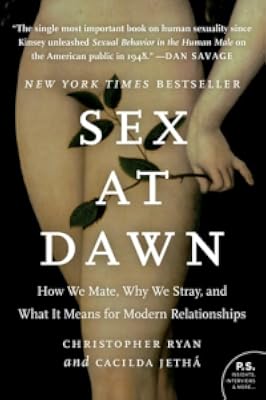
Sex at Dawn: How We Mate, Why We Stray, and What It Means for Modern Relationships
by Christopher Ryan, Cacilda Jetha
On This Page
Description
"A controversial, idea-driven book that challenges everything you know about sex, marriage, family, and society"--Provided by publisher. Since Darwin's day, we've been told that sexual monogamy comes naturally to our species. But this narrative is collapsing. Here, renegade thinkers Christopher Ryan and Cacilda Jethá, while debunking almost everything we "know" about sex, offer a bold alternative explanation. Ryan and Jethá's central contention is that human beings evolved in egalitarian show more groups that shared food, child care, and, often, sexual partners. Weaving together convergent, frequently overlooked evidence from anthropology, archaeology, primatology, anatomy, and psychosexuality, the authors show how far from human nature monogamy really is. With intelligence, humor, and wonder, Ryan and Jethá show how our promiscuous past haunts our struggles over monogamy, sexual orientation, and family dynamics. Human beings everywhere and in every era have confronted the same familiar, intimate situations in surprisingly different ways. The authors expose the ancient roots of human sexuality while pointing toward a more optimistic future illuminated by our innate capacities for love, cooperation, and generosity.--From publisher description. show lessTags
Recommendations









Member Recommendations
Member Reviews
Fun read that comes with pre-packaged sarcasm about the illogical ways we have structured our society since agriculture. This contains an accessible analysis of how statistics have been used to distort ideas about both female and male sexuality and cites studies that have good quality validity in terms of measuring what they purport to measure. 10,000 years is a blip in human evolution, not nearly enough to shift us to monogamy and the authors make a compelling argument for the archaelogical, anthopological and even extant biological evidence in our current bodies for why our culture does monogamy so poorly - and for why we maybe, just maybe, first shouldn't feel so bad about that, and second can then consider working out relationship show more arrangements that actually work for us.
I work in a library, and watched three little girls waiting to check out their books with their guardian yesterday. They came together for a group hug - one that involved ostentatious and stylized kissing - and then, giggling, decided they liked it so much they wanted to do it again. The forthright enjoyment of human contact and expression of desire for that contact may seem like a simple and direct thing, but gods, I can't remember the last time I was touched. We are social creatures, and I wish we had more forthright acknowledgement of the fact that we need physical contact, sexual and platonic.
Maybe the work peeps will be interested in instituting voluntary group hug time in the schedule. show less
I work in a library, and watched three little girls waiting to check out their books with their guardian yesterday. They came together for a group hug - one that involved ostentatious and stylized kissing - and then, giggling, decided they liked it so much they wanted to do it again. The forthright enjoyment of human contact and expression of desire for that contact may seem like a simple and direct thing, but gods, I can't remember the last time I was touched. We are social creatures, and I wish we had more forthright acknowledgement of the fact that we need physical contact, sexual and platonic.
Maybe the work peeps will be interested in instituting voluntary group hug time in the schedule. show less
A popular science book for people who hate science, Sex at Dawn manages to combine weak arguments with a prose style of such overbearing condescension that I had to grit my teeth to get through it. Everything is couched in terms of facile jokiness or, even worse, of coy euphemism, so that we have the ghastly prospect of a supposedly serious book about sexuality that can talk about a ‘human female's naughty bits’.
The basic argument is that evolutionary psychologists, anthropologists and palaeontologists are conspiring to propagate the ‘lie’ that human beings have evolved to be broadly monogamous. The few studies that ‘dare’ to question this narrative are hailed as revolutionary, while the rest of the scientific community is show more written off as ‘the clipboard-carrying crowd’, who ‘rigidly insist’ on the status quo. Unfortunately this blanket dismissal of an entire discipline succeeds only in fatally damaging the authors' own credibility.
The debate over prehistoric sexuality is one that I have followed amateurishly, but with some interest, so I was quite looking forward to seeing what kind of evidence was going to be brought forward. By about page 40 I had realised with a sinking feeling that there wasn't going to be any. Instead, their approach is simply to restate their opponents' arguments in the most ludicrously simplistic terms they can, and hope that will stand for a rebuttal.
For instance, there is a mountain of evidence suggesting that prehistoric females were in the habit of ‘bartering’ sex, consciously or otherwise, for access to protection and resources supplied by males. This is a complicated and sophisticated argument, which Ryan and Jethá summarise like so:
Darwin says your mother's a whore. Simple as that.
After reading that I gave up any hope of finding a serious argument in here.
Of the book's other stylistic tics, I will just highlight a few of the more irritating. There is a tendency to ask rhetorical questions as a substitute for actually making an argument: Could it be possible that…? Dare we ask whether…? ‘How many families are fractured by this common, tragic, undetected sequence of events?’ I don't know – do you?? If not, stop asking stupid questions and show me some evidence. (It reminds me of a tabloid headline like ARE IMMIGRANTS CAUSING CANCER?, where the rest of the article amounts to a long admission that the answer is ‘no’.)
A few other representative quotations: ‘Sexual monogamy itself may be shrinking men's balls’; ‘Homo sapiens: the great ape with the great penis!’; ‘ancestral females were shameless trollops’; ‘Who's your daddies?’; ‘We've no space for a comprehensive response to this’; ‘Yabba-dabba-doo’. Malthus is introduced, laughably, as ‘Wikipedia's eightieth Most Influential Person in History’.
If you're worried about missing the subtle message hidden in all this facile nudge-nudge-wink-winking, have no fear, because they will simply put entire sentences that they consider important in italics. Reading these passages feels like being talked down to by someone who doesn't even properly understand their own arguments. They also repeatedly make the infuriating implication that anyone who disagrees with them is doing so because they're morally offended or out of political expediency.
What makes it all so sad is that a book offering some new ideas on hot topics like male parental investment or female sexual receptivity would actually be very welcome. This is not that book. What it really is is a plea for a return to an imagined ‘ancient [sexual] egalitarianism’ where humans – especially men – had repercussion-free sex with multiple partners. I would be more than happy to read a book promoting the benefits of polyamory, but please, don't dress it up as science.
Sex at Dawn was condemned by most of the academic community, but it was widely promoted by people like Dan Savage and Peter Sagal, and ended up on the New York Times bestseller list. It doesn't deserve the attention, and I wish I'd done a bit more research on it before I bought a copy. Instead, my advice is to consider the response that a pseudonymous primatologist was moved to write, [book:Sex at Dusk: Lifting the Shiny Wrapping from Sex at Dawn|15892127]. Because my impression of this one is that it's a disastrous blend of wilful misrepresentations with very poor writing. show less
The basic argument is that evolutionary psychologists, anthropologists and palaeontologists are conspiring to propagate the ‘lie’ that human beings have evolved to be broadly monogamous. The few studies that ‘dare’ to question this narrative are hailed as revolutionary, while the rest of the scientific community is show more written off as ‘the clipboard-carrying crowd’, who ‘rigidly insist’ on the status quo. Unfortunately this blanket dismissal of an entire discipline succeeds only in fatally damaging the authors' own credibility.
The debate over prehistoric sexuality is one that I have followed amateurishly, but with some interest, so I was quite looking forward to seeing what kind of evidence was going to be brought forward. By about page 40 I had realised with a sinking feeling that there wasn't going to be any. Instead, their approach is simply to restate their opponents' arguments in the most ludicrously simplistic terms they can, and hope that will stand for a rebuttal.
For instance, there is a mountain of evidence suggesting that prehistoric females were in the habit of ‘bartering’ sex, consciously or otherwise, for access to protection and resources supplied by males. This is a complicated and sophisticated argument, which Ryan and Jethá summarise like so:
Darwin says your mother's a whore. Simple as that.
After reading that I gave up any hope of finding a serious argument in here.
Of the book's other stylistic tics, I will just highlight a few of the more irritating. There is a tendency to ask rhetorical questions as a substitute for actually making an argument: Could it be possible that…? Dare we ask whether…? ‘How many families are fractured by this common, tragic, undetected sequence of events?’ I don't know – do you?? If not, stop asking stupid questions and show me some evidence. (It reminds me of a tabloid headline like ARE IMMIGRANTS CAUSING CANCER?, where the rest of the article amounts to a long admission that the answer is ‘no’.)
A few other representative quotations: ‘Sexual monogamy itself may be shrinking men's balls’; ‘Homo sapiens: the great ape with the great penis!’; ‘ancestral females were shameless trollops’; ‘Who's your daddies?’; ‘We've no space for a comprehensive response to this’; ‘Yabba-dabba-doo’. Malthus is introduced, laughably, as ‘Wikipedia's eightieth Most Influential Person in History’.
If you're worried about missing the subtle message hidden in all this facile nudge-nudge-wink-winking, have no fear, because they will simply put entire sentences that they consider important in italics. Reading these passages feels like being talked down to by someone who doesn't even properly understand their own arguments. They also repeatedly make the infuriating implication that anyone who disagrees with them is doing so because they're morally offended or out of political expediency.
What makes it all so sad is that a book offering some new ideas on hot topics like male parental investment or female sexual receptivity would actually be very welcome. This is not that book. What it really is is a plea for a return to an imagined ‘ancient [sexual] egalitarianism’ where humans – especially men – had repercussion-free sex with multiple partners. I would be more than happy to read a book promoting the benefits of polyamory, but please, don't dress it up as science.
Sex at Dawn was condemned by most of the academic community, but it was widely promoted by people like Dan Savage and Peter Sagal, and ended up on the New York Times bestseller list. It doesn't deserve the attention, and I wish I'd done a bit more research on it before I bought a copy. Instead, my advice is to consider the response that a pseudonymous primatologist was moved to write, [book:Sex at Dusk: Lifting the Shiny Wrapping from Sex at Dawn|15892127]. Because my impression of this one is that it's a disastrous blend of wilful misrepresentations with very poor writing. show less
By examining physical, cultural, and anthropological data in modern humans, ancient human ancestors, and our closest living primate kin, Ryan presents revolutionary evidence that our prehistoric sexual and relationship dynamic was one involving multiple partners.
One disquieting takeaway is in the chapters speculating upon naturally-occurring violence among primates: it turns out that this supposedly inborn tendency toward violence, observed by anthropologists Goodall and Chagnon, commenced only upon the introduction of food or resources via the researchers themselves! Although somewhat dryly presented at times -- surprising, given the potentially provocative subject matter! -- I have to admit that the argument against instinctive show more monogamy is fairly convincing. However, if it is true that monogamy is, for humans, entirely a culturally and religiously prescribed practice rather than an innate inclination, where does that leave us? It is one thing to understand or accept the science in one's brain, but what of one's heart? And how to reconcile it with the culture of today? show less
One disquieting takeaway is in the chapters speculating upon naturally-occurring violence among primates: it turns out that this supposedly inborn tendency toward violence, observed by anthropologists Goodall and Chagnon, commenced only upon the introduction of food or resources via the researchers themselves! Although somewhat dryly presented at times -- surprising, given the potentially provocative subject matter! -- I have to admit that the argument against instinctive show more monogamy is fairly convincing. However, if it is true that monogamy is, for humans, entirely a culturally and religiously prescribed practice rather than an innate inclination, where does that leave us? It is one thing to understand or accept the science in one's brain, but what of one's heart? And how to reconcile it with the culture of today? show less
What did I think? What didn't I think. A well researched, it seems, (although I didn't hunt down the copious references) volume on polygamy.
For many the instinctive argument would be obvious by tell tale signs in our every day lives but to have some research unfolded into the specific relationship we have with that is well deserved - although not new, these studies into polygamy before agriculture are not findings that are revelatory to us through this book but it is a relevance that is both systematic and semantic and should be taken further. Moreover we should by now be seeking individual reference points to this material.
The overall colour of the book is to introduce the research in somewhat of a mix between opinion piece and well show more researched paper, although at times the 'asides' come across as Cosmopolitan Magazine editorial, I would have preferred something dryer than zippy elbows into my chest when observing apparent paradox or irony. I guess though this can be a good thing for those looking for some literary gusto and not subtle wit.
All in all if you are seeking some wisdom into Polygamy or Polyamory this is a worthwhile addition to the bookshelf. The sheer endurance of it should be enough to feast upon, and provide insight otherwise overlooked in all the other alternative sources of information about this topic, refreshing to have it compiled so vigilantly. show less
For many the instinctive argument would be obvious by tell tale signs in our every day lives but to have some research unfolded into the specific relationship we have with that is well deserved - although not new, these studies into polygamy before agriculture are not findings that are revelatory to us through this book but it is a relevance that is both systematic and semantic and should be taken further. Moreover we should by now be seeking individual reference points to this material.
The overall colour of the book is to introduce the research in somewhat of a mix between opinion piece and well show more researched paper, although at times the 'asides' come across as Cosmopolitan Magazine editorial, I would have preferred something dryer than zippy elbows into my chest when observing apparent paradox or irony. I guess though this can be a good thing for those looking for some literary gusto and not subtle wit.
All in all if you are seeking some wisdom into Polygamy or Polyamory this is a worthwhile addition to the bookshelf. The sheer endurance of it should be enough to feast upon, and provide insight otherwise overlooked in all the other alternative sources of information about this topic, refreshing to have it compiled so vigilantly. show less
This book is an awesome read that kept me interested from start to finish. I’m not usually much for anthropology or psychology. Sexuality, however, is an interesting subject in that we tend to think about it a lot. even when we aren’t thinking about it, sexuality is thrust in our face by the media, politics, advertising, and in many other ways. That being said, this book could easily have been titled “War at Dawn” or “Poverty at Dawn” as the author touches on these subjects as well. He spends a lot of time on what he calls the “standard narrative” of human nature: monogamy, universal marriage, innate violence and proclivity for war, and the fact that we are better off now than before. Much of the research in these areas show more leads to data that could more readily lead to the opposite conclusions of those made by researchers biased to support the standard narrative.
One thing I took from the book is that while the standard narrative makes millions of people feel guilty and shamed for not being able to achieve monogamy, for failed families and relationships, or even for just “lusting in one’s heart”, we should actually feel like we’ve qualified for the World Cup if we are able be monogamous. And I’m sure that you know the number soccer players that actually play in a World Cup is a small percentage of the soccer players out there. And we certainly shouldn’t assume that our partner has the same view of marriage/monogamy as we do. It’s a topic to be discussed so there is no misunderstanding, I suppose.
The book points out that neither of our closest evolutionary relatives, the chimpazees or the bonobos, are monogamous. Both have multi-male, multi-female systems. In fact the only monogamous monkeys dwell in trees, like gibbons (the only monogamous ape), and are very far removed from us in an evolutionary sense. And with other animals that we are told “mate” for life, like swans, the word “mate” is used in a loose sense; “partnering” for life might be closer to the truth as it does not imply sexual fidelity.
Regardless of your personal stance on the issue, this book does a good job of presenting the other side of the standard narrative. The authors don’t suggest that we should “go wild” or make any recommendations on what to do with the data. Merely stating, “Only by arriving at a more nuanced understanding of the nature of human sexuality will we learn to make smarter decisions about our long-term commitments. But this understanding requires us to face some uncomfortable facts.” show less
One thing I took from the book is that while the standard narrative makes millions of people feel guilty and shamed for not being able to achieve monogamy, for failed families and relationships, or even for just “lusting in one’s heart”, we should actually feel like we’ve qualified for the World Cup if we are able be monogamous. And I’m sure that you know the number soccer players that actually play in a World Cup is a small percentage of the soccer players out there. And we certainly shouldn’t assume that our partner has the same view of marriage/monogamy as we do. It’s a topic to be discussed so there is no misunderstanding, I suppose.
The book points out that neither of our closest evolutionary relatives, the chimpazees or the bonobos, are monogamous. Both have multi-male, multi-female systems. In fact the only monogamous monkeys dwell in trees, like gibbons (the only monogamous ape), and are very far removed from us in an evolutionary sense. And with other animals that we are told “mate” for life, like swans, the word “mate” is used in a loose sense; “partnering” for life might be closer to the truth as it does not imply sexual fidelity.
Regardless of your personal stance on the issue, this book does a good job of presenting the other side of the standard narrative. The authors don’t suggest that we should “go wild” or make any recommendations on what to do with the data. Merely stating, “Only by arriving at a more nuanced understanding of the nature of human sexuality will we learn to make smarter decisions about our long-term commitments. But this understanding requires us to face some uncomfortable facts.” show less
The conventional narrative about the evolution of human sexuality goes something like this: Humans are basically a monogamous species (or, to use the more accurate biological term, we "pair bond"). We normally tend to form nuclear family units, in which the male helps to feed, protect, and care for his mate and children. As a consequence of this, human men generally come hardwired with a sense of sexual jealousy and a desire to control their mates' sexuality (biological term: "mate-guarding"), since a man who invests his resources in another man's children tends to lose out big-time, evolutionarily. Also, women generally come hardwired with a desire to keep their mate emotionally bound to them and a preference for men of high status who show more will be "good providers." (Of course, none of this keeps men from being interested in any other fertile females who might be available, or women from being attracted to hunky young men who might be more physically fit than their mates, since both of those have value when it comes to passing more of your genes on, as well.) You have to admit, it does explain a lot about modern humans, including how messed-up we can be when it comes to relationships and sex.
The authors of this book dispute that narrative, though. They contend that prehistoric human societies were extremely egalitarian, with communal food-sharing and child-raising as standard practices, and that in that situation there is very little advantage to men being strongly concerned about paternity or women being strongly concerned about pairing up with a "provider." They don't deny that these concerns (and the consequent messed-upedness) exist in modern humans, but believe that their origins are cultural, rather than genetic, that they only really came into play with the advent of agriculture, and that prehistoric humans were generally sexually promiscuous, being more concerned with community values than with "family values." And they believe that the reason for the prevalence of the conventional narrative lies firmly in the cultural biases of researchers.
You can see the potential for this to be a touchy subject. It's hard to get into this stuff without opening big cans of worms involving social issues. And at first, I wasn't terribly impressed with the authors' approach on this score. They're not exactly free of biases themselves, certainly, and in the opening chapters of the book, particularly, they use some very loaded language. (Actual quote describing the conventional point of view: "Darwin says your mother's a whore.") Now, in fairness, I think this was largely an attempt to be lively, amusing, and entertainingly provocative. But really, starting a supposedly scientific argument with appeals to emotion and wishful thinking instead of logic, along with intimations that your opponent's viewpoint ought to be considered personally insulting to your readers? Not good form, and it's even less so in a case where half your argument involves the idea that the other side are the ones blinded by bias.
Fortunately -- very fortunately -- it mostly settles down after the first fifty pages or so, as the authors actually get down to making their case. As is usual in this field, they mostly rely on studies of modern and historical hunter-gatherer societies as well as our primate relatives to draw their conclusions, though they also cite research on current human sexuality. Some of their arguments are stronger than others, and I do think there are a few places where they've significantly oversimplified the viewpoint they're arguing against. There's also a bit of "he said, she said" when it comes to some of the disputed evidence, which leaves me unsure quite who to believe on specific points. All that having been said, though, their argument as a whole is extremely interesting, highly readable, and entirely plausible. Even if it turns out to be incorrect, this kind of informed challenging of conventional wisdom is truly healthy in science, and if they're right, they have some potentially relevant things to say about the implications for modern human lives. So in the end, despite a rocky start, I did find it quite a worthwhile read. I'd be very interested to see these ideas addressed further by archaeologists, anthropologists or evolutionary scientists, whether supporting or disputing them.
Rating: Despite the flaws, I'm calling it 4/5. show less
The authors of this book dispute that narrative, though. They contend that prehistoric human societies were extremely egalitarian, with communal food-sharing and child-raising as standard practices, and that in that situation there is very little advantage to men being strongly concerned about paternity or women being strongly concerned about pairing up with a "provider." They don't deny that these concerns (and the consequent messed-upedness) exist in modern humans, but believe that their origins are cultural, rather than genetic, that they only really came into play with the advent of agriculture, and that prehistoric humans were generally sexually promiscuous, being more concerned with community values than with "family values." And they believe that the reason for the prevalence of the conventional narrative lies firmly in the cultural biases of researchers.
You can see the potential for this to be a touchy subject. It's hard to get into this stuff without opening big cans of worms involving social issues. And at first, I wasn't terribly impressed with the authors' approach on this score. They're not exactly free of biases themselves, certainly, and in the opening chapters of the book, particularly, they use some very loaded language. (Actual quote describing the conventional point of view: "Darwin says your mother's a whore.") Now, in fairness, I think this was largely an attempt to be lively, amusing, and entertainingly provocative. But really, starting a supposedly scientific argument with appeals to emotion and wishful thinking instead of logic, along with intimations that your opponent's viewpoint ought to be considered personally insulting to your readers? Not good form, and it's even less so in a case where half your argument involves the idea that the other side are the ones blinded by bias.
Fortunately -- very fortunately -- it mostly settles down after the first fifty pages or so, as the authors actually get down to making their case. As is usual in this field, they mostly rely on studies of modern and historical hunter-gatherer societies as well as our primate relatives to draw their conclusions, though they also cite research on current human sexuality. Some of their arguments are stronger than others, and I do think there are a few places where they've significantly oversimplified the viewpoint they're arguing against. There's also a bit of "he said, she said" when it comes to some of the disputed evidence, which leaves me unsure quite who to believe on specific points. All that having been said, though, their argument as a whole is extremely interesting, highly readable, and entirely plausible. Even if it turns out to be incorrect, this kind of informed challenging of conventional wisdom is truly healthy in science, and if they're right, they have some potentially relevant things to say about the implications for modern human lives. So in the end, despite a rocky start, I did find it quite a worthwhile read. I'd be very interested to see these ideas addressed further by archaeologists, anthropologists or evolutionary scientists, whether supporting or disputing them.
Rating: Despite the flaws, I'm calling it 4/5. show less
This book is an "Emperor wears no clothes" revelation everyone should read. If we could shift attitudes about our innate sexuality, just think how close to justice we could get in so many other realms. Finally a book that challenges the Political doctrines which disempower the commoner, keeping those with power in control. There is enough. No one has greater value than any other. Love and sharing is better than competition and war. Why do we deny the inherently obvious in our culture?
Members
- Recently Added By
Lists

A Brilliant List of Science Books for People Who Want Their Minds Blown
16 works; 3 members

Mind Expanding Books by hackerkid
581 works; 8 members
Author Information

2 Works 1,963 Members
Christopher Ryan and his work have been featured on MSNBC, Fox News, CNN, NPR, HBO, Netflix, the New York Times, the Times of London, Playboy, the Washington Post, Time, Newsweek, the Atlantic, Salon, TED, and Big Think. He is coauthor of the New York Times bestseller Sex at Dawn (translated into twenty-two languages) and hosts a weekly podcast, show more Tangentially Speaking, featuring conversations with people ranging from famous comics to bank robbers to astrophysicists. show less
1 Work 1,756 Members
Some Editions
Awards and Honors
Work Relationships
Common Knowledge
- Canonical title*
- Paritellen : Seksuaalikäyttäytymisen kehityshistoria
- Original title
- Sex at Dawn: The Prehistoric Origins of Modern Sexuality
- Original publication date
- 2010
- Dedication
- To all our relations
- First words
- Forget what you've heard about human beings having descended from the apes.
- Quotations
- Darwin says your mother's a whore. Simple as that.
Sexual monogamy itself may be shrinking men's balls. - Last words
- (Click to show. Warning: May contain spoilers.)Like our distant ancestors, we watch the eternal dance of our sun and our moon, looking for clues to the nature of man and woman, masculine and feminine here at home.
*Some information comes from Common Knowledge in other languages. Click "Edit" for more information.
Classifications
- Genres
- Anthropology, Science & Nature, General Nonfiction, Nonfiction, History
- DDC/MDS
- 306.7 — Society, government, & culture Social sciences, sociology & anthropology Social Behavior - Dating, Marriage, Divorce Sexual relations
- LCC
- HQ12 .R93 — Social sciences The family. Marriage, Women and Sexuality The Family. Marriage. Women Sexual life
- BISAC
Statistics
- Members
- 1,786
- Popularity
- 12,286
- Reviews
- 48
- Rating
- (3.96)
- Languages
- 8 — English, Finnish, French, German, Italian, Polish, Slovenian, Spanish
- Media
- Paper, Audiobook, Ebook
- ISBNs
- 19
- UPCs
- 1
- ASINs
- 11
