On This Page
Description
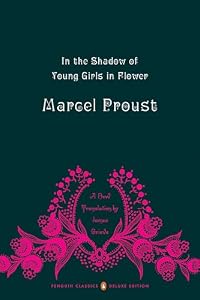
Edited and annotated by leading Proust scholar William Carter, In the Shadow of Young Girls in Flower is the second volume of one of the twentieth century ?s great literary triumphs. It was this volume that won the Prix Goncourt in 1919, affirming Proust as a major literary figure and dramatically increasing his fame. Here the narrator whose childhood was reflected in Swann ?s Way moves further through childhood and into adolescence, as the author brilliantly examines themes of love and show more youth, in settings in Paris and by the sea in Normandy. The reader again encounters Swann, now married to his former mistress and largely fallen from high society, and meets for the first time several of Proust ?s most memorable characters: the handsome, dashing Robert de Saint-Loup, who will become the narrator ?s best friend; the enigmatic Albertine, leader of the ?little band ? of adolescent girls; the profoundly artistic Elstir, believed to be Proust ?s composite of Whistler, Monet, and other leading painters; and, making his unforgettable entrance near the end of the volume, the intense, indelible Baron de Charlus. Permeated by the ?bloom of youth ? and its resonances in memories of love and friendship, In the Shadow of Young Girls in Flower takes readers into the heart of Proust ?s comic and poetic genius. As with Swann ?s Way, Carter uses C. K. Scott Moncrieff ?s beloved translation as the basis for this annotated and fully revised edition. Carter corrects long-standing errors in Scott Moncrieff ?s otherwise superlative translation, bringing it closer than ever to the spirit and style of Proust ?s original text ?and reaching English readers in a way that the Pløiade annotations cannot. Insightful and accessible, Carter ?s edition of Marcel Proust ?s masterwork will be the go-to text for generations of readers seeking to understand Proust ?s remarkable bygone world. show lessTags
Recommendations











Member Recommendations

Member Reviews
Beauty is truth, truth beauty.
-John Keats
Let us first treat this as a premise, a maxim if you will, this quote from a long dead poet with a penchant for ancient pottery. Then, let us strip whatever meaning that has accrued upon it. Whether it resulted from pure instinct or rote memorization, fling it all away, and leave just the words. Little as they are, they are more than enough.
So, beauty is truth, truth beauty. Now, what is beauty? What is truth?
We sacrifice to beauty in all its forms, the physical splendor of the human anatomy alongside the colored transience of the heavens, the powerful magnificence of mathematical proofs side by side with the profound pleasure of inspirational prose. Proust is the essence of the last, his grand show more ability enabling him to gloriously burst from the pages in whatever language he finds himself in.
Like the fires caught and fixed by a great colourist from the impermanence of the atmosphere and the sun, so that they should enter and adorn a human dwelling, they invited me, those chrysanthemums, to put away all my sorrows and to taste with a greedy rapture during that tea-time hour the all-too-fleeting pleasures of November, whose intimate and mysterious splendour they set ablaze all around me.There is no doubting the beauty embodied in this phrase, one defined by the seduction of multiple senses through fire, color, chrysanthemum, November, whatever taste would inspire 'a greedy rapture'. But beauty does not always require seduction. Beauty can also be simple, yet profound.
...genius, having the widest experience of the human intelligence, can best understand the ideas most directly in opposition to those which form the foundation of its own works.The state of being profound requires immensity, depth, an amount of magnitude that it cannot be denied. The seduction of the senses through prose inspires recollection, calls for the reader to relive their own experiences in an effort to imagine the beauty being described as thoroughly as possible. In other words, both require truth, whether by accumulation of theoretical meaning or of real life.
But Proust knew that it is not so simple as that.
We need, between us and the fish which, if we saw it for the first time cooked and served on a table, would not appear worth the endless shifts and wiles required to catch it, the intervention, during our afternoons with the rod, of the rippling eddy to whose surface come flashing, without our quite knowing what we intend to do with them, the bright gleam of flesh, the hint of a form, in the fluidity of a transparent and mobile azure.There is much more to life than beauty and truth. There is the supreme effort between seeing one and realizing the other, from observing the flash of scales in the water to consuming because one knows one can. And within that effort, there are whole hosts of misunderstandings and miscommunications and mistakes, propagated by the fact that existences are individual, reality is subjective, and time is always racing away.
We betroth ourselves by proxy, and then feel obliged to marry the intermediary.
With the girls, on the other hand, if the pleasure which I enjoyed was selfish, at least it was not based on the lie which seeks to make us believe that we are not irremediably alone and prevents us from admitting that, when we chat, it is no longer we who speak, that we are fashioning ourselves then in the likeness of other people and not of a self that differs from them.”
We fall in love with a beauty and take it for truth, or one we think is a truth, or one we believe we are in love with. There is no doubt that we held at one point, no matter how singular, that beauty and truth were one and the same. The question is, do we tell more truths about our love by loving it, or about ourselves? And when the communication between individuals and the shifting of reality and the passage of time have worked their magic, can we say that neither the beauty nor its underlying truth have changed?
It's difficult, annoying, and oftentimes heartbreaking to acknowledge this inconsistency of a world that provides an infinite amount of infinitesimal moments of beautiful truth, but rarely leaves the two to peacefully coexist for any length of time. It would be all too easy to slip into a state of constant intoxication, where
inebriation brings about for an hour or two a state of subjective idealism, pure phenomenalism; everything is reduced to appearances and exists only as a function of our sublime self.Or to withdraw from the pandering lies that fill so much of reality, despite having so much to give it.
Everything he possessed, ideas, works, and the rest which he counted for far less, he would have given gladly to anyone who understood him. But, for lack of congenial company, he lived in an unsociable isolation which fashionable people call pose and ill-breeding, the authorities a recalcitrant spirit, his neighbours madness, his family selfishness and pride.Or even to come to terms with the futility of it all and fully embrace resignation in its myriad flavors.
And it is, after all, as good a way as any of solving the problem of existence to get near enough to the things and people that have appeared to use beautiful and mysterious from a distance to be able to satisfy ourselves that they have neither mystery nor beauty...it enables us to regret nothing, by assuring us that we have attained to the best, and that the best was nothing out of the ordinary—with which to resign ourselves to death.Or, despite all that, despite all those moments of beauty refusing the hand of truth and vice versa, to realize that there is always a chance for the two to come into alignment somewhere down the path. It may last for a fraction of a second, but it also may subsist for a lifetime. That is the miracle of memory so expounded by Proust in his Swann's Way, one whose passages can be found blooming within this budding grove, a miracle of a single instant conjuring up a endless passages of wonder and insight as memories spring from previous experiences and intersperse themselves among the new reality, both undergoing endless shifts and yet every so often joining together in sublime perfection.
...I tried to find beauty there were I had never imagined before that it could exist, in the most ordinary things, in the profundities of “still life.”
Wonder and insight. Beauty, and Truth. show less
Early in this second volume, the narrator observes that some rare books "take you somewhere". This one took me on a voyage through my own head. Like Joyce, Proust has the ability to ransack my brain and drag all kinds of things out into the light that I haven't seen in years, exposing me again to all of their attached emotions. It took me beyond enjoying the book's contents into a two month enjoyment of the reading experience itself. It can also be a little unnerving.
I find the best inner voice with which to consume Proust is a sort of breathless wonder, like how a ringmaster might introduce his next act. He toured me through the idea that art can best be appreciated only when it is at its best; that there is a pinnacle moment in which show more to receive it (such as, the very best age at which to read a particular book!). In this respect there's some character growth for the narrator, however; by the end he entertains a reversal of this thought, a sort of "therapy" for dealing with the inevitable disappointment that too much effort in this arena can bring.
I'm fascinated by his thoughts on music appreciation. The first time you hear a song, the missing ingredient is memory; you can only compare it with other songs you know. You appreciate those familiar parts first, while the rest is still confusion, until after hearing it multiple times. The parts that you appreciate last are the parts you will appreciate longest. His throwaway thought on travel also put me on pause, after my decades of naysaying those experiences: that standing before a monument is the only way to feel an awe that cannot be transmitted by photos or others' descriptions. I also loved his reflections on how a man's flaws are his personal blind spot, while at the same time he may readily identify that flaw in others.
All of these observations on life and art are engaging, but none so much as the observations on attraction and love. Love is a kind of madness, as he demonstrates through his apt observations of how others perceive our infatuations, and how the attainment of goals in this arena can feel almost surreal, like living inside of a dream: of course he cannot read what he's being shown by his love, or refuse the food she offers him at teatime. By then two worlds have diverged, his normal reality and the one he inhabits in the light of her eyes. Reading this made perfect sense to me, in the context of all of my adolescent turmoil having been captured in a bottle by Proust and transmorgrified into literature. I remember a magical name that acquired power and echoes in the mind. I remember being tongue-tied, longing for her company, unable to memorize her face, the otherworldliness of her company. I remember her anger and the awkward parting, the imposed distance, the mix of fear and hope, and the inability to communicate any longer across that void.
Proust goes in some directions I do not know as intimately from the same degree of personal experience, but even then I follow willingly. Freed of any particular attachment and casting about, the narrator senses the chasm that exists between his life and those of a passing bevy of attractive girls. Alright, so I can remember that. But then he maneuvers his way into their company and has the pleasure of a place in that "budding grove", sharing his general sense of attraction among them and resisting attaching it to any one in particular, measuring and responding to the gravitic pull of each in turn.
The intensity of memories that Proust conjures up is a part of the magic of reading him. It's at least half the reader's own creation if you come to him when you're old enough to look back on a host of memories and relate, and patient enough with being unable to read more than a page without the words blurring as you stare into space, revisiting a lost time. show less
I find the best inner voice with which to consume Proust is a sort of breathless wonder, like how a ringmaster might introduce his next act. He toured me through the idea that art can best be appreciated only when it is at its best; that there is a pinnacle moment in which show more to receive it (such as, the very best age at which to read a particular book!). In this respect there's some character growth for the narrator, however; by the end he entertains a reversal of this thought, a sort of "therapy" for dealing with the inevitable disappointment that too much effort in this arena can bring.
I'm fascinated by his thoughts on music appreciation. The first time you hear a song, the missing ingredient is memory; you can only compare it with other songs you know. You appreciate those familiar parts first, while the rest is still confusion, until after hearing it multiple times. The parts that you appreciate last are the parts you will appreciate longest. His throwaway thought on travel also put me on pause, after my decades of naysaying those experiences: that standing before a monument is the only way to feel an awe that cannot be transmitted by photos or others' descriptions. I also loved his reflections on how a man's flaws are his personal blind spot, while at the same time he may readily identify that flaw in others.
All of these observations on life and art are engaging, but none so much as the observations on attraction and love. Love is a kind of madness, as he demonstrates through his apt observations of how others perceive our infatuations, and how the attainment of goals in this arena can feel almost surreal, like living inside of a dream: of course he cannot read what he's being shown by his love, or refuse the food she offers him at teatime. By then two worlds have diverged, his normal reality and the one he inhabits in the light of her eyes. Reading this made perfect sense to me, in the context of all of my adolescent turmoil having been captured in a bottle by Proust and transmorgrified into literature. I remember a magical name that acquired power and echoes in the mind. I remember being tongue-tied, longing for her company, unable to memorize her face, the otherworldliness of her company. I remember her anger and the awkward parting, the imposed distance, the mix of fear and hope, and the inability to communicate any longer across that void.
Proust goes in some directions I do not know as intimately from the same degree of personal experience, but even then I follow willingly. Freed of any particular attachment and casting about, the narrator senses the chasm that exists between his life and those of a passing bevy of attractive girls. Alright, so I can remember that. But then he maneuvers his way into their company and has the pleasure of a place in that "budding grove", sharing his general sense of attraction among them and resisting attaching it to any one in particular, measuring and responding to the gravitic pull of each in turn.
The intensity of memories that Proust conjures up is a part of the magic of reading him. It's at least half the reader's own creation if you come to him when you're old enough to look back on a host of memories and relate, and patient enough with being unable to read more than a page without the words blurring as you stare into space, revisiting a lost time. show less
This is gorgeous writing. The precise descriptions and flow of consciousness are wonderful. This volume covers from childhood to late adolescence and his disillusionment with romantic love. The book is split into two sections. I kept having to stop at times to write down phrases and paragraphs into my journal.
Some of the observations are that love is not the result of objective qualities of another person but rather an internal projection created by oneself. Love is interchangable and anonymous. It literally thrives on uncertainty, jealousy and distance. As soon as full access is acquired, passion begins to fade. Habit numbs human sensitivity, causing people to look at the world without truly seeing it. To experience genuine reality, show more one must break from habit and view the world with fresh eyes. Art is a unique lens that strips away Habit to reveal the poetic truth of existence. show less
Some of the observations are that love is not the result of objective qualities of another person but rather an internal projection created by oneself. Love is interchangable and anonymous. It literally thrives on uncertainty, jealousy and distance. As soon as full access is acquired, passion begins to fade. Habit numbs human sensitivity, causing people to look at the world without truly seeing it. To experience genuine reality, show more one must break from habit and view the world with fresh eyes. Art is a unique lens that strips away Habit to reveal the poetic truth of existence. show less
You know how Proust is all about memory blah blah blah? Well, I disagree, but I did have a very 'Proustian' experience re-reading this. I was really excited to get through Swann and move onto this, because I remembered it being a beautiful, sunny beach holiday in which he makes me remember what it was like to be young and in 'love' (i.e., confused lust). I love the little band of girls, even though in real life they would never, never have spoken to me at all. I love the narrator, who is so pathetic and yet so like everyone. I love Elstir, being all wise and understanding.
So I start reading, (so excited!!!), and it turns out that my memory has played me for a fool: before we even get to Balbec, there are hundreds of pages of fairly show more uninspired sequel to Swann. The narrator eventually falls out of 'love' with Gilberte, but you probably won't care. He remains awe-struck by Mme. Swann, about which you will care slightly more. But really, we just want to get to the beach.
And once there, it's as fabulous as I remember. How does he remember what it's like to be 15? How does he manage to make you think about the girls/boys you 'loved' when you were 15, with just a few well-placed episodes? How does he have such deep knowledge of the stupid things we do? And then, how does he combine this with hilarious comedy-of-manners parts, interesting essays on aesthetics, and fairly dull ekphraseis (tell me more about that water-colour. No, really.), as well as nearly as many zinging aphorisms as Swann's--
"We construct our lives for one person, and when at length it is ready to receive her that person does not come; presently she is dead to us, and we live on, prisoners within the walls which were intended only for her."
--and reflection on and warnings about the use of other peoples' aphorisms
"Whenever we confidently admire anyone, we collect from him and quote with admiration sayings vastly inferior to the sort which, left to our own judgment, we would sternly reject, just as the writer of a novel puts into it, on the pretext that they are true, 'witticism' and characters which in the living context are like a dead weight, mere padding."
How does he do this? I have no idea. Amazing. But as ever the longueurs will keep people from discovering how wonderful Proust is, which is a real shame. show less
So I start reading, (so excited!!!), and it turns out that my memory has played me for a fool: before we even get to Balbec, there are hundreds of pages of fairly show more uninspired sequel to Swann. The narrator eventually falls out of 'love' with Gilberte, but you probably won't care. He remains awe-struck by Mme. Swann, about which you will care slightly more. But really, we just want to get to the beach.
And once there, it's as fabulous as I remember. How does he remember what it's like to be 15? How does he manage to make you think about the girls/boys you 'loved' when you were 15, with just a few well-placed episodes? How does he have such deep knowledge of the stupid things we do? And then, how does he combine this with hilarious comedy-of-manners parts, interesting essays on aesthetics, and fairly dull ekphraseis (tell me more about that water-colour. No, really.), as well as nearly as many zinging aphorisms as Swann's--
"We construct our lives for one person, and when at length it is ready to receive her that person does not come; presently she is dead to us, and we live on, prisoners within the walls which were intended only for her."
--and reflection on and warnings about the use of other peoples' aphorisms
"Whenever we confidently admire anyone, we collect from him and quote with admiration sayings vastly inferior to the sort which, left to our own judgment, we would sternly reject, just as the writer of a novel puts into it, on the pretext that they are true, 'witticism' and characters which in the living context are like a dead weight, mere padding."
How does he do this? I have no idea. Amazing. But as ever the longueurs will keep people from discovering how wonderful Proust is, which is a real shame. show less
Amidst the meanderingly precise descriptions of faces, personalities, and internal states of near-delirium, the charming but endlessly frustrating characters, the incessant dithering, the sub-clauses atop of sub-clauses all the way down, the startling unexpected observations, and the sheer weight of sentence upon sentence, I always return to one further fact: Proust can be damn funny. His comic set-pieces, such as M. de Charlus’ strange behaviour at Balbec, or M. de Norpois’ equivocal reasoning, are worth the price of admission. Of course there is far more here than I have gathered in one reading. Wonderful – I’ll read it again, and again, and its value, for me, shall increase with time.
The second book in Proust's series In Search of Lost Time involves our narrator contemplating art in its various forms - writing, painting, acting. He is trying to discover what it is that makes works great, and is at that age when two things happen: 1, you have started to develop some taste, so you find yourself for the first time faced with things you thought you would like, but didn't, and 2, you start wondering if other people are seeing something you're missing, or if they're just toeing the party line on what is great so that they don't seem like Philistines. It's an interesting theme, of course investigated from all angles.
The narrator is, predictably, also contemplating girls. The first book left him infatuated with Gilberte show more Swann, and we see a sort of resolution of that entanglement here. Then he goes to the seaside at Balbec and is intrigued by a group of girls who wander together and look like they're having a lot of fun. The changeable nature of adolescent love comes to the forefront, and Proust pokes at the idea that at that age, you're just looking for someone to be in love with. Circumstances can play a bigger part in actually falling in love than any quality of the loved one.
Not much happens in the way of plot, of course, but I think this is an intriguing book for the time period it covers in the narrator's life. So much happens in these awkward years internally, and there are episodes where the narrator seems impossibly childish, then quite grown up, then so completely unsure of himself that I am saying out loud, "what a dolt" in reaction to something he does. It's full of warmth, humor, nostalgia, and the confusion over what might be going on in other people's heads. It has solidified my desire to keep going with this series.
Recommended for: people who remember being a teenager, people who realize that every generation throughout history has said "Kids these days!"
Quote: "So it is that a well-read man will at once begin to yawn with boredom when one speaks to him of a new "good book," because he imagines a sort of composite of all the good books that he has read, whereas a good book is something special, something unforeseeable, and is made up not of the sum of all previous masterpieces but of something which the most thorough assimilation of every one of them would not enable him to discover, since it exists not in their sum but beyond it." show less
The narrator is, predictably, also contemplating girls. The first book left him infatuated with Gilberte show more Swann, and we see a sort of resolution of that entanglement here. Then he goes to the seaside at Balbec and is intrigued by a group of girls who wander together and look like they're having a lot of fun. The changeable nature of adolescent love comes to the forefront, and Proust pokes at the idea that at that age, you're just looking for someone to be in love with. Circumstances can play a bigger part in actually falling in love than any quality of the loved one.
Not much happens in the way of plot, of course, but I think this is an intriguing book for the time period it covers in the narrator's life. So much happens in these awkward years internally, and there are episodes where the narrator seems impossibly childish, then quite grown up, then so completely unsure of himself that I am saying out loud, "what a dolt" in reaction to something he does. It's full of warmth, humor, nostalgia, and the confusion over what might be going on in other people's heads. It has solidified my desire to keep going with this series.
Recommended for: people who remember being a teenager, people who realize that every generation throughout history has said "Kids these days!"
Quote: "So it is that a well-read man will at once begin to yawn with boredom when one speaks to him of a new "good book," because he imagines a sort of composite of all the good books that he has read, whereas a good book is something special, something unforeseeable, and is made up not of the sum of all previous masterpieces but of something which the most thorough assimilation of every one of them would not enable him to discover, since it exists not in their sum but beyond it." show less
The translator of this volume was [[James Grieve]] and I thought this was an especially good translation. This book takes us through the narrator's infatuation with Gilberte, and the beginnings of his infatuation with Albertine. Definitely a book that takes patience, with dinner parties that last forever. The attention to detail is overwhelming, but yields some interesting character exploration; as in this description of Mme Swann's dress:
"her outfit was more elegant than anyone else's, she wore it for herself but also for her friends, naturally, without show but also without complete indifference, not objecting if the light bows on her bodice and skirt drifted slightly in front of her, like pets whose presence she was aware of but show more whose caprices she indulged, leaving them to their own devices as long as they stayed close to her; and as though her purple parasol, often furled when she first emerged into the avenue, was a posy of Parma violets, it too at times received from her happy eyes a glance which, though directed not at her friends but at an inanimate object brimmed with so much gentle goodwill that it still seemed to be a smile."
The description goes on for several pages, and contrasts with the description of her dress in the first volume, when it was made of discordant parts.
So it's going to be interesting (assuming I make it through all 7 volumes) to see how Mme Swann's fashion progresses.
I am feeling a bit ambivalent about the book, however, since the focus is on love, and the love object, and in Proust's world; this seems often to be more objectifying the woman involved. His passion for Albertine is not based on anything in particular about her, and is generally not flattering towards her. Of course, in real life, Albertine was based on a young man that Proust was interested in (I think his butler?) so perhaps it's not just women who are objectified? At any rate, it does not seem a health relationship. show less
"her outfit was more elegant than anyone else's, she wore it for herself but also for her friends, naturally, without show but also without complete indifference, not objecting if the light bows on her bodice and skirt drifted slightly in front of her, like pets whose presence she was aware of but show more whose caprices she indulged, leaving them to their own devices as long as they stayed close to her; and as though her purple parasol, often furled when she first emerged into the avenue, was a posy of Parma violets, it too at times received from her happy eyes a glance which, though directed not at her friends but at an inanimate object brimmed with so much gentle goodwill that it still seemed to be a smile."
The description goes on for several pages, and contrasts with the description of her dress in the first volume, when it was made of discordant parts.
So it's going to be interesting (assuming I make it through all 7 volumes) to see how Mme Swann's fashion progresses.
I am feeling a bit ambivalent about the book, however, since the focus is on love, and the love object, and in Proust's world; this seems often to be more objectifying the woman involved. His passion for Albertine is not based on anything in particular about her, and is generally not flattering towards her. Of course, in real life, Albertine was based on a young man that Proust was interested in (I think his butler?) so perhaps it's not just women who are objectified? At any rate, it does not seem a health relationship. show less
Members
- Recently Added By
Lists

Top-Rated Books on LibraryThing
272 works; 117 members

1001 Books You Must Read Before You Die
1,448 works; 1,131 members

1910s
90 works; 16 members
Favourite Books
1,817 works; 311 members

20th Century Literature
1,161 works; 55 members
Folio Society
831 works; 49 members

F. Scott Fitzgerald's 22 Essential Books (1936)
22 works; 3 members

Modernism
140 works; 8 members

Books Read in 2020
4,379 works; 124 members

Mustich's 1000 Books to Read Before You Die: A Life Changing List
1,001 works; 18 members
The Complete Rory Gilmore Reading List
506 works; 5 members

Le Monde - Les 100 livres du siècle
121 works; 25 members

The Five Books That Represent Us
389 works; 146 members
Talk Discussions
Past Discussions
In Search of Lost Time - Volume II: Within a Budding Grove in 1001 Books to read before you die (April 2014)
***Group Read: Within a Budding Grove in 75 Books Challenge for 2010 (October 2010)
Author Information

867+ Works 47,675 Members
Proust is one of the seminal figures in modern literature, matched only in stature by Joyce, Woolf, Mann and Kafka. By the last decade of the 19th century, the charming and ambitious Proust, born into a wealthy bourgeois family, was already a famous Paris socialite who attended the most fashionable salons of the day. The death of his parents in show more the early years of the 20th century, coupled with his own increasingly ill health, made of Proust a recluse who confined himself to his cork-lined bedroom on the Boulevard Haussmann. There he concentrated on the composition of his great masterpiece, Remembrance of Things Past (1913-27). In recent years, it was discovered that he had already prepared a first draft of the work in the 1890s in Jean Santeuil, which was only published posthumously in 1952. Remembrance of Things Past resists summary. Seeming at turns to be fiction, autobiography, and essay, Remembrance is a vast meditation on the relationship between time, memory, and art. In it the narrator, who bears the same first name as the author, attempts to reconstruct his life from early childhood to middle age. In the process, he surveys French society at the turn of the century and describes the eventual decline of the aristocracy in the face of the rising middle class. The process of reconstruction of Marcel's past life is made possible by the psychological device of involuntary memory; according to this theory, all of our past lies hidden within us only to be rediscovered and brought to the surface by some unexpected sense perception. In the final volume of the work, the narrator, who has succeeded in recapturing his past, resolves to preserve it through the Work of Art, his novel. He died of pneumonia and a pulmonary abscess in 1922. He was buried in the Père Lachaise Cemetery in Paris. (Bowker Author Biography) show less
Some Editions
Awards and Honors
Series

Belongs to Publisher Series
Work Relationships
Is contained in
Contains
Has the adaptation
Is abridged in
Has as a commentary on the text
Has as a student's study guide
Common Knowledge
- Canonical title
- In the Shadow of Young Girls in Flower
- Original title
- À l'ombre des jeunes filles en fleurs; À la recherche du temps perdu; A la sombra de las muchachas en flor- En busca del tiempo perdido
- Alternate titles
- Within a Budding Grove
- Original publication date
- 1919
- People/Characters
- Albertine Simonet; Marcel, The Narrator; Marcel's Mother; Marcel's Father; M. de Norpois; Professor Cottard (show all 34); Mme. Léontine Cottard; Gilberte Swann; Marcel's Grandmother; Françoise; Solomon Bloch; Albert Bloch; Mme. Bontemps; Odette Swann (de Cré | cy); Charles Swann; Princesse Mathilde; M. Bergotte; Mme. Verdurin; Prince d'Agrigente; M. de Stermaria; Mme. de Villeparisis; Aimé; Princesse de Luxembourg; Mme. Blandais; Robert de Saint-Loup; Baron de Charlus (Palamè | de de Guermantes); M. Nissim Bernard; M. Elstir (M. Biche); Gabrielle Elstir; Octave; Andrée; Gisèle; Rosemonde; Maurice de Vaudémont
- Important places
- Paris, France; Balbec, Normandy, France; France
- First words
- El piar matinal de los pájaros parecía insípido a Francoise.
- Quotations
- So it is that a well-read man will at once begin to yawn with boredom when one speaks to him of a new "good book," because he imagines a sort of composite of all the good books that he has read, whereas a good book is somethi... (show all)ng special, something unforeseeable, and is made up not of the sum of all previous masterpieces but of something which the most thorough assimilation of every one of them would not enable him to discover, since it exists not in their sum but beyond it.
- Last words
- (Click to show. Warning: May contain spoilers.)"Y usted no se deje impresionar por esas tonterías de los médicos, ¿qué caramba! Son unos asnos.Está usted como en Pont-Neuf. ¡Nos enterrará usted a todos!"
- Blurbers*
- Walser, Martin
- Original language
- French
*Some information comes from Common Knowledge in other languages. Click "Edit" for more information.
Classifications
- Genres
- General Fiction, Fiction and Literature
- DDC/MDS
- 843.912 — Literature & rhetoric French & related literatures French fiction 1900- 20th Century 1900-1945
- LCC
- PQ2631 .R63 .A97313 — Language and Literature French, Italian, Spanish and Portuguese literatures French literature Modern literature 1900-1960
- BISAC
Statistics
- Members
- 4,329
- Popularity
- 3,448
- Reviews
- 60
- Rating
- (4.35)
- Languages
- 19 — Czech, Danish, Dutch, English, Finnish, French, German, Hungarian, Italian, Korean, Lithuanian, Norwegian (Bokmål), Polish, Portuguese, Romanian, Russian, Spanish, Swedish, Turkish
- Media
- Paper, Audiobook, Ebook
- ISBNs
- 169
- UPCs
- 2
- ASINs
- 84