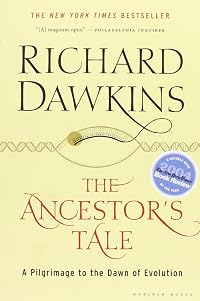
The Ancestor's Tale: A Pilgrimage to the Dawn of Life
by Richard Dawkins
On This Page
Description
The renowned biologist and thinker Richard Dawkins presents his most expansive work yet: a comprehensive look at evolution, ranging from the latest developments in the field to his own provocative views. Loosely based on the form of Chaucer's Canterbury Tales, Dawkins's Tale takes us modern humans back through four billion years of life on our planet. As the pilgrimage progresses, we join with other organisms at the forty "rendezvous points" where we find a common ancestor. The band of show more pilgrims swells into a vast crowd as we join first with other primates, then with other mammals, and so on back to the first primordial organism. Dawkins's brilliant, inventive approach allows us to view the connections between ourselves and all other life in a bracingly novel way. It also lets him shed bright new light on the most compelling aspects of evolutionary history and theory: sexual selection, speciation, convergent evolution, extinction, genetics, plate tectonics, geographical dispersal, and more. The Ancestor's Tale is at once a far-reaching survey of the latest, best thinking on biology and a fascinating history of life on Earth. Here Dawkins shows us how remarkable we are, how astonishing our history, and how intimate our relationship with the rest of the living world. show lessTags
Recommendations




Member Recommendations

StephenBarkley Ancestor's Tale is a more involved explanation of his argument in River Out of Eden.
Member Reviews
A long slog with lots of technical scientific info which, I have to admit, I sometimes skimmed parts of. However, I really liked his conversational tone and his personal stories, e.g., his childhood teachers and misadventures, as if he's just chatting with the reader over a cup of tea. I also liked the way he set up the journey along the lines of Chaucer's "The Canterbury Tales," a book I abandoned a few years ago, way too soon, but am now inspired to begin again.
One chilling scene from the book (though it wasn't meant to be chilling) has stayed with me -- he had us imagine standing at a shoreline at the beginning, on a barren Earth, the only life an oozy slime at our feet. Completely alone. In my mind, I stood there, trapped in the far show more ancient past, knowing my fellow creatures would not evolve for hundreds of millions of years. That's a long time to wait. Sort of like in the Twilight Zone... except with no libraries! What a nightmare!
This is a solid book, and recommended to anyone who's willing. show less
One chilling scene from the book (though it wasn't meant to be chilling) has stayed with me -- he had us imagine standing at a shoreline at the beginning, on a barren Earth, the only life an oozy slime at our feet. Completely alone. In my mind, I stood there, trapped in the far show more ancient past, knowing my fellow creatures would not evolve for hundreds of millions of years. That's a long time to wait. Sort of like in the Twilight Zone... except with no libraries! What a nightmare!
This is a solid book, and recommended to anyone who's willing. show less
Masterly as ever. As a non-scientist I found it clear and easy to understand (apart from a few sections about creatures I'd never heard of). Little touches of humour or personal experience help to lighten what is really a hefty magnum opus covering the whole history and origins of life on earth. as the story delves deeper into the past and into the oceans, you get a sense of how tiny and perhaps accidental is Man; like looking into deep space .
Heard an abridged version on audio some years back (of which I remember little); Worth a third reading.
Heard an abridged version on audio some years back (of which I remember little); Worth a third reading.
It’s something I’d wondered myself in the past: not how we see colours, not the biological technicalities of colour vision, but what they’re for, why we see in colour at all. And after reading one particular essay in this extraordinary book, then mulling it over while out being taken for a walk by my dog, I suddenly saw the answer to that. It wasn’t exactly what the essay was about; that was more to do with the ways in which very different animals sense the world around them (the star-nosed mole, the bat, the platypus, or us humans) but I got even more out of it than the author had put in. It had already crossed my mind years before that, with her almost unbelievably sensitive nose, I’m betting my dog doesn’t just smell the show more world in colour, but in full on, in-your-face, technicolour—and now, if that’s so, I also understood why. And all that from a single short essay among dozens, a three-page sliver tucked away among a humongous seven hundred.
The book itself isn’t easy to characterise in a short review. It’s patterned after Chaucer’s The Canterbury Tales, and just as that was a series of reflections on life, so is this; but while, for Chaucer, that meant human life, in The Ancestor’s Tale it’s all of life on Earth, everything else that lives here too. The “stories” are actually essays about the whole business of being a tiny living part of this planet.
Perhaps some will be put off by the author’s name, which would be a pity. Dawkins is used as a human punch-bag by an impressive variety of people, on which to vent their own shortcomings, frustrations and bile; but you get a truer picture here: more likeable than the rabble would have you believe, as clear-headed and meticulous a guide as you could ask for to lead an odyssey across several billion years—and even has a sense of humour (although the publishers should have handed out free gas-masks ahead of the paddlefish-up-a-creek joke!).
An exceptional book. show less
The book itself isn’t easy to characterise in a short review. It’s patterned after Chaucer’s The Canterbury Tales, and just as that was a series of reflections on life, so is this; but while, for Chaucer, that meant human life, in The Ancestor’s Tale it’s all of life on Earth, everything else that lives here too. The “stories” are actually essays about the whole business of being a tiny living part of this planet.
Perhaps some will be put off by the author’s name, which would be a pity. Dawkins is used as a human punch-bag by an impressive variety of people, on which to vent their own shortcomings, frustrations and bile; but you get a truer picture here: more likeable than the rabble would have you believe, as clear-headed and meticulous a guide as you could ask for to lead an odyssey across several billion years—and even has a sense of humour (although the publishers should have handed out free gas-masks ahead of the paddlefish-up-a-creek joke!).
An exceptional book. show less
I think this is Dawkin’s best book so far (I haven’t read The Greatest Show on Earth yet). I probably don’t need to explain too much about Dawkin’s writing style; his atheist polemics are somewhat tempered here – because what he’s talking about is so interesting that he doesn’t have time to jump all over the religious.
The basic theme of the book is a tracing evolution backward, in a series of “rendezvous”. At each rendezvous, another group of living things “joins” (and the phyletic level of the joining group gets broader and broader); chimpanzees, rodents, monotremes, sauropsids, lungfish, ctenophores, all the way back to eubacteria. This is the reverse of the normal evolutionary explanatory method, in which show more groups “split” as you go forward in time rather than “joining” as you go backward. It works quite well, because it emphasizes similarities rather than differences. There are little natural-history anecdotes at each “join”, which illustrate some aspect of the joining group’s biology; as a collection of essays, the book would be worth it for these alone.
Of personal importance to me is I’ve finally been dragged kicking and screaming out of my final death grip on phyletic systematics. I grew up with – Mom read it to me before I could read myself – The Golden Treasury of Natural History, which was a profusely illustrated children’s book covering everything from the origin of the solar system to modern biology – modern for 1953. There was a double page multi-colored spread of the Great Tree of Life, with things neatly divided into Mammals and Birds and Reptiles and Amphibians and Fish and so forth for the invertebrates. And in Mammals things like Odd-Toes Ungulates and Armadillos and so forth. All that’s gone now – “Fish”, in particular, has been known to be polyphyletic for years (in cladistics terms, a cow is more closely related to a coelacanth than a shark is; back then they were all “Fish”. Well, not the cow).
That means Dawkins springs a bunch of new groupings – Laurasiatheria and Sauropsidia, for example, and Ambulacraria - that I have to puzzle over. Everything I learned as a budding taxonomist is wrong. It’s wonderful. show less
The basic theme of the book is a tracing evolution backward, in a series of “rendezvous”. At each rendezvous, another group of living things “joins” (and the phyletic level of the joining group gets broader and broader); chimpanzees, rodents, monotremes, sauropsids, lungfish, ctenophores, all the way back to eubacteria. This is the reverse of the normal evolutionary explanatory method, in which show more groups “split” as you go forward in time rather than “joining” as you go backward. It works quite well, because it emphasizes similarities rather than differences. There are little natural-history anecdotes at each “join”, which illustrate some aspect of the joining group’s biology; as a collection of essays, the book would be worth it for these alone.
Of personal importance to me is I’ve finally been dragged kicking and screaming out of my final death grip on phyletic systematics. I grew up with – Mom read it to me before I could read myself – The Golden Treasury of Natural History, which was a profusely illustrated children’s book covering everything from the origin of the solar system to modern biology – modern for 1953. There was a double page multi-colored spread of the Great Tree of Life, with things neatly divided into Mammals and Birds and Reptiles and Amphibians and Fish and so forth for the invertebrates. And in Mammals things like Odd-Toes Ungulates and Armadillos and so forth. All that’s gone now – “Fish”, in particular, has been known to be polyphyletic for years (in cladistics terms, a cow is more closely related to a coelacanth than a shark is; back then they were all “Fish”. Well, not the cow).
That means Dawkins springs a bunch of new groupings – Laurasiatheria and Sauropsidia, for example, and Ambulacraria - that I have to puzzle over. Everything I learned as a budding taxonomist is wrong. It’s wonderful. show less
There are some facts the simple knowing of which seems to me to be a supreme achievement of our species. The fact that we are all made of stardust. The fact that 99.9999999999999 percent of all matter is empty. The fact that mass and energy can be expressed in terms of each other. Stuff like that.
Pre-eminent among these to me, for sheer mind-expanding awe, is the fact that life on this planet has developed precisely once, as far as we know, and everything on earth has evolved from it. That means that when you go outside and lie down in the garden, everything you can see and hear – people walking nearby, their pet dogs, the squirrel darting past, the birds you can hear tweeting, the insects and tiny bugs crawling around underneath you, show more the trees the birds are standing on, the grass you're lying on, the bacteria in your guts – all of them are your cousins: you're quite literally related to them in the real, genealogical sense.
If you go far enough back in time, in other words, you will eventually find a creature whose descendants evolved into both squirrels (say) and people. Indeed, the rules of heredity being what they are, you could even find a single individual who was a common ancestor to every squirrel and human alive. And indeed such an animal really did exist, around 75 million years ago in the Upper Cretaceous. It probably looked sort of mousey, and Dawkins estimates that he or she was our ‘15-million-greats-grandparent’. Squirrels are not ‘closer’ to this creature than humans are: we and they are equally related, having been evolving independently for the same amount of time.
The Ancestor's Tale takes exactly this approach to exploring evolution. It starts with humans and works backwards – looking first at the common ancestor between humans and chimpanzees, and continuing until we reach the common ancestor of all life on earth. Dawkins's word for a common ancestor of more than one species is ‘concestor’, and there are only about 40 of them (!) between us and the origin of life more than three billion years ago. The Cretaceous mammal I mentioned above, which evolved into us and squirrels (along with all the other rodents, lagomorphs and primates), is Concestor 10 according to this schema.
I think there's a lot of traps you can fall into when you start thinking about evolution. It's easy to feel, instinctively, that evolution is somehow teleological: that it's been working towards – if not us, then at least creatures that are increasingly complex and increasingly intelligent. But that of course is not the case. Things survive that reproduce themselves well, and there are plenty of single-celled organisms still with us that have seen no need to get any more complicated for millions of years. Bacterial life is in fact astonishingly varied and rich, whole phyla of creatures that branched off before multicellular life even came about; indeed, chemically speaking,
we are more similar to some bacteria than some bacteria are to other bacteria.
Just think about that for a second.
Before Dawkins got distracted by religious idiocy, he was well known as being one of the scientists most able to explain complicated ideas in a fresh and accessible way. All his skills are on display in this work. It's not just the zoology and the evolutionary biology, where you'd expect him to be strong; there's also a fantastically lucid explanation of the biochemistry within a cell, and even one of the best explanations of the physics of radioactivity that I've come across. He is calm and careful; he repeats himself where necessary; he shares several teacherly witticisms; and he does all this without ever condescending to the reader. He allows paragraphs of complex material to sit, so that you can read and re-read them a few times before he carries on. Occasionally he cannot stop himself breaking out in exclamations of wonder or poetic meditation – as when he discusses the fossilised footprints of three early hominids from some three-and-a-half million years ago:
Who does not wonder what these individuals were to each other, whether they held hands or even talked, and what forgotten errand they shared in a Pliocene dawn?
His enthusiasm is infectious. The whole book is a fantastic exploration of this most beautiful piece of modern human understanding. It's full of astonishing anecdotes and scientific details about the natural world, but it also all ties together into a conception of life that's more awe-inspiring and more moving than any supernatural system could ever be. show less
Pre-eminent among these to me, for sheer mind-expanding awe, is the fact that life on this planet has developed precisely once, as far as we know, and everything on earth has evolved from it. That means that when you go outside and lie down in the garden, everything you can see and hear – people walking nearby, their pet dogs, the squirrel darting past, the birds you can hear tweeting, the insects and tiny bugs crawling around underneath you, show more the trees the birds are standing on, the grass you're lying on, the bacteria in your guts – all of them are your cousins: you're quite literally related to them in the real, genealogical sense.
If you go far enough back in time, in other words, you will eventually find a creature whose descendants evolved into both squirrels (say) and people. Indeed, the rules of heredity being what they are, you could even find a single individual who was a common ancestor to every squirrel and human alive. And indeed such an animal really did exist, around 75 million years ago in the Upper Cretaceous. It probably looked sort of mousey, and Dawkins estimates that he or she was our ‘15-million-greats-grandparent’. Squirrels are not ‘closer’ to this creature than humans are: we and they are equally related, having been evolving independently for the same amount of time.
The Ancestor's Tale takes exactly this approach to exploring evolution. It starts with humans and works backwards – looking first at the common ancestor between humans and chimpanzees, and continuing until we reach the common ancestor of all life on earth. Dawkins's word for a common ancestor of more than one species is ‘concestor’, and there are only about 40 of them (!) between us and the origin of life more than three billion years ago. The Cretaceous mammal I mentioned above, which evolved into us and squirrels (along with all the other rodents, lagomorphs and primates), is Concestor 10 according to this schema.
I think there's a lot of traps you can fall into when you start thinking about evolution. It's easy to feel, instinctively, that evolution is somehow teleological: that it's been working towards – if not us, then at least creatures that are increasingly complex and increasingly intelligent. But that of course is not the case. Things survive that reproduce themselves well, and there are plenty of single-celled organisms still with us that have seen no need to get any more complicated for millions of years. Bacterial life is in fact astonishingly varied and rich, whole phyla of creatures that branched off before multicellular life even came about; indeed, chemically speaking,
we are more similar to some bacteria than some bacteria are to other bacteria.
Just think about that for a second.
Before Dawkins got distracted by religious idiocy, he was well known as being one of the scientists most able to explain complicated ideas in a fresh and accessible way. All his skills are on display in this work. It's not just the zoology and the evolutionary biology, where you'd expect him to be strong; there's also a fantastically lucid explanation of the biochemistry within a cell, and even one of the best explanations of the physics of radioactivity that I've come across. He is calm and careful; he repeats himself where necessary; he shares several teacherly witticisms; and he does all this without ever condescending to the reader. He allows paragraphs of complex material to sit, so that you can read and re-read them a few times before he carries on. Occasionally he cannot stop himself breaking out in exclamations of wonder or poetic meditation – as when he discusses the fossilised footprints of three early hominids from some three-and-a-half million years ago:
Who does not wonder what these individuals were to each other, whether they held hands or even talked, and what forgotten errand they shared in a Pliocene dawn?
His enthusiasm is infectious. The whole book is a fantastic exploration of this most beautiful piece of modern human understanding. It's full of astonishing anecdotes and scientific details about the natural world, but it also all ties together into a conception of life that's more awe-inspiring and more moving than any supernatural system could ever be. show less
An excellent, rather mathematical, doorstop of a book. So far, I have read only through "Rendezvous 0: The Tasmanian's Tale". This goes into detail about how estimates can be made of the time when the first shared ancestor of all living humans lived (Dawkins calls this Chang 1) and the time when all animals can be subdivided into two classes, those who are the ancestors of all living humans, and those who are the ancestors of no living humans (Chang 2). I've previously read Dawkins's "The Greatest Show on Earth", but that is a lighter, less mathematical book, and his discussion of the same topic in that book just ended up confusing me. He points out that the simplest mathematical model, which has assumptions of a completely stable show more population and random mating would put the earliest human "Concestor" as having lived around 500 AD, which is clearly wrong. This helpfully demonstrates why a mathematical model may not predict reality too well, with its additional complexity. He throws in the helpful idea that Concestor 0 must have lived before the most distant time when a human population became isolated and gives an estimate of a lower bound of tens of thousands of years and an upper bound of hundred's of thousands. Likely this concestor, who must be an ancestor of isolated populations like those in Tasmania did not live in Africa. He points out that quite a large number of humanity's Chang 2 ancestors have not bequeathed their genes to the current human population.
At only 8 hours, for a 600 page book, the audio edition that I'm listening to is abridged, with whole chapters dropped. I wish the cover had made this clear. show less
At only 8 hours, for a 600 page book, the audio edition that I'm listening to is abridged, with whole chapters dropped. I wish the cover had made this clear. show less
Finally!!
I think I spent more time with this book than any other in recent years...a solid six weeks. That's not to say it was boring or hard to get through, quite the opposite. I enjoyed slowly savoring the massive amount of information up for offer in this tome. Richard Dawkins' is a prolific author, and it took me a while to decide which of his books to read first. This one has been sitting on my shelf for about a year, and I finally picked it up to read concurrently with a Genetics and Evolution class that I am taking via Coursera. It was a splendid idea.
Dawkins tends to go on and on about the craziness of religion, but thankfully that was mostly absent in this book. I like to focus on the topic at hand, without the jests and jeers show more at those with a different view. And the topic at hand in The Ancestor's Tale is an over-arching tale of evolution on this planet, going backwards in time (from a human perspective), all the way back to the origin of life. More than anything, Dawkin's vast knowledge of zoology shines, and I learned more than I ever thought I could in one month about the variety of life on this planet, and how they have evolved to be so darn interesting. His modeling of Chaucer's Canterbury Tales lends itself very well to the subject, and was a great method of (non-fiction) storytelling.
As it was written ten years previously, one thought must accompany the reader. Evolutionary biology, genetics, molecular studies....these fields are constantly changing, with on-going innovations and new developments. Therefore, you must read a book like this with an eye to the present, and new research. For example, since Ancestor's Tale was published, a complete Neandertal genome was sequenced, and a few of Dawkins' statements are somewhat out-dated and not supported by recent findings. The same holds true for the molecular clock, and calculating the rendezvous points with various ancestors. I would love to see an updated edition of The Ancestor's Tale published at some point. show less
I think I spent more time with this book than any other in recent years...a solid six weeks. That's not to say it was boring or hard to get through, quite the opposite. I enjoyed slowly savoring the massive amount of information up for offer in this tome. Richard Dawkins' is a prolific author, and it took me a while to decide which of his books to read first. This one has been sitting on my shelf for about a year, and I finally picked it up to read concurrently with a Genetics and Evolution class that I am taking via Coursera. It was a splendid idea.
Dawkins tends to go on and on about the craziness of religion, but thankfully that was mostly absent in this book. I like to focus on the topic at hand, without the jests and jeers show more at those with a different view. And the topic at hand in The Ancestor's Tale is an over-arching tale of evolution on this planet, going backwards in time (from a human perspective), all the way back to the origin of life. More than anything, Dawkin's vast knowledge of zoology shines, and I learned more than I ever thought I could in one month about the variety of life on this planet, and how they have evolved to be so darn interesting. His modeling of Chaucer's Canterbury Tales lends itself very well to the subject, and was a great method of (non-fiction) storytelling.
As it was written ten years previously, one thought must accompany the reader. Evolutionary biology, genetics, molecular studies....these fields are constantly changing, with on-going innovations and new developments. Therefore, you must read a book like this with an eye to the present, and new research. For example, since Ancestor's Tale was published, a complete Neandertal genome was sequenced, and a few of Dawkins' statements are somewhat out-dated and not supported by recent findings. The same holds true for the molecular clock, and calculating the rendezvous points with various ancestors. I would love to see an updated edition of The Ancestor's Tale published at some point. show less
Members
- Recently Added By
Published Reviews
ThingScore 83
Beginning with modern humans and moving backwards in time, he describes our lineage as we successively join — a geneticist would say coalesce — with the common ancestors of other species. Human evolution has involved 40 such joints, each occupied by what Dawkins calls a "concestor", and each is the subject of a single chapter. He begins, of course, with our common ancestor with chimps, show more followed by the concestor with gorillas, then other primates, and so on through the fusion with early mammals, sponges, plants, Eubacteria and ultimately the Ur-species, probably a naked molecule of RNA. This narrative is engagingly written and attractively illustrated with reconstructions of the concestors, colourful phylogenies, and photographs of bizarre living species. The book is also remarkably up to date and, despite its size, nearly error-free. Especially notable are Dawkins' treatments of human evolution and the origin of life, the best accounts of these topics I've seen in a crowded literature. show less
added by jlelliott
Evolutionary trees have become the lingua franca of biology. Virus hunters draw them to find the origin of SARS and H.I.V. Conservation biologists draw them to decide which endangered species are in most urgent need of saving. Geneticists draw them to pinpoint the genes that have made us uniquely humans. Genome sequencers draw them to discover new genes that may lead to new technologies and show more medical treatments. If you want to understand these trees -- and through them, the nature of life -- ''The Ancestor's Tale'' is an excellent place to start. show less
added by jlelliott
Dawkins has already expounded the arguments that form his vision of life, both in the natural and human realm. Now, having risen from the Bar to Bench, he is in a position to offer himself as judge and senior guide. In The Ancestor's Tale, he has become the kind of teacher without whom childhood nostalgia is incomplete: unflagging in his devotion to enlightenment, given to idiosyncratic show more asides. His mission is to tell the story of the origin of species backwards show less
added by mikeg2
Lists

Best Science Books for Non-Scientists
113 works; 57 members

Recommended Nature Writing
346 works; 180 members

Unread books
1,063 works; 87 members

Non-Fiction Worth Reading
1,016 works; 255 members

Falling for Science
56 works; 3 members

Books Read in 2015
3,299 works; 129 members

Favourite Books
1,819 works; 316 members

Books We Love to Reread
688 works; 296 members

Books Read in 2024
4,727 works; 128 members
Books That Changed Our Perspective
423 works; 168 members
Talk Discussions
Past Discussions
The Pilgrimage Begins - Ancestor's Tale in Evolve! (March 2013)
The Ancestor's Tale in Evolve! (February 2013)
Author Information

76+ Works 64,053 Members
Richard Dawkins was educated at Oxford University and taught zoology at the University of California and Oxford University, holding the position of the Charles Simonyi Professor of the Public Understanding of Science. He writes about such topics as DNA and genetic engineering, virtual reality, astronomy, and evolution. His books include The show more Selfish Gene, The Extended Phenotype, The Blind Watchmaker, River Out of Eden, Climbing Mount Improbable, The God Delusion, and An Appetite for Wonder: The Making of a Scientist. (Bowker Author Biography) show less
All Editions
Some Editions
Awards and Honors
Common Knowledge
- Canonical title
- The Ancestor's Tale: A Pilgrimage to the Dawn of Evolution; The Ancestor's Tale: A Pilgrimage to the Dawn of Life
- Original title
- The Ancestor's Tale: A Pilgrimage to the Dawn of Evolution
- Original publication date
- 2004
- Dedication
- John Maynard Smith (1920-2004)
He saw a draft and graciously accepted the dedication, which now, sadly, must become
In Memoriam - First words
- History has been described as one damn thing after another.
- Last words
- (Click to show. Warning: May contain spoilers.)I feel I have returned from a true pilgrimage.
Classifications
Statistics
- Members
- 4,723
- Popularity
- 3,043
- Reviews
- 78
- Rating
- (4.21)
- Languages
- 14 — Czech, Danish, Dutch, English, French, German, Hungarian, Italian, Korean, Polish, Portuguese, Serbian, Spanish, Turkish
- Media
- Paper, Audiobook, Ebook
- ISBNs
- 41
- UPCs
- 2
- ASINs
- 23