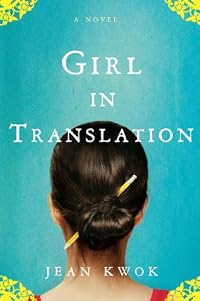
Girl in translation
by Jean Kwok 
On This Page
Description
From the author of Searching for Sylvie Lee, the iconic, New York Times-bestselling debut novel that introduced an important Chinese-American voice with an inspiring story of an immigrant girl forced to choose between two worlds and two futures.When Kimberly Chang and her mother emigrate from Hong Kong to Brooklyn squalor, she quickly begins a secret double life: exceptional schoolgirl during the day, Chinatown sweatshop worker in the evenings. Disguising the more difficult truths of her show more life—like the staggering degree of her poverty, the weight of her family's future resting on her shoulders, or her secret love for a factory boy who shares none of her talent or ambition—Kimberly learns to constantly translate not just her language but herself back and forth between the worlds she straddles.
Through Kimberly's story, author Jean Kwok, who also emigrated from Hong Kong as a young girl, brings to the page the lives of countless immigrants who are caught between the pressure to succeed in America, their duty to their family, and their own personal desires, exposing a world that we rarely hear about. Written in an indelible voice that dramatizes the tensions of an immigrant girl growing up between two cultures, surrounded by a language and world only half understood, Girl in Translation is an unforgettable and classic novel of an American immigrant-a moving tale of hardship and triumph, heartbreak and love, and all that gets lost in translation. show less
Tags
Recommendations












Member Recommendations
terran Chinese Americans, Mother and daughters, Family, Poverty, Immigrants
Member Reviews
Kimberly and her mother immigrate to New York from Hong Kong with the promise of help getting settled from her aunt. Unfortunately, Kimberly's aunt's "help" looks like finding them an illegal apartment with no heat and getting her mom work in one of her and her husband's garment factories, where the workers are illegally paid by the piece. Kimberly knows her only chance of getting out of this situation is working as hard as she can to succeed in school, but the cards are stacked against her -- she barely speaks English. Can she overcome the odds?
I enjoyed this overall. Kimberly is a character you can root for and her struggles and successes are captivating. I didn't care for theaccidental pregnancy at the end and the way that was show more resolved, but that was my only complaint. 4 stars. show less
I enjoyed this overall. Kimberly is a character you can root for and her struggles and successes are captivating. I didn't care for the
I loved this story about 11-year-old Kimberly Chang and her “Ma” who came from Hong Kong to Brooklyn in search of a better life.
Kim’s wealthy Aunt Paula paid for their passage to America, and set them up in a roach and rat infested apartment in Brooklyn without heat. Ma went to work in the filthy garment factory owned by Aunt Paula’s husband, where Ma, like the others, was secretly paid by the piece, an illegal practice. Kim soon began helping her mother out after school, along with other children there illegally, who came to help their parents make their work quotas.
In spite of all the challenges, including no knowledge at first of the English language, Kim managed to excel in school, and soon got a full scholarship to a show more private school. But she kept up her friendship with a girl she met at her first school, Annette Avery, who also changed to the private school, and a boy she got to know in the factory, Matt Wu. She didn’t understand her feelings for Matt until they were older, and he started dating someone else: a beautiful Chinese girl named Vivian. But there was always something between them.
Kim decided that to get her and Ma out of their bad situation, she would simply have to work harder and longer than anyone else in school so she could get a good job someday. But she also had to learn to navigate the tricky waters of jealousy from the other kids, and from Aunt Paula. Her aunt not only held their immediate fate in her hands, but she resented that Kim did better than her own similarly-aged son Godfrey.
The very end of the book is an epilogue that begins twelve years after the first part ends, when Kim is in her senior year in high school.
Discussion: There is so much that is good about this book. The story of Kim and her ma is told with such affection and compassion for the characters by the author that you can’t help feeling the same. The other characters are drawn with an excellent eye, such as Kim’s first public school teacher - he is not such a good person, but unfortunately very typical of tired and frustrated teachers in poor public schools. Even the evil Aunt Paula is portrayed in a sufficiently nuanced manner that you understand why she acts the way she does, and you can feel sympathy for her, which is not easily accomplished with a character that nasty.
The author is so clever at helping us understand the threads that connected all the parts of Kim’s life. For example, at the factory, Kim and Ma were paid 1.5 cents per skirt bagged, and Kim started to calculate whether or not they could afford something by how many skirts it cost:
“In those days, the subway was 100 skirts just to get to the factory and back, a package of gum cost 7 skirts, a hot dog was 50 skirts, a new toy could range from 300 to 2,000 skirts.”
The author also rendered dialogue in a manner that showed in italics the words Kim didn’t understand at first, with the sentences gradually having less and less of these italicized words. As one example, when the principal of her public school talked to Kim about getting accepted at the better private school and the need for recommendations:
“‘I know of several good schools, if you should need some names,’ she said. . . . Do you want some recordy shunts?” [meaning recommendations].
We not only see what words Kim still didn’t know, but how they sounded to her. We also learn that often, she does not understand a word or concept because in her previous culture, practices were different. Illustrating this, there are a number of Chinese customs and sayings included in the story, all explained by our narrator Kim.
What was most interesting to me was that the biggest cultural conflict in the book is not between the Chinese and non-Chinese, but between two of the main Chinese protagonists, one of whom believes in the "old ways" and the other who is looking to the future.
Evaluation: I hope readers will not eschew reading this book because of reluctance to read about another culture they think may not be relevant to their own experiences. This book is first and foremost about the human condition and human emotions which we all share - love, hope, despair, jealousy, determination, and perseverance. The story is engaging and engrossing, and the experiences so seemingly true-to-life that I wasn’t too surprised to learn that a good bit of it was autobiographical. show less
Kim’s wealthy Aunt Paula paid for their passage to America, and set them up in a roach and rat infested apartment in Brooklyn without heat. Ma went to work in the filthy garment factory owned by Aunt Paula’s husband, where Ma, like the others, was secretly paid by the piece, an illegal practice. Kim soon began helping her mother out after school, along with other children there illegally, who came to help their parents make their work quotas.
In spite of all the challenges, including no knowledge at first of the English language, Kim managed to excel in school, and soon got a full scholarship to a show more private school. But she kept up her friendship with a girl she met at her first school, Annette Avery, who also changed to the private school, and a boy she got to know in the factory, Matt Wu. She didn’t understand her feelings for Matt until they were older, and he started dating someone else: a beautiful Chinese girl named Vivian. But there was always something between them.
Kim decided that to get her and Ma out of their bad situation, she would simply have to work harder and longer than anyone else in school so she could get a good job someday. But she also had to learn to navigate the tricky waters of jealousy from the other kids, and from Aunt Paula. Her aunt not only held their immediate fate in her hands, but she resented that Kim did better than her own similarly-aged son Godfrey.
The very end of the book is an epilogue that begins twelve years after the first part ends, when Kim is in her senior year in high school.
Discussion: There is so much that is good about this book. The story of Kim and her ma is told with such affection and compassion for the characters by the author that you can’t help feeling the same. The other characters are drawn with an excellent eye, such as Kim’s first public school teacher - he is not such a good person, but unfortunately very typical of tired and frustrated teachers in poor public schools. Even the evil Aunt Paula is portrayed in a sufficiently nuanced manner that you understand why she acts the way she does, and you can feel sympathy for her, which is not easily accomplished with a character that nasty.
The author is so clever at helping us understand the threads that connected all the parts of Kim’s life. For example, at the factory, Kim and Ma were paid 1.5 cents per skirt bagged, and Kim started to calculate whether or not they could afford something by how many skirts it cost:
“In those days, the subway was 100 skirts just to get to the factory and back, a package of gum cost 7 skirts, a hot dog was 50 skirts, a new toy could range from 300 to 2,000 skirts.”
The author also rendered dialogue in a manner that showed in italics the words Kim didn’t understand at first, with the sentences gradually having less and less of these italicized words. As one example, when the principal of her public school talked to Kim about getting accepted at the better private school and the need for recommendations:
“‘I know of several good schools, if you should need some names,’ she said. . . . Do you want some recordy shunts?” [meaning recommendations].
We not only see what words Kim still didn’t know, but how they sounded to her. We also learn that often, she does not understand a word or concept because in her previous culture, practices were different. Illustrating this, there are a number of Chinese customs and sayings included in the story, all explained by our narrator Kim.
What was most interesting to me was that the biggest cultural conflict in the book is not between the Chinese and non-Chinese, but between two of the main Chinese protagonists, one of whom believes in the "old ways" and the other who is looking to the future.
Evaluation: I hope readers will not eschew reading this book because of reluctance to read about another culture they think may not be relevant to their own experiences. This book is first and foremost about the human condition and human emotions which we all share - love, hope, despair, jealousy, determination, and perseverance. The story is engaging and engrossing, and the experiences so seemingly true-to-life that I wasn’t too surprised to learn that a good bit of it was autobiographical. show less
When I bought this book, the cover was immediate proof that I would never have picked it out myself. It's very simple and, when feeling it, the book feels as if it's made out of recycled paper. Feels old, but is new. In a strange way, I kind of liked that.
After I read the synopsis, I assumed that Girl in Translation would contain a lot of character development and I was immediately intrigued by how two people would survive in a foreign country, which a culture and language completely different from their own.
After a slow start - slow, but not "I have to fight to keep on reading"-slow - I soon completely crawled inside the book and took in everything it had to offer.
The writing itself had one unique component that I absolutely loved and show more by which you notice how the main character, Kim, is learning English. You'll see exactly what I mean in the next two quotes:
"Our new student, eye-prezoom?"
"This is a pop quick," he said. "Fill in allde captal see T's."
Another interesting and - to me - fun aspect of Joan Kwok's writing style is that she uses Chinese sayings, literally translated into English, and then explains what the actual meaning is. Of course I had to include a Chinese saying that has to do with rice, cause... Come on! They're still Chinese...
"Hey, someone has to find the rice right?" To earn the money.
"He's got a human heart too." She meant he had compassion and depth.
Because of all the details that are given in the book, you'd imagine it'd get boring after a while. But this wasn't the case at all. On the contrary. All the information you get, all the little details, make sure you experience Girl in Translation as more than just a bystander.
This book really got to me in terms of feeling how Kimberly and her mother experience all difficulties that come with their immigration. Not only that, but also the way they are treated by both strangers and family members.
All in all, Girl in Translation is a very confronting book when it comes to themes as poverty, immigration, acceptance and humanity. It also made me realize how much we really take for granted, while others - who have it so much worse - appreciate the things we don't even realize are worth being grateful for.
We all fight for what we want; we are all pressured by the standards of society and have a hard time living up to those. Yet... Imagine trying to achieve them while you have absolutely nothing to aid you in that fight. Nothing, except for your own being, your own willpower and wisdom. When you really have to fight to have even a fraction of what "normal" people have?
"I too would be expected to become attractive and well-rounded."
If you want to read about someone who fights to achieve exactly that - a "normal" life that is acceptable according to our society - you have to pick up this book and start reading.
Yes. It will be confronting. It will make you think about the things you have and take for granted. It will make you pause and reflect on friendships and how sincere they must be to really contribute something to life. Your gratitude for everything and everyone in your life will increase. So I'm saying this is a must read.
Because of the slowish start, I'm giving this book a 4,5/5 and the final message to you guys that you should add this to your TBR!
[For more of my reviews, visit my blog: booksandmunches.wordpress.com]
---
I paid full-price for this book and this is my honest review for which I am not being compensated in any way. All opinions are fully my own show less
After I read the synopsis, I assumed that Girl in Translation would contain a lot of character development and I was immediately intrigued by how two people would survive in a foreign country, which a culture and language completely different from their own.
After a slow start - slow, but not "I have to fight to keep on reading"-slow - I soon completely crawled inside the book and took in everything it had to offer.
The writing itself had one unique component that I absolutely loved and show more by which you notice how the main character, Kim, is learning English. You'll see exactly what I mean in the next two quotes:
"Our new student, eye-prezoom?"
"This is a pop quick," he said. "Fill in allde captal see T's."
Another interesting and - to me - fun aspect of Joan Kwok's writing style is that she uses Chinese sayings, literally translated into English, and then explains what the actual meaning is. Of course I had to include a Chinese saying that has to do with rice, cause... Come on! They're still Chinese...
"Hey, someone has to find the rice right?" To earn the money.
"He's got a human heart too." She meant he had compassion and depth.
Because of all the details that are given in the book, you'd imagine it'd get boring after a while. But this wasn't the case at all. On the contrary. All the information you get, all the little details, make sure you experience Girl in Translation as more than just a bystander.
This book really got to me in terms of feeling how Kimberly and her mother experience all difficulties that come with their immigration. Not only that, but also the way they are treated by both strangers and family members.
All in all, Girl in Translation is a very confronting book when it comes to themes as poverty, immigration, acceptance and humanity. It also made me realize how much we really take for granted, while others - who have it so much worse - appreciate the things we don't even realize are worth being grateful for.
We all fight for what we want; we are all pressured by the standards of society and have a hard time living up to those. Yet... Imagine trying to achieve them while you have absolutely nothing to aid you in that fight. Nothing, except for your own being, your own willpower and wisdom. When you really have to fight to have even a fraction of what "normal" people have?
"I too would be expected to become attractive and well-rounded."
If you want to read about someone who fights to achieve exactly that - a "normal" life that is acceptable according to our society - you have to pick up this book and start reading.
Yes. It will be confronting. It will make you think about the things you have and take for granted. It will make you pause and reflect on friendships and how sincere they must be to really contribute something to life. Your gratitude for everything and everyone in your life will increase. So I'm saying this is a must read.
Because of the slowish start, I'm giving this book a 4,5/5 and the final message to you guys that you should add this to your TBR!
[For more of my reviews, visit my blog: booksandmunches.wordpress.com]
---
I paid full-price for this book and this is my honest review for which I am not being compensated in any way. All opinions are fully my own show less
What a fabulous novel by a first time author! I had just finished reading Shanghai Girls by Lisa See and was afraid that I wouldn't enjoy "another" Chinese American immigration story. I couldn't have been more wrong. The story line can break your heart with its clear, unpitying description of the utter poverty and isolation some new immigrants face, and yet never does the plot cross the line into maudlin sappiness. The heroine of the story, 11-year-old Kimberly, is brilliant and hard-working, but saved from the stereotype of "hard-working immigrant makes good" by her confused efforts that sometimes make things worse and her adolescent angst. I honestly had no idea how the book would end and enjoyed it to the last page.
In addition to a show more great plot, Jean Kwok is simply a fantastic writer. From concise description to well-drawn characters to dialogue devices such as the use of italics in conversations to show words that Kimberly misunderstood, Kwok is a master of her craft. I can not wait to read more from this talented new author. Kudos! show less
In addition to a show more great plot, Jean Kwok is simply a fantastic writer. From concise description to well-drawn characters to dialogue devices such as the use of italics in conversations to show words that Kimberly misunderstood, Kwok is a master of her craft. I can not wait to read more from this talented new author. Kudos! show less
 This review was written for LibraryThing Early Reviewers.
There’s a Chinese saying that the fates are winds that blow through our lives from every angle, urging us along the paths of time. (4)
Despite the cold, I was sweating. What if I ran into Mr. Bogart or one of the kids from my class recognized me? I’d never done anything similar before. Like any good Chinese girl, I’d always followed the rules and been glad to be praised by the teachers. But the only alternative was going into Mr. Bogart’s classroom again. I was learning about desperation. (35)
It was freezing during those days I played hooky in the apartment. After skipping school for almost a week, I saw my first snowfall. Flakes came slanting down from the sky and at first, the concrete sidewalk absorbed them like a sponge. I show more touched the window with my hands, amazed it was cold when it seemed to me that the falling rice should be warm, as if it were a soup. (40)
Ma put aside the skirt and sat down on a stool. She looked at me, “Don’t get too closed to the other children here. Ah-Kim, you must always remember this: If you play with them, learn to talk like them, act like them - what will make you different? Nothing. And in ten or twenty years, you’ll be doing precisely what the older girls are doing, working on the sewing machines in this factory until you’re worn, and when you are too old for that, you’ll cut thread like Mrs. Wu.” (44)
Even stuffed into my clothes, like a lump of sticky rice tied in bamboo leaves, I was still freezing. (49)
“Without my violin, I’d forget who I was.” (Ma) (108)
I did try to ask Ma about wildlife conservation when we had to read an article on it for classes.
“Why would anyone want to save animals like tigers?” she’d asked, baffled. She looked sad. “A baby in our old village in China was taken by one.” (120)
In a way I gave myself the excuse of not even trying to get close to the others because I knew I couldn’t be a part of their lives. I still had my responsibilities at the factory, but even without that, Ma wouldn’t have allowed me to go out anyway. That wasn’t what nice Chinese girls from her background did. (134)
“No, let’s meet earlier. I can get some bears,” Greg said.
While they discussed the logistic of their evening, my mind whirled. A show that started at midnight. And some bears? Then I realized he had to mean the alcoholic drink, beer. (134)
After the dusty, physical work of the factory, the scientific world created a clear and logical paradise where I could feel safe. Just for pleasure, I had started reading library books about subjects we’d touched upon in school: amino acids, mitosis, prokarytoes, DNA forensic, karyotyping, monohybrid crosses, endothermic reactions. And mathematics was the only language I truly understood. It was pure, orderly and predictable. It gave me great satisfaction to work on mathematical puzzles and forget about my real life at the apartment and factory. (158)
“Brains are beautiful,” I said. (213)
But sometimes our fate is different from the one we imagined for ourselves. (249)
‘A bamboo door needs a bamboo door and a metal door needs a metal door.’ (255) show less
Despite the cold, I was sweating. What if I ran into Mr. Bogart or one of the kids from my class recognized me? I’d never done anything similar before. Like any good Chinese girl, I’d always followed the rules and been glad to be praised by the teachers. But the only alternative was going into Mr. Bogart’s classroom again. I was learning about desperation. (35)
It was freezing during those days I played hooky in the apartment. After skipping school for almost a week, I saw my first snowfall. Flakes came slanting down from the sky and at first, the concrete sidewalk absorbed them like a sponge. I show more touched the window with my hands, amazed it was cold when it seemed to me that the falling rice should be warm, as if it were a soup. (40)
Ma put aside the skirt and sat down on a stool. She looked at me, “Don’t get too closed to the other children here. Ah-Kim, you must always remember this: If you play with them, learn to talk like them, act like them - what will make you different? Nothing. And in ten or twenty years, you’ll be doing precisely what the older girls are doing, working on the sewing machines in this factory until you’re worn, and when you are too old for that, you’ll cut thread like Mrs. Wu.” (44)
Even stuffed into my clothes, like a lump of sticky rice tied in bamboo leaves, I was still freezing. (49)
“Without my violin, I’d forget who I was.” (Ma) (108)
I did try to ask Ma about wildlife conservation when we had to read an article on it for classes.
“Why would anyone want to save animals like tigers?” she’d asked, baffled. She looked sad. “A baby in our old village in China was taken by one.” (120)
In a way I gave myself the excuse of not even trying to get close to the others because I knew I couldn’t be a part of their lives. I still had my responsibilities at the factory, but even without that, Ma wouldn’t have allowed me to go out anyway. That wasn’t what nice Chinese girls from her background did. (134)
“No, let’s meet earlier. I can get some bears,” Greg said.
While they discussed the logistic of their evening, my mind whirled. A show that started at midnight. And some bears? Then I realized he had to mean the alcoholic drink, beer. (134)
After the dusty, physical work of the factory, the scientific world created a clear and logical paradise where I could feel safe. Just for pleasure, I had started reading library books about subjects we’d touched upon in school: amino acids, mitosis, prokarytoes, DNA forensic, karyotyping, monohybrid crosses, endothermic reactions. And mathematics was the only language I truly understood. It was pure, orderly and predictable. It gave me great satisfaction to work on mathematical puzzles and forget about my real life at the apartment and factory. (158)
“Brains are beautiful,” I said. (213)
But sometimes our fate is different from the one we imagined for ourselves. (249)
‘A bamboo door needs a bamboo door and a metal door needs a metal door.’ (255) show less
This was a great read. Such an in-depth story of a mother and daughter new to NYC as Chinese immigrants. They are so very poor living in a condemned building and working in a sweatshop managed by Kim’s aunt who helped them immigrate and now demands repayment. But Kim and her “ma” have a strong bond and Kim has “a talent for school” and they work and sacrifice everything. They count how many skirts it would cost to purchase anything. The novel beautifully details what their life was like without becoming maudlin or insincere. I loved how the Chinese featured in this novel even using colloquialism to show how an English word sounds to a Chinese person.
Kim is a fascinating character determined, respectful, brilliant and kind. show more Unbelievably she is 12 years old for a good part of her story show less
Kim is a fascinating character determined, respectful, brilliant and kind. show more Unbelievably she is 12 years old for a good part of her story show less
One of my friends just casually picked up this book for me because I mentioned I wanted to read some Asian fiction. I have several Asian fiction books in my TBR pile but I decided to remove this one because another bibliophile was raving about it. The night I started this book I only expected to read a few pages and ended up staying up reading until 4am. If I had to sum up this book in one word I would say it was simply, delightful.
This is a coming of age story about a Chinese immigrant named Kimberly Chang. Kimberly and her mother come to America when Kimberly is eleven years old. Kimberly’s jealous Aunt Paula paid for them to come to America and provided them with an apartment in the projects. Kimberly and her mother found show more themselves having to pay back their debt by working in Aunt Paula’s husband’s clothing factory in Chinatown, NY. The apartment and the factory were characters all on their own. Kimberly is an extremely brilliant young lady that draws you in with her meek spirit. Her mother is equally as charming without saying much. They affectionately refer to each other as “mother and cub” and this is exactly how they were personified throughout the text. Kimberly has a fierce drive and determination without being arrogant or prideful. Kimberly was a normal teen but she always stayed focused because she knew she had to make a better life for her and her mother. A roach filled apartment with no heat was even more motivation.
As we follow Kimberly from grade school on to college we also are introduced to her best friend Annette. I loved Annette’s character. Annette was very eccentric but yet fiercely loyal. Just when I thought the text could not get any better a beautiful love story starts to blossom. Matt Wu is working in the factory with his mother and little brother when Kimberly and her mother arrive. Kwok makes you believe that what Matt and Kimberly share is only puppy love but then she gives you a real jolt. The sudden turn of events at the end had me turning pages like a mad woman. The ending is anything but predictable but every bit amazing.
Yes I really enjoyed this book. I enjoyed reading about Kimberly and her mother’s triumph’s because the odds were against them not to mention the language barrier. They were some determined women and instead of complaining they overcame. I also enjoyed all the Chinese proverbs that were sprinkled throughout. show less
This is a coming of age story about a Chinese immigrant named Kimberly Chang. Kimberly and her mother come to America when Kimberly is eleven years old. Kimberly’s jealous Aunt Paula paid for them to come to America and provided them with an apartment in the projects. Kimberly and her mother found show more themselves having to pay back their debt by working in Aunt Paula’s husband’s clothing factory in Chinatown, NY. The apartment and the factory were characters all on their own. Kimberly is an extremely brilliant young lady that draws you in with her meek spirit. Her mother is equally as charming without saying much. They affectionately refer to each other as “mother and cub” and this is exactly how they were personified throughout the text. Kimberly has a fierce drive and determination without being arrogant or prideful. Kimberly was a normal teen but she always stayed focused because she knew she had to make a better life for her and her mother. A roach filled apartment with no heat was even more motivation.
As we follow Kimberly from grade school on to college we also are introduced to her best friend Annette. I loved Annette’s character. Annette was very eccentric but yet fiercely loyal. Just when I thought the text could not get any better a beautiful love story starts to blossom. Matt Wu is working in the factory with his mother and little brother when Kimberly and her mother arrive. Kwok makes you believe that what Matt and Kimberly share is only puppy love but then she gives you a real jolt. The sudden turn of events at the end had me turning pages like a mad woman. The ending is anything but predictable but every bit amazing.
Yes I really enjoyed this book. I enjoyed reading about Kimberly and her mother’s triumph’s because the odds were against them not to mention the language barrier. They were some determined women and instead of complaining they overcame. I also enjoyed all the Chinese proverbs that were sprinkled throughout. show less
Members
- Recently Added By
Published Reviews
ThingScore 100
Through Kimberly's story, author Jean Kwok, who also emigrated from Hong Kong as a young girl, brings to the page the lives of countless immigrants who are caught between the pressure to succeed in America, their duty to their family, and their own personal desires, exposing a world that we rarely hear about. Written in an indelible voice that dramatizes the tensions of an immigrant girl show more growing up between two cultures, surrounded by a language and world only half understood, Girl in Translation is an unforgettable and classic novel of an American immigrant—a moving tale of hardship and triumph, heartbreak and love, and all that gets lost in translation. show less
added by shieldwolf
Kwok adeptly captures the hardships of the immigrant experience and the strength of the human spirit to survive and even excel despite the odds.
added by khuggard
Lists

The Immigrant's Stories
74 works; 19 members

Mothers and Daughters
114 works; 11 members

My TBR list
38 works; 1 member

Books Read in 2016
4,666 works; 199 members

To Read
617 works; 7 members

Virginia Banned Books 2023
68 works; 3 members
Author Information

7+ Works 4,155 Members
Jean Kwok has a BA in English and American Literature from Harvard University and an MFA in Fiction from Columbia University. She taught at the University of Leiden and is an alumnus of the Amsterdam Writing Workshops. Jean's debut novel is entitled Girl in Translation. This 2010 novel has already been sold in eight countries. It made the IBooks show more Best Seller List in 2017. (Bowker Author Biography) show less
Jean Kwok is a LibraryThing Author, an author who lists their personal library on LibraryThing.
Some Editions
Awards and Honors
Awards
Distinctions
Series
Belongs to Publisher Series
Blackbirds (2013)
Common Knowledge
- Canonical title
- Girl in translation
- Original title
- Girl in translation
- Original publication date
- 2010-05-03
- People/Characters
- Ah-Kim "Kimberly" Chang; Mrs. Chang; Annette Avery; Aunt Paula Yue; Uncle Bob Yue; Matt Wu (show all 19); Park Wu; Curt; Jason; Nick Bogart; Mr. Al; Mrs. La Guardia; Tammy; Greg; Nelson Yue; Godfrey Yue; Mr. Jamali; Vivian; Mrs. Avery
- Important places
- Brooklyn, New York, USA; Hong Kong, China; Harrison Prep School
- Dedication
- For Erwin, Stefan and Milan, and to the memory of my brother Kwan S. Kwok
- First words
- I was born with a talent. Not for dance, nor comedy, nor anything so delightful. I've always had a knack for school. Everything that was taught there, I could learn: quickly and without too much effort. It was as if school we... (show all)re a vast machine and I a cog perfectly formed to fit in it. This is not to say that my education was always easy for me. When Ma and I moved to the U.S., I spoke only a few words of English and for a very long time, I struggled.
- Quotations
- What Annette didn't understand was that silence could be a great protector. I couldn't afford to cry when there was no escape. Talking about my problems would only illuminate the lines of my unhappiness in the cold light of d... (show all)ay, showing me, as well as her, the things I had been able to bear only because they had been half hidden in the shadows. I couldn't expose myself like that, not even for her.
Brains are beautiful.
In those days, I wanted to believe our love was something tangible and permanent, like a good luck charm I could always wear around my neck. Now I know it was more like the wisp of smoke trailing off a stick of incense: most ... (show all)of what I could hold onto was the memory of the burning, the aftermath if its scent. - Last words
- (Click to show. Warning: May contain spoilers.)Then I took a deep breath, got off the bed and opened the door.
- Publisher's editor
- McGrath, Sarah
- Blurbers
- Moriarty, Laura; Otsuka, Julie; Lee, Min Jin; Vida, Vendela; Barry, Brunonia; Wood, Patricia (show all 8); Scott, Joanna; Packer, Ann
- Original language*
- Amerikanisch
*Some information comes from Common Knowledge in other languages. Click "Edit" for more information.
Classifications
Statistics
- Members
- 2,409
- Popularity
- 8,059
- Reviews
- 187
- Rating
- (3.91)
- Languages
- 11 — Danish, Dutch, English, Finnish, French, German, Italian, Norwegian (Bokmål), Portuguese, Spanish, Swedish
- Media
- Paper, Audiobook, Ebook
- ISBNs
- 39
- ASINs
- 11
