
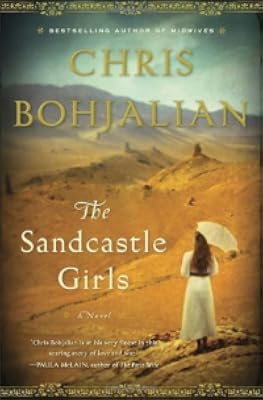
The Sandcastle Girls
by Chris Bohjalian 
On This Page
Description
"Parallel stories of a woman who falls in love with an Armenian soldier during the Armenian Genocide and a modern-day New Yorker prompted to rediscover her Armenian past"--Tags
Recommendations







Member Recommendations

Member Reviews
Do not be deceived by the cover or title. This book is not a light romance or beach read. It is historical fiction about the Armenian Genocide in Turkey in 1915. The plot revolves around a set of photos of the refugees taken by German soldiers that are confiscated but resurface many years later. It is told in dual timeline, with the vast majority set in Syria, where the Armenian refugees had arrived after their horrific march through the Turkish desert. The modern timeline is set in 2012, with the granddaughter of the protagonist researching and writing her family’s history.
As may be expected in a book about genocide, it contains a great deal of disturbing content – gruesome descriptions of beheadings, rape, starvation, harm to show more children, and other cruelties. I think the author does a good job of balancing the narrative with other topics, such as the investigation of the family’s history and the question of what happened to the photos. The portion set in the past is the more effective of the two timelines. It is a historical story well-told. show less
As may be expected in a book about genocide, it contains a great deal of disturbing content – gruesome descriptions of beheadings, rape, starvation, harm to show more children, and other cruelties. I think the author does a good job of balancing the narrative with other topics, such as the investigation of the family’s history and the question of what happened to the photos. The portion set in the past is the more effective of the two timelines. It is a historical story well-told. show less
I received this book almost six months ago, but I haven't written the review until now because it was deeply, darkly disturbing to me. The story of very personal tragedies on Nazi-esque proportions was painful, but compelling. I could not put it down even as the mental images evoked by Bohjalian's clean, precise prose made it difficult for me to fully embrace the depth of the story. Those characters stayed with me a long time, and I found myself trapped in a cycle of torture porn as I read more about the Armenian genocide and what it meant in 1915, how it is virtually forgotten today.
I did have to go back and reread a few chapters because the story is told from the viewpoint of two women over three generations, which is a difficult show more device and not always done as well as it could be. show less
I did have to go back and reread a few chapters because the story is told from the viewpoint of two women over three generations, which is a difficult show more device and not always done as well as it could be. show less
 This review was written for LibraryThing Early Reviewers.
For all that this is a book that centers on a genocide, it's not very compelling. There are two stories told in parallel, neither of which I found particularly engaging. The primary story is the one that takes place during the 1915 Armenian genocide. It's the story of Elizabeth, a recent Mount Holyoke graduate who travels to Aleppo with her father on a mission of humanitarian relief (although in her father's case it seems to have more to do with making sure his money is being responsibly spent). In Aleppo, Elizabeth meets Armen, an Armenian engineer. Although Armen presumes that his wife and daughter are dead, victims of the Turkish transportation, he is in Aleppo hoping to find someone who accompanied them across the desert and can show more tell him what exactly happened to them. This might have made Armen a tragic and interesting character, except that he more or less abandons his quest the moment he meets Elizabeth. He is drawn to her because her cheekbones remind him of his wife's, and he falls in love with her almost instantly. The attraction is mutual, if not entirely believable, and the rest of the story is a foregone conclusion, and would be even if we did not already know the end of their story from their granddaughter.
The second story is told by Laura, Armen and Elizabeth's granddaughter, a writer who knows very little about her Armenian heritage (although, to be fair, she doesn't seem to know that much about her Boston Brahmin heritage either). She is drawn into researching her history when a friend forwards her a photograph of someone with her last name from an exhibition focusing on the Armenian genocide. Her story of discovering her grandparent's history is interesting, but lacks emotional heft, although that may be because I found her grandparent's story itself to also lack spark.
Put together, we get two stories, neither of which is adequately fleshed out. Perhaps if Bohjalian had chosen to tell a single story, there would have been more room to create a more fully-realized world, and fewer characters who are simply shadows (Elizabeth's father, Armen's wife, and so on). Likewise, if Bohjalian had chosen to tell only the historical story (adding the contemporary story seems like little more than self-indulgence on his part), he might have been able to actually help his readers understand more about the Genocide You Know Nothing About (as he has Laura call it). Instead, I found myself confused by how Syria figured into the Armenian story, what the Germans were doing there, and what the Turks had against the Armenians in the first place (though I suspect most of the Armenians were asking the same question) and unconvinced both by Armen and Elizabeth's love affair and by Laura's historical quest. show less
The second story is told by Laura, Armen and Elizabeth's granddaughter, a writer who knows very little about her Armenian heritage (although, to be fair, she doesn't seem to know that much about her Boston Brahmin heritage either). She is drawn into researching her history when a friend forwards her a photograph of someone with her last name from an exhibition focusing on the Armenian genocide. Her story of discovering her grandparent's history is interesting, but lacks emotional heft, although that may be because I found her grandparent's story itself to also lack spark.
Put together, we get two stories, neither of which is adequately fleshed out. Perhaps if Bohjalian had chosen to tell a single story, there would have been more room to create a more fully-realized world, and fewer characters who are simply shadows (Elizabeth's father, Armen's wife, and so on). Likewise, if Bohjalian had chosen to tell only the historical story (adding the contemporary story seems like little more than self-indulgence on his part), he might have been able to actually help his readers understand more about the Genocide You Know Nothing About (as he has Laura call it). Instead, I found myself confused by how Syria figured into the Armenian story, what the Germans were doing there, and what the Turks had against the Armenians in the first place (though I suspect most of the Armenians were asking the same question) and unconvinced both by Armen and Elizabeth's love affair and by Laura's historical quest. show less
This review was written for LibraryThing Early Reviewers.Elizabeth Endicott, fresh out of basic nursing training, arrives with her father in Aleppo, Syria, as part of a humanitarian effort to bring medical care and food supplies to besieged refugees. They were told that Armenian citizens are being deported to Syria from Turkey, but outside of the immediate region no one had any comprehension of the severity and shocking brutality of what was actually occurring. After meeting an Armenian man who has lost both his wife and daughter, Elizabeth becomes more invested in doing everything in her power to assist the Armenians and taking more of a personal stake in their fates.
In what I like to think of as welcome literary coincidence, within a day or two after I obliviously selected this novel to show more read, President Biden formally recognized the Armenian genocide for the first time since it occurred 1915-1917. I'm confident I would have enjoyed the story regardless, but knowing that definitely made it seem more poignant and relevant. It isn't far-fetched in hindsight to imagine the ways these annihilations likely inspired the Holocaust, and it's tragic that the rest of the world either didn't believe or didn't take seriously at that time what truly had happened. show less
In what I like to think of as welcome literary coincidence, within a day or two after I obliviously selected this novel to show more read, President Biden formally recognized the Armenian genocide for the first time since it occurred 1915-1917. I'm confident I would have enjoyed the story regardless, but knowing that definitely made it seem more poignant and relevant. It isn't far-fetched in hindsight to imagine the ways these annihilations likely inspired the Holocaust, and it's tragic that the rest of the world either didn't believe or didn't take seriously at that time what truly had happened. show less
Elizabeth Endicott travels with her wealthy father to help deliver food and medical aid to refugees of the Armenian Genocide during World War I. There she meets and falls in love with a young Armenian, Armen, who has lost his wife and daughter.
The book is a haunting study of a shameful chapter in history that has been swept under the rug, told through the framework of Elizabeth's and Armen's relationship, and through their eyes, and the eyes of others they come into contact with.
The characters are well-drawn, the scenes are horrific, and the history is well researched, as Elizabeth and Armen's granddaughter researches their lives.
The book is a haunting study of a shameful chapter in history that has been swept under the rug, told through the framework of Elizabeth's and Armen's relationship, and through their eyes, and the eyes of others they come into contact with.
The characters are well-drawn, the scenes are horrific, and the history is well researched, as Elizabeth and Armen's granddaughter researches their lives.
Audio book performed by Cassandra Campbell and Alison Fraser.
Elizabeth Endicott is a wealthy young American who accompanies her father to Aleppo Syria in 1915 to bring food and medical aid to refugees of the Armenian Genocide. The scenes she witnesses are so horrific they are almost unbelievable. Shortly after arriving she meets Armen, a young Armenian engineer whose wife and daughter have died in the war. They develop a connection, but he is compelled to join the British Army and fight against the Germans and Turks. They write to one another, realizing their love, but frustrated with the realities of war-time correspondence to-and-from a combat zone.
Some ninety years later, their American granddaughter, Laura, begins researching her show more family’s history, uncovering the story of her grandparents’ love, losses, regrets and secrets.
The novel is told in alternating time frames. Laura’s present-day story is written in first person, allowing the reader to discover her family’s story as Laura uncovers it. The World War I story is told in third person, slowly revealing the characters, their motivations, reactions and thoughts as they experience the horrors of war. Both are compelling story arcs and Bohjalian moves from present to past and back again seamlessly.
I loved how sensitive Laura was to the story she uncovered, how excited she became as she learned more and found new sources of information, how she was stricken by grief on learning what had happened to so many “nameless” people, how determined she was to uncover the truth and bring the story to light. I connected to her and her interest became mine. The war story was compelling and horrifying, but Bohjalian’s characters behaved with integrity and the best intentions. Did they regret any of their decisions? Perhaps. But in the same circumstances could they (or I) have done any better? My only regret is that the novel is finished. I want to go back and re-read it.
Cassandra Campbell and Alison Fraser do a wonderful job performing the audio version. Having two narrators made it very easy to tell which time frame I was in. I’m not sure which of these talented voice artists narrated the World War I story, but she had the more difficult task because of the many characters of different nationalities and with different accents. The audio version also has a bonus interview with Bohjalian. show less
Elizabeth Endicott is a wealthy young American who accompanies her father to Aleppo Syria in 1915 to bring food and medical aid to refugees of the Armenian Genocide. The scenes she witnesses are so horrific they are almost unbelievable. Shortly after arriving she meets Armen, a young Armenian engineer whose wife and daughter have died in the war. They develop a connection, but he is compelled to join the British Army and fight against the Germans and Turks. They write to one another, realizing their love, but frustrated with the realities of war-time correspondence to-and-from a combat zone.
Some ninety years later, their American granddaughter, Laura, begins researching her show more family’s history, uncovering the story of her grandparents’ love, losses, regrets and secrets.
The novel is told in alternating time frames. Laura’s present-day story is written in first person, allowing the reader to discover her family’s story as Laura uncovers it. The World War I story is told in third person, slowly revealing the characters, their motivations, reactions and thoughts as they experience the horrors of war. Both are compelling story arcs and Bohjalian moves from present to past and back again seamlessly.
I loved how sensitive Laura was to the story she uncovered, how excited she became as she learned more and found new sources of information, how she was stricken by grief on learning what had happened to so many “nameless” people, how determined she was to uncover the truth and bring the story to light. I connected to her and her interest became mine. The war story was compelling and horrifying, but Bohjalian’s characters behaved with integrity and the best intentions. Did they regret any of their decisions? Perhaps. But in the same circumstances could they (or I) have done any better? My only regret is that the novel is finished. I want to go back and re-read it.
Cassandra Campbell and Alison Fraser do a wonderful job performing the audio version. Having two narrators made it very easy to tell which time frame I was in. I’m not sure which of these talented voice artists narrated the World War I story, but she had the more difficult task because of the many characters of different nationalities and with different accents. The audio version also has a bonus interview with Bohjalian. show less
Do not be deceived by the cover or title. This book is not a light romance or beach read. It is historical fiction about the Armenian Genocide in Turkey in 1915. The plot revolves around a set of photos of the refugees taken by German soldiers that are confiscated but resurface many years later. It is told in dual timeline, with the vast majority set in Syria, where the Armenian refugees had arrived after their horrific march through the Turkish desert. The modern timeline is set in 2012, with the granddaughter of the protagonist researching and writing her family’s history.
As may be expected in a book about genocide, it contains a great deal of disturbing content – gruesome descriptions of beheadings, rape, starvation, harm to show more children, and other cruelties. I think the author does a good job of balancing the narrative with other topics, such as the investigation of the family’s history and the question of what happened to the photos. The portion set in the past is the more effective of the two timelines. It is a historical story well-told. show less
As may be expected in a book about genocide, it contains a great deal of disturbing content – gruesome descriptions of beheadings, rape, starvation, harm to show more children, and other cruelties. I think the author does a good job of balancing the narrative with other topics, such as the investigation of the family’s history and the question of what happened to the photos. The portion set in the past is the more effective of the two timelines. It is a historical story well-told. show less
Members
- Recently Added By
Lists

Recommend the 20 best books you've read in the last five years
2,168 works; 606 members

Historical Fiction
889 works; 91 members

Top Five Books of 2017
757 works; 231 members

Top Five Books of 2015
811 works; 241 members

Five star books
1,755 works; 107 members
Historical Fiction Lovers
88 works; 4 members

IMPAC Dublin Literary Award 2014 longlist
150 works; 3 members

Books You Couldn't Finish
202 works; 28 members

THE WAR ROOM
813 works; 24 members
Author Information

37+ Works 28,783 Members
Chris Bohjalian (born on August 12, 1962 in White Plains, New York) graduated from Amherst College and worked as an account representative for J. Walter Thompson advertising agency in New York in the mid-1980s. Bohjalian is an American novelist and the author of 15 novels, including the bestsellers Midwives and The Sandcastle Girls. His first show more novel, A Killing in the Real World, was released in 1988. His other novels include Water Witches, The Law of Similars, Before You Know Kindness, Skeletons at the Feast, and The Night Strangers. Past the Bleachers and Midwives were made into Hallmark Hall of Fame movies and Secrets of Eden was made into a Lifetime Television movie. He won the New England Book Award in 2002. He also contributes to numerous publications including Cosmopolitan, Reader's Digest, Boston Globe Sunday Magazine and the Burlington Free Press. Bohjalian's The Guest Room is a New York Times bestseller. (Bowker Author Biography) show less
Chris Bohjalian is a LibraryThing Author, an author who lists their personal library on LibraryThing.
Awards and Honors
Awards
Distinctions
Common Knowledge
- Canonical title
- The Sandcastle Girls
- Original publication date
- 2012-07-17
- People/Characters
- Elizabeth Endicott; Armen Petrosian; Laura Petrosian; Ryan Donald Martin; Alicia Wells; Silas Endicott (show all 11); David Herbert; Nevart; Hatoun; Eric; Helmut Krause
- Important places
- Aleppo, Syria; Egypt; New York, New York, USA; Gallipoli, Turkey
- Important events
- World War I; Armenian Genocide
- Epigraph
- "we shot our heretical need
to see the horror of the past
thru a wide-angled lens"
"You asked: If there is no one to listen to the story, what's left?
The blown-out ceiling with its tinge of Duccio-color?"
Peter Balakian,
"Sarajevo," from his collection Ziggurat - Dedication
- In memory of my mother-in-law, Sondra Blewer, 1931-2011, and my father, Aram Bohjalian, 1928-2011. Sondra urged me to write this novel, and my father helped to inspire it.
- First words
- Prologue
When my twin brother and I were small children, we would take turns sitting on our grandfather's lap.
Part One "Chapter 1"
The Young woman, twenty-one, walks gingerly down the dusty street between her father and the American consul her in Aleppo, an energetic fellow almost her father's age named Ryan Donald Martin, and dra... (show all)ws the scarf over her hair and her cheeks. - Last words
- (Click to show. Warning: May contain spoilers.)This time, however, there was a ripple of happiness amid all those tears, because among the cadavers who would be raised from the Aleppo dead was this woman's grandmother: a quiet, watchful, intense little girl named Hatoun.
- Publisher's editor
- Jackson, Jenny
- Blurbers
- McLain, Paula; Lamb, Wally
Classifications
Statistics
- Members
- 1,577
- Popularity
- 14,409
- Reviews
- 162
- Rating
- (3.87)
- Languages
- English, French, Italian
- Media
- Paper, Audiobook, Ebook
- ISBNs
- 27
- ASINs
- 8
