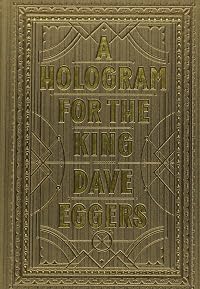
A Hologram for the King
by Dave Eggers
On This Page
Description
In a rising Saudi Arabian city, far from weary, recession-scarred America, a struggling businessman named Alan Clay pursues a last-ditch attempt to stave off foreclosure, pay his daughter's college tuition, and finally do something great. In A Hologram for the King, Dave Eggers takes us around the world to show how one man fights to hold himself and his splintering family together..
Tags
Recommendations




















Member Recommendations

Member Reviews
I feel like I've grown up with Dave Eggers.
AHWOSG and YSKOV! appealed to my youthful naivete; What is the What and Zeitoun my maturing empathy; the Circle my interest in social media issues and technology (though I disagreed with the simplified, negative message); YF, WAT? ATP, DTLF? my quieting hopelessness as I get way too old to have not done anything yet. I keep expecting to hate the next book of his, or find his simplification of issues boring, and yet I always come away feeling simply--comforted. He's a close friend, far too smart and far too humble for his own good, always happy to spend time with you.
[N.B. This review includes images, and was formatted for my site, dendrobibliography -- located here.]
A Hologram for the King show more harks back to Eggers' interest in simplifying important social issues--in environmental and economic resilience, specifically. Alan Clay is Eggers' American everyman, a selfish and simple guy who just wants to support his daughter (who loathes him, of course), teetering on the embarrassment of bankruptcy. He's succeeded in the 20th-century American dream, which inevitably, in its selfishness and ignorance, ushered in the very collapsing economy that ruined him. Don't mistake this for Yet Another Novel on the mid-life crisis white guy -- its scope is closer to western civilization.
To fulfill the 21st-century equivalent, he's traveled to Saudi Arabia with the aim of selling IT services to King Abdullah's nonexistent King Abdullah Economic City (KAEC). Their presentation is directly with the king, but he never shows up. For days and weeks, they're kept waiting always with a 'Tomorrow, for sure,' and whether the king cares one way or the other about the Americans or his KAEC is a bit nebulous (until it's not). No longer able to export material goods, we're attempting to export the only thing we can--technology or technological expertise--and failing at that because market fundamentalism and cultural wars and whatever else fuels unsustainable economies.
The proposed city's as stupid and impossibly near-sighted as it looks: A monument to our desire to dominate the environment. It's an idea that can't thrive and won't ever thrive due to the need for importing everything in order to keep it green--not just like nearby Dubai, but American cities like Phoenix, Arizona, too.
A highlight: Eggers' characterization is as strong as ever. He has a unique way of capturing the disconnected logic of the everyday, defined by paranoia and self-absorption. E.g., Alan Clay's day-to-day is plagued by
a) rewriting the first few lines of the Letter That Will Change His Daughter's Life, aka that sad, semi-drunk letter every aging depressed parent writes their children hoping to pass on life lessons they themselves never quite figured out
b) worrying about a growth on his neck
c) worrying about how said growth would be perceived by others
d) experimenting with said growth
e) reading too far into his coworkers' expressions
f) poorly applying good--if dated--lessons in salesmanship, e.g., begging for names to create a first-name basis personal connection reads as downright needy and pushy.
Not the most fun person to spend time with, but his worries and fears and fuckups and aspirations all feel real (and relatable) in the most depressing sense of the word. He speaks to the fuckup in all of us, and that's precisely why I feel so connected to Eggers' writing. It's simple, it's passive--maybe even too much of these things--but it tries really damn hard to make its message accessible.
## People worried about our passing over into some robotic state [in the future], but we were so much like robots already, programmed and easy to manipulate. We had buttons, we had circuits, and it could all be mapped and explained, reprogrammed and calibrated. The utter mechanical simplicity of being able to move this oddity, the clitoris, up and down and around, to provoke the greatest pleasure, seemed laughably easy. And so we did it, because it created happiness of some kind. We push the buttons that provide the rewards. Again the greatest use of a human was to be useful. Not to consume, not to watch, but to do something for someone else that improved their life, even for a few minutes. show less
AHWOSG and YSKOV! appealed to my youthful naivete; What is the What and Zeitoun my maturing empathy; the Circle my interest in social media issues and technology (though I disagreed with the simplified, negative message); YF, WAT? ATP, DTLF? my quieting hopelessness as I get way too old to have not done anything yet. I keep expecting to hate the next book of his, or find his simplification of issues boring, and yet I always come away feeling simply--comforted. He's a close friend, far too smart and far too humble for his own good, always happy to spend time with you.
[N.B. This review includes images, and was formatted for my site, dendrobibliography -- located here.]
A Hologram for the King show more harks back to Eggers' interest in simplifying important social issues--in environmental and economic resilience, specifically. Alan Clay is Eggers' American everyman, a selfish and simple guy who just wants to support his daughter (who loathes him, of course), teetering on the embarrassment of bankruptcy. He's succeeded in the 20th-century American dream, which inevitably, in its selfishness and ignorance, ushered in the very collapsing economy that ruined him. Don't mistake this for Yet Another Novel on the mid-life crisis white guy -- its scope is closer to western civilization.
To fulfill the 21st-century equivalent, he's traveled to Saudi Arabia with the aim of selling IT services to King Abdullah's nonexistent King Abdullah Economic City (KAEC). Their presentation is directly with the king, but he never shows up. For days and weeks, they're kept waiting always with a 'Tomorrow, for sure,' and whether the king cares one way or the other about the Americans or his KAEC is a bit nebulous (until it's not). No longer able to export material goods, we're attempting to export the only thing we can--technology or technological expertise--and failing at that because market fundamentalism and cultural wars and whatever else fuels unsustainable economies.
The proposed city's as stupid and impossibly near-sighted as it looks: A monument to our desire to dominate the environment. It's an idea that can't thrive and won't ever thrive due to the need for importing everything in order to keep it green--not just like nearby Dubai, but American cities like Phoenix, Arizona, too.
A highlight: Eggers' characterization is as strong as ever. He has a unique way of capturing the disconnected logic of the everyday, defined by paranoia and self-absorption. E.g., Alan Clay's day-to-day is plagued by
a) rewriting the first few lines of the Letter That Will Change His Daughter's Life, aka that sad, semi-drunk letter every aging depressed parent writes their children hoping to pass on life lessons they themselves never quite figured out
b) worrying about a growth on his neck
c) worrying about how said growth would be perceived by others
d) experimenting with said growth
e) reading too far into his coworkers' expressions
f) poorly applying good--if dated--lessons in salesmanship, e.g., begging for names to create a first-name basis personal connection reads as downright needy and pushy.
Not the most fun person to spend time with, but his worries and fears and fuckups and aspirations all feel real (and relatable) in the most depressing sense of the word. He speaks to the fuckup in all of us, and that's precisely why I feel so connected to Eggers' writing. It's simple, it's passive--maybe even too much of these things--but it tries really damn hard to make its message accessible.
## People worried about our passing over into some robotic state [in the future], but we were so much like robots already, programmed and easy to manipulate. We had buttons, we had circuits, and it could all be mapped and explained, reprogrammed and calibrated. The utter mechanical simplicity of being able to move this oddity, the clitoris, up and down and around, to provoke the greatest pleasure, seemed laughably easy. And so we did it, because it created happiness of some kind. We push the buttons that provide the rewards. Again the greatest use of a human was to be useful. Not to consume, not to watch, but to do something for someone else that improved their life, even for a few minutes. show less
I almost 5 starred this. I’m super hot and cold on Dave Eggers and totally understand the “poor little upper middle class white guy” criticism but I like that even the bosses and upper middle management are getting crushed by the wheel of capitalism. I enjoyed the main characters openness to experience which gave him some charm and redeemed his early woe is me attitude. The story is simultaneously so dream like and so true to life that it fits with its hologram theming perfectly. I often think Dave Eggers stories are just like an “idea” he had that didn’t deserve more than short story treatment but I think the novella length was perfect here too. The modern writing style and his unique tone work well with the content.
Meet Alan Clay, an American salesman in his mid-fifties. He is in debt, his credit is bad, and his career is in decline. His daughter and ex-wife are not getting along. He is becoming increasingly aware of his shortcomings, though he remains optimistic. Alan’s company has sent him and a team of three young consultants to Jeddah to try to win the information technology infrastructure contract for King Abdullah Economic City, a sprawling new development in the middle of the Saudi Arabian desert. They are all set to meet with the king to demonstrate the company’s holographic conferencing capability. The only problem is that the king is repeatedly unavailable, and the team is setup in a tent with limited wi-fi and no food. Alan believes show more if he can just sell this contract, he can get his life back on track.
Eggers has written a book filled with subtle humor and irony. Alan’s actions have contributed to his predicament, but he fails to acknowledge it. He is trying to sell virtual technology in a city that may never be fully developed to a king who repeatedly fails to appear. So, Alan drifts aimlessly. He tours the construction zone, encounters a few women, and, in one of the highlights of the book, forms a friendship with a local driver.
This book is, in part, a social commentary on globalization and the associated economic impacts. It is also a deep character study of a man who used to manufacture and sell physical products (bicycles), but now struggles to remain relevant in an increasingly virtual, downsized, and outsourced world. Alan is presented as somewhat of a holographic image himself, a person whose role has faded and who keeps making poor decisions. He tries to point to an external reason for his troubles, a growth on his neck, but the real problem lies deeper within. He is still trying to apply old rules to a new game.
The plot is sparse, the prose is spare, and the pace matches the on-again-off-again schedule for meeting with the king. Eggers explores several aspects Saudi Arabian culture through the eyes of an American, which may hold a few surprises for readers. I can’t speak to the accuracy, but Eggers appears to have done his homework in fact-checking with those in the know. I found it clever and entertaining. show less
Eggers has written a book filled with subtle humor and irony. Alan’s actions have contributed to his predicament, but he fails to acknowledge it. He is trying to sell virtual technology in a city that may never be fully developed to a king who repeatedly fails to appear. So, Alan drifts aimlessly. He tours the construction zone, encounters a few women, and, in one of the highlights of the book, forms a friendship with a local driver.
This book is, in part, a social commentary on globalization and the associated economic impacts. It is also a deep character study of a man who used to manufacture and sell physical products (bicycles), but now struggles to remain relevant in an increasingly virtual, downsized, and outsourced world. Alan is presented as somewhat of a holographic image himself, a person whose role has faded and who keeps making poor decisions. He tries to point to an external reason for his troubles, a growth on his neck, but the real problem lies deeper within. He is still trying to apply old rules to a new game.
The plot is sparse, the prose is spare, and the pace matches the on-again-off-again schedule for meeting with the king. Eggers explores several aspects Saudi Arabian culture through the eyes of an American, which may hold a few surprises for readers. I can’t speak to the accuracy, but Eggers appears to have done his homework in fact-checking with those in the know. I found it clever and entertaining. show less
So, I work in Saudi Arabia. For two years, I lived there too. Recently though, I’ve decided life is better across the 20km bridge separating this nation from Bahrain, where I now live. The commute, which can take up to two hours on the way home, is very much worth it.
Now, I have a friend, a very dear friend, Matt, who lives somewhere many people would find even less appealing than Saudi: Cleveland, Ohio. If you want to know what Cleveland is like, you have to see the Cleveland Tourism Video on YouTube. Trust me, just watch it.
But I digress.
Matt recently sent me a book for my birthday which is set in Saudi Arabia. It’s called A Hologram for the King and it’s by Dave Eggers who I’ve never heard of let alone read anything by. But show more (apart from a horrible experience with the first Harry Potter book) I usually regard Matt’s recommendations in any department as very worth making note of. This was a fun read and with all the heavy stuff I read off the 1001 list, it’s been a long time since I’ve read anything so easy. It was so easy, I almost felt guilty reading it.
Was it worth it? Well, yes. Yes, I think it was, but I have to say I only think it was worth it for me because I’ve lived in Saudi and know something about it. Had I been living the last two years in, say, Burkina Faso, I don’t think I would have found this such a captivating read. And then I don’t think Matt would have sent it to me in the first place.
Alan Clay is a businessman attempting to present some hologram technology to (the now late) King Abdullah. As is typical, the trip descends into farce with delays, misinformation, more delays and adventures arising mostly out of Eggers’ imagination rather than any reality. The reality would be far, far too tedious and devoid of incident to make a novel out of.
Has Eggers captured Saudi accurately? I think he has in many ways. That quote below about the infamous homebrew spirit sid (don’t let anyone tell you Saudi has no rivers!) is absolutely spot on (apparently!) This is one example where he’s nailed it; his sequences where Alan gets hit by homebrew in the lonely cell of his hotel room are absolutely classic.
But there were many others that just didn’t work. Alan Clay complains about the heat hitting him like a hammer but has dinner on his hotel balcony. No one eats on a balcony when the summer sun is that hot. He mentions Filipinos doing gardening work on the roads, but, er, no, that would be Bangladeshis or Indians. Filipinos do office or retail/service industry jobs in Saudi. Their hosts are very discriminating when it comes to nationality. And when I read “they sped through the city,” I thought, “Ha, ha… good one!” No one speeds through Jeddah. The traffic is legendarily appalling.
There was enough in there that rang true though, but for the undiscerning, you’re likely to come away with as many false as true impressions.
What troubled me more were the fairly ludicrous plot turns: a Danish businesswoman tries to seduce him, he almost shoots someone, he drives a multi-million pound yacht, he ends up very intimately involved with a Saudi woman… and all this on a brief business trip to Jeddah. Hmmmm. There’s a distinct lack of plausibility about the whole thing that means it’s hard to take Alan seriously when you are faced with the fact that his life is a fairly sad and lamentable affair. That’s a shame, I thought.
There’s no doubt that Eggers can write amusing, entertaining prose and that he can create characters that you want to know more about. But I think because he can write and because he can create characters and entertain you, that’s what he does at the cost of perhaps communicating something a bit more meaningful and meaty. I’m either a snob, or just used to more carefully crafted novels. Maybe that amounts to the same thing! show less
Now, I have a friend, a very dear friend, Matt, who lives somewhere many people would find even less appealing than Saudi: Cleveland, Ohio. If you want to know what Cleveland is like, you have to see the Cleveland Tourism Video on YouTube. Trust me, just watch it.
But I digress.
Matt recently sent me a book for my birthday which is set in Saudi Arabia. It’s called A Hologram for the King and it’s by Dave Eggers who I’ve never heard of let alone read anything by. But show more (apart from a horrible experience with the first Harry Potter book) I usually regard Matt’s recommendations in any department as very worth making note of. This was a fun read and with all the heavy stuff I read off the 1001 list, it’s been a long time since I’ve read anything so easy. It was so easy, I almost felt guilty reading it.
Was it worth it? Well, yes. Yes, I think it was, but I have to say I only think it was worth it for me because I’ve lived in Saudi and know something about it. Had I been living the last two years in, say, Burkina Faso, I don’t think I would have found this such a captivating read. And then I don’t think Matt would have sent it to me in the first place.
Alan Clay is a businessman attempting to present some hologram technology to (the now late) King Abdullah. As is typical, the trip descends into farce with delays, misinformation, more delays and adventures arising mostly out of Eggers’ imagination rather than any reality. The reality would be far, far too tedious and devoid of incident to make a novel out of.
Has Eggers captured Saudi accurately? I think he has in many ways. That quote below about the infamous homebrew spirit sid (don’t let anyone tell you Saudi has no rivers!) is absolutely spot on (apparently!) This is one example where he’s nailed it; his sequences where Alan gets hit by homebrew in the lonely cell of his hotel room are absolutely classic.
But there were many others that just didn’t work. Alan Clay complains about the heat hitting him like a hammer but has dinner on his hotel balcony. No one eats on a balcony when the summer sun is that hot. He mentions Filipinos doing gardening work on the roads, but, er, no, that would be Bangladeshis or Indians. Filipinos do office or retail/service industry jobs in Saudi. Their hosts are very discriminating when it comes to nationality. And when I read “they sped through the city,” I thought, “Ha, ha… good one!” No one speeds through Jeddah. The traffic is legendarily appalling.
There was enough in there that rang true though, but for the undiscerning, you’re likely to come away with as many false as true impressions.
What troubled me more were the fairly ludicrous plot turns: a Danish businesswoman tries to seduce him, he almost shoots someone, he drives a multi-million pound yacht, he ends up very intimately involved with a Saudi woman… and all this on a brief business trip to Jeddah. Hmmmm. There’s a distinct lack of plausibility about the whole thing that means it’s hard to take Alan seriously when you are faced with the fact that his life is a fairly sad and lamentable affair. That’s a shame, I thought.
There’s no doubt that Eggers can write amusing, entertaining prose and that he can create characters that you want to know more about. But I think because he can write and because he can create characters and entertain you, that’s what he does at the cost of perhaps communicating something a bit more meaningful and meaty. I’m either a snob, or just used to more carefully crafted novels. Maybe that amounts to the same thing! show less
Small novel about globalization, whereby an American salesman in his mid-50s hopes to recoup his business luck by selling an advanced IT package to the king of Saudi Arabia for use in his advanced city in the desert that is not quite taking off. Alan needs the money to pay off his many debtors and advance his daughter’s school career. He gets sent to Saudi-Arabia because he once met a distant cousin to the Saudi king, which supposedly gives him and his consortium a cutting edge in the business.
But once there, Alan and his young team of tech whizz kids (capable of conjuring up a hologram of one of their London based colleagues) find themselves in a huge circus tent, with hardly any internet and no-one to attend to them in a city show more consisting of a collection of empty buildings of marble and stones. The vacuousness extends for weeks. The king can come any moment. Alan interacts with a Danish consultant lady, who takes him to some drunken orgies. But Alan can’t get it up anymore. He keeps on trying to write to his daughter in drunken stupors. The only thing going for him is his relationship with a local driver in a clapped-out car. Alan tells him jokes, to great acclaim. Meanwhile we get a perfect description of the kind of collapse of Industrial America, where all jobs and manufacturing has been outsourced to Asia, over time. The back cloth to Trump’s rise. At some stage Alan joins his driver to the latter’s ancestral home in the desert, and goes on a hunting party at night, where he almost shoots a young herdsboy (mistaking him for a wolf). Next Alan receives surgery on a lymphoma in his neck, and then engages with the Saudi female surgeon.
The end is swift and devastating – the king visits, the hologram show works perfectly, but the King ignores Alan, proceeds to the next door building, is seen leaving shaking hands of Chinese businessman, and then it turns out that Alan’s consortium has won no contract. Alan decides to hang on to see whether it is nevertheless possible to gain some next contract. End.
Wow, this is so vacuous. It confirms all my prejudice against Saudi Arabia as a place of no interest whats-o-ever. And Eggers paints a shrill picture of the globalized world – devoid of values or feelings, whereby modern-day (migrant) slaves do the work and the elite enjoys a completely morally decrepit life. And America does not matter anymore. show less
But once there, Alan and his young team of tech whizz kids (capable of conjuring up a hologram of one of their London based colleagues) find themselves in a huge circus tent, with hardly any internet and no-one to attend to them in a city show more consisting of a collection of empty buildings of marble and stones. The vacuousness extends for weeks. The king can come any moment. Alan interacts with a Danish consultant lady, who takes him to some drunken orgies. But Alan can’t get it up anymore. He keeps on trying to write to his daughter in drunken stupors. The only thing going for him is his relationship with a local driver in a clapped-out car. Alan tells him jokes, to great acclaim. Meanwhile we get a perfect description of the kind of collapse of Industrial America, where all jobs and manufacturing has been outsourced to Asia, over time. The back cloth to Trump’s rise. At some stage Alan joins his driver to the latter’s ancestral home in the desert, and goes on a hunting party at night, where he almost shoots a young herdsboy (mistaking him for a wolf). Next Alan receives surgery on a lymphoma in his neck, and then engages with the Saudi female surgeon.
The end is swift and devastating – the king visits, the hologram show works perfectly, but the King ignores Alan, proceeds to the next door building, is seen leaving shaking hands of Chinese businessman, and then it turns out that Alan’s consortium has won no contract. Alan decides to hang on to see whether it is nevertheless possible to gain some next contract. End.
Wow, this is so vacuous. It confirms all my prejudice against Saudi Arabia as a place of no interest whats-o-ever. And Eggers paints a shrill picture of the globalized world – devoid of values or feelings, whereby modern-day (migrant) slaves do the work and the elite enjoys a completely morally decrepit life. And America does not matter anymore. show less
Loved this! "Waiting for Godot"--or maybe Kafka's "The Castle"--for those living through the Second Great Depression and the Decline and Fall of the American Empire. And Eggers would probably hate that description. He pulls it all off with an unassuming, small story about a divorced American consultant and worried father on a business trip to Saudi Arabia, where he waits for the King to see his company's presentation. Whenever the story felt like it might fall into cliche, Eggers opted for the real. Beautifully direct, psychologically acute, culturally true.
A very well-written and timely novel which reflects the changing world, where we find ourselves on the cusp of the decline of the United States. Eggers reveals this in America’s decreased entrepreneurship, competitive spirit, and pride, in its stopping of the shuttle program, in its bureaucracy getting in the way even in the simple building of a garden wall, and of course in its outsourcing of manufacturing to China. “We’ve become a nation of indoor cats”, says one of the characters early on. “A nation of doubters, worriers, overthinkers.”
And it’s not that America is dealing with like-minded nations; while Eggers shows that life in Saudi Arabia has an “underground” culture of sorts which defies the stereotype we may show more otherwise have, we do see the moral difficulties of globalization when doing business there, where fundamentally different views of human rights, women’s rights, and religion’s place in the state exist.
Eggers’ prose is clean, and a joy to read. His humor comes through in jokes and in his subtle observations about life, and he has a wonderful way of putting things. For example, his descriptions of the heat in Saudi Arabia, sprinkled in the book: “The heat was alive, predatory.” … “They got out of the car, the heat profound. It was 110 degrees.” … and “The sun, hotter than any other day so far, screamed obscenities from above…”
Some others:
On starting a beat-up car: “It coughed awake, sounding like the past.”
On a slim box of cigarettes marketed for women: “It was silver and white and tiny, like a miniature Cadillac driven by an insect pimp.”
On shells on a beach: “The sand, just a shade from white, was messy with fragments of shells, as though someone had been dropping dishes for a hundred years.”
On a human level, the changes to the world are seen through the eyes of a divorced and aging salesman, who understands somewhat painfully that he is quickly becoming irrelevant, fading, and breaking down physically. He is trying desperately to write letters to his daughter to explain he and his wife’s past behavior, to provide context, to put things in perspective, to offer words of wisdom … and finding it futile, impossible to do any of that. America’s impotence to “do anything” is reflected in his own impotence to sell its technology, and his physical impotence.
It’s telling that the technology he is trying to sell, holographic communication, while impressive, is essentially a fantasy, smoke and mirrors, and a mirage. A mirage presented to the King of a desert country no less.
Quotes:
On American outsourcing:
“Every day, Alan, all over Asia, hundreds of container ships are leaving their ports, full of every kind of consumer good. Talk about three-dimensional, Alan. These are actual things. They’re making actual things over there, and we’re making websites and holograms. Every day our people are making their websites and holograms, while sitting in chairs made in China, working on computers made in China, driving over bridges made in China. Does this sound sustainable to you, Alan?”
And this one on the outsourcing of the blast-resistant glass used in the building of the Freedom Tower to China instead of using Pittsburgh-based PPG, a true story, and what it meant relative to honoring those who died in 9/11.
“The dishonor of it all. Not just the business aspect, the fact that the Port Authority had dragged PPG along, had indicated a dozen times that of course PPG, the originator of the technology, would be the supplier. It was the fact that they would go abroad for such a thing, would knowingly lead PPG on – millions in equipment upgrades and retooling to enable them to build the glass – my God, the whole thing was underhanded and it was cowardly and lacking in all principle. It was dishonor. And at Ground Zero. Alan was pacing, his hands in fists. The dishonor! At Ground Zero! Amid the ashes! The dishonor! Amid the ashes! The dishonor! The dishonor! The dishonor!”
On choices:
“Kit, Live long enough and you’ll disappoint everyone. People think you’re able to help them and usually you can’t. And so it becomes a process of choosing the one or two people you try hardest not to disappoint. The person in my life I am determined not to disappoint is you.”
On the Internet generation:
“A feeling of dread had crept up on him overnight, a sense that something had happened to his friend. This is the peculiar problem of constant connectivity: any silence of more than a few hours provokes apocalyptic thoughts.”
On natural disasters:
“Nature wants to kill, kill, kill, laugh at our work, wipe itself clean. But people lived wherever they wanted, and they lived here, too, in this impossible valley, and they thrived. Thrived? They lived. They survived, reproduced, sent their children to the cities to make money. Their children made money and came back to level hilltops and build castles in the same impossible valley. The work of man is done behind the back of the natural world. When nature notices, and can muster the energy, it wipes the slate clean again.”
On old age, and meaninglessness:
“His body was scarred everywhere from the accidents of his last five years. He’d become clumsy. He was hitting his head on cabinets. Crushing his hands in car doors. He’d fallen in an icy parking lot and walked for months like a man made of wood. He was no longer elegant. Someone had called him that, elegant, decades earlier. It was summer, a warm wind, and he had been dancing. The woman was elderly, a stranger, but the word had lodged with him, had given him solace. Did it mean anything that an old woman had once thought him elegant?”
And:
“When they passed the tent, Brad stopped. – Good luck, he said. His face was full of worry and wonder. Alan knew at that moment what it would be like, decades later, when he was feeble, unable to take care of himself, when Kit would first catch him soiling his pants and drooling. The look she would give him was this, the one Brad was giving him now – that of gazing upon a human who was more burden than boon, more harm than good, irrelevant, superfluous to the forward progress of the world.”
On parenting, and children:
“Did children want sports cars for parents? No. They wanted Hondas. They wanted to know that the car would start in all seasons.
‘Kit, you know the key to relating to your parents now? It’s mercy. Children, when they become teenagers and then young adults, grow unforgiving. Anything but perfection is pathos. Children are judgmental on an Old Testament level. All errors are unforgivable, as if a contract of perfection has been broken. But what if one’s parents are granted the same mercy, the same empathy as other humans? Children need more Jesus in them.’”
And:
“Parenting is a test of endurance. You have to have the fortitude of a triathlete. People say, It goes so fast. They grow up so fast. But I don’t remember it ever going fast. It was ten thousand days, Kit, requiring a military sense of order and precision. You were never late for school, for practice, for anything. Think of it! It was an intricate architecture of daily meals, appointments, check-ups, rules enacted and enforced, sympathy begged for and granted, frustration felt, ruinously, and stamped down. That’s not to say it went slowly or seemed overlong. Just that it wasn’t fast.”
On regret in a relationship:
“A sudden pain shot through him, a cold bolt of regret, everything they had done to each other, the primary mistake of his life, that time wasted hurting her and being hurt by her, the terrible things that take away the little life we have.”
On sex:
“People worried about our passing over into some robotic state, but we were so much like robots already, programmed and easy to manipulate. We had buttons, we had circuits, and it could all be mapped and explained, reprogrammed and calibrated. The utter mechanical simplicity of being able to move this oddity, the clitoris, up and down and around, to provoke the greatest pleasure, seemed laughably easy. And so we did it, because it created happiness of some kind. We push the buttons that provide the rewards.”
On sex in old age:
“But they found themselves apologizing for various failures, for parts of their bodies that would not cooperate, or did so only intermittently. When he was ready, she was not, and this sent him shrinking. Still, they caressed each other desperately, clumsily, with diminishing returns. At one point, trying to move behind her, his elbow struck her forehead.
…
- It doesn’t have to be today, she said, though it sounded to him like, It doesn’t have to be.
- Shit, he said. Shit shit shit shit shit shit.
- It’s okay, she said.
- Shit shit shit.
- Shhh, she said, and they leaned against each other, tired as prizefighters, as they watched the sun pour into the sea.”
On travel:
“He could not think of an instance when a custom or dictum described in a guidebook had ever been borne out in practice. Conveying cultural norms was like reporting traffic conditions. By the time you published them they were irrelevant.”
On whining:
“She had no tolerance for whining, for any sort of malaise in the midst of the bounty of their suburban life. Forty million dead during World War II, she would say. Fifteen million during the war before. What was it that you were complaining about?”
Lastly this somewhat morbid joke, which I thought was funny:
“There’s a policeman. And he’s pulled up to the scene of a horrible car accident. There are parts of the victims everywhere, an arm here, a leg there. He’s taking it all down when he comes across a head. He writes it in his notebook: ‘Head on bullevard’ but he spells it b-u-l-l, and he knows he’s spelled it wrong. So he crosses it out, tries again. ‘Head on bouelevard.’ Again he spells it wrong, too many ‘e’s. So scratch scratch. He tries again. ‘Head on boolevard,’ b-o-o-l. ‘Damn!’ he says. He looks around and sees that no one is looking. He nudges the head a little bit with his foot, takes out his pencil again. ‘Head on curb.’” show less
And it’s not that America is dealing with like-minded nations; while Eggers shows that life in Saudi Arabia has an “underground” culture of sorts which defies the stereotype we may show more otherwise have, we do see the moral difficulties of globalization when doing business there, where fundamentally different views of human rights, women’s rights, and religion’s place in the state exist.
Eggers’ prose is clean, and a joy to read. His humor comes through in jokes and in his subtle observations about life, and he has a wonderful way of putting things. For example, his descriptions of the heat in Saudi Arabia, sprinkled in the book: “The heat was alive, predatory.” … “They got out of the car, the heat profound. It was 110 degrees.” … and “The sun, hotter than any other day so far, screamed obscenities from above…”
Some others:
On starting a beat-up car: “It coughed awake, sounding like the past.”
On a slim box of cigarettes marketed for women: “It was silver and white and tiny, like a miniature Cadillac driven by an insect pimp.”
On shells on a beach: “The sand, just a shade from white, was messy with fragments of shells, as though someone had been dropping dishes for a hundred years.”
On a human level, the changes to the world are seen through the eyes of a divorced and aging salesman, who understands somewhat painfully that he is quickly becoming irrelevant, fading, and breaking down physically. He is trying desperately to write letters to his daughter to explain he and his wife’s past behavior, to provide context, to put things in perspective, to offer words of wisdom … and finding it futile, impossible to do any of that. America’s impotence to “do anything” is reflected in his own impotence to sell its technology, and his physical impotence.
It’s telling that the technology he is trying to sell, holographic communication, while impressive, is essentially a fantasy, smoke and mirrors, and a mirage. A mirage presented to the King of a desert country no less.
Quotes:
On American outsourcing:
“Every day, Alan, all over Asia, hundreds of container ships are leaving their ports, full of every kind of consumer good. Talk about three-dimensional, Alan. These are actual things. They’re making actual things over there, and we’re making websites and holograms. Every day our people are making their websites and holograms, while sitting in chairs made in China, working on computers made in China, driving over bridges made in China. Does this sound sustainable to you, Alan?”
And this one on the outsourcing of the blast-resistant glass used in the building of the Freedom Tower to China instead of using Pittsburgh-based PPG, a true story, and what it meant relative to honoring those who died in 9/11.
“The dishonor of it all. Not just the business aspect, the fact that the Port Authority had dragged PPG along, had indicated a dozen times that of course PPG, the originator of the technology, would be the supplier. It was the fact that they would go abroad for such a thing, would knowingly lead PPG on – millions in equipment upgrades and retooling to enable them to build the glass – my God, the whole thing was underhanded and it was cowardly and lacking in all principle. It was dishonor. And at Ground Zero. Alan was pacing, his hands in fists. The dishonor! At Ground Zero! Amid the ashes! The dishonor! Amid the ashes! The dishonor! The dishonor! The dishonor!”
On choices:
“Kit, Live long enough and you’ll disappoint everyone. People think you’re able to help them and usually you can’t. And so it becomes a process of choosing the one or two people you try hardest not to disappoint. The person in my life I am determined not to disappoint is you.”
On the Internet generation:
“A feeling of dread had crept up on him overnight, a sense that something had happened to his friend. This is the peculiar problem of constant connectivity: any silence of more than a few hours provokes apocalyptic thoughts.”
On natural disasters:
“Nature wants to kill, kill, kill, laugh at our work, wipe itself clean. But people lived wherever they wanted, and they lived here, too, in this impossible valley, and they thrived. Thrived? They lived. They survived, reproduced, sent their children to the cities to make money. Their children made money and came back to level hilltops and build castles in the same impossible valley. The work of man is done behind the back of the natural world. When nature notices, and can muster the energy, it wipes the slate clean again.”
On old age, and meaninglessness:
“His body was scarred everywhere from the accidents of his last five years. He’d become clumsy. He was hitting his head on cabinets. Crushing his hands in car doors. He’d fallen in an icy parking lot and walked for months like a man made of wood. He was no longer elegant. Someone had called him that, elegant, decades earlier. It was summer, a warm wind, and he had been dancing. The woman was elderly, a stranger, but the word had lodged with him, had given him solace. Did it mean anything that an old woman had once thought him elegant?”
And:
“When they passed the tent, Brad stopped. – Good luck, he said. His face was full of worry and wonder. Alan knew at that moment what it would be like, decades later, when he was feeble, unable to take care of himself, when Kit would first catch him soiling his pants and drooling. The look she would give him was this, the one Brad was giving him now – that of gazing upon a human who was more burden than boon, more harm than good, irrelevant, superfluous to the forward progress of the world.”
On parenting, and children:
“Did children want sports cars for parents? No. They wanted Hondas. They wanted to know that the car would start in all seasons.
‘Kit, you know the key to relating to your parents now? It’s mercy. Children, when they become teenagers and then young adults, grow unforgiving. Anything but perfection is pathos. Children are judgmental on an Old Testament level. All errors are unforgivable, as if a contract of perfection has been broken. But what if one’s parents are granted the same mercy, the same empathy as other humans? Children need more Jesus in them.’”
And:
“Parenting is a test of endurance. You have to have the fortitude of a triathlete. People say, It goes so fast. They grow up so fast. But I don’t remember it ever going fast. It was ten thousand days, Kit, requiring a military sense of order and precision. You were never late for school, for practice, for anything. Think of it! It was an intricate architecture of daily meals, appointments, check-ups, rules enacted and enforced, sympathy begged for and granted, frustration felt, ruinously, and stamped down. That’s not to say it went slowly or seemed overlong. Just that it wasn’t fast.”
On regret in a relationship:
“A sudden pain shot through him, a cold bolt of regret, everything they had done to each other, the primary mistake of his life, that time wasted hurting her and being hurt by her, the terrible things that take away the little life we have.”
On sex:
“People worried about our passing over into some robotic state, but we were so much like robots already, programmed and easy to manipulate. We had buttons, we had circuits, and it could all be mapped and explained, reprogrammed and calibrated. The utter mechanical simplicity of being able to move this oddity, the clitoris, up and down and around, to provoke the greatest pleasure, seemed laughably easy. And so we did it, because it created happiness of some kind. We push the buttons that provide the rewards.”
On sex in old age:
“But they found themselves apologizing for various failures, for parts of their bodies that would not cooperate, or did so only intermittently. When he was ready, she was not, and this sent him shrinking. Still, they caressed each other desperately, clumsily, with diminishing returns. At one point, trying to move behind her, his elbow struck her forehead.
…
- It doesn’t have to be today, she said, though it sounded to him like, It doesn’t have to be.
- Shit, he said. Shit shit shit shit shit shit.
- It’s okay, she said.
- Shit shit shit.
- Shhh, she said, and they leaned against each other, tired as prizefighters, as they watched the sun pour into the sea.”
On travel:
“He could not think of an instance when a custom or dictum described in a guidebook had ever been borne out in practice. Conveying cultural norms was like reporting traffic conditions. By the time you published them they were irrelevant.”
On whining:
“She had no tolerance for whining, for any sort of malaise in the midst of the bounty of their suburban life. Forty million dead during World War II, she would say. Fifteen million during the war before. What was it that you were complaining about?”
Lastly this somewhat morbid joke, which I thought was funny:
“There’s a policeman. And he’s pulled up to the scene of a horrible car accident. There are parts of the victims everywhere, an arm here, a leg there. He’s taking it all down when he comes across a head. He writes it in his notebook: ‘Head on bullevard’ but he spells it b-u-l-l, and he knows he’s spelled it wrong. So he crosses it out, tries again. ‘Head on bouelevard.’ Again he spells it wrong, too many ‘e’s. So scratch scratch. He tries again. ‘Head on boolevard,’ b-o-o-l. ‘Damn!’ he says. He looks around and sees that no one is looking. He nudges the head a little bit with his foot, takes out his pencil again. ‘Head on curb.’” show less
Members
- Recently Added By
Published Reviews
ThingScore 81
The saving grace is that Eggers' subject is so timely and important, and the way he dramatises it so apt and amusing. [...] Eggers is good at conveying the hallucinatory, weightless feeling of expatriate life in the Gulf states: the featureless hotels that "could have been in Arizona, in Orlando, anywhere"; the wild parties in closed-off diplomatic compounds; the huge structures thrown up by show more oil wealth in the middle of nowhere. show less
added by DieterBoehm
A diverting, well-written novel about a middle-aged American dreamer, joined to a critique of how the American dream has been subverted by outsourcing our know-how and manufacturing to third-world nations. That last is certainly a distinctly contemporary touch. However, as for Alan himself: We’ve seen him and his brothers before, in William Dean Howells’s “The Rise of Silas Lapham,” show more in Theodore Dreiser’s “The Financier” and Sinclair Lewis’s “Babbitt,” in Arthur Miller’s “Death of a Salesman” and John Updike’s Rabbit novels. In literature, if not in life, middle-aged businessmen seldom find happiness. show less
added by DieterBoehm
Dave Eggers hat einen ebenso vergnüglichen wie gescheiten Roman über den Aberwitz der Globalisierung geschrieben.
added by private library
Lists

2013 Notable Books for Adults
26 works; 5 members

National Book Award Finalists - Fiction
377 works; 12 members

Books Read in 2014
2,343 works; 89 members

Middle East Fiction
179 works; 16 members

IMPAC Dublin Literary Award 2014 longlist
150 works; 3 members
To Read
617 works; 7 members

Authors from the United States
245 works; 3 members

Books Read in 2024
4,727 works; 128 members
Author Information

168+ Works 73,434 Members
Dave Eggers was born on March 12th, 1970, in Boston, Massachusetts. His family moved to Lake Forest, Illinois when he was a child. Eggers attended the University of Illinois at Urbana-Champaign, until his parents' deaths in 1991 and 1992. The loss left him responsible for his eight-year-old brother and later became the inspiration for his highly show more acclaimed memoir "A Heartbreaking Work of Staggering Genius". Published in 2000, the memoir was nominated for a nonfiction Pulitzer the following year. Eggers edits the popular "The Best American Nonrequired Reading" published annually. In 1998, he founded the independent publishing house, McSweeney's which publishes a variety of magazines and literary journals. Eggers has also opened several nonprofit writing centers for high school students across the United States. Eggers has written several novels and his title, A Hologram for the King, was a finalist for the 2012 National Book Award. His most recent work of fiction, entitled The Circle, was published in 2013. His recent nonfiction books are The Monk of Mokha (January 2018) and What Can a Citizen Do? (Illustrated by Shawn Harris)(September 2018). (Bowker Author Biography) show less
Some Editions
Awards and Honors
Awards
Distinctions
Notable Lists
Series
Belongs to Publisher Series
Work Relationships
Has the adaptation
Has as a student's study guide
Common Knowledge
- Canonical title*
- Een hologram voor de koning
- Original title
- A Hologram for the King
- Original publication date
- 2012-06
- People/Characters
- Alan Clay
- Important places
- Jeddah, Saudi Arabia; Saudi Arabia
- Related movies
- A Hologram for the King (2015 | IMDb)
- Epigraph
- It's not every day that we are needed.
- Samuel Beckett - Dedication
- For Daniel McSweeney, Ron Hadley,
and Paul Vida, great men all - First words
- Alan Clay woke up in Jeddah, Saudi Arabia. It was May 30, 2010. He had spent two days on planes to get there.
- Quotations*
- Er zou een tijd komen waarin de wereld mensen voortbracht die sterker waren dan zij. [..] Maar tot die tijd zouden er vrouwen en mannen zijn zoals Hanne en Alan, onvolmaakt en zonderde weg naar de volmaaktheid te kennen.
- Last words
- (Click to show. Warning: May contain spoilers.)He wasn't being sent away, after all, and he couldn't go home yet, not empty handed like this. So he would stay. He had to. Otherwise who would be here when the King came again?
- Blurbers*
- Kakutani, Michiko
- Original language
- English
*Some information comes from Common Knowledge in other languages. Click "Edit" for more information.
Classifications
Statistics
- Members
- 1,862
- Popularity
- 11,604
- Reviews
- 72
- Rating
- (3.37)
- Languages
- 9 — Catalan, Chinese, Dutch, English, French, German, Italian, Portuguese, Spanish
- Media
- Paper, Audiobook, Ebook
- ISBNs
- 49
- ASINs
- 18