On This Page
Description
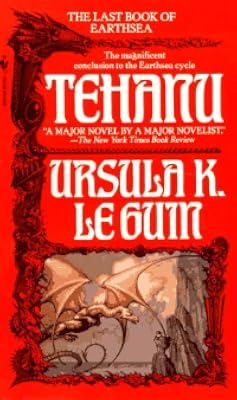
Arha's isolated existence as high priestess in the tombs of Atuan is jarred by a thief who seeks a special treasure.Tags
Recommendations














Member Recommendations

Aquila I feel like The Unspoken Name takes The Tombs of Atuan as a starting point, but it's just the beginning of a completely different story.
30
themulhern Girl escape from labyrinth with help of foreign hero.
Member Reviews
Something I'm really coming to appreciate about Le Guin in reading these Earthsea novels for the first time is her craftsmanship. When reading them one gets the feeling watching an understated but impeccably constructed watch. However simple the face seems, the internals have to be just right for it to tick along as smoothly as it does.
There's lots to praise about these novels--others have already done that. The setting is very well-realized, the plots are engaging, the prose is brisk and evocative. That's all definitely true. But what is really just doing it for me is the way Le Guin's strengths as a conventional novelist come through in these stories. I think people who read fantasy and sci-fi may tend to overlook this virtue of hers, show more partly because (please don't get mad) many of the people who read fantasy and sci-fi only read fantasy and sci-fi. There's been much talk of political filter bubbles in the last few decades, but truly it seems to me that genre fiction has become, it seems to me, even more so sectioned off into little hermetically sealed jungle gyms where you know, more or less, exactly what you're getting ahead of time. Look, I love genre fiction. I read tons of fantasy and sci-fi. But it also must be said that novels in these genres are not typically known for their grasp of the subtleties of human psychology, their interest in complex interpersonal dynamics, their appreciation for the limits of human agency. I suppose the response might be that these are precisely the things we come to genre fiction to escape. Fair enough, to a point. But as I puzzle out the byzantine imperial conflicts of Steven Erikson and George R. R. Martin and patiently watch as Kim Stanley Robinson entangles and untangles ideas from economic theory and materials science, I sometimes catch myself struggling to see how all these capital I Ideas can mean anything for us when the characters fundamentally behave like D&D archetypes and secondary characters in the Matrix. I guess what I'm getting at is that it's an old tired truth that fantasy and sci-fi have literary value because they reflect and refract truths about the real world. I think that's totally true, but for them to succeed in doing this, they need to say something about the real world. And no, it's not enough to just pepper your story with ideas cribbed from history, anthropology, and social science.
So, with all that throat-clearing aside, it's such a breath of fresh air to find in Le Guin's writing stories which appear on their surface to be relatively conventional fantasy fare, but which use the unique strengths of the genre to say something about the world. These are not books you come to for the latest iteration of a hard magic system. They are stories that use all the resources of their (individually interesting) supernatural elements and invented world to further the tell. In short, they're like all the young adult books I hoovered up in my teens, but good.
The Tombs of Atuan is the coming of age story of a woman, Arha, raised in a repressive religious community, selected from birth as the successor to the last High Priestess of the Nameless Ones, dark and powerful entities whose site of power is a pitch-black labyrinth deep beneath their temple. The story is anchored by a carefully rendered set of interpersonal relationships. There are the two other high priestesses for the other gods worshipped in the Kargad Empire, the death of one being a catalyst for heightening tensions between Arha and the other. There is Arha's sole friend among her peers, a dreamy and undisciplined younger woman. There is Arha's eunuch servant, Manan, upon whom she depends entirely, but who she finds herself incapable of loving, much to her shame. And, lastly, there is Ged, the protagonist of the first Earthsea book, who will come to represent for Arha something like a surrogate older brother.
Against this background, Arha herself is delicately realized. Almost imperceptibly throughout the novel, her early religious dedication is eroded by misgivings over the ritual torture and sacrifice she is obligated to carry out, by the meaninglessness of her life, and by what she hears about the outside world. We never really get one reason why she decides to risk sparing Ged, and, eventually, to leave her life behind. At the same time, Le Guin leads us to see how really any other outcome would be unthinkable. That is, Arha's like a real person, maybe a little irrational, making decisions for reasons she can't fully explain, but aiming, fundamentally, to do the right thing. And it's in this way that the reader gets to watch the character of Arha take shape and, at the end of the novel, become fully realized.
Again, maybe none of this seems groundbreaking. But none of it would work if Le Guin was not such an expert in bringing to life not just a fantasy setting but a social world and an internal life for her protagonist. What the book says and what it makes us feel is really attributable to a rock solid narrative core and a fine literary craftsmanship. What the genre of fantasy offers here is just a way to say something new about some very old ideas. show less
There's lots to praise about these novels--others have already done that. The setting is very well-realized, the plots are engaging, the prose is brisk and evocative. That's all definitely true. But what is really just doing it for me is the way Le Guin's strengths as a conventional novelist come through in these stories. I think people who read fantasy and sci-fi may tend to overlook this virtue of hers, show more partly because (please don't get mad) many of the people who read fantasy and sci-fi only read fantasy and sci-fi. There's been much talk of political filter bubbles in the last few decades, but truly it seems to me that genre fiction has become, it seems to me, even more so sectioned off into little hermetically sealed jungle gyms where you know, more or less, exactly what you're getting ahead of time. Look, I love genre fiction. I read tons of fantasy and sci-fi. But it also must be said that novels in these genres are not typically known for their grasp of the subtleties of human psychology, their interest in complex interpersonal dynamics, their appreciation for the limits of human agency. I suppose the response might be that these are precisely the things we come to genre fiction to escape. Fair enough, to a point. But as I puzzle out the byzantine imperial conflicts of Steven Erikson and George R. R. Martin and patiently watch as Kim Stanley Robinson entangles and untangles ideas from economic theory and materials science, I sometimes catch myself struggling to see how all these capital I Ideas can mean anything for us when the characters fundamentally behave like D&D archetypes and secondary characters in the Matrix. I guess what I'm getting at is that it's an old tired truth that fantasy and sci-fi have literary value because they reflect and refract truths about the real world. I think that's totally true, but for them to succeed in doing this, they need to say something about the real world. And no, it's not enough to just pepper your story with ideas cribbed from history, anthropology, and social science.
So, with all that throat-clearing aside, it's such a breath of fresh air to find in Le Guin's writing stories which appear on their surface to be relatively conventional fantasy fare, but which use the unique strengths of the genre to say something about the world. These are not books you come to for the latest iteration of a hard magic system. They are stories that use all the resources of their (individually interesting) supernatural elements and invented world to further the tell. In short, they're like all the young adult books I hoovered up in my teens, but good.
The Tombs of Atuan is the coming of age story of a woman, Arha, raised in a repressive religious community, selected from birth as the successor to the last High Priestess of the Nameless Ones, dark and powerful entities whose site of power is a pitch-black labyrinth deep beneath their temple. The story is anchored by a carefully rendered set of interpersonal relationships. There are the two other high priestesses for the other gods worshipped in the Kargad Empire, the death of one being a catalyst for heightening tensions between Arha and the other. There is Arha's sole friend among her peers, a dreamy and undisciplined younger woman. There is Arha's eunuch servant, Manan, upon whom she depends entirely, but who she finds herself incapable of loving, much to her shame. And, lastly, there is Ged, the protagonist of the first Earthsea book, who will come to represent for Arha something like a surrogate older brother.
Against this background, Arha herself is delicately realized. Almost imperceptibly throughout the novel, her early religious dedication is eroded by misgivings over the ritual torture and sacrifice she is obligated to carry out, by the meaninglessness of her life, and by what she hears about the outside world. We never really get one reason why she decides to risk sparing Ged, and, eventually, to leave her life behind. At the same time, Le Guin leads us to see how really any other outcome would be unthinkable. That is, Arha's like a real person, maybe a little irrational, making decisions for reasons she can't fully explain, but aiming, fundamentally, to do the right thing. And it's in this way that the reader gets to watch the character of Arha take shape and, at the end of the novel, become fully realized.
Again, maybe none of this seems groundbreaking. But none of it would work if Le Guin was not such an expert in bringing to life not just a fantasy setting but a social world and an internal life for her protagonist. What the book says and what it makes us feel is really attributable to a rock solid narrative core and a fine literary craftsmanship. What the genre of fantasy offers here is just a way to say something new about some very old ideas. show less
This is a book that I find rather tough to review. The way Le Guin writes, in these first two Earthsea books I have read by her, is beautifully intricate and I feel like not only do I have to give myself time to think on each segment of the book I am reading but that I also need to re-read it to truly be able to even begin grasping the many meanings hidden in it's seemingly simplistic folds. Something striking about both Le Guin's A Wizard of Earthsea and The Tombs of Atuan, is this simplistic outer layer of story, which is almost akin to the tombs of this novel itself, in which the outer layer is only a small portion of what is really there. Upon entering the tombs there are many levels and twisting corridors and just as Tenar must go show more through the labyrinth time and again, slowly learning it's many, many twists and turns, we must go through this story. This book is only 180 pages, and I happened to listen to it on audio, but it took me much longer than I had anticipated. Nearly a month in fact. There were times I needed to rewind as well, to listen to parts again. Sometimes, because of this book's extremely slow pacing, I would find myself feeling like I missed something and having to go back. And indeed, every detail has to be taken into account in a book where the lighting in particular scenes, the sounds, the tones- it all must be taken into account. Reading mostly YA and manga, I feel like I am not used to having to be so hyper-aware while reading, but that is not to say that it is unpleasant. I thoroughly enjoy the challenge and appreciate the attention to detail put into every moment.
Tenar, taken from her home at the age of 5, is taken to the Tombs of Atuan to be the next Priestess of the Nameless ones, whose domain are these very same tombs. However, it is not so much that she is the next priestess as it is that she is the next reincarnation of this figure known as "the eaten one" translated into "Ahar." The Priestess is a servant of the ancient gods called The Nameless Ones who have eaten her soul. She must spend her life in their service: giving sacrifices, performing many rituals, and protecting the sacred realms of the Tombs. She must protect the darkness, for that is also what The Nameless Ones are. She must learn her way at the tombs in the dark, never seeing the truth of things because of the dark powers that hide them. The first time she is ever able to see the undertomb is when Ged, from A Wizard of Earthsea, comes into the sacred place and defiles it with light. Ahar must decide what to do about the intruder, what to make of his magic, and how to proceed as The Eaten One. Ahar also must walk carefully with Cossil, who worships the Godking- or rather, the power he holds. This character is shrouded by cloaks and darkness and a strong distaste for the gods and for their servants.
Tenar, being Ahar's true name which was supposedly eaten along with the rest of her soul, is re-given her name by this light-bringer in the tombs and they enter the labyrinth together. I feel almost certain that their being in the labyrinth together is meant to be symbolic of Ged helping her to find her way. The tombs, the dark and the light, the names, the emergence visuals, etc. all take the plot of a girl growing into a woman and make it into physical aspects of the world the main character must traverse through before emerging into her changed self at the end. Tenar must learn what she chooses to believe and what she chooses to leave behind of the girl that had to lean on the understanding of those around her. With the little help of an outsider's point of view, she is finally able to get a better idea of the type of life she leads and how it compares to the world, and it's people, that she has been so isolated from.
Tenar's journey had similarities to that of Ged's in the first novel of this series, mainly that of being a seemingly simplistic journey that translates itself through the many themes, the very environment, the words used, all of it, into so many different intricacies that I feel as though I have missed many somethings in both books and that I must go back over them again. We even see Ged again, at a later stage of his life, helping another through a similar situation he went through when he was her age. Similar in the way that growing in this world and learning of it's darkness and of it's light, is similar to all humanity. Yet, different in most every other way.
I would recommend this second book of the Earthsea series, just as I would recommend the first, to those who enjoy fantasy with a lot of philosophical undertones. They are probably the most similar in this aspect. However, I will caution not to fly through it because of it's brevity and appearance of simplicity. Take the story in slowly, and watch as it travels beneath the surface of the Tombs of Atuan, to transform and emerge and become something all the more liberated for the journey. show less
Tenar, taken from her home at the age of 5, is taken to the Tombs of Atuan to be the next Priestess of the Nameless ones, whose domain are these very same tombs. However, it is not so much that she is the next priestess as it is that she is the next reincarnation of this figure known as "the eaten one" translated into "Ahar." The Priestess is a servant of the ancient gods called The Nameless Ones who have eaten her soul. She must spend her life in their service: giving sacrifices, performing many rituals, and protecting the sacred realms of the Tombs. She must protect the darkness, for that is also what The Nameless Ones are. She must learn her way at the tombs in the dark, never seeing the truth of things because of the dark powers that hide them. The first time she is ever able to see the undertomb is when Ged, from A Wizard of Earthsea, comes into the sacred place and defiles it with light. Ahar must decide what to do about the intruder, what to make of his magic, and how to proceed as The Eaten One. Ahar also must walk carefully with Cossil, who worships the Godking- or rather, the power he holds. This character is shrouded by cloaks and darkness and a strong distaste for the gods and for their servants.
Tenar, being Ahar's true name which was supposedly eaten along with the rest of her soul, is re-given her name by this light-bringer in the tombs and they enter the labyrinth together. I feel almost certain that their being in the labyrinth together is meant to be symbolic of Ged helping her to find her way. The tombs, the dark and the light, the names, the emergence visuals, etc. all take the plot of a girl growing into a woman and make it into physical aspects of the world the main character must traverse through before emerging into her changed self at the end. Tenar must learn what she chooses to believe and what she chooses to leave behind of the girl that had to lean on the understanding of those around her. With the little help of an outsider's point of view, she is finally able to get a better idea of the type of life she leads and how it compares to the world, and it's people, that she has been so isolated from.
Tenar's journey had similarities to that of Ged's in the first novel of this series, mainly that of being a seemingly simplistic journey that translates itself through the many themes, the very environment, the words used, all of it, into so many different intricacies that I feel as though I have missed many somethings in both books and that I must go back over them again. We even see Ged again, at a later stage of his life, helping another through a similar situation he went through when he was her age. Similar in the way that growing in this world and learning of it's darkness and of it's light, is similar to all humanity. Yet, different in most every other way.
I would recommend this second book of the Earthsea series, just as I would recommend the first, to those who enjoy fantasy with a lot of philosophical undertones. They are probably the most similar in this aspect. However, I will caution not to fly through it because of it's brevity and appearance of simplicity. Take the story in slowly, and watch as it travels beneath the surface of the Tombs of Atuan, to transform and emerge and become something all the more liberated for the journey. show less
Like the first book of the Earthsea series, I had childhood memories of key figures and scenes from The Tombs of Atuan, but much of the story seemed new to me in this re-read half a century later. In particular, my recollection had falsely collapsed this second book into a simple sequel with Ged as its protagonist, when in fact it is Tenar who is the main character. Ged doesn't appear at all until the fifth of twelve chapters, and even then isn't positively identified until late in the sixth. Tombs is a girl's magical bildungsroman as Wizard was a boy's.
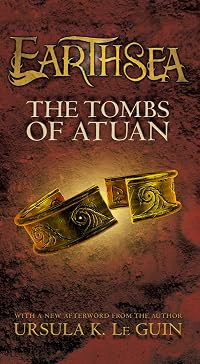
In her 2012 afterword, Le Guin admits that the story and its heroine fall short of ideals latterly promoted for feminist fantasy. Girlbossery is nothing admirable here, and women and show more men do rely on each other for fulfillment and freedom. This lesson is bluntly symbolized by the reassembly of the two pieces of the Ring of Erreth-Akbe (even pictured on the cover of the recent edition I read). Tenar faces far more adversity than Ged did. While he was allowed to win his own power, she was given an authority that bound her into a catena of oppression. His catalyzing of her liberation could be read as a "rescue."
I have much more cultural context now than I did as a young reader to appreciate the Kargish religion that Le Guin presents. In particular, the tulku One Priestess Arha was a concept that was worked out in a convincing and intriguing way. The supernatural elements of the story are handled with a gentler touch than in the first book.
Where Wizard had Ged ranging from one end of Earthsea to another, this one takes place almost entirely in a single insular community, cut off from the wider culture and commerce of the world. Even so, some nested exposition allows Le Guin to considerably fill in the lore of her larger setting. Ged's experiences have given him stories worth sharing. He observes, "Dragons think we are amusing" (135). It's a natural outcome of the fact that the book was written in some measure to explore the throwaway allusion at the end of the first book to one of Ged's later accomplishments to have "brought back the Ring of Erreth-Akbe from the Tombs of Atuan to Havnor." show less
In her 2012 afterword, Le Guin admits that the story and its heroine fall short of ideals latterly promoted for feminist fantasy. Girlbossery is nothing admirable here, and women and show more men do rely on each other for fulfillment and freedom. This lesson is bluntly symbolized by the reassembly of the two pieces of the Ring of Erreth-Akbe (even pictured on the cover of the recent edition I read). Tenar faces far more adversity than Ged did. While he was allowed to win his own power, she was given an authority that bound her into a catena of oppression. His catalyzing of her liberation could be read as a "rescue."
I have much more cultural context now than I did as a young reader to appreciate the Kargish religion that Le Guin presents. In particular, the tulku One Priestess Arha was a concept that was worked out in a convincing and intriguing way. The supernatural elements of the story are handled with a gentler touch than in the first book.
Where Wizard had Ged ranging from one end of Earthsea to another, this one takes place almost entirely in a single insular community, cut off from the wider culture and commerce of the world. Even so, some nested exposition allows Le Guin to considerably fill in the lore of her larger setting. Ged's experiences have given him stories worth sharing. He observes, "Dragons think we are amusing" (135). It's a natural outcome of the fact that the book was written in some measure to explore the throwaway allusion at the end of the first book to one of Ged's later accomplishments to have "brought back the Ring of Erreth-Akbe from the Tombs of Atuan to Havnor." show less
There seem to me to have been some extraordinary storytelling choices made with this book. Sideline the hero of the previous volume, have him absent for nearly a third of the book, tell the entire story from the perspective of a young priestess raised to worship dark and terrible powers in a warlike expanding empire. It's as if the sequel to Star Wars had been told from the point of view of a trainee Sith and Luke Skywalker turned up just after having his hand chopped off, an invalid in an Imperial prison. And yet it is a beautiful book about learning that the things you have believed and taken for granted all your life are far narrower, more constrained and fundamentally strange, if not downright bad, than you could have imagined, and show more that your life in devotion to this thing, which you never had any choice about anyway, has been wasted. Haunting and written with an attention to craft and detail that makes the heart ache and the mind snap to attention, this is one of the great novels about breaking free. show less
If this were a more adult-oriented story, Tenar (I refuse to call her Arha) would have been more conscious of her loss of family, more resistant to her fate, more difficult to control. For those reasons I took this story rather lightly at first, but now I think I was wrong to do so. Someone who resists from the beginning is only seeking an opportunity to escape. What happens to Tenar is more nefarious. She is given enough power, just enough freedom in her world within its walls, that she can believe herself powerful, believe herself free. The walls of her trap are almost invisible to her, making it that much more difficult to escape. On some subconscious level she is aware of it and oppressed by it, even as she wonders at Penthe's show more dreams. Her dismissal of the world beyond the walls, beyond the desert, is an attempted dismissal of her own inner doubts. She defers viewing the secret underground treasure in order to preserve at least one last mystery, to make the world she is confined to feel larger than it really is. It is not until Ged's arrival that she feels its true smallness.
The back cover blurb positions Ged as Tenar's rescuer, but I am more interested in how Tenar rescues herself. She preserves Ged's life, this symbol of true freedom. Confronted with an identity crisis, she makes her choice after it is clear that Ged has the power but not the strength to make her obey his will. I read the final escape not just as the Nameless Ones' last grasp, but as Tenar's final answer to whether she will cross beyond the boundaries of all that she knows. I felt sorry for Manan, but the contrast in fates is necessary - someone who never questions, never desires escape. Two chapters of anticlimax feels a bit much in a book this short, but there's the end of a trilogy to prepare for on top of the nice link we're given to the first book. While this was effectively the continuing adventures of Ged, it would have made for a dull tale to hear this story from him. LeGuin moved the viewpoint to Tenar, made her sympathetic, and gave us a new (then scarce) heroine to celebrate. show less
The back cover blurb positions Ged as Tenar's rescuer, but I am more interested in how Tenar rescues herself. She preserves Ged's life, this symbol of true freedom. Confronted with an identity crisis, she makes her choice after it is clear that Ged has the power but not the strength to make her obey his will. I read the final escape not just as the Nameless Ones' last grasp, but as Tenar's final answer to whether she will cross beyond the boundaries of all that she knows. I felt sorry for Manan, but the contrast in fates is necessary - someone who never questions, never desires escape. Two chapters of anticlimax feels a bit much in a book this short, but there's the end of a trilogy to prepare for on top of the nice link we're given to the first book. While this was effectively the continuing adventures of Ged, it would have made for a dull tale to hear this story from him. LeGuin moved the viewpoint to Tenar, made her sympathetic, and gave us a new (then scarce) heroine to celebrate. show less
9/10
Such a slim book, but it holds such a full and deep story! Arha, stolen from her ordinary childhood to become the One Priestess of the Nameless Ones, learns of power, loneliness, trust, and freedom as she matures and faces a mystery that challenges all she has been taught and believes. The author makes the Undertomb and the Labyrinth come alive. The secondary characters (Manan, Thar, Kossil, Penthe) are only briefly sketched yet fully realized. Most importantly, the reader is drawn completely into Arha/Tenar’s life, thoughts, and feelings.
Such a slim book, but it holds such a full and deep story! Arha, stolen from her ordinary childhood to become the One Priestess of the Nameless Ones, learns of power, loneliness, trust, and freedom as she matures and faces a mystery that challenges all she has been taught and believes. The author makes the Undertomb and the Labyrinth come alive. The secondary characters (Manan, Thar, Kossil, Penthe) are only briefly sketched yet fully realized. Most importantly, the reader is drawn completely into Arha/Tenar’s life, thoughts, and feelings.
In the second installment in the Earthsea series, a girl is declared to be the reincarnated Priestess of a remote, timeless place and is taken from her family at an early age. She grows up learning its customs and believes herself to have great power, but has very limited experience of the actual world. She’s also got a rival in the form of the head Priestess of the State, which has its political power increasing.
What could have been a conventional coming-of-age tale in less skillful hands than Le Guin’s becomes a critique of cloistered, religious institutions that deny reality and don’t affirm life and joy, and I love the book for that. Much of the action takes place in subterranean tombs and an enormous labyrinth, all in show more darkness, which is telling. The young woman administers ancient rites with little meaning, and has no qualms about ceremonially executing enemies of the State who have been brought there. Her personal flaws and the flaws of the religious system she finds herself in are evident. There is real darkness here, and I don’t just mean the claustrophobic, blind environment Le Guin successfully creates. Just as in ‘A Wizard of Earthsea,’ the first book in the series, there are elements of identity and finding one’s self, but there is also profound disillusionment and loss of faith. It’s a mature, very intelligent work with a gravitas not often seen in young adult fiction.
Quote:
“The Earth is beautiful, and bright, and kindly, but that is not all. The Earth is also terrible, and dark, and cruel. The rabbit shrieks dying in the green meadows. The mountains clench their great hands full of hidden fire. There are sharks in the sea, and there is cruelty in men’s eyes. And where men worship these things and abase themselves before them, there evil breeds; there places are made in the world where darkness gathers, places given over wholly to the Ones whom we call Nameless, the ancient and holy Powers of the Earth before the Light, the powers of the dark, of ruin, of madness…”
Also, this one from the Afterword, Le Guin explaining the limitations of the main character, which unfortunately led to criticism. Personally I loved the balance in this book and for just how progressive it was, with its critique of religion and its protagonists, one of whom was female and the other of whom was black:
“In such a world, I could put a girl at the heart of my story, but I couldn’t give her a man’s freedom, or chances equal to a man’s chances. She couldn’t be a hero in the hero-tale sense. Not even in a fantasy? No. Because to me, fantasy isn’t wishful thinking, but a way of reflecting, and reflecting on reality. After all, even in a democracy, in the second decade of the twenty-first century, after forty years of feminist striving, the reality is that we live in a top-down power structure that was shaped by, and is still dominated by, men. Back in 1969, that reality seemed almost unshakeable.” show less
What could have been a conventional coming-of-age tale in less skillful hands than Le Guin’s becomes a critique of cloistered, religious institutions that deny reality and don’t affirm life and joy, and I love the book for that. Much of the action takes place in subterranean tombs and an enormous labyrinth, all in show more darkness, which is telling. The young woman administers ancient rites with little meaning, and has no qualms about ceremonially executing enemies of the State who have been brought there. Her personal flaws and the flaws of the religious system she finds herself in are evident. There is real darkness here, and I don’t just mean the claustrophobic, blind environment Le Guin successfully creates. Just as in ‘A Wizard of Earthsea,’ the first book in the series, there are elements of identity and finding one’s self, but there is also profound disillusionment and loss of faith. It’s a mature, very intelligent work with a gravitas not often seen in young adult fiction.
Quote:
“The Earth is beautiful, and bright, and kindly, but that is not all. The Earth is also terrible, and dark, and cruel. The rabbit shrieks dying in the green meadows. The mountains clench their great hands full of hidden fire. There are sharks in the sea, and there is cruelty in men’s eyes. And where men worship these things and abase themselves before them, there evil breeds; there places are made in the world where darkness gathers, places given over wholly to the Ones whom we call Nameless, the ancient and holy Powers of the Earth before the Light, the powers of the dark, of ruin, of madness…”
Also, this one from the Afterword, Le Guin explaining the limitations of the main character, which unfortunately led to criticism. Personally I loved the balance in this book and for just how progressive it was, with its critique of religion and its protagonists, one of whom was female and the other of whom was black:
“In such a world, I could put a girl at the heart of my story, but I couldn’t give her a man’s freedom, or chances equal to a man’s chances. She couldn’t be a hero in the hero-tale sense. Not even in a fantasy? No. Because to me, fantasy isn’t wishful thinking, but a way of reflecting, and reflecting on reality. After all, even in a democracy, in the second decade of the twenty-first century, after forty years of feminist striving, the reality is that we live in a top-down power structure that was shaped by, and is still dominated by, men. Back in 1969, that reality seemed almost unshakeable.” show less
Members
- Recently Added By
Published Reviews
ThingScore 75
Carol Reich (KLIATT Review, March 1995 (Vol. 29, No. 2))
Le Guin's 1970 fantasy for YAs (part two of the Earthsea Trilogy) has held up well over the decades and remains engaging. Narrative predominates throughout, but during the dialogue Inglis' voiced characters are never confusing to the listener. The three main female voices are acceptably done, the two main male voices are well done, the show more recording is clear, and Inglis is skilled enough to drop out of character for phrases such as "she said." Between the two of them, Le Guin and Inglis paint a vivid picture of the devious, threatening labyrinth that exists both underneath the temple and within the heart of the High Priestess whom the Wizard Ged rescues from service to the Nameless Ones. This book can stand alone. Category: Fiction Audiobooks. KLIATT Codes: JS*--Exceptional book, recommended for junior and senior high school students. 1994, Recorded Books, 4 tapes, 5.5 hrs. show less
Le Guin's 1970 fantasy for YAs (part two of the Earthsea Trilogy) has held up well over the decades and remains engaging. Narrative predominates throughout, but during the dialogue Inglis' voiced characters are never confusing to the listener. The three main female voices are acceptably done, the two main male voices are well done, the show more recording is clear, and Inglis is skilled enough to drop out of character for phrases such as "she said." Between the two of them, Le Guin and Inglis paint a vivid picture of the devious, threatening labyrinth that exists both underneath the temple and within the heart of the High Priestess whom the Wizard Ged rescues from service to the Nameless Ones. This book can stand alone. Category: Fiction Audiobooks. KLIATT Codes: JS*--Exceptional book, recommended for junior and senior high school students. 1994, Recorded Books, 4 tapes, 5.5 hrs. show less
added by kthomp25
Lists

Best Fantasy Novels
821 works; 361 members

Favorite Childhood Books
1,651 works; 519 members
Favourite High Fantasy Books
113 works; 23 members
NPRs Ultimate Backseat Bookshelf: 100 Must-Reads for kids 9-14
222 works; 30 members

Best Newbery Honor Books
257 works; 32 members

NPRs your favorites: 100 Best Ever Teen Novels
237 works; 49 members

20th Century Literature
1,161 works; 55 members

Female Protagonist
1,056 works; 57 members

Fantasy novels with a female protagonist
76 works; 15 members

Here There Be Dragons
143 works; 23 members

1970s
657 works; 23 members

Favourite Books
1,819 works; 316 members
The 100 Best Fantasy Books of All Time
100 works; 15 members
Speculative Fiction to Read
706 works; 32 members

Recommended Speculative Fiction by Women and People of Color
298 works; 45 members

infjsarah's wishlist
408 works; 2 members
Science Fiction and Fantasy
63 works; 4 members

Books Read in 2024
4,727 works; 128 members

Books Read in 2003
258 works; 7 members

Recommended Reading : 600 Classics Reviewed, Editors of Salem Press, 2015
634 works; 6 members

Books That Made Us Cry
278 works; 145 members

Book Club: There aren’t any [Blank] authors in Sci Fi/Fantasy!
12 works; 1 member

Books Read in 2022
5,226 works; 115 members

Les 100 principaux titres de la science-fiction (1981)
126 works; 3 members

Maybe This Year? Books to Look Forward To
412 works; 9 members

Lista d1
22 works; 1 member

Books Read in 2025
4,128 works; 98 members

Newbery Honor Books By Year - I - 1922-1980
199 works; 3 members
Books Read in 2018
4,360 works; 110 members

Books Read in 2009
464 works; 11 members

Books Read in 2021
5,361 works; 114 members
Literature About Women and Girls
394 works; 39 members

Unread books
1,063 works; 87 members

Fantastic Librarians
11 works; 3 members

Books Read in 2015
3,299 works; 129 members

Books Read in 2014
2,343 works; 87 members
Stories Featuring Passages, Gateways and Doors
39 works; 11 members
Read These Too
458 works; 9 members

Best Feminist Science Fiction
188 works; 35 members
Books tagged unread
41 works; 1 member

Read in 2003
81 works; 1 member
Favorite Science Fiction by Women Authors
737 works; 202 members
Best Children's Books You've Read
197 works; 74 members
Author Information

498+ Works 167,577 Members
Ursula K. Le Guin was born Ursula Kroeber in Berkeley, California on October 21, 1929. She received a bachelor's degree from Radcliffe College in 1951 and a master's degree in romance literature of the Middle Ages and Renaissance from Columbia University in 1952. She won a Fulbright fellowship in 1953 to study in Paris, where she met and married show more Charles Le Guin. Her first science-fiction novel, Rocannon's World, was published in 1966. Her other books included the Earthsea series, The Left Hand of Darkness, The Dispossessed: An Ambiguous Utopia, The Lathe of Heaven, Four Ways to Forgiveness, and The Telling. A Wizard of Earthsea received an American Library Association Notable Book citation, a Horn Book Honor List citation, and the Lewis Carroll Shelf Award in 1979. She received the Medal for Distinguished Contribution to American Letters in 2014. She also received the Nebula Award and the Hugo Award. She also wrote books of poetry, short stories collections, collections of essays, children's books, a guide for writers, and volumes of translation including the Tao Te Ching of Lao Tzu and selected poems by Gabriela Mistral. She died on January 22, 2018 at the age of 88. (Bowker Author Biography) show less
Some Editions
Awards and Honors
Awards
Series

Belongs to Publisher Series
Work Relationships
Is contained in
Common Knowledge
- Canonical title
- The Tombs of Atuan
- Original title
- The Tombs of Atuan
- Original publication date
- 1970
- People/Characters
- Tenar (Arha, the One Priestess); Ged (Sparrowhawk); Penthe; Manan; Kossil (Priestess of the God-King); Thar (Priestess of the Twin Gods)
- Important places
- Atuan; Karego-At; Earthsea; Havnor
- Related movies
- Earthsea (2004 | IMDb)
- Epigraph*
- Solo nel silenzio la parola,
solo nella tenebra la luce,
solo nella morte è vita;
fulgido è il volo del falco
nel cielo deserto.
La creazione di Éa - Dedication
- For the redhead from Telluride
- First words
- "Come home, Tenar!" (prologue)
One high horn shrilled and ceased. - Quotations*
- Stáli tam plné významu, ktorý však ostával skrytý. (s. 21)
Plakala pre stratené roky strávené v područí bezcenného zla. Vzlykala od bolesti, pretože bola slobodná. (s. 133)
Začínala si uvedomovať, aká je sloboda ťažká. Zistila, že sloboda je ťažký náklad, veľké a zvláštne bremeno, ktoré na seba nakladá duch. Nie je to dar, ale voľba, a tá voľba môže byť veľmi ťažká. A... (show all)ko cesta, čo stúpa k svetlu, ale po ktorej k nemu pútnik s takým bremenom nemusí nikdy dôjsť. (s. 134) - Last words
- (Click to show. Warning: May contain spoilers.)Gravely she walked beside him up the white streets of Havnor, holding his hand, like a child coming home.
- Original language
- English
- Canonical DDC/MDS
- 813.087661
*Some information comes from Common Knowledge in other languages. Click "Edit" for more information.
Classifications
- Genres
- Fantasy, Fiction and Literature, Teen
- DDC/MDS
- 813.087661 — Literature & rhetoric American literature in English American fiction in English By type Genre fiction Adventure fiction Speculative fiction Fantasy High fantasy
- LCC
- PZ7 .L5215 .T — Language and Literature Fiction and juvenile belles lettres Fiction and juvenile belles lettres Juvenile belles lettres
- BISAC
Statistics
- Members
- 10,248
- Popularity
- 957
- Reviews
- 187
- Rating
- (4.02)
- Languages
- 29 — Catalan, Czech, Danish, Dutch, English, Estonian, Finnish, French, German, Galician, Greek, Hebrew, Hungarian, Italian, Japanese, Korean, Lithuanian, Maltese, Norwegian (Bokmål), Polish, Russian, Serbian, Slovak, Spanish, Swedish, Turkish, Ukrainian, Portuguese (Portugal), Chinese, traditional
- Media
- Paper, Audiobook, Ebook
- ISBNs
- 126
- ASINs
- 54