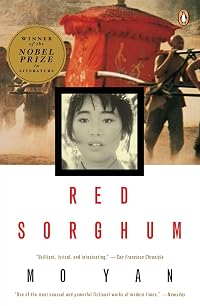
Red Sorghum
by Mo Yan
On This Page
Description
Spanning three generations, this novel of family and myth is told through a series of flashbacks that depict events of staggering horror set against a landscape of gemlike beauty, as the Chinese battle both Japanese invaders and each other in the turbulent 1930s. A legend in China, where it won major literary awards and inspired an Oscar-nominated film, Red Sorghum is a book in which fable and history collide to produce fiction that is entirely new--and unforgettable.Tags
Recommendations




Member Reviews
A family in rural China in the 1920s and 30s confronts banditry, civil war and the Japanese occupation. Mo Yan plays with the timeline to force us to read this as a novel about individual people, not abstract historical events, and there's a lot of local colour — most of it red and cereal-based — grim wit, and human resilience in the face of overwhelming odds.
Inevitably, given that it's dealing with times in which civil order had broken down in the face of barbarism and competing factions, there's a lot of violence. Mo Yan places at least one act of extreme violence at the centre of each chapter, and each one is described in loving and often grotesque detail. I'm guessing that the idea is that we are supposed to realise how the show more incessant piling up of shocking detail is desensitising us to what is going on, in something like the way it might if we were confronted with it in real life, but after a while it just started to feel vaguely pornographic.
I can see the importance of this book, and it probably goes a long way to explain how China works and why the current Chinese government is so authoritarian and so extremely allergic to any sign of disorder. But, from the perspective of my particular squeamish, western, liberal ivory tower, it's not really a book that I would ever want to read again or to recommend to anyone else. show less
Inevitably, given that it's dealing with times in which civil order had broken down in the face of barbarism and competing factions, there's a lot of violence. Mo Yan places at least one act of extreme violence at the centre of each chapter, and each one is described in loving and often grotesque detail. I'm guessing that the idea is that we are supposed to realise how the show more incessant piling up of shocking detail is desensitising us to what is going on, in something like the way it might if we were confronted with it in real life, but after a while it just started to feel vaguely pornographic.
I can see the importance of this book, and it probably goes a long way to explain how China works and why the current Chinese government is so authoritarian and so extremely allergic to any sign of disorder. But, from the perspective of my particular squeamish, western, liberal ivory tower, it's not really a book that I would ever want to read again or to recommend to anyone else. show less
Saw the movie, read the book. The film, as colorful and vivid as it is, covers only the first two chapters.
This is a multi-generational story of a family in the Shandong countryside. One might be tempted to label it 'magical realism', but this is all set during the Japanese invasion, and life, already hard due to banditry, becomes even more gruesome. For example - in the first 40 pages, one family member is skinned alive.
Mo Yan also experiments with story structure, flitting back and forth in time. He doesn't let any chronology build up, but instead lets the collection of memories make an impression upon you. The family member who had his skin ripped off comes back several times, and, dare I say, his fate hits you more.
This is also a show more novel of extreme contradictions, and a sort of warm irony. The transitions of events are jarring. Elaborate family funerals, rotten bodies, love stories, people's heads exploding, red sorghum wine.
There is a final metaphor here. The author/narrator returns to his home village, and the 'red sorghum' has been replaced by a green pasty substitute. The curtain has changed, and something is missing.
An impressive book, and one which gives a discerning look at the past, as ignoble and beautiful as it can be. show less
This is a multi-generational story of a family in the Shandong countryside. One might be tempted to label it 'magical realism', but this is all set during the Japanese invasion, and life, already hard due to banditry, becomes even more gruesome. For example - in the first 40 pages, one family member is skinned alive.
Mo Yan also experiments with story structure, flitting back and forth in time. He doesn't let any chronology build up, but instead lets the collection of memories make an impression upon you. The family member who had his skin ripped off comes back several times, and, dare I say, his fate hits you more.
This is also a show more novel of extreme contradictions, and a sort of warm irony. The transitions of events are jarring. Elaborate family funerals, rotten bodies, love stories, people's heads exploding, red sorghum wine.
There is a final metaphor here. The author/narrator returns to his home village, and the 'red sorghum' has been replaced by a green pasty substitute. The curtain has changed, and something is missing.
An impressive book, and one which gives a discerning look at the past, as ignoble and beautiful as it can be. show less
Originally published as 5 separate novellas, the novel can feel a bit disjointed in places - the main timeline in each of them is slightly different and that changes how the story inside of each segment works. But the novel has a unified overall structure - each of the stories weaves in and out of different timelines (sometimes multiple times on the same page) and ends up fitting like a puzzle - every part of the stories fit in its own place and by the time you finish the novel, you have the story of a family from the early 20th century to the 80s. It is heavier on the earlier part of the stories - the story of Grandma in the 20s and the Father's story in the 30s and early 40s dominate the story; the story of the narrator which spans show more the 60s-80s are there mostly for comparison and in short notes. The more you know of Chinese history, the more you will get from some of these glimpses into these periods -- without at least a basic idea, some of their importance can be lost.
But it is not just a historical novel - it weaves in a lot of mythology into the narrative. Sometimes it is hard to draw the line between the real and the unreal and between the mythological and the historical. Add the constant shift between the timelines (and in one of the chapters in the viewpoint - the story about the dogs is so full of allusions and metaphors that I was never sure if it is part of the novel really or if it was added just as a commentary. On the other hand, it actually connects with the main story and allows some additional comparisons and insights which add to the tapestry of the novel).
In a way, it is as much the story of a family as it is a story of a country. From Grandma, still proud with her golden lotuses (bound feet), through the rebels fighting against Japan (although it seemed to fight more internally than with the imperial army) and into the modern times, the family changes as China changes. That's where the story really shines - the family sounds unconventional but is connected to the traditions of the times in so many ways that you can almost see where the traditional turns into a new thing. It is this constant change that ends up the main thread that connects the disjointed parts of the story - and a lot of that change was almost hidden into the colors through the story - keeping track of what colors are mentioned and where helps with the understanding of the story. These two threads, the constant change and the colors, are there to the very end - from the ghost of the Second Grandma who makes a point to come back from the grave to condemn the narrator for spending so much time in the city to that very last stalk of red sorghum which somehow survived the change to higher yielding varietals - it all came back down to tradition and change, to the new and the old. And depending on how you want to read certain parts, you may get a different idea of which side the narrator (or the author) is on.
It is not an easy novel to read through - between the time jumps (some predictable, some feeling as if the author wrote the stories and then cut them into pieces and just inserted one into the other in random places), the constant stories starting with their ends (we were told what happened before we were told the story of that event) and the gory details in some parts of the story, it required a certain state of mind. Keeping track of the various stories became easier as the novel progressed and as the reader gets more familiar with the people (some of which had different names in different periods - and the author made the distinction clear so one had to follow these and connect the dots when the timelines intersected), the story started to feel less of a jumble. But sometimes it still seemed more like a literary exercise than a novel - while the story is in there, the modernistic style felt a bit too overwhelming. It adds to the uneasiness that the novel projects and was probably designed with that in mind but I wonder if a bit less jumbled story, even if it was still not completely linear, would not have served the underlying story better. But considering that it was published in the form of separate stories in various magazines and that it is the first novel of the author play somewhat into this - the different chapters/novellas have their own internal cohesiveness.
I am still not entirely sure if I liked the novel. There is enough in it that I enjoyed so I am not sorry that I read it but I found it heavy going in places where I least expected. It could have used some notes and a glossary - while some elements were supposed to be explained in the novel (and they were), the initial audience of the novel would have recognized some of the references in the Chinese text. show less
But it is not just a historical novel - it weaves in a lot of mythology into the narrative. Sometimes it is hard to draw the line between the real and the unreal and between the mythological and the historical. Add the constant shift between the timelines (and in one of the chapters in the viewpoint - the story about the dogs is so full of allusions and metaphors that I was never sure if it is part of the novel really or if it was added just as a commentary. On the other hand, it actually connects with the main story and allows some additional comparisons and insights which add to the tapestry of the novel).
In a way, it is as much the story of a family as it is a story of a country. From Grandma, still proud with her golden lotuses (bound feet), through the rebels fighting against Japan (although it seemed to fight more internally than with the imperial army) and into the modern times, the family changes as China changes. That's where the story really shines - the family sounds unconventional but is connected to the traditions of the times in so many ways that you can almost see where the traditional turns into a new thing. It is this constant change that ends up the main thread that connects the disjointed parts of the story - and a lot of that change was almost hidden into the colors through the story - keeping track of what colors are mentioned and where helps with the understanding of the story. These two threads, the constant change and the colors, are there to the very end - from the ghost of the Second Grandma who makes a point to come back from the grave to condemn the narrator for spending so much time in the city to that very last stalk of red sorghum which somehow survived the change to higher yielding varietals - it all came back down to tradition and change, to the new and the old. And depending on how you want to read certain parts, you may get a different idea of which side the narrator (or the author) is on.
It is not an easy novel to read through - between the time jumps (some predictable, some feeling as if the author wrote the stories and then cut them into pieces and just inserted one into the other in random places), the constant stories starting with their ends (we were told what happened before we were told the story of that event) and the gory details in some parts of the story, it required a certain state of mind. Keeping track of the various stories became easier as the novel progressed and as the reader gets more familiar with the people (some of which had different names in different periods - and the author made the distinction clear so one had to follow these and connect the dots when the timelines intersected), the story started to feel less of a jumble. But sometimes it still seemed more like a literary exercise than a novel - while the story is in there, the modernistic style felt a bit too overwhelming. It adds to the uneasiness that the novel projects and was probably designed with that in mind but I wonder if a bit less jumbled story, even if it was still not completely linear, would not have served the underlying story better. But considering that it was published in the form of separate stories in various magazines and that it is the first novel of the author play somewhat into this - the different chapters/novellas have their own internal cohesiveness.
I am still not entirely sure if I liked the novel. There is enough in it that I enjoyed so I am not sorry that I read it but I found it heavy going in places where I least expected. It could have used some notes and a glossary - while some elements were supposed to be explained in the novel (and they were), the initial audience of the novel would have recognized some of the references in the Chinese text. show less
Fields of Sorghum appear on nearly every page of Mo Yan's novel and it is no wonder because his characters; eat it, feed their animals with it, make wine from it, fight in it, die in it, take refuge in it, make love in it, keep warm from it, build houses from it and one bandit group actually live in it. I felt right at home with this aspect of the novel because where I live I am surrounded by Maize fields, which like sorghum grows incredibly quickly and produces dense fields of tall plants well above head height. In the summer it becomes home to the wild boar population, but I don't believe bandits live in it.
This description of Sorghum is taken from wiki:
One species, Sorghum bicolor, is an important world crop, used for food (as grain show more and in sorghum syrup or "sorghum molasses"), fodder, the production of alcoholic beverages, and biofuels. Most varieties are drought- and heat-tolerant, and are especially important in arid regions, where the grain is one of the staples for poor and rural people. These varieties form important components of pastures in many tropical regions. Sorghum bicolor is an important food crop in Africa, Central America, and South Asia and is the "fifth most important cereal crop grown in the world".
Although there is a variety of sorghum called red sorghum I am guessing that Yan's book is called Red Sorghum because of the amount of blood spilled. Be warned this is an extremely violent novel and the reader is not spared any of the horrific acts that take place. It is set in rural China and follows the fortunes of a family from the 1920's to the 1950's and a little beyond. It was a bloody time to be alive with continuing warring factions amongst the Chinese groups and the Japanese invaders, who seem to wish to outdo each other in atrocities. For the most part the book deals with poor rural peasants and the bandit groups that fight with the local administrators and the Japanese, although the family featured are relatively wealthy as they own the local distillery and produce the most sought after wine in the area.
The story is related by the grandson and there are frequent time shifts as he tells the story of his grandfather's generation and his father's generation. This could have been confusing however Mo Yan refers to his characters by their generic family tree name as they relate to the narrator and so the reader can easily discover where he is in the timeline. This insider view of the world of rural China is brilliantly handled. Mo Yan places the reader right in the zone of the book and his writing outdoes Zola in its earthy descriptions of rural conditions. The smells, the sights, the feel of the environment in which his characters fight for their survival comes alive in descriptions that are as poetic as they are visceral, but there are a couple of times when I felt it was Mo Yan speaking rather than the grandson, for example:
"I sometimes think that there is a link between the decline in humanity and the increase in prosperity and comfort. Prosperity and comfort are what people seek, but the costs are often terrifying"
My immediate thoughts were; give me comfort and prosperity any day rather than the violent world in which Yan's characters live. I have to keep on talking about the violence because it is the single most affecting thing in the book. I never became inured to it and almost dreaded turning the page to discover what would happened to a character whose fate was in the hands of the bandits or the Japanese, (I hardly recovered from a passage early on in the book when one of the characters was skinned alive), There is little doubt that the levels of violence portrayed in the book were not too far exaggerated, but when the reader is invited to witness the colours and odours of someone having their brains beaten out in language that leaves nothing to the imagination, then it is probably up to the individual to decide on how much reality they can take. I got to the end of the book because there is so much fine writing, so much fascinating detail about Chinese rural culture and a story that is enhanced by the shifts in time method of the telling (and not just because it had been my choice for our book club read). Some of the action sequences linger long in the memory: the fight with the Japanese platoon around the river bridge, the battles with the dog packs and the attack at the funeral. I also loved grandmothers journey to her wedding.
If you want a reading experience that takes you into another world, but a world that seems all too real, then I would recommend Red Sorghum. Mo Yan invites you to feel people and their natures in the raw and the sometimes shocking outcomes that result from people being particularly brutal towards each other, must be part of that reading experience. A four star read. show less
This description of Sorghum is taken from wiki:
One species, Sorghum bicolor, is an important world crop, used for food (as grain show more and in sorghum syrup or "sorghum molasses"), fodder, the production of alcoholic beverages, and biofuels. Most varieties are drought- and heat-tolerant, and are especially important in arid regions, where the grain is one of the staples for poor and rural people. These varieties form important components of pastures in many tropical regions. Sorghum bicolor is an important food crop in Africa, Central America, and South Asia and is the "fifth most important cereal crop grown in the world".
Although there is a variety of sorghum called red sorghum I am guessing that Yan's book is called Red Sorghum because of the amount of blood spilled. Be warned this is an extremely violent novel and the reader is not spared any of the horrific acts that take place. It is set in rural China and follows the fortunes of a family from the 1920's to the 1950's and a little beyond. It was a bloody time to be alive with continuing warring factions amongst the Chinese groups and the Japanese invaders, who seem to wish to outdo each other in atrocities. For the most part the book deals with poor rural peasants and the bandit groups that fight with the local administrators and the Japanese, although the family featured are relatively wealthy as they own the local distillery and produce the most sought after wine in the area.
The story is related by the grandson and there are frequent time shifts as he tells the story of his grandfather's generation and his father's generation. This could have been confusing however Mo Yan refers to his characters by their generic family tree name as they relate to the narrator and so the reader can easily discover where he is in the timeline. This insider view of the world of rural China is brilliantly handled. Mo Yan places the reader right in the zone of the book and his writing outdoes Zola in its earthy descriptions of rural conditions. The smells, the sights, the feel of the environment in which his characters fight for their survival comes alive in descriptions that are as poetic as they are visceral, but there are a couple of times when I felt it was Mo Yan speaking rather than the grandson, for example:
"I sometimes think that there is a link between the decline in humanity and the increase in prosperity and comfort. Prosperity and comfort are what people seek, but the costs are often terrifying"
My immediate thoughts were; give me comfort and prosperity any day rather than the violent world in which Yan's characters live. I have to keep on talking about the violence because it is the single most affecting thing in the book. I never became inured to it and almost dreaded turning the page to discover what would happened to a character whose fate was in the hands of the bandits or the Japanese, (I hardly recovered from a passage early on in the book when one of the characters was skinned alive), There is little doubt that the levels of violence portrayed in the book were not too far exaggerated, but when the reader is invited to witness the colours and odours of someone having their brains beaten out in language that leaves nothing to the imagination, then it is probably up to the individual to decide on how much reality they can take. I got to the end of the book because there is so much fine writing, so much fascinating detail about Chinese rural culture and a story that is enhanced by the shifts in time method of the telling (and not just because it had been my choice for our book club read). Some of the action sequences linger long in the memory: the fight with the Japanese platoon around the river bridge, the battles with the dog packs and the attack at the funeral. I also loved grandmothers journey to her wedding.
If you want a reading experience that takes you into another world, but a world that seems all too real, then I would recommend Red Sorghum. Mo Yan invites you to feel people and their natures in the raw and the sometimes shocking outcomes that result from people being particularly brutal towards each other, must be part of that reading experience. A four star read. show less
“With this book I respectfully invoke the heroic, aggrieved souls wandering in the boundless bright-red sorghum fields of my hometown. As your unfilial son, I am prepared to carve out my heart, marinate it in soy sauce, have it minced and placed in three bowls, and lay it out as an offering in a field of sorghum. Partake of it in good health.”
Land is an altruistic asset. It belongs to no one; neither to its possessor nor to the ruthless capturer and not even to the industrious farmer who survives on its souvenirs; apathetic to worldly narcissism, does it shines in its benevolent vitality. If the land could speak it would spin tales of worship and treachery; if it could cry it would wail for the corpses cuddled in its core and one show more day, the red sorghum would desists from transforming into a fiery liquid, shying away, fearing the stark resemblance of the scarlet wine to the gory mayhem on its very land.
“Start skinning! Fuck your ancestors and skin him!” shouted the interpreter." The Japanese commander says to skin him. If you don’t do a good job of it, he’ll have his dog tear your heart out”. The knife in the lonesome butcher Sun Five’s hand trembled as he begged Uncle Arhat’s forgiveness for cleaning his blood soaked body with cold water ; skinning the man alive like a cattle suspended on a hook. Sun Five breathed his last humanly air while he pierced the shining blade in Arhat’s moist dermis and somewhere between heart wrenching screams and primitiveness of exposed tissue; Sun entered sadistic chambers of hell. Killing and getting killed became a way of life to the citizens of Gaomi Township. Families slaughtered, men skinned alive, women raped, employed as sex slaves; it was a hemorrhaging mockery of the very land that took pride in its humanity. Death completes human suffering. Love and hate amalgamates into a vaporizing sensation dissolving the final string of civilization; life is overwhelmingly frightening. Was Arhat heroic for enduring horrendous tortures for being a faithful servant to his birthing land?
The elongated sorghum stalks clapped through the swirling air welcoming the young, beautiful bride with the most exquisite golden lotuses (lily-feet) as the sedan braved the bronzed sweaty shoulders of its dancing carriers. Dai Fenglian was all of sixteen when her father married her of to Shan Bianlang , a rumored leper for couple of mules. As she traveled though the black soil of the sorghum field, the Northeastern Gaomi Township waited for its mistress. A quintessentially docile daughter like many other Chinese girls;Dai endured the agonizing foot-binding ritual – a cultural norm during feudalism, primed herself for a marriageable suitor and lived a sheltered life. Dai was a fearless soul defying the authoritative patriarchal society. She dared to love Yu Zhan’ao- the young sedan carrier; took over the wine distillery after Shan’s death, tricked Spotted Neck-a local bandit from raping her and solely inspired the vengeance of Arhat’s death by pledging to the God of Wine. She gave her life a rebellious possibility charting its own consequences and eccentricities. Was she heroic after all in her succinct existence? Did her pleading to the heavens for her life make her any less a victor?
“Is this death? Will I have never again see this sky, this earth, this sorghum, this son, this lover who has led this troops into battle? My heaven you gave me riches, you gave me thirty years of life as robust as red sorghum. Heaven since you gave me all don’t take it back now. Forgive me, let me go. Have I sinned? Would it have been right to share my pillow with a leper and produce a misshapen, putrid monster to contaminate this beautiful world? What is chastity then? What is the correct path? What is goodness? What is evil? You never told me, so I had to decide on my own. I loved happiness, I loved strength, I loved beauty; it was my body, and I used it as I thought fitting. Sin doesn't frighten me, nor does punishment. I'm not afraid of your eighteen levels of hell. I did what I had to do, I managed as I thought proper. I fear nothing.”
Dai saw the sorghum grow in her fields frolicking in the sun, standing tall in the rain and yielding the fiery scarlet wine after its harvest. Were the chaste crimson sorghum stalks Gaomi’s heroes?
“The glorious history of man is filled with legends of dogs and memories of dogs; despicable dogs, fearful dogs, pitiful dogs”.
Yu Zhan’ao was a man of many traits; a gambler, murderer, adulterer, a lover, a father and eventually a hero in the anti-Japanese revolution. A bastard that he was dearly loved Douguan’s mother and stepmother. Yu Zhan’ao was a man of integrity. He obeyed Dai like a diligent soldier in the 1939 Black River Massacare to avenge the death of many of his people. Yu was the triumphant idol now, one who lived like a pitiful dog nevertheless, fought like a ferocious animal claiming victories on his perished land. But, the nakedness of his vacant heart froze his heroic endeavors in the frosty graves of his loved ones.
Mo Yan’s metaphorical saga nostalgically maps heroic virtues through the landscape of his hometown of Northeastern Gaomi Township; a paradoxical ground that once flourished in prosperity of human grit and kindness was now a cauldron of heinous crimes howling at the ill-fated blackened cinders. Gaomi was plagued just like its former resident Shan Bianlang perishing in its own pitiful existence.
"At one time the site had been a wasteland covered with brambles, underbrush and reeds; it became a paradise for foxes and rabbits. Then a few huts appeared and it became a haven for escaped murderers, drunks, gamblers, who built home, cultivated the land and turned it into a paradise for humans driving away the foxes and wild rabbits, who set howls of protest on the eve of their departure. Now the village lay in ruins; man created it and man had destroyed it. It was now a sorrowful paradise, a monument to both grief and joy, built upon ruins."
The accentuated elegiac impression of the appalling devastation, reeks of imperialist nihilism; irony of human ambitions. We construct houses; raise our families merely to see them being annihilated by outsiders sheltering their own. Yu Zha’ao questioning the dying Japanese combatant about the existence of his family and whether he loved them, and if so why would he guiltlessly slaughter their ( the Chinese populace) kin ;cites the anguish of two men – one on his death bed and the other fretting his own death; slamming bullets in his wounded chest. Mo Yan’s symbolism of life and death surpasses the familiar grounds of human hostilities delineating the sarcasm of the rising red sun flying high on the Japanese flag whilst it eclipses bleeding the Chinese frontiers. The red sorghum wine that once got its peculiar scrumptious taste from Yu’s urine, now, seeps into the ground serenading its distillers. Mo Yan bleeds his deepest sorrows through the verses blurring the lines between the past and present depicting the end of feudalism and the rise of Japanese imperialist incursion. The laudable tale chronicled by Dai Fenglian’s third generation embarks on the end of the Japanese invasion during WWII following an anti-Japanese ambush by Commander Yu. It spans from the 1929- the first year of Republic wandering all the way through the Cultural Revolution; witnessing inhumane crimes of rape, slaughter and numerous horrendous war crimes. Mo Yan underplays the political aspects of the Japanese-Sino war putting human life on a valuable didactic dais. He diligently scripts history through the eyes of his villagers and their kin; the desolation of loss and the emptiness that chases a rewarded vengeance. The veneration of the ancestors, as every descendant has a generation that endured darkness darker than hell. The idea of colonial power – act of imperialist pursuit of a nation, itself is a cowardly act. Slaughtering the fearless and ambushing agricultural lands; how can one take pride in destroying lives while trying to improvise their own? And in the end, the acquisition of land is futile if all it gives are the graves of blameless souls.
The concluding passage of the novel delineates the narrator’s resentment of importing “hybrid sorghum” into the Gaomi’s fields spoiling the authenticity- undesirable outsiders. I speculate whether the Hainan sorghum stalks was an allegory to Japanese establishing naval bases on Hainan islands in South China Sea; blocking outside communication in China necessary of arms import and related materials or was it to signify that bastard children of Japanese descents were undesirable in China. The disdain of the vulgarity in hypocritical affection by the urban societal dogma shows the loss of harmony in acknowledging noble sacrifices.
“Heroes are born, not made. Heroic qualities flow through a person’s veins like an undercurrent ready to be translated into action."
Yan’s heroes are not Mao’s preferred comrades but ordinary people who fight for their survival in most corrupt yet heroic ways. They are unconventional, passionate, rebellious and brave; they may not have inherited monetary affluences, but demonstrated mutinous arrogance and undying grit.
“This was a great victory..... China has 400 million people. Japan has 100 million. If 100 million of us fought them to death they’d be wiped out, but there’s still 300 million of us.”
Dai- who dared to love a bastard and stand up for her rights, Yu Zhan’ao- who never let his pitiful surrounding hamper his audacity, Passion- who braved the horrendous sex crime, Douguan – for being an honorable at a young age, Douguan’s wife- who got her first period while hiding in a cave embracing her death brother, Uncle Arhat- for being loyal to his kin and enduring the agonizing torture, Sun Five – for sacrificing his human existence for sullied lunacy and numerous other citizens of Gaomi Townships and above all the very earth where the deep-rooted sorghum still bow to blazing sun; all of them are heroes. They rebelled against feudalism, poverty, love, abhorrence, imperialism and most of all human greed. Approximating the demeanor of the bold sorghum stalks, they stood tall and when autumn befell they sacrificed their world saluting the heroic spirit of Gaomi Township.
"....The yang of White Horse Mountain and the yin of the Black Water River, there is also a stalk of pure-red sorghum which you much sacrifice…wield it high as you re-enter a world of dense brambles and wild predators. It is your talisman, as well as you family’s glorious totem and a symbol of the heroic spirit of Northeast Gaomi Township!"
Yan’s characters are not judged by their individual demeanor but by their cohesive valor. Therefore, I chose to do the same. I let go of all those prejudices of several Goami’s residents and recognized the obvious. The text is bounded by nameless heroes who drank their wines and never kowtowed to the Emperor in Japan’s holy war.
New wine on the ninth of ninth
Good wine from our labour, good wine!
If you drink our wine,
You'll breathe well, you won't cough.
If you drink our wine,
You'll be well, your breath won't smell.
If you drink our wine,
You'll dare go through Qingsha Kou alone.
If you drink our wine,
You won't kowtow to the emperor
On the ninth of ninth you'll go with me
Good wine, good wine, good wine!
**(the song taken from the namesake film by Zhang Yimou)
Every now and then when reading a remarkable book it becomes crucial to pen copious notes; precious to be wasted on an epigrammatic appraisal, making it even harder to articulate the treasured sentiments. So, without thinking much, I decided to pour my heart out, just as Mo Yan. show less
***************************************
For about eight years (1937-1940), northeastern China was occupied by Japan. This brutal invasion occurred coincidentally within the 23 years of the Chinese Civil War (1927-1950). For someone who might not be at least superficially familiar with the appalling conditions of these two wars of attrition fought upon a countryside already devastated by poverty and organized crime, it might appear that this book contains far too much gratuitous horror.
But for someone like Mo Yan, who was born and raised in Shandong Province (completely taken over by Japan), it might constitute family memory and cultural history.
Red Sorghum is at least a work of historical fiction. But it appears much more than that.
Told show more as a first person narrative, this tale betrays the nationalism, racism, and sexism of that fictional narrator, permanently marked by his times and traumatic heritage. An individual of a later 20th century Chinese lifespan, this man’s experience of that earlier time is found through flashbacks of family memory that play out in bits of seemingly disjointed montages. But as the book progresses these bits assemble in the readers mind into a more complete picture.
The manner in which Mo Yan organizes these bits and pieces are masterfully presented so that the reader is at first transported by a poetic lyricism that emotionally tears the heart so, that the reader is now as deeply in love with the land and the region as would be a native.
The many characters are flawed but humanly seductive such that one becomes attached to them as though they are family—despicable but endearing. We become bonded to these folks and their homeland. Mo Yan’s prose is so well crafted that it is this beauty that enmesh us into this world.
We are now trapped.
We are trapped because it is this region and these people who are doomed to participate in this particularly tragic and grotesque portion of 20th century history. Mo Yan sees to it that we are complicit with them and experience with them this horror.
And his very powerful prose that so beautifully describes each flower and star and fish and drop of dew—also describes in awful detail every part of the horror these souls find themselves a part of.
These details are not easy for a reader to experience. And they last longer than many readers will want to endure. But these Chinese protagonists represent real people who were subjected to much worse for decades.
How would we react in such a time? Would we be heroes? Would we be bastards? Would we even survive? Who would we be afterwards?
As Second Grandma observes:
"You revere heroes and loathe bastards, but who among us is not the 'most heroic and most bastardly'?
This book is lyrically beautiful and mercilessly horrific. But this story could be told in no other way. show less
For about eight years (1937-1940), northeastern China was occupied by Japan. This brutal invasion occurred coincidentally within the 23 years of the Chinese Civil War (1927-1950). For someone who might not be at least superficially familiar with the appalling conditions of these two wars of attrition fought upon a countryside already devastated by poverty and organized crime, it might appear that this book contains far too much gratuitous horror.
But for someone like Mo Yan, who was born and raised in Shandong Province (completely taken over by Japan), it might constitute family memory and cultural history.
Red Sorghum is at least a work of historical fiction. But it appears much more than that.
Told show more as a first person narrative, this tale betrays the nationalism, racism, and sexism of that fictional narrator, permanently marked by his times and traumatic heritage. An individual of a later 20th century Chinese lifespan, this man’s experience of that earlier time is found through flashbacks of family memory that play out in bits of seemingly disjointed montages. But as the book progresses these bits assemble in the readers mind into a more complete picture.
The manner in which Mo Yan organizes these bits and pieces are masterfully presented so that the reader is at first transported by a poetic lyricism that emotionally tears the heart so, that the reader is now as deeply in love with the land and the region as would be a native.
The many characters are flawed but humanly seductive such that one becomes attached to them as though they are family—despicable but endearing. We become bonded to these folks and their homeland. Mo Yan’s prose is so well crafted that it is this beauty that enmesh us into this world.
We are now trapped.
We are trapped because it is this region and these people who are doomed to participate in this particularly tragic and grotesque portion of 20th century history. Mo Yan sees to it that we are complicit with them and experience with them this horror.
And his very powerful prose that so beautifully describes each flower and star and fish and drop of dew—also describes in awful detail every part of the horror these souls find themselves a part of.
These details are not easy for a reader to experience. And they last longer than many readers will want to endure. But these Chinese protagonists represent real people who were subjected to much worse for decades.
How would we react in such a time? Would we be heroes? Would we be bastards? Would we even survive? Who would we be afterwards?
As Second Grandma observes:
"You revere heroes and loathe bastards, but who among us is not the 'most heroic and most bastardly'?
This book is lyrically beautiful and mercilessly horrific. But this story could be told in no other way. show less
I persevered to the end but honestly, I should have abandoned this book. I found the graphic descriptions of war, famine and atrocities ranged from unpleasant to nauseating and the back and forth timeline didn't seem to add anything to the plot. Perhaps there's a message in this to today's Chinese readers that I didn't get - I hope so because otherwise this book is just wallowing in misery and disgusting images.
Members
- Recently Added By
Lists

Best Contemporary Literary Fiction (Around the Last 30 Years)
388 works; 124 members

Best of World Literature
434 works; 51 members
1980s
356 works; 23 members

Nobel Price Winners
222 works; 20 members

Canon de la narrativa universal del siglo XX
254 works; 6 members

Novels Published in 1987
81 works; 19 members

Books Read in 2022
5,168 works; 111 members

Books You Couldn't Finish
202 works; 32 members

A Rainbow of Books: Colors in the Title
570 works; 24 members

Speculative Fiction from around the World
610 works; 18 members

The China Project Book List
100 works; 2 members

Canon de la narrativa universal del s. XX (cicutadry)
499 works; 3 members
Talk Discussions
Past Discussions
Red Sorghum - discussion in Read Mo Yan (December 2012)
Author Information

121+ Works 4,927 Members
Mo Yan is the pseudonym of Guan Moye, who was born in Gaomi, Shandong Province, China on March 5, 1955. He became a teenager during the Cultural Revolution, leaving school to work first on a farm and then in a cottonseed oil factory. He started writing while he was serving in the People's Liberation Army. His first short story was published in show more 1981. His works include Life and Death Are Wearing Me Out, Red Sorghum, The Garlic Ballads, Big Breasts and Wide Hips, The Republic of Wine, and Sandalwood Death. He received the 2012 Nobel Prize in Literature. (Bowker Author Biography) show less
Some Editions
Awards and Honors
Awards
Series
Belongs to Publisher Series
Otavan kirjasto (259)
Common Knowledge
- Canonical title
- Red Sorghum
- Original title
- 红高粱家族
- Original publication date
- 1987
- Important places
- Shandong Province, People's Republic of China
- Important events
- Second Sino-Japanese War
- Related movies
- Hong gao liang (1988 | IMDb)
- Dedication
- With this book I repsectfully invoke the heroic, aggrieved souls wandering in the boundless bright-red sorghum fields of my hometown. As your unfilial son, I am prepared to carve out my heart, marinate it in soy sauce, have ... (show all)it minced and placed in three bowls, and lay it out as an offering in a field of sorhum. Partake of it in good health!
- First words
- The ninth day of the eighth lunar month, 1939. My father, a bandit's offspring who had passed his fifteenth birthday, was joining the forces of Commander Yu Zhan'ao, a man destined to become a legendary hero, to ambush a Japa... (show all)nese convoy on the Jiao-Ping highway.
- Last words
- (Click to show. Warning: May contain spoilers.)It is your talisman, as well as our family's glorious totem and a symbol of the heroic spirit of Northeast Gaomi Township!
- Blurbers
- Tan, Amy
- Original language
- Mandarin Chinese
Classifications
- Genres
- Fiction and Literature, General Fiction
- DDC/MDS
- 895.1352 — Literature & rhetoric Literatures of other languages Literatures of East and Southeast Asia Chinese Chinese fiction Modern period 1912–2010 1949–2010
- LCC
- PL2886 .H8613 — Language and Literature Languages and literatures of Eastern Asia, Africa, Oceania Languages of Eastern Asia, Africa, Oceania Chinese language and literature Chinese literature Individual authors and works
- BISAC
Statistics
- Members
- 1,261
- Popularity
- 19,451
- Reviews
- 45
- Rating
- (3.82)
- Languages
- 15 — Danish, Dutch, English, Estonian, Finnish, French, German, Italian, Norwegian (Bokmål), Polish, Romanian, Spanish, Swedish, Turkish, Chinese, traditional
- Media
- Paper, Audiobook, Ebook
- ISBNs
- 65
- UPCs
- 1
- ASINs
- 11