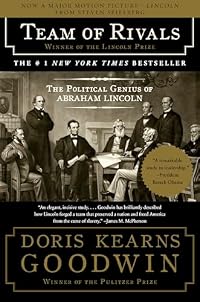
Team of Rivals: The Political Genius of Abraham Lincoln
by Doris Kearns Goodwin
On This Page
Description
This multiple biography is centered on Lincoln's mastery of men and how it shaped the most significant presidency in the nation's history. Historian Goodwin illuminates Lincoln's political genius, as the one-term congressman rises from obscurity to prevail over three gifted rivals to become president. When Lincoln emerged as the victor at the Republican National Convention, his rivals were dismayed. Throughout the turbulent 1850s, each had energetically sought the presidency as the conflict show more over slavery led inexorably to civil war. That Lincoln succeeded, Goodwin demonstrates, was because of his extraordinary ability to put himself in the place of other men, to experience what they were feeling, to understand their motives and desires. It was this that enabled Lincoln to bring his disgruntled opponents together, create the most unusual cabinet in history, and marshal their talents to the task of preserving the Union. show lessTags
Recommendations




Member Recommendations

Member Reviews
I come to this amazing book late in the game, after having read [[Dorris Kearns Goodwin]]’s memoir [Wait ‘Til Next Year]. But there are very few current historians writing such well-researched yet accessible books. Honestly, while the text is littered with quotation marks and footnotes, it reads like a novel of political intrigue. For Republicans these days to invoke Lincoln as the father of their party is the worst kind of misdirection. Lincoln was, above all, a kind man, engaged in thoughtful governance and willing to do absolutely anything to keep the peace, save the union, and abolish slavery. Some historians pull certain events out of context to shame him for coming to the cause late, but Goodwin makes clear that he was always show more part of the cause but had his eyes open about how quickly to move the cause. While it wasn’t fast enough or strident enough for some, both at the time and in hindsight, he moved as quickly as he could. And his uncanny sense of timing turns out to be the product of many late nights filled with agonizing work.
Best, most prescient quote for our time from Lincoln, on the nature of his struggle, which is our struggle today –
”I consider the central idea pervading this struggle is the necessity that is upon us, of proving that popular government is not an absurdity. We must settle this question now, whether in a free government the minority have the right to break up the government whenever they choose. If we fail it will go far to prove the incapability of the people to govern themselves.”
5 bones!!!!!
Highly recommended show less
Best, most prescient quote for our time from Lincoln, on the nature of his struggle, which is our struggle today –
”I consider the central idea pervading this struggle is the necessity that is upon us, of proving that popular government is not an absurdity. We must settle this question now, whether in a free government the minority have the right to break up the government whenever they choose. If we fail it will go far to prove the incapability of the people to govern themselves.”
5 bones!!!!!
Highly recommended show less
62. Team of Rivals: The Political Genius of Abraham Lincoln by Doris Kearns Goodwin (2005, 763 pages, read Aug 15-Nov 17)
Lincoln was the perfect president. He was awkward, humble, and brilliant, morally pure to the deepest part of his heart, yet manipulative to great effect, and yet thoroughly reasonable. The oddball politician who won arguments through that underused, politically suicidal technique of presenting his actual reasoning. It seems that practically every single person who came across Lincoln in any capacity, came away with a strong sense of affection and admiration. That's the myth, and, if I can believe Goodwin, it's remarkably accurate.
This is one of the best books I've read this year. It starts out a little slow as show more Goodwin puts a good number of pages into Lincoln's opponents for the Republican presidential nomination for the 1859 election. These guys are interesting and each becomes a key member of Lincoln's cabinet, but they aren't Lincoln. Once the book centers on Lincoln, if became a terrific pick-me-up. Every time I put the book down, it would be with sense of inspiration. Goodwin does a masterful job of bringing out Lincoln's character and his relationships with various key people. His plodding methods that would drag out problems, and yet, in the end resolve them to wide approval. His masterful sense of timing, of when to wait and when to act. And his deep understanding of the people around him...and how to win them over. He knew people's strengths, and once he had power, how to control them so that they focused in the place he wanted them to focus. For example, Henry Seward, brilliant, arrogant and crushed by his defeat by Lincoln, is, upon that day of assassination, both Lincoln's most valuable and most dedicated adviser.
As I'm writing this, and trying to actually constrain my Lincoln-awe to get something useful out, I keep thinking to myself there must be more to this, Goodwin must have manipulated this history to his advantage. And my skeptical side thinks maybe she did. But, set that aside, let Lincoln be my hero for now. I'll need to read more about him later, anyway. For now I'll keep him up there in that vaguely defined lofty place, in all the color Goodwin has brought out of him and presented, our poet president, our one true national hero. Maybe I'll read the Gettysburg address one more time.
(You can find this review on my 2012 LT thread here: http://www.librarything.com/topic/138560#3772632 ) show less
Lincoln was the perfect president. He was awkward, humble, and brilliant, morally pure to the deepest part of his heart, yet manipulative to great effect, and yet thoroughly reasonable. The oddball politician who won arguments through that underused, politically suicidal technique of presenting his actual reasoning. It seems that practically every single person who came across Lincoln in any capacity, came away with a strong sense of affection and admiration. That's the myth, and, if I can believe Goodwin, it's remarkably accurate.
This is one of the best books I've read this year. It starts out a little slow as show more Goodwin puts a good number of pages into Lincoln's opponents for the Republican presidential nomination for the 1859 election. These guys are interesting and each becomes a key member of Lincoln's cabinet, but they aren't Lincoln. Once the book centers on Lincoln, if became a terrific pick-me-up. Every time I put the book down, it would be with sense of inspiration. Goodwin does a masterful job of bringing out Lincoln's character and his relationships with various key people. His plodding methods that would drag out problems, and yet, in the end resolve them to wide approval. His masterful sense of timing, of when to wait and when to act. And his deep understanding of the people around him...and how to win them over. He knew people's strengths, and once he had power, how to control them so that they focused in the place he wanted them to focus. For example, Henry Seward, brilliant, arrogant and crushed by his defeat by Lincoln, is, upon that day of assassination, both Lincoln's most valuable and most dedicated adviser.
As I'm writing this, and trying to actually constrain my Lincoln-awe to get something useful out, I keep thinking to myself there must be more to this, Goodwin must have manipulated this history to his advantage. And my skeptical side thinks maybe she did. But, set that aside, let Lincoln be my hero for now. I'll need to read more about him later, anyway. For now I'll keep him up there in that vaguely defined lofty place, in all the color Goodwin has brought out of him and presented, our poet president, our one true national hero. Maybe I'll read the Gettysburg address one more time.
(You can find this review on my 2012 LT thread here: http://www.librarything.com/topic/138560#3772632 ) show less
There's little I can add to the other rave reviews. The view of history as the account of great individuals might be out of fashion, but this book would convince all but the most sceptical that Lincoln was indispensable for the outcome of the Civil War. The author has a hard time covering her distaste for the self-righteous Salmon Chase, nor for the self-aggrandising and maddeningly immobile George MacLellan, but for other major characters, she displays a depth of understanding that matches her thesis: Lincoln displayed his greatness not only by surrounding himself with his defeated rivals for the nomination, but then through strength of character becoming the undisputed master of the administration, winning the admiration of the others show more in the process. This could well be an unrivalled feat in the annals of government. Unreservedly recommended. show less
Team of Rivals by Doris Kearns Goodwin
This is one of those books that has been on my TBR pile for a long time having gotten a lot of hype several years ago when Obama was reading the book and supposedly assembling his own team of rivals cabinet. Ultimately, it took an audiobook version for me to really get into the story because it is a very thick non-fiction book.
All that being said, I loved Team of Rivals and it has gone to the top of my list for reads this year. Kearns Goodwin uses the lives of several member's of Lincoln's cabinet to illustrate Lincoln's life. The primary comparisons are with William Seward, Edward Bates, and Salmon Chase who all contended with Lincoln for the 1860 Republican nomination although the stories of Edwin show more Stanton and the Blair family also figure prominently in the story.
The book opens with a discussion of just how unlikely a candidate Lincoln was for the 1860 Republican nomination and how, to the outside world, he was the least likely of the four men vying for the nomination to receive it. From there, the book moves backward to explain the formative years of the four men and how they came to the 1860 convention with a better chance of the nomination than Lincoln.
Once Lincoln wins the nomination and then the presidency, the book talks about how Lincoln turned each man into an ally and brought them into his cabinet where each served successfully and to the benefit of the country as a whole.
Finally, the book accounts, in detail, the Civil War, the Emancipation Proclamation, the Gettysburg Address and so on all the way up to Lincoln's assassination. However, where the book really shines is in the details of the lesser known struggles that Lincoln faced - whether it was placating warring factions in the Republican party, keeping border states from seceding, defusing international disputes with England, etc. Through it all, Kearns Goodwin portrays Lincoln as having almost supernatural powers of compassion, patience, forgiveness, and humor yet she also humanizes him too. It is a remarkable portrayal of America's greatest president and a fascinating read. show less
This is one of those books that has been on my TBR pile for a long time having gotten a lot of hype several years ago when Obama was reading the book and supposedly assembling his own team of rivals cabinet. Ultimately, it took an audiobook version for me to really get into the story because it is a very thick non-fiction book.
All that being said, I loved Team of Rivals and it has gone to the top of my list for reads this year. Kearns Goodwin uses the lives of several member's of Lincoln's cabinet to illustrate Lincoln's life. The primary comparisons are with William Seward, Edward Bates, and Salmon Chase who all contended with Lincoln for the 1860 Republican nomination although the stories of Edwin show more Stanton and the Blair family also figure prominently in the story.
The book opens with a discussion of just how unlikely a candidate Lincoln was for the 1860 Republican nomination and how, to the outside world, he was the least likely of the four men vying for the nomination to receive it. From there, the book moves backward to explain the formative years of the four men and how they came to the 1860 convention with a better chance of the nomination than Lincoln.
Once Lincoln wins the nomination and then the presidency, the book talks about how Lincoln turned each man into an ally and brought them into his cabinet where each served successfully and to the benefit of the country as a whole.
Finally, the book accounts, in detail, the Civil War, the Emancipation Proclamation, the Gettysburg Address and so on all the way up to Lincoln's assassination. However, where the book really shines is in the details of the lesser known struggles that Lincoln faced - whether it was placating warring factions in the Republican party, keeping border states from seceding, defusing international disputes with England, etc. Through it all, Kearns Goodwin portrays Lincoln as having almost supernatural powers of compassion, patience, forgiveness, and humor yet she also humanizes him too. It is a remarkable portrayal of America's greatest president and a fascinating read. show less
Doris Kearns Goodwin's Team of Rivals is panoramic and wonderful. The broad outlines of the story are well-known, but just in case, I'll give a Spoiler Alert, for those who don't want to know more about the book before reading it. And apologies in advance for the length of this - it's a big book!
It starts with Lincoln on the lawyer circuit in Illinois, gaining renown as a storyteller and orator. It then takes us through his adolescence and his marriage to Mary, and his astute jockeying for the Republican nomination over more celebrated and well-heeled rivals. After that is his election, and his forming of the cabinet of the best possible men from which the title derives, including those he defeated in the election. His attempts to avoid show more civil war, his learning to be commander-in-chief and to get the generals he needs to win the war (get out of here, McClellan!), the waging of the Civil War, and his brief time after its conclusion comprise the rest.
He famously educated himself, somehow overcoming that log cabin upbringing.
"Lincoln's book hunger was regarded as odd and indolent. Nor would his community understand the thoughts and emotions stirred by his reading; there were few to talk to about the most important and deeply experienced activities of his mind." He'd have been a great LTer, yes?
He even read geometry books, and worked on math problems in his office, to improve himself.
He lost loved ones early in life to disease - including his mother, his sister, and the great love of his life, Anne Rutledge. Contemporaries often remarked on his melancholy look that would become animated and sharply intelligent as soon as he began talking to people or telling stories. Seems like it would be hard not to be melancholy with what he experienced throughout his life - including those early losses, and the devastating war that he was responsible for, that killed over 600,000 Americans (out of 31.5 milllion in the country then), more than the rest of our wars put together.
The ubiquity of death by disease and in childbirth is staggering to read about. At the same time, families of nine and ten and more children were common - although those numbers would dwindle as family members were struck down by diseases such as tuberculosis. His wife Mary Todd's family had 16 children; her mother died in giving birth to her seventh child, and her stepmother had nine more children.
I loved learning that Lincoln was an irrepressible storyteller, constantly illustrating his points with down to earth stories, and Goodwin persuasively conveys his honesty, integrity, and personal charm. He was well aware of his physical deficiencies. When someone called him two-faced, he responded, "If I had two faces, do you really think I would have picked this one?" I read somewhere (not in this book) that he may have had Marfan's disease, a genetic disorder that causes unusual height and long, thin limbs.
A surprise for me was how personally vilified he was by rivals and skeptics, especially early in his career. "Ape", "long-armed gorilla", "imbecile", "second-rate Illinois lawyer", the list goes on and on. He came out of "nowhere" to be elected, and there were many who doubted his qualifications. Goodwin's portrayal of the rivals also is compelling - especially Salmon Chase, chock full of his belief in his wonderfulness and his predestination to be president, who instead became Secretary of the Treasury and Chief Justice of the Supreme Court, and Seward, a beloved politician who was expected to carry the nomination easily and instead bitterly lost to Lincoln. Seward became Secretary of State and an admiring close friend of Lincoln. He ended up calling Lincoln, this unknown upstart from Illinois, "the best and wisest man he had ever known."
Goodwin's extensive research supports that conclusion. Lincoln's ability to keep his eye on the big picture, to defuse animosity and to cause opponents to work productively with him, reluctantly or enthusiastically, and his sense of timing, waiting for the opportune moment for success, all come through vividly. It is fascinating to watch Lincoln inch his way toward emancipation of the slaves and passage of the 13th Amendment to the Constitution. His pragmatic approach, beginning with pushing for a restriction of slavery to those states in which it already existed and not permitting its extension to new states, to publicly proclaiming, to assuage fears, that slaves would not be given rights equal to whites, to advocating full equality, is a much fuller and thought-provoking story than I had known before reading this book. Even after Lincoln signed the Emancipation Proclamation, a carping congressman said, "Strange phenomenon in the world's history when a second-rate Illinois lawyer is the instrument to utter words which shall form an epoch memorable in all future ages."
Lincoln's astounding eloquence, as an "instrument to utter words", is heard throughout this book. I was happy that she gave us the Gettysburg address in full, and it is quite moving to read it in context. I can't say enough about what a good book this is. You finish wishing you had a chance to meet this great man, whose kindness to others was perhaps his most fundamental trait. show less
It starts with Lincoln on the lawyer circuit in Illinois, gaining renown as a storyteller and orator. It then takes us through his adolescence and his marriage to Mary, and his astute jockeying for the Republican nomination over more celebrated and well-heeled rivals. After that is his election, and his forming of the cabinet of the best possible men from which the title derives, including those he defeated in the election. His attempts to avoid show more civil war, his learning to be commander-in-chief and to get the generals he needs to win the war (get out of here, McClellan!), the waging of the Civil War, and his brief time after its conclusion comprise the rest.
He famously educated himself, somehow overcoming that log cabin upbringing.
"Lincoln's book hunger was regarded as odd and indolent. Nor would his community understand the thoughts and emotions stirred by his reading; there were few to talk to about the most important and deeply experienced activities of his mind." He'd have been a great LTer, yes?
He even read geometry books, and worked on math problems in his office, to improve himself.
He lost loved ones early in life to disease - including his mother, his sister, and the great love of his life, Anne Rutledge. Contemporaries often remarked on his melancholy look that would become animated and sharply intelligent as soon as he began talking to people or telling stories. Seems like it would be hard not to be melancholy with what he experienced throughout his life - including those early losses, and the devastating war that he was responsible for, that killed over 600,000 Americans (out of 31.5 milllion in the country then), more than the rest of our wars put together.
The ubiquity of death by disease and in childbirth is staggering to read about. At the same time, families of nine and ten and more children were common - although those numbers would dwindle as family members were struck down by diseases such as tuberculosis. His wife Mary Todd's family had 16 children; her mother died in giving birth to her seventh child, and her stepmother had nine more children.
I loved learning that Lincoln was an irrepressible storyteller, constantly illustrating his points with down to earth stories, and Goodwin persuasively conveys his honesty, integrity, and personal charm. He was well aware of his physical deficiencies. When someone called him two-faced, he responded, "If I had two faces, do you really think I would have picked this one?" I read somewhere (not in this book) that he may have had Marfan's disease, a genetic disorder that causes unusual height and long, thin limbs.
A surprise for me was how personally vilified he was by rivals and skeptics, especially early in his career. "Ape", "long-armed gorilla", "imbecile", "second-rate Illinois lawyer", the list goes on and on. He came out of "nowhere" to be elected, and there were many who doubted his qualifications. Goodwin's portrayal of the rivals also is compelling - especially Salmon Chase, chock full of his belief in his wonderfulness and his predestination to be president, who instead became Secretary of the Treasury and Chief Justice of the Supreme Court, and Seward, a beloved politician who was expected to carry the nomination easily and instead bitterly lost to Lincoln. Seward became Secretary of State and an admiring close friend of Lincoln. He ended up calling Lincoln, this unknown upstart from Illinois, "the best and wisest man he had ever known."
Goodwin's extensive research supports that conclusion. Lincoln's ability to keep his eye on the big picture, to defuse animosity and to cause opponents to work productively with him, reluctantly or enthusiastically, and his sense of timing, waiting for the opportune moment for success, all come through vividly. It is fascinating to watch Lincoln inch his way toward emancipation of the slaves and passage of the 13th Amendment to the Constitution. His pragmatic approach, beginning with pushing for a restriction of slavery to those states in which it already existed and not permitting its extension to new states, to publicly proclaiming, to assuage fears, that slaves would not be given rights equal to whites, to advocating full equality, is a much fuller and thought-provoking story than I had known before reading this book. Even after Lincoln signed the Emancipation Proclamation, a carping congressman said, "Strange phenomenon in the world's history when a second-rate Illinois lawyer is the instrument to utter words which shall form an epoch memorable in all future ages."
Lincoln's astounding eloquence, as an "instrument to utter words", is heard throughout this book. I was happy that she gave us the Gettysburg address in full, and it is quite moving to read it in context. I can't say enough about what a good book this is. You finish wishing you had a chance to meet this great man, whose kindness to others was perhaps his most fundamental trait. show less
Just – wow! Admit I approached this enormous volume with some trepidation – could even a subject as vast and fascinating as the life and death of Abraham Lincoln hold my interest for so long? The answer is a resounding yes! This riveting and superbly-told tale of Lincoln’s life and political career not only held my interest: it kept me up nights, pinned me at home on beautiful weekend afternoons, and had me turning down invitations for lunch so that I could bolt down my food while reading.
Obviously, Doris Kearns Goodwin is a wonderful storyteller. But it helps that her protagonist is such an extraordinary individual. Over and over again I was amazed by Lincoln’s wisdom, his decency, his patience, and his extraordinary political show more acumen. Goodwin’s intent here, it’s pretty clear, is to focus on the latter of these attributes. While most Americans know of Lincoln’s moral courage, his social legacy, and (of course) his exemplary oratorical skills, few (I’m betting) fully appreciate his political genius. Over and over again he pulls political miracles out of his hat – extracting victory from defeat, forging unforgeable compromises – armed with little more than an unwavering moral compass, an encompassing empathy, humility, patience, and a seemingly endless stock of jokes, puns, and folksy anecdotes. Few anecdotes illustrate his politicla genius as clearly as the fact that he staffed the major posts of his new cabinet with political rivals …. or that, in time, those same rivals became his most adamant supporters.
I thought I had a fairly good background knowledge of Lincoln’s life and his administration, but by the end of the second chapter I jettisoned this misconception. Goodwin’s scholarship is as exceptional as her storytelling skills. Scarcely a page passed without exposing me to some startling new bit of information, constantly enhancing and challenging my preconceived notions.
There are so many lessons here that I wish modern politicians would embrace: do the right thing for the right reasons, no matter how unpopular; always allow your political opponents to save face; invite – don’t avoid (or worse, squash)- dissenting opinions; compromise always trumps conflict; and, above all, always put the good of the nation above your own personal ambitions. Alas, since our politicians seem to be too busy doing the wrong thing for the wrong reasons, humiliating each other, squashing dissenting opinions, seeking out conflict, and placing their own interests above those of the country, perhaps it’s up to us U.S. citizens to absorb the lessons from this book on their behalf and then let them know the standards against which we intend to hold them accountable!
I don’t give out many 5 star ratings, but if I could give this 6 stars, I would. This is one of those rare volumes that has permanently changed the way that I view our country, our political system, our destiny, and – above all – the potential of ordinary Americans to accomplish extraordinary things. show less
Obviously, Doris Kearns Goodwin is a wonderful storyteller. But it helps that her protagonist is such an extraordinary individual. Over and over again I was amazed by Lincoln’s wisdom, his decency, his patience, and his extraordinary political show more acumen. Goodwin’s intent here, it’s pretty clear, is to focus on the latter of these attributes. While most Americans know of Lincoln’s moral courage, his social legacy, and (of course) his exemplary oratorical skills, few (I’m betting) fully appreciate his political genius. Over and over again he pulls political miracles out of his hat – extracting victory from defeat, forging unforgeable compromises – armed with little more than an unwavering moral compass, an encompassing empathy, humility, patience, and a seemingly endless stock of jokes, puns, and folksy anecdotes. Few anecdotes illustrate his politicla genius as clearly as the fact that he staffed the major posts of his new cabinet with political rivals …. or that, in time, those same rivals became his most adamant supporters.
I thought I had a fairly good background knowledge of Lincoln’s life and his administration, but by the end of the second chapter I jettisoned this misconception. Goodwin’s scholarship is as exceptional as her storytelling skills. Scarcely a page passed without exposing me to some startling new bit of information, constantly enhancing and challenging my preconceived notions.
There are so many lessons here that I wish modern politicians would embrace: do the right thing for the right reasons, no matter how unpopular; always allow your political opponents to save face; invite – don’t avoid (or worse, squash)- dissenting opinions; compromise always trumps conflict; and, above all, always put the good of the nation above your own personal ambitions. Alas, since our politicians seem to be too busy doing the wrong thing for the wrong reasons, humiliating each other, squashing dissenting opinions, seeking out conflict, and placing their own interests above those of the country, perhaps it’s up to us U.S. citizens to absorb the lessons from this book on their behalf and then let them know the standards against which we intend to hold them accountable!
I don’t give out many 5 star ratings, but if I could give this 6 stars, I would. This is one of those rare volumes that has permanently changed the way that I view our country, our political system, our destiny, and – above all – the potential of ordinary Americans to accomplish extraordinary things. show less
Before reading this marvellous, comprehensive yet eminently accessible biography I was lamentably ignorant about the life of Abraham Lincoln - I knew that he was tall and that he was assassinated (Oops! Sorry if that spoils the ending for anyone!), but very little else. Professor Goodwin's excellent book has certainly remedied that.
The "Team of Rivals" to which the title alludes was the four leading contenders (Lincoln, William Seward, Edward Bates and Salmon Chase) for the Republican nomination for the 1860 Presidential election. It was a great testament to Lincoln's personal charisma that he was able to secure the cooperation of the three people whom he defeated to secure that nomination, and then to induce them to serve in his show more Cabinet. Professor Goodwin details the prior history of all four rivals, and we see the whole panoply of class and family prosperity laid out. Perhaps the only things they shared in common were their growing hatred of slavery and their heavy baggage of personal tragedy ... and their sheer determination to improve (themselves and their people).
She also offers a concise, yet still appalling, history of slavery within the United States. One aspect of my previous ignorance of the details of Lincoln's life was reflected in my subscription to the general canonisation of him. I was, therefore, surprised to find that while Lincoln abhorred the practice of slavery, he was less emphatic in his acknowledgement of freed slaves' rights for absolutely equal treatment. For instance, as late as 1860 he was still unconvinced of the appropriateness of African-Americans serving as jurors. Indeed, within the Team of Rivals it was William Seward who took the lead on seeking untrammelled equality of rights.
Professor Goodwin covers the Civil War with great clarity, evoking the horror of a nation torn in two but never clogging the reader's attention with unnecessary detail. Similarly, her coverage of the passage of the key legislation through the two Houses is handled sensitively, and the potentially dry material relating to political process is handled in a lively way.
I wish that more biographies managed to achieve Professor Goodwin's adept combination of scholarly depth and clarity of expression. show less
The "Team of Rivals" to which the title alludes was the four leading contenders (Lincoln, William Seward, Edward Bates and Salmon Chase) for the Republican nomination for the 1860 Presidential election. It was a great testament to Lincoln's personal charisma that he was able to secure the cooperation of the three people whom he defeated to secure that nomination, and then to induce them to serve in his show more Cabinet. Professor Goodwin details the prior history of all four rivals, and we see the whole panoply of class and family prosperity laid out. Perhaps the only things they shared in common were their growing hatred of slavery and their heavy baggage of personal tragedy ... and their sheer determination to improve (themselves and their people).
She also offers a concise, yet still appalling, history of slavery within the United States. One aspect of my previous ignorance of the details of Lincoln's life was reflected in my subscription to the general canonisation of him. I was, therefore, surprised to find that while Lincoln abhorred the practice of slavery, he was less emphatic in his acknowledgement of freed slaves' rights for absolutely equal treatment. For instance, as late as 1860 he was still unconvinced of the appropriateness of African-Americans serving as jurors. Indeed, within the Team of Rivals it was William Seward who took the lead on seeking untrammelled equality of rights.
Professor Goodwin covers the Civil War with great clarity, evoking the horror of a nation torn in two but never clogging the reader's attention with unnecessary detail. Similarly, her coverage of the passage of the key legislation through the two Houses is handled sensitively, and the potentially dry material relating to political process is handled in a lively way.
I wish that more biographies managed to achieve Professor Goodwin's adept combination of scholarly depth and clarity of expression. show less
Members
- Recently Added By
Published Reviews
ThingScore 100
"We needed the strongest men of the party in the cabinet," Lincoln replied. "These were the very strongest men. Then I had no right to deprive the country of their services." They were indeed strong men, Goodwin notes. "But in the end, it was the prairie lawyer from Springfield who would emerge as the strongest of them all."
added by John_Vaughan
"But this immense, finely boned book is no dull administrative or bureaucratic history; rather, it is a story of personalities -- a messianic drama, if you will -- in which Lincoln must increase and the others must decrease."
added by bookfitz
Lists

Best Biographies
216 works; 26 members

Top Five Books of 2013
1,564 works; 722 members

Lincoln
7 works; 4 members

100 books to read in a lifetime
102 works; 37 members

Non-Fiction Worth Reading
1,015 works; 260 members
Best Biographies of U.S. Presidents
61 works; 6 members

Recommend the 20 best books you've read in the last five years
2,167 works; 601 members

World History
4 works; 1 member

Books recommended by Barack Obama
295 works; 28 members

Obama Reads
181 works; 3 members

Política - Clásicos
164 works; 2 members

al.vick-parents books
301 works; 1 member

Tagged Civil War
16 works; 4 members

Female Author
1,235 works; 65 members

r/History Recommended Reading List
603 works; 12 members

Biographies of American Presidents
39 works; 4 members

History & Political Science: US
158 works; 1 member

My List
302 works; 1 member

Top Five Books of 2023
767 works; 317 members

Club Read's Recommended Nonfiction Written by Women
618 works; 30 members

.
184 works; 1 member

Presidents and First Ladies
25 works; 5 members

2024-2025 Ezra Klein Guest Recommendations
213 works; 5 members
Talk Discussions
Past Discussions
2012 Team of Rivals Group Read, November in 75 Books Challenge for 2012 (January 2013)
Group reading of The Team of Rivals by Doris Kearns Goodwin, in November 2012 in 75 Books Challenge for 2012 (November 2012)
Author Information

17+ Works 23,131 Members
Doris Kearns Goodwin was born in Brooklyn, New York on January 4, 1943. She received a bachelor of arts degree from Colby College in 1964 and a Ph.D. in government from Harvard University in 1968. She taught at Harvard University and worked as an assistant to President Lyndon Johnson during his last year in the White House. She has written show more numerous books including The Fitzgeralds and the Kennedys, Lyndon Johnson and the American Dream, Wait Till Next Year, and The Bully Pulpit: Theodore Roosevelt, William Howard Taft, and the Golden Age of Journalism, and Leadership: In Turbulent Times. She has received numerous awards including Pulitzer Prize in history, the Harold Washington Literary Award, the Ambassador Book Award for No Ordinary Time: Franklin and Eleanor Roosevelt: The Home Front in World War II, and the Lincoln Prize and the Book Prize for American History for Team of Rivals: The Political Genius of Abraham Lincoln. (Bowker Author Biography) show less
Some Editions
Awards and Honors
Awards
Distinctions
Series
Belongs to Publisher Series
Work Relationships
Has the adaptation
Is abridged in
Common Knowledge
- Canonical title
- Team of Rivals: The Political Genius of Abraham Lincoln
- Original title
- Team of Rivals: The Political Genius of Abraham Lincoln
- Original publication date
- 2005-10-25
- People/Characters
- Abraham Lincoln; Edward Bates; Salmon P. Chase; Ulysses S. Grant; Mary Todd Lincoln; William Henry Seward (show all 26); Edwin M. Stanton; Gideon Welles; Montgomery Blair; John Hay; George B. McClellan; Thurlow Weed; Kate Chase Sprague; Francis Preston Blair; Francis Preston Blair, Jr.; Noah Brooks; Simon Cameron; Stephen A. Douglas; Frederick Douglass; Ulysses S. Grant; Thomas "Tad' Lincoln; Robert Todd Lincoln; George B. McClellan; John G. Nicolay; Frances Miller Seward; Charles Sumner
- Important places
- Washington, D.C., USA; Springfield, Illinois, USA; Auburn, New York, USA; White House, Washington, D.C., USA; Anderson Cottage, Soldiers Home, Washington, D.C., USA; Illinois, USA (show all 9); Fort Sumter, Charleston Harbor, South Carolina, USA; Richmond, Virginia, USA; War Department Telegraph Office, Washington, D.C., USA
- Important events
- Kansas-Nebraska Act (1854); Lincoln-Douglas Debates (1858); Republican National Convention (1860); United States presidential election (1860, 1864); Presidency of Abraham Lincoln (1861 | 1865); Lincoln's First Inaugural Address (1861) (show all 14); American Civil War (1861 | 1865); Peninsula Campaign (1862); Emancipation Proclamation (1863-01-01); Gettysburg Address (1863-11); Lincoln's Second Inaugural Address (1865); 13th Amendment to the U.S. Constitution; Reconstruction Era of the United States; 19th century
- Related movies
- Lincoln (2012 | IMDb)
- Epigraph
- "The conduct of the republican party in this nomination is a remarkable indication of small intellect, growing smaller. They pass over ... statesmen and able men, and they take up a fourth rate lecturer, who cannot speak goo... (show all)d grammar." —The New York Herald (May 19, 1860), commenting on Abraham Lincoln's nomination for president at the Republican National Convention.
"Why, if the old Greeks had had this man, what trilogies of plays—what epics—would have been made out of him! How the rhapsodes would have recited him! How quickly that quaint tall form would have enter'd into the regio... (show all)n where men vitalize gods, and gods devinify men! But Lincoln, his times, his death—great as any, any age—being altogether to our own." —Walt Whitman, "Death of Abraham Lincoln," 1879.
"The greatness of Napoleon, Caesar or Washington is only moonlight by the sun of Lincoln. His example is universal and will last thousands of years. ... He was bigger than his country—bigger than all the Presidents togethe... (show all)r ... and as a great character he will live as long as the world lives." —Leo Tolstoy, The World, New York, 1909. - Dedication
- For Richard M. Goodwin, my husband of thirty years
- First words
- On May 18, 1860, the day when the Republican Party would nominate its candidate for president, Abraham Lincoln was up early.
- Quotations
- After all, to [Simon] Cameron was attributed the oft-quoted definition: "an honest politician is one who, when he is bought, stays bought."
- Last words
- (Click to show. Warning: May contain spoilers.)The deathless name he sought form the start had grown far beyond Sangamon County and Illinois, reached across the truly United States, until his legacy, as Stanton had surmised at the moment of his death, belonged not only to America but to the ages - to be revered and sung throughout all time.
- Blurbers
- Kakutani, Michiko; Rhodehamel, John; Winik, Jay; McPherson, James M.; Wills, Garry; Brinkley, Douglas (show all 9); Williams, Frank J.; Holzer, Harold; Schwartz, Thomas F
- Original language
- English
- Canonical DDC/MDS
- 973.7092
- Canonical LCC
- E457.45
Classifications
- Genres
- History, General Nonfiction, Biography & Memoir, Nonfiction
- DDC/MDS
- 973.7092 — History & geography History of North America United States Administration of Abraham Lincoln, 1861-1865 Civil War
- LCC
- E457.45 — History of the United States United States Civil War period, 1861-1865 Lincoln's administrations, 1861-April 15, 1865
- BISAC
Statistics
- Members
- 11,217
- Popularity
- 807
- Reviews
- 243
- Rating
- (4.44)
- Languages
- 5 — Chinese, Czech, English, French, Portuguese
- Media
- Paper, Audiobook, Ebook
- ISBNs
- 42
- UPCs
- 1
- ASINs
- 57