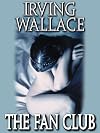
The Fan Club
by Irving Wallace
On This Page
Description
Dissatisfied with their lives and hoping to turn their sexual fantasies into reality, four men kidnap Sharon Fields, Hollywood's newest sex symbol.Tags
Recommendations
















Member Recommendations

Member Reviews
Irving Wallace's novel The Fan Club was quite successful when it was published in 1974, spending nearly six months on the NYT best seller list and serving as the basis for a movie project that never got to the shooting stage. Like most popular novels of its period, it has since fallen into obscurity. It is a "thriller" about the abduction, rape, ransom, and rescue of a sex-symbol movie star. I read a portion of it in the 1980s and I came back to read the whole thing more than thirty years later.
Rather than a single psychopathic villain (cf. Straub's Hellfire Club), the story offers a misfit team of perpetrators. This feature seems to be an indictment of masculine pack dynamics: the group is morally less than the sum of its parts, while show more operationally greater than them. This notion is bolstered by fact that the most practically capable and ethically depraved of the four culprits has a military background, having participated in atrocities as an American soldier in Viet Nam.
The four "fan club" malefactors are repeatedly identified by their roles, rather than proper names--first for purposes of concealment in the journal kept by their organizer, and then in the mental indexing performed by their captive victim. These roles--the Club President i.e. "Dreamer," Accountant i.e. "Milquetoast," Insurance Person i.e. "Salesman," and Mechanic i.e. "Evil One"--seem to suggest an allegorical reading, where the diverse character types of the four could represent larger social functions, or even psychological components (e.g. self, super-ego, ego, and id).
Except for some passages from the notebooks of the Dreamer-instigator, the novel is told in an omniscient third-person voice, but using an assortment of characters for perspective orientation. For the most part, focus alternates between the fan club members on the one hand and their captive on the other, with all of the post-abduction rapes and assaults emphasizing her perspective. She does survive the ordeal, and it seems clear that she would not have done so without her own resourcefulness and personal agency.
By making his President/Dreamer character a writer, Wallace invites suspicion of an element of self-portraiture in this eventually declared anti-hero. This protagonist treats the predatory fan club as an "experiment" in the real-world manifestation of fantasy. Are we supposed to congratulate Wallace on having chosen to write a fiction rather than carrying out the sort of criminal acts about which he wrote? The decision here to leave the Dreamer at large and unrehabilitated may have been intended as a horror-style coda to signal the persistence of evil. But given the extent to which the entire novel might be construed as rape-as-entertainment, it does come off disturbingly as "no comeuppance!"--especially in today's interpretive climate. While I do not myself insist on moral justice in fictional narrative, Emma Bovary this fellow is not.
In any case, I do think the book was more interesting than the only other Wallace novel I've read, the later Celestial Bed, which shares some of its preoccupations--even signaling them in the title, which featured as an invocation (with the same historical referent) in The Fan Club. show less
Rather than a single psychopathic villain (cf. Straub's Hellfire Club), the story offers a misfit team of perpetrators. This feature seems to be an indictment of masculine pack dynamics: the group is morally less than the sum of its parts, while show more operationally greater than them. This notion is bolstered by fact that the most practically capable and ethically depraved of the four culprits has a military background, having participated in atrocities as an American soldier in Viet Nam.
The four "fan club" malefactors are repeatedly identified by their roles, rather than proper names--first for purposes of concealment in the journal kept by their organizer, and then in the mental indexing performed by their captive victim. These roles--the Club President i.e. "Dreamer," Accountant i.e. "Milquetoast," Insurance Person i.e. "Salesman," and Mechanic i.e. "Evil One"--seem to suggest an allegorical reading, where the diverse character types of the four could represent larger social functions, or even psychological components (e.g. self, super-ego, ego, and id).
Except for some passages from the notebooks of the Dreamer-instigator, the novel is told in an omniscient third-person voice, but using an assortment of characters for perspective orientation. For the most part, focus alternates between the fan club members on the one hand and their captive on the other, with all of the post-abduction rapes and assaults emphasizing her perspective. She does survive the ordeal, and it seems clear that she would not have done so without her own resourcefulness and personal agency.
By making his President/Dreamer character a writer, Wallace invites suspicion of an element of self-portraiture in this eventually declared anti-hero. This protagonist treats the predatory fan club as an "experiment" in the real-world manifestation of fantasy. Are we supposed to congratulate Wallace on having chosen to write a fiction rather than carrying out the sort of criminal acts about which he wrote? The decision here to leave the Dreamer at large and unrehabilitated may have been intended as a horror-style coda to signal the persistence of evil. But given the extent to which the entire novel might be construed as rape-as-entertainment, it does come off disturbingly as "no comeuppance!"--especially in today's interpretive climate. While I do not myself insist on moral justice in fictional narrative, Emma Bovary this fellow is not.
In any case, I do think the book was more interesting than the only other Wallace novel I've read, the later Celestial Bed, which shares some of its preoccupations--even signaling them in the title, which featured as an invocation (with the same historical referent) in The Fan Club. show less
This is a captivating thriller based on the fantasy most men have had since they became capable of doing so. It may be a bit too much for some due to the graphic scenes. Nevertheless, it's a fine novel.
Very intersting book which I am unable to say I liked!
Sharon Fields, estrella de cine, es una mujer cuyo éxito parece irresistible a todo el mundo. Existe un silecioso grupo masculino de fans que está planeando raptarla. Su meta retorcida, sus aspiraciones, son satisfacer sus más oscuros deseos y frustraciones con ella. Sharon, a quien la vida sonreía, se ve secuestrada, atada, humillada y, lejos de rendirse, planea su propia escapada. Uno por uno engatusa a los secuestradores para salir sana y salva de su prisión.
Dec 25, 2010Spanish
Ratings
Members
- Recently Added By
Lists

Publisher's Weekly Bestsellers - Part II - 1940 - 1979
355 works; 5 members

Guilty Pleasures
223 works; 86 members
Author Information

103+ Works 9,030 Members
Irving Wallace was born March 19, 1916 in Chicago, Illinois. He began writing for various magazines at age 15 and worked as a screenwriter for a number of Hollywood studios---Columbia, Fox, Warner Brothers, Universal, and MGM from 1950 to 1959, then he turned solely to writing books. His first major bestseller was The Chapman Report in 1960, a show more fictional account of a sexual research team's investigations of a wealthy Los Angeles suburb. Among other fictional works by Wallace are The Prize and The Word. His meticulously researched fiction often has the flavor of spicy journalism. A great deal of research goes into his novels, which cover a wide variety of subjects, from the presentation of the Nobel Prize to political scenarios. With their recurring dramatic confrontations, his novels lend themselves well to screenplay adaptation, and most of them have been filmed, including The Chapman Report and The Prize. Wallace has also compiled several nonfiction works with his family, including The People's Almanac and The Book of Lists, both of which have spawned sequels. Irving Wallace died June 29, 1990 in Los Angeles, California at the age of 74 from pancreatic cancer. (Bowker Author Biography) show less
Awards and Honors
Distinctions
Common Knowledge
- Canonical title
- The Fan Club
- Original title
- The Fan Club
- Original publication date
- 1974
- People/Characters*
- Adam Malone; Sharon Fields
- Important places*
- Los Angeles, California, USA
- Dedication
- Voor alle vrouwen
en vooral voor
Sylvia
For all women
and particularly one
named
SYLVIA - First words
- It was not long after daybreak this early June morning--ten minutes after seven o'clock, according to his wristwatch--and the sun was continuing to rise, slowly warming the vast sprawl of buildings and the long stretch of Sou... (show all)thern California country.
- Quotations*
- Het maakt me niet uit belast te zijn met glamour en seksuele aantrekkingskracht. Maar wat er bij komt kan werkelijk een last zijn ....de mensen nemen heel wat als vanzelfsprekend aan en verwachten vreselijk veel voor een sc... (show all)hijntje. Een sekssymbool wordt tot een ding. Maar ik haat het een ding te zijn. (Marilyn Monroe-1962).
Was het niet om de verbeelding, meneer, dan zou een man zich even gelukkig voelen in de armen van een kamermeid als van een hertogin. (Dr Samuel Johnson-1778)
De allermeeste mensen leiden een bestaan van ingetogen vertwijfeling. (Henry David Thoreau-1854) - Last words
- (Click to show. Warning: May contain spoilers.)I find myself filled with excitement and purpose once more ...
*Some information comes from Common Knowledge in other languages. Click "Edit" for more information.
Classifications
Statistics
- Members
- 285
- Popularity
- 113,276
- Reviews
- 4
- Rating
- (3.10)
- Languages
- 6 — Dutch, English, German, Italian, Portuguese, Spanish
- Media
- Paper, Audiobook, Ebook
- ISBNs
- 20
- ASINs
- 12