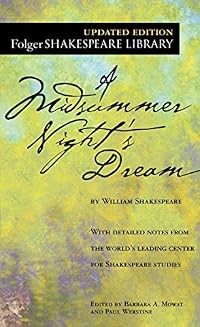
A Midsummer Night's Dream
by William Shakespeare
On This Page
Description
Midsummer Night's Dream is Shakespeare's classic tale of two couples who can't quite pair up to everyone's satisfaction. Demetrius and Lysander love Hermia. Hermia loves Lysander but has been promised to Demetrius by her father. Hermia's best friend Helena loves Demetrius, but in his obsession for Hermia Demetrius barely even notices her smitten friend. When Hermia and Lysander plan to elope all four find themselves in the forest late at night where the fairy Puck and his lord Oberon wreck show more havoc on the humans with a love potion that causes the victim to fall in love with the first thing they see upon waking.. show less
Tags
Recommendations

Member Recommendations

Member Reviews
http://nhw.livejournal.com/1110873.html
Of Shakespeare's really famous plays, this is probably the one I knew least well before starting this project. It is brilliant. Somehow it all comes together, in terms of plot and language. The human side of the plot - conflicting love interests resolved by supernatural means, entertained by a local am dram group - is straightforward enough; the special bit is the fairy world. And somehow here Shakespeare manages to construct an alien culture, beings which have super powers yet whose motivations remain mostly familiar. Not knowing the play, I tended to assume the fairies would be more or less of the Andrew Lang variety, but these are much more serious beings.
It seemed comparatively short, and the show more text seems more approachable; certainly the humorous and farcical aspects of the plot are pretty timeless (none of the incomprehensible wordplay scenes of, say, Love's Labour's Lost). In particular, to my surprise, Bottom stands out as a vivid character - the guy in the club who thinks the whole thing revolves around him, and because he thinks so it has largely become true; and even having his head turned into a donkey's while the fairy queen makes love to him doesn't seriously faze him.
The Arkangel production has veteran comedian Roy Hudd doing a superb Bottom (climaxing with a glorious Pyramus death scene), and two other particularly good performances: David Harewood as Oberon and Adjoah Andoh (Martha's mother in Doctor Who) as Titania, playing the fairy couple with Caribbean accents, which of course adds to their exotic characterisations (as does the effective soundscape). Amanda Root and Saskia Wickham are good also as the human girls, Hermia and Helena. The most enjoyable so far. show less
Of Shakespeare's really famous plays, this is probably the one I knew least well before starting this project. It is brilliant. Somehow it all comes together, in terms of plot and language. The human side of the plot - conflicting love interests resolved by supernatural means, entertained by a local am dram group - is straightforward enough; the special bit is the fairy world. And somehow here Shakespeare manages to construct an alien culture, beings which have super powers yet whose motivations remain mostly familiar. Not knowing the play, I tended to assume the fairies would be more or less of the Andrew Lang variety, but these are much more serious beings.
It seemed comparatively short, and the show more text seems more approachable; certainly the humorous and farcical aspects of the plot are pretty timeless (none of the incomprehensible wordplay scenes of, say, Love's Labour's Lost). In particular, to my surprise, Bottom stands out as a vivid character - the guy in the club who thinks the whole thing revolves around him, and because he thinks so it has largely become true; and even having his head turned into a donkey's while the fairy queen makes love to him doesn't seriously faze him.
The Arkangel production has veteran comedian Roy Hudd doing a superb Bottom (climaxing with a glorious Pyramus death scene), and two other particularly good performances: David Harewood as Oberon and Adjoah Andoh (Martha's mother in Doctor Who) as Titania, playing the fairy couple with Caribbean accents, which of course adds to their exotic characterisations (as does the effective soundscape). Amanda Root and Saskia Wickham are good also as the human girls, Hermia and Helena. The most enjoyable so far. show less
"The course of true love never did run smooth"; but oh my friends and neighbours, when was love ever "true"? This is the jolly cynic's Romeo and Juliet, with English country faire elements displaced to Theseus's Athens (itself a place that hardly did exist) and the mythological, metaphysical backdrop, the ridiculous-but-still-great-and-terrible Olympians, disinvited from the party in favour of the fairies, magnificent and dreadful but still ridiculous (it sounds like the same thing as the gods but it's actually the opposite): Oberon, equal parts virile intensity and cat-chasing-his-tail; Titania, majestic and intoxicating and yet you also just want to pat her on the head; Puck, with all the mystique of a trickster spirit and all the show more bathos of a cigar-smoking baby. Lord, what fools these immortals be!
They elevate the humans as the humans drag them into the mundane, to the benefit of the action in both cases. Just a quartet of pretty young goofballs bouncing through the sacred groves on a wave of hormonal exuberance, as the rules get mixed up and upside-downed and love-potion-number-nined till it's all reduced to the lowest common denominator. Bucolic rumpus--pratfalls and sex. They seem too quick and alive for the law to catch up with them, and indeed Theseus and Hippolyta do present a fairly mellow or enlightened face on disciplining authority, as the king reassures us that EVEN IF things fall over the precipice and go all two-households-both-alike-in-dignity on us, Hermia can choose forcible cloisterment over death--but is this really such a comfort? We see Demetrius and Lysander play fistfights for laughs and never think about how close either of them is to braining himself on a rock, the other being strung up. Skulking around somewhere in the background is always the deeply unfunny Egeus, the patriarch with filicide in his fist.
The estimable Bottom and his bunch of goony players (special shout out to Wall--I see you, Wall!) bring it all home by staging the tragic romance of Pyramus and Thisbe farcically for a bunch of complacent chuckleheads who don't know that they're in a play themselves, and that comedy and tragedy are a mere knife-edge apart. And ever if we manage to keep it light and nobody falls on a dagger, love fades and everyone you know will one day still certainly die. The comic dignity of the man with the donkey's head sums up the message quite nicely: The play's an ass, and it is a matter of life and death that we keep it that way. Laugh at that! No, I mean it! show less
They elevate the humans as the humans drag them into the mundane, to the benefit of the action in both cases. Just a quartet of pretty young goofballs bouncing through the sacred groves on a wave of hormonal exuberance, as the rules get mixed up and upside-downed and love-potion-number-nined till it's all reduced to the lowest common denominator. Bucolic rumpus--pratfalls and sex. They seem too quick and alive for the law to catch up with them, and indeed Theseus and Hippolyta do present a fairly mellow or enlightened face on disciplining authority, as the king reassures us that EVEN IF things fall over the precipice and go all two-households-both-alike-in-dignity on us, Hermia can choose forcible cloisterment over death--but is this really such a comfort? We see Demetrius and Lysander play fistfights for laughs and never think about how close either of them is to braining himself on a rock, the other being strung up. Skulking around somewhere in the background is always the deeply unfunny Egeus, the patriarch with filicide in his fist.
The estimable Bottom and his bunch of goony players (special shout out to Wall--I see you, Wall!) bring it all home by staging the tragic romance of Pyramus and Thisbe farcically for a bunch of complacent chuckleheads who don't know that they're in a play themselves, and that comedy and tragedy are a mere knife-edge apart. And ever if we manage to keep it light and nobody falls on a dagger, love fades and everyone you know will one day still certainly die. The comic dignity of the man with the donkey's head sums up the message quite nicely: The play's an ass, and it is a matter of life and death that we keep it that way. Laugh at that! No, I mean it! show less
Rackham turns his pen and paintbrush to Shakespeare's most whimsical and fantastic play to wonderful results. Instead of focusing on the humans in the story, Rackaham's paintings and illustrations are filled with the forest dwellers and fairy court of Titania and Oberon. This subject matter is well within Rackham's oeuvre, and each illustration can stand on its own outside of the context of Midsummer Night's Dream since his fairies and mystical creatures are timeless. He also captures the idea that this story takes place at night in a forest with dark colour pallettes and tangles of foliage that force viewers to look harder for the details and personages, which is a rare choice for illustrators.
2019 review:
I've read quite a few show more different version of a Midsummer Night's Dream, and even though many are wonderfully illustrated I think that Arthur Rackham's version has to be awarded the top spot. Charles Vess' version is a close second place, but in comparison Rackham's illustrations contain a depth and darkness that Vess' more pastelle palette seems to be missing to fully convey the setting and characters. The woods and the beings who dwell in them may ake on a lighter tone at times, but Rackham's dark colour scheme accurately portrays the twilight setting and hints at the potential danger that these mortals may be in. The Puck may be honest in his words, but the trickery plied on the couples and Bottom could have gone very much awry and the trauma of self-discovery that they wach inadvertantly face is not a theme to be taken lightly. The fairies themselves are often portrayed with gossamer wings and airy garments, but the smaller fey creatures betray their otherworldly origins by looking slightly imp-like and taking on the attributes of the natural world - a realm with no sympathy for human kind due to its wild and untamed nature. Yet this dark beauty portrayed by Rackham is subtly glamorous in that we can't help but be curious about what is in the woods, and we are drawn to examine the fairy world even though it presents a potential danger to us. Into the woods we are all drawn, to see how our heroes will fare, but we all emerge with the dawn safely having returned from an undoubtedly wonderous experience and journey. show less
2019 review:
I've read quite a few show more different version of a Midsummer Night's Dream, and even though many are wonderfully illustrated I think that Arthur Rackham's version has to be awarded the top spot. Charles Vess' version is a close second place, but in comparison Rackham's illustrations contain a depth and darkness that Vess' more pastelle palette seems to be missing to fully convey the setting and characters. The woods and the beings who dwell in them may ake on a lighter tone at times, but Rackham's dark colour scheme accurately portrays the twilight setting and hints at the potential danger that these mortals may be in. The Puck may be honest in his words, but the trickery plied on the couples and Bottom could have gone very much awry and the trauma of self-discovery that they wach inadvertantly face is not a theme to be taken lightly. The fairies themselves are often portrayed with gossamer wings and airy garments, but the smaller fey creatures betray their otherworldly origins by looking slightly imp-like and taking on the attributes of the natural world - a realm with no sympathy for human kind due to its wild and untamed nature. Yet this dark beauty portrayed by Rackham is subtly glamorous in that we can't help but be curious about what is in the woods, and we are drawn to examine the fairy world even though it presents a potential danger to us. Into the woods we are all drawn, to see how our heroes will fare, but we all emerge with the dawn safely having returned from an undoubtedly wonderous experience and journey. show less
One of the plays by Shakespeare that remains in the first rank of choices for theatre performance today, 'A Midsummer Night's Dream' (1595/1596) is always hard to categorise. At one level it is a conventional comedy of love thwarted and then reconciled but it is clearly more than that.
Shakespeare weaves the world of faery with a peculiar Elizabethan reinterpretation of antiquity, with a satirical and thoughtful commentary on theatre and the imagination and with that periodic interest of early modern drama, the very nature of reality (vide Calderon's 'Life is a Dream' (1630)).
The misimagining of antiquity is in itself intriguing. The law of Athens would have Hermia sent to her death or a nunnery for her defiance of her father - a very show more Catholic Ancient Greece! The faeries are folklorically English but might equally be a debased and whimsical version of the Gods.
The attraction of the play (which is one of the more accessible linguistically in performance) lies in the way Shakespeare transports the audience through the magic of words into an alternative reality which contains romantic aspiration and learned nostalgia in equal proportion.
It is the quintessential play about the business of play and the conversion of the suspension of disbelief into a reality very different from the reality of the materiality of stage, actors and costumes. What it does is done today by Netflix but Shakespeare reveals the magic and yet it stays magical.
This is a remarkable psychological achievement even if it may say just as much about the suggestability of our species and our yearning to believe in something different from our mundane world. The moon is positioned early as presiding over the play. The dark is key to the plot.
The play often speaks direct to the audience. To cap it all, we have a very mundane play within the play in the comical drama placed before Theseus and the 'gentles' of 'Pyramus and Thisbe' (not forgetting the wall and the lion) which dominates the final Act.
This play within the play is often neglected in contemporary analyses in their obsession with imposing gender politics on the work but it is important, if only in highlighting the class-conscious snobbery of the author towards working men.
The message is that the world of dreams and true imagination is only for the educated elite (despite the rather weird version of classical lore exhibited here) and that the clod-hopping working classes are there to be laughed at (by gentles) or (if Theseus) patronised. It seems convenient to forget this.
Those who can ignore this unjustified elitism and even satiric cruelty can nevertheless appreciate the manipulative genius of Shakespeare. The English faery subsequently became a safe semi-erotic aspiration towards freedom, to the spirit of paganism, in English culture in good part thanks to Will.
The play is an exercise in the uneasy balance between duty and pleasure, the law and the imagination, the State and the wild, obedience and freedom. The tension is indirect but it underpins the 'frisson' the play causes in audiences even today. If only, if only, if only ... and yet, it says. show less
Shakespeare weaves the world of faery with a peculiar Elizabethan reinterpretation of antiquity, with a satirical and thoughtful commentary on theatre and the imagination and with that periodic interest of early modern drama, the very nature of reality (vide Calderon's 'Life is a Dream' (1630)).
The misimagining of antiquity is in itself intriguing. The law of Athens would have Hermia sent to her death or a nunnery for her defiance of her father - a very show more Catholic Ancient Greece! The faeries are folklorically English but might equally be a debased and whimsical version of the Gods.
The attraction of the play (which is one of the more accessible linguistically in performance) lies in the way Shakespeare transports the audience through the magic of words into an alternative reality which contains romantic aspiration and learned nostalgia in equal proportion.
It is the quintessential play about the business of play and the conversion of the suspension of disbelief into a reality very different from the reality of the materiality of stage, actors and costumes. What it does is done today by Netflix but Shakespeare reveals the magic and yet it stays magical.
This is a remarkable psychological achievement even if it may say just as much about the suggestability of our species and our yearning to believe in something different from our mundane world. The moon is positioned early as presiding over the play. The dark is key to the plot.
The play often speaks direct to the audience. To cap it all, we have a very mundane play within the play in the comical drama placed before Theseus and the 'gentles' of 'Pyramus and Thisbe' (not forgetting the wall and the lion) which dominates the final Act.
This play within the play is often neglected in contemporary analyses in their obsession with imposing gender politics on the work but it is important, if only in highlighting the class-conscious snobbery of the author towards working men.
The message is that the world of dreams and true imagination is only for the educated elite (despite the rather weird version of classical lore exhibited here) and that the clod-hopping working classes are there to be laughed at (by gentles) or (if Theseus) patronised. It seems convenient to forget this.
Those who can ignore this unjustified elitism and even satiric cruelty can nevertheless appreciate the manipulative genius of Shakespeare. The English faery subsequently became a safe semi-erotic aspiration towards freedom, to the spirit of paganism, in English culture in good part thanks to Will.
The play is an exercise in the uneasy balance between duty and pleasure, the law and the imagination, the State and the wild, obedience and freedom. The tension is indirect but it underpins the 'frisson' the play causes in audiences even today. If only, if only, if only ... and yet, it says. show less
"I know not by what power I am made bold." (pg. 34)
Shakespeare's exuberant meditation on the joy of life. Rather than a simple 'fairy story' in which a character called Bottom is turned into an ass (the schoolchildren snigger), A Midsummer Night's Dream is a surprisingly adept metaphysical representation of the complexities of joyful feeling. It also gives the reader a not-to-be-missed opportunity to see the finest English-language wordsmith in history ponder a mortal creator's existential crisis about where his inspiration comes from – and, just as importantly, where it leads.
It can, I admit, sometimes be a bit wearing to follow the 'fairy story' element of the play, with content that seems unbearably twee to a modern audience. Like show more Much Ado About Nothing, the 'comedy' here relies on a strong and discerning performance by those who act it out, rather than any straight reading of the written play.
But once you recognize the repeated motif of the Moon in A Midsummer Night's Dream, along with the fact that the word 'lunacy' comes from the old superstition that to sleep in moonlight might induce madness (note the root word 'lunar' – and thanks to my Wordsworth Classics edition for pointing this out), you begin to recognize Shakespeare's extraordinary craft here. There are some fine passages on imagination, a multi-layered plot cycling around the strange and contradictory powers of love and lust, and the sort of wordplay and imagery that makes the best of Shakespeare so rich. "I am to discourse wonders; but ask me not what," Bottom declares on page 81. Such light complexity, such intricacy. show less
Shakespeare's exuberant meditation on the joy of life. Rather than a simple 'fairy story' in which a character called Bottom is turned into an ass (the schoolchildren snigger), A Midsummer Night's Dream is a surprisingly adept metaphysical representation of the complexities of joyful feeling. It also gives the reader a not-to-be-missed opportunity to see the finest English-language wordsmith in history ponder a mortal creator's existential crisis about where his inspiration comes from – and, just as importantly, where it leads.
It can, I admit, sometimes be a bit wearing to follow the 'fairy story' element of the play, with content that seems unbearably twee to a modern audience. Like show more Much Ado About Nothing, the 'comedy' here relies on a strong and discerning performance by those who act it out, rather than any straight reading of the written play.
But once you recognize the repeated motif of the Moon in A Midsummer Night's Dream, along with the fact that the word 'lunacy' comes from the old superstition that to sleep in moonlight might induce madness (note the root word 'lunar' – and thanks to my Wordsworth Classics edition for pointing this out), you begin to recognize Shakespeare's extraordinary craft here. There are some fine passages on imagination, a multi-layered plot cycling around the strange and contradictory powers of love and lust, and the sort of wordplay and imagery that makes the best of Shakespeare so rich. "I am to discourse wonders; but ask me not what," Bottom declares on page 81. Such light complexity, such intricacy. show less
This is a tough play to gauge. It revels in innuendo and balances the potentially boundless fantasy of feverish dreams of love with the essential other coin side of it, namely, the damning power of lust, ambivalence of forces beyond man's control, and overall absurdity of the divide between literary and personal narrative.
But what I enjoyed most about this play was its fascination with dreams and the act of dreaming. The whole play in this manner seems to be a front, with the real clue given towards the end (Bottom's dialogue upon waking from Puck's spell).
Interestingly, it's as if Shakespeare is inviting the readers (and viewers) into something indefinable, something that pretends to adhere to classical structure but in actuality is show more pretending to it for a higher purpose of narrative. That dreams are considered the stuff of potentially great works is something cliche, yet in this context and presentation, profound. show less
But what I enjoyed most about this play was its fascination with dreams and the act of dreaming. The whole play in this manner seems to be a front, with the real clue given towards the end (Bottom's dialogue upon waking from Puck's spell).
Interestingly, it's as if Shakespeare is inviting the readers (and viewers) into something indefinable, something that pretends to adhere to classical structure but in actuality is show more pretending to it for a higher purpose of narrative. That dreams are considered the stuff of potentially great works is something cliche, yet in this context and presentation, profound. show less
Oh, I loved this so much. It's charming and fun and hilarious and silly but it has a lot of heart- it's not just an empty comedy. There's wit and some really great observations on flights of fancy and the ridiculous things humans will do (with or without the help of forest nymphs) in the name of love. Also, an enchanted forest has got to be one of my favourite settings of all time, the heady summer air and a sense of magic really seeped through the pages.
Two of my favourite quotes, both by Robin Goodfellow a.k.a. Puck (and I'm reciting from memory here, so bear with me):
"If we shadows have offended,
Think but this, and all is mended.
That you have but slumbered here
While these visions did appear,
And this weak and idle theme;
No more show more yielding but a dream..."
"Captain of our fairy band,
Helena is here at hand
And the youth, mistook by me
Pleading for a lover's fee.
Shall we their fond pageant see?
Lord, what fools these mortals be!" show less
Two of my favourite quotes, both by Robin Goodfellow a.k.a. Puck (and I'm reciting from memory here, so bear with me):
"If we shadows have offended,
Think but this, and all is mended.
That you have but slumbered here
While these visions did appear,
And this weak and idle theme;
No more show more yielding but a dream..."
"Captain of our fairy band,
Helena is here at hand
And the youth, mistook by me
Pleading for a lover's fee.
Shall we their fond pageant see?
Lord, what fools these mortals be!" show less
Members
- Recently Added By
Lists

Favorite Shakespeare plays?
37 works; 45 members

Fêtes worse than death? — Village festivals in fiction
37 works; 7 members

Well-Educated Mind
150 works; 3 members

1:28 p.m.'s 350 Stage Plays Challenge
94 works; 3 members

Pleasant Surprises: Books That Exceeded Our Expectations
418 works; 143 members

Fake Top 100 Fiction
81 works; 4 members

My 100 Favorite Books of All Time
57 works; 2 members

Rory Gilmore Book Club
193 works; 5 members

Best high-school English books reread later in life
30 works; 21 members

Greatest Books, allegedly
484 works; 9 members

Books Mentioned in The Wedding Planner's Daughter series
107 works; 2 members

Books Read in 2014
2,341 works; 89 members
r/acting on Reddit - Essential Plays
44 works; 2 members
Stage Plays/Screenplays/Dialogues/Anything Dialogue-Storytelling Related
81 works; 2 members

Books Read in 2020
4,379 works; 124 members

The Well-Educated Mind Reading Challenge
75 works; 7 members

Comedy of Manners
73 works; 1 member

College Reads (Lit Edition)
75 works; 5 members

AP Lit
363 works; 6 members

Books available on Open Library
171 works; 4 members
'Books You Can't Live Without: The Top 100', The Guardian, 2007
156 works; 7 members

Take Four Books
131 works; 1 member
School Made Us Read It
380 works; 196 members

The Complete Rory Gilmore Reading List
506 works; 5 members
My Play Collection
769 works; 3 members

Recommended Reading : 600 Classics Reviewed, Editors of Salem Press, 2015
634 works; 6 members

The Well-Educated Mind, Susan Wise Bauer, 2016
179 works; 3 members

Classroom Library
22 works; 1 member

Mustich's 1000 Books to Read Before You Die: A Life Changing List
1,001 works; 18 members

Book Titles Mentioned In Newberry Medal And Honor Books
884 works; 3 members

readingList
38 works; 1 member

Books You Read For University
184 works; 3 members

Books Read in 2023
5,547 works; 145 members

Summer Reading
30 works; 1 member

scav
54 works; 2 members
Essential/Recognized Stage Plays
115 works; 4 members

Books With Time Words in the Title
160 works; 4 members
Out of Copyright
244 works; 14 members

Unread books
1,063 works; 87 members

Great Books Favorites
71 works; 6 members

University literature
145 works; 5 members

Bibliography for How to be a Heroine
148 works; 12 members

100 Books to Read in a Lifetime (That Are Older Than 200 Years)
415 works; 175 members
Favorite Literary Love Stories
182 works; 101 members

Ambleside Books
459 works; 18 members
Love and Marriage
93 works; 10 members
Books I've Read More Than Once
602 works; 49 members

CCE 1000 Good Books List
1,033 works; 12 members

Merrill's English Texts
59 works; 3 members
Folio Society
831 works; 53 members
Books You Read During High School (For School)
301 works; 52 members
Favourite Books
1,817 works; 316 members
Best of British Literature
226 works; 41 members

Bibliography for Among Others
159 works; 15 members
Plays I Like
230 works; 31 members

Generation Joshua
115 works; 3 members

Les Vases communicants
23 works; 1 member

Summer Books
82 works; 9 members
Historical Fiction
889 works; 91 members

Best of World Literature
431 works; 51 members
Five star books
1,755 works; 107 members

Best Love Stories
107 works; 14 members

Books Read in 2018
4,360 works; 110 members

Europe
205 works; 6 members
Books on my Kindle
162 works; 3 members
The College Board: 101 Great Books Recommended for College-Bound Readers
111 works; 7 members

Western World's Greatest Books - Project Gutenberg
295 works; 15 members
Faerie Mythology
87 works; 13 members
Early Modern (Shakesperean)
64 works; 2 members

The League of Extraordinary Gentlemen
87 works; 4 members
Blue Pyramid 1,276 Best Books of All Time
1,248 works; 32 members

Read
293 works; 4 members
100 World Classics
99 works; 15 members
Ten Unforgettable Dreams in Literature
10 works; 4 members

Literary Works Read in College
316 works; 15 members
In Our Time books
4,934 works; 2 members
Talk Discussions
Past Discussions
FSD BookClub... MARCH 2014: A Midsummer Night's Dream by Shakespeare (Book 1) in Folio Society Devotees (March 2014)
Author Information

William Shakespeare, 1564 - 1616 Although there are many myths and mysteries surrounding William Shakespeare, a great deal is actually known about his life. He was born in Stratford-Upon-Avon, son of John Shakespeare, a prosperous merchant and local politician and Mary Arden, who had the wealth to send their oldest son to Stratford Grammar School. show more At 18, Shakespeare married Anne Hathaway, the 27-year-old daughter of a local farmer, and they had their first daughter six months later. He probably developed an interest in theatre by watching plays performed by traveling players in Stratford while still in his youth. Some time before 1592, he left his family to take up residence in London, where he began acting and writing plays and poetry. By 1594 Shakespeare had become a member and part owner of an acting company called The Lord Chamberlain's Men, where he soon became the company's principal playwright. His plays enjoyed great popularity and high critical acclaim in the newly built Globe Theatre. It was through his popularity that the troupe gained the attention of the new king, James I, who appointed them the King's Players in 1603. Before retiring to Stratford in 1613, after the Globe burned down, he wrote more than three dozen plays (that we are sure of) and more than 150 sonnets. He was celebrated by Ben Jonson, one of the leading playwrights of the day, as a writer who would be "not for an age, but for all time," a prediction that has proved to be true. Today, Shakespeare towers over all other English writers and has few rivals in any language. His genius and creativity continue to astound scholars, and his plays continue to delight audiences. Many have served as the basis for operas, ballets, musical compositions, and films. While Jonson and other writers labored over their plays, Shakespeare seems to have had the ability to turn out work of exceptionally high caliber at an amazing speed. At the height of his career, he wrote an average of two plays a year as well as dozens of poems, songs, and possibly even verses for tombstones and heraldic shields, all while he continued to act in the plays performed by the Lord Chamberlain's Men. This staggering output is even more impressive when one considers its variety. Except for the English history plays, he never wrote the same kind of play twice. He seems to have had a good deal of fun in trying his hand at every kind of play. Shakespeare wrote 154 sonnets, all published on 1609, most of which were dedicated to his patron Henry Wriothsley, The Earl of Southhampton. He also wrote 13 comedies, 13 histories, 6 tragedies, and 4 tragecomedies. He died at Stratford-upon-Avon April 23, 1616, and was buried two days later on the grounds of Holy Trinity Church in Stratford. His cause of death was unknown, but it is surmised that he knew he was dying. (Bowker Author Biography) show less
Some Editions
Awards and Honors
Series
Belongs to Publisher Series
New Warwick Shakespeare (1969, edited by Allan Rodway)
New Penguin Shakespeare (NS2)
William Shakespeare, Theatralische Werke in 21 Einzelbänden, übersetzt von Christoph Martin Wieland (1)
Penguin Shakespeare (B6)
RSC scripts (Shakespeare)
The Yale Shakespeare (10)
Signet Classic Shakespeare (CD171)
Haagse Comedie (41)
The Pocket Library (PL-67)
Signet Classics (CD171)
Work Relationships
Is contained in
4 Plays: As You Like It; A Midsummer Night's Dream; The Tempest; Twelfth Night by William Shakespeare
The Works of William Shakespeare: The Henry Irving Shakespeare: Volume 3: King Henry VI Pt. 3, King Henry Vi Condensed, The Taming of the Shrew, A Midsummer Night's Dream by William Shakespeare
4 Plays: The Merchant of Venice; A Midsummer Night's Dream; The Taming of the Shrew; Twelfth Night by William Shakespeare
5 Plays: As You Like It; The Merry Wives of Windsor; A Midsummer Night's Dream; Much Ado About Nothing; Twelfth Night by William Shakespeare
3 Plays: Love's Labour's Lost; The Merchant of Venice; A Midsummer Night's Dream by William Shakespeare
5 Plays: The Comedy of Errors; Love's Labours Lost; A Midsummer Night's Dream; The Taming of the Shrew; The Two Gentlemen of Verona by William Shakespeare
4 Plays: A Midsummer Night's Dream; The Taming of the Shrew; The Tempest; Twelfth Night by William Shakespeare
Ein Sommernachtstraum / Der Kaufmann von Venedig / Viel Lärm um nichts / Wie es euch gefällt / Die lustigen Weiber von by William Shakespeare
4 Plays: The Comedy of Errors; The Merry Wives of Windsor; A Midsummer Night's Dream; The Taming of the Shrew by William Shakespeare
Contains
Is retold in
Has the (non-series) sequel
Has the adaptation
Is abridged in
Is parodied in
Inspired
Has as a study
Has as a supplement
Has as a commentary on the text
Has as a student's study guide
Common Knowledge
- Canonical title
- A Midsummer Night's Dream
- Original title
- A Midsummer Night's Dream
- Alternate titles*
- A Midsummer Night's Dream
- Original publication date
- 1600 (Engels) (Engels)
- People/Characters
- Theseus; Hermia; Egeus; Lysander; Demetrius; Helena (show all 21); Hippolyta; Peter Quince; Nick Bottom; Puck; Oberon (King of the Fairies); Titania (Queen of the Fairies); Peaseblossom; Cobweb; Moth; Mustardseed; Philostrate; Francis Flute; Tom Snout; Snug; Robin Starveling
- Important places
- Athens, Greece; Greece; Ancient Greece
- Important events
- Classical Antiquity; Summer Solstice
- Related movies
- A Midsummer Night's Dream (1999 | IMDb); Ill Met by Moonlight (1994 | IMDb); A Midsummer Night's Dream (1996 | IMDb); A Midsummer Night's Dream (1968 | IMDb); A Midsummer Night's Dream (1935 | IMDb); A Midsummer Night's Dream (1981 | IMDb) (show all 9); A Midsummer Night's Rave (2002 | IMDb); Were the World Mine (2008 | IMDb); Get Over It (2001 | IMDb)
- First words
- Now, fair Hippolyta, our nuptial hour
Draws on apace; four happy days bring in
Another moon: but, O, methinks, how slow
This old moon wanes! - Quotations
- Ay me! for aught that I could ever read,
Could ever hear by tale or history,
The course of true love never did run smooth;
I never heard
So musical a discord, such sweet thunder.
I know a bank where the wild thyme blows,
Where oxlips and the nodding violet grows,
Quite over-canopied with luscious woodbine,
With sweet musk-roses, and with eglantine;
There sleeps Titania some... (show all)time of the night,
Lull'd in these flowers with dances and delight;
And there the snake throws her enamell'd skin,
Weed wide enough to wrap a fairy in;
If we shadows have offended,
Think but this, and all is mended,
That you have but slumb'red here
While these visions did appear.
And this weak and idle theme,
Gentles, do not reprehend.
If you pardon, we will mend.
Lord, what fools these mortals be! - Last words
- (Click to show. Warning: May contain spoilers.)And as I am an honest Puck,
If we have unearned luck,
Now to escape the serpent’s tongue,
We will make amends before long:
Else the Puck a liar call.
So good night unto you all.
Give me your hands, if we be friends,
And Robin shall restore amends. - Publisher's editor
- Brooks, Harold F. (Arden, 1979); Wells, Stanley (New Penguin Shakespeare); Harrison, G. B. (Penguin Popular Classics); Newborn, Sasha (Bandanna Books); Rodway, Allan (New Warwick Shakespeare, 1969)
- Original language
- English
*Some information comes from Common Knowledge in other languages. Click "Edit" for more information.
Classifications
Statistics
- Members
- 22,410
- Popularity
- 233
- Reviews
- 209
- Rating
- (3.97)
- Languages
- 28 — Bulgarian, Catalan, Chinese, Czech, Danish, Dutch, English, Esperanto, Finnish, French, Frisian, German, Greek, Hungarian, Italian, Japanese, Korean, Norwegian (Bokmål), Farsi/Persian, Polish, Russian, Serbian, Spanish, Swedish, Turkish, Welsh, Portuguese (Portugal), Portuguese (Brazil)
- Media
- Paper, Audiobook, Ebook
- ISBNs
- 891
- UPCs
- 10
- ASINs
- 291