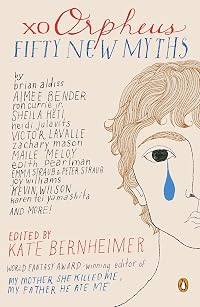
xo Orpheus: Fifty New Myths
by Kate Bernheimer (Editor)
On This Page
Description
Fifty leading writers retell myths from around the world in this follow-up to the bestselling My mother she killed me, my father he ate me. "Icarus flies once more. Aztec jaguar gods again stalk the earth. An American soldier designs a new kind of Trojan horse--his cremains in a bullet. Here ... are your favorite mythological figures--Daedalus and Icarus, Narcissus and Echo, Orpheus and Eurydice, Pygmalion and Galatea, even Argos, Odysseus's faithful dog--alongside characters from Indian, show more Punjabi, Inuit, Aztec, and other traditions"--Page 4 of cover. show lessTags
Recommendations





Member Reviews
I am normally a great fan of reimagined versions of the classics, but this collection of fifty stories inspired by myth did not click for me, and by the second half of the book, I was mostly browsing and skimming, hoping to find at least a few stories that would hold my attention.
I think the main problem is that the stories have been too contemporized, to the point of removing the gods from them entirely. The stakes are dramatically lowered if there's no element of god vs. human in these stories; reducing the story of Demeter and Persephone to a story about the awkwardness of shared custody diminishes the story.
The book is dominated by Greek myth, but there are stories built around Chinese, Indian, Norse, Inuit, and Mexican myths; it show more warmed my atheist heart to see that one story's mythological referent in the table of contents was "God and Satan."
The book sequences the stories in alphabetical order by their mythological source, so we progress from "Anthropogenesis and Norse Creation Myth" to "Zeus and Europa." That leads to a few stretches of redundancy; hitting all of the Daedalus stories in a clump feels more repetitious than it would if they'd been scattered throughout.
There were a few stories that clicked for me, though not necessarily because of their mythological resonance; they were just nicely written stories. Kit Reed's "Sissy" suggests that for some men, finding a way to connect to their father is the metaphorical rock they must forever push up the hill. Willy Vlautin's "Kid Collins" is the best of the book's several takes on Persephone; ditto for Anthony Marra's "The Last Flight of Daedalus" and that character.
Aimee Bender's "Devourings" is a Cronos variation that finds a way to keep something of the god/human dynamic; Maile Chapman's "Friend Robin" puts the Irish Brownies in modern context; Elanor Dymott's "Henry and Booboo" makes the story of Candaules and Gyges (which I hadn't previously known) even creepier than the original.
Best in show honors go to Edward Carey, whose signature style of gently disquieting strangeness is well suited to the story of Baucis and Philemon, which he reimagines in "Sawdust."
This is a collection of fine authors, and I don't think anything here is badly written. But most of the stories have, in their reinterpretation, removed themselves so far from the original myth that they simply read as contemporary literary fiction, which is a genre that just doesn't interest me much. Your mileage is likely to vary. show less
I think the main problem is that the stories have been too contemporized, to the point of removing the gods from them entirely. The stakes are dramatically lowered if there's no element of god vs. human in these stories; reducing the story of Demeter and Persephone to a story about the awkwardness of shared custody diminishes the story.
The book is dominated by Greek myth, but there are stories built around Chinese, Indian, Norse, Inuit, and Mexican myths; it show more warmed my atheist heart to see that one story's mythological referent in the table of contents was "God and Satan."
The book sequences the stories in alphabetical order by their mythological source, so we progress from "Anthropogenesis and Norse Creation Myth" to "Zeus and Europa." That leads to a few stretches of redundancy; hitting all of the Daedalus stories in a clump feels more repetitious than it would if they'd been scattered throughout.
There were a few stories that clicked for me, though not necessarily because of their mythological resonance; they were just nicely written stories. Kit Reed's "Sissy" suggests that for some men, finding a way to connect to their father is the metaphorical rock they must forever push up the hill. Willy Vlautin's "Kid Collins" is the best of the book's several takes on Persephone; ditto for Anthony Marra's "The Last Flight of Daedalus" and that character.
Aimee Bender's "Devourings" is a Cronos variation that finds a way to keep something of the god/human dynamic; Maile Chapman's "Friend Robin" puts the Irish Brownies in modern context; Elanor Dymott's "Henry and Booboo" makes the story of Candaules and Gyges (which I hadn't previously known) even creepier than the original.
Best in show honors go to Edward Carey, whose signature style of gently disquieting strangeness is well suited to the story of Baucis and Philemon, which he reimagines in "Sawdust."
This is a collection of fine authors, and I don't think anything here is badly written. But most of the stories have, in their reinterpretation, removed themselves so far from the original myth that they simply read as contemporary literary fiction, which is a genre that just doesn't interest me much. Your mileage is likely to vary. show less
Summary: Most people think of myths in terms of the ancient world, gods and goddesses and togas and warriors and great beasts. But mythology speaks to us as much today as it did to people back then, and the stories and the lessons that it contains are just as applicable to our modern world. This book asks authors to retell or re-imagine their favorite myth, recasting ancient gods and heroes in their roles in the modern world, and creating new myths in the process, new forms for the old stories.
Review: I love mythology, and stories that use mythology in new ways. (Witness: 2012/2013's binge on Rick Riordan's books.) We read D'Aulaire's Book of Greek Myths in 6th grade and I begged my parents to buy me my own copy and I never looked show more back. (I've gone as mythological figures for several Halloween, although that's partly because it's easy to re-accessorize your basic toga for a whole new costume.) The old stories still have power for me, and I love authors that can harness that power and use it to make something new. So this book should have been a lock for me, but in trying to make the stories new and modern and dark and edgy, I felt like a lot of the stories really lost something - whatever it is about the myths that I connected to in the first place.
So in her introduction to this book, Bernheimer says that in the modern age, when humans have powers that can rival those of the gods, our myths "reveal a gaping anxiety, a primal fear, leading to sadness about what we have done." I see where she's coming from with that, even if I'm not sure that I believe it, and it's true that it's certainly reflective of the stories in this collection. But I found the unrelenting bleakness of so many of the stories in this book kind of disheartening, and disquieting, and it made this book not entirely satisfying, and often times hard to want to go back to and read more.
There were some stories I really liked. Several stories in this volume re-imagine Persephone as a child shuffling between divorced parents, and two of them really stood out for me. "Demeter", by Maile Meloy, was my favorite in the collection by far. I'm not quite sure why it struck me the way that it did - I'm not a mother, let alone a divorced mother with shared custody who has to give my child up for half the year. But the characters in this one were vivid, the imagery was beautiful, and it was one of the few stories that left the reader with at least a spark of hope. "Lost Lake", by Emma Straub and Peter Straub, was another of my favorites; it also used the child of divorced parents as a basis but focused more of the experience of Persephone in the Underworld. I also really enjoyed "What Wants My Son", by Kevin Wilson. It was one of the more literal "bring the ancient gods and demigods (in this case, Helios and Phaeton) into the modern world" re-tellings, and as such sort of reminded me of Riordan, but it felt honest and like it had some sense of humor about itself. Several of the other stories - "Modern Coyote" by Shane Jones (a trickster/Coyote story), "Killcrop" by Victore LaValle (changelings), "Slaves" by Elizabeth Evans (Maenads), and "Sissy" by Kit Reed (a combination of Sisyphus and Oedipus) - were all very well done, and very effective, but too disquieting to say that I exactly enjoyed them. "The Status of Myth" by Kelly Braffet and Owen King had some really beautiful moments, but didn't quite come together for me (even though I recognize that it was supposed to be disjointed.) Two of the shorter pieces, "Argos" by Joy Williams and "So Many-Headed Gates" by Sheila Heti were both quite lovely.
There were also stories that didn't work for me. The stories that I had the hardest time with, and frequently wound up skimming or skipping, were those that were translated from other languages (mostly French). Maybe something got lost in translation, or maybe modernist French literature is just not for me, but these stories were just not my cup of tea. In general, those stories that tried to be the most "literary", the most experimental with the language or the story style or the story concept, were usually my least favorites. As I said in my review of My Mother She Killed Me, My Father He Ate Me, I like stories that focus on telling a good story, and that's especially true when the inspiration is fairy tales, or mythology - two forms where the universality and the power of the story itself is what should be the star of the show. And in this book, a number of the stories got there, but too many of them didn't for the collection as a whole to really bowl me over. 3 out of 5 stars.
Recommendation: I think people who read more contemporary "literary" fiction than I do may have a better time with this collection than I did. It's an interesting idea, but the final product wasn't quite what I'd hoped it would be. show less
Review: I love mythology, and stories that use mythology in new ways. (Witness: 2012/2013's binge on Rick Riordan's books.) We read D'Aulaire's Book of Greek Myths in 6th grade and I begged my parents to buy me my own copy and I never looked show more back. (I've gone as mythological figures for several Halloween, although that's partly because it's easy to re-accessorize your basic toga for a whole new costume.) The old stories still have power for me, and I love authors that can harness that power and use it to make something new. So this book should have been a lock for me, but in trying to make the stories new and modern and dark and edgy, I felt like a lot of the stories really lost something - whatever it is about the myths that I connected to in the first place.
So in her introduction to this book, Bernheimer says that in the modern age, when humans have powers that can rival those of the gods, our myths "reveal a gaping anxiety, a primal fear, leading to sadness about what we have done." I see where she's coming from with that, even if I'm not sure that I believe it, and it's true that it's certainly reflective of the stories in this collection. But I found the unrelenting bleakness of so many of the stories in this book kind of disheartening, and disquieting, and it made this book not entirely satisfying, and often times hard to want to go back to and read more.
There were some stories I really liked. Several stories in this volume re-imagine Persephone as a child shuffling between divorced parents, and two of them really stood out for me. "Demeter", by Maile Meloy, was my favorite in the collection by far. I'm not quite sure why it struck me the way that it did - I'm not a mother, let alone a divorced mother with shared custody who has to give my child up for half the year. But the characters in this one were vivid, the imagery was beautiful, and it was one of the few stories that left the reader with at least a spark of hope. "Lost Lake", by Emma Straub and Peter Straub, was another of my favorites; it also used the child of divorced parents as a basis but focused more of the experience of Persephone in the Underworld. I also really enjoyed "What Wants My Son", by Kevin Wilson. It was one of the more literal "bring the ancient gods and demigods (in this case, Helios and Phaeton) into the modern world" re-tellings, and as such sort of reminded me of Riordan, but it felt honest and like it had some sense of humor about itself. Several of the other stories - "Modern Coyote" by Shane Jones (a trickster/Coyote story), "Killcrop" by Victore LaValle (changelings), "Slaves" by Elizabeth Evans (Maenads), and "Sissy" by Kit Reed (a combination of Sisyphus and Oedipus) - were all very well done, and very effective, but too disquieting to say that I exactly enjoyed them. "The Status of Myth" by Kelly Braffet and Owen King had some really beautiful moments, but didn't quite come together for me (even though I recognize that it was supposed to be disjointed.) Two of the shorter pieces, "Argos" by Joy Williams and "So Many-Headed Gates" by Sheila Heti were both quite lovely.
There were also stories that didn't work for me. The stories that I had the hardest time with, and frequently wound up skimming or skipping, were those that were translated from other languages (mostly French). Maybe something got lost in translation, or maybe modernist French literature is just not for me, but these stories were just not my cup of tea. In general, those stories that tried to be the most "literary", the most experimental with the language or the story style or the story concept, were usually my least favorites. As I said in my review of My Mother She Killed Me, My Father He Ate Me, I like stories that focus on telling a good story, and that's especially true when the inspiration is fairy tales, or mythology - two forms where the universality and the power of the story itself is what should be the star of the show. And in this book, a number of the stories got there, but too many of them didn't for the collection as a whole to really bowl me over. 3 out of 5 stars.
Recommendation: I think people who read more contemporary "literary" fiction than I do may have a better time with this collection than I did. It's an interesting idea, but the final product wasn't quite what I'd hoped it would be. show less
I did not have high hopes for this, as I'd only read books by two of the authors, and didn't like either one of them. Still, this is a decent (though overlong) collection of stories inspired, however vaguely, by mythology from all over the world. Like all anthologies, there are some fantastic tales (The Sisters by Sabina Murray and The Last Flight of Daedelus by Anthony Marra are particular favorites), some truly dreadful ones, and a bunch that are just okay. The trouble with anthologies is that so many people who write short stories forget to include the story part: it's just a bunch of descriptive passages with nothing ever actually happening. I would not have complained had the selection here been trimmed down a bit, but I understand show more the appeal of a nice round number like fifty. I also question the decision to order the tales by myth, meaning for example that all the Icarus tales were next to each other. Of course, this was not consistent: the story inspired by Demeter & Persephone was near the beginning, while the one just about Persephone came much later. I most appreciated the afterwords provided by each author or translator, explaining the connection to their chosen myth (or with mythology in general, as some chose to do). In short, I found this to be an interesting literary experiment, if not to my particular taste. Do not pick it up expecting modern retellings of classic myths. Instead, think of it as a general anthology with mythological elements thrown in. show less
Overall I can't say I liked this collection as much as My Mother She Killed Me, My Father He Ate Me, but it included some truly stellar stories, including The Sisters by Sabina Murray; Devourings by Aimee Bender; Galatea by Madeline Miller; and Belle-Medusa by Manuela Drageur; and likely a few others neglected because I started this book in October and proceeded to spend half a year returning to it.
Today, I have to write a review I don’t really want to. See, there are negative reviews and negative reviews. Sometimes a negative review is really satisfying, because the book was, at least by your own estimation, perfectly horrid and/or rage-inducing. Times like today, though, the book is quite good in its own way, but that doesn’t happen to be a way that coincides so much with your taste. I always feel so bad when this happens with a review book, because I feel like I should have known better than to accept it, but you really can’t always know these things. Anyway, from as objective a standpoint as I can get to, xo Orpheus is a great read for scholarly folks, with stories that can be unpacked and considered, but which consisted show more largely of stories which do not work for me personally.
Read the full review at A Reader of Fictions. show less
Read the full review at A Reader of Fictions. show less
Ratings
Members
- Recently Added By
Lists

Titles beginning with X
72 works; 3 members
Author Information

Kate Bernheimer, Assistant Professor in the Creative Writing Program at the University of Alabama, has been the George Bennett Fellow in Creative Writing at Phillips Exeter Academy in New Hampshire.
All Editions
Awards and Honors
Awards
Common Knowledge
- Canonical title
- xo Orpheus: Fifty New Myths
- Alternate titles
- Orpheus : Fifty new myths; Orpheus : 50 new myths
- Original publication date
- 2013-09-24
- Epigraph
- What is the deepest loss that you have suffered? If drinking is bitter, change yourself to wine. -from Sonnets to Orpheus II, 29 Rainer Maria Rilke, Translated by Stephen Mitchell
- First words
- In the modern characterization of Orpheus, culled from diverging stories of antiquity, Orpheus is the best musician of all time--let's make that the greatest artist.
Classifications
Statistics
- Members
- 317
- Popularity
- 100,650
- Reviews
- 5
- Rating
- (3.57)
- Languages
- English
- Media
- Paper, Ebook
- ISBNs
- 2
- ASINs
- 1