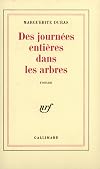
Whole Days in the Trees & Other Stories
by Marguerite Duras
On This Page
Description
Gives instructions and describes the tools and materials needed for making a model ship.Tags
Recommendations

































Member Reviews
This is a collection of short stories published in 1954 fairly early in the long writing career of Marguerite Duras. The title story of nearly one hundred pages could be classed as a novella. In each of these works Duras is stretching herself to create something a little different and she succeeds in creating an atmosphere, although the shortest story Boa is the leat successful because while the longer stories develop and build the stories with their different styles, Boa is over all too quickly.
Des Journées dans les Arbres tells of an elderly woman journeying to visit her son. She arrives by aeroplane and is met by her son and his partner at the airport. The son hardly recognises his mother and this is because she has aged show more tremendously in the long time that they have not seen each other. The story is written as a conversation mainly between the three protagonists, and it quickly becomes apparent that the relationship is a difficult one. Jacques has been the black sheep of the family the only son who has not made money and been successful, he feels resentful and his relationship with a prostitute Marcelle is on thin ice. They live in a small three roomed apartment and the mother has to cope with fairly squalid conditions while trying to recover her health after the flight. The conversation is not easy and the visit to a nightclub where Jacques and Marcelle work as dancers/hosts becomes an ordeal for all three of them. The story was adapted and made into a film which Duras directed and it also enjoyed a run as a stage play.
Madame Dodin takes us back to between the wars and perhaps a popular subject of some writing in France; a Parisian concièrge. Madame Dodin is in her sixties and is indulging in a war with the tenants of the apartment block over the collection of refuse. It is her job to wheel out the communal bins every day, but she complains bitterly because the tenants do not throw away their rubbish everyday, saving it up so that the bins become very heavy. Madame Dodin makes sure she wakes them all up when she drags out the bins in the early morning. She has a confident in the concierge next door but also with the roadsweeper Gaston, who stops by every day on his rounds. The story turns towards Gaston who at first takes pride in his job, but becomes increasingly disenchanted. Madam Dodin an equally unhappy person confides in him and it becomes evident that there is something between them. This story develops from a fairly lengthy description of Madame Dodin's situation and gets right under the skin of the protagonists, building in confidence as it moves along.
The final story: Les Chantiers is the most experimental. A young man on holiday in a hotel notices a girl leaving to go into some woods. He misses dinner to meet her when she returns to stare at a building construction site across from the hotel. They speak briefly and for the remainder of the holiday the young man watches the young woman. Confident that she will eventually come to him. The story is told from the young man's perspective and his inner belief that the young woman will eventually notice him.
The stories have a climax to them of sorts, but the resolutions if there are any are open. There is an undeniable power, almost mystic in a couple of them; sexual attraction is an underlying theme of the final two and they are worth reading. Difficult to grasp at times as Duras searches for inner motivation, but the stories unfold and stay in the memory 4 stars. show less
Des Journées dans les Arbres tells of an elderly woman journeying to visit her son. She arrives by aeroplane and is met by her son and his partner at the airport. The son hardly recognises his mother and this is because she has aged show more tremendously in the long time that they have not seen each other. The story is written as a conversation mainly between the three protagonists, and it quickly becomes apparent that the relationship is a difficult one. Jacques has been the black sheep of the family the only son who has not made money and been successful, he feels resentful and his relationship with a prostitute Marcelle is on thin ice. They live in a small three roomed apartment and the mother has to cope with fairly squalid conditions while trying to recover her health after the flight. The conversation is not easy and the visit to a nightclub where Jacques and Marcelle work as dancers/hosts becomes an ordeal for all three of them. The story was adapted and made into a film which Duras directed and it also enjoyed a run as a stage play.
Madame Dodin takes us back to between the wars and perhaps a popular subject of some writing in France; a Parisian concièrge. Madame Dodin is in her sixties and is indulging in a war with the tenants of the apartment block over the collection of refuse. It is her job to wheel out the communal bins every day, but she complains bitterly because the tenants do not throw away their rubbish everyday, saving it up so that the bins become very heavy. Madame Dodin makes sure she wakes them all up when she drags out the bins in the early morning. She has a confident in the concierge next door but also with the roadsweeper Gaston, who stops by every day on his rounds. The story turns towards Gaston who at first takes pride in his job, but becomes increasingly disenchanted. Madam Dodin an equally unhappy person confides in him and it becomes evident that there is something between them. This story develops from a fairly lengthy description of Madame Dodin's situation and gets right under the skin of the protagonists, building in confidence as it moves along.
The final story: Les Chantiers is the most experimental. A young man on holiday in a hotel notices a girl leaving to go into some woods. He misses dinner to meet her when she returns to stare at a building construction site across from the hotel. They speak briefly and for the remainder of the holiday the young man watches the young woman. Confident that she will eventually come to him. The story is told from the young man's perspective and his inner belief that the young woman will eventually notice him.
The stories have a climax to them of sorts, but the resolutions if there are any are open. There is an undeniable power, almost mystic in a couple of them; sexual attraction is an underlying theme of the final two and they are worth reading. Difficult to grasp at times as Duras searches for inner motivation, but the stories unfold and stay in the memory 4 stars. show less
Over een moeder die haar zoon nog een laatste maal komt bezoeken.
Lu dans sa forme théâtrale (publiée en 1968) et non sous sa forme initiale (nouvelle publiée en 1954). "Des journées entières dans les arbres" se lisent comme une variation partielle de "Un barrage contre le Pacifique" qui évoquait déjà l'amour fou de la mère de Marguerite Duras pour le fils aîné abject et paré de tous les défauts. Bien sûr, les prénoms des personnages ont été changés mais les éléments du texte relatent bien la vie de la mère plutôt folle dans une lointaine colonie française, faisant peu de cas de sa fille (ici appelée Mimi).
Aux personnages de la mère (de passage en France pour seulement 24 heures) et du fils s'ajoute celui de Marcelle, une fille simple et gentille (issue de l'assistance show more publique) que le mauvais fils maltraite. Les dialogues se font essentiellement entre eux trois, parmi des didascalies assez nombreuses (rappelons que ce texte a initialement été rédigé sous forme de nouvelle). A l'exception de Marcelle qui écoute, la mère et le fils sont incapables d'écouter et semblent plutôt s'adresser à eux-mêmes. La mère, dingue et dévorante (au propre comme au figuré, elle ne pense qu'à manger et à s'emplir du fils aimé), est dans une sorte de délire perpétuel et sert les mauvaises intentions du fils.
Les mots sont froids et brûlants, excessifs et coupants comme du verre. L'orage gronde sans cesse, aucune issue n'est possible.
Un très bon texte, éminemment durassien. show less
Aux personnages de la mère (de passage en France pour seulement 24 heures) et du fils s'ajoute celui de Marcelle, une fille simple et gentille (issue de l'assistance show more publique) que le mauvais fils maltraite. Les dialogues se font essentiellement entre eux trois, parmi des didascalies assez nombreuses (rappelons que ce texte a initialement été rédigé sous forme de nouvelle). A l'exception de Marcelle qui écoute, la mère et le fils sont incapables d'écouter et semblent plutôt s'adresser à eux-mêmes. La mère, dingue et dévorante (au propre comme au figuré, elle ne pense qu'à manger et à s'emplir du fils aimé), est dans une sorte de délire perpétuel et sert les mauvaises intentions du fils.
Les mots sont froids et brûlants, excessifs et coupants comme du verre. L'orage gronde sans cesse, aucune issue n'est possible.
Un très bon texte, éminemment durassien. show less
Nov 28, 2020French
Una forma d'immaturità esistenziale accumuna i personaggi delle storie: il rapporto tra il figlio viziato e una madre ricca e egoista, ai margini della normalità borghese; una collegiale che impara dall'osservazione di un boa il senso della felicità; una portinaia che sogna di morire per non svuotare i bidoni della spazzatura; un'amore fatto di sguardi e gesti, nell'attesa del fatale incontro.
Feb 12, 2020Italian
Ratings
Members
- Recently Added By
Author Information

234+ Works 18,899 Members
Marguerite Duras was born in Gia-Dinh, Indochina on April 4, 1914. After attending school in Saigon, she moved to Paris, France to study law and political science. After graduation, she worked as a secretary in the French Ministry of the Colonies until 1941. During World War II, she joined the Resistance and published her first books. After the show more liberation, she became a member of the French Communist Party, and though she later resigned, she always described herself as a Marxist. Her first book, Les Impudents, was published in 1943. During her lifetime, she wrote more than 70 novels, plays, screenplays and adaptations. Her novels include The Sea Wall, The Lover, The Lover from Northern China, The War, and That's All. In 1959, she wrote her first film scenario, Hiroshima, Mon Amour, and has since been involved in a number of other films, including India Song, Baxter, Vera Baxter, Le Camion (The Truck), and The Lover. She died on March 4, 1996 at the age of 81. (Bowker Author Biography) show less
Some Editions
Series
Belongs to Publisher Series
Work Relationships
Is contained in
Common Knowledge
- Canonical title
- Whole Days in the Trees; Whole Days in the Trees & Other Stories
- Original title
- Des journées entières dans les arbres
- Original publication date
- 1954 (Frans) (Frans); 1987 (Nederlands) (Nederlands)
- Important places*
- Vietnam
- Original language*
- Frans
*Some information comes from Common Knowledge in other languages. Click "Edit" for more information.
Classifications
Statistics
- Members
- 132
- Popularity
- 248,467
- Reviews
- 4
- Rating
- (3.75)
- Languages
- 5 — Dutch, English, French, German, Italian
- Media
- Paper, Ebook
- ISBNs
- 13
- ASINs
- 2