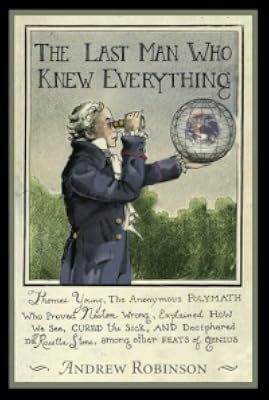
The Last Man Who Knew Everything: Thomas Young, the Anonymous Genius Who Proved Newton Wrong and Deciphered the Rosetta Stone, Among Other Surprising Feats
by Andrew Robinson
On This Page
Description
No one has given the polymath Thomas Young (1773-1829) the all-round examination he so richly deserves-until now. Celebrated biographer Andrew Robinson portrays a man who solved mystery after mystery in the face of ridicule and rejection, and never sought fame. As a physicist, Young challenged the theories of Isaac Newton and proved that light is a wave. As a physician, he showed how the eye focuses and proposed the three-colour theory of vision, only confirmed a century and a half later. show more As an Egyptologist, he made crucial contributions to deciphering the Rosetta Stone. It is hard to grasp how much Young knew. This biography is the fascinating story of a driven yet modest hero who cared less about what others thought of him than for the joys of an unbridled pursuit of knowledge-with a new foreword by Martin Rees and a new postscript discussing polymathy in the two centuries since the time of Young. It returns this neglected genius to his proper position in the pantheon of great scientific thinkers. show lessTags
Recommendations

Member Reviews
This is more an overview than a complete biography. Thomas Young was, depending on your viewpoint, a genius who applied his talents to anything and everything, or a dilettante who couldn't focus on a single subject. The truth, as ever, is probably somewhere in the middle. I'd heard of him in science, having covered Young's slits and Young's modulus in various physics courses as a student. Anyone with one important phenomena to his name, let alone two, clearly had some skills. And that's not the extent of his discoveries. He first proposed the three colour sensor theory of vision which wasn't proven until the mid 20th century. He was also a linguist and spoke multiple languages which contributed to his early breakthroughs in translating show more Egyptian hieroglyphs. Trouble is that he wasn't necessarily his own best promotor. His writing is somewhat convoluted (as was the style of tie time) and it is not always clear if he had actually performed the experiment, or merely thought his way through it. There are mixed messages as well. He was trying to set up as a doctor, so most of his early publications were anonymous, but then he tended to take exception to not being credited by later work (Champollion being the most notable example). At the end of this he remains a bit of an enigma. It spends quite a lot of time on his technical achievement and almost none on his family, his poor wife barely gets a look in. I don't feel like I know the subject much more although I know more about the subject. I think that the age of people able to become an expert in multiple broad fields has gone - and I think that's a shame in some ways. show less
An unremarkable biography of a remarkable man. The subject is fascinating, but Robinson's writing isn't strong and the repeated cross references to topics covered elsewhere in the book got very annoying.
I actually finished this book. At least, I remember moving the bookmark further and further and then not needing it anymore. This actually happened at least a year ago, and all I remember about "what I learned from this book" is that Thomas Young was smart (although I may only be recalling the title) and that the first few chapters were interesting.
Ratings
Members
- Recently Added By
Author Information

26+ Works 2,970 Members
Andrew Robinson is the author of some 25 books on the arts and sciences, including India: A Short History and Lost Languages: The Enigma of the World's Undeciphered Scripts. He writes for The Lancet, Nature and Science.
Some Editions
Common Knowledge
- Original publication date
- 2006
- People/Characters
- Thomas Young
- Important places
- United Kingdom
- Epigraph
- "Fortunate Newton, happy childhood of science! ... Nature to him was an open book, whose letters he could read without effort. ... Reflection, refraction, the formation of images by lenses, the mode of operation of the eye, t... (show all)he spectral decomposition and the recomposition of the different kinds of light, the invention of the reflecting telescope, the first foundations of color theory, the elementary theory of the rainbow pass by us in procession, and finally come his observations of the colors of thin films as the origin of the next great theoretical advance, which had to await, over a hundred years, the coming of Thomas Young."
--Albert Einstein, Foreword to the fourth edition of Isaac Newton's Opticks, 1931 - Dedication
- For Dipli, "con amore"
- First words
- Open any book on the science of light and vision, and you cannot miss the name of Thomas Young.
- Last words
- (Click to show. Warning: May contain spoilers.)What is undeniable, though, is that Thomas Young really did approximate to 'the last man who knew everything' -- however much he himself would have denied this -- and we can safely say, with the endless expansion and bifurcation of knowledge, that no one will be able to stake this awesome claim ever again.
- Original language
- English
Classifications
Statistics
- Members
- 273
- Popularity
- 118,148
- Reviews
- 3
- Rating
- (3.64)
- Languages
- English
- Media
- Paper, Ebook
- ISBNs
- 9
- UPCs
- 1
- ASINs
- 2