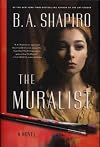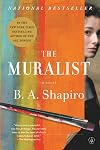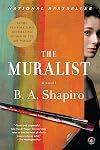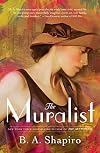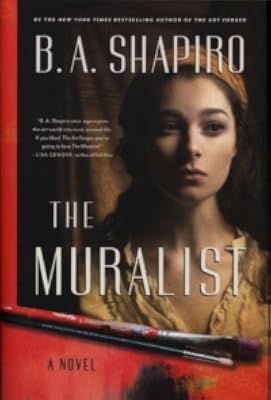
The Muralist
by B. A. Shapiro
On This Page
Description
Alizée Benoit, an American painter working for the Works Progress Administration (WPA), vanishes in New York City in 1940 amid personal and political turmoil. No one knows what happened to her. Not her Jewish family living in German-occupied France. Not her artistic patron and political compatriot, Eleanor Roosevelt. Not her close-knit group of friends, including Mark Rothko, Jackson Pollock, and Lee Krasner. And, some seventy years later, not her great-niece, Danielle Abrams, who while show more working at Christie's auction house uncovers enigmatic paintings hidden behind recently found works by those now famous Abstract Expressionist artists. Do they hold answers to the questions surrounding her missing aunt? Entwining the lives of both historical and fictional characters, and moving between the past and the present, The Muralist plunges readers into the divisiveness of prewar politics and the largely forgotten plight of European refugees refused entrance to the United States. It captures both the inner workings of today's New York art scene and the beginnings of the vibrant and quintessentially American school of Abstract Expressionism. B.A. Shapiro is a master at telling a gripping story while exploring provocative themes. In Alizée and Danielle she has created two unforgettable women, artists both, who compel us to ask, What happens when luminous talent collides with inexorable historical forces? Does great art have the power to change the world? And to what lengths should a person go to thwart evil? show lessTags
Recommendations




































Member Recommendations
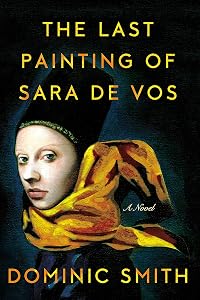
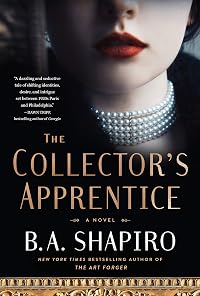
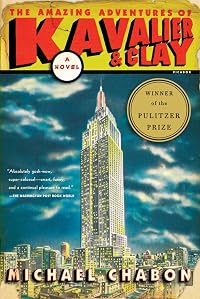
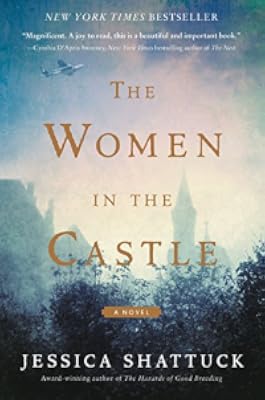
BookshelfMonstrosity These well-researched, moving novels contain multiple parallel plotlines and showcase framed paintings that hide other works of art. The heart-wrenching stories of Jewish war refugees combine with those of historical and fictional figures as modern characters discover their family connections.
Member Reviews
The mid-century American abstract expressionist artists may not be my forté in terms of style, but Shapiro’s novel was so engaging that I couldn’t put it down. The book weaves together two intertwined narratives, following a (very fictional) member of the artistic group during the late 1930s and her grand-niece, who is an art appraiser/researcher for Christie’s auction house. The modern storyline was interesting and would easily appeal to the genealogist crowd, who would revel in the historical mystery that Danielle is trying to uncover, but what got me was the historical narrative. Shapiro paints a vivid portrait of New York during the late 1930s, covering politics, social unrest, and the artistic movements that were slowly show more coming to be known in the new American schools of thought through her characters and scenes. The events precluding and during World War II have been trotted out ad nauseum at this point in the historical fiction market, so her focus on the American perspective leant this novel a fresh breath. The carefully written protagonist, Alizée Benoit, provides further tension to the narrative, as she is firmly entrenched in her life in New York as an artist, but hears the growing clarion of war in Europe far more acutely than her American friends, since she still has a number of Jewish family members in France. As grand-niece Danielle explores Alizée’s story we are frustrated alongside her, knowing that there is more to discover but that much of history (unless carefully documented) can and is lost to time, but thankfully Shapiro concludes the story with some carefully placed accidental discoveries that wrap things up neatly by the final pages. Alizée Benoit may be a fictional creation, as is her story, but it gives us an interesting view into the past, and opens up some questions about the gaps in the historical record that I think are definitely worth exploring! show less
Rating 4.5
When coupled with the author's engaging narrative, her expansive knowledge of the art world creates an immersive, engaging experience much like it was with "The Art Forger".
We first meet Danielle, a staff member at Christie's Art Auction gallery who comes across some early Abstract Expressionist paintings from the 40s. As she researches their background she realizes they were painted by her great aunt Alizee, who grew up in France and moved to New York early in her career. Alizee became part of a team of artists hired to paint murals by a government program. Working side by side with the likes of Jackson Pollock, Lee Krasner, Mark Rathko and others their art caused a stir due to its groundbreaking style. Across the ocean, the show more Nazi's had begun their ethnic cleansing push causing concern for Alizee's family.
Toggling back and forth from 1940 to 2015, Danielle's investigation into Alizee's history grows worrisome when she learns she'd entered mental health ward and suddenly disappears. We learn that Alizee and her colleagues become outraged with Breckinridge Long, a member of FDRs cabinet in charge of immigration. Parallel, Eleanor Roosevelt visits the muralists and is captured by Alizee's art; soon after a close relationship develops. What's fascinating is the parallel between FDR's administration and Trump's due to their 'immigrants will steal American jobs' mentality.
Learning that her family's attempts to get visas became hopeless, Alizee learns that Long undermined Congressional immigration law by going behind FDR's back. Making Eleanor aware of what she'd discovered, the First Lady's appeal to FDR fails. As the Nazi invasion deepens, and the US refuses to allow immigrants, Alizee's emotional stability wavers. When she finally has a breakdown, she's taken to the Bloom Sanitarium and disappears a couple of days later.
Well paced, each chapter provides twists and turns which when added to letters builds momentum. And with each twist, reader engagement deepens. Evocative, passionate and revealing, its immersive quality and historical relevance makes for an enjoyable reader experience.
Shapiro has a unique style, does copious research and engages with believable characters. Highly recommended for those who enjoy the world of art, history and intrigue show less
When coupled with the author's engaging narrative, her expansive knowledge of the art world creates an immersive, engaging experience much like it was with "The Art Forger".
We first meet Danielle, a staff member at Christie's Art Auction gallery who comes across some early Abstract Expressionist paintings from the 40s. As she researches their background she realizes they were painted by her great aunt Alizee, who grew up in France and moved to New York early in her career. Alizee became part of a team of artists hired to paint murals by a government program. Working side by side with the likes of Jackson Pollock, Lee Krasner, Mark Rathko and others their art caused a stir due to its groundbreaking style. Across the ocean, the show more Nazi's had begun their ethnic cleansing push causing concern for Alizee's family.
Toggling back and forth from 1940 to 2015, Danielle's investigation into Alizee's history grows worrisome when she learns she'd entered mental health ward and suddenly disappears. We learn that Alizee and her colleagues become outraged with Breckinridge Long, a member of FDRs cabinet in charge of immigration. Parallel, Eleanor Roosevelt visits the muralists and is captured by Alizee's art; soon after a close relationship develops. What's fascinating is the parallel between FDR's administration and Trump's due to their 'immigrants will steal American jobs' mentality.
Learning that her family's attempts to get visas became hopeless, Alizee learns that Long undermined Congressional immigration law by going behind FDR's back. Making Eleanor aware of what she'd discovered, the First Lady's appeal to FDR fails. As the Nazi invasion deepens, and the US refuses to allow immigrants, Alizee's emotional stability wavers. When she finally has a breakdown, she's taken to the Bloom Sanitarium and disappears a couple of days later.
Well paced, each chapter provides twists and turns which when added to letters builds momentum. And with each twist, reader engagement deepens. Evocative, passionate and revealing, its immersive quality and historical relevance makes for an enjoyable reader experience.
Shapiro has a unique style, does copious research and engages with believable characters. Highly recommended for those who enjoy the world of art, history and intrigue show less
The Muralist is riveting, haunting and tragic till the end when it gives a ray of hope and leaves the reader satisfied. It also provides a slight insight into what goes on in the minds of the isolationist political leaders calling for ban on refugees in the present day and how it is not much different from history.
Before America enters WWII, Alizee Benoit, an American Jew is working as an artist with the Works Progress Administration and is friends with Jackson Pollock, Mark Rothko and Lee Krasner before they became popular as the early Abstract Expressionists. Here, Alizee is the one who is painting in abstract and influences each of them and their painting styles. She is also haunted by the fact that her whole family is in France, show more just before the German occupation. The roundups and arrests of Parisian Jews has begun and she is frightened. She tries her level best to secure visas for her family but is unsuccessful. She also enlists the help of First Lady Eleanor Roosevelt (who incidentally loves and purchases her paintings) but even Eleanor cannot convince the President to allow more refugees into the country because he is running for re-election and cannot afford to go against the public sentiment and support of isolationists like Breckenridge Long, Joe Kennedy and Charles Lindbergh. Alizee even decides to paint murals with a political point instead of the original commissioned artwork that is to be installed because she comes to believe that the more people who view and understand the pain and devastation depicted in it, the more they will be able to empathize with the refugees and give them safe haven. When nothing works, she even becomes a party to an assassination attempt on a powerful politician, because she assumes naively that eliminating him would somehow quench the hatred (call it anti-Semitism) of the masses and would put a stop to the wastage of visas which in turn will save thousands of innocents. Through all this, she is also devolving, has been suffering from depersonalization and finally has a breakdown just before she goes missing forever.
Seventy five years later, Alizee’s grand-niece Dani Abrams finds some murals that come her way for appraisal and she is stunned to find them very similar in style and emotion to the only two surviving paintings of her aunt. As Alizee is an unknown commodity, Dani is forbidden by her employer from digging into her aunt’s history. But she invests all her remaining time to this endeavor, hanging onto any thread she can find and finally arriving in Paris to confront the horrors that were perpetrated on her family. This journey also becomes a turning point in her life and sets her on a path to finally fulfil her destiny to be a painter.
These two remarkable women and their lives are great to read about and especially Alizee’s struggles with her art, family and her mind are truly tragic. However, the most important theme that lingers in the mind is how politicians then and now, use their words and fear psychosis to incite a group of people to hate another and play political football with the lives of hundreds of thousands of refugees. They are always going to use every tool at their disposal to gain votes and the gullible voters will get hoodwinked by the propaganda and forget the things that separates humans from other species – thinking capacity and morality. The book also serves as a reminder of the part of American history that many would want to forget – that America too was in someway complicit in the 6 million deaths, by virtue of being unresponsive.
Overall, this is a great book – an excellent amalgamation of fictional with real, history with contemporary and art with politics and also offers a unique American perspective of the Holocaust. show less
The latest B. A. Shapiro novel, after The Art Forger, delves into the art world in two centuries and with two artists.
In 2015, Danielle Abrams (Dani) works as a cataloguer for Christies in New York. A lapsed artist, Dani receives several paintings that have been found in an attic. They could be some undiscovered works by Jackson Pollock, Lee Krasner, or Mark Rothko. However, Dani sees something different; the paintings remind her of her great-aunt Alizee Benoit’s work. In the world of abstract expressionism, there has always seemed to be a missing link. Dani has always thought that work could be Alizee’s.
In1939, Alizee Benoit is working for the WPA (Works Progress Adminstration under Franklin Roosevelt’s New Deal). Her best show more friends are Jackson Pollock, Leo Krasner, and Mark Rothko. They are painting murals for various buildings, but their true passion is abstract expressionism.
Alizee is a Jew from France and has left her entire family there. As Hitler’s rise to power escalates, letters from her family become more and more desperate, begging her to help them obtain visas to get out. When she’s working on her art, she wants her paintings to reflect the Jewish crisis. When she’s working for the WPA but she’s forced to paint idyllic country scenes. Alizee gets to meet Eleanor Roosevelt, who becomes a champion of her art. This seems a tad implausible, but Shapiro is so deft as a writer, that it’s interesting but not a read-breaker.
Alizee’s family (her brother, aunt, uncle, and two cousins, one with a family) manage to get aboard the MS St. Louis. The plight of the 937 Jews trying to escape persecution was mentioned, but did not delve deep enough for me. That story is all but a footnote in history now, but readers who are curious can learn more about it in: Refuge Denied: The St. Louis Passengers and the Holocaust by Sarah A. Ogilvie and Scott Miller.
In the meantime, Dani discovers envelopes containing pieces of canvas behind the paintings that were recently discovered. Dani is also trying to uncover what happened to Alizee. She checked into a sanatorium in 1940 and simply disappeared.
The narrative weaves back and forth between the past and present, bring the art world of the mid-20th century to life. I had hoped to be swept away into this world while I read, but I was not. I was intrigued, but I didn’t find myself anxiously awaiting the time I could get back to the story. Therefore, I give The Muralist 4 out of 5 stars. show less
In 2015, Danielle Abrams (Dani) works as a cataloguer for Christies in New York. A lapsed artist, Dani receives several paintings that have been found in an attic. They could be some undiscovered works by Jackson Pollock, Lee Krasner, or Mark Rothko. However, Dani sees something different; the paintings remind her of her great-aunt Alizee Benoit’s work. In the world of abstract expressionism, there has always seemed to be a missing link. Dani has always thought that work could be Alizee’s.
In1939, Alizee Benoit is working for the WPA (Works Progress Adminstration under Franklin Roosevelt’s New Deal). Her best show more friends are Jackson Pollock, Leo Krasner, and Mark Rothko. They are painting murals for various buildings, but their true passion is abstract expressionism.
Alizee is a Jew from France and has left her entire family there. As Hitler’s rise to power escalates, letters from her family become more and more desperate, begging her to help them obtain visas to get out. When she’s working on her art, she wants her paintings to reflect the Jewish crisis. When she’s working for the WPA but she’s forced to paint idyllic country scenes. Alizee gets to meet Eleanor Roosevelt, who becomes a champion of her art. This seems a tad implausible, but Shapiro is so deft as a writer, that it’s interesting but not a read-breaker.
Alizee’s family (her brother, aunt, uncle, and two cousins, one with a family) manage to get aboard the MS St. Louis. The plight of the 937 Jews trying to escape persecution was mentioned, but did not delve deep enough for me. That story is all but a footnote in history now, but readers who are curious can learn more about it in: Refuge Denied: The St. Louis Passengers and the Holocaust by Sarah A. Ogilvie and Scott Miller.
In the meantime, Dani discovers envelopes containing pieces of canvas behind the paintings that were recently discovered. Dani is also trying to uncover what happened to Alizee. She checked into a sanatorium in 1940 and simply disappeared.
The narrative weaves back and forth between the past and present, bring the art world of the mid-20th century to life. I had hoped to be swept away into this world while I read, but I was not. I was intrigued, but I didn’t find myself anxiously awaiting the time I could get back to the story. Therefore, I give The Muralist 4 out of 5 stars. show less
There’s an old saying which, I discovered, fittingly, is the translation of a French proverb: The more things change, the more they stay the same and the conflicts in this book mirror some of the headlines in the news today.
One primary story line in the books is the struggle between the isolationist movement in the United States circa 1940 against allowing refuges from Europe into the country and other groups and individuals who were sympathetic, and in the case of one of the main characters, were desperate to help relatives escape Nazi oppression.
This novel relates two stories in one with 2 main characters in 2 time periods. It begins in 2015 with Danielle Abrams whose great aunt Alizee Benoit, an artist, has seemed to have show more disappeared in 1940. The story is driven by the mystery of what happened to Alizee.I have to admit that I’m not usually a fan of books that bounce through different time zones and I found myself wanting to hurry through the chapters set in 2015 to get to the more (to me, anyway) Alizee’s more compelling story. In a way, thispropelled me through the book, so it may have been a good thing. show less
One primary story line in the books is the struggle between the isolationist movement in the United States circa 1940 against allowing refuges from Europe into the country and other groups and individuals who were sympathetic, and in the case of one of the main characters, were desperate to help relatives escape Nazi oppression.
This novel relates two stories in one with 2 main characters in 2 time periods. It begins in 2015 with Danielle Abrams whose great aunt Alizee Benoit, an artist, has seemed to have show more disappeared in 1940. The story is driven by the mystery of what happened to Alizee.I have to admit that I’m not usually a fan of books that bounce through different time zones and I found myself wanting to hurry through the chapters set in 2015 to get to the more (to me, anyway) Alizee’s more compelling story. In a way, thispropelled me through the book, so it may have been a good thing. show less
As a big fan of THE ART FORGER, I couldn’t wait to get ahold of THE MURALIST. But I must say it was NOT as good as I had hoped.
One thread of the novel concerns Danielle Abrams, a young woman who works at a prestigious auction house in NYC. She is also obsessed with the history of her great-aunt Alizée Benoit, an American painter who worked for the Works Progress Administration in the 1930s painting murals to decorate public buildings. In the course of her auction work, Abrams comes across several intriguing and unattributed paintings she believes may be related to her great-aunt.
The other thread to the story is Benoit (a fictional character) herself. She was one of a number of artists involved in the WPA work. Others you meet in the show more novel include Mark Rothko, Jackson Pollock and Lee Krasner. Between Abrams and Benoit, Benoit’s was the more interesting story.
In addition to hanging out with her fellow artists, Benoit's tale involves her increasingly panicked efforts to get her Jewish relatives safely out of Nazi-occupied territory, in advance of World War II. As well as the impact her growing fears have on her psyche and her work. Eleanor Roosevelt and Breckinridge Long (a former assistant Secretary of State infamous for limiting the number of people granted visas to the US) make appearances. As do several activist organizations working to get refugees out of Europe. There’s also a brief mention of two leading pacifists of the era - Joseph Kennedy Sr. And Charles Lindbergh.
Danielle’s unraveling of her aunt’s dramatic story should have been a page turner. But some how it wasn’t. It was just OK. Certainly worth reading to learn a bit about the artists of the WPA. But not the grabber I expected. show less
One thread of the novel concerns Danielle Abrams, a young woman who works at a prestigious auction house in NYC. She is also obsessed with the history of her great-aunt Alizée Benoit, an American painter who worked for the Works Progress Administration in the 1930s painting murals to decorate public buildings. In the course of her auction work, Abrams comes across several intriguing and unattributed paintings she believes may be related to her great-aunt.
The other thread to the story is Benoit (a fictional character) herself. She was one of a number of artists involved in the WPA work. Others you meet in the show more novel include Mark Rothko, Jackson Pollock and Lee Krasner. Between Abrams and Benoit, Benoit’s was the more interesting story.
In addition to hanging out with her fellow artists, Benoit's tale involves her increasingly panicked efforts to get her Jewish relatives safely out of Nazi-occupied territory, in advance of World War II. As well as the impact her growing fears have on her psyche and her work. Eleanor Roosevelt and Breckinridge Long (a former assistant Secretary of State infamous for limiting the number of people granted visas to the US) make appearances. As do several activist organizations working to get refugees out of Europe. There’s also a brief mention of two leading pacifists of the era - Joseph Kennedy Sr. And Charles Lindbergh.
Danielle’s unraveling of her aunt’s dramatic story should have been a page turner. But some how it wasn’t. It was just OK. Certainly worth reading to learn a bit about the artists of the WPA. But not the grabber I expected. show less
I didn't like this novel as much as The Art Forger, perhaps because there was less about art and more tragedy. I have read a lot of holocaust literature in my life and personally right now was just not the time for that sadness. However, the writing is beautiful and the story is interesting. If I were in a different mood I might have liked it much more. The most interesting part for me was the relationship between the painter and Eleanor Roosevelt.
Members
- Recently Added By
Lists

World War II Books
34 works; 1 member

Indie Next Picks
196 works; 4 members

Art and Artists
10 works; 1 member
Author Information

14 Works 3,632 Members
Awards and Honors
Awards
Common Knowledge
- Canonical title
- The Muralist
- Original publication date
- 2015-11-03
- People/Characters
- Alizee Benoit; Mark Rothko; Jackson Pollock; Danielle Abrams; Lee Krasner; Eleanor Roosevelt
- Important places
- New York, New York, USA; France
- Important events
- World War II; Holocaust
- Epigraph
- Eleanor's failure to force her husband to admit more refugees
remained her deepest regret at the end of her life.
-- Doris Kearns Goodwin,
No Ordinary Time - Dedication
- For Emma and Charlotte,
the wonders of my world - First words
- It was there when I arrived that morning, sitting to the right of my desk, ostensibly no different from the other half-dozen cartons on the floor, flaps bend back, paintings haphazardly poking out.
- Blurbers
- Genova, Lisa; Turow, Scott; Landay, William
Classifications
Statistics
- Members
- 636
- Popularity
- 45,704
- Reviews
- 29
- Rating
- (3.56)
- Languages
- English, Italian, Spanish
- Media
- Paper, Audiobook, Ebook
- ISBNs
- 14
- ASINs
- 2