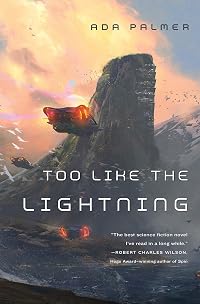
On This Page
Description
Mycroft Canner is a convict. For his crimes he is required, as is the custom of the 25th century, to wander the world being as useful as he can to all he meets. Carlyle Foster is a sensayer-a spiritual counselor in a world that has outlawed the public practice of religion, but which also knows that the inner lives of humans cannot be wished away. The world into which Mycroft and Carlyle have been born is as strange to our 21st-century eyes as ours would be to a native of the 1500s. It is a show more hard-won utopia built on technologically-generated abundance, and also on complex and mandatory systems of labeling all public writing and speech. What seem to us normal gender distinctions are now distinctly taboo in most social situations. And most of the world's population is affiliated with globe-girdling clans of the like-minded, whose endless economic and cultural competition is carefully managed by central planners of inestimable subtlety. To us it seems like a mad combination of heaven and hell. To them, it seems like normal life. And in this world, Mycroft and Carlyle have stumbled on the wild card that may destabilize the system: the boy Bridger, who can effortlessly make his wishes come true. Who can, it would seem, bring inanimate objects to life. show lessTags
Recommendations







Member Recommendations

Member Reviews
To begin at the end: this book is far from a standalone novel, and I would only recommend it to those with a reasonable expectation of continuing to the later numbers of the Terra Ignota tetralogy. It opens a variety of plots and questions, but it supplies very little closure. Mostly, this volume accomplishes the presentation of a future world society and the definition of key characters within it.
The setting is a 25th century that I found a little improbably optimistic in terms of the perpetuation of our contemporary civilization, although there are increasingly explicit references to upheavals that have happened in the interim. The questionably reliable narrator is a sort of public slave ("servicer") with intimate connections to the show more global elite, and his conscious efforts to supply historical perspective mostly reference the 18th-century Enlightenment. It has really been a joy for me to read sf that is in overt conversation with Voltaire and de Sade!
Ada Palmer's future world supposes a formidable transportation network that makes the whole planet local. Ethnic phenotypes and nationalities have become merely ornamental, while public expressions of human gender are socially discouraged. Religion has been actively suppressed by universal legislation, with individual spiritual needs ministered to by non-prostelytizing "sensayer" professionals. The largest polities are a handful of Hives which adults join voluntarily.
The Hive with the greatest population is that of the Masonic Empire, distinguished by--among other features--its official and social use of Latin. This detail reminded me at once of the Martian language in the Church of All Worlds in Stranger in a Strange Land. The connection is more than incidental. Like Heinlein's touchstone work, Too Like the Lightning also concerns itself with sex and religion, and suspends much of its plot from the advent of a child with miraculous powers. In fact, there is an explicit allusion to Valentine Michael Smith (267).
The style here is however more Wolfe than Heinlein, where the fictional narrator's exposition assumes a hypothetical audience whose needs are different than those of the actual 21st-century reader. Palmer cleverly highlights this fact with a device that has apparently irritated some reviewers: The reader is conscripted to protest elements of the narrator's presentation, and given the actual verbiage of doing so, with these interjections distinguished by italic type and archaic diction.
The book is an ambitious and intricate start to a work I will certainly continue reading. show less
The setting is a 25th century that I found a little improbably optimistic in terms of the perpetuation of our contemporary civilization, although there are increasingly explicit references to upheavals that have happened in the interim. The questionably reliable narrator is a sort of public slave ("servicer") with intimate connections to the show more global elite, and his conscious efforts to supply historical perspective mostly reference the 18th-century Enlightenment. It has really been a joy for me to read sf that is in overt conversation with Voltaire and de Sade!
Ada Palmer's future world supposes a formidable transportation network that makes the whole planet local. Ethnic phenotypes and nationalities have become merely ornamental, while public expressions of human gender are socially discouraged. Religion has been actively suppressed by universal legislation, with individual spiritual needs ministered to by non-prostelytizing "sensayer" professionals. The largest polities are a handful of Hives which adults join voluntarily.
The Hive with the greatest population is that of the Masonic Empire, distinguished by--among other features--its official and social use of Latin. This detail reminded me at once of the Martian language in the Church of All Worlds in Stranger in a Strange Land. The connection is more than incidental. Like Heinlein's touchstone work, Too Like the Lightning also concerns itself with sex and religion, and suspends much of its plot from the advent of a child with miraculous powers. In fact, there is an explicit allusion to Valentine Michael Smith (267).
The style here is however more Wolfe than Heinlein, where the fictional narrator's exposition assumes a hypothetical audience whose needs are different than those of the actual 21st-century reader. Palmer cleverly highlights this fact with a device that has apparently irritated some reviewers: The reader is conscripted to protest elements of the narrator's presentation, and given the actual verbiage of doing so, with these interjections distinguished by italic type and archaic diction.
The book is an ambitious and intricate start to a work I will certainly continue reading. show less
OKAY oh my goodness I'm finally letting this one go.
I'm not going to give it any stars because I don't think it's fair. This is one that I feel like I can only fairly rate if I stuck it out to the end, but I did not.
So here's what I loved - everything about Bridger and sensayers and the set-sets and the social and technical and moral world-building. LOVED it. Like, I ate it up. Those were the moments I had to get off the bus or something and I walked around in the world with my nose in this book. The moments that I had to ask people to wait a sec because I was just in the middle of a section and just give me a few minutes, I'll be with you when the chapter is done.
What I didn't love - the politics. I found it SO BORING. Part of it was show more that there were a lot of names of people and groups and I couldn't keep them straight and just reading through wasn't helping me to make sense of anything. Part of it was the way that Mycroft was presenting it just jumbled things. Part of it was that I actually didn't care about the petty internal machinations of the political players. I'd hit a section about some politician or another calling Mycroft in to be his eyes and ears or ply him for information or what have you and my eyes would glaze over. I'd try to read through because I thought that maybe it would have an important bearing on something I found interesting later on but it wouldn't stick in my head. I started skimming until I saw Bridger or Carlyle again, then would be right into it, then I'd hit another political section and just completely lose it. I held on to this book for way longer than I should have because of how awesome I found some of it, and maybe in the future I'll be in a mood where I can get through the stuff I'm resistant to right now, but for now it's not worth it. I thought I could just skip the stuff I didn't like but that's not going to be very satisfying for me, so here I am putting this book down. Which I'm kind of devastated about! I'll probably try to come back to it later. show less
I'm not going to give it any stars because I don't think it's fair. This is one that I feel like I can only fairly rate if I stuck it out to the end, but I did not.
So here's what I loved - everything about Bridger and sensayers and the set-sets and the social and technical and moral world-building. LOVED it. Like, I ate it up. Those were the moments I had to get off the bus or something and I walked around in the world with my nose in this book. The moments that I had to ask people to wait a sec because I was just in the middle of a section and just give me a few minutes, I'll be with you when the chapter is done.
What I didn't love - the politics. I found it SO BORING. Part of it was show more that there were a lot of names of people and groups and I couldn't keep them straight and just reading through wasn't helping me to make sense of anything. Part of it was the way that Mycroft was presenting it just jumbled things. Part of it was that I actually didn't care about the petty internal machinations of the political players. I'd hit a section about some politician or another calling Mycroft in to be his eyes and ears or ply him for information or what have you and my eyes would glaze over. I'd try to read through because I thought that maybe it would have an important bearing on something I found interesting later on but it wouldn't stick in my head. I started skimming until I saw Bridger or Carlyle again, then would be right into it, then I'd hit another political section and just completely lose it. I held on to this book for way longer than I should have because of how awesome I found some of it, and maybe in the future I'll be in a mood where I can get through the stuff I'm resistant to right now, but for now it's not worth it. I thought I could just skip the stuff I didn't like but that's not going to be very satisfying for me, so here I am putting this book down. Which I'm kind of devastated about! I'll probably try to come back to it later. show less
Ambitious, provocative, challenging science fiction political thriller, complete with unreliable narrator who favours 18th century styles and philosophical digressions and a weird habit of going out of his way to justify misgendering other characters in a society where gendered langage is almost taboo. Mycroft Canner is a servitor, a criminal on lifelong parole as a sort of public slave. For such a lowly person he moves in circles with the most powerful people on the planet who treat him with trust and familiarity. He also spends time at the household of the family unit that controls and oversees the vital global transport network, the speeding flying cars that have made nation states redundant. It's a household full of secrets, but the show more the most terrible secret is the little boy who can perform miracles, and his potential impact in a society that has banished all religion and religious talk, instead providing sensayers to give sessions of spiritual and philosophical therapy.
You couldn't call it a perfect utopia, but it's got a lot going for it, and is worth protecting when a theft and a break-in threaten to be the pebbles that start a catastrophic avalanche
It took me longer than I liked to get into this, the archaic language and Mycroft's sometimes dense narration proving tough for my lazy brain, but when I did finally break through, a revelation here, a twist there, I couldn't put it down. Next volume, please. show less
You couldn't call it a perfect utopia, but it's got a lot going for it, and is worth protecting when a theft and a break-in threaten to be the pebbles that start a catastrophic avalanche
It took me longer than I liked to get into this, the archaic language and Mycroft's sometimes dense narration proving tough for my lazy brain, but when I did finally break through, a revelation here, a twist there, I couldn't put it down. Next volume, please. show less
This is unlike any book you are likely to have read before. On one level, it is a political thriller set in the 25th century. Religion has been abolished. So has the nation state. Instead, people declare their adherence to one of seven 'Hives', which are trans-national and each of which has their own laws, observances, customs and practices. A big part of this novel is about the interplay between those Hives; how crime is dealt with when law is a fluid thing; and how political power and influence can be exercised in such a society. These topics have been looked at before (I most recently experienced it in Neal Stephenson's The Diamond Age); but here the subject is treated seriously and the practical implications of such a change are show more laid out clearly.
On another level, this is an excursion into the Eighteenth Century mind, expressed through the medium of an Eighteenth Century novel. (For the most part. Some of the subject matter would never have been addressed in a novel from the Eighteenth Century. And I don't just mean the science fictional parts.) Politics, fashion, public spectacle, crime and punishment are all influenced by the re-discovered philosophies of the Eighteenth Century. For me, this was an excursion back into my school history. Diderot and the Encyclopaedists! Jean-Jacques Rousseau and the Noble Savage! Voltaire and the Enlightenment! The Marquis de Sade! (Well, he wasn't covered in school.) All these got mentions. The fascination with the Eighteenth Century is expressed in the format of the novel. There are asides, diversions to explain this philosophical point or that social nicety. I had been warned about this by other reviews; I didn't find it as disruptive to my reading as I feared.
Having said that, the author has mixed things up considerably by deliberately adopting gender-neutral pronouns; partly to show that the future society is situated at a time where such things are both sometimes necessary, and always polite; but also, by having one of their main characters break that particular rule, to help explain the society's mores to us. Having read Anne Leckie's Ancillary Sword series not so long ago, I wasn't too taken aback by this, and indeed began challenging the gender identity of some characters fairly early on, which turned out to be a helpful move on my part.
As to the plot: it starts out as the investigation of a theft, a very First World sort of theft. Political influence in this world is gauged by "Seven-Ten Lists", lists published by a number of influential news sources every so often, detailing who is up, who is down, and who are the ones to watch out for. (And anyone who thinks this is unlikely needs to look at the sports pages of their favourite news outlet.) One particular 'bash' (from the Japanese 'basho', used here to denote an extended household with a specific Hive affiliation and a particular high-profile role in the global society) falls under suspicion of being involved in the theft. Investigation shows that they are probably being set up for this crime, but the investigation also uncovers a lot of suspicious activities that point in a very worrying direction. And that's before anyone realises that the bash' is sheltering a strange child with even stranger powers.
Characters are interestingly drawn; in keeping with the style of the novel, we are told as much as we are shown. The plot gets quite complex, so much so that as we get towards the end of this first part of the story (there are another three volumes in the series), the author feels it necessary to bring together many of the central characters for an Agatha Christie-like reveal, although in this instance, it's more of a review of how the plot threads have become tangled, and what the characters propose to do to try to untangle them. And the central character, through whom the story is told to an off-stage Reader (and possibly others), is something of an unusual choice. He is a rarity in this world, a mass murderer, who has been sentenced to Servitude; effectively an indentured slave to the whole world, he is at the beck and call of any citizen to do jobs that require people to get their hands dirty, usually in literal ways. For this, he is kept, and fed; but he is unable to hold property or possessions, and has to be on constant call. But his skills are such that the jobs he is called upon to do are a cut above shovelling ordure; he is considered to be one of the finest analytical minds on earth, and so was too important to be put to death. And connected with this character is the child with remarkable powers who seems to be implicated in some sort of change to the world that the Reader lives in but the writer does not.
In Britain, we would call this a "Marmite" book; you will either love it or hate it. Personally, I loved it; for the world-building, for the erudition, for the sheer difference of this world from our own. I started reading science fiction to be challenged; and this book certainly achieves that. But this isn't a rip-roaring, action-packed page-turner, and if that is your preference, you should look elsewhere. show less
On another level, this is an excursion into the Eighteenth Century mind, expressed through the medium of an Eighteenth Century novel. (For the most part. Some of the subject matter would never have been addressed in a novel from the Eighteenth Century. And I don't just mean the science fictional parts.) Politics, fashion, public spectacle, crime and punishment are all influenced by the re-discovered philosophies of the Eighteenth Century. For me, this was an excursion back into my school history. Diderot and the Encyclopaedists! Jean-Jacques Rousseau and the Noble Savage! Voltaire and the Enlightenment! The Marquis de Sade! (Well, he wasn't covered in school.) All these got mentions. The fascination with the Eighteenth Century is expressed in the format of the novel. There are asides, diversions to explain this philosophical point or that social nicety. I had been warned about this by other reviews; I didn't find it as disruptive to my reading as I feared.
Having said that, the author has mixed things up considerably by deliberately adopting gender-neutral pronouns; partly to show that the future society is situated at a time where such things are both sometimes necessary, and always polite; but also, by having one of their main characters break that particular rule, to help explain the society's mores to us. Having read Anne Leckie's Ancillary Sword series not so long ago, I wasn't too taken aback by this, and indeed began challenging the gender identity of some characters fairly early on, which turned out to be a helpful move on my part.
As to the plot: it starts out as the investigation of a theft, a very First World sort of theft. Political influence in this world is gauged by "Seven-Ten Lists", lists published by a number of influential news sources every so often, detailing who is up, who is down, and who are the ones to watch out for. (And anyone who thinks this is unlikely needs to look at the sports pages of their favourite news outlet.) One particular 'bash' (from the Japanese 'basho', used here to denote an extended household with a specific Hive affiliation and a particular high-profile role in the global society) falls under suspicion of being involved in the theft. Investigation shows that they are probably being set up for this crime, but the investigation also uncovers a lot of suspicious activities that point in a very worrying direction. And that's before anyone realises that the bash' is sheltering a strange child with even stranger powers.
Characters are interestingly drawn; in keeping with the style of the novel, we are told as much as we are shown. The plot gets quite complex, so much so that as we get towards the end of this first part of the story (there are another three volumes in the series), the author feels it necessary to bring together many of the central characters for an Agatha Christie-like reveal, although in this instance, it's more of a review of how the plot threads have become tangled, and what the characters propose to do to try to untangle them. And the central character, through whom the story is told to an off-stage Reader (and possibly others), is something of an unusual choice. He is a rarity in this world, a mass murderer, who has been sentenced to Servitude; effectively an indentured slave to the whole world, he is at the beck and call of any citizen to do jobs that require people to get their hands dirty, usually in literal ways. For this, he is kept, and fed; but he is unable to hold property or possessions, and has to be on constant call. But his skills are such that the jobs he is called upon to do are a cut above shovelling ordure; he is considered to be one of the finest analytical minds on earth, and so was too important to be put to death. And connected with this character is the child with remarkable powers who seems to be implicated in some sort of change to the world that the Reader lives in but the writer does not.
In Britain, we would call this a "Marmite" book; you will either love it or hate it. Personally, I loved it; for the world-building, for the erudition, for the sheer difference of this world from our own. I started reading science fiction to be challenged; and this book certainly achieves that. But this isn't a rip-roaring, action-packed page-turner, and if that is your preference, you should look elsewhere. show less
If Voltaire and William Gibson had a love child, it would be Ada Palmer. Palmer is a historian specializing in the Renaissance. Her first novel, Hugo-nominated Too Like the Lightning, shows that she also knows her way around the 18th and 25th centuries. The narrator, Mycroft Canner, assumes the audience for his memoir will be as far in his future as the Enlightenment is in his past. With head-scratching logic, he decides to write in an old-fashioned style as foreign to him as his contemporary language would be to his future readers.
But that is not all. His themes are drawn as much from Voltaire, Aristotle, and the Marquis de Sade as they are from his own post-scarcity utopia. His society bans religious practice, but cults sometimes show more “debate religion in secret, and try their best to do so safely” (Chapter 17). One group combines discussion of theology with sex: “For beginners it’s before and after mostly, managing it during sex takes skill and concentration. It’s our unique service” (Chapter 26). They draw their inspiration from the works of de Sade. Canner, a notorious serial killer sentenced to a life of anonymous service, seems tame by comparison.
In Canner’s 25th century society, nation states have been replaced by special interest “hives” and extended ad hoc family groups called bashes. The Mitsubishi hive focuses on wealth and land acquisition. Humanists emphasize individual achievement. The Cousins are ethical altruists. The Masons speak Latin and have a monarchy. And there are others.
The geographic state was brought down by the invention of AI software that permitted cars to safely travel faster than the speed of sound. Of course, some groups live outside the hive system, and crime has not entirely disappeared.
In sum, Too Like the Lightning is an inventively ambitious speculative fiction with a self-consciously allusive voice and just a snad of magic realism. It deserved to be nominated for the Hugo. show less
But that is not all. His themes are drawn as much from Voltaire, Aristotle, and the Marquis de Sade as they are from his own post-scarcity utopia. His society bans religious practice, but cults sometimes show more “debate religion in secret, and try their best to do so safely” (Chapter 17). One group combines discussion of theology with sex: “For beginners it’s before and after mostly, managing it during sex takes skill and concentration. It’s our unique service” (Chapter 26). They draw their inspiration from the works of de Sade. Canner, a notorious serial killer sentenced to a life of anonymous service, seems tame by comparison.
In Canner’s 25th century society, nation states have been replaced by special interest “hives” and extended ad hoc family groups called bashes. The Mitsubishi hive focuses on wealth and land acquisition. Humanists emphasize individual achievement. The Cousins are ethical altruists. The Masons speak Latin and have a monarchy. And there are others.
The geographic state was brought down by the invention of AI software that permitted cars to safely travel faster than the speed of sound. Of course, some groups live outside the hive system, and crime has not entirely disappeared.
In sum, Too Like the Lightning is an inventively ambitious speculative fiction with a self-consciously allusive voice and just a snad of magic realism. It deserved to be nominated for the Hugo. show less
If you can't finish a story in 450 pages...maybe don't write a book?
Don't get me wrong, this book is mostly fine, apart from featuring exactly zero likable/sympathetic/compelling characters. But when I buy a book I have certain expectations, first and foremost that it tells at least one complete story. I don't have anything against series, but this is something else. This is like when something is marked as free but when you read the fine print it's actually exorbitantly expensive. Actually, its not like that, because if it's in the fine print it's at least possible that you can find out before you buy in. Not so, here. This is 450 pages of build-up, no resolution until -- surprise you shell out again for another brick of book, which, show more I guess, might include some sort of conclusion. But fool me twice, right?
Reader, this is not a book. This is a scam. show less
Don't get me wrong, this book is mostly fine, apart from featuring exactly zero likable/sympathetic/compelling characters. But when I buy a book I have certain expectations, first and foremost that it tells at least one complete story. I don't have anything against series, but this is something else. This is like when something is marked as free but when you read the fine print it's actually exorbitantly expensive. Actually, its not like that, because if it's in the fine print it's at least possible that you can find out before you buy in. Not so, here. This is 450 pages of build-up, no resolution until -- surprise you shell out again for another brick of book, which, show more I guess, might include some sort of conclusion. But fool me twice, right?
Reader, this is not a book. This is a scam. show less
I'm not entirely sure what to say about this. It's brilliant (I'm pretty sure), but it's just dense enough that I felt out of my depth reading it, and it kind of felt like swimming in the deep end almost the whole time. Which is weirdly enjoyable, because I haven't been challenged like this in a while. And it's the almost that kept me coming back -- I'd suddenly figure out what was going on and then not be able to tear myself away.
I did have to take breaks and read a couple of straightforward books in between because trying to figure out what is going on was so tricky. Also philosophy in general makes my teeth itch, but if you're going to play with us, you could do worse than messing about with the 18th c french.
No I didn't see the show more ending coming. There was a lot I didn't see coming. I love that the whole shebang felt true to itself and to its own rules. I despair about trying to read the second book because I know I won't remember enough of the first book to even start, and I'm not ready to reread this one soon.
Extra, extra kudos to your book designer -- beautifully laid out in all the best 18th c ways, and I've handled some of those, so I know of what I speak.
Grrr, argh. 5 stars for achievement, not necessarily my enjoyment. It's a hell of a book. show less
I did have to take breaks and read a couple of straightforward books in between because trying to figure out what is going on was so tricky. Also philosophy in general makes my teeth itch, but if you're going to play with us, you could do worse than messing about with the 18th c french.
No I didn't see the show more ending coming. There was a lot I didn't see coming. I love that the whole shebang felt true to itself and to its own rules. I despair about trying to read the second book because I know I won't remember enough of the first book to even start, and I'm not ready to reread this one soon.
Extra, extra kudos to your book designer -- beautifully laid out in all the best 18th c ways, and I've handled some of those, so I know of what I speak.
Grrr, argh. 5 stars for achievement, not necessarily my enjoyment. It's a hell of a book. show less
Members
- Recently Added By
Lists

Favorite Science Fiction by Women Authors
741 works; 203 members

Best Science Fiction Novels
816 works; 430 members

2017 Hugo Eligible Novels
145 works; 14 members

Recommend the 20 best books you've read in the last five years
2,168 works; 608 members

Dystopian and Apocalyptic Literature
350 works; 74 members

Science Fiction by female authors
43 works; 4 members

Otherland Book Club
36 works; 2 members

Top Five Books of 2016
795 works; 229 members

2016 Science Fiction and Fantasy Books I'm Looking Forward To.
54 works; 6 members

Female Author
1,234 works; 66 members
LGBTQ+ Speculative Fiction
821 works; 51 members

Speculative Fiction to Read
706 works; 32 members

Books Read in 2019
4,052 works; 110 members
Books Read in 2018
4,360 works; 110 members

Books Read in 2021
5,361 works; 114 members

Overdue Podcast
808 works; 9 members

Books Read in 2017
4,249 works; 130 members
Book Worlds We'd Like To Visit
322 works; 158 members

Top Five Books of 2025
954 works; 304 members
Favorite Science Fiction
457 works; 223 members
Author Information

11+ Works 4,248 Members
Some Editions
Awards and Honors
Awards
Distinctions
Notable Lists
Series

Work Relationships
Common Knowledge
- Canonical title
- Too Like the Lightning
- Original title
- Too Like the Lightning
- Original publication date
- 2016-05-10
- People/Characters
- Mycroft Canner; Carlyle Foster; Bridger; Thisbe Saneer; J.E.D.D. Mason; Martin Guildbreaker (show all 7); Dominic Seneschal
- Epigraph
- Ah, my poor Jacques! You are a philosopher. But don't worry: I'll protect you.
—Diderot, Jacques the Fatalist and His Master - Dedication
- This book is dedicated to the first human who thought to hollow out a log to make a boat, and his or her successors.
- First words
- You will criticize me, reader, for writing in a style six hundred years removed from the events I describe, but you came to me for explanation of those days of transformation which left your world the world it is, and since i... (show all)t was the philosophy of the Eighteenth Century, heavy with optimism and ambition, whose abrupt revival birthed the recent revolution, so it is only in the language of the Enlightenment, rich with opinion and sentiment, that those days can be described.
- Last words
- (Click to show. Warning: May contain spoilers.)"No, not ten billion people. Seven. Seven is enough."
- Publisher's editor
- Nielsen Hayden, Patrick
- Blurbers
- Walton, Jo; Wilson, Robert Charles; Smith, Sherwood; Brust, Steven; Wilde, Fran
- Original language
- English
Classifications
Statistics
- Members
- 2,236
- Popularity
- 9,070
- Reviews
- 107
- Rating
- (3.73)
- Languages
- 5 — English, French, German, Polish, Turkish
- Media
- Paper, Audiobook, Ebook
- ISBNs
- 20
- ASINs
- 7