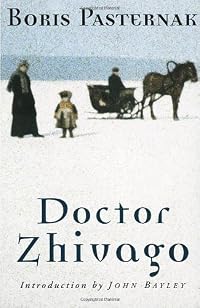
Doctor Zhivago
by Boris Pasternak
On This Page
Description
"Boris Pasternak's widely acclaimed novel comes gloriously to life in a magnificent new translation by Richard Pevear and Larissa Volokhnosky, the award-winning translators of War and Peace and Anna Karenina, and to whom The New York Review of Books declared, "the English-speaking world is indebted." First published in Italy in 1957 amid international controversy--the novel was banned in the Soviet Union until 1988, and Pasternak declined the Nobel prize a year later under intense pressure show more from Soviet authorities--Doctor Zhivago is the story of the life and loves of a poet-physician during the turmoil of the Russian Revolution. Taking his family from Moscow to what he hopes will be shelter in the Ural Mountains, Zhivago finds himself instead embroiled in the battle between the Whites and the Reds. Set against this backdrop of cruelty and strife is Zhivago's love for the tender and beautiful Lara: pursued, found, and lost again, Lara is the very embodiment of the pain and chaos of those cataclysmic times. Stunningly rendered in the spirit of Pasternak's original --resurrecting his style, rhythms, voicings, and tone--and including an introduction, textual annotations, and a translators' note, this edition of Doctor Zhivago is destined to become the definitive English translation of our time."--Jacket. show lessTags
Recommendations














Member Recommendations
BeeQuiet This is one of my favourite books; it explores themes of modernity, providing a fresh insight moving away from the idea that modernity is about fixed repeated sequences. It works through various texts from Goethe, Marx and Baudelaire, through to works created in St Petersburg by authors living in a time when modernity seemed to be passing them by in another world. This is why I would suggest it to anyone fascinated by Russian literature as it gives a brilliant new perspective on the reasons behind their writing.
20

MeisterPfriem Nadezhda Mandelstam knew personally Pasternak. Her account gives a unique inside to the Russian/USSR society and life under Stalin which is the background to Doctor Zhivago.
Member Reviews
Caution - this is definitely NOT the movie. The movie took liberties and focused on the love story between Lara and Yuri. For those who think that this book is going to be just like the movie, please take note.
Now that I have that out of the way, Mr. Pasternak's novel is very much a love story but rather than between man and woman, it is between a man and his country. Mr. Pasternak's love for Russia is evident in the care he takes with the scenery and developing the characters in such a way that the reader truly understands what it means to be Russian. His pastoral descriptions are breath-taking and make one want to move to Siberia. His dialogue is pure poetry.
There is so much that occurs in this novel that it is difficult to summarize show more them into one short assessment. Dr. Zhivago's life is truly tragic and mirrors pre- and post-revolutionary Russia. From the loss of his mother at a young age to the loss of his beloved Lara, Yuri faces world wars, civil war, imprisonment by revolutionaries, and so much more. Lara, too, faces her own trials and tribulations throughout the novel. In fact, the best description is that each major character faces his or her own personal revolution. Interspersed with the tragic details are details about life in revolutionary Russia.
Speaking of revolutionary Russia, as an American, the descriptions of life in the early stages of the U.S.S.R. is fascinating. Mr. Pasternak gives the reader a glimpse of a world that the Western world has vilified and which the Russian culture has kept secret from outsiders. It is an amazing study of culture and history, written by a man who truly does love his country. I feel privileged to have been able to get a glimpse of this mysterious world. In addition, it has helped me understand a bit more about the Cold War and the machinations behind it.
Make no mistake, this is an extremely challenging read. However, if you stick with it, you will be rewarded with a better understanding of Soviet Russia, the Russian culture, and with some of the most beautiful passages I have ever had the pleasure of reading. This isn't for the faint of heart, and I'll admit that I had to do some side research to make sure that I understood the history behind the story. In spite of that, I am extremely glad that I read this novel and would recommend it to others who are interested in Russian history. show less
Now that I have that out of the way, Mr. Pasternak's novel is very much a love story but rather than between man and woman, it is between a man and his country. Mr. Pasternak's love for Russia is evident in the care he takes with the scenery and developing the characters in such a way that the reader truly understands what it means to be Russian. His pastoral descriptions are breath-taking and make one want to move to Siberia. His dialogue is pure poetry.
There is so much that occurs in this novel that it is difficult to summarize show more them into one short assessment. Dr. Zhivago's life is truly tragic and mirrors pre- and post-revolutionary Russia. From the loss of his mother at a young age to the loss of his beloved Lara, Yuri faces world wars, civil war, imprisonment by revolutionaries, and so much more. Lara, too, faces her own trials and tribulations throughout the novel. In fact, the best description is that each major character faces his or her own personal revolution. Interspersed with the tragic details are details about life in revolutionary Russia.
Speaking of revolutionary Russia, as an American, the descriptions of life in the early stages of the U.S.S.R. is fascinating. Mr. Pasternak gives the reader a glimpse of a world that the Western world has vilified and which the Russian culture has kept secret from outsiders. It is an amazing study of culture and history, written by a man who truly does love his country. I feel privileged to have been able to get a glimpse of this mysterious world. In addition, it has helped me understand a bit more about the Cold War and the machinations behind it.
Make no mistake, this is an extremely challenging read. However, if you stick with it, you will be rewarded with a better understanding of Soviet Russia, the Russian culture, and with some of the most beautiful passages I have ever had the pleasure of reading. This isn't for the faint of heart, and I'll admit that I had to do some side research to make sure that I understood the history behind the story. In spite of that, I am extremely glad that I read this novel and would recommend it to others who are interested in Russian history. show less
https://fromtheheartofeurope.eu/doctor-zhivago-by-boris-pasternak/
I first read this at least 35 years ago, possibly longer, and my copy still smells of the mildewy second-hand bookshop where I got it, probably in Cambridge. It’s a great book. There’s a wonderful human story in the transition from the fading empire to the brutality of the Communist regime, with people clinging to what crumbs of comfort they can, especially each other.
Although the title of the book is Doctor Zhivago, it’s just as much Lara’s story; she’s there at the beginning and the end, and has a more complicated life, with the climax of the story coming when three of her lovers end up in the same place at almost the same time. A lot of her story is unstated show more – for instance, when she is first seduced by Komarovsky, it happens entirely off screen, where most writers today would go into explicit erotic detail about the encounter. But we know perfectly well what has happened.
There is also a tremendous sense of place. Moscow, the steppes, the fictional towns that Yuri and Lara end up living in, are all vividly described, and although if you’re not used to Russian nomenclature you can get lost among the characters (most of whom have at least three completely different modes of address), you can’t get lost among the locations.
I haven’t seen the film (which lost the Best Oscar to The Sound of Music, though it won just as many awards on the night), and given that it’s three hours long, I am a little intimidated; but I really enjoyed revisiting the book after a third of a century. show less
I first read this at least 35 years ago, possibly longer, and my copy still smells of the mildewy second-hand bookshop where I got it, probably in Cambridge. It’s a great book. There’s a wonderful human story in the transition from the fading empire to the brutality of the Communist regime, with people clinging to what crumbs of comfort they can, especially each other.
Although the title of the book is Doctor Zhivago, it’s just as much Lara’s story; she’s there at the beginning and the end, and has a more complicated life, with the climax of the story coming when three of her lovers end up in the same place at almost the same time. A lot of her story is unstated show more – for instance, when she is first seduced by Komarovsky, it happens entirely off screen, where most writers today would go into explicit erotic detail about the encounter. But we know perfectly well what has happened.
There is also a tremendous sense of place. Moscow, the steppes, the fictional towns that Yuri and Lara end up living in, are all vividly described, and although if you’re not used to Russian nomenclature you can get lost among the characters (most of whom have at least three completely different modes of address), you can’t get lost among the locations.
I haven’t seen the film (which lost the Best Oscar to The Sound of Music, though it won just as many awards on the night), and given that it’s three hours long, I am a little intimidated; but I really enjoyed revisiting the book after a third of a century. show less
What a weird book, man. I can say with 100% certainty that I've never read anything that's been written quite like this, so before we get to what's good and bad, let's talk about the strange.
If you're aiming to enjoy Doctor Zhivago, you'll have to get over a few big things. Firstly, you'll need to forget how gigantic Russia is and how bizarre it is that the whole country seems to be inhabited by nine or so people that keep running into each other all the time. Walking along some random ass railroad tracks? You'll see a guy you know. Traversing a firebombed village? You'll run into a kid you know. That's just how it works.
Secondly, you'll need to adjust your understanding of what a conversation is. These people NEVER talk to each other. show more One person will stand next to another and then soliloquize off into the distance while the other occasionally says something like, "You speak so well!"
Finally, don't be surprised if you don't have a clue which characters are relevant to the narrative and which aren't until the end of the novel. You get swamped with names in the first 50 pages, some of which are vital, some of which disappear entirely (damn you, Voskoboinikov!). I've read a ton of Russian lit and have never struggled with names the way I did with Doctor Zhivago.
What makes this book particularly strange to me, though, is the way Pasternak actually acknowledges these oddities in several encounters throughout the novel. In reference to the incredible chance encounters that Yuri Zhivago has with his half-brother, Pasternak writes:
In terms of the conversations that aren't quite conversations, the interaction between Zhivago and his uncle Nikolai upon returning home from the war is described by Pasternak thusly:
Yuri Zhivago's greatest "failure" as a Russian during the October Revolution is his individuality. Dissent of any kind, be it armed resistance or just speech, was quickly and violently quashed, to the point where, in Pasternak's view, interaction and discussion of ideas became nothing more than groupthink that would rapidly veer in a radical direction. Look at every conversation that takes place in the novel after the abdication of the tsar, and keep track of what happens to those with a dissenting voice. Resistance to ideas in Doctor Zhivago is just as dangerous as resisting the Red Army, albeit in a different way. Intellectual disagreement quickly becomes ancient history.
Unfortunately, this leads me to my one big beef with the book. One of my favorite "conversations" occurs between Zhivago and his friend Misha Gordon about the Jewish people, who at the time (like most times in their history) were suffering through a great period of persecution in Russia. Gordon makes the point that, despite his own Jewish heritage and distaste for religious persecution, much of the suffering of the Jews is due to their collective identity. He argues that their refusal to individualize and their continued struggle to remain a united Jewish community is a bizarre and unnecessary sacrifice, given the fact that their identity as Jews limits both their ideological and economic development.
Could this point be made about the Soviet Union as a whole? Of course it could. But for some reason, in a process not described in the book, after the February Revolution, Misha Gordon becomes boring and uninspired. Here's how it's justified in the book:
So now that Misha is out of the running, we can at least count on Zhivago to make the point that Gordon no longer could: that the forced collective identity of the Revolution hindered thought and progress. Except we can't.
About 200 pages after Gordon's talk, Larissa Antipova, the best character in the novel, makes an incredibly similar point about Jews to Zhivago. Here's where my mouth waters. "Good!" I say. "Zhivago's going to finally break it all down." But no. Larissa asks Zhivago if he agrees with her, and here's his response:
That all being said, I can't forget to mention how good the good parts are. The last 10 pages (excluding the utterly useless epilogue) are as heart-wrenching as it gets. Anything involving Larissa is wonderful, and I wish more of the book had been written from her perspective.
I also would have liked more of Uncle Nikolai, specifically because of his arc. He's the best part of the book's first 50 pages. He's intelligent and incredibly influential, especially on Zhivago and Misha Gordon. His belief in the power and importance of the individual carries Zhivago throughout his life. So why in the world does he ally himself with the Bolsheviks? A case is never made, and this is a problem for me. The Bolshevik cause is never defended enough to give people like Nikolai and Gordon any reason to join it. I get that this is an anti-Soviet work (which probably led to Pasternak's Nobel Prize), but in a novel that largely shied away from politics, this seemed too much of a good vs. evil dynamic to justify good, intelligent people throwing their support behind Lenin.
I still don't know what I think about any of this. I guess losing the privileges of the upper strata has really hindered my individuality. show less
If you're aiming to enjoy Doctor Zhivago, you'll have to get over a few big things. Firstly, you'll need to forget how gigantic Russia is and how bizarre it is that the whole country seems to be inhabited by nine or so people that keep running into each other all the time. Walking along some random ass railroad tracks? You'll see a guy you know. Traversing a firebombed village? You'll run into a kid you know. That's just how it works.
Secondly, you'll need to adjust your understanding of what a conversation is. These people NEVER talk to each other. show more One person will stand next to another and then soliloquize off into the distance while the other occasionally says something like, "You speak so well!"
Finally, don't be surprised if you don't have a clue which characters are relevant to the narrative and which aren't until the end of the novel. You get swamped with names in the first 50 pages, some of which are vital, some of which disappear entirely (damn you, Voskoboinikov!). I've read a ton of Russian lit and have never struggled with names the way I did with Doctor Zhivago.
What makes this book particularly strange to me, though, is the way Pasternak actually acknowledges these oddities in several encounters throughout the novel. In reference to the incredible chance encounters that Yuri Zhivago has with his half-brother, Pasternak writes:
"As usual, he dropped from the sky... As always before, the riddle of his power remained unexplained. Yuri Andreevich did not even try to penetrate the mystery."To me, that says, "Yeah, I know it's weird that people keep running into each other all the time, but sometimes, that's just how things go. Don't worry about it."
In terms of the conversations that aren't quite conversations, the interaction between Zhivago and his uncle Nikolai upon returning home from the war is described by Pasternak thusly:
"The two men constantly exclaimed and rushed about the room, clutching their heads from the faultlessness of each other's conjectures, or went to the window and silently drummed on the glass with their fingers, amazed at the proofs of mutual understanding."That is EVERY CONVERSATION. We aren't privy to the words of this particular one, but we can easily picture good old Uncle Kolya dropping five paragraphs as Yuri bangs his head on the wall yelling, "Good God, this is brilliant!" Is it a weakness in Pasternak's writing that every conversation he describes, even one without the words, is the exact same? After reflecting more on Yuri and Nikolai's conversation, I think it's a deliberate attempt to illustrate one of the novel's most important themes.
Yuri Zhivago's greatest "failure" as a Russian during the October Revolution is his individuality. Dissent of any kind, be it armed resistance or just speech, was quickly and violently quashed, to the point where, in Pasternak's view, interaction and discussion of ideas became nothing more than groupthink that would rapidly veer in a radical direction. Look at every conversation that takes place in the novel after the abdication of the tsar, and keep track of what happens to those with a dissenting voice. Resistance to ideas in Doctor Zhivago is just as dangerous as resisting the Red Army, albeit in a different way. Intellectual disagreement quickly becomes ancient history.
Unfortunately, this leads me to my one big beef with the book. One of my favorite "conversations" occurs between Zhivago and his friend Misha Gordon about the Jewish people, who at the time (like most times in their history) were suffering through a great period of persecution in Russia. Gordon makes the point that, despite his own Jewish heritage and distaste for religious persecution, much of the suffering of the Jews is due to their collective identity. He argues that their refusal to individualize and their continued struggle to remain a united Jewish community is a bizarre and unnecessary sacrifice, given the fact that their identity as Jews limits both their ideological and economic development.
Could this point be made about the Soviet Union as a whole? Of course it could. But for some reason, in a process not described in the book, after the February Revolution, Misha Gordon becomes boring and uninspired. Here's how it's justified in the book:
Apparently, [Zhivago] had overestimated [his friends] earlier. As long as the order of things had allowed the well-to-do to be whimsical and eccentric at the expense of the deprived, how easy it had been to mistake for a real face and originality that whimsicality and the right to idleness which the minority enjoyed while the majority suffered!What a load of garbage that is. In a book full of insanely lucky coincidences, this is as contrived as it gets.
But as soon as the lower strata arose and the privileges of the upper strata were abolished, how quickly everyone faded, how unregretfully they parted with independent thinking, which none of them, evidently, had ever had!
So now that Misha is out of the running, we can at least count on Zhivago to make the point that Gordon no longer could: that the forced collective identity of the Revolution hindered thought and progress. Except we can't.
About 200 pages after Gordon's talk, Larissa Antipova, the best character in the novel, makes an incredibly similar point about Jews to Zhivago. Here's where my mouth waters. "Good!" I say. "Zhivago's going to finally break it all down." But no. Larissa asks Zhivago if he agrees with her, and here's his response:
"I haven't thought about it. I have a friend, a certain Gordon, who is of the same opinion."WHAT? This is a punt to end all punts, as the topic never comes up again, and it absolutely baffles me. I'm willing to believe quite a bit, especially when it comes to fiction. I refuse to believe that after the most interesting dialogue in the book, one of the men involved becomes dumb, and the other never thinks about it again, which is even worse. It might sound strange that I want a point of view that I came up with independently to be elucidated by a fictional character, but to me, having Zhivago not make this argument is wildly inconsistent from who he is throughout the rest of the novel. I'd like to believe this was intentional, like some of the other things that feel weird about the book, but I just don't think so.
That all being said, I can't forget to mention how good the good parts are. The last 10 pages (excluding the utterly useless epilogue) are as heart-wrenching as it gets. Anything involving Larissa is wonderful, and I wish more of the book had been written from her perspective.
I also would have liked more of Uncle Nikolai, specifically because of his arc. He's the best part of the book's first 50 pages. He's intelligent and incredibly influential, especially on Zhivago and Misha Gordon. His belief in the power and importance of the individual carries Zhivago throughout his life. So why in the world does he ally himself with the Bolsheviks? A case is never made, and this is a problem for me. The Bolshevik cause is never defended enough to give people like Nikolai and Gordon any reason to join it. I get that this is an anti-Soviet work (which probably led to Pasternak's Nobel Prize), but in a novel that largely shied away from politics, this seemed too much of a good vs. evil dynamic to justify good, intelligent people throwing their support behind Lenin.
I still don't know what I think about any of this. I guess losing the privileges of the upper strata has really hindered my individuality. show less
First published in Italy in 1957, Boris Pasternak's sweeping epic Doctor Zhivago stirred controversy in his native Russia. Set in Moscow and the Ural Mountains, the novel tells the story of a poet-physician whose life is defined by the Bolshevik Revolution and its aftermath. The novel's underlying criticism of the Bolshevik party led to it being banned until 1988 in Russia. When Pasternak was chosen for the esteemed Nobel Prize for Literature, his native Russians protested so much that the author declined the honor. Felt to be largely autobiographical, Doctor Zhivago reveals much about its author's philosophical ideology and personal life.
The novel opens with the suicide of Zhivago's father just before the Russian Revolution when show more Zhivago is still a young boy. Pasternak reveals early on that the novel will be about truth and sacrifice; about one man's beliefs and how he lives with his choices.
As the story develops, the reader is pulled into the life of Zhivago, who matures into a young man, loses his wealth, marries his childhood sweetheart, becomes embroiled in the fast accelerating revolution and finds Lara, his true love. The overriding theme of the novel is the importance of the individual vs. the rules of the state and the terror inflicted on the masses in the name of a political ideal.
Pasternak writes prose like the poet he was - painting the chaos of the times on wide brush strokes of beautiful description.
Throughout the novel, the idea of fate - of being swept along with the tide of the times - is often repeated. Characters re-emerge in unusual ways, seemingly by coincidence - and yet we are left with the idea that some things cannot be chance and nothing is coincidental. The characters seem to be victims of the Soviet ideology.
Most people think of Doctor Zhivago as a love story. The love between Lara and Yurii spins throughout the novel, and reminds the reader again about the power of the individual even during tumult and upheaval. But, calling Doctor Zhivago merely a love story would be undervaluing its bigger messages. The novel is full of wonderful passages and beautiful prose; and defines a generation of Russians during a cataclysmic time in history.
Certainly a classic and one which will stand the test of time - Doctor Zhivago is a must read for anyone who strives to better understand the Russian Revolution and who has a love of great literature.
Highly Recommended. show less
The novel opens with the suicide of Zhivago's father just before the Russian Revolution when show more Zhivago is still a young boy. Pasternak reveals early on that the novel will be about truth and sacrifice; about one man's beliefs and how he lives with his choices.
As the story develops, the reader is pulled into the life of Zhivago, who matures into a young man, loses his wealth, marries his childhood sweetheart, becomes embroiled in the fast accelerating revolution and finds Lara, his true love. The overriding theme of the novel is the importance of the individual vs. the rules of the state and the terror inflicted on the masses in the name of a political ideal.
Pasternak writes prose like the poet he was - painting the chaos of the times on wide brush strokes of beautiful description.
Throughout the novel, the idea of fate - of being swept along with the tide of the times - is often repeated. Characters re-emerge in unusual ways, seemingly by coincidence - and yet we are left with the idea that some things cannot be chance and nothing is coincidental. The characters seem to be victims of the Soviet ideology.
Most people think of Doctor Zhivago as a love story. The love between Lara and Yurii spins throughout the novel, and reminds the reader again about the power of the individual even during tumult and upheaval. But, calling Doctor Zhivago merely a love story would be undervaluing its bigger messages. The novel is full of wonderful passages and beautiful prose; and defines a generation of Russians during a cataclysmic time in history.
Certainly a classic and one which will stand the test of time - Doctor Zhivago is a must read for anyone who strives to better understand the Russian Revolution and who has a love of great literature.
Highly Recommended. show less
”The forest does not change its place, we cannot lie in wait for it and catch it in the act of change. Whenever we look at it, it seems to be motionless. And such also is the immobility to our eyes of the eternally growing, ceaselessly changing history, the life of society moving invisibly in its incessant transformations."
Doctor Zhivago is about nothing, if not about change, transformation, upheaval and survival. Set against the background of the Russian Revolutions of 1905 and 1917, Doctor Zhivago is a love story between a man and his wife, a man and his mistress and a man and his country. It catalogs the atrocities and the progressions of a political system that seeks to destroy the individual in the name of saving the masses. But, show more more importantly, it catalogs the attempt of one man to reconcile the ideals of his heart with the realities of a Marxist society.That he dies of a heart failure seems appropriate to me on so many levels.
The story encompasses, in the life of its title character, all the possibilities of love and suffering open to humankind. The desertion of Yuri Zhivago by his parents (one by leaving and one by death) starts Yuri on his fated journey into a world where partings become commonplace, but where heartache never ceases to accompany them. The love story between Zhivago and Lara is so deep and poignant that it takes your breath at moments.
I was moved by the beauty of the writing, the stark imagery, and the character development that extends itself to even the least significant characters. Pasternak is a poet, and the entire book is a poem, as lyrical as the life’s blood he pumps into his protagonist’s veins.
“They loved each other, not driven by necessity, by the "blaze of passion" often falsely ascribed to love. They loved each other because everything around them willed it, the trees and the clouds and the sky over their heads and the earth under their feet.”
He details the effects of the political changes around him and he seems to lament most of all the loss of personality, of independent thought, of individuality.
The root of all the evil to come was the loss of confidence in the value of one's own opinion. People imagined that it was out of date to follow their own moral sense, that they must sing in chorus, and live by other people's notions, notions that were being crammed down everybody's throat.
Too often when you have loved a book and then see the movie, or have loved a movie and then read the book, there is some disappointment you cannot help feeling toward one media or the other. David Lean did a remarkable job of bringing to life on screen a book that is truly epic in its scope and its meaning. I am pleased to find that this is one time when the movie and the book complement one another perfectly. I approved of the changes that the movie made to both the beginning and the ending of the story--it served to hold the story together in a very cohesive manner and lost nothing of the impact or importance.Eliminating the third “wife” from the tale seems to be an improvement to me. I found it hard to imagine Zhivago cohabitating with another woman and fathering children with her after having loved both Tonia and Lara. It somehow diminishes his love to have this third lover. Minor objection when you consider the fine quality of the book at large.
If you have never seen the movie, you should see it. If you have never read the book, you are missing something unique and remarkable. show less
Doctor Zhivago is about nothing, if not about change, transformation, upheaval and survival. Set against the background of the Russian Revolutions of 1905 and 1917, Doctor Zhivago is a love story between a man and his wife, a man and his mistress and a man and his country. It catalogs the atrocities and the progressions of a political system that seeks to destroy the individual in the name of saving the masses. But, show more more importantly, it catalogs the attempt of one man to reconcile the ideals of his heart with the realities of a Marxist society.
The story encompasses, in the life of its title character, all the possibilities of love and suffering open to humankind. The desertion of Yuri Zhivago by his parents (one by leaving and one by death) starts Yuri on his fated journey into a world where partings become commonplace, but where heartache never ceases to accompany them. The love story between Zhivago and Lara is so deep and poignant that it takes your breath at moments.
I was moved by the beauty of the writing, the stark imagery, and the character development that extends itself to even the least significant characters. Pasternak is a poet, and the entire book is a poem, as lyrical as the life’s blood he pumps into his protagonist’s veins.
“They loved each other, not driven by necessity, by the "blaze of passion" often falsely ascribed to love. They loved each other because everything around them willed it, the trees and the clouds and the sky over their heads and the earth under their feet.”
He details the effects of the political changes around him and he seems to lament most of all the loss of personality, of independent thought, of individuality.
The root of all the evil to come was the loss of confidence in the value of one's own opinion. People imagined that it was out of date to follow their own moral sense, that they must sing in chorus, and live by other people's notions, notions that were being crammed down everybody's throat.
Too often when you have loved a book and then see the movie, or have loved a movie and then read the book, there is some disappointment you cannot help feeling toward one media or the other. David Lean did a remarkable job of bringing to life on screen a book that is truly epic in its scope and its meaning. I am pleased to find that this is one time when the movie and the book complement one another perfectly. I approved of the changes that the movie made to both the beginning and the ending of the story--it served to hold the story together in a very cohesive manner and lost nothing of the impact or importance.
If you have never seen the movie, you should see it. If you have never read the book, you are missing something unique and remarkable. show less
I can completely understand why this novel was banned from the former Soviet Union. Heaven forbid the people realize they have traded one form of oppression (Tsar) for something even worse (communism).
Dr. Zhivago's short life and love affair is played out amid all the furor of WWI and then war between Russians vying for control. It's not a happy story.
Dr. Zhivago's short life and love affair is played out amid all the furor of WWI and then war between Russians vying for control. It's not a happy story.
Reading the novel Dr. Zhivago with memories of Dr. Zhivago the movie will cause you to misunderstand what is going on. This is not the tragic love story portrayed by movie stars. Pasternak is painting a different picture. His characters are of two types. The first, vividly described like individual leaves in the sunlight or the rain, appear only briefly and then are gone. Some of these may reappear much later, as they fall from their branches. The second, such as Zhivago, Lara, and Tonia, flow through the novel acting as the trees, giving it the hint of a plot allowing the reader to wander through the landscape. But it is the forest that is important, the overall chaos of the Russian revolution. The love story is between Pasternak and show more Russia itself, and is told in the only way such a huge story could be told.
Surprisingly, for such a masterpiece, this book seems to break all the rules of good writing taught to modern authors. Its omniscient point of view allows Pasternak to tell instead of show, although he wraps his philosophical, political, and religious lectures within dialogue. It doesn’t seem to matter much who is speaking. You must figure it out from the context. Along with the lectures comes another common feature of Russian novels, the names. However, the biggest fault with my copy was the translation. Translating poetry is an almost futile task, and Pasternak’s descriptions of people and places are overwhelmingly poetical. Therefore, once in a while the translation is too literal with very odd results that could not possibly be what the author intended.
Reading this novel is not for the faint of heart, but the experience will be unforgettable. show less
Surprisingly, for such a masterpiece, this book seems to break all the rules of good writing taught to modern authors. Its omniscient point of view allows Pasternak to tell instead of show, although he wraps his philosophical, political, and religious lectures within dialogue. It doesn’t seem to matter much who is speaking. You must figure it out from the context. Along with the lectures comes another common feature of Russian novels, the names. However, the biggest fault with my copy was the translation. Translating poetry is an almost futile task, and Pasternak’s descriptions of people and places are overwhelmingly poetical. Therefore, once in a while the translation is too literal with very odd results that could not possibly be what the author intended.
Reading this novel is not for the faint of heart, but the experience will be unforgettable. show less
Members
- Recently Added By
Published Reviews
ThingScore 100
A la découverte de la littérature russe
Publié en 1958, ce roman n'est autorisé à paraître en URSS qu'en 1985. Cette autorisation est un signe de l'ouverture souhaitée par Mikhaïl Gorbatchev. Le Docteur Jivago dépeint le passage de l'Empire russe à l'URSS, qui s'est traduit par une horrible guerre civile marquant les esprits de toute la population. Un chef-d’œuvre pour découvrir show more une Sibérie attachante et accueillante. show less
Publié en 1958, ce roman n'est autorisé à paraître en URSS qu'en 1985. Cette autorisation est un signe de l'ouverture souhaitée par Mikhaïl Gorbatchev. Le Docteur Jivago dépeint le passage de l'Empire russe à l'URSS, qui s'est traduit par une horrible guerre civile marquant les esprits de toute la population. Un chef-d’œuvre pour découvrir show more une Sibérie attachante et accueillante. show less
added by Joop-le-philosophe
At the beginning of his novel Pasternak deliberately deprives the Zhivago family of its wealth, as a kind of symbolic prelude to the revolution that is to come. Like so much else in the novel it happens as arbitrarily as if in a fairy tale: the rich king suddenly becomes a poor beggar. “There was a Zhivago factory, a Zhivago bank, Zhivago buildings, a Zhivago necktie pin,…and at one time show more if you said ‘Zhivago’ to your sleigh driver in Moscow, it was as if you had said: ‘Take me to Timbuctoo!’ and he carried you off to a fairy tale kingdom.” This wealth of gold both symbolizes and contrasts with the wealth of life which will be the precious gift and possession of the son, the hero of the novel...
Tossed about like corks in the tumult, people are thrown up against one another in all sorts of unexpected ways and places. The ruthless partisan commander turns out to be the same young officer we used to know, rumored to have been killed in an attack on the Austrian entrenchments in 1916. The old Swiss lady walking past the trolley in which Zhivago has his fatal heart attack was the former governess of a noble Russian whom he had known briefly when they both worked at a hospital during the war. And this final coming together is in any case unknown to both parties, without apparent significance. And yet everything in life has significance, just because it is life, the thing itself, and not the abstract vision of how it ought to be for which the tyrants of ideology drench the world in blood. As Zhivago observes, you must live, you cannot always be making preparations for living—a sharp comment on the Communist promise that everything is going to be wonderful, some day in the future. show less
Tossed about like corks in the tumult, people are thrown up against one another in all sorts of unexpected ways and places. The ruthless partisan commander turns out to be the same young officer we used to know, rumored to have been killed in an attack on the Austrian entrenchments in 1916. The old Swiss lady walking past the trolley in which Zhivago has his fatal heart attack was the former governess of a noble Russian whom he had known briefly when they both worked at a hospital during the war. And this final coming together is in any case unknown to both parties, without apparent significance. And yet everything in life has significance, just because it is life, the thing itself, and not the abstract vision of how it ought to be for which the tyrants of ideology drench the world in blood. As Zhivago observes, you must live, you cannot always be making preparations for living—a sharp comment on the Communist promise that everything is going to be wonderful, some day in the future. show less
added by SnootyBaronet
Those who expect some kind of counter-revolutionary or anti-Soviet journalism from Dr Zhivago will be disappointed. It is not, in that sense, a political novel at all, although it is entirely about the effects of the revolution of 1905, the First World War, the 1917 revolution and the last war, upon a group of families of the upper-class intelligentsia and others. Pasternak is apolitical. His show more temper is Christian; Marxism is dismissed scornfully as half-baked folly and pomposity...
There is no cliche of invention in Pasternak; there is no eccentricity either. He has the eye of nature. Another refreshing quality is the freedom from the Anglo-American obsession with sex. In love, he is concerned with the heart. It is hard to imagine an English, French or American novel on Pasternak’s subject that would not be an orgy of rape or creeping sexuality.
Dr Zhivago is a great mound of minutely observed particulars and this particularity is, of course, expressive of his central attitude - his stand for private life and integrity. show less
There is no cliche of invention in Pasternak; there is no eccentricity either. He has the eye of nature. Another refreshing quality is the freedom from the Anglo-American obsession with sex. In love, he is concerned with the heart. It is hard to imagine an English, French or American novel on Pasternak’s subject that would not be an orgy of rape or creeping sexuality.
Dr Zhivago is a great mound of minutely observed particulars and this particularity is, of course, expressive of his central attitude - his stand for private life and integrity. show less
added by SnootyBaronet
Lists

1001 Books You Must Read Before You Die
1,448 works; 1,131 members

The Guardian's 1000 Novels Everyone Must Read
1,005 works; 546 members

Read the book and saw the movie
1,170 works; 192 members

Russian Literature
184 works; 35 members

The Telegraph's 110 Best Books: The Perfect Library
101 works; 18 members

Best Historical Fiction
620 works; 261 members

Favorite Long Books
330 works; 42 members

Favorite Literary Love Stories
182 works; 100 members

Historical Fiction
889 works; 90 members
Banned Books Week 2014
268 works; 62 members

Unread books
1,063 works; 84 members

Top Five Books of 2013
1,564 works; 716 members
Favourite Books
1,817 works; 308 members

Books That Made Me Cry
199 works; 105 members
20th Century Literature
1,161 works; 54 members
Philip Ward's Lifetime Reading Plan
592 works; 22 members

Best War Stories
87 works; 16 members
Best Political Fiction
92 works; 12 members

1950s
340 works; 22 members

Canon de la narrativa universal del siglo XX
254 works; 6 members
Folio Society
831 works; 53 members

Winter Books
127 works; 17 members

Top Five Books of 2017
757 works; 231 members
Love and Marriage
93 works; 10 members

Stories of War and Revolution
143 works; 54 members

Nobel Price Winners
222 works; 20 members
LibraryThingers' 1001 Books You Must Read Before You Die
442 works; 30 members

Blue Pyramid 1,276 Best Books of All Time
1,248 works; 32 members

Watched the Movie, Probably Won't Read the Book
185 works; 34 members
Banned or Challenged Books
400 works; 41 members

Books about Russia and the former USSR
67 works; 12 members

Top Five Books of 2014
1,064 works; 397 members

Harold Bloom - The Western Canon: D. The Chaotic Age
833 works; 24 members

It Just Wasn't Worth the Effort
21 works; 7 members
World War I Fiction
94 works; 15 members
Five star books
1,755 works; 108 members
Epic Fiction
42 works; 12 members

A Novel Cure
742 works; 23 members

Best War Fiction Books
41 works; 4 members
1,001 BYMRBYD Concensus
723 works; 27 members

Fiction Set During a Revolution
55 works; 24 members
Love Triangles in Literature
108 works; 15 members
War Literature
101 works; 19 members

Mensa for Kids Excellence in Reading Award Program (Grades 9-12)
116 works; 5 members
The College Board: 101 Great Books Recommended for College-Bound Readers
111 works; 7 members

Publisher's Weekly Bestsellers - Part II - 1940 - 1979
355 works; 5 members
My list of 100 books to read next
100 works; 4 members

Europe
205 works; 6 members

Books set in Moscow
16 works; 1 member

Reading List of Christopher McCandless
12 works; 1 member

Discontinued
19 works; 4 members

Books Read in 2017
4,248 works; 130 members

100
56 works; 1 member

SHOULD Read Books!
354 works; 9 members
First Novels
373 works; 17 members

Books Read in 2020
4,379 works; 124 members

Tammen Keltainen kirjasto
81 works; 1 member
Literature About Adultery
69 works; 10 members

Schwob Nederland
207 works; 2 members

Macho Fiction
7 works; 4 members
Widely acclaimed, one book per year
105 works; 3 members
My Favorite Russian Novels
37 works; 2 members

DigitalDreamDoor top 300
300 works; 4 members

All Things Russia
459 works; 11 members

.
194 works; 2 members

Recommended Reading : 600 Classics Reviewed, Editors of Salem Press, 2015
634 works; 6 members
School Made Us Read It
380 works; 196 members
Read For Your Life
157 works; 1 member
.
396 works; 1 member

Read 2026 Ranked
17 works; 1 member
Canon de la narrativa universal del s. XX (cicutadry)
499 works; 3 members

LT picks: Blue Books
197 works; 39 members
Our Favorite Banned Books
138 works; 122 members
THE WAR ROOM
813 works; 24 members

Great Films Based on Books
319 works; 140 members
Mustich's 1000 Books to Read Before You Die: A Life Changing List
1,001 works; 18 members

AP Lit
363 works; 6 members

Greatest Books, allegedly
484 works; 9 members

1964 College Preparatory Reading List
202 works; 8 members
Mensa for Kids Excellence in Reading Award Program (Grades 9-12)
116 works; 3 members
Read These Too
458 works; 9 members

Allie's Wishlist
217 works; 2 members

100 knjiga
100 works; 1 member
Literature in Translation
113 works; 5 members
Talk Discussions
Past Discussions
Dr. Zhivago in Folio Society Devotees (September 2022)
Dr Zhivago in Fans of Russian authors (June 2018)
Author Information

257+ Works 15,412 Members
Pasternak was acclaimed as a major poet some 30 years before Doctor Zhivago (1955) made him world famous. After first pursuing promising careers in music and philosophy, he started to write around 1909 and published his first collection of verse in 1914. His first genuine triumph came with the collection My Sister, Life (1917), in which a love show more affair stimulates a rapturous celebration of nature. The splendid imagery and difficult syntax of this volume are a hallmark of the early Pasternak. During the 1920s, Pasternak tried to accept the reality of the new society and moved from the lyric to the epic, taking up historical and contemporary subjects. The long poem The Year 1905 (1926) is an example. While tolerated by the literary establishment, Pasternak turned increasingly in the 1930s to translation rather than original verse. He was a prolific translator; his versions of major Shakespeare plays are the standard texts used in Soviet theaters. From the start, however, prose was an important focus for Pasternak. The most notable early work is the story "Zhenia's Childhood," written in 1918, which explored a girl's developing consciousness of her surroundings. There is also his artistic and intellectual autobiography Safe Conduct (1931). But Pasternak's greatest prose achievement came later with the novel Doctor Zhivago, written over a number of years and completed in 1955. Its hero, a physician and poet, confronts the great changes of the early twentieth century including world war, revolution, and civil war, and travels a path through life that creates a parallel between his fate and that of Christ. (The theme of preordained sacrifice is strengthened by the cycle of poems included as the last section of the book.) Doctor Zhivago was rejected for publication but appeared in 1957 in the West and won its author worldwide acclaim. A Nobel Prize followed in 1958. This led the Soviet authorities to launch a major public campaign against Pasternak and to make his personal life even more difficult. So successful were they that the poet officially turned down the award. After that, he was left in relative peace and died two years later. He was but the first of many writers in the post-Stalin period to challenge the Soviet state. During the 1970s and 1980s, Pasternak's heritage was cautiously brought into public purview in the Soviet Union. The Gorbachev period saw the removal of all restrictions on his work, and publication of Doctor Zhivago followed at long last. Several major editions of Pasternak's writings have appeared. (Bowker Author Biography) show less
Some Editions
Awards and Honors
Distinctions
Notable Lists
Greatest Books algorithm (154)
Series
Belongs to Publisher Series
Grote Beren (1)
Harvill (2)
Fontana Modern Novels (2198)
Lanterne (L 5)
Colecção Mil Folhas (13)
Keltainen kirjasto (20)
Nobelpreisträger Coron-Verlag (weiß) (1958 (Russland))
Fontana (485)
Fischer Bücherei (587)
Gallimard, Folio (79)
Work Relationships
Is contained in
Has the adaptation
Has as a student's study guide
Common Knowledge
- Canonical title*
- Il dottor Zivago
- Original title
- До́ктор Жива́го
- Original publication date
- 1957 (Italian trans.) (Italian trans.); 1988 (Novy mir) (Novy mir)
- People/Characters
- Yuri Andreievich Zhivago; Tonia Alexandrovna Gromeko; Larisa "Lara" Feodorovna Guishar Antipova; Pavel "Pasha" Pavlovich Antipov; Victor Ippolitovich Komarovsky; Evgraf Andreievich Zhivago (show all 7); Nikolai Nikolaievich Vedeniapin (Uncle Kolia)
- Important places
- Moscow, Russia; Yuriatin, Russia; Siberia, Russia; Russia; USSR
- Important events
- World War I; Russian Revolution (1917); Russian Civil War (1917 ∙ | 1921)
- Related movies
- Doctor Zhivago (1965 | IMDb); Doctor Zhivago (2002 | IMDb); Doktor Zhivago (2006 | IMDb); 'Doctor Zhivago': The Making of a Russian Epic (1995 | IMDb); David Lean's Film of Doctor Zhivago (1965 | IMDb)
- First words
- On they went, singing "Rest Eternal," and whenever they stopped, their feet, the horses, and the gusts of wind seemed to carry on their singing.
- Quotations
- The fear known as spymania had reduced all speech to a single formal, predictable patter. The display of good intentions in discourse was not conductive to conversation.
After two or three stanzas that came pouring and several metaphors by which he was himself surprised, the work took possession of him, and he began to feel the presence of what is called inspiration. At such moments the corre... (show all)lation of the forces that govern artistic genius have as it were been turned upside down. It is no longer the man and the state of his soul, for which he is seeking expression, that are in the ascendancy now, but the language. his instrument of expression. Language, the home and dwelling of beauty and meaning, itself begins to think and speak for man and turns wholly into music, not in the sense of outward, audible sounds, but by virtue of the power and momentum of its inward flow. Then, like the current of a mighty river polishing stones and turning wheels by its very movement, the flow of speech creates in passing, by the force of its own laws, rhyme and rhythm and countless other forms and formations, still more important and until now undiscovered, unconsidered and unnamed.
The rising sun had cast the long dewy shadow of trees in loops over the park grounds. The shadow was not black but dark gray like wet felt. The heady fragrance of the morning seemed to come from this damp shadow on the ground... (show all), with strips of light in it like a girl’s fingers. Suddenly a streak of quicksilver, as shiny as the dew on the grass, flowed by him a few paces away. It flowed on and on and the ground did not absorb it. Then, with an unexpectedly sharp movement, it swerved aside and vanished.
He began to write down the legend of St George and the Dragon in lyrical form. He started with broad, spacious pentameter, but its harmony, derived from the metre itself, and independent of the sense, annoyed him by its slick... (show all), humdrum sing-song. He gave up the pompous rhythm and the caesura and cut down the lines to four beats, as you cut out useless words in prose.... The writing was livelier but still too verbose. He forced himself to shorter lines. Now the words were crammed in their tetrameters and he felt wide awake, roused, excited; the right words to fill the shot lines came, prompted by the measure.... He heard the horses' hoofs ringing on the surface of the poem as you hear the trotting of a horse in one of Chopin's Ballades. - Last words
- (Click to show. Warning: May contain spoilers.)And the book they held seemed to confirm and encourage their feeling.
- Original language
- Russian
- Canonical DDC/MDS
- 891.7342
- Canonical LCC
- PG3476.P27
- Disambiguation notice
- Book. Do not combine with film.
*Some information comes from Common Knowledge in other languages. Click "Edit" for more information.
Classifications
- Genres
- General Fiction, Fiction and Literature, Romance, Historical Fiction
- DDC/MDS
- 891.7342 — Literature & rhetoric Literatures of other languages East Indo-European and Celtic literatures Russian and East Slavic languages Russian fiction USSR 1917–1991 Early 20th century 1917–1945
- LCC
- PG3476 .P27 — Language and Literature Slavic languages and literatures. Baltic languages. Albanian language Slavic. Baltic. Albanian Russian literature Individual authors and works 1917-1960
- BISAC
Statistics
- Members
- 12,982
- Popularity
- 607
- Reviews
- 172
- Rating
- (3.85)
- Languages
- 29 — Catalan, Chinese, Czech, Danish, Dutch, English, Estonian, Finnish, French, German, Hebrew, Hungarian, Indonesian, Italian, Korean, Lithuanian, Norwegian (Bokmål), Norwegian, Polish, Portuguese, Romanian, Russian, Serbian, Slovak, Slovenian, Spanish, Swedish, Turkish, Yiddish
- Media
- Paper, Audiobook, Ebook
- ISBNs
- 318
- UPCs
- 3
- ASINs
- 259