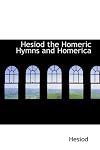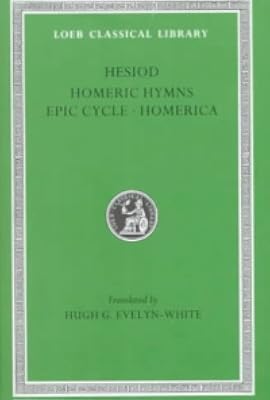
The Homeric Hymns and Homerica
by Hesiod
On This Page
Description
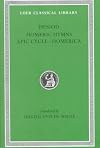
"Hesiod, The Homeric Hymns, and Homerica" is a collection of ancient Greek writings that are attributed to Hesiod, Homer, and others whose style emulates the two. This volume translated by Hugh G. Evelyn-White includes the following works: Works and Days, The Divination by Birds, The Astronomy, The Precepts of Chiron, The Great Works, The Idaean Dactyls, The Theogony, The Catalogues of Women and the Eoiae, The Shield of Heracles, The Marriage of Ceyx, The Great Eoiae, The Melampodia, The show more Aegimius, Fragments of Unknown Position, and Doubtful Fragments, The Homeric Hymns, The Epigrams Of Homer, The War of the Titans, The Story of Oedipus, The Thebais, The Epigoni, The Cypria, The Aethiopis, The Little Illiad, The Sack of Illium, The Returns, The Telegony, The Expedition of Amphiara|s, The taking of Oechalia, The Phocais, The Margites, The Cercopes, The Battle of the Frogs and Mice, and The Contest Of Homer And Hesiod. show lessTags
Recommendations

Member Reviews
ok, proof that i'm a nerd: i love the formula of the hymns.
Hesiod ( /ˈhiːsiəd/ or /ˈhɛsiəd/;[1] Ancient Greek: Ἡσίοδος, Hēsíodos) was a Greek oral poet generally thought by scholars to have been active between 750 and 650 BC, around the same time as Homer.[2][3] His is the first European poetry in which the poet regards himself as a topic, an individual with a distinctive role to play.[4] Ancient authors credited him and Homer with establishing Greek religious customs.[5] Modern scholars refer to him as a major source on Greek mythology, farming techniques, early economic thought (he is sometimes identified as the first economist),[6] archaic Greek astronomy and ancient time-keeping.
Hesiod practised various styles of traditional verse, including gnomic, hymnic, genealogical and show more narrative poetry, but he was not able to manipulate them all fluently. Comparisons with Homer can be unflattering. As one modern scholar observed: "It is as if an artisan with his big, awkward fingers were patiently, fascinatedly, imitating the fine seam of the professional tailor."[7] show less
Hesiod practised various styles of traditional verse, including gnomic, hymnic, genealogical and show more narrative poetry, but he was not able to manipulate them all fluently. Comparisons with Homer can be unflattering. As one modern scholar observed: "It is as if an artisan with his big, awkward fingers were patiently, fascinatedly, imitating the fine seam of the professional tailor."[7] show less
"2012-10-26 12:00:00"
Ratings
Members
- Recently Added By
Author Information

163+ Works 7,444 Members
The poet Hesiod tells us that his father gave up sea-trading and moved from Ascra to Boeotia, that as he himself tended sheep on Mount Helicon the Muses commanded him to sing of the gods, and that he won a tripod for a funeral song at Chalcis. The poems credited to him with certainty are: the Theogony, an attempt to bring order into the otherwise show more chaotic material of Greek mythology through genealogies and anecdotes about the gods; and The Works and Days, a wise sermon addressed to his brother Perses as a result of a dispute over their dead father's estate. This latter work presents the injustice of the world with mythological examples and memorable images, and concludes with a collection of folk wisdom. Uncertain attributions are the Shield of Heracles and the Catalogue of Women. Hesiod is a didactic and individualistic poet who is often compared and contrasted with Homer, as both are representative of early epic style. "Hesiod is earth-bound and dun colored; indeed part of his purpose is to discredit the brilliance and the ideals of heroism glorified in the homeric tradition. But Hesiod, too, is poetry, though of a different order. . . " (Moses Hadas, N.Y. Times). (Bowker Author Biography) show less
All Editions
Some Editions
Series
Belongs to Publisher Series
Work Relationships
Contains
Common Knowledge
- Canonical title
- The Homeric Hymns and Homerica
- Original publication date
- 1914 (This collection) (This collection); 1920 (Revised Edition) (Revised Edition); 1936 (New and Revised Edition) (New and Revised Edition); 8th-7th Century BCE: Hesiod's poems; 7th-6th Century BCE : Homeric Hymns (most hymns, some hymns may have been written later) (most hymns, some hymns may have been written later)
- Important places
- Ancient Greece
- Original language
- Ancient Greek
Classifications
- Genres
- Poetry, Fiction and Literature
- DDC/MDS
- 881.01 — Literature & rhetoric Classical & modern Greek literatures Classical Greek poetry Different categories of Greek classical poetry Philosophy and Theory
- LCC
- PA3623 .E65 .H47 — Language and Literature Greek language and literature. Latin language and literature Greek literature Translations
- BISAC
Statistics
- Members
- 432
- Popularity
- 71,533
- Reviews
- 3
- Rating
- (4.11)
- Languages
- English, Greek (Ancient), Greek, Multiple languages
- Media
- Paper, Ebook
- ISBNs
- 18
- ASINs
- 19