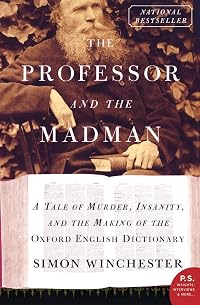
The Professor and the Madman: A Tale of Murder, Insanity, and the Making of the Oxford English Dictionary
by Simon Winchester
On This Page
Description
A New York Times Notable Book - Now a Major Motion Picture The Professor and the Madman is an extraordinary tale of madness, genius, and the incredible obsessions of two remarkable men that led to the making of the Oxford English Dictionary-and literary history. The making of the OED was one of the most ambitious projects ever undertaken. As definitions were collected, the overseeing committee, led by Professor James Murray, was stunned to discover that one man, Dr. W. C. Minor, had show more submitted more than ten thousand. But their surprise would pale in comparison to what they were about to discover when the committee insisted on honoring him. For Dr. Minor, an American Civil War veteran, was also an inmate at an asylum for the criminally insane. Masterfully researched and eloquently written, The Professor and the Madman. This P.S. edition features an extra 16 pages of insights into the book, including author interviews, recommended reading, and more. show lessTags
Recommendations









Member Recommendations
The Devil in the White City: Murder, Magic, and Madness at the Fair That Changed America by Erik Larson
Stbalbach Both concern late-19th C American killers in the backdrop of a bigger social story of advancement (Chicago Fair and Oxford English Dictionary).
20
PuddinTame Two accounts of the creation of the Oxford English Dictionary. The Meaning of Everything is a history of how the dictionary was created. The Professor and the Madman is focussed on a peculiar story: a detailed acccount of the man who contributed the most entries to the Oxford English Dictionary, while living in the Broadmoor Asylum (near Crawthorne) for the Criminally Insane.


Member Reviews
Gimmicky and overblown. This might have worked better as an essay than a book, but since Simon Winchester doesn't seem to have much of a point to make about the life of William Chester Minor and his involvement with James Murray and the creation of the Oxford English Dictionary beyond "He was mad! Isn't that luridly shocking and enthralling?", perhaps not. There's an angle here about social class that seems worthy of further exploration but that Winchester seemed uninterested in.
There's also a lot of jingoism, dubious psychologising, suspect logic (just because the OED doesn't record "to look up" in the sense of "to search for in a dictionary or reference work" until 1692 does not mean "it follows that there was essentially no concept show more either, certainly not at the time when Shakespeare was writing"), weirdness about women (Winchester really likes the word "whore"), and queasy weirdness about very young Sri Lankan women ("young, chocolate-skinned, ever-giggling naked girls with sleek wet bodies, rosebud nipples"—even allowing for an attempt to convey something of Minor's sexual monomania, this is a bit much).
Meh. show less
There's also a lot of jingoism, dubious psychologising, suspect logic (just because the OED doesn't record "to look up" in the sense of "to search for in a dictionary or reference work" until 1692 does not mean "it follows that there was essentially no concept show more either, certainly not at the time when Shakespeare was writing"), weirdness about women (Winchester really likes the word "whore"), and queasy weirdness about very young Sri Lankan women ("young, chocolate-skinned, ever-giggling naked girls with sleek wet bodies, rosebud nipples"—even allowing for an attempt to convey something of Minor's sexual monomania, this is a bit much).
Meh. show less
Author Simon Winchester, a self-described adventurer, takes what could otherwise seem lexicographical drudgery, the 70 plus year making of the Oxford English Dictionary, and turns it into a relatively compact fascinating story about this massive undertaking and the men (and women) behind it. He weaves the broader story about cataloging the English language with a more narrow tale about the Professor (the editor James Murray) with the Madman (major contributor William Minor, an American doctor, Civil War Veteran, murderer, and schizophrenic). This book works on multiple levels. It is at once a great narrative about the massive etymological study of our native language and a fascinating and strange story of great, though in the case of show more Minor extremely disturbed, men. The story is at once tragic and triumphant, one of great accomplishment and personal tragedy. Winchester takes a topic that looks like it could weigh you down and indeed turns it into a bit of an intellectual adventure. show less
This is the fascinating, incredible, but true story of the 70+ year project to compile “The New English Dictionary on Historical Principles” - a biography of words that became “The Oxford English Dictionary” (OED). Not that you’d know that from the title. I enjoyed the story more than the novelistic telling of it.
Imagine when there was no dictionary… when “looking something up” was impossible. That’s how it was for Shakespeare, hence his coinages are the ones that stuck, whether or not they were usual for the time. Winchester thinks this might have been frustrating, whereas I imagine the Bard having the lexical confidence of Humpty Dumpty.
“‘When I use a word,’ Humpty Dumpty said in rather a scornful tone, ‘it show more means just what I choose it to mean - neither more nor less.’
‘The question is,’ said Alice, ‘whether you can make words mean so many different things.’
‘The question is,’ said Humpty Dumpty, ‘which is to be master - that’s all.’”
From Through the Looking-Glass, by Lewis Carroll (another Oxford connection).
Image: Humpty Dumpty, by Mervyn Peake. (Source.)
The Good
This is a gripping story of triumph over multiple adversities, with touches of Victorian gothic: the promised murder and madness, as well as passion for the project, thwarted titillation, and grim self-harm.
Winchester describes the family background, collaboration, and relationship between the primary editor (Sir James Murray), and American ex-army surgeon (Dr William Minor, incarcerated after he murdered a stranger while deluded), including some surprising parallels in the outwardly very different men.
“A relationship… that would combine sublime scholarship, fierce tragedy, Victorian reserve, deep gratitude, mutual respect, and a slowly growing amity that could even… be termed friendship.”
The three main characters, Murray, Minor, and the dictionary itself, are vividly portrayed, and the murder victim, George Merrett, is not forgotten - indeed, the book is dedicated to G.M.
The history of word lists, thesauruses, and dictionaries, as well as the actual methods for compiling the behemoth OED, are carefully explained.
Minor was by far the most prolific of the hundreds of volunteers: an accurate, methodical, meticulous researcher, submitting up to twenty slips a day (fewer in summer) for more than twenty years. His contribution is staggering - even if he were not seriously mentally ill. Except that as Winchester points out, if modern psychoactive drugs had been available, maybe Minor would have been less obsessive, less productive.
The Bad
The misleading titles annoy me: “The Surgeon of Crowthorne” in the UK and “The Professor and the Madman” in the US. The name of the village housing the asylum is not very relevant, nor that Minor was previously a surgeon, and the US title is horribly tabloid as well as inaccurate: James Murray was never a professor, nor any sort of university academic. He was an autodidact school-teacher who was employed by Oxford University Press, and knighted in his 70s, and awarded an honorary doctorate the year before he died.
This book has an awkward hybrid tone: neither novel nor biography/history. A particularly egregious example is where Winchester details an important series of incidents, over several pages, before explaining that was what people said at the time because it was more dramatic. Only then does he relate the more probable version. Much later, he indulges in prurient speculation, before confessing “no suggestion exists” that it’s true.
There is disproportionate, dull detail about things not hugely relevant for the main story, such as battles of the American Civil War (but I was reading the US edition, which is 35 pages longer) and some of the processes and conditions of Broadmoor (the asylum).
Several times, Winchester refers to “Doctor Murray”, even though the nearest he got to such a title was an honorary doctorate, the year before he died, aged 78. Sloppy.
Sometimes Winchester is tripped up by the threads of his own embroidery. Because it was annoying me, I noticed he wrote that on 5 November, “darkness had fallen on London soon after half past five” - which is about an hour later than is actually the case. Sloppy, again.
Winchester rattles off a list of delightful obscure words on p85 - and doesn’t define or contextualise a single one! In a book about a dictionary! In a later book, The Meaning of Everything: The Story of the Oxford English Dictionary, some of these same words are described as “words [that] were nonsensical, but people used them to give the impression that they were wise and clever”. Others I managed to find definitions of: abequitate (ride away), sullevation (rousing or exciting), commotrix (a female who helps makes things happen), parentate (perform funeral rites, especially for a parent), adminiculation (attestation or corroboration), plus a few compounds whose meaning you can guess.
There is no index (unforgivable in a book of non-fiction) or bibliography (though there is “further reading”).
These aspects of Winchester’s style are presumably a popular feature. I had similar issues with The Man Who Loved China (see my review HERE).
The Indifferent and Odd
Image: Dr Minor among his books. (Illustration from this edition: source.)
The occasional line drawings were a nice idea to give a period feel (though I don’t think they’re especially good).
Each chapter starts with a lengthy definition of a word that is vaguely relevant to that chapter. It would have been nice if they’d been rather more unusual. Reading about a dictionary, I’d have liked to enlarge my vocabulary.
Winchester’s novelistic style makes it readable and immersive, but for some reason, his embellishments often involve anthropomorphised horses ("The horses did their best, their hooves striking sparks from the cobbles as they rushed the victim to the emergency entrance"). The book made me snarky, so the equines kept jumping off the page.
Dr Minor had “distinctively American handwriting”. I wish I knew what that was. Anyone?
Non-Trivial Trivia
Image: An elderly Murray in the Scriptorium. (Source.)
I was left in awe at the compilers of the first OED, as anyone who reads this will be.
For centuries, there were atlases, prayer books, histories, romances, and books of science and art, but no English dictionary as we think of one. Shakespeare probably had Cooper’s thesaurus, and word lists grouped by subject, but not a dictionary.
Dr Johnson made huge strides in lexicography, but the delight of his dictionary is its personal quirkiness, rather than scientific rigour and objectivity. A well-known example: “Oats: a grain which in England is generally given to horses, but in Scotland supports the people.”
The bold and unique aim of the OED was to include every single word, however trivial, alphabetically, with etymology, patterns of use, and examples of each meaning from published sources. The OED still shows the meaning and the history of meaning. Words are never removed; merely marked as archaic or obsolete.
Because it was such a huge undertaking, relying on volunteers, it was seen as “a democratic product” - a practice that continues to this day, though perhaps as “crowdsourcing”.
The first OED was 71 years in the making (1857-1928), though sections were published from 1884 (aa to ant).
Meanwhile, the first edition of Fowler’s A Dictionary of Modern English Usage was published in 1926.
Lexicographers find the letter C “unusually filled with ambiguities and complexities, not least because of its frequent overlaps with the letters G, K, and S”, and the letter T took five years to compile.
The 1928 OED was 12 (or 10, if Wikipedia is correct) volumes, listing 414,825 headwords, with 1,827,306 illustrative quotes. The hand-set letterpress type was 178 miles (the distance from London to the outskirts of Manchester), comprising 227,779,589 letters and numerals - plus spaces and punctuation.
1988 saw the first electronic version of the dictionary.
This book was published a decade later, in 1998.
The OED has been available online since 2000.
For more, see:
• OED home
• Wikipedia on OED
• Winchester’s 2003 book, The Meaning of Everything: The Story of the Oxford English Dictionary, which is apparently a broader history of the OED.
Mel Gibson Movie
Image: Gibson as Murray and Penn as Minor (Source.)
Completing the dictionary took far longer than predicted, and so with the film of this story. More than 20 years after buying the rights, Mel Gibson’s film is due for release later this year. See imdb here.
I was frustrated by some of the fictional fluff in the book, and probably will be with the film: it was shot in Dublin, rather than Oxford, London, and Berkshire (cheaper).
5* for the story, 3* for the writing = 4* show less
Imagine when there was no dictionary… when “looking something up” was impossible. That’s how it was for Shakespeare, hence his coinages are the ones that stuck, whether or not they were usual for the time. Winchester thinks this might have been frustrating, whereas I imagine the Bard having the lexical confidence of Humpty Dumpty.
“‘When I use a word,’ Humpty Dumpty said in rather a scornful tone, ‘it show more means just what I choose it to mean - neither more nor less.’
‘The question is,’ said Alice, ‘whether you can make words mean so many different things.’
‘The question is,’ said Humpty Dumpty, ‘which is to be master - that’s all.’”
From Through the Looking-Glass, by Lewis Carroll (another Oxford connection).
Image: Humpty Dumpty, by Mervyn Peake. (Source.)
The Good
This is a gripping story of triumph over multiple adversities, with touches of Victorian gothic: the promised murder and madness, as well as passion for the project, thwarted titillation, and grim self-harm.
Winchester describes the family background, collaboration, and relationship between the primary editor (Sir James Murray), and American ex-army surgeon (Dr William Minor, incarcerated after he murdered a stranger while deluded), including some surprising parallels in the outwardly very different men.
“A relationship… that would combine sublime scholarship, fierce tragedy, Victorian reserve, deep gratitude, mutual respect, and a slowly growing amity that could even… be termed friendship.”
The three main characters, Murray, Minor, and the dictionary itself, are vividly portrayed, and the murder victim, George Merrett, is not forgotten - indeed, the book is dedicated to G.M.
The history of word lists, thesauruses, and dictionaries, as well as the actual methods for compiling the behemoth OED, are carefully explained.
Minor was by far the most prolific of the hundreds of volunteers: an accurate, methodical, meticulous researcher, submitting up to twenty slips a day (fewer in summer) for more than twenty years. His contribution is staggering - even if he were not seriously mentally ill. Except that as Winchester points out, if modern psychoactive drugs had been available, maybe Minor would have been less obsessive, less productive.
The Bad
The misleading titles annoy me: “The Surgeon of Crowthorne” in the UK and “The Professor and the Madman” in the US. The name of the village housing the asylum is not very relevant, nor that Minor was previously a surgeon, and the US title is horribly tabloid as well as inaccurate: James Murray was never a professor, nor any sort of university academic. He was an autodidact school-teacher who was employed by Oxford University Press, and knighted in his 70s, and awarded an honorary doctorate the year before he died.
This book has an awkward hybrid tone: neither novel nor biography/history. A particularly egregious example is where Winchester details an important series of incidents, over several pages, before explaining that was what people said at the time because it was more dramatic. Only then does he relate the more probable version. Much later, he indulges in prurient speculation, before confessing “no suggestion exists” that it’s true.
There is disproportionate, dull detail about things not hugely relevant for the main story, such as battles of the American Civil War (but I was reading the US edition, which is 35 pages longer) and some of the processes and conditions of Broadmoor (the asylum).
Several times, Winchester refers to “Doctor Murray”, even though the nearest he got to such a title was an honorary doctorate, the year before he died, aged 78. Sloppy.
Sometimes Winchester is tripped up by the threads of his own embroidery. Because it was annoying me, I noticed he wrote that on 5 November, “darkness had fallen on London soon after half past five” - which is about an hour later than is actually the case. Sloppy, again.
Winchester rattles off a list of delightful obscure words on p85 - and doesn’t define or contextualise a single one! In a book about a dictionary! In a later book, The Meaning of Everything: The Story of the Oxford English Dictionary, some of these same words are described as “words [that] were nonsensical, but people used them to give the impression that they were wise and clever”. Others I managed to find definitions of: abequitate (ride away), sullevation (rousing or exciting), commotrix (a female who helps makes things happen), parentate (perform funeral rites, especially for a parent), adminiculation (attestation or corroboration), plus a few compounds whose meaning you can guess.
There is no index (unforgivable in a book of non-fiction) or bibliography (though there is “further reading”).
These aspects of Winchester’s style are presumably a popular feature. I had similar issues with The Man Who Loved China (see my review HERE).
The Indifferent and Odd
Image: Dr Minor among his books. (Illustration from this edition: source.)
The occasional line drawings were a nice idea to give a period feel (though I don’t think they’re especially good).
Each chapter starts with a lengthy definition of a word that is vaguely relevant to that chapter. It would have been nice if they’d been rather more unusual. Reading about a dictionary, I’d have liked to enlarge my vocabulary.
Winchester’s novelistic style makes it readable and immersive, but for some reason, his embellishments often involve anthropomorphised horses ("The horses did their best, their hooves striking sparks from the cobbles as they rushed the victim to the emergency entrance"). The book made me snarky, so the equines kept jumping off the page.
Dr Minor had “distinctively American handwriting”. I wish I knew what that was. Anyone?
Non-Trivial Trivia
Image: An elderly Murray in the Scriptorium. (Source.)
I was left in awe at the compilers of the first OED, as anyone who reads this will be.
For centuries, there were atlases, prayer books, histories, romances, and books of science and art, but no English dictionary as we think of one. Shakespeare probably had Cooper’s thesaurus, and word lists grouped by subject, but not a dictionary.
Dr Johnson made huge strides in lexicography, but the delight of his dictionary is its personal quirkiness, rather than scientific rigour and objectivity. A well-known example: “Oats: a grain which in England is generally given to horses, but in Scotland supports the people.”
The bold and unique aim of the OED was to include every single word, however trivial, alphabetically, with etymology, patterns of use, and examples of each meaning from published sources. The OED still shows the meaning and the history of meaning. Words are never removed; merely marked as archaic or obsolete.
Because it was such a huge undertaking, relying on volunteers, it was seen as “a democratic product” - a practice that continues to this day, though perhaps as “crowdsourcing”.
The first OED was 71 years in the making (1857-1928), though sections were published from 1884 (aa to ant).
Meanwhile, the first edition of Fowler’s A Dictionary of Modern English Usage was published in 1926.
Lexicographers find the letter C “unusually filled with ambiguities and complexities, not least because of its frequent overlaps with the letters G, K, and S”, and the letter T took five years to compile.
The 1928 OED was 12 (or 10, if Wikipedia is correct) volumes, listing 414,825 headwords, with 1,827,306 illustrative quotes. The hand-set letterpress type was 178 miles (the distance from London to the outskirts of Manchester), comprising 227,779,589 letters and numerals - plus spaces and punctuation.
1988 saw the first electronic version of the dictionary.
This book was published a decade later, in 1998.
The OED has been available online since 2000.
For more, see:
• OED home
• Wikipedia on OED
• Winchester’s 2003 book, The Meaning of Everything: The Story of the Oxford English Dictionary, which is apparently a broader history of the OED.
Mel Gibson Movie
Image: Gibson as Murray and Penn as Minor (Source.)
Completing the dictionary took far longer than predicted, and so with the film of this story. More than 20 years after buying the rights, Mel Gibson’s film is due for release later this year. See imdb here.
I was frustrated by some of the fictional fluff in the book, and probably will be with the film: it was shot in Dublin, rather than Oxford, London, and Berkshire (cheaper).
5* for the story, 3* for the writing = 4* show less
The pretext for this book is rather slight – one of the significant volunteer contributors to the Oxford English Dictionary was, although an intelligent and educated man, also an inmate of an insane asylum, confined for a murder committed while in the throes of a schizophrenic paranoid delusion.
While, as a revelation, this fact may be less than earth-shattering, Winchester uses this story of the inmate, Dr. W.C. Minor, the man he killed, George Merrett, and the main editor of the OED, Dr. James Murray, as a vehicle for all kinds of interesting details – he goes on quite a number of tangents, but they're always immensely well-written and fascinating! Winchester isn't afraid to stray from dry, historical writing – he definitely show more makes guesses, fleshes things out for colorful effect – but his research is also obviously thoroughly done, and he also stops short of fictifying (ok, that's not a word, but I think it should be) his topic – it's always made clear when his scenarios are theoretical.
I'd highly recommend this book not only for those interested in dictionaries and lexicography, but for anyone interested in Victorian England, the Civil War, treatment of the mentally ill, or any of a number of other topics. show less
While, as a revelation, this fact may be less than earth-shattering, Winchester uses this story of the inmate, Dr. W.C. Minor, the man he killed, George Merrett, and the main editor of the OED, Dr. James Murray, as a vehicle for all kinds of interesting details – he goes on quite a number of tangents, but they're always immensely well-written and fascinating! Winchester isn't afraid to stray from dry, historical writing – he definitely show more makes guesses, fleshes things out for colorful effect – but his research is also obviously thoroughly done, and he also stops short of fictifying (ok, that's not a word, but I think it should be) his topic – it's always made clear when his scenarios are theoretical.
I'd highly recommend this book not only for those interested in dictionaries and lexicography, but for anyone interested in Victorian England, the Civil War, treatment of the mentally ill, or any of a number of other topics. show less
In The Professor and the Madman: A Tale of Murder, Insanity, and the Making of the Oxford English Dictionary, Simon Winchester examines the parallel lives of Sir James Murray, chief editor of the Oxford English Dictionary, and Dr. William Chester Minor, late of the U.S. Army; the titular “professor” and “madman.” Dr. Minor, having suffered from mental illness possibly exacerbated by his Civil War experience (p. 60-61), was certified a “criminal lunatic” (p. 21) and housed in the Asylum for the Criminally Insane, Broadmoor, a new facility determined to provide a more humane housing than Bedlam in London. Winchester notes that the story he unfolds has “two protagonists” in the form of Dr. Minor and Professor Murray, even show more as academics debated the plurality of the term “protagonist” while the OED was in construction (p. 28, 31). He argues, “Murray. The lives of the two men [Murray and Minor] were over the years to become inextricably and most curiously entwined” (p. 31).
Winchester links Minor’s illness, as did contemporary writers, to the Battle of the Wilderness. He writes, “It was a fight to test the sanest of men: Some of the occurrences of those two days were utterly beyond human imagination” (p. 53). Deserters faced the harshest of punishment and regulations often required surgeons to perform the task. Winchester relates, “An Irish deserter, who had been convicted at drumhead of running away during the terrors of the Wilderness, was sentenced to be branded. The officers of the court – there would have been a colonel, four captains, and three lieutenants – demanded in this case that the new young acting assistant surgeon who had been assigned to them, this fresh-faced and genteel-looking aristocrat, this Yalie, fresh down from the hills of New England, be instructed to carry out the punishment. It would be as good a way as any, the old war-weary officers implied, to induct Doctor Minor into the rigors of war. And so the Irishman was brought to him, his arms shackled behind his back” (p. 60). Following this, Minor faced transfer to a billet on Governor’s Island and faced a new generation of Irish immigrants, experiencing great guilt in their presence (p. 67). All of this culminated in his delusion that Irishmen were haunting him in his nocturnal hours. This delusion provoked Minor to murder.
While in Her Majesty’s custody, Minor benefitted from his background as an educated member of a wealthy family with a reliable U.S. Army pension. He “furnished his cells comfortably – much, indeed, as a member of the Athenaeum might” (p. 122) and brought both his books from New Haven as well as new volumes from London bookstores in addition to his paints, wines, flute, and more. Crucially, Minor reached out to his victim’s widow to make amends. Eventually, he and Eliza Merrett communicated and she brought him new books, introducing Minor to the Oxford English Dictionary project requesting readers (p. 127). The project was proceeding with great difficulties as prior dictionaries only focused on unique words. Professor Murray repeatedly admonished readers that they “must find and note all and any words that seemed interesting, or that were quoted in interesting and signifying ways or in ways that were good, apt, or pithy” (p. 137). Amid this, Minor “was maverick enough, original-minded enough, however, to realize that he could do better than simply follow Murray’s orders to the letter. Given his peculiar position, his leisure, his library, he could do more, do otherwise. It took hm some days of pondering exactly how he might best serve the project; but after some weeks of thinking he came up with what he thought was the best way to tackle the task” (p. 138). Even with Minor’s contributions, the project may have failed. Murray worked tirelessly with the Delegates of the Press at Oxford University to ensure the project’s success.
Winchester writes, “there was one sustaining fact: The first of the fascicles, the revenue-producing installments into which Oxford insisted that the dictionary be divided, had at last been published, on January 29, 1884. Nearly five years had elapsed since James Murray had been appointed editor. Twenty-seven years had passed since Richard Chenevix Trench had given his famous address in which he called for a new English dictionary. Now, in a muddy off-white cover and with its sheets half uncut, was the first part, 352 pages worth of all the known English words from A to Ant, published by the Clarendon Press, Oxford, at a price of twelve shillings and sixpence. Here, at last, was the first morsel of substance: part one of A New English Dictionary on Historical Principles, Founded Mainly on the Materials Collected by The Philological Society, edited by James A. H. Murray, LID., Sometime President of the Philological Society, with the Assistance of Many Scholars and Men of Science” (p. 147). The work eventually took Doctor Murray and his family to the Scriptorium in Oxford in order to house his and his volunteers’ work (p. 149). Even amid the project’s success, it was years before Murray and Minor finally met in person (p. 155).
Eventually, the connection between Dr. Minor and the OED reached the presses, spreading as far as Tianjin, China (p. 172). While Dr. Minor rose to more public acclaim, his mental illness worsened and he found himself subject to the restrictions of Dr. Brayn, including the affair of a loss of a painting intended for the Princess of Wales (p. 197) and the loss of his library. Fortunately and humanely, Winston Churchill intervened to secure Minor’s parole to America for his final years amid his decline (p. 199).
Winchester argues of Minor, “if he had been so treated, he might never have felt impelled to work on it as he did. By offering him mood-altering sedatives, as they would have done in Edwardian times, or treating him as today with such antipsychotic drugs as quetiapine or risperidone, many of his symptoms of madness might have gone away – but he might well have felt disinclined or unable to perform his work for Doctor Murray. In a sense doing all those dictionary slips was his medication; in a way they became his therapy. The routine of his quiet and cellbound intellectual stimulus, month upon month, year upon year, appears to have provided him with at least a measure of release from his paranoia. His sad situation onlv worsened when that stimulus was gone” (p. 214).
In his conclusion, Winchester moves to New Years Eve, 1927. He writes, “The New York Times put the fact on the front page the next morning, a Sunday – that with the inclusion of the Old Kentish word zyzt – the second indicative present tense, in local argot, of the verb to see – the work was done, the alphabet was exhausted, and the full text was now wholly in the printers’ hands. The making of the great book, declared the newspaper roundly and generously, was ‘one of the great romances of English literature’” (p. 219). In this, his narrative helps the reader to better see how this great project incorporated so much of the English-speaking world in a testament to their language. Even with its lapse of the word “bondmaid” (p. 220), the connection between Drs. Minor and Murray encapsulates the unique conditions that fostered the creation of a work so many take for granted. Thus, Winchester’s work evoke s Erik Larson in his dramatization of history and his unpacking of a particular story that deepens our understanding of that history. show less
Winchester links Minor’s illness, as did contemporary writers, to the Battle of the Wilderness. He writes, “It was a fight to test the sanest of men: Some of the occurrences of those two days were utterly beyond human imagination” (p. 53). Deserters faced the harshest of punishment and regulations often required surgeons to perform the task. Winchester relates, “An Irish deserter, who had been convicted at drumhead of running away during the terrors of the Wilderness, was sentenced to be branded. The officers of the court – there would have been a colonel, four captains, and three lieutenants – demanded in this case that the new young acting assistant surgeon who had been assigned to them, this fresh-faced and genteel-looking aristocrat, this Yalie, fresh down from the hills of New England, be instructed to carry out the punishment. It would be as good a way as any, the old war-weary officers implied, to induct Doctor Minor into the rigors of war. And so the Irishman was brought to him, his arms shackled behind his back” (p. 60). Following this, Minor faced transfer to a billet on Governor’s Island and faced a new generation of Irish immigrants, experiencing great guilt in their presence (p. 67). All of this culminated in his delusion that Irishmen were haunting him in his nocturnal hours. This delusion provoked Minor to murder.
While in Her Majesty’s custody, Minor benefitted from his background as an educated member of a wealthy family with a reliable U.S. Army pension. He “furnished his cells comfortably – much, indeed, as a member of the Athenaeum might” (p. 122) and brought both his books from New Haven as well as new volumes from London bookstores in addition to his paints, wines, flute, and more. Crucially, Minor reached out to his victim’s widow to make amends. Eventually, he and Eliza Merrett communicated and she brought him new books, introducing Minor to the Oxford English Dictionary project requesting readers (p. 127). The project was proceeding with great difficulties as prior dictionaries only focused on unique words. Professor Murray repeatedly admonished readers that they “must find and note all and any words that seemed interesting, or that were quoted in interesting and signifying ways or in ways that were good, apt, or pithy” (p. 137). Amid this, Minor “was maverick enough, original-minded enough, however, to realize that he could do better than simply follow Murray’s orders to the letter. Given his peculiar position, his leisure, his library, he could do more, do otherwise. It took hm some days of pondering exactly how he might best serve the project; but after some weeks of thinking he came up with what he thought was the best way to tackle the task” (p. 138). Even with Minor’s contributions, the project may have failed. Murray worked tirelessly with the Delegates of the Press at Oxford University to ensure the project’s success.
Winchester writes, “there was one sustaining fact: The first of the fascicles, the revenue-producing installments into which Oxford insisted that the dictionary be divided, had at last been published, on January 29, 1884. Nearly five years had elapsed since James Murray had been appointed editor. Twenty-seven years had passed since Richard Chenevix Trench had given his famous address in which he called for a new English dictionary. Now, in a muddy off-white cover and with its sheets half uncut, was the first part, 352 pages worth of all the known English words from A to Ant, published by the Clarendon Press, Oxford, at a price of twelve shillings and sixpence. Here, at last, was the first morsel of substance: part one of A New English Dictionary on Historical Principles, Founded Mainly on the Materials Collected by The Philological Society, edited by James A. H. Murray, LID., Sometime President of the Philological Society, with the Assistance of Many Scholars and Men of Science” (p. 147). The work eventually took Doctor Murray and his family to the Scriptorium in Oxford in order to house his and his volunteers’ work (p. 149). Even amid the project’s success, it was years before Murray and Minor finally met in person (p. 155).
Eventually, the connection between Dr. Minor and the OED reached the presses, spreading as far as Tianjin, China (p. 172). While Dr. Minor rose to more public acclaim, his mental illness worsened and he found himself subject to the restrictions of Dr. Brayn, including the affair of a loss of a painting intended for the Princess of Wales (p. 197) and the loss of his library. Fortunately and humanely, Winston Churchill intervened to secure Minor’s parole to America for his final years amid his decline (p. 199).
Winchester argues of Minor, “if he had been so treated, he might never have felt impelled to work on it as he did. By offering him mood-altering sedatives, as they would have done in Edwardian times, or treating him as today with such antipsychotic drugs as quetiapine or risperidone, many of his symptoms of madness might have gone away – but he might well have felt disinclined or unable to perform his work for Doctor Murray. In a sense doing all those dictionary slips was his medication; in a way they became his therapy. The routine of his quiet and cellbound intellectual stimulus, month upon month, year upon year, appears to have provided him with at least a measure of release from his paranoia. His sad situation onlv worsened when that stimulus was gone” (p. 214).
In his conclusion, Winchester moves to New Years Eve, 1927. He writes, “The New York Times put the fact on the front page the next morning, a Sunday – that with the inclusion of the Old Kentish word zyzt – the second indicative present tense, in local argot, of the verb to see – the work was done, the alphabet was exhausted, and the full text was now wholly in the printers’ hands. The making of the great book, declared the newspaper roundly and generously, was ‘one of the great romances of English literature’” (p. 219). In this, his narrative helps the reader to better see how this great project incorporated so much of the English-speaking world in a testament to their language. Even with its lapse of the word “bondmaid” (p. 220), the connection between Drs. Minor and Murray encapsulates the unique conditions that fostered the creation of a work so many take for granted. Thus, Winchester’s work evoke s Erik Larson in his dramatization of history and his unpacking of a particular story that deepens our understanding of that history. show less
Who knew a book about the assembling of a dictionary could be so fascinating? This book provides biographies of two men who played key roles in the compilation of the Oxford English Dictionary (OED), Professor James Murray, the chief editor, and Dr. W.C. Minor, the “madman” of the title. It also covers the process used in the monumental task of assembling the OED, which comprised “twelve mighty volumes; 414,825 words defined; 1,827,306 illustrative quotations” and took over 70 years.
The book hinges on the intriguing, but tragic, life of Dr. Minor, whose insanity had led to murder. I found myself pondering the nature of mental illnesses, and how far we still must go to truly understand and treat them. I thought Winchester did an show more excellent job of weaving the history of dictionaries together with the biographies to deliver an engrossing story. My only quibbles were that the author took quite a few liberties in surmising what people were feeling and twice included a sensational, but admittedly false, vignette.
The book was filled with intriguing observations. For example, I had never previously considered what it would have been like not to have access to a dictionary, but the author points out that William Shakespeare did not. How remarkable that he could create such works without one!
Recommended to those who love words, the history of words, books about books, and biographies. show less
The book hinges on the intriguing, but tragic, life of Dr. Minor, whose insanity had led to murder. I found myself pondering the nature of mental illnesses, and how far we still must go to truly understand and treat them. I thought Winchester did an show more excellent job of weaving the history of dictionaries together with the biographies to deliver an engrossing story. My only quibbles were that the author took quite a few liberties in surmising what people were feeling and twice included a sensational, but admittedly false, vignette.
The book was filled with intriguing observations. For example, I had never previously considered what it would have been like not to have access to a dictionary, but the author points out that William Shakespeare did not. How remarkable that he could create such works without one!
Recommended to those who love words, the history of words, books about books, and biographies. show less
The multi-volume Oxford English Dictionary, or OED, is the gold standard of English dictionaries. How did the editors research and compile such a massive work? With lots of help. One of the volunteers who made a tremendous contribution to the work was William Chester Minor, an American who spent half his life in Broadmoor Criminal Lunatic Asylum. Winchester examines Minor’s life, from his birth in Ceylon to missionary parents, his medical training, his experience as a Civil War physician, and his subsequent descent into the madness that resulted in murder. The biography of James Murray, editor of the OED, stands in contrast to that of the mentally ill Minor. The two men found common ground in their dedication to the OED over multiple show more decades.
Winchester’s narration of the audio version is as good as that of many professional narrators I’ve listened to. The audio version includes a bonus interview between Winchester and John Simpson, who at the time was an editor of the OED. I would call it a conversation rather than an interview, since it was hard to tell which was the interviewer and which was the interviewee. They seemed to switch roles a lot. I got a chuckle out of Winchester’s recommendation to use the CD-ROM version of the OED. References to technology tend to date a book. show less
Winchester’s narration of the audio version is as good as that of many professional narrators I’ve listened to. The audio version includes a bonus interview between Winchester and John Simpson, who at the time was an editor of the OED. I would call it a conversation rather than an interview, since it was hard to tell which was the interviewer and which was the interviewee. They seemed to switch roles a lot. I got a chuckle out of Winchester’s recommendation to use the CD-ROM version of the OED. References to technology tend to date a book. show less
Members
- Recently Added By
Published Reviews
Here, as so consistently throughout, Winchester finds exactly the right tool to frame the scene.
added by John_Vaughan
Lists

Great Books About Language
73 works; 48 members

Best books about books
209 works; 104 members

Really Good Narrative Non-Fiction
65 works; 24 members

Books about Books
149 works; 24 members

Non-Fiction Worth Reading
1,016 works; 263 members

Unread books
1,063 works; 85 members

Best Biographies
216 works; 26 members

Etymology
26 works; 7 members

True Crime
216 works; 16 members

100 Biographies and Memoirs to Read in a (Single) Lifetime
98 works; 12 members

Top Five Books of 2015
811 works; 241 members

Books Read in 2015
3,299 works; 126 members

Summer Reading
31 works; 2 members

Folio Society
831 works; 53 members

Books Read in 2021
5,361 works; 114 members

My List
302 works; 1 member

Weirdo Nonfiction
138 works; 3 members
Best Historical Crime
44 works; 16 members

Check Library
178 works; 1 member

Books Read in 2026
2,122 works; 70 members
Author Information

53+ Works 38,666 Members
Simon Winchester was born in London, England on September 28, 1944. He read geology at St. Catherine's College, Oxford. After graduation in 1966, he joined a Canadian mining company and worked as field geologist in Uganda. The following year he decided to become a journalist. His first reporting job was for The Journal, Newcastle upon Tyne. In show more 1969, he joined The Guardian and was named Britain's Journalist of the Year in 1971. He also worked for the Daily Mail and the Sunday Times before becoming a freelancer. He is the author of numerous books including In Holy Terror, The River at the Center of the World, The Alice Behind Wonderland, The Professor and the Madman: A Tale of Murder, Insanity, the Making of the Oxford English Dictionary, and.Exactly: How Precision Engineers Created the Modern World. In 2006, he was made an Officer of the Order of the British Empire for services to journalism and literature. (Bowker Author Biography) show less
Some Editions
Awards and Honors
Awards
Distinctions
Series
Belongs to Publisher Series
Work Relationships
Common Knowledge
- Canonical title*
- De gekwelde woordenaar
- Original title
- The Surgeon of Crowthorne : A Tale of Murder, Madness and the Love of Words
- Alternate titles
- The Professor and the Madman; The Professor and the Madman: A Tale of Murder, Insanity, and the Making of the Oxford English Dictionary
- Original publication date
- 1998
- People/Characters
- William Chester Minor; James Murray (Sir, lexicographer)
- Important places
- UK; Broadmoor Hospital, Crowthorne, Berkshire, England, UK; Crowthorne, Berkshire, England, UK
- Important events
- American Civil War (1861 | 1865)
- Related movies
- The Professor and the Madman (2019 | IMDb)
- Dedication
- To the memory of
G. M. - First words
- [Preface Popular myth has it that one of the most remarkable conversations in modern literary history took place on a cool and misty late autumn in 1896, in the small village of Crowthorne in the county of Berkshire.
The word (murder) has not been found in any Teut. lang. but Eng. and Gothic, but that it existed in continental WGer. is evident, as it is the source of OF. murdre, murtre (md. F. meurtre) and of med. L. mord... (show all)rum, murdrum, and OHG.
[Postscript] And why this book is offered as a small testament to the late George Merrett of Wiltshire and Lambeth, without whose untimely death these events would never have unfolded and this tale could never have been told... (show all).
[Author's Note] But she won, and a grandfather I never met made a thousand guineas, all because of a word that briefly took his fancy. - Quotations
- One word --and only one word-- was ever actually lost: bondmaid, which appears in Johnson's dictionary, was actually lost by Murray and was found, a stray without a home, long after the fascicle Battentlie - Bozzom<... (show all)/i> had been published. It, and tens of thousands of words that had evolved or appeared during the forty-four years spent assembling the fascicles and their [twelve] parent volumes, appeared in a supplement, which came out in 1933. Four further supplements appeared between 1972 and 1986. In 1989, using the new abilities of the computer, Oxford University Press issued its fully integrated second edition, incorporating all the changes and additions of the supplements in twenty rather more slender volumes. [220]
Defining words properly is a fine and peculiar craft. There are rules—a word (to take a noun as an example) must first be defined according to the class of things to which it belongs (mammal, quadruped), and then differenti... (show all)ated from other members of that class (bovine, female). There must be no words in the definition that are more complicated or less likely to be known than the word being defined. The definition must say what something is, and not what it is not. If there is a range of meanings of any one word—cow having a broad range of meanings, cower having essentially only one—then they must be stated. And all the words in the definition must be found elsewhere in the dictionary—a reader must never happen upon a word in the dictionary that he or she cannot discover elsewhere in it. If the definer contrives to follow all these rules, stirs into the mix an ever-pressing need for concision and elegance—and if he or she is true to the task, a proper definition will probably result.
He would index and collect and collate words and sentences from each of the books, until his prison desk was heavy with the quires of paper, each one containing a master-list of the indexed words from his eclectic, very valua... (show all)ble and much valued little gem of a library.... He had made a key, a Victorian word-Rolodex, a dictionary-within-a-dictionary, and instantly available. - Last words
- (Click to show. Warning: May contain spoilers.)It was the heroic creation of a legion of interested and enthusiastic men and women of wide general knowledge and interest; and it lives on today, just as lives the language of which it rightly claims to be a portrait.
(Click to show. Warning: May contain spoilers.)[Preface] What follows is the strange tragic, yet spiritually uplifting story they reveal.
(Click to show. Warning: May contain spoilers.)[Postscript] This has been the story of an American soldier whose involvement in the making of the world's greatest dictionary was singular, astonishing, memorable, and laudable--and yet at the same time wretchedly sad.
(Click to show. Warning: May contain spoilers.)[Author's Note] I first became intrigued by the central figure of this story, the dictionary itself, back in the early 1980s, when I was living in Oxford. - Publisher's editor
- Waddington, Anya; Ashmead, Larry; Llewellyn, Sue
- Blurbers
- Safire, William; Banville, John; Self, Will; Sacks, Oliver
- Original language
- English
- Canonical DDC/MDS
- 423.092
- Canonical LCC
- PE1617.O94
- Disambiguation notice
- UK title: The Surgeon of Crowthorne
US title: The Professor and the Madman
*Some information comes from Common Knowledge in other languages. Click "Edit" for more information.
Classifications
- Genres
- Reference, General Nonfiction, History, Biography & Memoir, Nonfiction
- DDC/MDS
- 423.092 — Language English & Old English languages Dictionaries of standard English standard subdivisions History, geographic treatment, biography Biography
- LCC
- PE1617 .O94 — Language and Literature English language English Modern English
- BISAC
Statistics
- Members
- 13,041
- Popularity
- 611
- Reviews
- 312
- Rating
- (3.82)
- Languages
- 14 — Catalan, Chinese, Danish, Dutch, English, Finnish, French, German, Italian, Korean, Norwegian (Bokmål), Portuguese, Spanish, Swedish
- Media
- Paper, Audiobook, Ebook
- ISBNs
- 63
- UPCs
- 1
- ASINs
- 39