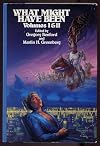
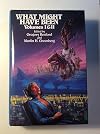
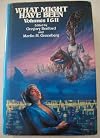
What Might Have Been, Volumes 1 & 2: Alternate Empires, Alternate Heroes
by Gregory Benford (Editor), Martin H. Greenberg (Editor)
What Might Have Been (Collections and Selections — 1,2)
On This Page
Tags
Recommendations



















Member Reviews
There are some fantastic stories in this collection--my favorite is actually the very last one included, "No Spot of Ground" by Walter Jon Williams, which takes a look at what life Poe might have lived if he hadn't died in Baltimore when he did, and the view Williams has of him 20 years later is fantastic. And with a book full of other great authors--such Robert Silverberg, Harry Turtledove, Poul Anderson, and Larry Niven, to name only a few--I think any fan of science fiction is bound to find some stories to fall in love with here. This was something of an introduction to alternate history for me, as I've only read a few books in this subgenre in the past, but it was a fascinating journey. In some cases, I think I would have gotten show more quite a bit more out of the stories if I'd been more familiar with the history they were playing off of, but I suppose that would be true for anyone diving into this genre (and it's also true that I'm not the history buff many readers are, which may have put me behind to begin with). Still, I'd absolutely recommend this collection to anyone interested, and there are a few stories here which I'll no doubt come back to and re-read. The collection is incredibly varied, too, so don't let the page count scare you off! show less
Excellent book that I bought, read, did not understand, and read again.
The re-telling of history is fascinating in this volume of short stories. Many things are covered: an alternate Confederacy allows women to become doctors, but only doctors. Lawrence of Arabia is really in hiding, not dead (yet!) and helps the Allies during the North African campaigns of the Second World War. Most touching and heart-wrenching is that two extra helicopters go to help rescue the hostages from Iraq; because of this decision, the hostages are rescued, Carter is re-elected, and someone is in a crucial spot at a crucial time during December, 1980.
While history changes on pivotal points, and almost too quickly sometimes to catch these pivotal points, this show more is a fascinating look at what "might" have been. show less
The re-telling of history is fascinating in this volume of short stories. Many things are covered: an alternate Confederacy allows women to become doctors, but only doctors. Lawrence of Arabia is really in hiding, not dead (yet!) and helps the Allies during the North African campaigns of the Second World War. Most touching and heart-wrenching is that two extra helicopters go to help rescue the hostages from Iraq; because of this decision, the hostages are rescued, Carter is re-elected, and someone is in a crucial spot at a crucial time during December, 1980.
While history changes on pivotal points, and almost too quickly sometimes to catch these pivotal points, this show more is a fascinating look at what "might" have been. show less
Ratings
Members
- Recently Added By
Author Information

Gregory Benford, was born on January 30, 1941 in Mobile, Alabama. He is a physicist and science fiction writer who earned his Ph.D. from the University of California, San Diego, in 1967. He is a Woodrow Wilson Fellow and a consultant for NASA. Benford's first novel "Deeper than the Darkness" (1970), which was revised as "The Stars in Shroud" show more (1978), gave him notice as a serious Science Fiction writer. His most popular work is "Timescape" (1980), which was the winner of the Nebula and John W. Campbell Memorial Awards; it presented a hard physics approach to limited time travel. "In the Ocean of Night" (1977), "Across the Sea of Suns" (1984), "Great Sky River" (1987), "Tides of Light" (1989) and "Furious Gulf" (1994) were all a part of the Galactic Cluster Series. He has also written the juvenile novel "Jupiter Project" (1975), "Against Infinity" (1983) and the thriller "Artifact" (1985). He has been nominated for 12 Nebula Awards (winning for "Timescape" and for the novelette, "If the Stars are Gods"). Benford, writing alternately with Bruce Sterling, produces science fact articles for the Magazine of Fantasy and Science Fiction. They took over after the death of regular columnist Isaac Asimov. He has also co-edited theme anthologies with Martin H. Greenburg, which include "Hitler Victorious" (1986), "Nuclear War" (1988), "What Might Have Been, Volume 1: Alternate Empires" (1988), "Volume 2: Alternate Heroes" (1989) and "Volume 3: Alternate Wars." (Bowker Author Biography) show less

Martin Harry Greenberg (March 1, 1941 - June 25, 2011) was an American academic and speculative fiction anthologist. In all, he compiled 1,298 anthologies. He founded Tekno Books, a packager of more than 2000 published books; he was also a co-founder of the Sci-Fi Channel. Some of his anthologies included: Past Imperfect (2001), Once Upon a Galaxy show more (2002) and Sirius: The Dog Star (2004). (Bowker Author Biography) show less
All Editions
Series

Work Relationships
Common Knowledge
- Canonical title
- What Might Have Been, Volumes 1 & 2: Alternate Empires, Alternate Heroes
- Original publication date
- 1990
- Original language
- English
Classifications
- Genres
- Fiction and Literature, Science Fiction
- DDC/MDS
- 813.087608 — Literature & rhetoric American literature in English American fiction in English By type Genre fiction Adventure fiction Speculative fiction Collections
- LCC
- PS648 .S3 — Language and Literature American literature American literature Collections of American literature Prose (General)
Statistics
- Members
- 184
- Popularity
- 177,516
- Reviews
- 2
- Rating
- (3.86)
- Languages
- English
- Media
- Paper
- ASINs
- 11