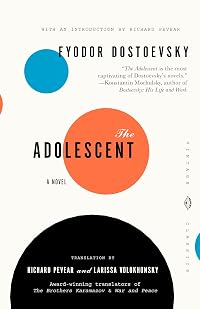
The Adolescent (Vintage Classics)
by Fyodor Dostoyevsky 
On This Page
Description
The narrator and protagonist of Dostoevsky's novel The Adolescent (first published in English as A Raw Youth) is Arkady Dolgoruky, a na*ve 19-year-old boy bursting with ambition and opinions. The illegitimate son of a dissipated landowner, he is torn between his desire to expose his father's wrongdoing and the desire to win his love. He travels to St. Petersburg to confront the father he barely knows, inspired by an inchoate dream of communion and armed with a mysterious document that he show more believes gives him power over others. This new English version by the most acclaimed of Dostoevsky's translators is a masterpiece of pathos and high comedy. show lessTags
Recommendations











Member Recommendations
Member Reviews
As with The Devils, I think here, Dostoevsky's reach exceeded his grasp artistically - and while the former novel was hindered by censorship (Stavrogin's "confession" was not allowed to appear in the original version, and since each character represents a "type," this necessitated a re-working of the book in such a way that blunts the coherency and strength of its implicit social-political commentary) , the latter is hindered by a mix of self-censorship and self-indulgence.
Dostoevsky was placing his novel in a journal with political leanings seen as contrary to his own, with an editor who had earlier derided Dostoevsky for his focus on pathological sensationalism - consequently he seems to restrict his subject matter and motifs to a show more greater degree than with any other work from his mature period. At the same time, there seems to be no limit to the number of devices, plot points, or character-traits haphazardly recycled from his published and unpublished oeuvre. This is also easily the most convoluted of his books, with every character pushed across hundreds of pages from one ridiculous intrigue to the next (Dostoevsky even mistakenly changed the name of one character from one part of the book to the next, so the reader should be forgiven for having any trouble keeping up with the action).
There are a few striking or memorable passages, as well as a clear theme (i.e. who can/should the Russian youth look to for moral guidance or as models?), but overall the novel seems distinctly and strangely unfocused. Perhaps the novel makes more sense when situated in the context of contemporaneous depictions of the Russian "family" - especially Turgenev's [b:Fathers and Sons|19117|Fathers and Sons|Ivan Turgenev|https://images.gr-assets.com/books/1390793535s/19117.jpg|1294426] and Tolstoy's [b:Anna Karenina|15823480|Anna Karenina|Leo Tolstoy|https://images.gr-assets.com/books/1352422904s/15823480.jpg|2507928] - but [b:The Brothers Karamazov|4934|The Brothers Karamazov|Fyodor Dostoyevsky|https://images.gr-assets.com/books/1427728126s/4934.jpg|3393910] is such a towering response both aesthetically and philosophically to these works (as well as a great achievement on its own), that it is difficult not to consign The Adolescent to the shadows.
So, while (Dostoevsky's biographer) Joseph Frank's critical assessment of The Devils lead me to appreciate it much more than I would have on my own, I've yet to encounter a convincing defense of the abiding merit of this book. show less
Dostoevsky was placing his novel in a journal with political leanings seen as contrary to his own, with an editor who had earlier derided Dostoevsky for his focus on pathological sensationalism - consequently he seems to restrict his subject matter and motifs to a show more greater degree than with any other work from his mature period. At the same time, there seems to be no limit to the number of devices, plot points, or character-traits haphazardly recycled from his published and unpublished oeuvre. This is also easily the most convoluted of his books, with every character pushed across hundreds of pages from one ridiculous intrigue to the next (Dostoevsky even mistakenly changed the name of one character from one part of the book to the next, so the reader should be forgiven for having any trouble keeping up with the action).
There are a few striking or memorable passages, as well as a clear theme (i.e. who can/should the Russian youth look to for moral guidance or as models?), but overall the novel seems distinctly and strangely unfocused. Perhaps the novel makes more sense when situated in the context of contemporaneous depictions of the Russian "family" - especially Turgenev's [b:Fathers and Sons|19117|Fathers and Sons|Ivan Turgenev|https://images.gr-assets.com/books/1390793535s/19117.jpg|1294426] and Tolstoy's [b:Anna Karenina|15823480|Anna Karenina|Leo Tolstoy|https://images.gr-assets.com/books/1352422904s/15823480.jpg|2507928] - but [b:The Brothers Karamazov|4934|The Brothers Karamazov|Fyodor Dostoyevsky|https://images.gr-assets.com/books/1427728126s/4934.jpg|3393910] is such a towering response both aesthetically and philosophically to these works (as well as a great achievement on its own), that it is difficult not to consign The Adolescent to the shadows.
So, while (Dostoevsky's biographer) Joseph Frank's critical assessment of The Devils lead me to appreciate it much more than I would have on my own, I've yet to encounter a convincing defense of the abiding merit of this book. show less
"Подросток". Книга, в которой основная тема творчества великого Достоевского — тема судьбы человека, психологически и духовно не укладывающегося в привычные рамки, — обрамлена запутанным, почти "детективным" сюжетом, достойным классического "романа тайн". Книга не просто гениальная, но еще и бесконечно глубокая. "Отцы и дети" по Достоевскому? Или — интеллектуальный остросюжетный роман? Быть может, то и show more другое одновременно?.. show less
I enjoyed the beginning of this book immensely. I liked the part where Dolguruky described his family history. The narrator sounded youthful and enthusiastic. Unfortunately when he got to the part about his father Versilov doing shadowy things to young women and causing them to commit suicide. I decided that that was enough for me to stop reading it. Although it was not stated exactly what he did to these girls it seems like perhaps his very presence (even if he only intended to be helpful) was in some way toxic. Dolguruky at age 8 was subjected to physical and mental abuse at a boarding school that he was sent to by his father. Versilov refused to be a parent to Dolguruky and instead acted like an unsafe Jeffrey Epstein type taking an show more unnatural and interest in adolescent girls. This book should have come with trigger warnings. I'm giving the book 2 stars based on the narrator’s excellent voice and the beginning of the book with the family history. show less
This book has been overlooked to an astonishing degree, even by fans of Dostoyevsky, and perhaps I could understand why. But it is not bad by any means - compared to the rest of his books, a merely interesting book can seem awful in comparison.
The plot concerns an adolescent (although the translation is still up for a fine-tuned debate) who is illegitimate and something about a mysterious letter. It is not exactly full of the grand philosophy and debate that Dostoyevsky employs, but what he does have is still as good as ever. The narrator's voice is surprisingly convincing. The ambition and soul of a ninteteen year old is well done.
Worth reading if you're already a fan of Dosty. I would not recommend this to people who are not used to show more him yet, though. show less
The plot concerns an adolescent (although the translation is still up for a fine-tuned debate) who is illegitimate and something about a mysterious letter. It is not exactly full of the grand philosophy and debate that Dostoyevsky employs, but what he does have is still as good as ever. The narrator's voice is surprisingly convincing. The ambition and soul of a ninteteen year old is well done.
Worth reading if you're already a fan of Dosty. I would not recommend this to people who are not used to show more him yet, though. show less
Echoes all of the themes one knows and loves in Dostoevsky, albeit with a plot that's a little harder to follow (as my notes in the back of my book attest). One thing I like about this particular edition is the introduction by Andrew MacAndrew; it's the best analysis of the forces that shaped Dostoevsky that I've read.
I won't try to capture the plot :-) but excerpt many great passages:
On atheism, transience, living in the now:
“With the great concept of immortality gone, they have to replace it with something, and the immense reserves of love that before were lavished on Him who was immortality are now directed toward nature, the world, fellow men, every blade of grass. The more clearly they come to realize how transitory and finite show more their own existence is, the more ardently they grow to love the earth and life, and that special love is different from anything they’ve felt before. They start noticing and discovering in nature moments and secrets that they never suspected until then, because now they look at it with different eyes, with the eyes of a lover looking at his beloved. On awakening, they rush to kiss one another in their haste to love, constantly aware that the number of their days is limited and that there is nothing left for them when these days are spent. They work for one another and each of them gives up all he has, and this giving is happiness in itself. Every child knows and feels that everyone on earth is like a father or mother to him. ‘Let this be the last day of my life,’ every one of them thinks, gazing at the setting sun; ‘it doesn’t matter, for after I die they’ll still be here, and after them there’ll be their children…’”
On brotherhood and love of fellow man:
“You know, my boy,” he said, “it’s impossible to love men as they are. And yet we must. So try to do good to men by doing violence to your feelings, holding your nose, and shutting your eyes, especially shutting your eyes. Endure their villainy without anger, as much as possible; try to remember that you’re a man too. For, if you’re even a little above average intelligence, you’ll have the propensity to judge people severely. … There’s a passage in the Koran where Allah bids the Prophet look upon those troublesome creatures as upon mice, do them good and pass them by. It may sound rather haughty but it’s the right way. … It’s impossible to love one’s neighbor without despising him. I believe that man is physically unable to love his neighbor. The very concept of ‘love of mankind’ is completely misleading from the start, unless ‘mankind’ is something he has created in his mind…”
On communism:
“Tell me, how can you prove to me that it will be better when you have things your way? What will you do if my human dignity revolts against your barracks-like world? … You’ll have barracks, communal dormitories, le strict necessaire, atheism, communal wives, and no children – that’s your final goal, I’m quite aware of it. And it’s for that sort of thing, for the small share of your miserable welfare that will be assured me by your rational organization, for a morsel of food and a small heated corner, that you’re asking me to sacrifice my individuality!”
On death:
“There’s a limit to how long a man is remembered on this earth. It’s about a hundred years, that limit. Less than a hundred years after a man’s death, he may still be remembered by his children or perhaps his grandchildren who have seen his face, but after that time, even if his name is still remembered, it’s only indirectly, from other people’s words, and it’s just an idea about him, because all those who have seen him alive will by then be dead too. And grass will grow over his grave in the cemetery, the white stone over him will crumble, and everyone will forget him, including his own descendants, because only very few names remain in people’s memory. So that’s all right – let them forget! Yes, go on, forget me, dear ones, but me, I’ll go on loving you even from my grave. I can hear, dear children, your cheerful voices and I can hear your steps on the graves of your fathers; live for some time yet in the sunlight and enjoy yourselves while I pray for you and I’ll come to you in your dreams…Death doesn’t make any difference, for there’s love after death too!”
On democracy:
“…whenever all citizens are granted equal rights, there is a general weakening of the sense of honor and, therefore, the sense of duty. Selfishness replaces the old unifying system, and the whole system breaks up into a multitude of individuals, each with a full set of civil rights.”
On enlightenment, and happiness:
“We spent the night, my friend, in an open field and I awoke early in the morning when everyone else was still asleep and the sun hadn’t even peeped out from behind the forest yet. I lifted my head, my boy, and looked around, and everything was so beautiful that it couldn’t be put into words so I just sighed. It was still and quiet, the air was light, and the grass was growing…Grow, God’s grass, grow!…A bird sang…Sing you little bird of God!…A little babe squealed in a woman’s arms…God bless you, little man, grow and be happy, dear child!…And for the first time in my life I became conscious of all that was going on inside me. I put my head down again and went back to sleep, and it was so nice. It’s so good to be alive, my dear boy! If I should get better, I’ll go wandering again come spring…And if there’s mystery in the world, it only makes it even better; it fills the heart with awe and wonder, and it gladdens the heart…”
On judging others:
“…Once an intelligent woman told me that I have no right to judge others because I don’t know how to suffer and that, in order to qualify as a judge of others, I must first earn that right through suffering.”
On lies:
“The first type is all enthusiasm: ‘Just let me tell my lies and you’ll see how nice everything will be!’ The second type is all gloom and lack of imagination: ‘No, I won’t allow you to lie. Be specific: Where did it happen? What year?’ In short a man without a heart. You must always allow people to lie a little. It’s an innocent pleasure. Even a lot, sometimes. First of all, it shows that you’re tactful and secondly, it’ll enable you to lie too…”
On memories:
“…I still think we should agree on one point: even if some day we should disapprove of each other, if we should become spiteful and nasty and horrid, even if we should forget everything else, let us always remember this day and this hour; let us vow never to forget this day when we walked side by side, laughing and feeling so gay and happy.”
On nihilism:
“…In our society today nothing is clear, gentlemen. Since you deny God and deny saintly self-sacrifice, I want to know what blind, deaf, or dumb force of inertia could make me act against my own interest? You may argue that behaving responsibly in society is to my advantage. But what if I consider all your reasonableness unreasonable, what if I find nothing so reasonable about your communal dormitories and phalansteries? What the hell do I care about all that and about the distant future when I have only one life to live here?”
On religion:
“…They choose God so as not to submit to their fellow men without, of course, acknowledging the underlying reason, namely, that it’s less humiliating to submit to God. Some of these people become ardently religious, or rather thirst ardently for religion. But then they mistake their desire for faith for faith itself.”
On the younger generation:
“…Oh, mon cher, the problems facing a child are really frightening in our day…First, for a while these innocent little faces framed by their golden curls look at you with their innocent eyes and radiant smiles – they’re just like God’s angels or beautiful birds…But later…later it may turn out that it would have been better if they’d never grown up.”
“Our time,” he said slowly, “is an age of the golden mean and insensitivity, of a cult of ignorance and idleness, of an inability to do anything, and of a longing for the ready-made. No one stops to think; hardly anyone can work out an original thought…”
“Indeed, recently the process has been reversed: no longer is human jetsam latching itself on to our elite; instead, whole batches of our best people are tearing themselves away from it and lightheartedly joining the roving packs of the disorderly and the envious. Moreover, it is no longer so rare to find fathers and heads of our culture-bearing families mocking and ridiculing values that their children may still have been happy to believe in.”
On youth:
“You worry too much about these things. If you think you shouldn’t have said what you did, don’t say it next time. You’ve still got fifty years ahead of you to correct your mistakes.” show less
I won't try to capture the plot :-) but excerpt many great passages:
On atheism, transience, living in the now:
“With the great concept of immortality gone, they have to replace it with something, and the immense reserves of love that before were lavished on Him who was immortality are now directed toward nature, the world, fellow men, every blade of grass. The more clearly they come to realize how transitory and finite show more their own existence is, the more ardently they grow to love the earth and life, and that special love is different from anything they’ve felt before. They start noticing and discovering in nature moments and secrets that they never suspected until then, because now they look at it with different eyes, with the eyes of a lover looking at his beloved. On awakening, they rush to kiss one another in their haste to love, constantly aware that the number of their days is limited and that there is nothing left for them when these days are spent. They work for one another and each of them gives up all he has, and this giving is happiness in itself. Every child knows and feels that everyone on earth is like a father or mother to him. ‘Let this be the last day of my life,’ every one of them thinks, gazing at the setting sun; ‘it doesn’t matter, for after I die they’ll still be here, and after them there’ll be their children…’”
On brotherhood and love of fellow man:
“You know, my boy,” he said, “it’s impossible to love men as they are. And yet we must. So try to do good to men by doing violence to your feelings, holding your nose, and shutting your eyes, especially shutting your eyes. Endure their villainy without anger, as much as possible; try to remember that you’re a man too. For, if you’re even a little above average intelligence, you’ll have the propensity to judge people severely. … There’s a passage in the Koran where Allah bids the Prophet look upon those troublesome creatures as upon mice, do them good and pass them by. It may sound rather haughty but it’s the right way. … It’s impossible to love one’s neighbor without despising him. I believe that man is physically unable to love his neighbor. The very concept of ‘love of mankind’ is completely misleading from the start, unless ‘mankind’ is something he has created in his mind…”
On communism:
“Tell me, how can you prove to me that it will be better when you have things your way? What will you do if my human dignity revolts against your barracks-like world? … You’ll have barracks, communal dormitories, le strict necessaire, atheism, communal wives, and no children – that’s your final goal, I’m quite aware of it. And it’s for that sort of thing, for the small share of your miserable welfare that will be assured me by your rational organization, for a morsel of food and a small heated corner, that you’re asking me to sacrifice my individuality!”
On death:
“There’s a limit to how long a man is remembered on this earth. It’s about a hundred years, that limit. Less than a hundred years after a man’s death, he may still be remembered by his children or perhaps his grandchildren who have seen his face, but after that time, even if his name is still remembered, it’s only indirectly, from other people’s words, and it’s just an idea about him, because all those who have seen him alive will by then be dead too. And grass will grow over his grave in the cemetery, the white stone over him will crumble, and everyone will forget him, including his own descendants, because only very few names remain in people’s memory. So that’s all right – let them forget! Yes, go on, forget me, dear ones, but me, I’ll go on loving you even from my grave. I can hear, dear children, your cheerful voices and I can hear your steps on the graves of your fathers; live for some time yet in the sunlight and enjoy yourselves while I pray for you and I’ll come to you in your dreams…Death doesn’t make any difference, for there’s love after death too!”
On democracy:
“…whenever all citizens are granted equal rights, there is a general weakening of the sense of honor and, therefore, the sense of duty. Selfishness replaces the old unifying system, and the whole system breaks up into a multitude of individuals, each with a full set of civil rights.”
On enlightenment, and happiness:
“We spent the night, my friend, in an open field and I awoke early in the morning when everyone else was still asleep and the sun hadn’t even peeped out from behind the forest yet. I lifted my head, my boy, and looked around, and everything was so beautiful that it couldn’t be put into words so I just sighed. It was still and quiet, the air was light, and the grass was growing…Grow, God’s grass, grow!…A bird sang…Sing you little bird of God!…A little babe squealed in a woman’s arms…God bless you, little man, grow and be happy, dear child!…And for the first time in my life I became conscious of all that was going on inside me. I put my head down again and went back to sleep, and it was so nice. It’s so good to be alive, my dear boy! If I should get better, I’ll go wandering again come spring…And if there’s mystery in the world, it only makes it even better; it fills the heart with awe and wonder, and it gladdens the heart…”
On judging others:
“…Once an intelligent woman told me that I have no right to judge others because I don’t know how to suffer and that, in order to qualify as a judge of others, I must first earn that right through suffering.”
On lies:
“The first type is all enthusiasm: ‘Just let me tell my lies and you’ll see how nice everything will be!’ The second type is all gloom and lack of imagination: ‘No, I won’t allow you to lie. Be specific: Where did it happen? What year?’ In short a man without a heart. You must always allow people to lie a little. It’s an innocent pleasure. Even a lot, sometimes. First of all, it shows that you’re tactful and secondly, it’ll enable you to lie too…”
On memories:
“…I still think we should agree on one point: even if some day we should disapprove of each other, if we should become spiteful and nasty and horrid, even if we should forget everything else, let us always remember this day and this hour; let us vow never to forget this day when we walked side by side, laughing and feeling so gay and happy.”
On nihilism:
“…In our society today nothing is clear, gentlemen. Since you deny God and deny saintly self-sacrifice, I want to know what blind, deaf, or dumb force of inertia could make me act against my own interest? You may argue that behaving responsibly in society is to my advantage. But what if I consider all your reasonableness unreasonable, what if I find nothing so reasonable about your communal dormitories and phalansteries? What the hell do I care about all that and about the distant future when I have only one life to live here?”
On religion:
“…They choose God so as not to submit to their fellow men without, of course, acknowledging the underlying reason, namely, that it’s less humiliating to submit to God. Some of these people become ardently religious, or rather thirst ardently for religion. But then they mistake their desire for faith for faith itself.”
On the younger generation:
“…Oh, mon cher, the problems facing a child are really frightening in our day…First, for a while these innocent little faces framed by their golden curls look at you with their innocent eyes and radiant smiles – they’re just like God’s angels or beautiful birds…But later…later it may turn out that it would have been better if they’d never grown up.”
“Our time,” he said slowly, “is an age of the golden mean and insensitivity, of a cult of ignorance and idleness, of an inability to do anything, and of a longing for the ready-made. No one stops to think; hardly anyone can work out an original thought…”
“Indeed, recently the process has been reversed: no longer is human jetsam latching itself on to our elite; instead, whole batches of our best people are tearing themselves away from it and lightheartedly joining the roving packs of the disorderly and the envious. Moreover, it is no longer so rare to find fathers and heads of our culture-bearing families mocking and ridiculing values that their children may still have been happy to believe in.”
On youth:
“You worry too much about these things. If you think you shouldn’t have said what you did, don’t say it next time. You’ve still got fifty years ahead of you to correct your mistakes.” show less
I waited a number of days after finishing this book to gather my thoughts and to be able to give justice to Dostoyevksy's genius in this remarkable novel, which is not as well known as "Crime and Punishment", "Brothers Karamazov", and "The Idiot"... And still I think I would fail at this task. I was, of course, overjoyed to have read it in original. The language is remarkable. Dostoyevksy's craft of describing his protagonist's sentiments, aspirations and ruminations is unparalleled. It's rare to see agony manifested in a more poignant way. We also come to know of the author's own thoughts on many problems of his day. In short, it was quite an experience to be immersed in this novel.
Old Prince Sokolsky is nearing the end of his life, and already his family and hangers on are vying with each other to become the heirs to his immense fortune. Chief among them are his daughter, Katerina Nikolaevna, and his friend and companion of his final years, Anna Andreevna, who has managed to persuade the old man to marry her and legitimise their relationship. These two women compete for the old man’s affections with a bitterness and hatred their frosty politeness and protestations of undying love for each other only just manage to mask.
Andrei Petrovich Versilov is a gentleman of the superfluous generation of the 1840s. Widowed at an early age, he has spent his life alternately living with the paramour of his youth, one of his show more serfs, Sofya, and running away from her to live abroad in Europe. He has four children, two of them with his serf ‘wife’, and two of them from his late legal wife, one of whom is Anna Andreevna. Although Versilov loves and admires his serf mistress and his two children by her, he is obsessively in love with Prince Sokolsky’s daughter Katerina Nikolaevna.
To avoid the scandal of her youthful seduction by Versilov, Sofya had been given away in marriage to another serf from Versilov’s estate, a much older peasant, Makar Dolguruky, who has conveniently been absent as a Holy Wanderer all over Russia for much of his life, but who has now come to Petersburg to die in the home of his nominal wife. Once he dies, Versilov will be able to marry Soya and legitimise their life long union and their children. This causes a crisis in his relationship to Katerina Nikolaevna.
These plot strands are woven together and presented to the reader through the memoirs of Versilov’s illegitimate son, the adolescent of the title, Arkady Makarovich. He has been brought up away from his family, first in the home of a kindly couple in Moscow, and then in a Dickensian school (the arc of Arkady’s early life has striking similarities to David Copperfield’s). He has come into possession of certain documents which, if revealed, could bring the struggle for Prince Sokolsky’s inheritance as well as his natural father’s position, to a nasty head.
Arkady, through a series of misadventures, falls in with a gang of blackmailers, headed by a former schoolmate, who learns of the existence of Arkady’s documents, and unbeknownst to him, steals them, replacing them with empty pieces of paper. The gang attempt to blackmail both Anna Andreevna, and Katerina Nikolaevna. Each women attempts to use Arkady, again, without his knowledge, to protect herself.
The last full length novel before the final masterpiece of Karamazov, The Adolescent has been unfairly overlooked and even maligned by some Dostoevskyans. While it is true that it lacks the powerful focus and hallucinatory strength of some of the other novels, it is an essential work for understanding (the development of) Dostoevsky’s ideas concerning the nature of consciousness and of the self. It also represents his most fully worked out attempt at a bildungsroman, that quintessentially 19th century, Romantic genre.
Read the full review on The Lectern show less
Andrei Petrovich Versilov is a gentleman of the superfluous generation of the 1840s. Widowed at an early age, he has spent his life alternately living with the paramour of his youth, one of his show more serfs, Sofya, and running away from her to live abroad in Europe. He has four children, two of them with his serf ‘wife’, and two of them from his late legal wife, one of whom is Anna Andreevna. Although Versilov loves and admires his serf mistress and his two children by her, he is obsessively in love with Prince Sokolsky’s daughter Katerina Nikolaevna.
To avoid the scandal of her youthful seduction by Versilov, Sofya had been given away in marriage to another serf from Versilov’s estate, a much older peasant, Makar Dolguruky, who has conveniently been absent as a Holy Wanderer all over Russia for much of his life, but who has now come to Petersburg to die in the home of his nominal wife. Once he dies, Versilov will be able to marry Soya and legitimise their life long union and their children. This causes a crisis in his relationship to Katerina Nikolaevna.
These plot strands are woven together and presented to the reader through the memoirs of Versilov’s illegitimate son, the adolescent of the title, Arkady Makarovich. He has been brought up away from his family, first in the home of a kindly couple in Moscow, and then in a Dickensian school (the arc of Arkady’s early life has striking similarities to David Copperfield’s). He has come into possession of certain documents which, if revealed, could bring the struggle for Prince Sokolsky’s inheritance as well as his natural father’s position, to a nasty head.
Arkady, through a series of misadventures, falls in with a gang of blackmailers, headed by a former schoolmate, who learns of the existence of Arkady’s documents, and unbeknownst to him, steals them, replacing them with empty pieces of paper. The gang attempt to blackmail both Anna Andreevna, and Katerina Nikolaevna. Each women attempts to use Arkady, again, without his knowledge, to protect herself.
The last full length novel before the final masterpiece of Karamazov, The Adolescent has been unfairly overlooked and even maligned by some Dostoevskyans. While it is true that it lacks the powerful focus and hallucinatory strength of some of the other novels, it is an essential work for understanding (the development of) Dostoevsky’s ideas concerning the nature of consciousness and of the self. It also represents his most fully worked out attempt at a bildungsroman, that quintessentially 19th century, Romantic genre.
Read the full review on The Lectern show less
Members
- Recently Added By
Lists

Russian Literature
184 works; 35 members

Fyodor Dostoevsky books
17 works; 1 member
Author Information

1,481+ Works 180,476 Members
One of the most powerful and significant authors in all modern fiction, Fyodor Dostoevsky was the son of a harsh and domineering army surgeon who was murdered by his own serfs (slaves), an event that was extremely important in shaping Dostoevsky's view of social and economic issues. He studied to be an engineer and began work as a draftsman. show more However, his first novel, Poor Folk (1846), was so well received that he abandoned engineering for writing. In 1849, Dostoevsky was arrested for being a part of a revolutionary group that owned an illegal printing press. He was sentenced to be executed, but the sentence was changed at the last minute, and he was sent to a prison camp in Siberia instead. By the time he was released in 1854, he had become a devout believer in both Christianity and Russia - although not in its ruler, the Czar. During the 1860's, Dostoevsky's personal life was in constant turmoil as the result of financial problems, a gambling addiction, and the deaths of his wife and brother. His second marriage in 1887 provided him with a stable home life and personal contentment, and during the years that followed he produced his great novels: Crime and Punishment (1886), the story of Rodya Raskolnikov, who kills two old women in the belief that he is beyond the bounds of good and evil; The Idiots (1868), the story of an epileptic who tragically affects the lives of those around him; The Possessed (1872), the story of the effect of revolutionary thought on the members of one Russian community; A Raw Youth (1875), which focuses on the disintegration and decay of family relationships and life; and The Brothers Karamazov (1880), which centers on the murder of Fyodor Karamazov and the effect the murder has on each of his four sons. These works have placed Dostoevsky in the front rank of the world's great novelists. Dostoevsky was an innovator, bringing new depth and meaning to the psychological novel and combining realism and philosophical speculation in his complex studies of the human condition. (Bowker Author Biography) show less
Fyodor Dostoyevsky has a Legacy Library. Legacy libraries are the personal libraries of famous readers, entered by LibraryThing members from the Legacy Libraries group.
Some Editions
Awards and Honors
Series
Belongs to Publisher Series
Work Relationships
Common Knowledge
- Canonical title*
- L'adolescente
- Original title
- Подросток (Podrostok) (Podrostok)
- Alternate titles
- A raw youth; The Adolescent; An Accidental Family
- Original publication date
- 1875
- People/Characters
- Arkady Makarovich Dolgoruky; Makar Ivanovich Dolgoruky; Andrei Versilov; Katerina Akhmakov; Monsieur Touchard
- Important places
- Russia; St. Petersburg, Russia; Moscow, Russia
- Related movies
- Podrostok (1983 | IMDb)
- First words
- Unable to restrain myself, I have sat down to record this history of my first steps on life's career, though I could have done as well without it.
- Quotations*
- … l'epoca attuale è il tempo della mediocrità aurea e dell'insensibilità, della passione per l'ignoranza, della pigrizia, dell'incapacità al lavoro e dell'aspirazione a trovar tutto già bell'e pronto. Nessuno pensa; di... (show all) rado si trova qualcuno che concepisca un'idea.
Ma forse è meglio che gli altri ci offendano: almeno ci liberano dalla disgrazia di amarli.
Conosco invece a Pietroburgo alcuni luoghi «felici», cioè luoghi dove una volta, per qualche ragione, sono stato felice: ebbene, ho cari questi luoghi, ed appositamente ci vado meno che posso per poter un giorno, quando mi... (show all) sentirò solitario e infelice, ritornarvi a rivivere i miei ricordi in un'ora di dolce malinconia.
«E l'avvocato si sa cos'è: l'avvocato è “una coscienza presa in affitto”» … - Last words
- (Click to show. Warning: May contain spoilers.)They will preserve at least certain faithful features by which to guess what might have been hidden in the soul of some adolescent of that troubled time---a not-entirely-insignificant knowledge, for the generations are made up of adolescents...
- Original language
- Russian
- Disambiguation notice
- Variant Titles: The Adolescent was also published as The Raw Youth and An Accidental Family.
*Some information comes from Common Knowledge in other languages. Click "Edit" for more information.
Classifications
- Genres
- General Fiction, Fiction and Literature
- DDC/MDS
- 891.733 — Literature & rhetoric Literatures of other languages East Indo-European and Celtic literatures Russian and East Slavic languages Russian fiction 1800–1917
- LCC
- PG3326 .P5 — Language and Literature Slavic languages and literatures. Baltic languages. Albanian language Slavic. Baltic. Albanian Russian literature Individual authors and works 1800-1870 Dostoyevsky
- BISAC
Statistics
- Members
- 1,997
- Popularity
- 10,546
- Reviews
- 21
- Rating
- (3.78)
- Languages
- 25 — Catalan, Chinese, Czech, Danish, Dutch, English, Finnish, French, German, Greek, Hebrew, Hungarian, Italian, Lithuanian, Norwegian (Bokmål), Polish, Portuguese, Romanian, Russian, Serbian, Croatian, Slovenian, Spanish, Swedish, Turkish
- Media
- Paper, Audiobook, Ebook
- ISBNs
- 146
- ASINs
- 54