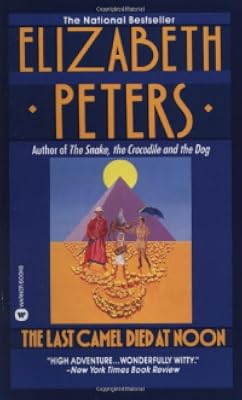
The Last Camel Died at Noon
by Elizabeth Peters
Amelia Peabody [Publication order] (6), Amelia Peabody [Chronological Order] (6, 1897–98)
On This Page
Description
Bestselling author Elizabeth Peters brings back nineteenth-century Egyptologist Amelia Peabody and her entourage in this delicious caper that digs up mystery in the shadow of the pyramids.The last camel is dead, and Egyptologist Amelia Peabody, her dashing husband, Emerson, and her precocious son, Ramses, are in dire straits on the sun-scorched desert sands. Months before, back in cool, green England, Viscount Blacktower had approached them to find his son and his son's new bride, who have show more been missing in war-torn Sudan for over a decade. An enigmatic message scrawled on papyrus and a cryptic map had been delivered to Blacktower, awakening his hope that the couple was still alive.
Neither Amelia nor Emerson believes the message is authentic, but the treasure map proves an irresistible temptation. Now, deep in Nubia's vast wasteland, they discover too late how much treachery is afoot (and on camelback), and survival depends on Amelia's solving a mystery as old as ancient Egypt and as timeless as greed and revenge.
. show less
Tags
Recommendations
















Member Recommendations
cbl_tn Both author Elizabeth Peters and her character, Amelia Peabody, are fans of Sir Henry Rider Haggard's novels. This book is written in Haggard's "lost world" style.
50
cbl_tn Both author Elizabeth Peters and her character, Amelia Peabody, are fans of Sir Henry Rider Haggard's novels. This book is written in Haggard's "lost world" style.
40
Member Reviews
Deliberately written to sound like the works of H. Rider Haggard, this Amelia Peabody adventure was filled with over-the-top melodrama and adventure.
This year's dig is planned for the Sudan but before they can get started, Amela, Emerson, and Ramses are off following a dubious map to locate an explorer and his wife who have been missing for twelve years. However, the map also hints at an archaeological treasure: the remnants of a long dead culture.
From almost dying of thirst in the desert to finding themselves in the middle of a Royal coup, Amelia, Emerson, and Ramses have all they can handle. And despite Emerson's pleas, Amelia gets involved with the aristocracy and even helps out a pair of young lovers.
I enjoyed the now-ten-year-old show more Ramses part in this story and only wish the Amelia would spend more time listening to what he has to say. However, that would shorten the story and I enjoyed every action-packed minute of this audiobook narrated by Susan O'Malley. show less
This year's dig is planned for the Sudan but before they can get started, Amela, Emerson, and Ramses are off following a dubious map to locate an explorer and his wife who have been missing for twelve years. However, the map also hints at an archaeological treasure: the remnants of a long dead culture.
From almost dying of thirst in the desert to finding themselves in the middle of a Royal coup, Amelia, Emerson, and Ramses have all they can handle. And despite Emerson's pleas, Amelia gets involved with the aristocracy and even helps out a pair of young lovers.
I enjoyed the now-ten-year-old show more Ramses part in this story and only wish the Amelia would spend more time listening to what he has to say. However, that would shorten the story and I enjoyed every action-packed minute of this audiobook narrated by Susan O'Malley. show less
I like all the Amelia Peabody mysteries but, for me, this is the only "keeper" among them - so far. I really enjoy the H. Rider Haggard-inspired adventure story. Emerson makes a better RH protagonist than most of Haggard's heroes and the whole thing is great fun. Books-within-books: just in case we didn't read the author's homage to Haggard in the preface, just in case we didn't recognize what is being celebrated (parody is too harsh a word), the native prince actually pilfers and devours a copy of King Solomon's Mines - that explains it! Emerson groans: "He sounds exactly like one of those confounded natives in those confounded books!" Wonderful.
Fun reread. This is Elizabeth Peters' love letter to the novels of H. Rider Haggard. I've never read any of those, but to judge by this homage, they must be rip-roaring!!
Emerson, Amelia, and their precocious son Ramses get drawn in to a search for a missing explorer and his wife, rumored to have found a lost civilisation in the western Egyptian desert.
They find themselves living every archaeologist's dream... observing firsthand A LIVING ancient nation. But there's much more than scholarly pursuit at hand. They find themselves squarely in the middle of a power struggle of the royal class. Meanwhile, desperate to find a way out of this lost oasis, they still have to figure out if there's anything left of the old explorer and his show more wife.
Plenty of slight Gothic touches, adventurous thrills, running around in tunnels, and general fun. This book contains one of my favorite Amelia quotes, "If all else fails, we will simply have to drug our attendants, overpower the guards, raise the oppressed peasants to arms, and take over the government."
I quite recommend this. show less
Emerson, Amelia, and their precocious son Ramses get drawn in to a search for a missing explorer and his wife, rumored to have found a lost civilisation in the western Egyptian desert.
They find themselves living every archaeologist's dream... observing firsthand A LIVING ancient nation. But there's much more than scholarly pursuit at hand. They find themselves squarely in the middle of a power struggle of the royal class. Meanwhile, desperate to find a way out of this lost oasis, they still have to figure out if there's anything left of the old explorer and his show more wife.
Plenty of slight Gothic touches, adventurous thrills, running around in tunnels, and general fun. This book contains one of my favorite Amelia quotes, "If all else fails, we will simply have to drug our attendants, overpower the guards, raise the oppressed peasants to arms, and take over the government."
I quite recommend this. show less
Another classic adventure for Amelia and her family. I enjoyed this book more than some of the others in the series. The interactions between Amelia and her husband are humorous as always. The most interesting aspect of this story lies in the setting: a hidden city still living as if it were in Ancient Egypt. The setting and descriptions were enjoyable and interesting. This wasn’t a murder mystery, as most of the books in the series are. Probably the best of the series so far. I would not recommend this to someone who has had no experience with the series.
The author's explicit homage to H. Rider Haggard has Amelia and family being taken to a lost city surviving from the Cushite period of Ancient Egypt.
Great fun with lots of treachery and twists and turns. But one conversation in the last chapter had so many Victorian oblique euphemisms I'm not sure whether I understood or not.
SPOILER
Did Lord Blacktower seduce/rape his soon-to-be daughter-in-law and so Nefret is his daughter rather than granddaughter?
Great fun with lots of treachery and twists and turns. But one conversation in the last chapter had so many Victorian oblique euphemisms I'm not sure whether I understood or not.
SPOILER
Did Lord Blacktower seduce/rape his soon-to-be daughter-in-law and so Nefret is his daughter rather than granddaughter?
The sixth volume of Amelia Peabody's adventures swerves somewhat from the criminal mystery precedent of the earlier books. This episode is instead concerned with the Emerson-Peabody family's discovery of (and captivity in) a lost civilization in the Sudan, where Cushite-exported pharaonic customs have survived into the late 19th century. There is, however, plenty of intrigue and skulduggery, not to mention the most plain violence on display in any of the series' books thus far.
Despite the emphasis on action, there is something especially bookish about this volume, with notable attention given to popular 19th-century English literature. The author confesses that The Last Camel Died at Noon is an homage to the work of H. Rider Haggard, show more and there are many references throughout the novel to Haggard's books She and King Solomon's Mines, both of which are fodder for the central narrative. In addition, Wilkie Collins' seminal 19th-century mystery The Moonstone is given a part to play.
The longish story is broken into two parts: first the archeological expedition to the Sudan and the circumstances that drew them to the Holy Mountain in the desert wilderness, and then the events of their stay and eventual escape. This book, unlike its predecessors, also benefits from a small handful of maps and line illustrations. The latter tend to depict relevant art and artifacts, of which a typically amusing example is the carved relief of a "Queen of Meroe spearing captives with girlish enthusiasm." (312)
The final chapter of the book seems to intimate an impending change to the scope and arrangements of Peabody's family, but I suppose it will be necessary to read the next installment to find out whether and how that comes to pass. show less
Despite the emphasis on action, there is something especially bookish about this volume, with notable attention given to popular 19th-century English literature. The author confesses that The Last Camel Died at Noon is an homage to the work of H. Rider Haggard, show more and there are many references throughout the novel to Haggard's books She and King Solomon's Mines, both of which are fodder for the central narrative. In addition, Wilkie Collins' seminal 19th-century mystery The Moonstone is given a part to play.
The longish story is broken into two parts: first the archeological expedition to the Sudan and the circumstances that drew them to the Holy Mountain in the desert wilderness, and then the events of their stay and eventual escape. This book, unlike its predecessors, also benefits from a small handful of maps and line illustrations. The latter tend to depict relevant art and artifacts, of which a typically amusing example is the carved relief of a "Queen of Meroe spearing captives with girlish enthusiasm." (312)
The final chapter of the book seems to intimate an impending change to the scope and arrangements of Peabody's family, but I suppose it will be necessary to read the next installment to find out whether and how that comes to pass. show less
This was a much better developed book than the previous five, but still Peyers doesn't know, it seems, how to move a plot forward rather than in circles. Emerson, Peabody, and even Ramses are simply too good to be true, though of the three I think Ramses the most believable. I don't think these are categorized as YA, but if there were, I would add a star.
Members
- Recently Added By
Lists

egypt novels
16 works; 2 members

Books With Interesting Titles
173 works; 14 members

Books Read in 2014
2,343 works; 89 members

Stories Inspired by Other Fiction
127 works; 24 members

Books With the Most Memorable Titles
478 works; 158 members

Scholar Novels
26 works; 4 members
Author Information

60+ Works 58,698 Members
Some Editions
Awards and Honors
Awards
Series


Work Relationships
Is contained in
Has the adaptation
Common Knowledge
- Canonical title
- The Last Camel Died at Noon
- Original title
- The Last Camel Died at Noon
- Alternate titles*
- Il mistero della città perduta
- Original publication date
- 1991
- People/Characters
- Wallis Budge; Amelia Peabody Emerson; Radcliffe Emerson; Ramses Emerson; Reginald Forthright; Franklin Forth (show all 19); Cynthia Forth; Nefret Forth; Willoughby Forth; Tarek; Nastasen; Murtek; Pesaker; Amenit; Harsetef; Maleneqen; Mentarit; The Heneshem; Rudolf von Slatin
- Important places
- Gebel Barkel, Sudan; Holy Mountain, Sudan (Fictional)
- Dedication
- For Ellen Nehr
With the compliments of the author
and Ahmet, the camel - First words
- Hands on hips, brows lowering, Emerson stood gazing fixedly at the recumbent ruminant.
- Last words
- (Click to show. Warning: May contain spoilers.)One could only hope that state of things would endure.
*Some information comes from Common Knowledge in other languages. Click "Edit" for more information.
Classifications
Statistics
- Members
- 2,316
- Popularity
- 8,566
- Reviews
- 52
- Rating
- (3.91)
- Languages
- 9 — Czech, Danish, English, French, German, Italian, Spanish, Portuguese (Portugal), Portuguese (Brazil)
- Media
- Paper, Audiobook, Ebook
- ISBNs
- 42
- ASINs
- 22