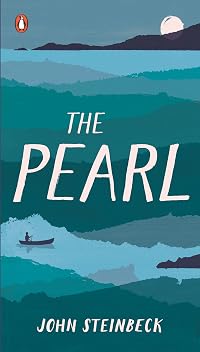
The Pearl
by John Steinbeck
On This Page
Description
“There it lay, the great pearl, perfect as the moon.”Like his father and grandfather before him, Kino is a poor diver, gathering pearls from the gulf beds that once brought great wealth to the Kings of Spain and now provide Kino, Juana, and their infant son with meager subsistence. Then, on a day like any other, Kino emerges from the sea with a pearl as large as a sea gull's egg, as "perfect as the moon." With the pearl comes hope, the promise of comfort and of security....
A story show more of classic simplicity, based on a Mexican folk tale, The Pearl explores the secrets of man's nature, the darkest depths of evil, and the luminous possibilities of love. show less
Tags
Recommendations

































Member Recommendations


Member Reviews
The Pearl by John Steinbeck surprised me. Why? Because even though I haven’t yet read a lot of Steinbeck, his style in this novella was completely different to the last book of his I read. I was impressed and looking forward to see how his style changes with his longer fiction and non-fiction.
The Pearl is a parable retelling of a Mexican folktale. Kino and his wife Juana are poor but happy in their relationship and delighted with baby Coyotito. They live in relative poverty, but have each other and their families. One day when Kino is diving, he finds an oyster that contains a huge pearl. Convinced that this will be the solution to all his problems, Kino is ecstatic. He and Juana can get married, Coyotito can go to school and they show more will have the money to pay the doctor when they are ill. The whole community is overjoyed, but the pearl doesn’t bring the happiness Kino expected. People attempt to harm them and the pearl buyers try to swindle them. Forced out of their home, the family leaves their town in search for a better price for the pearl and a better life. Juana wants Kino to throw the pearl away, but he refuses until tragedy strikes.
For a slim read, The Pearl packs a lot of punch. It gets right to the heart of the main issues – money and greed. As poor people, Juana and Kino have few rights and are looked down upon by the rich – the doctor, the pearl dealers and the priest. Once they come into money, all these people immediately think about how to swindle them out of their fortune. Looking at this through a modern lens, it’s shocking, as is the violence the couple experience. Kino’s treatment of Juana is also shocking to a modern eye – hitting her when she wants to get rid of the pearl. But she is right, no good comes of the family while they are in possession of the pearl. At the end, they are left with less than what they started with. Is this suggesting that the poor cannot rise in status without being thwarted at every turn? Is Kino wrong for trying to better his status and want more for his child? Is he just as greedy as those who want to cheat him out of his pearl?
Overall, The Pearl raises a lot of questions about class, money and luck as well as the phrase ‘be careful what you wish for’. It’s written very visually and is fast paced, but the pace never detracts from the emotions experienced by Kino.
http://samstillreading.wordpress.com show less
The Pearl is a parable retelling of a Mexican folktale. Kino and his wife Juana are poor but happy in their relationship and delighted with baby Coyotito. They live in relative poverty, but have each other and their families. One day when Kino is diving, he finds an oyster that contains a huge pearl. Convinced that this will be the solution to all his problems, Kino is ecstatic. He and Juana can get married, Coyotito can go to school and they show more will have the money to pay the doctor when they are ill. The whole community is overjoyed, but the pearl doesn’t bring the happiness Kino expected. People attempt to harm them and the pearl buyers try to swindle them. Forced out of their home, the family leaves their town in search for a better price for the pearl and a better life. Juana wants Kino to throw the pearl away, but he refuses until tragedy strikes.
For a slim read, The Pearl packs a lot of punch. It gets right to the heart of the main issues – money and greed. As poor people, Juana and Kino have few rights and are looked down upon by the rich – the doctor, the pearl dealers and the priest. Once they come into money, all these people immediately think about how to swindle them out of their fortune. Looking at this through a modern lens, it’s shocking, as is the violence the couple experience. Kino’s treatment of Juana is also shocking to a modern eye – hitting her when she wants to get rid of the pearl. But she is right, no good comes of the family while they are in possession of the pearl. At the end, they are left with less than what they started with. Is this suggesting that the poor cannot rise in status without being thwarted at every turn? Is Kino wrong for trying to better his status and want more for his child? Is he just as greedy as those who want to cheat him out of his pearl?
Overall, The Pearl raises a lot of questions about class, money and luck as well as the phrase ‘be careful what you wish for’. It’s written very visually and is fast paced, but the pace never detracts from the emotions experienced by Kino.
http://samstillreading.wordpress.com show less
8 minutes in, and I already love Juana, the protagonist's wife. Juana made of iron. Juana who can be patient and cheerful and can arch her back in childbirth without so much as a cry.
Hector Elizondo reads as a narrator and his voice has a gravel texture but has a smoothness to it, like waves crashing on the shore. I'd never listened to a Steinbeck book before but I felt more than ever, how he uses repetition in his work so skilfully.
This story is about a pearl diver, and how he finds a pearl so big, and so beautiful that in it, he can see the future of his family. A wedding. A sailor suit for his son. His son going to school.
And then, as with all Steinbeck books, ruin is inevitable, and I find myself being pulled down a slope I'm unable show more to return from, along with all the characters.
I forgot that Steinbeck does this thing where he makes me care about characters and then he wrecks them and ruins their lives and then I cry.
Damn you, Steinbeck. I'm supposed to return to normal life after this? show less
Hector Elizondo reads as a narrator and his voice has a gravel texture but has a smoothness to it, like waves crashing on the shore. I'd never listened to a Steinbeck book before but I felt more than ever, how he uses repetition in his work so skilfully.
This story is about a pearl diver, and how he finds a pearl so big, and so beautiful that in it, he can see the future of his family. A wedding. A sailor suit for his son. His son going to school.
And then, as with all Steinbeck books, ruin is inevitable, and I find myself being pulled down a slope I'm unable show more to return from, along with all the characters.
I forgot that Steinbeck does this thing where he makes me care about characters and then he wrecks them and ruins their lives and then I cry.
Damn you, Steinbeck. I'm supposed to return to normal life after this? show less
John Steinbeck as an author is didactic, moralistic and depressingly bleak, and when he pulls this off – as with my three previous Steinbeck experiences: Of Mice and Men, The Moon is Down and The Grapes of Wrath – the results are extremely impressive. But when he doesn't necessarily pull it off, as with The Pearl, the results are mild at best.
The problem with this little novella is that it is a parable, but one in which the central moral lesson is not very substantial. It is not, as some reviewers suggest, a warning against greed and the dangers of sudden wealth, although there are one or two passages which hint at this. For you see, whilst greed does arise among Kino's community after the discovery of the pearl, it does not really show more affect him personally. If the reader is to be instructed by the story, it is by what happens to Kino, and all he wants is to sell the pearl and provide for his family – an education for his infant son, for example. He is not greedy; he is just using his good fortune to improve his life. That would be a nice moral, wouldn't it? If he banished all the temptations of sudden wealth and used the pearl to try and provide a future for his family?
This is what Kino does try to do. Unfortunately, the general progress of the plot, and a rather explicit outline of Steinbeck's moral on pages 61-2, suggests that Kino is wrong to aspire to better; the world beats him down, steals from him and cheats him. He should know his damn place. Moral: don't try to rise above your station. Wealth is not meant for the likes of you. Kino behaves decently throughout; it is the world that screws him over.
Now, as I said before, Steinbeck's writing is always depressing (just read The Grapes of Wrath) and, to be honest, Kino's story would probably have played out the same in real life as it did here. If a desperately poor, illiterate fisherman did find a valuable pearl, people would try to screw him over, and given the state of the world and the malign pressures it can bring upon the innocent, and the perverse desire it seems to take in abusing the kind-hearted, they would probably succeed in doing so. Steinbeck recognises this, but where he errs is in thinking he had found a moral there. Steinbeck seems to be saying: OK, the world will screw you over if you step out of line. So… keep your head down? Know your place? Don't fight against injustice? This doesn't sound like the same Steinbeck who railed so venomously against social injustices in The Grapes of Wrath, and warned that the poor won't stand for being kicked around much longer. Never before have I been so confused by such a simple story as I have by The Pearl. Maybe Steinbeck was having a crisis of confidence over whether his socialist worldview would bear fruit, and in response wrote an angry little story in which a poor man is relentlessly beat into the ground and loses everything, with no hope of recourse or remedy. I don't know. All I know is the story is a parable, and when the central message fails, it becomes hard to see much else of value in it. I've read a fair bit of Steinbeck and will continue to do so, but this seems like a mis-step. show less
The problem with this little novella is that it is a parable, but one in which the central moral lesson is not very substantial. It is not, as some reviewers suggest, a warning against greed and the dangers of sudden wealth, although there are one or two passages which hint at this. For you see, whilst greed does arise among Kino's community after the discovery of the pearl, it does not really show more affect him personally. If the reader is to be instructed by the story, it is by what happens to Kino, and all he wants is to sell the pearl and provide for his family – an education for his infant son, for example. He is not greedy; he is just using his good fortune to improve his life. That would be a nice moral, wouldn't it? If he banished all the temptations of sudden wealth and used the pearl to try and provide a future for his family?
This is what Kino does try to do. Unfortunately, the general progress of the plot, and a rather explicit outline of Steinbeck's moral on pages 61-2, suggests that Kino is wrong to aspire to better; the world beats him down, steals from him and cheats him. He should know his damn place. Moral: don't try to rise above your station. Wealth is not meant for the likes of you. Kino behaves decently throughout; it is the world that screws him over.
Now, as I said before, Steinbeck's writing is always depressing (just read The Grapes of Wrath) and, to be honest, Kino's story would probably have played out the same in real life as it did here. If a desperately poor, illiterate fisherman did find a valuable pearl, people would try to screw him over, and given the state of the world and the malign pressures it can bring upon the innocent, and the perverse desire it seems to take in abusing the kind-hearted, they would probably succeed in doing so. Steinbeck recognises this, but where he errs is in thinking he had found a moral there. Steinbeck seems to be saying: OK, the world will screw you over if you step out of line. So… keep your head down? Know your place? Don't fight against injustice? This doesn't sound like the same Steinbeck who railed so venomously against social injustices in The Grapes of Wrath, and warned that the poor won't stand for being kicked around much longer. Never before have I been so confused by such a simple story as I have by The Pearl. Maybe Steinbeck was having a crisis of confidence over whether his socialist worldview would bear fruit, and in response wrote an angry little story in which a poor man is relentlessly beat into the ground and loses everything, with no hope of recourse or remedy. I don't know. All I know is the story is a parable, and when the central message fails, it becomes hard to see much else of value in it. I've read a fair bit of Steinbeck and will continue to do so, but this seems like a mis-step. show less
“It was a morning like other mornings and yet perfect among mornings.”
This novella opens with the simple contentment of a young Mexican pearlfisher: at peace with his life, wife, and baby, living in a tightknit community, and accompanied by the “Song of the Family” that plays in his mind.
Pearls, by contrast, are a consequence of imperfection - possibly of pain or discomfort. But from the irritation caused by stray sand, rare transfixing beauty can occur. Unlike gold and diamonds, a pearl needs no finishing, and yet its allure arises from its imperfections: the shifting elusiveness of the watery light it exudes, the unexpectedly grainy surface, the not-quite spherical shape, and the glowing warmth it imparts to eye and skin.
Be show more Careful What You Wish For
Quiet contentment would not make much of a story. But wherein lies the greater danger: a scorpion, poised to pounce on a resting babe, or a huge pearl that could pay for school, and thus enable little Coyotito to “break out of the pot that holds us in”?
There is mystical hope when “the need was great and the desire was great”, but beware, “It is not good to want a thing too much.”
Oyster being opened, source here.
Fortune shines. “In the surface of the great pearl he could see dreams forming.”
Fortune is fickle. “The pearl has become my soul”. Wealth brings power, and power tends to corrupt. What once offered warm lucent promise turns “gray and ulcerous”. The possession possesses him.
Ultimately, this is a story of sacrifice - specifically, of choosing what and when to surrender. Make the wrong choice, and you risk losing everything.
Story in Song
The people of the Gulf of California had songs for everything, though maybe only Kino hears them now. The story is encapsulated in the evolving sequence of songs (minor spoilers implied):
* “Clear and soft… The Song of the Family.”
* “The Song of Evil… a savage, secret, dangerous melody, and underneath, the Song of the Family cried plaintively.”
* “A secret little inner song… sweet and secret and clinging, almost hiding in the counter-melody, and this was the Song of the Pearl That Might Be.”
* “The music of the pearl had merged with the music of the family so that one beautified the other.”
* “The music of evil, of the enemy sounded, but it was faint and weak.”
* “The music of the pearl was triumphant… and the quiet melody of the family underlay it.”
* “The music of the pearl had become sinister… and it was interwoven with the music of evil.”
* “The Song of the Family had become as fierce and sharp and feline as the snarl of a female puma.“
* “The Song of the Family was as fierce as a cry… a battle cry.”
* “The music of the pearl, distorted and insane.”
* “The music of the pearl drifted to a whisper and disappeared.”
Faith… in What?
Kino and Juana blend belief systems: ancient magic invocations, Hail Marys and prayers, and a resentful faith in the knowledge and consequent power of white settlers. A traditional remedy might be as effective as one from the doctor, but “lacked his authority because it was simple and didn't cost anything.”
For those raised on Bible stories, it’s impossible to read this without thinking of the pearl of great price, the desire for which Jesus likened to the Kingdom of Heaven:
“Again, the kingdom of heaven is like a merchant in search of fine pearls; on finding one pearl of great value, he went and sold all that he had and bought it.” Matthew 13:45 - 46 (KJV)
But it’s an oft-misquoted proverb that comes more sadly and strongly to mind:
“For the love of money is the root of all evil: which while some coveted after, they have erred from the faith, and pierced themselves through with many sorrows.” 1 Timothy 6:10 (KJV)
For the mere prospect of great wealth changes priorities, changes people - for ever. Transfiguration is not always for the better.
And the Moral Is...
Unlike a traditional parable or morality tale, there is no explicit teaching point, not even a clear ending. Just a new, stark, and very uncertain beginning.
“Oyster Pearl,” Hawaii, by Anna. Licensed under CC By 2.0.
Steinbeck’s Philosophy
Steinbeck distanced himself from Christianity over the years, and atheists sometimes claim him as their own. The Bible was certainly part of his heritage, but broader, non-sectarian social justice permeates his works.
Of particular relevance to this novella:
* Steinbeck grew up in California, and was always interested in Mexican culture around him.
* His concern for the poor and marginalised is reflected in his writings.
* He was shocked by race riots in his easygoing state, and wrote this two years later.
* He was also reeling from the success and infamy of Grapes of Wrath.
* This was written with the intention of its being filmed for and by Mexicans. And it was.
* Steinbeck studied marine biology at university (but didn’t complete the course).
Quotes
* “The uncertain air that magnified some things and blotted out others… so that all sights were unreal and vision could not be trusted.”
* “There is no almsgiver in the world like a poor man who is suddenly lucky.”
* “So lovely it was, so soft, and its own music came from it - its music of promise and delight, its guarantee of the future, of comfort, of security. Its warm lucence promised a poultice against illness and a wall against insult. It closed a door on hunger.”
* “The sky was brushed clean by the wind and the stars were cold in a black sky.”
* “The land was waterless, furred by the cacti.”
* In the desert, “pools were places of life because of the water, and places of killing because of the water, too.”
* “He had lost one world and had not gained another.”
Neil Gaiman's take on Pearls
In American Gods, Gaiman says we insulate ourselves from the tragedies of others: “we build a shell around it like an oyster dealing with a painful particle of grit... This is how we walk and talk and function... immune to others' pain and loss.” See my review HERE. show less
This novella opens with the simple contentment of a young Mexican pearlfisher: at peace with his life, wife, and baby, living in a tightknit community, and accompanied by the “Song of the Family” that plays in his mind.
Pearls, by contrast, are a consequence of imperfection - possibly of pain or discomfort. But from the irritation caused by stray sand, rare transfixing beauty can occur. Unlike gold and diamonds, a pearl needs no finishing, and yet its allure arises from its imperfections: the shifting elusiveness of the watery light it exudes, the unexpectedly grainy surface, the not-quite spherical shape, and the glowing warmth it imparts to eye and skin.
Be show more Careful What You Wish For
Quiet contentment would not make much of a story. But wherein lies the greater danger: a scorpion, poised to pounce on a resting babe, or a huge pearl that could pay for school, and thus enable little Coyotito to “break out of the pot that holds us in”?
There is mystical hope when “the need was great and the desire was great”, but beware, “It is not good to want a thing too much.”
Oyster being opened, source here.
Fortune shines. “In the surface of the great pearl he could see dreams forming.”
Fortune is fickle. “The pearl has become my soul”. Wealth brings power, and power tends to corrupt. What once offered warm lucent promise turns “gray and ulcerous”. The possession possesses him.
Ultimately, this is a story of sacrifice - specifically, of choosing what and when to surrender. Make the wrong choice, and you risk losing everything.
Story in Song
The people of the Gulf of California had songs for everything, though maybe only Kino hears them now. The story is encapsulated in the evolving sequence of songs (minor spoilers implied):
* “Clear and soft… The Song of the Family.”
* “The Song of Evil… a savage, secret, dangerous melody, and underneath, the Song of the Family cried plaintively.”
* “A secret little inner song… sweet and secret and clinging, almost hiding in the counter-melody, and this was the Song of the Pearl That Might Be.”
* “The music of the pearl had merged with the music of the family so that one beautified the other.”
* “The music of evil, of the enemy sounded, but it was faint and weak.”
* “The music of the pearl was triumphant… and the quiet melody of the family underlay it.”
* “The music of the pearl had become sinister… and it was interwoven with the music of evil.”
* “The Song of the Family had become as fierce and sharp and feline as the snarl of a female puma.“
* “The Song of the Family was as fierce as a cry… a battle cry.”
* “The music of the pearl, distorted and insane.”
* “The music of the pearl drifted to a whisper and disappeared.”
Faith… in What?
Kino and Juana blend belief systems: ancient magic invocations, Hail Marys and prayers, and a resentful faith in the knowledge and consequent power of white settlers. A traditional remedy might be as effective as one from the doctor, but “lacked his authority because it was simple and didn't cost anything.”
For those raised on Bible stories, it’s impossible to read this without thinking of the pearl of great price, the desire for which Jesus likened to the Kingdom of Heaven:
“Again, the kingdom of heaven is like a merchant in search of fine pearls; on finding one pearl of great value, he went and sold all that he had and bought it.” Matthew 13:45 - 46 (KJV)
But it’s an oft-misquoted proverb that comes more sadly and strongly to mind:
“For the love of money is the root of all evil: which while some coveted after, they have erred from the faith, and pierced themselves through with many sorrows.” 1 Timothy 6:10 (KJV)
For the mere prospect of great wealth changes priorities, changes people - for ever. Transfiguration is not always for the better.
And the Moral Is...
Unlike a traditional parable or morality tale, there is no explicit teaching point, not even a clear ending. Just a new, stark, and very uncertain beginning.
“Oyster Pearl,” Hawaii, by Anna. Licensed under CC By 2.0.
Steinbeck’s Philosophy
Steinbeck distanced himself from Christianity over the years, and atheists sometimes claim him as their own. The Bible was certainly part of his heritage, but broader, non-sectarian social justice permeates his works.
Of particular relevance to this novella:
* Steinbeck grew up in California, and was always interested in Mexican culture around him.
* His concern for the poor and marginalised is reflected in his writings.
* He was shocked by race riots in his easygoing state, and wrote this two years later.
* He was also reeling from the success and infamy of Grapes of Wrath.
* This was written with the intention of its being filmed for and by Mexicans. And it was.
* Steinbeck studied marine biology at university (but didn’t complete the course).
Quotes
* “The uncertain air that magnified some things and blotted out others… so that all sights were unreal and vision could not be trusted.”
* “There is no almsgiver in the world like a poor man who is suddenly lucky.”
* “So lovely it was, so soft, and its own music came from it - its music of promise and delight, its guarantee of the future, of comfort, of security. Its warm lucence promised a poultice against illness and a wall against insult. It closed a door on hunger.”
* “The sky was brushed clean by the wind and the stars were cold in a black sky.”
* “The land was waterless, furred by the cacti.”
* In the desert, “pools were places of life because of the water, and places of killing because of the water, too.”
* “He had lost one world and had not gained another.”
Neil Gaiman's take on Pearls
In American Gods, Gaiman says we insulate ourselves from the tragedies of others: “we build a shell around it like an oyster dealing with a painful particle of grit... This is how we walk and talk and function... immune to others' pain and loss.” See my review HERE. show less
Kino, his faithful wife Juana, and their young child Coyotito live in a small fishing village in Mexico. Their simple lives are transformed overnight when Kino finds "The Pearl of the World" in the sea one day.
Steinbeck has written a parable about how wealth may erase innocence and bring evil into our lives. With his lyrical and beautiful prose, he brings the story to life. Juana symbolizes wisdom and common sense - she is Kino's partner and supports his dreams and idealism while being wary of the pearl's lure. Kino's brother is the voice of reason and caution - he represents the history of his people, recognizing that they will always be cheated and must not show too much ambition lest everything that is good will be torn from them. In show more less than 100 pages, Steinbeck pulls the reader in and makes her care deeply about the characters - we reluctantly turn the pages knowing that only disaster awaits Kino and his family as the pearl becomes Kino's soul and desire. The tale is archetypal as it represents ideas common to all people - greed and desire for wealth. Steinbeck uses the idea of music (the song of family, the song of evil, the song of the pearl) to create a dreamlike story. His attention to detail adds complexity to his character, as when Kino and Juano prepare to go out to sell the pearl.
'Kino put on his straw hat and felt it with his hand to see that it was properly placed, not on the back or side of his head, like a rash, unmarried, irresponsible man, and not flat as an elder would wear it, but tilted a little forward to show aggressiveness and seriousness and vigor. There is a great deal to be seen in the tilt of a hat on a man.' -From The Pearl, page 49-
The Pearl is felt to be a deeply personal story for Steinbeck who wrote it soon after his overnight success with The Grapes of Wrath. Disillusioned and overwhelmed by the reaction to that novel, Steinbeck turned inward to examine his own motivations. The Pearl also reveals Steinbeck's understanding of people of poverty, including the underlying discrimination he witnessed against the Mexican people in the 1940s.
The Pearl is another masterpiece by this Nobel Laureate.
Highly recommended. show less
Steinbeck has written a parable about how wealth may erase innocence and bring evil into our lives. With his lyrical and beautiful prose, he brings the story to life. Juana symbolizes wisdom and common sense - she is Kino's partner and supports his dreams and idealism while being wary of the pearl's lure. Kino's brother is the voice of reason and caution - he represents the history of his people, recognizing that they will always be cheated and must not show too much ambition lest everything that is good will be torn from them. In show more less than 100 pages, Steinbeck pulls the reader in and makes her care deeply about the characters - we reluctantly turn the pages knowing that only disaster awaits Kino and his family as the pearl becomes Kino's soul and desire. The tale is archetypal as it represents ideas common to all people - greed and desire for wealth. Steinbeck uses the idea of music (the song of family, the song of evil, the song of the pearl) to create a dreamlike story. His attention to detail adds complexity to his character, as when Kino and Juano prepare to go out to sell the pearl.
'Kino put on his straw hat and felt it with his hand to see that it was properly placed, not on the back or side of his head, like a rash, unmarried, irresponsible man, and not flat as an elder would wear it, but tilted a little forward to show aggressiveness and seriousness and vigor. There is a great deal to be seen in the tilt of a hat on a man.' -From The Pearl, page 49-
The Pearl is felt to be a deeply personal story for Steinbeck who wrote it soon after his overnight success with The Grapes of Wrath. Disillusioned and overwhelmed by the reaction to that novel, Steinbeck turned inward to examine his own motivations. The Pearl also reveals Steinbeck's understanding of people of poverty, including the underlying discrimination he witnessed against the Mexican people in the 1940s.
The Pearl is another masterpiece by this Nobel Laureate.
Highly recommended. show less
This is one of Steinbeck’s shorter works (my paperback copy runs to just ninety pages) and its simple plot is his 1947 reworking of a Mexican folk tale.
Mexico is where we are here, up in the northwest corner of the map on the inner coastline of that long narrow tectonic peninsula which forms the Sea of Cortés. In the poorest part of the town of La Paz live Kino, his wife Juana and their first baby, little Coyotito. They own virtually nothing and live in a house made from brushwood—part of a whole community scratching a living as pearl-divers, collecting oysters from twenty feet down on the floor of the gulf. Some oysters, a few, contain pearls, which the divers take uptown through the more prosperous stone-and-plaster streets show more where they are routinely fleeced by the buyers, the pearl dealers.
It’s about as simple as a life could be. One fateful day, though, Kino dives and finds a gnarled old oyster containing a monster of a pearl: the Pearl of the World, the pearl of his dreams. The story itself then describes how Kino’s dream descends, step by inevitable step, into nightmare.
To someone sitting reading while it’s bucketing down outside (again), the setting is striking: eel grass swaying in the warm gulf waters, banks of coral, little seahorses; among the houses above, the noon sunlight so harsh even tiny stones cast sharp shadows. The more distant landscape is all heat-haze and mirages, in places as clear as if looked at through a telescope, but in others shifting so in and out of focus it’s hard to know what’s real and what isn’t—and compared to an outer world like that, Kino’s own inner feelings seem the more reliable, certain, the more real. Steinbeck describes this inner life as music: there’s the Song of the Family…and of course, increasingly, the Song of Evil.
And the moral of this parable? It’s about the loss of innocence. And it’s about naïvety versus cunning, versus that depressingly familiar combination you find everywhere you go on this Earth of lies, contempt and greed. And it’s also about not coveting worldly things, about not messing up a simple life with ambition; materially poor before the Pearl, Kino is rich in other ways: he has a wife (and quite a wife too; one feature of the story is what a strong, loyal, calm and clear-headed woman Juana is); he has a healthy baby son, the respect of his friends, and a home. But the intrusion of the Pearl of the World shatters the peace of La Paz, and most of the things Kino imagines he will buy or do with the money are, to him at least, modern things: for Juana, marriage in a church; for Coyotito, books and a school education; and for himself, a Winchester rifle.
Not everyone has praised The Pearl—some consider it racist, perpetuating a stereotypical view of the indigenous people of the region. But it’s the message itself I’m more dubious about: it’s getting four stars because it is a wonderful read, but is Steinbeck really telling us, “Don’t have hopes and dreams, don’t want a better life for your kids, don’t imagine”? show less
Mexico is where we are here, up in the northwest corner of the map on the inner coastline of that long narrow tectonic peninsula which forms the Sea of Cortés. In the poorest part of the town of La Paz live Kino, his wife Juana and their first baby, little Coyotito. They own virtually nothing and live in a house made from brushwood—part of a whole community scratching a living as pearl-divers, collecting oysters from twenty feet down on the floor of the gulf. Some oysters, a few, contain pearls, which the divers take uptown through the more prosperous stone-and-plaster streets show more where they are routinely fleeced by the buyers, the pearl dealers.
It’s about as simple as a life could be. One fateful day, though, Kino dives and finds a gnarled old oyster containing a monster of a pearl: the Pearl of the World, the pearl of his dreams. The story itself then describes how Kino’s dream descends, step by inevitable step, into nightmare.
To someone sitting reading while it’s bucketing down outside (again), the setting is striking: eel grass swaying in the warm gulf waters, banks of coral, little seahorses; among the houses above, the noon sunlight so harsh even tiny stones cast sharp shadows. The more distant landscape is all heat-haze and mirages, in places as clear as if looked at through a telescope, but in others shifting so in and out of focus it’s hard to know what’s real and what isn’t—and compared to an outer world like that, Kino’s own inner feelings seem the more reliable, certain, the more real. Steinbeck describes this inner life as music: there’s the Song of the Family…and of course, increasingly, the Song of Evil.
And the moral of this parable? It’s about the loss of innocence. And it’s about naïvety versus cunning, versus that depressingly familiar combination you find everywhere you go on this Earth of lies, contempt and greed. And it’s also about not coveting worldly things, about not messing up a simple life with ambition; materially poor before the Pearl, Kino is rich in other ways: he has a wife (and quite a wife too; one feature of the story is what a strong, loyal, calm and clear-headed woman Juana is); he has a healthy baby son, the respect of his friends, and a home. But the intrusion of the Pearl of the World shatters the peace of La Paz, and most of the things Kino imagines he will buy or do with the money are, to him at least, modern things: for Juana, marriage in a church; for Coyotito, books and a school education; and for himself, a Winchester rifle.
Not everyone has praised The Pearl—some consider it racist, perpetuating a stereotypical view of the indigenous people of the region. But it’s the message itself I’m more dubious about: it’s getting four stars because it is a wonderful read, but is Steinbeck really telling us, “Don’t have hopes and dreams, don’t want a better life for your kids, don’t imagine”? show less
Un clásico en el que Steinbeck combina un gran sentido de la aventura con un discurso fatalista contra los daños que causa la avaricia y la futilidad de la ambición (Se podría decir que ese armazón la hermana con La Taza de Oro) La lucha de Kino y su familia contra la injusticia social y el destino que tiene marcado su pueblo engancha a la vez que profetiza un destino trágico. Junto a ello, el autor demuestra una capacidad prodigiosa para dar vida a entornos y paisajes y convertirlos en un personaje más de la historia (Especialmente en el climax de la novela)
Una brillante fábula contada en el tono de las leyendas.
Una brillante fábula contada en el tono de las leyendas.
Members
- Recently Added By
Lists

20th Century Literature
1,161 works; 54 members

Great American Novels
158 works; 40 members

Recommend the 20 best books you've read in the last five years
2,168 works; 602 members
1940s
221 works; 25 members

Canon de la narrativa universal del siglo XX
254 works; 6 members

Blue Pyramid 1,276 Best Books of All Time
1,248 works; 32 members

1970s
657 works; 23 members

100 World Classics
99 works; 15 members

A Novel Cure
742 works; 23 members

Modernism
140 works; 8 members

Most Depressing Books
69 works; 16 members

Carole's List
445 works; 13 members

Books Read in 2016
4,666 works; 199 members

Generation Joshua
115 works; 3 members

Books Read in 2022
5,166 works; 114 members

American Lit for Eng 11 Research Project
368 works; 6 members

Tammen Keltainen kirjasto
81 works; 1 member

Best literature ever!
39 works; 1 member
School Made Us Read It
380 works; 196 members

Canon de la narrativa universal del s. XX (cicutadry)
499 works; 3 members
Reading LIst
648 works; 1 member
Books Mentioned in The Wedding Planner's Daughter series
107 works; 2 members

Short and Sweet
246 works; 24 members

Read
293 works; 4 members

Unread books
1,063 works; 84 members
Talk Discussions
Past Discussions
Steinbeckathon 2012: The Pearl in 75 Books Challenge for 2012 (December 2012)
Author Information

In recent years Steinbeck has been elevated to a more prominent status among American writers of his generation. If not quite at the world-class artistic level of a Hemingway or a Faulkner, he is nonetheless read very widely throughout the world by readers of all ages who consider him one of the most "American" of writers. Born in Salinas County, show more California on February 27, 1902, Steinbeck was of German-Irish parentage. After four years as a special student at Stanford University, he went to New York, where he worked as a reporter and as a hod carrier. Returning to California, he devoted himself to writing, with little success; his first three books sold fewer than 3,000 copies. Tortilla Flat (1935), dealing with the paisanos, California Mexicans whose ancestors settled in the country 200 years ago, established his reputation. In Dubious Battle (1936), a labor novel of a strike and strike-breaking, won the gold medal of the Commonwealth Club of California. Of Mice and Men (1937), a long short story that turns upon a melodramatic incident in the tragic friendship of two farm hands, written almost entirely in dialogue, was an experiment and was dramatized in the year of its publication, winning the New York Drama Critics Circle Award. It brought him fame. Out of a series of articles that he wrote about the transient labor camps in California came the inspiration for his greatest book, The Grapes of Wrath (1939), the odyssey of the Joad family, dispossessed of their farm in the Dust Bowl and seeking a new home, only to be driven on from camp to camp. The fiction is punctuated at intervals by the author's voice explaining this new sociological problem of homelessness, unemployment, and displacement. As the American novel "of the season, probably the year, possibly the decade," it won the Pulitzer Prize in 1940. It roused America and won a broad readership by the unusual simplicity and tenderness with which Steinbeck treated social questions. Even today, The Grapes of Wrath remains alive as a vivid account of believable human characters seen in symbolic and universal terms as well as in geographically and historically specific ones. Ma Joad is one of the most memorable characters in twentieth-century American fiction. It is her courage that sustains the family. Steinbeck's best and most ambitious novel after The Grapes of Wrath is East of Eden (1952), a saga of two American families in California from before the Civil War through World War I. Cannery Row (1945), The Wayward Bus (1947), and Sweet Thursday (1955) are lighter works that find Steinbeck returning to the lighthearted tone of Tortilla Flat as he recounts picaresque adventures of modern-day picaros. The Winter of Our Discontent (1961) struck some reviewers as being appropriately titled because of its despairing treatment of humanity's fall from grace in a wasteland world where money is king. Steinbeck also wrote important nonfiction, including Russian Journal (1948) in collaboration with the photographer Robert Capa; Once There Was a War (1958) and America and Americans (1966), which features pictures by 55 leading photographers and a 70-page essay by Steinbeck. His interest in marine biology led to two books primarily about sea life, Sea of Cortez (1941) (with Edward F. Ricketts) and The Log from the Sea of Cortez (1951). Travels with Charley (1962) is an engaging account of his journey of rediscovery of America, which took him through approximately 40 states. Steinbeck was married three times and died in New York City on December 20, 1968 of heart disease and congestive heart failure. He was 66, and had been a life-long smoker. (Bowker Author Biography) show less
Some Editions
Awards and Honors
Series
Belongs to Publisher Series
New Windmill Series (25)
Salamanderpockets (38)
Penguin Clothbound Classics (2014)
Keltainen kirjasto (45)
A tot vent (803)
Gallimard, Folio (428)
Work Relationships
Is contained in
Has the adaptation
Is abridged in
Has as a study
Has as a student's study guide
Common Knowledge
- Canonical title*
- De parel
- Original title
- The Pearl
- Alternate titles
- The Pearl of the World
- Original publication date
- 1947
- People/Characters
- Kino; Juana; Coyotito (son of Kino and Juana); Priest; Juan Tomás (brother of Kino); Apolonia (wife of Juan Tomás)
- Important places
- Mexico; La Paz, Baja California Sur, Mexico; Gulf of California
- Related movies
- The Pearl (2001 | IMDb)
- First words
- Kino woke up early in the morning.
Kino awakened in the near dark. - Quotations
- It is said that human beings are never satisfied, that you give them one thing and they want something more. And this is said in disparagement, whereas it is one of the greatest talents the species has and one that has made i... (show all)t superior to animals that are satisfied with what they have.
- Last words
- (Click to show. Warning: May contain spoilers.)And the music of the pearl drifted to a whisper and disappeared.
- Original language
- English
- Disambiguation notice
- Please do not combine abridged version into the main work.
*Some information comes from Common Knowledge in other languages. Click "Edit" for more information.
Classifications
Statistics
- Members
- 15,225
- Popularity
- 465
- Reviews
- 238
- Rating
- (3.50)
- Languages
- 26 — Albanian, Basque, Catalan, Czech, Danish, Dutch, English, Estonian, Finnish, French, German, Galician, Greek, Indonesian, Italian, Japanese, Korean, Malay, Norwegian (Bokmål), Norwegian, Portuguese, Russian, Spanish, Swedish, Thai, Turkish
- Media
- Paper, Audiobook, Ebook
- ISBNs
- 225
- UPCs
- 3
- ASINs
- 137