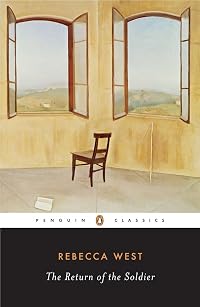
The Return of the Soldier
by Rebecca West
On This Page
Description
When Captain Chris Baldry, a World War I soldier, is sent home with a severe case of shellshock amnesia, he is a stranger to his wife, Kitty, and his adoring cousin, Jenny. Recoiling from the horrors of war and disillusioned with years of superficial married life, his mind has regressed fifteen years, where his heart may take refuge once again in the magic circle of his youth and of his first love, Margaret Allington.In this lyrical and poignant story of a wounded man and the three show more concerned women who seek to heal him, Rebecca West explores the complexity of the mind and its subtle strategies for coping with life's painful realities. Only when Chris has the courage to face one pivotal moment of truth in his married life will he be able to awaken from his boyish fantasy and become, indeed, "every inch a soldier."
. Literature. Fiction. show less
Tags
Recommendations





















Member Recommendations



Member Reviews
Wow. Such a small novel to pack such a wallop, from beginning to end.
This is my first West book and was also the first she published. At 24! I'm dumbfounded by that.
Most reviewers have mentioned the lyricism of her writing, and it's true. However, the sentence structure -- often very long sentences -- I found an effort to follow; more commas would have helped this lazy reader. Is this the way West always writes, I wondered. Is it some sort of Edwardian thing? Now I see the structure (and the reward for my dogged efforts to re-read the same sentence multiple times) was integral to the tale she was telling: a kind of stream of consciousness with the deliberate building of the private observations by the narrator, Jenny, until the brutal show more insights and impressions were rolled in that astute lyricism making you jolt at the often cruel meaning. And, paradoxically, the cruelty was the precise thing to invoke reader's compassion too. Jenny's astute description of the other two woman not only told us accurately about their lives and roles, but also unintentionally a brutal insight about herself and the precariousness of her own life.
The three women are stuck in an awful time in history (during WW I), firmly stuck within their restrictive roles, lives firmly defined by their relationship to men. Not one is to be envied by present day readers, nor even hated, although Kitty does appear the least sympathetic. One could, actually, make the case that Kitty deserves our sympathy most. She is the most stuck in her pre-defined life without any escape except down. And her life was not unfolding at all as it should. Shallow Kitty was also lacking the depth of heart to begin to understand the changes happening to her life or how to adapt to those changes. She is stuck in her suffering.
I'm especially glad I read the novel itself before the included 1997 Introduction by Samuel Hynes, the order which I normally do anyway. A "cold read" absolutely allowed The Return of the Soldier to play out every bit of talent and power it has rights to claim.
Rebecca West, I need to read more of your works. You were amazing. At 24! show less
This is my first West book and was also the first she published. At 24! I'm dumbfounded by that.
Most reviewers have mentioned the lyricism of her writing, and it's true. However, the sentence structure -- often very long sentences -- I found an effort to follow; more commas would have helped this lazy reader. Is this the way West always writes, I wondered. Is it some sort of Edwardian thing? Now I see the structure (and the reward for my dogged efforts to re-read the same sentence multiple times) was integral to the tale she was telling: a kind of stream of consciousness with the deliberate building of the private observations by the narrator, Jenny, until the brutal show more insights and impressions were rolled in that astute lyricism making you jolt at the often cruel meaning. And, paradoxically, the cruelty was the precise thing to invoke reader's compassion too. Jenny's astute description of the other two woman not only told us accurately about their lives and roles, but also unintentionally a brutal insight about herself and the precariousness of her own life.
The three women are stuck in an awful time in history (during WW I), firmly stuck within their restrictive roles, lives firmly defined by their relationship to men. Not one is to be envied by present day readers, nor even hated, although Kitty does appear the least sympathetic. One could, actually, make the case that Kitty deserves our sympathy most. She is the most stuck in her pre-defined life without any escape except down. And her life was not unfolding at all as it should. Shallow Kitty was also lacking the depth of heart to begin to understand the changes happening to her life or how to adapt to those changes. She is stuck in her suffering.
I'm especially glad I read the novel itself before the included 1997 Introduction by Samuel Hynes, the order which I normally do anyway. A "cold read" absolutely allowed The Return of the Soldier to play out every bit of talent and power it has rights to claim.
Rebecca West, I need to read more of your works. You were amazing. At 24! show less
A rare First World War novella told entirely from the home front, through the eyes of three women – a wife, a cousin and a first love – each losing Chris in a different way. I found the dense modernist prose slow going at times but ultimately rewarding. West closes on a single image that quietly reframes the preceding events, leaving me haunted by the cure.
Upper class man, Chris Baldry, becomes a Captain in the British Army and goes off to fight in the trenches of World War I. Something happens, we never know what, but it leaves him with no physical injuries but a total loss of memory of the last fifteen years. His aristocratic wife Kitty and his cousin Jenny only learn of his condition when Mrs. Grey, a lower class woman appears at their doorstep to let them know that she has received letters from Captain Baldry who's been writing from a hospital. This comes as a surprise which they dismiss as a vile attempt to get money rather than the ugly truth. Eventually they realize Mrs. Grey had once been Margaret Allington and the Chris Baldry had fallen in love with her fifteen years ago but the show more class difference was too much. Captain Baldry comes home only to not recognize his wife or the home which they together had altered in many ways. He could only see the house as it as before and desperately wanted to see his true love Margaret Allington.
Great set up but how does this get worked out. Eventually to humor Chris they invite Mrs. Grey to return since she is the only person he wants to be with. The rejected wife sulks in the background while Margaret and Chris rekindle their feelings. By coincidence both had lost a young son. Eventually Mrs. Grey realizes it's up to her to break it to Chris and uses the deceased son's clothing as evidence. This raises the question whose "happiness" is more important. Chris was blissfully happy believing that it's still fifteen years in the past and nothing has happened since. By bringing him into the present it's the return of the soldier, much less happy and possibly even needing to return to the war. His wife is happy.
The upper class rejection of everything below them was too much for me. Yes there's lots of beauty, beautiful house, garden, and clothes. It's the interpersonal rejection which made it impossible for me to like the characters. Fortunately this is a very short book. Not a book I recommend unless one wants to see what was wrong with English society. show less
Great set up but how does this get worked out. Eventually to humor Chris they invite Mrs. Grey to return since she is the only person he wants to be with. The rejected wife sulks in the background while Margaret and Chris rekindle their feelings. By coincidence both had lost a young son. Eventually Mrs. Grey realizes it's up to her to break it to Chris and uses the deceased son's clothing as evidence. This raises the question whose "happiness" is more important. Chris was blissfully happy believing that it's still fifteen years in the past and nothing has happened since. By bringing him into the present it's the return of the soldier, much less happy and possibly even needing to return to the war. His wife is happy.
The upper class rejection of everything below them was too much for me. Yes there's lots of beauty, beautiful house, garden, and clothes. It's the interpersonal rejection which made it impossible for me to like the characters. Fortunately this is a very short book. Not a book I recommend unless one wants to see what was wrong with English society. show less
It's probably a disservice to Rebecca West to read her work as part of an investigation into the life of H. G. Wells. Still, reading about her relationship with Wells made me want to find out what she was like as a writer, as I have never read any of her work, so I picked up The Return of the Soldier, the most popular of her books published during their relationship. (Though I am also curious about The Judge based on Wells's account of its composition in H. G. Wells in Love, and a friend recommended Black Lamb and Grey Falcon.) Like Catherine Wells, West's literary interests are very different from those of her lover, though I was amused when a "Bert Wells" rated a brief mention. (Seemingly no connection beyond the name, though.)
I knew show more The Return of the Soldier was a Great War novel going in, but that was pretty much all I knew, so I was surprised to find a book that wasn't as much about the war as I thought. Christoper Baldry is a soldier who returns from the front, yes, but his ailment is that he's forgotten his life since 1901, and the novel (or, more accurately, novella) is an investigation into why someone might do this. Sure, the war is the triggering event, but the novel is more a portrait of how the person we thought we ought to be turns out not to be the person we become, and the tragedy that can result from that. West observes character most acutely, and it's in the highs and lows of being where this novel really shines. Not that there's a whole lot else to it, at 90 pages. She sets things up so that the title has a pretty compelling and sad double meaning in the end, too. (Wikipedia reads the ending as much more pat than I think it is intended to be. The wound is healed, but the tragedy lingers.) West is working in that sort of Woolf school of early modernism, and I think one of its better practitioners. Quick, but complex. show less
I knew show more The Return of the Soldier was a Great War novel going in, but that was pretty much all I knew, so I was surprised to find a book that wasn't as much about the war as I thought. Christoper Baldry is a soldier who returns from the front, yes, but his ailment is that he's forgotten his life since 1901, and the novel (or, more accurately, novella) is an investigation into why someone might do this. Sure, the war is the triggering event, but the novel is more a portrait of how the person we thought we ought to be turns out not to be the person we become, and the tragedy that can result from that. West observes character most acutely, and it's in the highs and lows of being where this novel really shines. Not that there's a whole lot else to it, at 90 pages. She sets things up so that the title has a pretty compelling and sad double meaning in the end, too. (Wikipedia reads the ending as much more pat than I think it is intended to be. The wound is healed, but the tragedy lingers.) West is working in that sort of Woolf school of early modernism, and I think one of its better practitioners. Quick, but complex. show less
How could you not enjoy a book that includes the idea of:
“An over-confiding explanation made by a shabby visitor while using the door-mat almost too zealously”?
PLOT
In this slim novel set during WW1, Charles and Kitty live in tasteful opulence, along with his cousin Jenny, who tells the story of Charles' memory loss. He returns to England with no memory of the last 15 years, desperate to see his youthful (and lower class) love, Margaret, who is also now married to someone else.
The story is really about the three women, their relationship with Charles, each other and their attitude to his condition. Can and should they persuade him of the truth, when he seems so happy as he is?
It is enhanced by some significant, and no doubt show more deliberate, omissions. In particular, we never know the content of some letters and Jenny is not privy to all that passes between Charles and Margaret when he returns.
LYRICAL LANGUAGE
Sections of it read more like poetry:
“The dusk flowed in wet and cool... as if to put out the fire of confusion... and the furniture, very visible through the soft evening opacity with the observant brightness of old well-polished wood, seemed terribly aware. Strangeness had come into the house and everything was appalled by it, even time.”
There are dark but insightful asides:
“The desolate merriment of an inattentively played pianola") and dark themes.”
MEMORY LOSS
The pain of confusion caused by memory loss is the most obvious:
“"All the inhabitants of this new tract of time were his enemies, all its circumstances his prison bars" and "his loss of memory was a triumph over the limitation of language which prevents the mass of men making explicit statement about their spiritual relationships.”
More strangely, Jenny idolises Charles far too much for a platonic cousin, though oddly, it doesn't seem to cause any friction. She talks of her "frenzied love", his "amazing goodness", "our task of refreshing him" and "passion for Chris was our point of honour".
CLASS
There are nasty attitudes to the lower middle classes. Jenny finds Margaret physically repellent, though she tries to be outwardly polite. In her narration, she mentions the "squalor" of Margaret's home (though Margaret can afford a part-time maid), that she is "not so much a person as an implication of dreary poverty" and that "it would have been such agony to the finger tips to touch any part of her apparel".
In contrast, Charles' ancestral home was:
“A vast piece of space partitioned off from the universe and decorated partly for beauty and partly to make our privacy more insolent.”
Despite, or more probably because of her more humble background, Margaret sees through this brittle and selfish beauty to reveal the burden of wealth:
“It's a big place. How poor Chris must have worked to keep it up.”
Jenny's unspoken response is that:
“It had been our pretence that by... organising a costly life we had been the servants of his desire. But she revealed the truth.”
I doubt modern readers will have much fondness for Kitty or Jenny, but it is a poignant and excellently written book.
SEE ALSO
• Janet Lewis' The Wife of Martin Guerre which I reviewed 3*, HERE.
• The Return of Martin Guerre - non-fiction that inspired Janet Lewis. show less
“An over-confiding explanation made by a shabby visitor while using the door-mat almost too zealously”?
PLOT
In this slim novel set during WW1, Charles and Kitty live in tasteful opulence, along with his cousin Jenny, who tells the story of Charles' memory loss. He returns to England with no memory of the last 15 years, desperate to see his youthful (and lower class) love, Margaret, who is also now married to someone else.
The story is really about the three women, their relationship with Charles, each other and their attitude to his condition. Can and should they persuade him of the truth, when he seems so happy as he is?
It is enhanced by some significant, and no doubt show more deliberate, omissions. In particular, we never know the content of some letters and Jenny is not privy to all that passes between Charles and Margaret when he returns.
LYRICAL LANGUAGE
Sections of it read more like poetry:
“The dusk flowed in wet and cool... as if to put out the fire of confusion... and the furniture, very visible through the soft evening opacity with the observant brightness of old well-polished wood, seemed terribly aware. Strangeness had come into the house and everything was appalled by it, even time.”
There are dark but insightful asides:
“The desolate merriment of an inattentively played pianola") and dark themes.”
MEMORY LOSS
The pain of confusion caused by memory loss is the most obvious:
“"All the inhabitants of this new tract of time were his enemies, all its circumstances his prison bars" and "his loss of memory was a triumph over the limitation of language which prevents the mass of men making explicit statement about their spiritual relationships.”
More strangely, Jenny idolises Charles far too much for a platonic cousin, though oddly, it doesn't seem to cause any friction. She talks of her "frenzied love", his "amazing goodness", "our task of refreshing him" and "passion for Chris was our point of honour".
CLASS
There are nasty attitudes to the lower middle classes. Jenny finds Margaret physically repellent, though she tries to be outwardly polite. In her narration, she mentions the "squalor" of Margaret's home (though Margaret can afford a part-time maid), that she is "not so much a person as an implication of dreary poverty" and that "it would have been such agony to the finger tips to touch any part of her apparel".
In contrast, Charles' ancestral home was:
“A vast piece of space partitioned off from the universe and decorated partly for beauty and partly to make our privacy more insolent.”
Despite, or more probably because of her more humble background, Margaret sees through this brittle and selfish beauty to reveal the burden of wealth:
“It's a big place. How poor Chris must have worked to keep it up.”
Jenny's unspoken response is that:
“It had been our pretence that by... organising a costly life we had been the servants of his desire. But she revealed the truth.”
I doubt modern readers will have much fondness for Kitty or Jenny, but it is a poignant and excellently written book.
SEE ALSO
• Janet Lewis' The Wife of Martin Guerre which I reviewed 3*, HERE.
• The Return of Martin Guerre - non-fiction that inspired Janet Lewis. show less
Wanda McCaddon, narrating this novel, perfectly captured the atmosphere of Edwardian England.
What really stood out is its subtle point of view of the war’s impact on one family’s relationships. There were moments I was thinking about J B Priestley’s stage play An Inspector Calls, but here the detective work is replaced with psychology.
The entire story is told from one person’s view, Jenny, and through her we start to see social class discrimination when the value of marriage, love and happiness are bought to light.
Chris, married to Kitty, returns from war with no memory of the last 15 years. He is bewildered to find he is married, older and the woman he thought he loved was a past love. The story ends leaving the question open show more of Chris’s happiness.
Rebecca West published this in 1918 – the year World War I ends – here, the war is a backdrop whist showing the conflict between duty and honour and being true to oneself. The power of this conundrum is not lost by the novel’s short length. show less
What really stood out is its subtle point of view of the war’s impact on one family’s relationships. There were moments I was thinking about J B Priestley’s stage play An Inspector Calls, but here the detective work is replaced with psychology.
The entire story is told from one person’s view, Jenny, and through her we start to see social class discrimination when the value of marriage, love and happiness are bought to light.
Chris, married to Kitty, returns from war with no memory of the last 15 years. He is bewildered to find he is married, older and the woman he thought he loved was a past love. The story ends leaving the question open show more of Chris’s happiness.
Rebecca West published this in 1918 – the year World War I ends – here, the war is a backdrop whist showing the conflict between duty and honour and being true to oneself. The power of this conundrum is not lost by the novel’s short length. show less
This short novel is a minor and rather early work by an author I really need to read more of. On the face of it, it's a "home-front" war novel, in which three women find themselves caring for a man who has come back from the trenches psychologically scarred. But it struck me as much more general than that. West uses the war as the clearest possible topical expression of the dreadful arbitrariness of life, and the story really seems to be about the irreversibility of time, and the need to face up to where we are because we aren't able to go back to where we were. Which is perhaps just the tiniest bit trite, but it provides a very useful framework on which to hang some really magnificently acute observations of the way relations between show more men and women and between people of different social classes and degrees of wealth function. It's especially interesting to see the way she implicates the reader in her narrator's shockingly physical disgust for the poverty of Margaret (a person she comes to admire and even love) to make us see how deeply class-prejudice is ingrained in the dominant ideology, and at the same time how false it is.
If you know something about West's biography, it's also amusing to notice how she uses the very Mister-Pollyish location of an inn on an island in the Thames to represent the idyllic past, and how the story centres on a man who is loved simultaneously and complacently by an absurd number of women (although probably not quite as many at once as Mr Wells...). show less
If you know something about West's biography, it's also amusing to notice how she uses the very Mister-Pollyish location of an inn on an island in the Thames to represent the idyllic past, and how the story centres on a man who is loved simultaneously and complacently by an absurd number of women (although probably not quite as many at once as Mr Wells...). show less
Members
- Recently Added By
Published Reviews
ThingScore 50
Though its style is occasionally a trifle strained, a trifle "Precious," the novel is on the whole, well written, and its plot well handled.
added by christiguc
Lists

1001 Books You Must Read Before You Die
1,448 works; 1,136 members

The Guardian's 1000 Novels Everyone Must Read
1,005 works; 551 members

Favourite Virago Modern Classics
183 works; 38 members

Women in War
148 works; 30 members

1910s
90 works; 16 members
20th Century Literature
1,161 works; 55 members

Best Love Stories
107 works; 14 members

Backlisted
109 works; 9 members

Best Downton Abbey-esqe books to read
17 works; 7 members

World War I Fiction
94 works; 15 members

Short and Sweet
246 works; 24 members

Books about World War I
80 works; 14 members

Books Read in 2014
2,344 works; 89 members

1,001 BYMRBYD Concensus
723 works; 27 members

World War I books
32 works; 8 members

First Novels
373 works; 17 members

Undiscovered Classics to Read
70 works; 15 members

Books Read in 2022
5,226 works; 115 members
THE WAR ROOM
813 works; 24 members

Books referenced in A Very Great Profession: The Woman's Novel 1914-39
199 works; 6 members

Books Read in 2019
4,052 works; 110 members

War Literature
101 works; 19 members
Canon de la narrativa universal del s. XX (cicutadry)
499 works; 3 members
Author Information

48+ Works 8,578 Members
Taking her name from one of Henrik Ibsen's strong-minded women, Rebecca West was a politically and socially active feminist all her long life. She had an intense 10-year affair with H.G. Wells, with whom she had a son. A brilliant and versatile novelist, critic, essayist, and political commentator, West's greatest literary achievement is perhaps show more her travel diary, Black Lamb and Grey Falcon: A Journey through Yugoslavia (1942). Five years in the writing, it is the story of an Easter trip that she and her husband, British banker Henry Maxwell Andrews (whom she had married in 1930), made through Yugoslavia in 1937. A historical narrative with excellent reporting, it is essentially an analysis of Western culture. During World War II, she superintended British broadcast talks to Yugoslavia. Her remarkable reports of the treason trials of Lord Haw and John Amery appeared first in the New Yorker and are included with other stories about traitors in The Meaning of Treason (1947), which was expanded to deal with traitors and defectors since World War II as The New Meaning of Treason (1964). The Birds Fall Down (1966), which was a bestseller, is the story of a young Englishwoman caught in the grip of Russian terrorists. From a true story told to her more than half a century ago by the sister of Ford Madox Ford (who had heard it from her Russian husband), West "created a rich and instructive spy thriller, which contains an immense amount of brilliantly distributed information about the ideologies of the time, the rituals of the Russian Orthodox Church, the conflicts of customs, belief, and temperament between Russians and Western Europeans, the techniques of espionage and counter-espionage, and the life of exiles in Paris" (New Yorker). Unlike that of her more famous contemporaries, her fiction is stylistically and structurally conventional, but it effectively details the evolution of daily life amid the backdrop of such historical disasters as the world wars. Her critical works include Arnold Bennett Himself, Henry James (1916), Strange Necessity: Essays and Reviews, and The Court and the Castle (1957), a study of political and religious ideas in imaginative literature. In 1949, she was made a Dame Commander of the Order of the British Empire. (Bowker Author Biography) show less
Some Editions
Awards and Honors
Notable Lists
Series
Belongs to Publisher Series
Work Relationships
Is contained in
Common Knowledge
- Canonical title*
- Il ritorno del soldato
- Original title
- The Return of the Soldier
- Original publication date
- 1918
- People/Characters
- Christopher Baldry; Kitty Baldry; Jenny Baldry; Margaret West (nee Allington)
- Important places
- Monkey Island, Bray, Berkshire, England, UK; England, UK; Harrow Weald, London, England, UK
- Important events
- World War I
- Related movies
- The Return of the Soldier (1982 | IMDb)
- Dedication
- To
J - First words
- 'Ah, don't begin to fuss!' wailed Kitty; 'if a woman began to worry in these days because her husband hadn't written to her for a fortnight -- !'
- Quotations
- We had suffered no transfiguration, for we are as we are, and there is nothing more to us. The whole truth about us lies in our material seeming. He sighs a deep sigh of delight and puts out his hand to the ball where Marga... (show all)ret shines. His sleeve catches the other one and sends it down to crash in a thousand pieces on the floor. The old man's smile continues to be lewd and benevolent; he is still not more interested in me than in the bare-armed woman. No one weeps for this shattering of our world.
...how entirely right Chris had been in his assertion that to lovers innumerable things do not matter.
"I don't know anybody in Wealdstone." That is the name of the red suburban stain which fouls the fields three miles nearer London than Harrowweald.
All her life long Margaret, who in her time had partaken of the inalienable dignity of a requited love, had lived with men who wore carpet slippers in the house. - Last words
- (Click to show. Warning: May contain spoilers.)'He's cured!' she whispered slowly. 'He's cured!'
*Some information comes from Common Knowledge in other languages. Click "Edit" for more information.
Classifications
Statistics
- Members
- 1,724
- Popularity
- 12,896
- Reviews
- 82
- Rating
- (3.91)
- Languages
- 8 — Catalan, Dutch, English, French, German, Italian, Portuguese, Spanish
- Media
- Paper, Audiobook, Ebook
- ISBNs
- 94
- UPCs
- 2
- ASINs
- 27