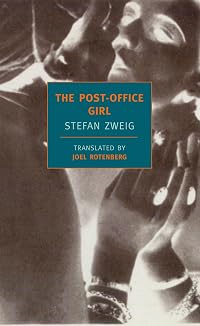
The Post Office Girl
by Stefan Zweig
On This Page
Description
Wes Anderson on Stefan Zweig: "I had never heard of Zweig...when I just more or less by chance bought a copy of Beware of Pity. I loved this first book. I also read the The Post-Office Girl. The Grand Budapest Hotel has elements that were sort of stolen from both these books. Two characters in our story are vaguely meant to represent Zweig himself — our “Author” character, played by Tom Wilkinson, and the theoretically fictionalised version of himself, played by Jude Law. But, in show more fact, M. Gustave, the main character who is played by Ralph Fiennes, is modelled significantly on Zweig as well."2009 PEN Translation Prize Finalist
The logic of capitalism, boom and bust, is unremitting and unforgiving. But what happens to human feeling in a completely commodified world? In The Post-Office Girl, Stefan Zweig, a deep analyst of the human passions, lays bare the private life of capitalism.Christine toils in a provincial post office in post–World War I Austria, a country gripped by unemployment. Out of the blue, a telegram arrives from Christine’s rich American aunt inviting her to a resort in the Swiss Alps. Christine is immediately swept up into a world of inconceivable wealth and unleashed desire. She feels herself utterly transformed: nothing is impossible. But then, abruptly, her aunt cuts her loose. Christine returns to the post office, where yes, nothing will ever be the same.
Christine meets Ferdinand, a bitter war veteran and disappointed architect, who works construction jobs when he can get them. They are drawn to each other, even as they are crushed by a sense of deprivation, of anger and shame. Work, politics, love, sex: everything is impossible for them. Life is meaningless, unless, through one desperate and decisive act, they can secretly remake their world from within.
Cinderella meets Bonnie and Clyde in Zweig’s haunting and hard-as-nails novel, completed during the 1930s, as he was driven by the Nazis into exile, but left unpublished at the time of his death. The Post-Office Girl, available here for the first time in English, transforms our image of a modern master’s achievement. show less
Tags
Recommendations























Member Recommendations



Member Reviews
”The war has in fact ended, but poverty has not. It only ducked beneath the barrage of ordinances, crawled foxily behind the paper ramparts of war loans and banknotes with their ink still wet. Now it’s creeping back out, hollow-eyed, broad muzzled, hungry, and bold, eating what’s left in the gutters of the war. An entire winter of denominations and zeroes snows down from the sky, hundreds of thousands, millions, but every flake, every thousand melts in your hand. Money dissolves while you’re sleeping, it flies away while you’re changing your shoes (coming apart, with wooden heels) to run to the market for a second time; you never stop moving, but you’re always late. Life becomes mathematics, addition, multiplication, a mad show more whirl of figures and numbers, a vortex that snatches the last of your possessions into its black insatiable vacuum: your mother’s gold hair clasp off your neck, her wedding ring off her finger, the damask cloth off the table. But no matter how much you toss in, it’s no use, you can’t plug the black hellish hole, it does no good to stay up late knitting wool sweaters and rent all your rooms out and use the kitchen as a bedroom, doubling up with someone else.”
Stefan Zweig was a master at being able to make you feel what abject poverty really felt like. His descriptions of it literally tear your heart out. Set after WWI in the 1920s, Austria is a particularly harrowing place to be. The eponymous post office girl, Christine Hoflehner, is a civil servant who maintains the office in the inconsequential village of Klein-Reifling, two hours outside Vienna. Her meager salary allows her and her very ill mother to maintain a tiny attic space in the village. But she has an aunt who married a wealthy American and has extended an invitation to Christine to spend two weeks with them at a posh Swiss resort so Christine goes. Her aunt is at once cognizant of the fact that her niece has neither the clothes nor the bearing to be accepted by the clientele as ‘one of them’ so she takes her shopping and Christine is transformed. And Zweig switches gears and as deftly as he described poverty he now describes the world of the very wealthy ‘where unspoken wishes are granted. How could anyone be anything but happy here?’ But something happens. Someone she thought had become a friend has been inquiring into her background and apparently the jig is up. Christine is shocked when her aunt decides to check out of the hotel abruptly and go on to another posh spot and Christine is not invited along so she must return to her former life.
That is when she meets Ferdinand, a man whose experiences in captivity in Russia and his return to the very challenging employment opportunities in Austria have left him bitter and desperate. And Christine realizes that she is complete agreement with this sorry soul. Things are as bad as she thought they were. They hatch a scheme after a few meetings and the story ends on a sour note.
This may be the most depressing book I’ve ever read. But Zweig’s ability to make me feel extreme sadness in one moment and exhilaration the next is an ability not many authors have. And his command of language makes him an instant favorite with me. Just an astounding read and very highly recommended. show less
Stefan Zweig was a master at being able to make you feel what abject poverty really felt like. His descriptions of it literally tear your heart out. Set after WWI in the 1920s, Austria is a particularly harrowing place to be. The eponymous post office girl, Christine Hoflehner, is a civil servant who maintains the office in the inconsequential village of Klein-Reifling, two hours outside Vienna. Her meager salary allows her and her very ill mother to maintain a tiny attic space in the village. But she has an aunt who married a wealthy American and has extended an invitation to Christine to spend two weeks with them at a posh Swiss resort so Christine goes. Her aunt is at once cognizant of the fact that her niece has neither the clothes nor the bearing to be accepted by the clientele as ‘one of them’ so she takes her shopping and Christine is transformed. And Zweig switches gears and as deftly as he described poverty he now describes the world of the very wealthy ‘where unspoken wishes are granted. How could anyone be anything but happy here?’ But something happens. Someone she thought had become a friend has been inquiring into her background and apparently the jig is up. Christine is shocked when her aunt decides to check out of the hotel abruptly and go on to another posh spot and Christine is not invited along so she must return to her former life.
That is when she meets Ferdinand, a man whose experiences in captivity in Russia and his return to the very challenging employment opportunities in Austria have left him bitter and desperate. And Christine realizes that she is complete agreement with this sorry soul. Things are as bad as she thought they were. They hatch a scheme after a few meetings and the story ends on a sour note.
This may be the most depressing book I’ve ever read. But Zweig’s ability to make me feel extreme sadness in one moment and exhilaration the next is an ability not many authors have. And his command of language makes him an instant favorite with me. Just an astounding read and very highly recommended. show less
The Post-Office Girl is set in Austria in the 1920s, where life was very harsh for people afflicted by post-war poverty and unemployment. The novel was written during the 1930s when the author was living abroad in exile from the Nazis and was only published after his death. It is about a young woman, Christine, who works in the village post office. She has experienced great hardship during the war, constantly worrying about money and working hard all day long to support her sick mother.
One of the themes of the book seemed to be the waste of youth, both as experienced by individuals and for a whole generation whose lives were ruined by the First World War, and the way in which, even once the war-time suffering was apparently over, the show more people and the country found it difficult to recover. This generation seem to feel that they were born at the wrong time, and even those just a little younger have more chance in life than they do themselves: “...these post-war seventeen- and eighteen-year-olds aren’t waiting quietly and patiently, waiting for someone to want them and take them. They’re demanding pleasure as their right, demanding it as impetuously as though it’s not just their own young lives they’re living but the lives of the hundred thousand dead and buried too... Surrounded by this coarse and lustful postwar generation she feels ancient, tired, useless, and overwhelmed, unwilling and unable to compete. No more struggling, no more striving, that’s the main thing! Breathe calmly, daydream quietly, do your work, water the flowers in the window, ask not, want not. No more asking for anything, nothing new, nothing exciting. The war stole her decade of youth. She has no courage, no strength left even for happiness.”
Christine’s life suddenly changes when her rich American aunt and uncle invite her to accompany them on holiday to Switzerland. Immediately she is overwhelmed by a life of excess and pleasure, dresses in beautiful new clothes bought by her aunt, mingles with the wealthy guests at the hotel, and spends her time in a whirl of dancing and parties. The book really creates a sense of the elation Christine feels in her new life of luxury, evoking the kind of intense longing for wealth and happiness that only someone who lives in exile and deprivation can feel. The main focus is on how Christine is transformed by her new surroundings. Her appearance is altered within hours by the ‘makeover’ her aunt gives her (‘not even in a dream has she ever dared to imagine herself so lovely, so young, so smart’), the way people respond to her is different, she is popular and admired, men pursue her, and her personality becomes carefree, vivacious and even a little naive. It was rather difficult for me to believe that Christine could change so much within little more than a week and could forget her everyday life and sick mother so completely. But if this part of the book isn’t quite realistic (to me), it is gripping as a kind of fairy tale and an exploration of how people are affected by their surroundings, their social status and their wealth or poverty. I think everyone must know the feeling of being a slightly different person when you are removed from your usual routine or spend time with a new group of people, and are even given a glimpse of the kind of person you could be if your life took another course. This novel takes this idea to an extreme, focusing mainly on the effects of social class and wealth. Christine herself feels a sense of unease at how her identity has been disrupted, thinking ‘is there suddenly something in me that was always there and yet not there, something that just couldn’t get out?’ and when questioning her sense of self, ‘confidence turns into insecurity again’.
This part of the book and Christine’s relationships with the other hotel guests is completely absorbing (as is the whole novel), but then this wonderful but fragile new life comes crashing down and Christine is sent home to her lonely old life, sleeping in a damp attic and working at mindless tasks in the post office. She then meets Ferdinand, who was a prisoner of war in Siberia, and has also had his youth and plans for a career as an architect taken away from him by the war. Christine’s relationship with Ferdinand is quite moving, being based on an instant understanding and connection between them, and the way their experiences and reactions paralleled each other. It is clear that Christine can only feel love for someone who feels the same sense of anger and disappointment in life that she does. Like Christine, Ferdinand almost has two selves, the ‘before and after’ superimposed over one another.
I found it interesting that Christine seemed to feel a stronger desire for the men she met while living in luxury in Switzerland, even though she had fairly shallow relationships with them; she was somehow enabled to feel desire by the hedonistic, flirtatious atmosphere at the hotel and her own new feeling of liberation and excitement. She has much deeper feelings for Ferdinand but they are both too worn down to feel much passion, and their poverty often leaves them without a place they can be alone together. They recognise an ally in each other, having each found a sympathetic listener, someone who really understands what the other is feeling, and their relationship is formed by long conversations. Ferdinand has the same feeling of anger that the impersonal force of the government has taken part of his life from him: ‘We came into the world at a bad time. No doctor’s going to fix that, those six years of youth ripped out of me, and who’s going to reimburse me?’ Their relationship is hopeless but also has some beauty, as it’s essentially two people against the rest of the world and what could be more romantic than that? I would definitely recommend this book - it is a completely addictive read and written with great intensity. [2011] show less
One of the themes of the book seemed to be the waste of youth, both as experienced by individuals and for a whole generation whose lives were ruined by the First World War, and the way in which, even once the war-time suffering was apparently over, the show more people and the country found it difficult to recover. This generation seem to feel that they were born at the wrong time, and even those just a little younger have more chance in life than they do themselves: “...these post-war seventeen- and eighteen-year-olds aren’t waiting quietly and patiently, waiting for someone to want them and take them. They’re demanding pleasure as their right, demanding it as impetuously as though it’s not just their own young lives they’re living but the lives of the hundred thousand dead and buried too... Surrounded by this coarse and lustful postwar generation she feels ancient, tired, useless, and overwhelmed, unwilling and unable to compete. No more struggling, no more striving, that’s the main thing! Breathe calmly, daydream quietly, do your work, water the flowers in the window, ask not, want not. No more asking for anything, nothing new, nothing exciting. The war stole her decade of youth. She has no courage, no strength left even for happiness.”
Christine’s life suddenly changes when her rich American aunt and uncle invite her to accompany them on holiday to Switzerland. Immediately she is overwhelmed by a life of excess and pleasure, dresses in beautiful new clothes bought by her aunt, mingles with the wealthy guests at the hotel, and spends her time in a whirl of dancing and parties. The book really creates a sense of the elation Christine feels in her new life of luxury, evoking the kind of intense longing for wealth and happiness that only someone who lives in exile and deprivation can feel. The main focus is on how Christine is transformed by her new surroundings. Her appearance is altered within hours by the ‘makeover’ her aunt gives her (‘not even in a dream has she ever dared to imagine herself so lovely, so young, so smart’), the way people respond to her is different, she is popular and admired, men pursue her, and her personality becomes carefree, vivacious and even a little naive. It was rather difficult for me to believe that Christine could change so much within little more than a week and could forget her everyday life and sick mother so completely. But if this part of the book isn’t quite realistic (to me), it is gripping as a kind of fairy tale and an exploration of how people are affected by their surroundings, their social status and their wealth or poverty. I think everyone must know the feeling of being a slightly different person when you are removed from your usual routine or spend time with a new group of people, and are even given a glimpse of the kind of person you could be if your life took another course. This novel takes this idea to an extreme, focusing mainly on the effects of social class and wealth. Christine herself feels a sense of unease at how her identity has been disrupted, thinking ‘is there suddenly something in me that was always there and yet not there, something that just couldn’t get out?’ and when questioning her sense of self, ‘confidence turns into insecurity again’.
This part of the book and Christine’s relationships with the other hotel guests is completely absorbing (as is the whole novel), but then this wonderful but fragile new life comes crashing down and Christine is sent home to her lonely old life, sleeping in a damp attic and working at mindless tasks in the post office. She then meets Ferdinand, who was a prisoner of war in Siberia, and has also had his youth and plans for a career as an architect taken away from him by the war. Christine’s relationship with Ferdinand is quite moving, being based on an instant understanding and connection between them, and the way their experiences and reactions paralleled each other. It is clear that Christine can only feel love for someone who feels the same sense of anger and disappointment in life that she does. Like Christine, Ferdinand almost has two selves, the ‘before and after’ superimposed over one another.
I found it interesting that Christine seemed to feel a stronger desire for the men she met while living in luxury in Switzerland, even though she had fairly shallow relationships with them; she was somehow enabled to feel desire by the hedonistic, flirtatious atmosphere at the hotel and her own new feeling of liberation and excitement. She has much deeper feelings for Ferdinand but they are both too worn down to feel much passion, and their poverty often leaves them without a place they can be alone together. They recognise an ally in each other, having each found a sympathetic listener, someone who really understands what the other is feeling, and their relationship is formed by long conversations. Ferdinand has the same feeling of anger that the impersonal force of the government has taken part of his life from him: ‘We came into the world at a bad time. No doctor’s going to fix that, those six years of youth ripped out of me, and who’s going to reimburse me?’ Their relationship is hopeless but also has some beauty, as it’s essentially two people against the rest of the world and what could be more romantic than that? I would definitely recommend this book - it is a completely addictive read and written with great intensity. [2011] show less
This has been on my shelf for years, and I'm kicking myself for letting it languish there for so long. It's a Cinderella story with a twist.
Christine lives an impoverished life with her mother in a small Austrian village, barely eking out a living as the postmistress. Then one day a postcard arrives from a long-forgotten aunt, who left for America years before under questionable circumstances, inviting Christine to visit at a luxurious resort in the Alps.
Christine arrives at the resort, and Zweig is masterful at describing her embarrassment at her own shabbiness and awe at the luxury and wealth surrounding her. But soon, after her aunt has purchased her beautiful clothes, and has treated her to the beauty parlor, Christine is having show more the time of her life.
Unfortunately, it doesn't last, and Christine must return to her desolate life, only now more disheartened. Then she meets Ferdinand, and things take a surprising turn.
This book was unpublished at the time of Zweig's death (a suicide after the rise of Hitler), and was not published until about 40 years after his death. Because of this, and because of the somewhat abrupt ending, there are some who question whether the book was actually finished. I actually liked the way it ended.
4 stars show less
Christine lives an impoverished life with her mother in a small Austrian village, barely eking out a living as the postmistress. Then one day a postcard arrives from a long-forgotten aunt, who left for America years before under questionable circumstances, inviting Christine to visit at a luxurious resort in the Alps.
Christine arrives at the resort, and Zweig is masterful at describing her embarrassment at her own shabbiness and awe at the luxury and wealth surrounding her. But soon, after her aunt has purchased her beautiful clothes, and has treated her to the beauty parlor, Christine is having show more the time of her life.
Unfortunately, it doesn't last, and Christine must return to her desolate life, only now more disheartened. Then she meets Ferdinand, and things take a surprising turn.
This book was unpublished at the time of Zweig's death (a suicide after the rise of Hitler), and was not published until about 40 years after his death. Because of this, and because of the somewhat abrupt ending, there are some who question whether the book was actually finished. I actually liked the way it ended.
4 stars show less
You were living a fairy tale life and you thought there is hope of a better life, but suddenly, one day, it is gone, and you are back to the drab routine that does not hold any hope. What will you do? Stefan Zwieg has painted such a vivid story of Christine and most readers will empathise with her, notwithstanding the questionable course she took at the end.
I wanted to read something by Stefan Zweig because his writing was apparently the inspiration for ‘The Grand Budapest Hotel’, one my favourite films of 2014. I picked ‘The Post Office Girl’ because a brief plot description proved intriguing: an impoverished young woman works at a post office. She is whisked away from her life of drudgery for a holiday by a rich relative, then has to go back to her old life. A simple plot, but one rife with dramatic possibility. From the Wes Anderson film, I anticipated something droll, mannered, yet with some sharp edges. How I underestimated Zweig! ‘The Post Office Girl’ has an incredible intensity of feeling. When Christine is torn away from her idyllic holiday, it’s nearly physically show more painful to read. When she meets someone else of equal bitterness, the feeling of recognition is like a static shock. And when one plan succeeds another towards the end, the wild hope is enough to make you gasp and clench your fists.
Rather than the film, I was reminded of [b:The Rector's Daughter|1220032|The Rector's Daughter|F.M. Mayor|https://images.gr-assets.com/books/1477226543s/1220032.jpg|1208509] and [b:A Clergyman's Daughter|319238|A Clergyman's Daughter|George Orwell|https://images.gr-assets.com/books/1420079227s/319238.jpg|1469726], both of which follow women with limited, lonely lives. Although they are good novels, in fact the former is brilliant, I like ‘The Post Office Girl’ more than either. As well as conveying beautifully the emotions of the titular Christine, Zweig’s novel makes much wider social points with astonishing power. Christine’s life in 1920s Austria has been blighted by the First World War and its aftermath. More generally, she only realises how wretched her existence is once she’s had a short insight into the world of wealth and privilege. This novel is in fact a vivid, beautiful, scathing indictment of inequality such as I’ve very rarely encountered in fiction. Part of Zweig’s genius is to fully explore the interdependence of the practical and emotional toll that poverty takes on Christine – both her shabby clothes and the depth of her feelings about them. Although the secondary characters are neatly drawn, indeed fascinating in the case of the more prominent ones, this is Christine’s novel. It is truly brilliant that Zweig has created such a sympathetic, nuanced, unusual character whilst also using her as a very pointed socio-political commentary. She is a person first and foremost, yet the symbolism also works well. The only other writer I can think of who walks that line so deftly is Zola in [b:Germinal|28407|Germinal (Les Rougon-Macquart, #13)|Émile Zola|https://images.gr-assets.com/books/1388208755s/28407.jpg|941651]. Orwell doesn’t manage it in [b:A Clergyman's Daughter|319238|A Clergyman's Daughter|George Orwell|https://images.gr-assets.com/books/1420079227s/319238.jpg|1469726]; his main character is too much symbol and not enough person. Whereas in [b:The Rector's Daughter|1220032|The Rector's Daughter|F.M. Mayor|https://images.gr-assets.com/books/1477226543s/1220032.jpg|1208509] there is no real attempt at wider social commentary and the individual predominates.
In short, Zweig really blew me away. It’s as if I was expecting a frothy decaf cappuccino and found myself drinking a triple expresso. I will definitely be searching the library for more of his work. More amazing still, this is not a novel that he considered ready for publication! I’m very glad that his posthumous wishes were not respected in this case, as what a loss that would have been. ‘The Post Office Girl’ does end in a distinctly abrupt manner, but in a very narratively satisfying place. The reader is then free to contemplate what most plausibly happened next, what you would really like to happen next, and the gap between the two. I must also add that the translation is wonderful and Zweig has a magnificent turn of phrase. Really, I should stop throwing around the hyperbolic adjectives and just heartily recommend that you read it. show less
Rather than the film, I was reminded of [b:The Rector's Daughter|1220032|The Rector's Daughter|F.M. Mayor|https://images.gr-assets.com/books/1477226543s/1220032.jpg|1208509] and [b:A Clergyman's Daughter|319238|A Clergyman's Daughter|George Orwell|https://images.gr-assets.com/books/1420079227s/319238.jpg|1469726], both of which follow women with limited, lonely lives. Although they are good novels, in fact the former is brilliant, I like ‘The Post Office Girl’ more than either. As well as conveying beautifully the emotions of the titular Christine, Zweig’s novel makes much wider social points with astonishing power. Christine’s life in 1920s Austria has been blighted by the First World War and its aftermath. More generally, she only realises how wretched her existence is once she’s had a short insight into the world of wealth and privilege. This novel is in fact a vivid, beautiful, scathing indictment of inequality such as I’ve very rarely encountered in fiction. Part of Zweig’s genius is to fully explore the interdependence of the practical and emotional toll that poverty takes on Christine – both her shabby clothes and the depth of her feelings about them. Although the secondary characters are neatly drawn, indeed fascinating in the case of the more prominent ones, this is Christine’s novel. It is truly brilliant that Zweig has created such a sympathetic, nuanced, unusual character whilst also using her as a very pointed socio-political commentary. She is a person first and foremost, yet the symbolism also works well. The only other writer I can think of who walks that line so deftly is Zola in [b:Germinal|28407|Germinal (Les Rougon-Macquart, #13)|Émile Zola|https://images.gr-assets.com/books/1388208755s/28407.jpg|941651]. Orwell doesn’t manage it in [b:A Clergyman's Daughter|319238|A Clergyman's Daughter|George Orwell|https://images.gr-assets.com/books/1420079227s/319238.jpg|1469726]; his main character is too much symbol and not enough person. Whereas in [b:The Rector's Daughter|1220032|The Rector's Daughter|F.M. Mayor|https://images.gr-assets.com/books/1477226543s/1220032.jpg|1208509] there is no real attempt at wider social commentary and the individual predominates.
In short, Zweig really blew me away. It’s as if I was expecting a frothy decaf cappuccino and found myself drinking a triple expresso. I will definitely be searching the library for more of his work. More amazing still, this is not a novel that he considered ready for publication! I’m very glad that his posthumous wishes were not respected in this case, as what a loss that would have been. ‘The Post Office Girl’ does end in a distinctly abrupt manner, but in a very narratively satisfying place. The reader is then free to contemplate what most plausibly happened next, what you would really like to happen next, and the gap between the two. I must also add that the translation is wonderful and Zweig has a magnificent turn of phrase. Really, I should stop throwing around the hyperbolic adjectives and just heartily recommend that you read it. show less
Another impossibly painful read from Zweig.
In post-WWI Austria, there is no time for living; poverty is the way of life, surviving the only mode. This is an Eliza Doolittle tale steeped in realism with no happy ending. Misery abounds (for the poor). Zweig places his characters in these complex situations where there are no easy answers, only insurmountable obstacles. You can only sympathise so much before getting angry at the inequality. Perhaps it's because I've been thinking more lately about money and capitalism and how to better support charities and those in need, but this book makes my frustrations overflow.
Don't get me wrong, this book is great at what it does, revealing and psychoanalysing the disillusionment faced by the people show more left behind after the war. But do not read it while feeling down, Zweig spares no mercy.
Aside: I've now read enough Zweig to watch Grand Budapest Hotel by Wes Anderson. show less
In post-WWI Austria, there is no time for living; poverty is the way of life, surviving the only mode. This is an Eliza Doolittle tale steeped in realism with no happy ending. Misery abounds (for the poor). Zweig places his characters in these complex situations where there are no easy answers, only insurmountable obstacles. You can only sympathise so much before getting angry at the inequality. Perhaps it's because I've been thinking more lately about money and capitalism and how to better support charities and those in need, but this book makes my frustrations overflow.
Don't get me wrong, this book is great at what it does, revealing and psychoanalysing the disillusionment faced by the people show more left behind after the war. But do not read it while feeling down, Zweig spares no mercy.
Aside: I've now read enough Zweig to watch Grand Budapest Hotel by Wes Anderson. show less
7.5/10
What a strange and powerful -- and ultimately disappointing -- novel this is! I kept thinking how I would have enjoyed it, had it been made into a film. The awkward and unworkable layers would have been stripped clean and one would have been left with a diamond, no longer in the rough.
The "unworkable layers" cannot be ascribed to Zweig alone (or at all?) since this was a work published posthumously, having been on the writer's table for more than a decade, in the 1930s, while he alternately wrestled with it, and put it from him -- and which was finally published about 40 years after he had shelved it for the last time. Neither did he leave any instructions for this one to be published after his death, as he did with [b:Chess show more Story|59151|Chess Story|Stefan Zweig|https://images.gr-assets.com/books/1386924796s/59151.jpg|57593]. It begs the question: did he want this one going out into the world at all? There must have been some sense of incompleteness or inadequacy that presented itself to him from within this impassioned work.
There are many levels herein which pulled at me: the transformative power of war, of society, of poverty. This part trampled my heart for it seems to me he described it accurately and much too poignantly. Coming from a generation whose parents and grandparents were affected directly by the destructive forces of war and its ensuing upheaval attendant with poverty, these passages felt real, and cutting.
How does one survive such crushing destruction of home, of self? How does one deal with one's world getting ever and ever smaller, until it all but disappears into a smoky little garret at the end of a street of no account? The cut to the self of losing everything one holds dear is barely noticeable, as each layer gets stripped away; and there is a shock of waking up one morning with only 4 cups to one's name, so not enough china even left over to serve coffee to 5 people at a mother's funeral: this minutiae that Zweig gathers tears out your heart. It is this part of the novel which felt most convincing to me: watching Christine's war and post war existence erode, drop by drop, and distilled into a little room with two beds, with smoke in the rafters from the ill-functioning cooker.
Christine has the unexpected opportunity of being sprung from this world for a few weeks when she is invited to visit with her relatives at a hotel in Switzerland. Her life turns on a metaphorical dime and instantly Cinderella is transformed into nothing other than a dancing fool. Made up, tarted up, drunked up, every desire fulfilled and every inhibtion left behind, she takes to the new society like a bird to the air. From the moment she first dons her new dress, one can see the fall. Having been deprived for so long from the liquor of life, it proves too intoxicating to withstand its worst appeal and emotional debauchery.
From this point on, the novel begins to fall apart for me because I'm not convinced that such a level headed girl would go so far into destruction. So this is the problem: either give me a girl of questionable character who would succumb to such enticements utterly; or give me a girl with higher morals who would enjoy the moment for what it is -- but don't try to convince me that a Saint Theresa will turn into The Whore of Babylon by donning a slinky gown.
Perhaps this is where it fell apart for Zweig as well and why he kept rewriting it for the better part of a decade: things fall apart. the center cannot hold.
I would have been more convinced had Zweig given me more cause and circumstance to believe in the rage that ensued on the turning of yet another dime. It certainly didn't follow the logic, nor the character of Christine as she had been previously laid out. (It does not follow, unless there was something psychologically wrong with her to begin with -- and this part we are never given.)
I found too many problems from this point on, that I lost interest in the story. I rushed to its end and found exactly what I expected: an ambiguous, unsatisfying finish that felt as rushed in its writing, as I felt in its reading.
My thoughts here are that Zweig couldn't quite get his character out of the hole into which he had dropped her -- it just feels that he's pulling her off in all directions, and wants it to end, no matter what end.
Having said all that, I loved the first half of this book, enough to convince me to seek out Zweig again. His observations on life are disturbing and heart-rending -- and exact. I don't quite understand why this one fell apart for him but I've seen enough to convince me that his other novels might be more rewarding. show less
What a strange and powerful -- and ultimately disappointing -- novel this is! I kept thinking how I would have enjoyed it, had it been made into a film. The awkward and unworkable layers would have been stripped clean and one would have been left with a diamond, no longer in the rough.
The "unworkable layers" cannot be ascribed to Zweig alone (or at all?) since this was a work published posthumously, having been on the writer's table for more than a decade, in the 1930s, while he alternately wrestled with it, and put it from him -- and which was finally published about 40 years after he had shelved it for the last time. Neither did he leave any instructions for this one to be published after his death, as he did with [b:Chess show more Story|59151|Chess Story|Stefan Zweig|https://images.gr-assets.com/books/1386924796s/59151.jpg|57593]. It begs the question: did he want this one going out into the world at all? There must have been some sense of incompleteness or inadequacy that presented itself to him from within this impassioned work.
There are many levels herein which pulled at me: the transformative power of war, of society, of poverty. This part trampled my heart for it seems to me he described it accurately and much too poignantly. Coming from a generation whose parents and grandparents were affected directly by the destructive forces of war and its ensuing upheaval attendant with poverty, these passages felt real, and cutting.
How does one survive such crushing destruction of home, of self? How does one deal with one's world getting ever and ever smaller, until it all but disappears into a smoky little garret at the end of a street of no account? The cut to the self of losing everything one holds dear is barely noticeable, as each layer gets stripped away; and there is a shock of waking up one morning with only 4 cups to one's name, so not enough china even left over to serve coffee to 5 people at a mother's funeral: this minutiae that Zweig gathers tears out your heart. It is this part of the novel which felt most convincing to me: watching Christine's war and post war existence erode, drop by drop, and distilled into a little room with two beds, with smoke in the rafters from the ill-functioning cooker.
Christine has the unexpected opportunity of being sprung from this world for a few weeks when she is invited to visit with her relatives at a hotel in Switzerland. Her life turns on a metaphorical dime and instantly Cinderella is transformed into nothing other than a dancing fool. Made up, tarted up, drunked up, every desire fulfilled and every inhibtion left behind, she takes to the new society like a bird to the air. From the moment she first dons her new dress, one can see the fall. Having been deprived for so long from the liquor of life, it proves too intoxicating to withstand its worst appeal and emotional debauchery.
From this point on, the novel begins to fall apart for me because I'm not convinced that such a level headed girl would go so far into destruction. So this is the problem: either give me a girl of questionable character who would succumb to such enticements utterly; or give me a girl with higher morals who would enjoy the moment for what it is -- but don't try to convince me that a Saint Theresa will turn into The Whore of Babylon by donning a slinky gown.
Perhaps this is where it fell apart for Zweig as well and why he kept rewriting it for the better part of a decade: things fall apart. the center cannot hold.
I would have been more convinced had Zweig given me more cause and circumstance to believe in the rage that ensued on the turning of yet another dime. It certainly didn't follow the logic, nor the character of Christine as she had been previously laid out. (It does not follow, unless there was something psychologically wrong with her to begin with -- and this part we are never given.)
I found too many problems from this point on, that I lost interest in the story. I rushed to its end and found exactly what I expected: an ambiguous, unsatisfying finish that felt as rushed in its writing, as I felt in its reading.
My thoughts here are that Zweig couldn't quite get his character out of the hole into which he had dropped her -- it just feels that he's pulling her off in all directions, and wants it to end, no matter what end.
Having said all that, I loved the first half of this book, enough to convince me to seek out Zweig again. His observations on life are disturbing and heart-rending -- and exact. I don't quite understand why this one fell apart for him but I've seen enough to convince me that his other novels might be more rewarding. show less
Members
- Recently Added By
Lists

Recommend the 20 best books you've read in the last five years
2,168 works; 606 members

Jewish Books
367 works; 24 members

Top Five Books of 2014
1,064 works; 398 members

Best books read in 2011
200 works; 51 members

Best literature ever!
39 works; 1 member

Best of World Literature
435 works; 52 members
Talk Discussions
Past Discussions
Zweig: The Post Office Girl in Author Theme Reads (May 2010)
Author Information

889+ Works 32,755 Members
Born in Vienna, the prolific Zweig was a poet in his early years. In the 1920s, he achieved fame with the many biographies he wrote of famous people including Balzac, Dostoevsky, Dickens and Freud. Erasmus with whom he closely identified, was the subject of a longer biography. He also wrote the novellas Amok (1922) and The Royal Game (1944). As show more Nazism spread, Zweig, a Jew, fled to the United States and then to Brazil. He hoped to start a new life there, but the haunting memory of Nazism, still undefeated, proved too much for him. He died with his wife in a suicide pact. (Bowker Author Biography) show less
Some Editions
Awards and Honors
Series
Belongs to Publisher Series
Common Knowledge
- Canonical title
- The Post Office Girl
- Original title
- Rausch der Verwandlung
- Alternate titles
- Ivresse de la métamorphose
- Original publication date
- 1982; 2008 (English translation) (English translation)
- People/Characters
- Christine; Ferdinand
- Important places
- Kleinreifling, Upper Austria, Austria; Palace Hotel, Pontresina, Graubünden, Switzerland; Vienna, Austria
- Important events*
- Primeira Guerra Mundial; Revolução Russa
- Related movies
- Das gestohlene Jahr (1951 | IMDb); Rausch der Verwandlung (1989 | IMDb)
- First words
- One village post office in Austria is much like another: seen one and you've seen them all.
- Quotations
- Memory is so corrupt that you remember only what you want to; if you want to forget about something, slowly but surely you do. [115]
Fear is a distorting mirror in which anything can appear as a distortion of itself, stretched to terrible proportions; once inflamed, the imagination pursues the craziest and most unlikely possibilities. [116]
"You wouldn't believe what a dead finger does to a living hand.
"The smell is suffocating. The smell of stale cigarette smoke, bad food, wet clothes, the smell of the old woman's dread and worry and wheezing."
"Poverty stinks, stinks like a ground-floor room off an air-shaft, or cloth... (show all)es that need changing. You smell it yourself, as though you were made of sewage." - Last words
- (Click to show. Warning: May contain spoilers.)He looked at her, brightly, lucidly, but without cheer. "No going Back?"
"No."
"Wednesday the tenth, at six?"
She returned his gaze and held out her hand.
"Yes." - Blurbers
- Lezard, Nicholas; Tennant, Neil; Deresiewicz, William; Lewis, Tess; Ackroyd, Peter; Freud, Esther
- Original language
- German
*Some information comes from Common Knowledge in other languages. Click "Edit" for more information.
Classifications
- Genres
- General Fiction, Fiction and Literature
- DDC/MDS
- 833.912 — Literature & rhetoric German & related literatures German fiction 1900- 1900-1990 1900-1945
- LCC
- PT2653 .W42 .R313 — Language and Literature German, Dutch and Scandinavian literatures German literature Individual authors or works 1860/70-1960
- BISAC
Statistics
- Members
- 1,336
- Popularity
- 17,979
- Reviews
- 65
- Rating
- (4.11)
- Languages
- 18 — Bulgarian, Catalan, Czech, English, Finnish, French, German, Greek, Hebrew, Hungarian, Italian, Polish, Russian, Spanish, Swedish, Turkish, Portuguese (Portugal), Portuguese (Brazil)
- Media
- Paper, Audiobook, Ebook
- ISBNs
- 33
- ASINs
- 15