On This Page
Description
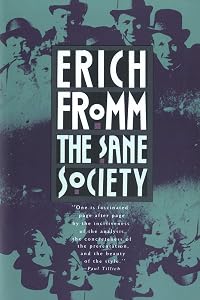
"The Sane Society "is a continuation and extension of the brilliant psychiatric concepts Erich Fromm first formulated in "Escape from Freedom"; it is also, in many ways, an answer to Freud's "Civilization and its Discontents," Fromm examines man's escape into overconformity and the danger of robotism in contemporary industrial society: modern humanity has, he maintains, been alienated from the world of their own creation. Here Fromm offers a complete and systematic exploration of his " show more humanistic psychoanalysis." In so doing, he counters the profound pessimism for our future that Freud expressed and sets forth the goals of a society in which the emphasis is on each person and on the social measures designed to further function as a responsible individual. show lessTags
Recommendations



























Member Recommendations

Member Reviews
Swedish psychoanalyst Erich Fromm probes the cerebral vigor of modern 21st century western civilization where humans are reduced to automatons who consume just to escape modern day drudgery and alienation from others.
Fromm touches all aspects of western modernism from which pathological neurosis arises like isolated living in hi-rises to alienated relationships through technological advances, where temporary instant gratification has become a necessity like a drug.
I found the psychological effect of Karl Marx’s concept of “Abstraction” arising from putting a $value on every interaction which gives a sense of separation and hence un-accountability very intriguing.
Having read Fromm’s previous works , this only adds to this show more Neo-Freudian man’s immense faculty to see way ahead of his time , a must read ! show less
Fromm touches all aspects of western modernism from which pathological neurosis arises like isolated living in hi-rises to alienated relationships through technological advances, where temporary instant gratification has become a necessity like a drug.
I found the psychological effect of Karl Marx’s concept of “Abstraction” arising from putting a $value on every interaction which gives a sense of separation and hence un-accountability very intriguing.
Having read Fromm’s previous works , this only adds to this show more Neo-Freudian man’s immense faculty to see way ahead of his time , a must read ! show less
Not my favorite of Fromm's -- That honor is still reserved for the three-way tie of Escape from Freedom, The Art of Loving, and Marx's Concept of Man -- but he still impresses with his daunting intellect and analytic capacity.
The book begins well and quickly draws you in, as Fromm reviews his argument against Western society and the way that it alienates man from himself, inadvertently creating a modern "robotism." This line of thought is taken from his previous books (including the ones listed above) and further developed in an engaging way.
The last two chapters, however, where he turns to solutions for transforming our society into a humanistic communitarian socialist democracy, fall flat. This is perhaps chiefly due to the material show more being dated, most obvious when he actually proposes to dismantle the film industry due to its pernicious effect on our psyches. This is something which might have been half-conceivable in the 50s, though it still strikes one as more than a little bizarre. Then he proposes a hypothetical town-hall bottom-up government in which the politicians refer all of their legislation to 500-person "face-to-face" groups where they can discuss and decide on policy at the grass-roots level. This just struck me as quaint, and would be utterly impossible in today's hyper-mobile age.
Ultimately, Fromm leans heavily on the Communitarian Socialist model proposed by Owen in England, and later popularized to some degree in France. He spends a large portion of Chapter 8 describing one such watch-making community, where the workers are the owners and participate equally in all the decision-making, earning in accordance with how much they contribute to the community, whether it be through watches or extracurriculars such as music, teaching, gardening, or what-have-you.
It is a nice picture that he paints, but when describing the political decision-making process, I couldn't help but feel like there was simply way too much bureacracy involved. Really? I have to go to a weekly, monthly, and bi-annual meeting just to make sure this stuff all runs effectively? What if my idea of fulfilling my human potential is not worrying about all of this organizational BS? What if I require solitude in order to realize my potential? I have no doubt that certain driven people could make this work, and probably quite enjoy it. But to propose it as a solution for all of humanity seems naive, or maybe just asking a lot of them for the time being. I can't help but wonder what Fromm would have thought if he had lived to see where we're at now. He probably would have been depressed. show less
The book begins well and quickly draws you in, as Fromm reviews his argument against Western society and the way that it alienates man from himself, inadvertently creating a modern "robotism." This line of thought is taken from his previous books (including the ones listed above) and further developed in an engaging way.
The last two chapters, however, where he turns to solutions for transforming our society into a humanistic communitarian socialist democracy, fall flat. This is perhaps chiefly due to the material show more being dated, most obvious when he actually proposes to dismantle the film industry due to its pernicious effect on our psyches. This is something which might have been half-conceivable in the 50s, though it still strikes one as more than a little bizarre. Then he proposes a hypothetical town-hall bottom-up government in which the politicians refer all of their legislation to 500-person "face-to-face" groups where they can discuss and decide on policy at the grass-roots level. This just struck me as quaint, and would be utterly impossible in today's hyper-mobile age.
Ultimately, Fromm leans heavily on the Communitarian Socialist model proposed by Owen in England, and later popularized to some degree in France. He spends a large portion of Chapter 8 describing one such watch-making community, where the workers are the owners and participate equally in all the decision-making, earning in accordance with how much they contribute to the community, whether it be through watches or extracurriculars such as music, teaching, gardening, or what-have-you.
It is a nice picture that he paints, but when describing the political decision-making process, I couldn't help but feel like there was simply way too much bureacracy involved. Really? I have to go to a weekly, monthly, and bi-annual meeting just to make sure this stuff all runs effectively? What if my idea of fulfilling my human potential is not worrying about all of this organizational BS? What if I require solitude in order to realize my potential? I have no doubt that certain driven people could make this work, and probably quite enjoy it. But to propose it as a solution for all of humanity seems naive, or maybe just asking a lot of them for the time being. I can't help but wonder what Fromm would have thought if he had lived to see where we're at now. He probably would have been depressed. show less
Interesante obra, aunque, quizá, es poco detallado para las enormes ideas que tiene. Critica la sociedad capitalista desde los ángulos conservadores (esencialmente, el religioso cristiano) y revolucionario (marxista), haciendo una absurda pero cautivante mezcla que redunda en una inteligente crítica. No obstante, esta obra es hija de su tiempo, y, por lo tanto, ya no es válida. Puede decirse que Fromm se equivocó en demasiadas ideas en este libro.
critique of 20th cent. capitalism, circa 1950, how society fails to meet basic human needs
Required reading for business owners, vulture capitalists, managers, and anyone else at the top of the hierarchy.
150 FRO 1
U of O 1970 - bought it for $.95
Members
- Recently Added By
Lists

Tom's Bookstore
346 works; 2 members

Books Read in 2010
631 works; 11 members
Author Information

179+ Works 18,444 Members
Psychologist and philosopher Erich Fromm was born in Frankfurt, Germany on March 23, 1900. He received a Ph.D in sociology from the University of Heidelberg in 1922 and finished his psychoanalytical training at the Psychoanalytical Institute in Berlin in 1930. He started his own clinical practice and joined the Frankfurt Institute for Social show more Research. In 1934, he moved to New York and became a professor at Columbia University. In 1950, he moved to Mexico City and became a professor at the Universidad Nacional Autónoma de Mexico, where he created a psychoanalytic section at the medical school. He retired from there in 1965 and moved to Muralto, Switzerland in 1974. Throughout his life, Fromm maintained a clinical practice and wrote books. His writings were notable for both their social and political commentary and their philosophical and psychological underpinnings. He became known for linking human personality types with socioeconomic and political structures. His most popular book, The Art of Loving, was first published in 1956 and became an international bestseller. He died on March 18, 1980. (Bowker Author Biography) show less
Awards and Honors
Distinctions
Series

Belongs to Publisher Series
Common Knowledge
- Canonical title
- The Sane Society
- Original title
- The Sane Society
- Original publication date
- 1955
- Epigraph
- And he shall judge among many people, and rebuke strong nations afar off; and they shall beat their swords into plowshares, and their spears into pruninghooks: nation shall not lift up a sword against nation, neither shall... (show all) they learn war any more.
But they shall sit every man under his vine and under his fig tree; and none shall make them afraid: for the mouth of the Lord of hosts hath spoken it.
MICAH
There exists no more difficult art than living. For other arts and sciences, numerous teachers are to be found everywhere. Even young people believe that they have acquired these in such a way, that they can teach them to ... (show all)others: throughout the whole of life, one must continue to learn to live and, what
will amaze you even more, throughout life one must learn to die.
SENECA
This world and yonder world are incessantly giving birth: every cause is a mother, its effect the child.
When the effect is born, it too becomes a cause and gives birth to wondrous effects.
These causes are ge... (show all)neration on generation, but it needs a very well lighted eye to see the links in their chain.
Rumi
Things are in the saddle and ride mankind.
EMERSON
The human race had the wisdom to create science and art; why should it not be capable to create a world of justice, brotherliness and peace? The human race has produced Plato, Homer, Shakespeare, and Hugo, Michelangelo and... (show all) Beethoven, Pascal and Newton, all these human heroes whose genius is only the contact with the fundamental truths, with the innermost essence of the universe. Why then should the same race not produce those leaders capable of leading it
to those forms of communal life which are closest to the lives and the harmony of the universe?
LEON BLUM - First words
- FOREWORD
This book is a continuation of The Fear of Freedom, written over fifteen years ago. In The Fear of Freedom I tried to show that the totalitarian movements appealed to a deep-seated craving to es... (show all)cape from the freedom man had achieved in the modern world; that modern man, free from medieval ties, was not free to
build a meaningful life based on reason and love, hence sought new security in submission to a leader, race or state.
1 - Are We Sane
Nothing is more common than the idea that we, the people living in the Western world of the twentieth century, are eminently sane. - Last words
- (Click to show. Warning: May contain spoilers.)A small tribe was told thousands of years ago: "I put before you life and death, blessing and curse—and you chose life." This is our choice too.
- Original language
- English
Classifications
- Genres
- Sociology, Nonfiction, General Nonfiction, Philosophy, Economics, Politics and Government
- DDC/MDS
- 320.53 — Society, government, & culture Political science Types of Government Political ideologies Radicalism, collectivism, fascism
- LCC
- HM271 .F75 — Social sciences Sociology (General) Sociology These are obsolete numbers no longer used
- BISAC
Statistics
- Members
- 1,022
- Popularity
- 25,422
- Reviews
- 12
- Rating
- (4.07)
- Languages
- 16 — Czech, Danish, Dutch, English, Finnish, German, Hungarian, Italian, Norwegian (Bokmål), Polish, Portuguese, Serbian, Croatian, Spanish, Swedish, Turkish
- Media
- Paper, Audiobook, Ebook
- ISBNs
- 50
- ASINs
- 31